Chinese invest US$260 million in Mozambican SEZ

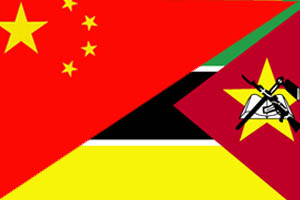
china_mozTo date Chinese company Dingsheng International Investments has invested US$260 million of a total US$500 million to build infrastructure in the Manga-Mungassa Special Economic Zone, in Mozambique’s Sofala province.

Aiuba Cuereneia, Mozambique’s Minister for Planning and Development, says, “The investment was used to build basic infrastructure, including the power and water supply, roads, industrial warehouses and other facilities, as part of a project that includes construction of an administrative building, customs warehouses, and an exhibition area, as well as a hotel.”

“The infrastructure built in the Manga-Mungassa SEZ would play a crucial role in supporting manufacturing and trading companies that, in turn, would reduce the cost of the initial investment made by Dingsheng International.”

The Manga-Mungassa SEZ was set up following a July 2012 law and covers an area of 217 hectares, which may be increased to 1,000 hectares. Dingsheng International manages the SEZ. Source: macauhub

US loses multi-billion dollar court cases against China and India

India, China, US [Picture: www.wespeaknews.com]

India, China, US [Picture: http://www.wespeaknews.com]

The World Trade Organization agreed on Monday this week to side with claims against the United States made by both China and India concerning US-imposed tariffs on products exported to America.

In both instances, the WTO ruled against the US and decided in favor of the major BRICs countries, who for two years now have each asked the organization to intervene and weigh in on America’s use of tariffs to tax certain imports dating back to 2007.

With regards to both cases, the WTO’s judges ruled that the US acted “inconsistent with its agreement on subsidies and countervailing duties,” or taxes imposed on goods sold by “public bodies.”

In China, the panel agreed, US officials improperly levied those taxes against state-owned enterprises that the WTO does not consider to be “public bodies.” Instead, the WTO said, those entities were majority-owned by the Chinese government, but did not perform “government function” or exercise “government authority,” according to the Financial Times. With respect to India, the WTO again agreed that the US was wrong to similarly treat state-owned National Mineral Development Corporation as a public body, according to the International Business Times.

At issue were billions of dollars’ worth of Chinese steel products, solar panels, aluminum, paper and other goods shipped to the US after being taxed as originating from public bodies. The panel’s decision, Reuters reported, “reflected a widespread concern in the 160-member WTO over what many see as illegal U.S. protection of its own producers.”

“China urges the United States to respect the WTO rulings and correct its wrongdoings of abusively using trade remedy measures, and to ensure an environment of fair competition for Chinese enterprises,” China’s commerce ministry said in a statement.

Mike Froman, the US trade representative, responded by saying Washington was “carefully evaluating its options, and will take all appropriate steps to ensure that US remedies against unfair subsidies remain strong and effective”.

Nevertheless, Froman added that the WTO’s ruling in the Indian case constituted at least a partial victory for the US.

“The panel’s findings rejecting most of India’s numerous challenges to our laws and determinations is a significant victory for the United States and for the (US) workers and businesses making these steep products,” he told Reuters. Source: Russia Today.

China Customs – New Valuation Regulations

China Customs EmblemImportant information regarding customs valuation in respect of imports and exports in the People’s Republic of China.

The General Administration of Customs of the People’s Republic of China (“GAC”) issued two new regulations on customs valuation, both effective from 1 February 2014. GAC Order No. 213 (“Order 213”), entitled Measures of Customs of the People’s Republic of China for the Determination of Dutiable Value of Imports and Exports, will replace the existing regulation with the same title issued under GAC Order No. 148 on 28 March 2006 (“Order 148”). In addition, GAC Order No. 211 (“Order 211”), entitled Measures of Customs of the People’s Republic of China for the Determination of Dutiable Value of Domestic Sales of Bonded Goods, is an entirely new regulation specifically providing for the valuation of bonded goods sold within the territory of China.

Briefly, the abovementioned Orders cover the following issues –

  • Customs may consider the circumstances of a sale in determining the acceptability of transaction value between related parties.
  • Calculation of international freight for imported goods.
  • Commissions in the valuation of exported goods.
  • Bonded materials or finished goods (including defective and substandard goods) sold by a contract manufacturer located within the territory of China.
  • Bonded waste and scrap materials, by-products and residue after accidents sold by a contract manufacturer located within the territory of China.
  • Bonded goods transferred under deep processing and sold by the transferee.
  • Bonded materials or finished goods sold by a manufacturer located within a customs bonded area.
  • Bonded scrap, defective or substandard products and by-products sold by a manufacturer located within a customs bonded area.
  • Bonded goods imported into a customs bonded area for logistics, inspection and exhibition purposes and sold within the territory of China.
  • Bonded goods for Research and Development (“R&D”) in a customs bonded area and sold within the territory of China.

 For more details, read the full analysis at Baker & MacKenzie’s website.

Zimbabwe to use the Chinese currency as legal tender

yuanZimbabwe’s central bank on Wednesday said it would allow the Chinese yuan, Indian rupee, Japanese yen, and Australian dollar to be added into the basket of multiple currencies to be circulated inside the country.

The decision was unveiled by the monetary statement issued by acting governor of the Reserved Bank of Zimbabwe Charity Dhliwayo.

“We wish to advise exporters and the general transacting public that individuals and corporates can also open accounts denominated in the Australian Dollar (AUD), Chinese Yuan (CYN), Indian Rupee (INR) and Japanese Yen (JPY),” Dhliwayo said.

She said the decision to include the three foreign currencies is made upon the consideration that trade and investment ties between Zimbabwe, China, India, Japan and Australia have grown appreciably in recent years.

Zimbabwe has adopted a multiple currency system since the collapse of its local currency, the Zimbabwean dollar in 2009. The most used currency in the southern African country since then has been the US dollar and South African rand. The Botswana pula and British pound are also among the foreign currencies allowed to circulate.

Zimbabwe’s Finance Minister Patrick Chinamasa said last December during his annual budget statement that the multiple currency system is to stay for foreseeable future.

China is Zimbabwe’s major trading partner. Bilateral trade exceeded 1 billion US dollars for two consecutive years since 2012. While Zimbabwean officials have expressed the intention to add Chinese yuan into the currency basket, no formal agreement has been signed between the central banks of the two countries yet. Source: zimdev.wordpress.com

Death by China

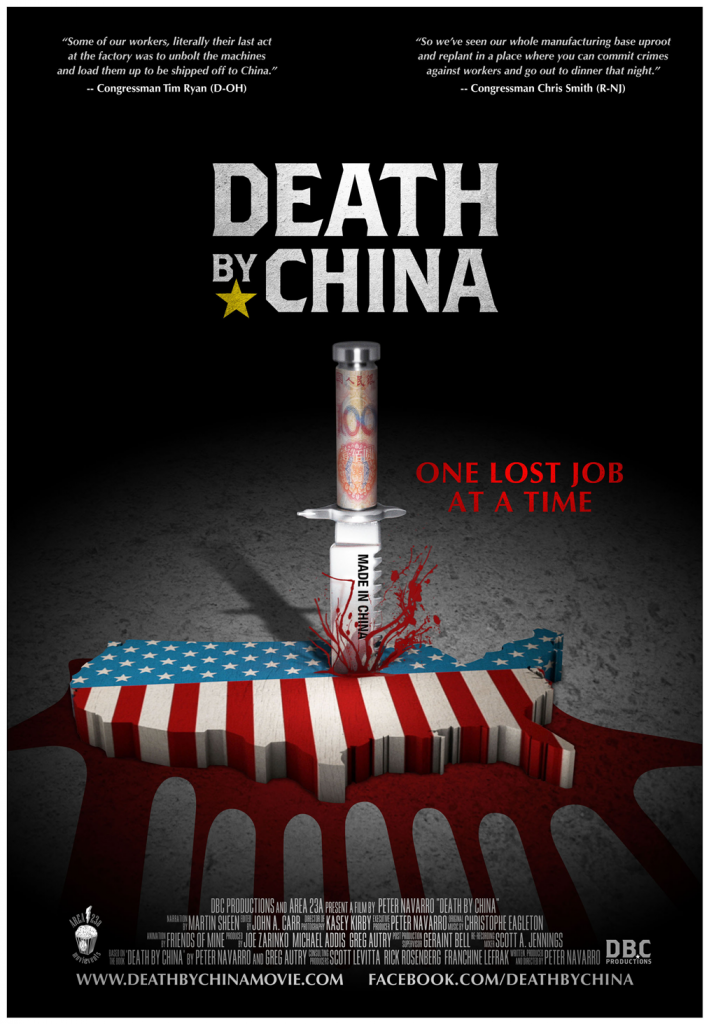
DeathByChina1013x1463-709x1024The featured documentary should be mandatory viewing for all small to medium company owners, economic and foreign trade advisers. While we are inclined to blame the Chinese for all prevailing economic woes, it is in fact the blatant greed of western CEO’s – multinational companies in particular – who have placed profit above prosperity of their country. The film clearly spells out the causes for the systematic destruction of the american economy and manufacturing base, all for the sake of shareholders and outrageous CEO bonuses. The rampant expansion of China in Africa should raise serious concerns for all sub-Saharan African citizens whose elected leaders appear happy, but oblivious, in courting the Chinese with little or no consideration of the realities of their economic and human rights track record.

DEATH BY CHINA is a documentary feature that pointedly confronts the most urgent problem facing America today – its increasingly destructive economic trade relationship with a rapidly rising China. Since China began flooding U.S. markets with illegally subsidized products in 2001, over 50,000 American factories have disappeared, more than 25 million Americans can’t find a decent job, and America now owes more than 3 trillion dollars to the world’s largest totalitarian nation. Through compelling interviews with voices across the political spectrum, DEATH BY CHINA exposes that the U.S.-China relationship is broken and must be fixed if the world is going to be a place of peace and prosperity. Visit – www.deathbychina.com for details on acquiring this powerful documentary.

“A truly life-changing, mouth-dropping documentary film…Peter Navarro’s ‘Death by China’ grabs you by the throat and never lets go.” Francesca McCaffery, Blackbook Magazine

Transnet receives 2 Chinese electric locomotives

THE FIRST two of 95 Class 20E dual-voltage electric locomotives being supplied to Transnet Freight Rail (TFR) by the CSR E-loco supply consortium was transferred from the port of Durban to the nearby depot at Umbilo on November 14 for commissioning.

The first 10 locomotives are being built by CSR Zhuzhou Electric Locomotive in China, while the remaining 85 units will be assembled in South Africa by Transnet Engineering. CSR is a 70% partner in CSR E-loco Supply, with local partner Matsetse Basadi holding the remaining 30%. The contract specifies a target of 60.5% for localised content.

The 3MW Class 20E is equipped for operation on 25kV ac and 3kV dc electrification systems and will be used by TFR’s general freight business.

Transnet says the two locomotives have been delivered a month earlier than expected, and it expects a second consignment of four units to arrive in South Africa next month. Source: www.railjournal.com (Pictures credits: FTW Online, and various)

China hopes to dominate Africa by boosting trade via Indian Ocean

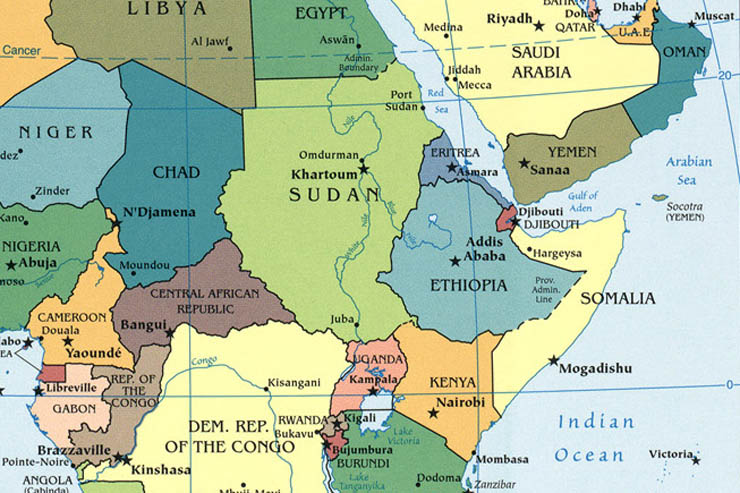
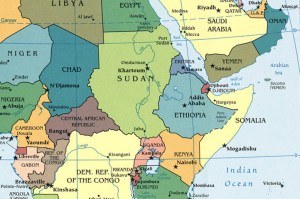
EastAfricaMapPeople’s Republic of China (PRC) officials are becoming increasingly apprehensive about the rise in the use of the westward corridor to export oil, diamonds, and rare minerals out of South Sudan and the Central African Republic via Cameroon. In other words, this creates a flow to Atlantic sea and air transportation routes, rather than routes eastward to Indian Ocean trade routes. Beijing is also concerned over the growing tension between Sudan and its neighbors – particularly South Sudan – because of the impact this might have on the PRC’s long-term designs to dominate Africa’s resources trade.

A key component of the Chinese long-term strategy has long been to converge all the flow of oil, gas, and minerals to a single export point on the shores of the Indian Ocean; that is, in the direction of China. This vision is getting closer to realization given the progress made toward beginning construction of the maritime complex in Lamu on the northern Kenyan shores of the Indian Ocean. The Lamu mega-port and adjacent industrial and transportation complexes are a major element of the Kenyan Government’s Vision 2030 initiative. Lamu is the key to the long-needed modernization of Kenya’s deteriorating infrastructure and boosting of economic output.

Although Nairobi keeps insisting that there will be international tenders for each and every phase of the Lamu project, the overall design in fact follows Beijing’s proposal, and Nairobi acknowledges that no international consortium has so far been able to remotely compete with the financial guarantees offered by official Beijing in support for proposals presented by Chinese entrants. This is because Beijing considers the Lamu mega-port and transportation complex to be the key to the PRC’s long term domination over African trade and resources.

The initial costs of the first phase of the Lamu project are estimated at $25.5-billion. The name of this first phase – the Lamu Port and New Transport Corridor Development to Southern Sudan and Ethiopia (LAPSSET) – points to the initial objectives. Significantly, the term used is “Southern Sudan” and not the state of South Sudan. When completed, the first phase of the Lamu complex will include a 32-berth port, three international airports, and a 1,500km railway line. As well, the Chinese plan oil pipelines from Juba in South Sudan, and from Addis Ababa via Moyale, Kenya, to converge into Kenya’s Eastern Province and end in a new huge oil refinery in Bargoni, near Lamu. The entire construction and pipelines will be supported by a 1,730km road network. In the longer term, the trans-African pipelines the Chinese plan on building from both Nigeria in the west and south-western Africa (most likely Angola) will also feed into the Lamu complex, thus giving the PRC effective control over the main hydrocarbon exports of Africa.

The strategic cooperation between Beijing and Khartoum constitutes the key to the Chinese confidence that their Sudanese allies be able to contain their Somali jihadist proxies so that the risk of terrorist attacks is minimal. Simply put, Beijing is ready to do anything just to ensure the flow of oil eastwards rather than westwards.

Ultimately, the significance of the Chinese long-term grand design for Africa can be best comprehended in the context of historic transformation in the grand strategy and polity of the PRC. Beijing has been arguing since the fall of the Soviet Union that the decline of the United States was also inevitable and that China was destined to rise as the global hegemon. Presently, Beijing is convinced that the time is ripe for delivering the coup de grace.

On October 13, 2013, the official Xinhua news agency published an official commentary stating that “it is perhaps a good time for the befuddled world to start considering building a de-Americanized world”. The commentary surveyed the “abuse” the entire world had suffered under US hegemony since World War II. The situation had only aggravated since the end of the Cold War, Xinhua argued. “Instead of honoring its duties as a responsible leading power, a self-serving Washington has abused its superpower status and introduced even more chaos into the world by shifting financial risks overseas.” To further its own unbridled ambitions, the US stoked “regional tensions amid territorial disputes, and fighting unwarranted wars under the cover of outright lies”, Xinhua explained.

The Xinhua commentary warned that with US society and economy collapsing, Washington was now tempted to intensify the abuse of the rest of the world in order to save the US. “Such alarming days when the destinies of others are in the hands of a hypocritical nation have to be terminated. A new world order should be put in place, according to which all nations, big or small, poor or rich, can have their key interests respected and protected on an equal footing.” Xinhua concluded by suggesting that the PRC, being inherently a developing country, is the rising power best suited to lead this global transformation and de-Americanization.

Beijing has long recognized that any confrontation with the US would inevitably lead to major economic crises, a series of conflicts world-wide and possibly a global war against the US. To sustain this global conflict, the PRC would need huge quantities of hydrocarbons, rare metals, other natural resources and even agricultural products; and these could only be secured for it as a result of a China-dominated Africa. Source: http://www.tralac.org 
India to Become World’s Largest Infrastructure Goods Importer by 2030

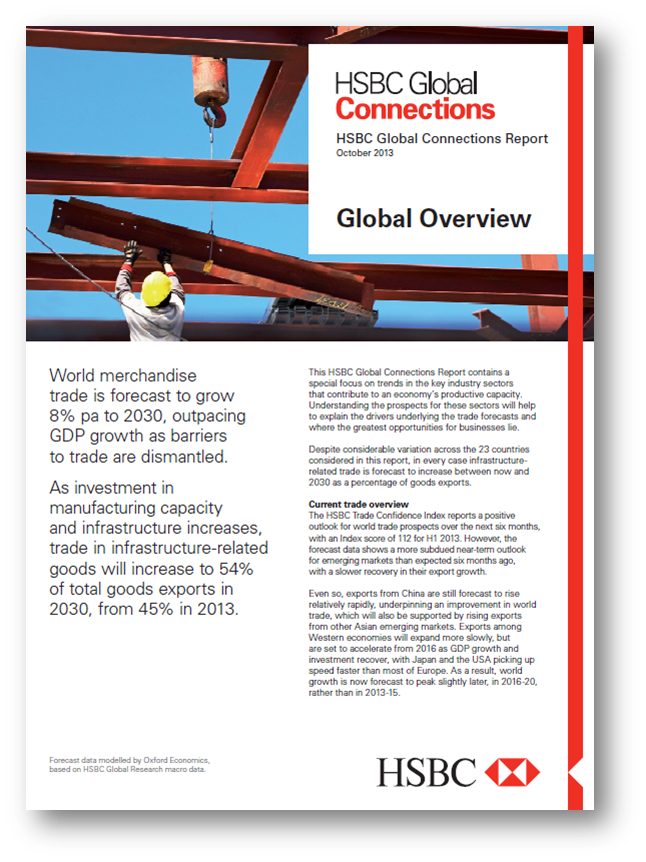
HSBCAccording to the recently released HSBC Trade Forecast Report, by 2020 India is expected to surge past the United States as the world’s biggest importer of infrastructure goods – a position it is expected to hold until at least 2030. This is a result of the country’s increased demand for materials for infrastructure projects (i.e., metals, minerals, buildings and transport equipment) as it invests more in the building of its civil infrastructure.

The report, which focuses primarily on infrastructure, notes that as Asian economies grow they will take an increasing share of infrastructure-related imports over the next two decades. Currently, the U.S. tops the list of countries importing infrastructure goods, followed by India, Hong Kong, China and Germany. By 2030, India will sit up the top of this list, followed by the U.S., China, Hong Kong and Korea.

Sandeep Uppal, HSBC India Managing Director and Head of Commercial Banking, noted that the “rising middle classes across Asia’s rapidly emerging markets, especially in India and China, will drive significant infrastructure demand in the region.”

“Aspirations of the new middle class and rapid urbanization will force India to upgrade its civil infrastructure, thus pushing up demand for overseas infrastructure related goods,” she added.

To continue with the rising trends, the report further states that Asia as a whole is predicted to see the most rapid growth in merchandise trade between 2020-2030 – led by India, China and Vietnam – at estimated annual export growth rates of more than 10 percent.

For comparison, the export rates of European countries, such as the UK, France and Germany, are forecasted to grow at about 4-5 percent annually on average over this 10-year period. Meanwhile, average export growth in the U.S. is estimated to top off at around 6 percent annually during the same period.

What this means is that by 2030 infrastructure-related goods will be the most commonly traded type of goods, increasing in market share from the current rate of 45 percent of total goods exported to upwards of 54 percent. Source: India Briefing

e-Book: BRICS – South Africa’s Way Ahead?

Another Tralac sponsored publication which should be of great interest to trade practitioners, economists and investors, and agricultural specialists. Herewith the foreword to the ebook which is available for download from Tralac’s website – Click here!

The accession of South Africa into the BRICS formation has attracted a lot of attention internationally. Some welcomed the step while others questioned it. A closer look at BRICS reveals that these countries share some fundamental features while they differ in others. On that note, this book does not attempt to define BRICS.

BRICS-front-cover-webBRIC, the acronym, was coined by Jim O’Neill of Goldman Sachs in 2001. The founding members of this political formation are Brazil, Russia, India and China, aligning well with the word formulation. The formation of the BRIC was motivated by global economic developments and change in the geopolitical configurations. South Africa joined the group in 2011, thus opening the possibility of putting Africa on the BRICS’ agenda. South Africa’s admission to the group was motivated by China and supported by Russia. Its accession to the BRICS generated much discussion about the country’s suitability to be part of the formation. One of the real issues raised is that South Africa does not measure up to the other BRIC economies in terms of population, trade levels and performance, and growth rates. A formation such as the BRICS is of value to South Africa only if the country’s strategic development interests (relating, for example, to agriculture) are to be on the agenda. South Africa faces particular challenges related to market access into the BRIC countries.

Agricultural issues are discussed under the Standing Expert Working Group on Agriculture and Agrarian Development. The issues that are prioritised include:

  • The development of a general strategy for access to food (this is where market access needs to be tabled), which is tasked to Brazil
  • Impact of climate change of food security, which is allocated to South Africa
  • The enhancement of agricultural technology, cooperation and innovation that is allocated to India
  • Creation of an information base of BRICS countries that is allocated to China

In 2012, at the annual conference of the Agricultural Economics Association of South Africa, the National Agricultural Marketing Council (NAMC) co-hosted a workshop aimed at establishing a dialogue on how agriculture can benefit from South Africa’s membership of the BRICS. It came out clearly from the workshop that agriculture needs to be better positioned to benefit from the BRICS formation. One important issue that was noted was that market access for South African agricultural produce into the BRICS countries could be improved. In this regard, an honest question was raised whether, as the country’s agriculture stakeholders, we fold our arms and do nothing since this this is a political formation (while market access is an economic issue), or whether we use this political formation to address our socioeconomic issues as they relate to these countries. Market access is one of the issues of interest to South Africa’s agriculture industry within the BRICS formation, together with issues such as the diffusion of technologies and collaborations.

The research that is presented in this book addresses a range of important issues related to the trade and investment relations among these countries. The performance of their agricultural sectors as well as trade amongst these countries is also examined. There is also focus on the relationship between BRICS and Africa, and what this means for South Africa’s trade relations with other African countries. Source: Tralac

China ‘VAT’ Syndrome – Uncertainty for International Forwarders

VAT-TAXGreg Knowler, of maritimeprofessional.com reports, “Whenever there is uncertainty in a particular trade, the container lines resolutely stick with the “shipper pays” principle. That’s understandable considering the state of the industry, but not exactly fair on their customers”.

For the last couple of decades shippers have been complaining that the host of extras they are charged – more than 100, according to the HK Shippers’ Council – should be built into the freight rates that are negotiated between them and the lines.

From this month [August 2013] there will be another charge levied – a six percent VAT charge on top of all charges payable in China, according to Lloyd’s List. Many of the major carriers have informed their customers, but the news has not been received with much enthusiasm.

China is changing its tax system from a turnover tax on companies’ gross revenue to a VAT, which is levied on the difference between a commodity’s pre-tax price and its cost of production.

Beijing rolled out a VAT pilot programme to test the market and iron out the bumps, starting in Shanghai in January last year. In September Beijing was included followed by a gradual nationwide rollout before the new system kicks in tomorrow.

But there is still major uncertainty in this new tax regime, and that is providing great consternation for shippers and the carriers. International shipping is not liable for VAT, so why should carriers impose a six percent VAT levy on customers, asks Sunny Ho of the HK Shippers’ Council.

The problem is that international container lines are not sure whether they are exempt from VAT or not. All the carriers have China offices and as that is where the billing of mainland shippers originates, so they fear Beijing may treat them as agents instead of international shipping services, which means their business will be eligible for the tax.

Maersk Line has decided to wait until mid-August before levying the six percent VAT on mainland charges to see how the situation unfolds. That is a welcome gesture and one that should be followed by all the international shipping lines.

With so much uncertainty surrounding the nationwide rollout of the new tax regime, how can carriers justify slapping customers with a VAT levy before the actual impact of that VAT can be measured?

It is a grasping approach that the lines instinctively default to when faced with the possibility of rising costs. It may serve to protect the bottom line, but it continues to reinforce the traditional unhealthy and antagonistic relationship between them and their customers.

The lines should wait until the costs of China’s VAT have been established and those costs should then be built into the freight rates. Surely that is the only reasonable approach. Source: www.maritimeprofessional.com

Why Do We Import Cure-Dent From China?

The following article is a lesson for all aspiring enterpeneurs on the African continent.

I got curious about the small, mostly unnoticed item in Kigali, what we like to call ‘cure-dent’, the tooth pick. This is how I stumbled onto the fact that we import toothpicks. Yes we import toothpicks from China. Toothpicks here are a symbol for all the things we could make ourselves but import.

toothpicksIt got me wondering – just how complicated is it to make a toothpick? Firstly, toothpicks are made from bamboo and we have plenty of that in Musanze. In any case bamboo can be cultivated. It grows fast and there are new genetically modified reach heights of over 15 metres. A little time on Google showed me that it does not take very much to make them. Indeed the whole process can be done in a woodwork workshop. The process from splitting the bamboo to sharpening the toothpicks takes less than half an hour. That is about 100 packets of toothpicks.

The reason we give for imported stuff is supposedly because we do not have the technology required to make it. This is clearly not true in this case, and, I bet, in the case of a lot of other imports.

Toothpicks are very cheap. They go for between Rwf100 and Rwf500 for each small packet. This is after all the manufacture, freight, taxes and, of course, the shopkeeper’s profits have been considered. Maybe this is why we consider it not to be a profitable venture. Would making toothpicks be profitable? The answer is yes. Let us consider two reasons.

One – the Chinese are not known for time wasting. If they would engage in this enterprise to this extent, they must be something in it. Two – consider being able to make 100 packs of toothpicks in half an hour.

That makes 200 per hour and 1600 per eight hour day (you are by no means tied to this. If you sell them at Rwf50 per pack, you will be grossing Rwf80,000 per day. Now that is profit!

Where is the market? Are we not in the East African Community? We have to start exporting beyond the agricultural produce. Why is urwagwa and akabanga not on the shelves of Kenyan, Ugandan, Tanzanian and Burundian shops?

Why are we always importing? If we are importing toothpicks what do we not import? Unfair Balance of Trade and its accompanying Balance of Payments in addition to aid dependency are the main propagators of poverty in our country. They give us aid… .we use it to buy their products, down to toothpicks!

If we are to make it to self-sufficiency we have to manufacture and export. The journey to self-sufficiency must precede self-reliance. As Bob Marley would say, “We gotta be conscious”.

Article by Sam Kebongo writing for the Rwanda New Times.

Euromonitor’s latest insight on the Tobacco industry

World Tobacco

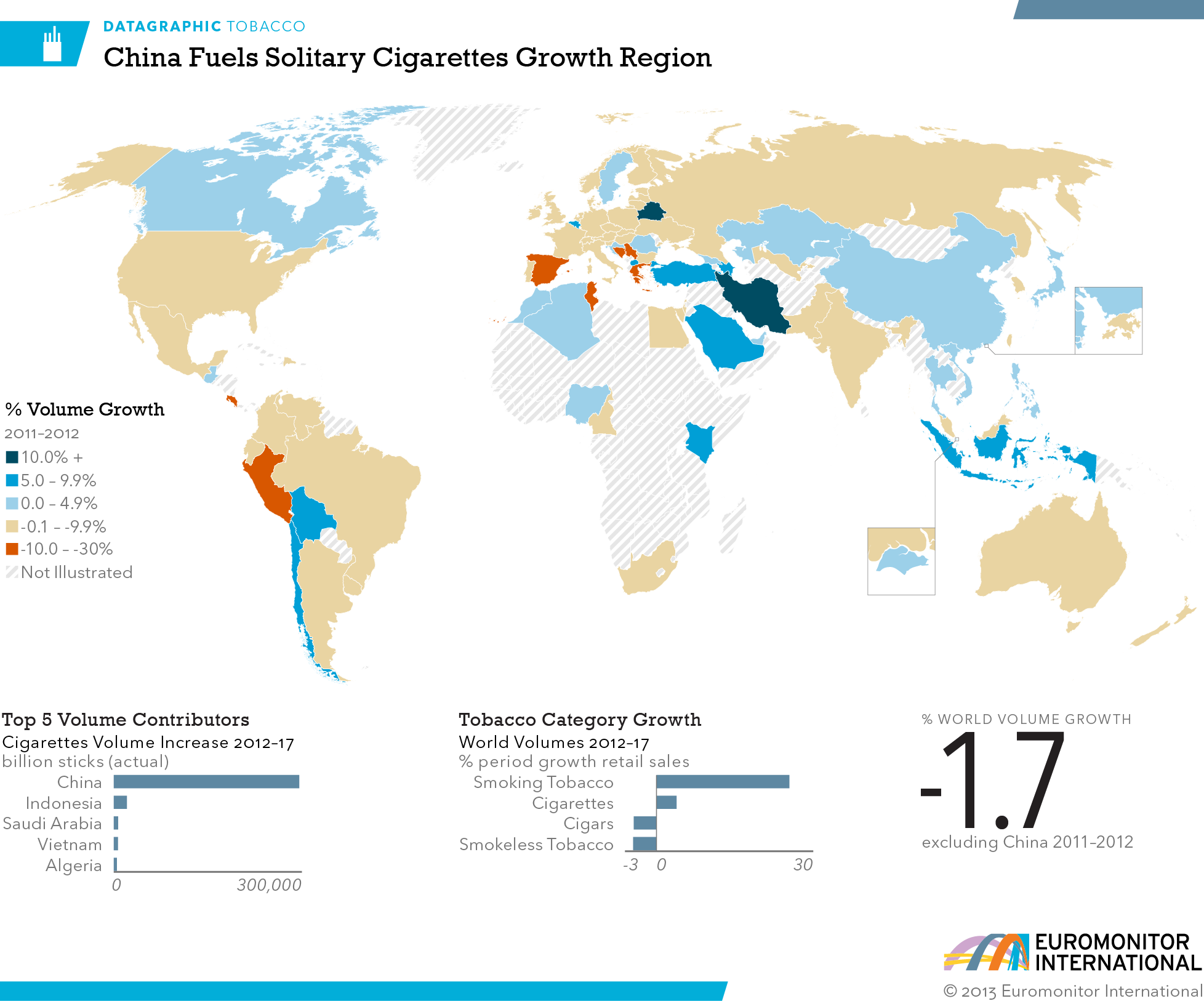
Euromonitor International‘s latest global Tobacco market research provides the latest insight on how the Tobacco industry performed in 2012 and identifies the key prospects through to 2017. The double whammy of continued global economic uncertainty and increasing tobacco control took its toll as the industry posted a year of weak growth, in which no region experienced volume increases with the solitary exception of Asia Pacific, itself bolstered by the cigarettes behemoth that is China. World cigarettes values, normally propelled by growing unit prices and consumer uptrading, also took a battering, unprecedentedly growing by the same amount as global illicit trade volumes. With the current debate surrounding the reduced risk credentials of non-combustible products such as electronic cigarettes and their classification (pharma vs tobacco), the industry finds itself at a crossroads, pursuing cigarette alternatives whilst maintaining its cash cow.

  • Worldwide, 5.8 trillion cigarettes were consumed in 2012, representing 0.19% growth on the previous year, though this was due to the effect of the world’s largest cigarettes market, China. Without China, the world witnessed a -1.7% decline in 2012 versus 2011.
  • Every region in the world, save for Asia Pacific, saw falls in cigarettes volume sales in 2012 (vs 2011), a decline expected to continue to 2017, with the sole exception of Middle East & Africa, which is expected to return to growth once political turmoil stabilises.
  • None of the BRIC markets registered cigarettes volume growth in 2012 (with the sole exception of China), a trend which will continue into 2017.
  • World cigarette value sales grew by almost the same amount in 2012 as global illicit trade volumes – at around 2.5% each. Values decreased in three regions – Western Europe, North America and Latin America – reflecting consumer down-trading.
  • Sales of premium cigarettes grew by nearly 10% globally in 2012, on the back of China’s double-digit premium growth, though this will not be sustained at the global level in the long term. For whilst China will grow its premium brands by nearly 30% over the next five years to 2017, world premium sales will register a 5% fall.
  • World RYO volumes conversely grew by 6% in 2012 (vs 2011), registering growth in all regions, particularly Eastern Europe where it saw double-digit growth. Growth will continue to 2017, albeit at a declining rate.
  • Sales of cigars and smokeless tobacco both saw volume declines of around 3% in 2012, affected by a combination of poor economic performance and declines in its major markets.

Source: Euromonitor International

Chinese President has sealed Tanzania’s Bagamoyo ‘mega-port’ project

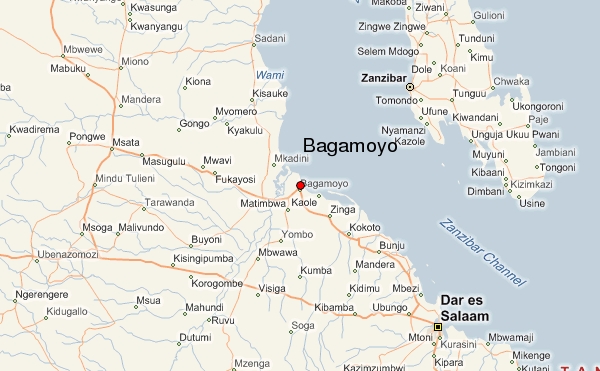
bagamoyo-mapThe Chinese President has sealed Tanzania’s Bagamoyo project. Tanzania has laid down its claim for a future large slice of regional trade through a deal with China to build the new port of Bagamoyo in its Mbegani area, north west of Dar es Salaam, at a total cost of $10bn.

The deal was announced by the President of China, Xi Jinping, while recently visiting Dar es Salaam and forms part of a major investment by the China in the infrastructure of the Mbegani area and East African seaboard – a project to be completed by 2028 with the expectation that Bagamoyo port will supersede Dar es Salaam port as the country’s main port and container handling centre.

The new port will be built with a draft sufficient to accommodate higher capacity container vessels up to 10,000 teu and beyond, as well as possess specialised roll-on roll-off berths and other cargo berths.

The overall scale of the planned development is such that it will provide a highly competitive solution to Kenya’s port expansion plans in Mombasa and Lamu which, as well as catering for national trade, are focused on meeting the needs of surrounding landlocked countries such as Uganda, Rwanda and Burundi.

Kenya has ground out plans for a new deep water container terminal in Mombasa – now under construction – and has embarked upon major new port development at Lamu, but the Bagamoyo port plan has a stronger profile and coherence to it. The money is down and in the background are new offshore gas discoveries for Tanzania which promise to play their part in promoting a strong and enduring relationship with China.

The first-phase development of Bagamoyo port is expected to be in operation by 2017 with construction undertaken by China Merchant Holdings of Hong Kong.

There has been no discussion to-date of whether the new port will feature cargo handling terminals operated by the private or public sector. As in Kenya, this subject remains something of a ‘hot potato’ with some Tanzania Port Authority executives suggesting it was a mistake to introduce the private sector as the operator of the Dar es Salaam Container Terminal. As in Mombasa, there is a belief that the public sector could have done as well as private interests in seeking to achieve efficient container terminal operation.

This belief persists in certain circles despite the TPA taking steps to raise the calibre of executives in its organisation through the introduction of executives from the private sector and a greater overall focus on human resources.

Dar es Salaam currently handles over 9m tons of cargo per year which is equivalent to about 95% of all Tanzania’s import and export volumes. In container trade alone, growth has been over 12% per annum since 2000. Despite this, the cost of shipping to Tanzania is about 25% higher than rates to the larger competing ports in southern Africa. This is mostly attributable to port inefficiencies brought about by inadequate investment in port infrastructure.

These costs are compounded when the effects of congestion and delay are added to the total freight bill, which can account for between 20%-70% of the total delivered price, inflating the price of imports and undermining global and regional export competitiveness.

The rationale for the introduction of major new port capacity in Tanzania is self-evident – demand is outstripping available capacity. It is to be hoped, however, that new capacity will be introduced supported by a modern port management model and institutional arrangements to facilitate optimum use of this capacity at the lowest cost. Source: PortTechnology.com

The Tobacco Industry at a Crossroads – The Decline of Cigarettes and the Rise of Alternatives

burning20cigarettesEuromonitor International’s latest global tobacco market research shows world cigarette volumes have been kept afloat only by China, as global economic uncertainty and increasing tobacco control continues to take its toll. No region experienced volume increases in 2012 apart from Asia Pacific while world cigarettes values, normally propelled by growing unit prices and consumer upgrading, also took a battering, growing by only the same amount as global illicit trade volumes.

With the industry debating the reduced risk credentials of non-combustible products such as electronic cigarettes and their classification, the industry finds itself at a crossroads, pursuing cigarette alternatives while maintaining its cash cow. But can cigarette alternatives deliver? Does the slowdown in cigarette values suggest pricing strength is over? What is happening to innovation and premiumisation?

Euromonitor International’s webinar will aim to answer these questions while setting the global tobacco market in context, reviewing overall performance by region alongside country case studies, related trends in duty-paid volume sales, smoking populations and illicit penetration. Click this link to register for the webinar. Market performance will be reviewed against legislative changes, manufacturer strategies, and trends in product innovation, with a view to what the industry can expect to 2017.  Source: Euromonitor International


Singapore and China’s Mutual Recognition Becomes a Reality

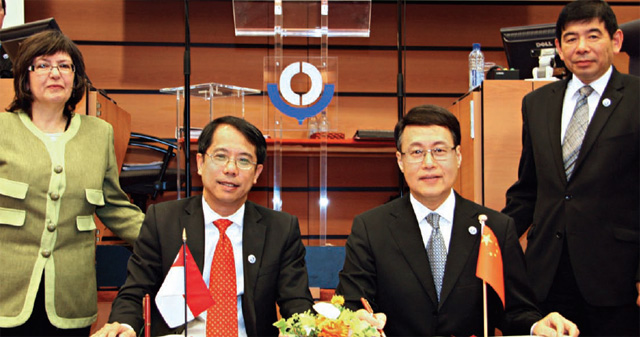
Director-General of Singapore Customs Fong Yong Kian and Vice Minister of the General Administration of China Customs Sun Yibiao (both seated), signed the China-Singapore MRA at the WCO Council Sessions in June 2012. The signing was witnessed by Chairperson of the WCO Council and Chairman of the Revenue Commissioners of Ireland, Josephine Feehily and WCO Secretary-General   Kunio Mikuriya.

Director-General of Singapore Customs Fong Yong Kian and Vice Minister of the General Administration of China Customs Sun Yibiao (both seated), signed the China-Singapore MRA at the WCO Council Sessions in June 2012. The signing was witnessed by Chairperson of the WCO Council and Chairman of the Revenue Commissioners of Ireland, Josephine Feehily and WCO Secretary-General Kunio Mikuriya.

General Administration of Customs of Singapore has announced that the Mutual Recognition Arrangement (MRA), signed with Customs of the People’s Republic of China went into effect on March 15, 2013.  Following the effective date, both Singapore’s STP-Plus companies and China’s Class AA accredited companies will be recognized as Authorized Economic Operators (AEOs) of the respective countries.

This recognition as AEOs allows Customs from both countries to grant clearance facilitation for accredited AEOs such as lower examination rates, priority inspections, and priority handling of customs clearance documents at each country’s port.  Included in the announcement were specific instructions for how importers in both Singapore and China should fill out customs forms when receiving exported goods from one of their respective AEOs.

For goods exported directly to Singapore from a Chinese Class AA company, the Chinese exporter would need to provide the Singapore importer with the 10-digit Customs Registration Code to place on their import declarations to Singapore along with inputting the “AEO code” into the portal for mutual recognition purposes and benefits of AEO.  The AEO code is comprised of “AEO”, “CN” and the 10-digit Customs Registration Code.

For goods exported to China from a Singapore STP-Plus company, the Chinese importer must fill in the “AEO code” of the Singapore’s exporter in the “remark column” in their import declarations to receive mutual recognition benefits.  The format for the AEO code is as follows:  “AEO (written in English half-width characters and capital letters)” plus “<” plus “SG” plus “12-digit AEO code” plus “>”.  For instance, if the AEO code of one Singapore STP-Plus company is AEOSG123456789012, then the remark column filled in by the Chinese importer would read as “AEO”.

The MRA signed between China and Singapore is but one example of several security programs in different countries making it easier for trusted traders to move goods through the supply chain. Other countries that also participate in MRAs include:

  • US Customs & Trade Partnership Against Terrorism (C-TPAT) which has MRAs in place with Canada’s Partners in Protection (PIP), New Zealand’s Secure Export Scheme Program (SES), Jordan’s Golden List Program (GLP), Japan’s Authorized Economic Operator Program (AEO), Korea’s AEO, and the European Union’s ( EU) AEO
  • European Union (EU) AEO which has MRAs in place with Canada’s PIP, Japan’s AEO, Australia’s AEO, New Zealand’s SES, and US C-TPAT
  • Japan Customs has MRAs in place with New Zealand’s SES, EU’s AEO, Canada’s PIP, Korea’s AEO, and Singapore’s STP-Plus
  • Singapore Customs has signed MRAs in place with Canada’s PIP, Korea’s AEO, Japan’s AEO, and China’s Class AA

Part of participating in any security program is the ability to assess and manage risk across the supply chain.  This includes soliciting and analysing information received from every partner within the supply chain to corrective actions and best practices.  While are security programs are still voluntary in nature, companies that take advantage of them are reaping benefits such as faster customs clearance and less inspections. Source: Integration Point