Czech Customs Seize Rhino Horns

Rhino horns seized from smugglers by the Czech Customs Authority

Rhino horns seized from smugglers by the Czech Customs Authority

Czech customs agents seized 24 rhinoceros horns Tuesday and charged 16 people with bringing the prized material illegally from South Africa to sell it in Asia.

“Our investigation showed that the transport is organized by an international ring of smugglers who have used fake export permissions seemingly complying with (the Convention on International Trade in Endangered Species of Wild Fauna and Flora) to import the rhinoceros horns from the Republic of South Africa to the European Union,” said Jiri Bartak, spokesman for the Czech customs department.

The arrests follow an investigation by Czech and EU customs authorities begun in 2011. The gang was alleged to have planned re-exporting the horns as trophies, according to their fake documentation. Rhino horns are popular in parts of Asia where many believe they can cure various illnesses or work as an aphrodisiac.

South Africa is home to the world’s largest rhino population, estimated at about 20 000, though the large upsurge in poaching is threatening their existence. Rhino poaching is expected to reach record levels this year, according to South African officials.

Czech authorities estimate the value of the seized rhino horns at up to 100 million koruna ($5 million), Mr. Bartak said. The authorities said the ring employed people impersonating hunters to gain permission to ship horns acquired from African poachers to Europe and elsewhere. Czech customs didn’t release details of where the charged individuals came from or give their names. If convicted they face up to eight years in prison. Source: leos.rousek@wsj.com

New Smart ID card next year

smart-id-naledi-pandor

Home Affairs Minister, Naledi Pandor with the new Smartcard ID (SAPA)

The new South African smart ID cards will start being issued in the new year. The cost of the card had not yet been determined. The minister for Home Affairs said the cost would not exceed that of the current green bar-coded identity document, which the card would replace.

A microchip, the specifications for which cannot be disclosed for security reasons, will house the necessary biometric data and the information on the chip will be laser-engraved to prevent tampering.

A range of physical and data-security features was being considered, and that there was also ongoing discussion about whether to include provision for a pin code as a secondary means of verification, to complement the biometric features of the card. The minister said the department was discussing how to implement the process. One option would be to issue smart ID cards to first applicants. The project was likely to be implemented over the next four years. For more info on the ID cards read the Government Gazette (click hyperlink).

Port-to-Hinterland…gearing up for growth?

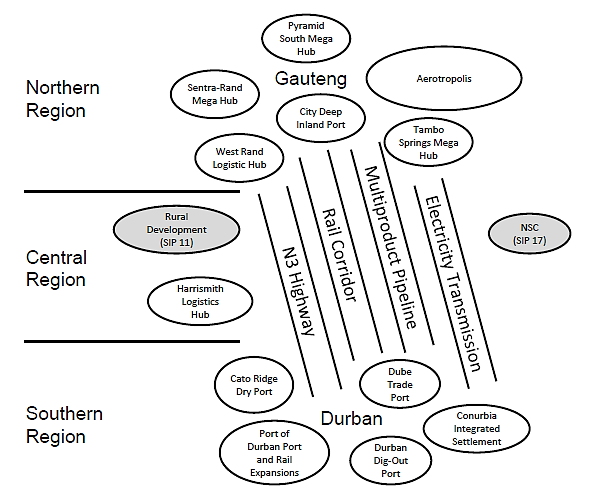
Proposed Durban-Free State-Gauteng Logistics and Industrial Corridor Plan (SIP2)

Proposed Durban-Free State-Gauteng Logistics and Industrial Corridor Plan (SIP2)

Notwithstanding on-going discontent amongst industry operators in regard to proposed legislative measures mandating customs clearance at first port of entry, the South African government (GCIS) reports that work has already commenced on a massive logistics corridor stretching between Durban and the central provinces of the Free State and Gauteng. Most of the projects that form part of the second Strategic Infrastructure Project (SIP 2), also known as the Durban-Free State-Johannesburg Logistics and Industrial Corridor, are still in the concept or pre-feasibility stage, but construction has already started on several projects.

These include:

  • the building of a R2,3 billion container terminal at City Deep
  • a R3,9 billion project to upgrade Pier 2 at the Port of Durban
  • R14,9 billion procurement of rolling stock for the rail line which will service the corridor.

Work has also started on the R250 million Harrismith logistics hub development to set up a fuel distribution depot, as well as on phase one of the new multi-product pipeline which will run between Johannesburg and Durban and transport petrol, diesel, jet fuel and gas.

The aim of these projects and others which form part of SIP 2, is to strengthen the logistics and transport corridor between South Africa’s main industrial hubs and to improve access to Durban’s export and import facilities. It is estimated that 135 000 jobs will be created in the construction of projects in the corridor. Once the projects are completed a further 85 000 jobs are expected to be created by those businesses that use the new facilities. Source: SA Government Information Service

Interested in more details regarding South Africa’s infrastructure development plan? Click here!

A South African RFID/GPS cross-border logistics and customs solution

Inefficiency of road freight transport is one of the primary factors that hamper the economy of sub-Saharan Africa. Long delays experienced at border posts are the single biggest contributor towards the slow average movement of freight. Cross-border operations are complicated by the conflicting security objectives of customs and border authorities versus efficiency objectives of transport operators. It furthermore suffers from illegal practices involving truck drivers and border officials. In theory the efficiency of cross-border operations can be improved based on the availability of more accurate and complete information – the latter will be possible if different stakeholders can exchange data between currently isolated systems.

Cross-border trade basically comprises 3 distinct but interlinked layers –

An information layer – in which various trade documentation (purchase order, invoice), cargo and conveyance information (packing list, manifest), customs and government regulatory data (declaration, permits) are exchanged between various supply chain entities and the customs authority. These primarily attest to the legal ownership, contract of carriage, reporting and compliance with customs and other regulatory authority formalities (export and import), and delivery at destination.

A logistics layer – for the collection, consolidation, sealing and conveyance of physical cargo from point of despatch via at least two customs control points (export and import), to deconsolidation and delivery at point of destination.

A financial layer – which refers to the monetary exchange flow from buyer (importer) to seller (exporter) according to the terms and conditions of the sale (INCOTERMS). Hmm… no, this does not include ‘bribe’ money.

All three layers are inter-linked and prone to risk at any point of a given transaction. There is also no silver bullet solution to secure supply chains. Moreover, it is a fallacy that Customs and Border Agencies will ever conquer cross-border crime – simply because there are too many angles to monitor. Furthermore, in order to set up cross—border information exchange and joint enforcement operations it is both legally and politically time-consuming. Criminal elements are not hampered by these ‘institutions’, they simply spot the gaps and forge ahead.

One of the areas requiring customs attention is that of chain of custody. In short this implies the formal adoption of the World Customs Organisation’s SAFE Framework principles. Each party with data that needs to be filed with the government for Customs and security screening purposes has responsibilities. Those responsibilities include –

  • Protecting the physical goods from tampering, theft, and damage.
  • Providing appropriate information to government authorities in a timely and accurate manner for security screening purposes.
  • Protecting the information related to the goods from tampering and unauthorized access. This responsibility applies equally to times before, during and after having custody of the goods.

Tenacent RFID Tag

Tenacent RFID Tag

Security seals are an integral part of the chain of custody. The proper grade and application of the security seal is addressed below. Security seals should be inspected by the receiving party at each change of custody for a cargo-laden container. Inspecting a seal requires visual check for signs of tampering, comparison of the seal’s identification number with the cargo documentation, and noting the inspection in the appropriate documentation. More recently the emergence of certain e-seals and container security devices (CSDs) contribute even further to minimizing the amount of ‘physical’ verification required, as they are able to electronically notify the owner of the goods or government authority in the event of an incidence of tampering.

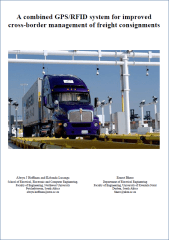
White Paper - GPS-RFID systems for cross-border management of freight consignments

White Paper – GPS-RFID systems for cross-border management of freight consignments

A group of South African specialist engineers have been working closely with transport authorities, logistics specialists, defense experts and customs authorities across the globe. Their e-seal is patented in no less than 16 high volume countries. It is produced in Singapore, China and Indonesia depending on politics, free-trade agreements and demand. May move some to Brazil and US in time. Proof of concept (POC) initiatives are currently underway in Brazil for rail cargo, US Marine Corps for their p-RFID program and other Department of Defense divisions in the USA, and will shortly be included in one of the GSA agreements making it available to any government department in the US. Further adrift, the e-seal is also currently enjoying interest in Guatemala, Mexico, Canada, Panama, Jordan, Italy, Spain, and Malaysia. Here, in South Africa, a POC was conducted at the 1st autogate at Durban Container Terminal, funded by the North West University, and overseen with successfully achieved objectives by Transnet Port Terminals. For technical details of the RFID seal, click here!

With much anticipated success abroad, how much support will this product attain in the local and sub-Saharan African scene? Government authorities, as well as logistics and supply chain operators are therefore encouraged to study the enclosed ‘white paper’ – Click Here!. It firstly quantifies the size of the problem and estimates the potential economic benefits that will be created by improved cross-border operations. It then proposes a combined GPS/RFID system that can provide the required level of visibility to support improved operational management, resulting in a simultaneous increase in the security and efficiency of cross-border freight operations. A brief cost-benefits analysis is performed to show that the expected benefits from such a system will by far exceed the costs of implementation. Source: Tenacent & iPico

UNCTAD – Africa ‘ignores its trade deals’

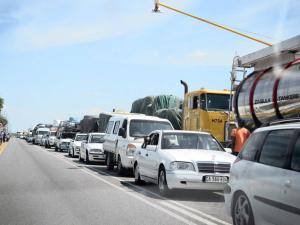
Cars and trucks at the South African border at Musina, Limpopo, queue to cross into Zimbabwe. The Unctad report says there are traditional transport routes in Africa - Photo: Motshwari Mofokeng.

Cars and trucks at the South African border at Musina, Limpopo, queue to cross into Zimbabwe. The Unctad report says there are traditional transport routes in Africa – Photo: Motshwari Mofokeng.

An official in the UN Conference on Trade and Development (Unctad), complains that Africa’s leaders repeatedly sign trade agreements and fail to implement them. Launching the organisation’s 2013 Africa development report in Johannesburg, Patrick Osakwe said leaders should set more realistic targets and “do more serious research” on the viability of the agreements.

Intra-African trade represents only about 11 percent of Africa’s total trade with the world, despite official commitments to improve the flows. Osakwe cited the case of the regional industrial policy adopted by the Economic Community of West African States in June 2010, which “has yet to be fully implemented”.

In June 2011 President Jacob Zuma announced talks on a 26-nation free trade agreement between three existing trading blocs, including the Southern African Development Community, of which South Africa is a member. Experts greeted the proposal with scepticism, noting a long history of leaders signing commitments to free trade or regional integration, but failing to follow through.

The Unctad report, which was launched simultaneously in Geneva and in centres in Africa, said development should be seen in a regional context: co-operation among countries in a broader range of areas than just trade and trade facilitation. It should include investment, research and development, and regional infrastructure development.

The report cited the Maputo Development Corridor linking Gauteng to the port of Maputo as “a successful, true transport corridor that has unlocked landlocked provinces in one of the most highly industrialised and productive regions of southern Africa”.

It said: “There are currently more than 20 corridors in operation in Africa but most tend to be traditional transport corridors. There is a need to move beyond that and to create industrial development corridors as well.

The report focused on intra-African trade and urged governments to unlock the private sector’s potential so that they could successfully diversify their economies. Most African countries are heavily dependent on commodities to grow their economies.

Africa accounts for only 1 percent of global manufacturing, and manufacturing represents only about 10 percent of African gross domestic product, compared with 35 percent for east Asia and the Pacific, and 16 percent for Latin America and the Caribbean.

The share of manufacturing in intra-African trade fell from about 54 percent between 1996 and 2000 to 43 percent between 2007 and 2011, as the value of commodity exports soared.

The report identified a major challenge to expanding the manufacturing sector. The average manufacturing company in sub-Saharan Africa has 47 employees, compared with 171 in Malaysia, 195 in Vietnam and 393 in Thailand. The small size of the operations prevents businesses from achieving economies of scale.

Other barriers were weak linkages between small and large firms, a high share of informal firms, low levels of export competitiveness and a lack of innovation capability. Transport costs were also prohibitive. “In central Africa, transporting 1 ton of goods from Douala in Cameroon to N’Djamena in Chad costs $0.11 (R1.10) per kilometre, more than twice the cost in western Europe and more than five times the cost in Pakistan.” Source: www.iol.co.za

FDI – Nigeria First in Africa for a Second Year

TCredit - Photobuckethe United Nations Conference on Trade and Development (UNTAD) yesterday ranked Nigeria Africa’s number one destination for Foreign Direct Investment (FDI) in Africa for the second time in two years. The latest UNCTAD report, entitled, “Global Value Chains: Investment and Trade for Development”, put Nigeria’s FDI inflows at $7.03billion while South Africa recorded $4.572bn; Ghana, $3.295bn; Egypt, $2.798bn and Angola, 6.898bn; among others.

According to the report, FDI inflows to African countries went up by five per cent to $50bn in 2012, though global FDI declined by 18 per cent. The report noted that most of the FDIs into Africa mainly driven by the extractive industry, but said there was an increase in investments in consumer-oriented manufacturing and services.

Global FDI fell by 18 per cent to $1.35 trillion in 2012. This sharp decline was in stark contrast to other key economic indicators such as GDP, international trade and employment, which all registered positive growth at the global level,” which was attributed to economic fragility and policy uncertainty in a number of major economies, giving rise to caution among investors.

It added that developing countries take the lead in 2012 for the first time ever, accounting for 52 per cent of global FDI flows. This is partly because the biggest fall in FDI inflows occurred in developed countries, which now account for only 42 per cent of global flows. In 2011, Nigeria was ranked Africa’s biggest destination for FDI, with total inflows of $8.92bn, South Africa followed with $5.81bn, while Ghana received $3.22bn. Source: AllAfrica.com


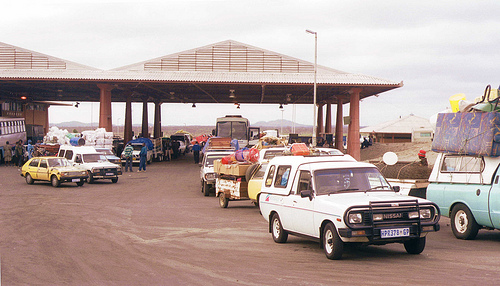
Study into the cooperation of border management agencies in Zimbabwe

tralacZimbabwe is a landlocked developing country with a population of 14 million, sharing common borders with Botswana, Mozambique, South Africa and Zambia. Zimbabwe has 14 border posts, varying in size in accordance with the volume of traffic passing through them. Beitbridge, the only border post with South Africa, is the largest and busiest, owing to the fact that it is the gateway to the sea for most countries along the North-South Corridor. Zimbabwe thus provides a critical trade link between several countries in the southern African regions. The need for the country, especially its border posts, to play a trade facilitative role can therefore not be over-emphasised.

Trade facilitation has become an important issue on the multilateral, regional and Zimbabwean trade agendas, and with it, border management efficiency. Border management concerns the administration of borders. Border agencies are responsible for the processing of people and goods at points of entry and exit, as well as for the detection and regulation of people and goods attempting to cross borders illegally. Efficient border management requires the cooperation of all border management agencies and such cooperation can only be achieved if proper coordination mechanisms, legal framework and institutions are established.

This study explores how border agencies in Zimbabwe operate and cooperate in border management. The objectives of the study were to:

  • Identify agencies involved in border management in Zimbabwe;
  • Analyse the scope of their role/involvement in border management; and
  • Review domestic policy and legislation (statutes of these agencies) specifically to identify the legal provisions that facilitate cooperation among them.

Visit the Tralac Trade Law website to download the study.

Source: TRALAC

New Ressano Garcia Cargo Terminal Operational By December

Mozambique flagA new cargo terminal will be opened at the Ressano Garcia – Lebombo border crossing before the end of the year to speed up the processing of customs clearance for goods moving between Mozambique and South Africa.

To further the project an agreement has been reached between the Mozambique Tax Authority (ATM) and a consortium composed of the Matola Cargo Terminal (Frigo), Matrix and the “Zambian Border Crossing Company”.

The 15 year concession contract was signed on 14 June in Ressano Garcia by the chairperson of ATM, Rosario Fernandes, and by the managing director of Frigo, Filipe Franco.

Filipe Franco told AIM that a new truck terminal is being built where facilities will be available for all the necessary services including customs, migration, and officials dealing with health and agriculture.

He pointed out that “our objective is to ensure that the terminal will be completed and operational by December”, adding that the consortium is composed of companies with a great deal of experience in managing cargo terminals.

Rosario Fernandes said that the cargo terminal project will facilitate trade by speeding up customs clearance at the border post through a one stop system and the single electronic window system which is being implemented throughout Mozambique. Source: AIM (Mozambique News Agency)

From Good to Grey: South Africa’s Low Emission X-Ray System

Lodox Body Scanner Image-Case-Study-1-bright

Click on the image to view fine details on Hi-Res image (Credit-Lodox)

While not exactly the kind of equipment for a Customs Enforcement operation, I did feel suitably proud to punt a locally developed ‘non-intrusive’ imaging device given its recent international prominence.

The South African Media have been abuzz following the airing of the Grey’s Anatomy episode Idle Hands (on MNET), featuring the South African developed Lodox full-body X-ray scanner.

In the episode, the doctors and nurses of Grey+Sloane Memorial Hospital’s brand new ER are excited and amazed to have the Lodox Statscan in their trauma department. After a long wait of anxious anticipation, they are suitably impressed by the X-ray scanner’s ability to take an entire body scan in just 13 seconds, and what this will mean for how they treat trauma patients. Far from paid-for product placement, this was a story line independently researched and written by the Grey’s Anatomy producers. Our Lodox NA team made sure they had a real, working Lodox machine on the set of the new ER.

Some of the tech and application notes off the Lodox website:

Due to its unique X-ray system, scanning technology and design, it emits extremely low levels of entry and scattered radiation, making it safer for operators and staff.

For emergency trauma situations, the Xmplar-dr permits easy access to the patient to allow for monitoring and resuscitation to take place around the scanning process. The 13-second, full-body scan provides instant information with which to form a diagnostic image of the patient’s injuries.

In forensic pathology (medico-legal) applications, the Xmplar-dr provides an easy-to-use, fast method for assessing the entire subject’s body in multiple planes to assist with pathology location, particularly useful in the case of gun shot victims. The single sweep eliminates the need to move the subject to obtain all necessary views, making it more efficient and safer for staff.

Lodox is also ideally suited to imaging of bariatric and paediatric patients, and has found applications in many other areas of medical imaging.

The high quality, digital images, ease of use and reliability make the Xmplar-dr an invaluable piece of imaging equipment in any medical trauma or forensic pathology arena.

Source: Lodox.com


Call to Develop Zim-RSA Transport and Trade Links

zim-rsaZimbabwe needs to further develop transport and trade infrastructure links with South Africa to maintain Africa’s biggest economy as its single most important trading partner, recent research findings have shown.

This came from preliminary findings of a research study carried out by Dr Medicine Masiiwa who was commissioned by the Ministry of Regional Integration and International Co-operation to undertake the study on trade and transport. The World Bank funded the study to assess the need to facilitate transport and trade in Zimbabwe. The findings form part of preliminary desk research ahead of a more detailed second phase.

Dr Masiiwa presented the initial findings from the desk research to stakeholders at a workshop in Harare. Preliminary findings of the study show that since economic and political stability, key for trade competitiveness of Zimbabwe is now in place, the country’s trade was bound for significant growth, making a trade and transport facilitation measure critical to support this growth.

“A major implication of having South Africa as Zimbabwe’s single most significant trading partner is that the transport and trade infrastructure between the two countries should be further developed,” he said.

Development options include expanding the current border post to accommodate more traffic or to construct a new border post altogether. Sound transport and trade infrastructure between Zimbabwe and South Africa is critical as more than 34 percent of local imports go to South Africa while Zimbabwe imports more than 60 percent of basic commodities from that country.

But the state of the main trunk road, on the Zimbabwe side, has remained in poor state despite also being the main link between the north and south. Increased trade with China implies that Zimbabwe, in collaboration with its regional partners, needs to further develop the Beira and Limpopo transport corridors, which link Zimbabwe with the ports on the east coast.

“It is also interesting to note that trade with the EU and other Western countries is on the rebound; meaning transport corridors linking western gateways also need to be further developed,” said Dr Masiiwa.

The major problem facing Zimbabwe is that the quality of infrastructure is deteriorating and therefore acting as an impediment to trade. A study by the World Bank showed that in the 1990s, the proportion of primary roads in “good” condition was about 90 percent, but this dropped to 85 percent in 2009. Roads with the worst conditions are secondary roads, where about 45 per cent of paved and 50 percent of the unpaved secondary roads are in poor condition. Source: Zimbabwe Herald

Zimbabwe Car Imports Up 23 Percent

Secondhand Cars ZimbabweVehicle imports through the Beitbridge Border Post increased by 23 percent between January and May this year compared to the same period last year, the Zimbabwe Revenue Authority has said. The increase is attributed to the price freeze of vehicles in South Africa and also the exorbitant prices of vehicles on the local market. Prices of second hand vehicles in South Africa have remained stable for the past 12 months. It costs on average US$7 000 to buy a second hand modest car from South Africa and at least US$20 000 and above to buy a similar car on the local market.

Figures from Zimra show that a total of 14 114 vehicles have been imported through Beitbridge between January 1 and May 31, 2013 compared to 10 851 vehicles during the same period last year.

Investigations by Herald Business show that on average Zimra clears a total of 1 500 cars per month at Manica bonded warehouse, and the figure has increased to between 2 000 and 3 500.

A total of between 15 and 25 car carriers offload vehicles at Manica daily. Zimra’s legal and corporate affairs director Ms Florence Jambwa said that most of the cars were coming from Japan via Durban, South Africa.

“There has been a marked increase of motor vehicle imports at Beitbridge Border Post this year as compared to the year 2012.

“The month of January had the lowest number of imports (1 194) while the month of May had the highest number (3 706), in fact there has been an increase every month.

“You will note that imports of motor vehicles through Beitbridge are increasing as such the work load increases.

“However, the Zimbabwe Revenue Authority employs several strategies to curb challenges at the border post mainly through embracing modern technological innovations such as the use of scanners and the ASYCUDA World system which is Internet-based,” said Ms Jambwa.

She said they had already addressed the challenges that were affecting the processing of vehicle imports at Beitbridge border post. Early this year there had been an outcry over the slow processing of vehicle imports at Manica where importers were spending around two days to complete the processes with Zimra. On average it should take less than one and half hours per vehicle if correct documentation was made available. She said they had no backlogs in terms of printing the customs clearance certificates for all newly imported vehicles.

Herald Business is reliably informed that plans are underway to have a cash office at the bonded warehouse and the authority has been encouraging its clients to make their payments through the bank and avoid carrying cash. Source: Zimbabwe Herald

Johburg Chamber to meet Parliment over Customs Bill

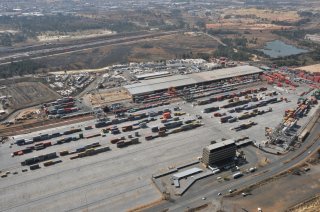
City Deep Container Terminal, Johannesburg

City Deep Container Terminal, Johannesburg

Online media company Engineering News reports that the Chamber of Commerce and Industry Johannesburg (JCCI) would take its objections of certain aspects of the recently tabled Customs Control Bill to Parliament and called on South African business and interested stakeholders to provide input as well.

The South African Revenue Services’ (Sars’) newly drafted Customs Control Bill, which, in conjunction with the Customs Duty Bill, would replace the current legislation governing customs operations, declared that all imported goods be cleared and released at first port of entry.

“The Customs Bill, cancelling the status of inland ports as a point of entry, will be before Parliament very soon, and only a short notice period for comment is expected,” JCCI former president Patrick Corbin said.

While all other comments and suggestions relating to the Bill were adequately dealt with, this remained the one disagreement that had not been satisfactorily resolved, he stated.

Corbin invited all parties to voice their concerns to ensure “all areas of impact and concern were captured”, adding further weight to the JCCI’s presentation. The implementation of the new Bill would directly impact the City Deep container terminal, which had been operating as an inland port for the past 35 years, alleviating pressure from the already-constrained coastal ports.

Despite customs officials assuring the chamber that the operations and facilities at City Deep/Kaserne would retain its licence as a container depot, Corbin stated that the Bill had failed to recognise the critical role City Deep played as an inland port and the impact it would have on the cost of doing business, the country’s road-to-rail ambitions, the coastal ports and ease of movement of goods nationally and to neighbouring countries.

“The authorities do not accept the fact that by moving the Customs release point back to the coast, a vessel manifest will terminate at the coastal port. There will not be the option of a multimodal Bill of Lading and seamless inland movements, as all boxes or the unpacked contents will remain at the coast until cleared and released by the line before being reconsigned,” he explained.

Citing potential challenges, Corbin said that only the containers cleared 72 hours prior to arrival would be allocated to rail transport and that those not cleared three days before arrival would be pushed onto road transport to prevent blocking and delaying rail operations.

This would also result in less rail capacity returning for export from Johannesburg, leading to increased volumes moving by road from City Deep to Durban.

He warned of the Durban port becoming heavily congested with uncleared containers, causing delays and potential penalties, while hampering berthing movements and upsetting shipping lines’ vessel schedules.

The release of the vessel manifest at the coastal port also placed increased risk on the shipping operators delivering cargo to Johannesburg following the clearance of goods at customs and required reconsignment at the country’s shores.

However, Transnet remained committed to investing R900-million for upgrading the City Deep terminal and the railway sidings, while Transnet CEO Brian Molefe had accepted the assurances from customs that “nothing would change and the boxes would still be able to move seamlessly once cleared”.

The Gauteng Department of Roads and Transport Department had allocated R122-million for the roadworks surrounding the inland port, while Gauteng MEC for Roads and Transport Dr Ismail Vadi said the department’s focus this year would narrow to the expansion and development opportunities at City Deep/Kaserne.

The department was also progressing well with the development of a second inland port, Tambo Springs Inland Port and Logistics Gateway, expected to be completed by 2017.

Vadi recently commented that the Gauteng Department of Roads and Transport, which was currently developing a terminal master plan for the project, would link the freight hub through road and rail transport to and from South Africa’s major freight routes and other freight hubs, including City Deep, which was about 33 km away.

The National Economic Development and Labour Council, under which the Bill had been drafted during a three-year development process, had agreed to fund an impact assessment study, led by Global Maritime Learning Solutions director Mark Goodger. The study was “close to completion” and would be presented alongside JCCI’s objections in Parliament. Source: Engineering News


SA Ratifies the Sanitary and Phytosanitary Annex to the SADC Protocol On Trade

WTO-SPS-Measures-Presentation-Transcript-23698Cabinet approved South Africa’s ratification of the Sanitary and Phytosanitary (SPS) Annex to the Southern African Development Community‘s (SADC) Protocol on Trade and for this to be submitted to Parliament.

Agriculture is one of the key sectors in the SADC region due to the sector having the highest potential for growth in terms of export. SADC realises, however, that the sector can only grow significantly if producers are able to access markets for agricultural products. To facilitate market access and promote intra Africa trade it is critical that border trade policies, including SPS measures be harmonised in line with international standards and guidelines in the interest of improving the movement of goods and services in the region. (Read in more red tape)

The SADC Protocol on Trade to which SA has acceded, serves to promote regional cooperation and integration amongst member states for trade in goods and services within the region, including agricultural products.

Article 16 of the Protocol encourages member states to base their Sanitary and Phytosanitary (SPS) measures on international standards, guidelines and recommendations so as to harmonise SPS measures for plant health, animal health and food safety.

To give effect to the provisions of Article 16 of the Protocol, an SPS annex to the SADC Protocol on Trade was drafted and consequently adopted by the SADC Committee of Ministers of Trade (CMT), in July 2008.  Annex VIII to the SADC Protocol on Trade concerning SPS measures represents an enabling regional strategy to promote cooperation in SADC with regards to issues of food safety, plant health and animal health.

In addition, most SADC member states are also signatory members to the World Trade Organisation‘s Agreement on Sanitary and Phytosanitary measures (WTO-SPS) which places obligations on member states to ensure that the SPS measures they implement are least restrictive to trade, while being scientifically justifiable for the protection of human, animal or plant life and health.

The ratification and implementation of the SPS Annex will therefore facilitate improved mechanisms and institutional arrangements in conformity with obligations under the WTO-SPS agreement so as to minimise SPS related issues that impact the trade of agricultural and services trade within the region. Source: SA Government

Want to understand more on the WTO Agreement on Sanitary and Phytosanitary MeasuresClick here!


Importing and Exporting in the absence of Customs Registration

Import exportAs of May 10 2013 an amendment to the South African Customs and Excise Act (91/1964) published in Government Gazette 36433, concerns an increase to the threshold for importation and exportation in the absence of customs registration.

General Registration Code 70707070 may be used by a party that is not registered as an importer or exporter with the South African Revenue Service, but wishes to import or export goods, provided that the following requirements are met:

  • The goods have a value of less than R 50,000 per consignment, subject to a limitation of three such consignments per calendar year;
  • The goods are declared for home consumption (ie, consumption or use in South Africa) or temporary import or export;
  • The importer or exporter is a natural person located in South Africa; and
  • The importer or exporter states its identity number or taxpayer reference number on the customs declaration form.

Traders should not confuse the above with the withdrawal of the General Registration Code from use by importers and exporters at land borders, which occurred during the course of 2012. In this regard refer to Rule Amendment Government Gazette No. 35178

Enforcement, Risk Management and Preferred Trade come together in the SACU Region

Enforcement, Risk Management and Preferred Trade come together in the SACU Region

Enforcement, Risk Management and Preferred Trade come together in the SACU Region

A WCO workshop on the topics of Enforcement, Risk Management and Preferred Trader was conducted in April in Johannesburg, South Africa, with the involvement of the WCO Secretariat, UK Customs and the member countries of the Southern African Customs Union – SACU (Botswana, Lesotho, Namibia, South Africa and Swaziland). Capacity Building in the mentioned areas in the SACU Region is part of the WCO Sub-Saharan Customs Capacity Building Programme financed by the Swedish Government through the Swedish International Development Cooperation Agency, SIDA.

An assessment including lessons learned was conducted concerning Operation Auto, targeted at second hand motor vehicles. This first ever regional enforcement operation in the 102 years of history of SACU presented good results as around 250 vehicles were seized by the Customs administrations. The Regional Intelligence Liaison Office contributed actively in the assessment process, ensuring that also future enforcement operations will benefit from the experiences gained.

The development of further risk management capacity is ongoing at the regional level and discussions were held concerning the establishment of common risk profiles. A number of high risk products have been identified and the formulation of profiles to engage illegal trade in these areas is ongoing.

Regarding the Preferred Trader program, progress can also be reported as SACU Members are approaching implementation at operational level. This project component fits very well with the risk management component as the latter is the foundation of the Preferred Trader approach. The process of selecting high compliant, low risk economic operators for the upcoming pilot scheme is well underway while capacity in verification and post clearance audit is being enhanced. A launch of (a pilot of) the regional Preferred Trade program is tentatively envisaged for the second half of 2013. Source: WCO