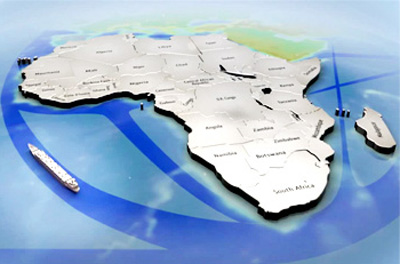
Southern African Narcotic Trafficking Landscape

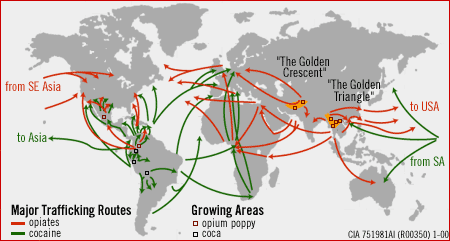
Drugroutemap

See what the CIA’s Factbook has to say about Southern African countries and their role in the international narcotics supply chain –

Zimbabwe A transit point for cannabis and South Asian heroin, mandrax, and methamphetamines en route to South Africa
Zambia A transshipment point for moderate amounts of methaqualone, small amounts of heroin, and cocaine bound for southern Africa and possibly Europe; a poorly developed financial infrastructure coupled with a government commitment to combating money laundering make it an unattractive venue for money launderers; major consumer of cannabis
South Africa A Transshipment center for heroin, hashish, and cocaine, as well as a major cultivator of marijuana in its own right; cocaine and heroin consumption on the rise; world’s largest market for illicit methaqualone, usually imported illegally from India through various east African countries, but increasingly producing its own synthetic drugs for domestic consumption; attractive venue for money launderers given the increasing level of organized criminal and narcotics activity in the region and the size of the South African economy
Mozambique Southern African transit point for South Asian hashish and heroin, and South American cocaine probably destined for the European and South African markets; producer of cannabis (for local consumption) and methaqualone (for export to South Africa); corruption and poor regulatory capability make the banking system vulnerable to money laundering, but the lack of a well-developed financial infrastructure limits the country’s utility as a money-laundering center
Angola Used as a transshipment point for cocaine destined for Western Europe and other African states, particularly South Africa

South Africa Now the Major Export Market for Zim Tobacco

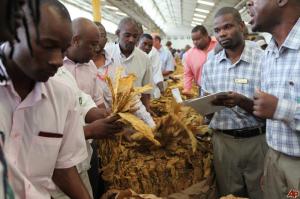
Zimbabwean auctioneers selling tobacco

Zimbabwean auctioneers selling tobacco

This should bring happiness to the local Ministry of Health.

South Africa has displaced China as the dominant export market for Zimbabwean tobacco, reports the Tobacco Industry and Marketing Board. Information from the TIMB indicates that as at February 27, South Africa maintained the top position having bought 7,5 million kilogrammes of the golden leaf valued at US$22,8 million.

The tobacco was sold at an average price of US$3,02 per kilogramme. South Africa has been dominating the regional market. The country has since overtaken China, which has dropped to third position. The United Arab Emirates occupies second spot having maintained its place among the top buyers of the golden leaf.

The top five tobacco export markets for Zimbabwe’s tobacco are South Africa, UAE, China, Hong Kong and Sudan. Last year, China, Belgium, Indonesia, South Africa and Russia were among the top five during the same period. Zimbabwe has so far earned US$82 million from tobacco exports to different destinations. The country produces tobacco and exports semi-processed leaf.

Japan is offering the highest price for tobacco at US$10, 03 per kilogramme, followed by China offering US$9,20 per kilogramme and India offering US$8,86 per kilogramme. In 2012, agriculture grew by 4,6 percent with tobacco being the main component behind this growth. The crop accounted for 10,7 percent of the GDP in 2012 and constituted 21,8 percent of all total exports, compared to 9,2 percent for other agriculture commodities. This compares favourably with the 61,1 percent contribution by all minerals combined.

The economic benefits of tobacco are expected to increase in view of more and more growers increasing their production or, diversifying or switching to the crop. Source: AllAfrica.com

Tobacco in South Africa

smoke-cigaretteCigarette volume sales increase in 2011 – Retail volume sales grew by 1% in 2011, following declines throughout the review period. Retail value sales grew significantly due to a general price increase to cater for taxation increases, as well as rising production costs for manufacturers.

Porous borders continue to influence the growth of illicit cigarette sales – Volume sales of illicit cigarettes continued to grow during 2011, despite efforts by the police and tobacco industry stakeholders to combat illicit trade. Porous borders have been identified as the key factor behind the rise in the amount of illegal cigarettes being smuggled into the country. The Beitbridge border post between South Africa and Zimbabwe was identified as the main point of entry for illicit cigarettes from Zimbabwe.

High import duties restrict the growth of the cigars category – The performance of the cigars category remains suppressed due to high import duties on all cigars. The unit price on most cigars increased significantly in 2011 to accommodate import duty increases. Local distributors were reluctant to import new cigar brands due to a low turnover for existing brands. Consumption of cigars declined in 2011 due to higher unit prices for leading brands, with only festive seasons seeing some respite.

Consumers continue to favour buying tobacco products from supermarkets – The supermarkets channel remains the major point of access for most tobacco products in South Africa. Supermarkets tend to sell tobacco products at relatively low profit margins when contrasted with other channels, such as tobacco specialists. With the rising cost of living, smokers still prefer to use supermarkets to buy tobacco products due to the lower prices.

Retail volume sales expected to decline over the forecast period – Slower but relatively stable growth is expected for retail plus illicit volume sales over the forecast period, however retail sales alone are expected to decline. Category performance is expected to be restricted by legislative restrictions, such as a ban on the advertising of tobacco products in any way other than at points of sale. The Government of South Africa is also considering a total ban on the display of tobacco products at points of sale. Thus, retail volumes are expected to decline, while illicit sales will continue to rise during the forecast period.

For a meagre sum of US$1,900 why not purchase the full report Discover the latest market trends and uncover sources of future market growth for the Tobacco industry in South Africa with research from Euromonitor‘s team of in-country analysts. Find hidden opportunities in the most current research data available, understand competitive threats with detailed market analysis, and plan your corporate strategy with expert qualitative analysis and growth projections. If you’re in the Tobacco industry in South Africa, this research will save time and money, empowering informed, profitable decisions – so the blah says.

Source: Euromonitor.com

SARS – Modernisation milestone materialising

Interfront logo2

Its been some time since I’ve penned an article on the South African Customs Modernisation Programme. Aside from it being the SA Revenue Service’s prerogative to communicate and publish notice of its internal developments and plans, some caution always needs to be exercised observing bureaucratic protocol, ensuring that the official message is forthcoming from SARS. Given the widespread interest in the programme as well as the development of the Interfront [formerly Tatis] integrated customs border management solution (iCBMs) as a wholly owned development of South Africa, I think it not out of place to inform the public interest on this matter. Readership of this blog has an extensive global following and a specific interest in Interfront developments.

Unlike ASYCUDA, Sofix, e-Biscus, and a host of other integrated Customs-tailored business solution offerings, Interfront’s solution for SARS will not include a client user frontend. In other words, the Interfront system (iCBMs) will essentially drive declaration backend processing. This comprises a fully integrated declaration validation and processing engine, supported by a sophisticated tariff engine and duty calculator; the latter offering future web-based services for customs users. In order to compliment the SARS corporate and standardised user interface approach, the iCBMs interfaces with SARS’s revenue accounting, trader registration, risk management, and case management workflow systems. Not only does this leverage cost savings and efficiencies, but ensures a unified ‘workspace’ for all of SARS employees.

Much of the Interfront technology is therefore hidden to the customs user, with traders experiencing an identical interface with SARS Customs, as it does today. From the outset of the Customs Modernisation Programme (July 2010), the approach has followed pragmatic migration of customs electronic clearance processing – across its 30 odd legacy systems – towards an integrated clearance process that could mimic the functionality featured on the new iCBMs. The modern technology and scalability of Interfront offers the ability and agility to enhance service levels and efficiencies to another level. At the same time, operational policies and procedures have been modernised with the aim and intent of meeting the requirements contained in Customs new Control and Duty Bills.

Much of the ‘change’ experienced by both customs officers and the trade over the last 2 years has prepared the country for the eventual migration to the new system. These have been significant, and at times painful changes, not without anxiety and apprehension. Over the last 6 months an even more painstaking and taxing effort has been expended by the Customs Modernisation Team, Interfront and other service providers in addressing a seamless harmonisation and switchover of customs business from disparate legacy systems to a new customs technology platform. The “Parallel Run” has witnessed the daily comparison of customs clearance data between the old and new systems, identification and logging of disparities (bugs), modification of the two environments to ensure the same result is achieved. This has not been an easy and simple process, as any country having undergone a system switchover can attest to.

This month, February 2013, service providers to the customs industry are readying their resources to commence user testing. This implies that service providers (computer bureaus) will engage their clients to prepare test cases for submission to customs to test the new Interfront process. Given that Customs legacy systems and Interfront have been synchronised to a high level of compatibility, the process for traders should not reveal much difference to what they have experienced over the period of modernisation over the last 2 years. One area of note will be the structure and content of Customs Response messages. Traders will have to familiarise themselves and test their interpretation of these messages to ensure they perform or respond appropriately to the instructions.

Satya Prasad Sahu - Technical Officer at the WCO provided members of SACU, SADC and the EAC comprehensive guidelines for the development of the GNC Utility Block concept in Africa (February 2012)

Satya Prasad Sahu – Senior Technical Officer at the WCO provided members of SACU, SADC and the EAC comprehensive guidelines for the development of the GNC Utility Block concept in Africa (February 2012)

In terms of compliance and compatibility with international developments, the new iCBMs is engineered on the WCO Data Model. All relevant simplification processes as exemplified in the Revise Kyoto Convention are likewise factored into its design, although not all of these will be immediately available with the initial rollout. Introduction of the new Customs Control and Duty Acts will require these principles to be fully functional and operational, however.

The WCO Data Model is the pivotal design component around which most of the new system’s business and validation rules are centred. This in itself is a major achievement as it bodes well for all future ‘cross border’, customs-2-customs connectivity initiatives. In this regard SARS is well advanced in bilateral and multilateral projects with key trading partners, for example IBSA (cross-global trilateral initiative), and in Africa, we are working with SACU, SADC, COMESA and the EAC to bring about regional customs connectivity. On a bilateral basis, initiatives with Swaziland, Mozambique and Zimbabwe are developing nicely. A significant contributor to cross border/cross global customs connectivity is undoubtedly the excellent work brought about by the dedicated members of the WCO’s Globally Networked Customs adhoc workgroup. In June last year, the WCOs policy Commission unanimously endorsed the GNC architecture and Utility Block approach. African customs connectivity efforts have likewise adopted this model which ensures harmonisation and uniformity in approach, legal dispensation, data exchange, risk management and procedure. The WCO moreover plays a overseeing role in many of these GNC and capacity building initiatives across the globe – this assists greatly in sharing and learning of experiences.

I would think that the above should be sufficient to wet the appetites of customs practitioners, traders, ICT technocrats, and perhaps even legislators and bureaucrats on developments in South Africa. Subsequent to the launch of Interfront SARS will make its ideas and strategy relating to forthcoming initiatives known to trade and the business community. A Year of Innovation? Yes, and hopefully a happy tale that will bode well for the South African trade and supply chain logistics community, and some good fortune for Interfront in its business development in the region and beyond!
How the Groenewald Gang made millions off illicit wildlife trafficking

rhino-1Dawie Groenewald of South Africa and 11 conspirators were arrested in September of 2010 on 1,872 counts of racketeering, including illegal trade of rhino horns. Among those arrested are two veterinarians, Karel Toet and Manie Du Plessis, as well as several professional hunters. This case is one of the biggest wildlife cases seen in South Africa and has been postponed several times since 2010. It is currently scheduled for early May 2013.

Groenewald owns a big game farm in Polokwane, South Africa as well as Out Of Africa Adventurous Safaris. A burial site of over a dozen horn-less rhinos was found on his property in 2010. Investigators show that these rhinos are thought to have been purchased from the South African National Parks in 2007-2010. In order to increase his profit margin, Groenewald decided to slaughter the rhinos after removing their horns; thus eliminating any upkeep costs associated with live rhinos.

Rhino horns are worth up to $60,000 per kilo in parts of East Asia, namely China and Vietnam. They are thought to possess medicinal value, including curing cancer and small ailments such as fevers and headaches.  Rhino poaching in South Africa has been rising steadily over the past several years. According to South Africa’s Department of Environmental Affairs, approximately 588 rhinos were poached in 2012. One could point to China and Vietnam’s increased affluence as having increased this demand.

Investigators have so far seized $6.8 million in assets from Groenewald, Toet, and Du Plessis. They also uncovered Valinor Trading CC, a “closed company” Groenewald used to launder money. However, this was not Groenewald’s first run in with the law. Groenewald is a former police officer and was discharged because of his ties to a car smuggling ring allegedly outfitted by ZANU PF, the ruling party of Zimbabwe’s notorious Robert Mugabe. Groenewald was arrested in Alabama in April 2010 for importing an unlawfully hunted leopard trophy. He was banned from the U.S. and ordered to pay a $30,000 fine as well as a $7,500 fee to the buyer in Alabama.

There is some evidence that the Groenewald Gang is part of a bigger international syndicate of illegal wildlife trafficking headed by high-ranking officials in Zimbabwe.

Groenewald and his associates are out of business, but many more like them remain. Poaching is a big business, and like any illicit business only exists at the scale it does because of the global shadow financial system. Money that Valinor Trading CC conceals becomes an illicit financial flow, and eventually must be deposited in a financial institution somewhere. Authorities have frozen $6.8 million of Groenewald’s assets, but who knows how much more is hiding behind a shell company’s bank account in some far-off tax haven.

It makes no sense that while Western countries work to protect endangered and threatened species from people like Groenewald and his clients, they simultaneously undermine these same policy goals by allowing money to be easily concealed. Article by Regina Morales who is a Policy Intern at Global Financial Integrity.

Beit Bridge afloat!

I received the following pictures purportedly of traffic under siege at the Beit Bridge border post 6 days ago. Normally its the sweltering heat which man and truck have to contend with. The pictures suggest severe flooding creating anxious moments for transporter and pedestrian alike. According to the Zimbabwe Herald, authorities closed the border to traffic after the Limpopo River flooded leaving the new Limpopo Bridge inaccessible.

Beitbridge handles half a million travellers over festive season

The queues at Beit Bridge

The queues at Beit Bridge

Beitbridge Border Post recorded a sharp increase in the number of travellers who passed through during the festive season with statistics indicating that 524 511 people passed through the port of entry between 14 December last year and 7 January this year compared to 392 660 during the same period the previous year. The assistant regional immigration manager in charge of Beitbridge Border Post, Mr Charles Gwede, said they handled  229 023 travellers on the exit side, an 11 percent increase compared to the last festive season when 202 348 people left the country.

On the arrivals side, 295 488 travellers entered the country, a 35 percent surge compared to the last festive season when immigration officials handled 190 312 travellers. The highest number of travellers on the entry side was recorded on 23 December when 42 435 people entered the country through the country’s busiest port of entry. On the departure side, the highest number was recorded on 3 January when 22 625 people left the country.

“This festive season between 14 December and 7 January, we handled 524 511 travellers, marking a 25 percent increase in the number of people who passed through Beitbridge during the festive season compared to the previous year when we handled 392 660 travellers,” said Gwede. Most of the travellers that they handled were Zimbabweans working in South Africa commonly known as injiva, who had visited home for the Christmas holidays. He attributed the increase in the number of travellers to the South African documentation exercise, which saw many Zimbabweans working in that country acquiring permits.

Many of Zimbabweans staying and working in South Africa are now documented after they acquired authentic permits during the regularisation exercise in that country hence they could now travel freely. The documents also enabled them to drive foreign registered vehicles, which is another factor that resulted in an increase in the volume of vehicular traffic during this festive period compared to the previous years. The South African government embarked on the process of documenting Zimbabweans illegally staying in that country between 5 May 2009 and 31 July 2010 during which over 275 000 applications from Zimbabweans were processed while several others were turned down and some are still pending. Source: The Chronical, Zimbabwe

Beitbridge congestion – Travellers tear-gassed by SA police

border-lines

Zimbabwean Police are set to meet their South African counterparts following an incident in which the South African officers used tear gas to control travellers at their side of the border last Friday morning. The majority of the travellers were Zimbabweans, with others coming from countries north of the Zambezi.

The South African Police Services (SAPS) used tear smoke to control travellers at around 9am as the number of human traffic started increasing at Beitbridge Border Post.

No one was injured in the incident which lasted for about 15 minutes when people started showing their discontent with the slow way they were being cleared by immigration officials from that country.

Some travellers started jumping queues after they had spent between three and four hours waiting to gain passage into South Africa. Police officer commanding Beitbridge district Chief Superintendent Lawrence Chinhengo said yesterday that the incident was a great cause for concern.

“This was a very unfortunate incident. We are not happy with the method our counterparts used to control queues and have since communicated to them that we need to have an urgent bilateral meeting to iron out the issue. There are better ways to manage people rather than the tear smoke. It is of paramount importance that we meet and find better ways to control crowds during this festive season,” he said. Source: Bulawayo24.com

For more insight also read “Zim travellers stranded at border post” on zoutnet.co.za.

Beit Bridge – ZIMRA and Immigration gear up for congestion

beitbridge

Beitbridge – crossing the Limpopo river

The Department of Immigration in Beitbridge has put in place mechanisms aimed at dealing with congestion at the country’s busiest border post in anticipation of an increase in the volume of traffic during the festive period. Assistant regional immigration manager in charge of Beitbridge Border Post, Mr Charles Gwede, said they have since held a series of meetings with key stakeholders and their South African counterparts to address congestion at the border.

“We have started preparing for the festive period in anticipation of a huge influx of travellers and all necessary strategies are now in place to help speed up the clearance of people during the festive period,” he said. “We are suspending leave and off-days for staff between 15 December and 16 January next year.

“As part of our decongestion drive we will scramble our shifts to maximise on manpower during the normal and extra peak days. In fact, starting from 15 December we expect a huge influx of travellers hence between 14 and 17 December, 21 and 24 December and 4 to 7 January, we will dissolve our shifts to ensure that we have more officers per shift who would effectively manage the queues and speed up the clearance process,” he said.

Mr Gwede said they were expecting 20 officers from other stations to beef up the local staff and ensure that all check points and counters were adequately manned. Beitbridge Border Post has a staff complement of 47 officers and support staff.

“As border stakeholders, we held several inter-border meetings with our South African counterparts to discuss and explore ways and strategies aimed at dealing with congestion during extra peak periods.

As part of their decongestion strategy, Mr Gwede said they would categorise travellers and create more counters to reduce queues. According to statistics, immigration officials at the border handled 73 825 travellers between Monday and Wednesday on both arrival and departure sides.

The Zimbabwe Revenue Authority (Zimra) spokesperson, Mr Canisio Mudzimu, said they would deploy relief officers to Beitbridge Border Post to beef up the local staff and help speed up the customs clearance process. “We are geared up in terms of facilitating the smooth movement of both human and vehicular traffic passing through Beitbridge Border Post during the festive season. We will deploy extra officers from less busy stations to Beitbridge Border Post during the festive period and to assist in border operations,” he said.

Beitbridge Border Post requires at least 247 customs officers to man it. The border post, which is the country’s busiest inland port of entry, has an establishment 141 officers. Mr Mudzimu said they would create separate traffic lanes to cater for tourists, returning residents, private motorists, commercial, buses and pedestrians to speed up the flow of traffic and reduce congestion.

Touts and bogus clearing agents continue to find their way into the customs yard where they would swindle unsuspecting travellers of their money under the guise of offering assistance. Beitbridge is the busiest inland port of entry in sub-Saharan Africa, which handles a huge volume of both human and vehicular traffic passing though daily. Commercial trucks destined for East and Central African countries such as Tanzania, the Democratic Republic of Congo and Zambia also pass through the border post.

On a normal day, the border handles between 6 000 and 8 000 travellers daily with the figures rising to 20 000 during the peak period. Source: Bulawayo24.com

Hijackers bleed cigarette exporters

While the world’s health authorities rally for legislation outlawing or at least curbing tobacco abuse, it seems there is a world of intrigue deep in the heart of the tobacco trade. 

Zimbabwe is investigating possible industrial espionage amid reports that South African tobacco firms are hiring hijackers to pounce on export cigarette consignments in transit to that country. In the past year or so, indigenous producers exporting to South Africa lost an estimated R100 million worth of cigarettes to armed robbery syndicates. Among the affected companies are Kingdom, Savanna Tobacco, Breco (Fodya), Cutrag, Trednet and Chelsea.

Savanna Tobacco has confirmed losing cigarettes worth over R18 million through hijackings and robberies while their warehouse in SA has been broken into several times. Only British American Tobacco Company has been spared. At least eight Zimbabweans were arrested at Savanna Tobacco in Harare on suspected espionage. Cosygene Dekeya, a former army military intelligence operative and Edmore Muronzerei appeared in court last week.

Investigations by The Herald showed that the Tobacco Institute of South Africa contracted a security firm, Forensic Security Service, to monitor Zimbabwean cigarette manufacturers, whose brands are giving their South African counterparts stiff competition. Stephen Botha, a former apartheid military supremo owns Forensic Security Services, the company that allegedly recruited spies within the workforce of Zimbabwean cigarette manufacturers. The spies allegedly supply consignment export details, enabling the cartel to track, intercept and hijack. FSS is said to have engaged a local business mogul (name supplied) who owns one of the largest courier service companies to co-ordinate the spies and their payments. The mogul’s trucks have also been hijacked in what might turn out to be inside jobs. Local (Zimbabwean) companies now suspect BAT of being behind the formation of TISA, which has since been regionalised.

Savanna Tobacco executive chairman Mr Adam Molai said it was shocking that South Africans were infiltrating local security organisations to commit economic crimes and bleed the economy. “It is deplorable, you cannot have foreign agencies working for our competitors to distabilise our operations in Zimbabwe. We hope our authorities will ensure that issues of this nature are dealt with accordingly,” said Mr Molai.

Trednet administrative manager Mr Graham Acutt said his company had reduced production by 70 percent. “We are aware of the under cover operations for quite some time now. This is tantamount to industrial espionage and it is highly illegal and frowned upon the world over. Imagine people spying on you and following your consignment. It becomes sensitive and clients will stop buying your product,” he said.

Mr Acutt said he was aware that police were investigating and he was willing to assist as much as he could. “We need more help from the authorities in Zimbabwe to investigate those who are actually behind this. We will assist where we can. This espionage has compromised our ability to export and obviously to earn foreign currency for the country,” he said.

Breco, which is now trading as Fodya said their market intelligence has over time indicated that there were clandestine activities being undertaken by some organisations to disrupt their business. “We understand most companies in this industry experienced this form of activity in one form or another,” said Breco in an e-mail to The Herald. “What is most alarming is that some of the organisations involved in these activities are externally-based and being assisted by local Zimbabweans. If the activities of these institutions or organisations are the real basis for our reduced capacity, then it is illegal,” it said. Source: The Herald (Zimbabwe)

Beitbridge to be Zim’s first economic zone?

The Chronicle (Zimbabwe) reports that the Ministry of Economic Planning and Investment Promotion and South Africa’s Department of Trade and Industry are creating economic zones in their respective countries to boost investment. Economic zones are areas where local and foreign investors or companies who invest there are given preferential benefits like low tax and low rentals.

Speaking during the 4th Investment and Trade Initiative between visiting South African business delegates and Bulawayo business people, the Deputy Minister of Economic Planning and Investment Promotion Dr Samuel Undenge said the Bilateral Investment Promotion and Protection Agreement signed in 2010 by the Zimbabwean and South African Governments would help in the creation of the economic zones.

South Africa’s Deputy Director General responsible for Enterprise and Development Mr Sipho Zikode said they were busy crafting a special document to guide the 12 identified economic zones in South Africa. “Messina is one of the chosen economic zones in South Africa and we also want to create linkages with Beitbridge as they are close to each other,” said Mr Zikode. Dr Undenge said there was need for countries to work together to boost economies on the continent. The business seminar was held to achieve mutual economic growth and development through outward investment facilitation, infrastructure development and trade liberalisation between Zimbabwe and South Africa.

Blood Diamonds – a case of western jealousy perhaps?

Reap What You Sow is the third investigation by Partnership Africa Canada into illicit activity in Zimbabwe‘s diamond sector. The report is divided into three main sections. The first looks at ongoing trade irregularities and the lack of transparency of diamond revenues, and examines ways ZANU and the global diamond industry have interacted, before, during and after the Kimberley Process imposed an embargo on Marange stones in 2009. The second examines the various revenue streams of Obert Mpofu and concludes the Minister of Mines is utilizing monies and assets divorced from his ministerial salary and known business entities. The third offers policy suggestions and recommendations that would improve the management and public beneficiation of Zimbabwe’s diamond revenues.

The biggest conclusion of this report is that despite government pronouncements to the contrary, the illicit trade of Marange diamonds is alive and well. A parallel trade in Marange diamonds continues to thrive, with the full knowledge and complicity of top officials in the Ministry of Mines, ZMDC, MMCZ and military.

The theft of Marange diamonds is perhaps the biggest single plunder of diamonds the world has seen since Cecil Rhodes. Conservative estimates place the losses due to illicit activity at over $2 billion since 2008. PAC has found that while the mismanagement of Marange remains primarily a Zimbabwean problem, the global dimensions of the illegality has metastasized to compromise most of the major diamond markets of the world. Previously most of the illegal trade primarily involved South Africa, Mozambique, UAE and India. This remains the case, but greater vigilance by enforcement authorities should now extend to other centres, particularly Israel. Source:http://www.kubatana.net

One commentator suggests that whilst it makes for interesting reading, it falls short of absolute indictments of individuals, particularly, Obert Mpofu. It unfortunately reads like a laundry list of barely substantiated rumours that have been doing the rounds for years. It seems the writers’ intention is to agitate the individuals, get them to sue the writers and thereby force the accused to disprove the claims on public record. This strategy is currently being used by Core mining in their case against the Minister where in a trial within a trial they claim they paid the Minister a bribe of $10million to ensure their mining rights and partnership with the ZMDC. This partnership was dissolved by the Minister under unclear circumstances. The cases are both before the courts with no resolution on the horizon.

Exposing the Illegal Rhino Horn Trade

Author and investigative journalist Julian Rademeyer has recently launched his book “Killing for Profit’ A terrifying true story of greed, corruption, depravity and ruthless criminal enterprise.

On the black markets of Southeast Asia, rhino horn is worth more than gold, cocaine and heroin. This is the story of a more than two-year-long investigation into a dangerous criminal underworld where merciless syndicates will stop at nothing to attain their prize. It is a tale of greed, folly and corruption, and of an increasingly desperate battle to save  rhinos – which have existed for more than 50 million years – from extinction.

Killing for Profit is a meticulous, devastating and revelatory account of one of the world’s most secretive trades. It exposes poachers, scoundrels, gangsters, conmen, mercenaries, killers, gun-runners,  diplomats, government officials and kingpins behind the slaughter. And it follows the bloody trail from the frontlines of the rhino wars in South Africa, Zimbabwe and Mozambique to the medicine markets of Vietnam and the lair of a wildlife-trafficking kingpin on the banks of the Mekong River in Laos …

For more information visit – http://killingforprofit.com/the-book/

To purchase the book online visit – Kalahari.com

Regional Blocs seek to remove Trade Barriers

THREE regional economic communities (Recs) have taken the lead as Africa seeks to remove trade barriers by 2017. The establishment of a Continental Free Trade Area (CFTA) was endorsed by African Union leaders at a summit in January to boost intra-Africa trade. Sadc, Common Market for Eastern and Southern Africa (Comesa) and the East African Community (EAC) have combined forces to establish a tripartite FTA by 2014.

Willie Shumba, a senior programmes officer at Sadc, told participants attending the second Africa Trade Forum in Ethiopia last week that the tripartite FTA would address the issue of overlapping membership, which had made it a challenge to implement instruments such as a common currency. “…overlapping membership was becoming a challenge in the implementation of instruments, for example, common currency. The TFTA is meant to reduce the challenges,” he said.

Countries such as Zimbabwe, Tanzania and Kenya have memberships in two regional economic communities, a situation that analysts say would affect the integration agenda in terms of negotiations and policy co-ordination. The TFTA has 26 members made up of Sadc (15), Comesa (19) and EAC (5). The triumvirate contributes over 50% to the continent’s US$1 trillion Gross Domestic Product and more than half of Africa’s population. The TFTA focuses on the removal of tariffs and non-tariff barriers such as border delays, and seeks to liberalise trade in services and facilitation of trade and investment.

It would also facilitate movement of business people, as well as develop and implement joint infrastructure programmes. There are fears the continental FTAs would open up the economies of small countries and in the end, the removal of customs duty would negatively affect smaller economies’ revenue generating measures.

Zimbabwe is using a cash budgeting system and revenue from taxes, primarily to sustain the budget in the absence of budgetary support from co-operating partners. Finance minister Tendai Biti recently slashed the budget to US$3,6 billion from US$4 billion saying the revenue from diamonds had been underperforming, among other factors.

Experts said a fund should be set up to “compensate” economies that suffer from the FTA. Shumba said the Comesa-Sadc-EAC FTA would create a single market of over 500 million people, more than half of the continent’s estimated total population. He said new markets, suppliers and welfare gains would be created as a result of competition. Tariffs and barriers in the form of delays have been blamed for dragging down intra-African trade.

Stephen Karingi, director at UN Economic Commission for Africa, told a trade forum last week that trade facilitation, on top on the removal of barriers, would see intra-African trade doubling. “The costs of reducing remaining tariffs are not as high; such costs have been overstated. We should focus on trade facilitation,” he said.

“If you take 11% of formal trade as base and remove the remaining tariff, there will be improvement to 15%. If you do well in trade facilitation on top of removing barriers, intra-African trade will double,” Karingi said. He said improving on trade information would save 1,8% of transaction costs. If member states were to apply an advance ruling on trade classification, trade costs would be reduced by up to 3,7%.He said improvement of co-ordination among border agencies reduces trade costs by up to 2,4%.Karingi called for the establishment of one-stop border posts.

Participants at the trade forum resolved that the implementation of the FTA be an inclusive process involving all stakeholders.They were unanimous that a cost-benefit analysis should be undertaken on the CFTA to facilitate the buy-in of member states and stakeholders for the initiative. Source: allAfrica.com

Exporters Blast ZIMRA and RBZ Red Tape


Zimbabwe‘s export procedures have come under severe criticism as they are said to be contributing to the country’s poor export performance. Local manufacturers have lamented delays in documents processing by the Zimbabwe Revenue Authority and the Reserve Bank of Zimbabwe, which they say is constraining the movement of goods into regional and international markets.

Latest official statistics show that the country’s trade deficit stands at around US$2,9 billion due to the underperformance of the export sector. Surface Investments executive director Mr Narottam Somani says although they have lodged complaints with ZIMRA over the issue there have been no positive outcome.

“The CD1 approval procedures and ZIMRA Bill of entry procedures are too lengthy and as such they spoil the whole momentum of exports. Government, ZIMRA and the RBZ need to appreciate the value of reducing period of these procedures. “We have engaged officials from ZIMRA and the RBZ over the need to file our CD1 and bill of entry forms online which will help reduce the time period to one day. They say that they appreciate our concerns but nothing has materialised,” he said. (Note for South African readers – CD1 refers to a ZIM exchange control document and not the SARS’ new electronic declaration form)

Surface Investments is the country’s largest multi-oilseed processing firm and it exports crude oil to Malawi and cotton linters, and cotton hulls to South Africa and Europe.

Both exporters and importers contend that the country’s export transit procedures have not improved significantly despite ZIMRA’s rollout from last year of the ASYCUDA World version 4.0.21 to over 14 of its stations. Implementation of the system was largely expected to expedite clearance procedures at the country’s border posts. ASYCUDA 2.3 was the earliest version to be introduced in Zimbabwe in 1992 and was upgraded to versions 2.5 and 2.7. ASYCUDA++ later came on board in the form of version 1.15 and 1.18. An expert in the field of transit procedures yesterday said improving these processes would take a wider regional approach.

“Transit operations of most countries in the region typically suffer from a number deficiencies such as lack of simplified and standardised customs procedures, documents and data processing that generally yield costly implications such as delays at border posts, opportunities for theft and corruption practices, and inflated transit transport costs.

“The key area that needs to be addressed therefore relate to regional harmonisation of transit procedures.” Source: The Herald (Harare)