I received this series of photos of an African Elephant via email. Now it may not be the designated border crossing, but gee – how skillful and considerate of “Mighty Mo” in leaving no damage to someone else’s property.


I received this series of photos of an African Elephant via email. Now it may not be the designated border crossing, but gee – how skillful and considerate of “Mighty Mo” in leaving no damage to someone else’s property.
 Important information regarding customs valuation in respect of imports and exports in the People’s Republic of China.
The General Administration of Customs of the People’s Republic of China (“GAC”) issued two new regulations on customs valuation, both effective from 1 February 2014. GAC Order No. 213 (“Order 213”), entitled Measures of Customs of the People’s Republic of China for the Determination of Dutiable Value of Imports and Exports, will replace the existing regulation with the same title issued under GAC Order No. 148 on 28 March 2006 (“Order 148”). In addition, GAC Order No. 211 (“Order 211”), entitled Measures of Customs of the People’s Republic of China for the Determination of Dutiable Value of Domestic Sales of Bonded Goods, is an entirely new regulation specifically providing for the valuation of bonded goods sold within the territory of China.
Briefly, the abovementioned Orders cover the following issues –
For more details, read the full analysis at Baker & MacKenzie’s website.
 This study is part of the ECDPM-SAIIA project on the Political Economy of Regional Integration in Southern Africa (PERISA). The PERISA project aims to inform and facilitate dialogue on the political economy drivers of regional integration in Southern Africa. It focuses particularly on the role of South Africa in this process with a view to better informing relations between the European Union and South Africa. Regional economic integration is essential for Africa’s development. While integration is taking place across the continent, it is not happening at the pace and the scope that the institutional architects in the Regional Economic Communities and their member states have agreed upon. Southern Africa is no exception. In looking for answers as to what obstructs or what drives regional integration, this study focuses on one particular type of integration process: cross-border transport corridors.
All Regional Economic Communities in Southern Africa have embraced transport corridors (also referred to as Spatial Development Initiatives) as key development tools. Adopting a corridor approach means engaging with a wide range of actors with different interests and influence along key transport routes that link neighbouring countries and ports. This includes the full range of government agencies that control borders for security, revenue collection, and regulatory purposes as well as infrastructure, transport, trade and economic ministries as well as a range of private sector actors from small-scale informal traders and producers to transporters and major international investors as well as port, rail and road operators.
The analysis focuses on the North-South Corridor and the Maputo Development Corridor. The North-South Corridor links Dar es Salaam in Tanzania to Durban in South Africa through Zambia, Zimbabwe and Botswana. The Maputo Development Corridor links Gauteng Province in South Africa to Maputo in Mozambique. The analytical focus is on South Africa and Mozambique, while from the multi-country North-South Corridor the focus in this paper is on Zambia, a potential key beneficiary of the initiative. Source: ECDPM.org
 In “Special Economic Zones – 20 years later” Camilla Jensen and Marcin Winiarczyk offer a panel data evaluation of the effectiveness of Poland’s regional policy since 1994. The policy was originally initiated to foster new economic activity in designated greenfield zones in high unemployment areas at the beginning of Poland’s transition. Over time the policy has evolved and many areas including areas that encompass economic activities from the socialist period have been adopted into the scheme.
The main incentive tool for new investors to locate in the SEZs are income tax reductions. In exchange Poland is expected to get new, environmentally friendly and export oriented investments that offer additional job placements. The econometric evaluation shows that the policy has been successful mainly on one criteria which is to attract foreign direct investment into the Polish SEZs. More qualitative and long-term development oriented targets such as instilling environmental friendly behaviour are lagging behind.
Comparing the wage developments in and out of the zones also suggests that industries and activities located in the zones are less skill intensive and therefore also less prone to catapult Poland into its next developmental phase, which is a skill-intensive innovation driven economy. Therefore, the authors conclude that to instil among investors in SEZs better behavioural models that will lock investors into a future oriented development path, it is necessary to consider other incentives and initiatives. Read the full report at this link! Source: CASE Research


The container ship Svendborg Maersk was battered by hurricane winds as it crossed the northern stretch of the Bay of Biscay on February 14th. Battling 30-foot waves and working through winds of 60 knots the ship arrived only to find that a large chunk of her cargo had been swept overboard. The ship was originally heading from Rotterdam to Sri Lanka.
The shipping giant initially reported that only 70 containers had been lost in the storms. However, last Wednesday this number skyrocketed to 517 – the largest recorded loss of containers overboard in a single incident. Countless more are supposed to have been damaged when six of the bays tilted over.
Maersk have suggested that almost 85 percent of the containers were empty, with the rest containing mostly dry goods and frozen meats. They also reinforced the fact that none of the containers were carrying harmful substances and that many had sunk in the turbulent seas.
Nevertheless, French authorities have been on the lookout for floating containers, which can be hugely problematic for other shipping vessels, alongside a huge environmental risk. According to New Zealand marine insurer Vero Marine, a 20-foot container can float for up to two months, whilst a 40-foot container may float up to three times longer.
Already, containers have been surfacing as far away as the coast of East Devon, United Kingdom. The 40-foot container washed up at Axmouth, near Seaton and is estimated to contain 14 tonnes of cigarettes. Police were immediately called in to cordon off the area and scare away any would-be smokers hoping to make a steal and sneak off with a portion of the 11 million cigarettes (refer to picture gallery).
As of yet, there has never been a requirement for shipping lines to report container loses to the International Maritime Organisation (IMO)or any other international body. In 2011, the World Shipping Council estimated that around 675 containers were lost at sea, whilst the Through Transport Club, which insures 15 of the top 20 container lines, has suggested that the number is closer to 2,000.
However, other sources suggest that this is nowhere near the true number, with some citing as many as 10,000 lost at sea each year. Analysts have suggested that one of the reasons such loses can occur are due to the lack of accuracy when weighing containers before transit. Some shippers have been found to understate the weight of containers in order to reduce shipping costs. Such misinformation can lead to uneven strain on a vessel as it transverses the seas.
One of the most notable incidents occurred in 2007 when the MSC Napoli ran aground off the English coast, breaking up and spilling 103 containers worth of toxic cargo, polluting five miles of the South Western coast. The UK marine accident investigation board ruled that the accident was due to cargo being loaded in such a way that it exceeded the baring weight of the hull girders, resulting in a structural failure across the ship. The report concluded that if such loses are to be prevented, it is essential that containers be weighed before embarkation. Source: Port Technology
 The International Chamber of Commerce (ICC) has released the results of its survey ‘What border barriers impede business ability?’. The analyses highlights common impediments to cross border trading that can be taken into consideration when determining how barriers to trade can be reduced to stimulate global economic growth.
The ICC recognises that the survey results are neither statistically valid nor entirely representative of the hundreds of thousands of organizations that trade globally, the survey does much to reveal a set of common prerequisites – such as predictability, reliability and consistency – that international traders seek. The ICC concludes that there is a need for further capacity-building efforts, in particular education and availability of information for both traders and border control officials on the correct process to follow. The survey results illustrates the need for an effective customs-business dialogue at national level to find ways to lessen delays in trade processes and shorten release times, as called for by ICC.
The survey coincides with a number of international developments seeking to facilitate trade and simplify border procedures. These include the conclusion of a multilateral agreement on trade facilitation at the 9th Ministerial Conference of the World Trade Organization in December 2013 and the ongoing negotiations of the Trans-Pacific Partnership Agreement, the Trans-Atlantic Trade and Investment Partnership and the Regional Comprehensive Partnership Negotiations. Source: International Chamber of Commerce
 The Special Economic Zones (SEZ) Bill 2013, according to the government will support a broader-based industrialisation growth part and be a significant milestone in pursuit of the aspirations of the National Development Plan (NDP).
Rob Davies, Department of Trade and Industry Minister says, “The bill aims to support a balanced regional industrial growth path, along with the development of more competitive and productive regional economies.”
SEZs are defined as geographically designated areas of a country set aside for specifically targeted economic activities, supported through special arrangements and systems that are often different from those that apply to the rest of the country.
Says Davies, “The aim of the SEZ Bill seeks to boost private investment (domestic and foreign) to labour-intensive areas to increase job creation, competitiveness, skills and technology transfer along with exports of beneficiated products.”
The Bill introduces a variation of SEZ’s to cater for the various spheres of government at local, provincial and national level.
It also provides for the designation of the following types of SEZs:
Source: Transport World Africa
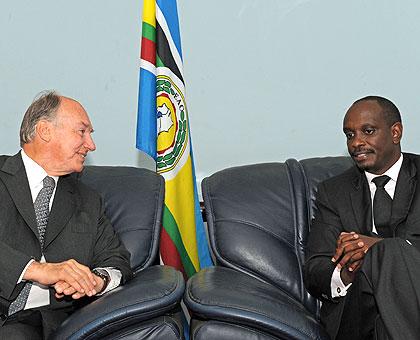
Dr Richard Sezibera meets His Highness the Agha Khan at the EAC Headquarters in Arusha. (Sunday Times Rwanda)
Overlapping membership in several trade areas is impeding “free circulation of goods” within the East African Community-members states, a regional integration and trade expert has said.
Alfred Ombudo K’Ombudo, the Coordinator of the EAC Common Market Scorecard team, has told The News Times that belonging to other trade blocs outside the EAC makes members reluctant to remove internal borders to allow goods to move more freely.
According to K’Ombudo, a Common External Tariff (CET) is critical to ensure free circulation of goods through the application of equal customs duties. The EAC Customs Union protocol has a three-band structure of 0 per cent duty on raw materials, 10 per cent on intermediate goods and 25 per cent on for finished goods.
However, of the five partner states, Tanzania is a member of the SADC and subscribes to a different structure while Burundi, Kenya, Rwanda, and Uganda, are members of the Common Market for Eastern and Southern Africa (Comesa). On the other hand, Burundi belongs to the Economic Community of Central African States (ECCAS).
This, according to the expert is “perforation of the bloc’s CET,” drilling a hole in the regions tariff structure as member- states trade with other countries below the agreed tariffs.
“This makes EAC countries less willing to remove internal borders because they are not sure whether goods may have come from other blocs. This is a serious structural problem that is difficult to solve because the customs union legally recognises other blocs that members belong to,” K’Ombudo noted.
Burundi, Kenya, Rwanda and Uganda’s participation in Comesa and Tanzania’s membership to SADC is recognised by the EAC, but no exception is granted to Burundi for participating in the ECCAS.
Article 37 of the bloc’s Customs Union Protocol recognises other free trade obligations of partner states but it requires them to formulate a mechanism to guide relationships between the protocol and other free trade arrangements.
EAC Secretary General, Richard Sezibera, told The New Times during the launch of the Scorecard in Arusha, that there have been efforts to address the issue of overlapping membership.
“They [EAC leaders] have done two things to [try] addressing it: One is to harmonize the CET of the EAC and that of COMESA. This makes it easier for COMESA states to reduce the level of perforation,” he explained.
He added that in 2008, the heads of state decided to negotiate a free trade area between the EAC, COMESA and SADC as another way of fixing the problem.
Dr Catherine Masinde, the Head of Investment Climate, East and southern Africa at the International Finance Corporation (IFC), said: “If we were not to perforate the EAC would end up with a bigger volume of trade figures”.
She noted that since the launch of the EAC Customs Union, in 2005, the region has witnessed strong growth in intra-regional trade, rising from $1.6 billion to $3.8 billion between 2006 and 2010. Intra-EAC trade to total EAC trade grew from 7.5 per cent in 2005 to 11.5 per cent in 2011.
“This is significant growth but, I am told that this is, in fact, a drop in the ocean. That it is far from the potential of the market. I was given a figure, that $22.7 billion [in inter-regional trade] was actually lost to other regional blocs, from this region, [between 2005 and 2012] because of non-compliance with the common market protocol.” The Scorecard, Masinde hopes, will solve various EAC compliance issues as well as energize reforms to spur the bloc’s development. Source: The Sunday Times (Rwanda)
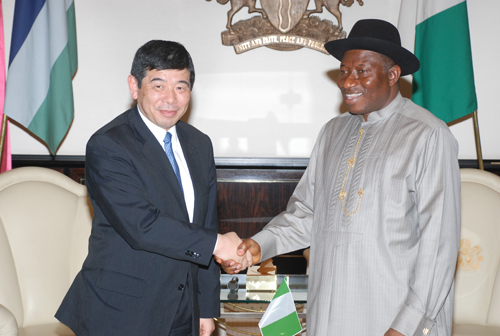
Secretary General Mikuriya during a courtesy visit paid to the President of the Republic of Nigeria, Mr. Goodluck Jonathan (WCO)
At the invitation of the Comptroller-General of the Nigeria Customs Service (NCS), Mr. Abdullahi Dikko Inde, the WCO Secretary General Kunio Mikuriya visited Nigeria on 17 and 18 February 2014 to observe Customs transformation activities after the termination of Destination Inspection contracts on 1 December 2013.
In Lagos, the Secretary General went to Apapa Port, Nigeria’s major port, to see Customs operations and also to visit the Customs Training Centre for a mentorship talk with young officers: the NCS has recruited many recent university graduates and trained them in computer and other necessary skills.
Secretary General Mikuriya also presided over a Stakeholder Forum to interact with the private sector. The business community were supportive of the ongoing Customs transformation programme that was enhanced by an improved communication strategy for Customs, the use of information technology – the Nigeria Trade Hub – and the implementation of modern Customs methods, such as risk management.
The private sector also suggested better use of a database for risk management purposes, including valuation, and expressed their hope for the introduction of coordinated border management and a Single Window to simplify the multiplicity of regulations and inspections at borders.
The Secretary General also travelled to Abuja, Nigeria’s capital city, and was joined by three heads of Customs from neighbouring countries, namely Benin, Ghana and Niger, who wanted to learn from NCS’s experience and obtain Nigeria’s support, as well as that of the WCO, for terminating contracts with inspection companies in order to regain ownership of core Customs functions.
The Secretary General also paid a courtesy visit to the President of the Republic, Mr. Goodluck Jonathan. As a former Customs official early in his career, the President talked fondly of his visit to the WCO to attend the 2012 Council Sessions and particularly noted the WCO’s strong and inspirational leadership. He also acknowledged the economic and social contribution of Customs to the nation, and promised to continue to support Customs reform in Nigeria and provide guidance and influence at the regional level. Source: WCO
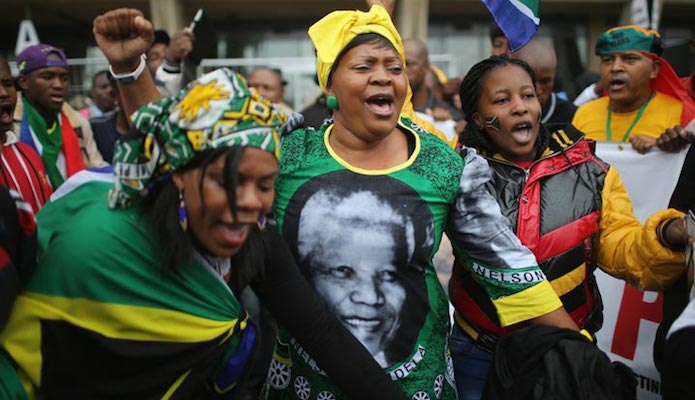 This recent publication, by Jakkie Celliers, executive director and co-founder of the Institute for Security Studies, sets out a trilogy of economic and political scenarios. While it may be of nominal interest to the man in the street, I would think that potential foreign investors would certainly consider its import. It is available in PDF or EPUB formats at the following link.
The paper presents three scenarios for South Africa up to 2030: ‘Bafana Bafana’, ‘A Nation Divided’ and ‘Mandela Magic’. The nation’s current development pathway, called ‘Bafana Bafana’ is the well-known story of a perennial underachiever, always playing in the second league when the potential for international championship success and flashes of brilliance are evident for all to see.‘Mandela Magic’, on the other hand, is the story of a country with a clear economic and developmental vision, which it pursues across all sectors of society. Competition is stiff and the barriers to success are high. The scenario of ‘A Nation Divided’ reflects a South Africa that steadily gathers speed downhill as factional politics and policy zigzagging open the door to populist policies.
The impact of the policy and leadership choices that South Africans will make in the years ahead, explored in this paper, is significant. The South African economy could grow 23 per cent larger in ‘Mandela Magic’ compared with its current growth path (‘Bafana Bafana’). The paper concludes with seven strategic interventions required to set South Africa on the most prosperous ‘Mandela Magic’ pathway. Source: Institute for Security Studies

WCO expert Ian Cremer (centre, back row) with SARS staff involved in valuation training project.
The SARS Academy is reviewing and packaging its training material so as to align its curriculum to international standards. It has embarked on a process of benchmarking its training material, kick-starting the process in the School of Customs and Excise.
WCO facilitator Ian Cremer recently visited the Academy at Waterkloof House in Pretoria to provide assistance with the strengthening of their valuation training programme. A group of trainers, curriculum developers and valuation specialists from business worked with the WCO valuation expert in the development of the new training material.
Training modules will be developed at the following levels: Basic, Intermediate and Advanced, and will be aligned to the WCO’s own valuation training modules.
Further work will now be conducted on developing a delivery strategy. This will ensure that key staff are trained to the necessary level and are able to conduct their duties in a professional level, meeting the dual requirements of fair and efficient revenue collection and the facilitation of compliant trade. Source: SARS
![SARS Customs North West Detector Dog Unit handlers. [SARS]](https://mpoverello.com/wp-content/uploads/2014/02/ddu_snapseed.jpg)
SARS Customs North West Detector Dog Unit handlers. [SARS]
There are now 90 regionally based detector dogs and handlers deployed in the country. Most dogs are dual trained to detect different substances and /or goods. They have the capacity to detect the following substances/goods hidden in vehicles, vessels, aircraft, cargo, containers, mail, rail, luggage and buildings:
At the end of phase 1, which ran from April 2013 to January 2014, a ceremony was held in Zeerust to hand out certificates to the members of the newly-formed North West Detector Dog Unit.
“The commitment, passion and drive of the trainees must be acknowledged as this contributed to the successful training of the new handlers and dogs. The teams performed extremely well, achieving pass rates ranging from between 92% to 99.80% and this could only be achieved with positive team work and the drive to go the extra mile and make a difference. The teams proved their commitment in playing an impactful role in the prevention of smuggling,” Hugo said.
The cooperation between different government agencies also played a major role in the successful training and operational deployment of the Customs dogs and handlers during Phase 1 and will continue during Phase 2 and 3, he added.
Phase 2 of the programme is planned to get underway on 7 April 2014 with the establishment of three new units – at Port Elizabeth, Ladybrand and Ermelo.
The DDU has been a major success story for SARS in recent years, providing expert training to several Customs and Border agencies in the region. The topic has also invoked significant interest amongst readers and followers of this blog. It needs to be stressed, however, that the recruitment and deployment of dog trainers in SARS is currently all achieved through training and up-skilling of officers within the organisation. No external recruitment drives have occurred. The nature and extent of Customs Modernisation places SARS in the fortunate position of being able to redeploy staff to specialised roles such as the DDU.
Source: SARS
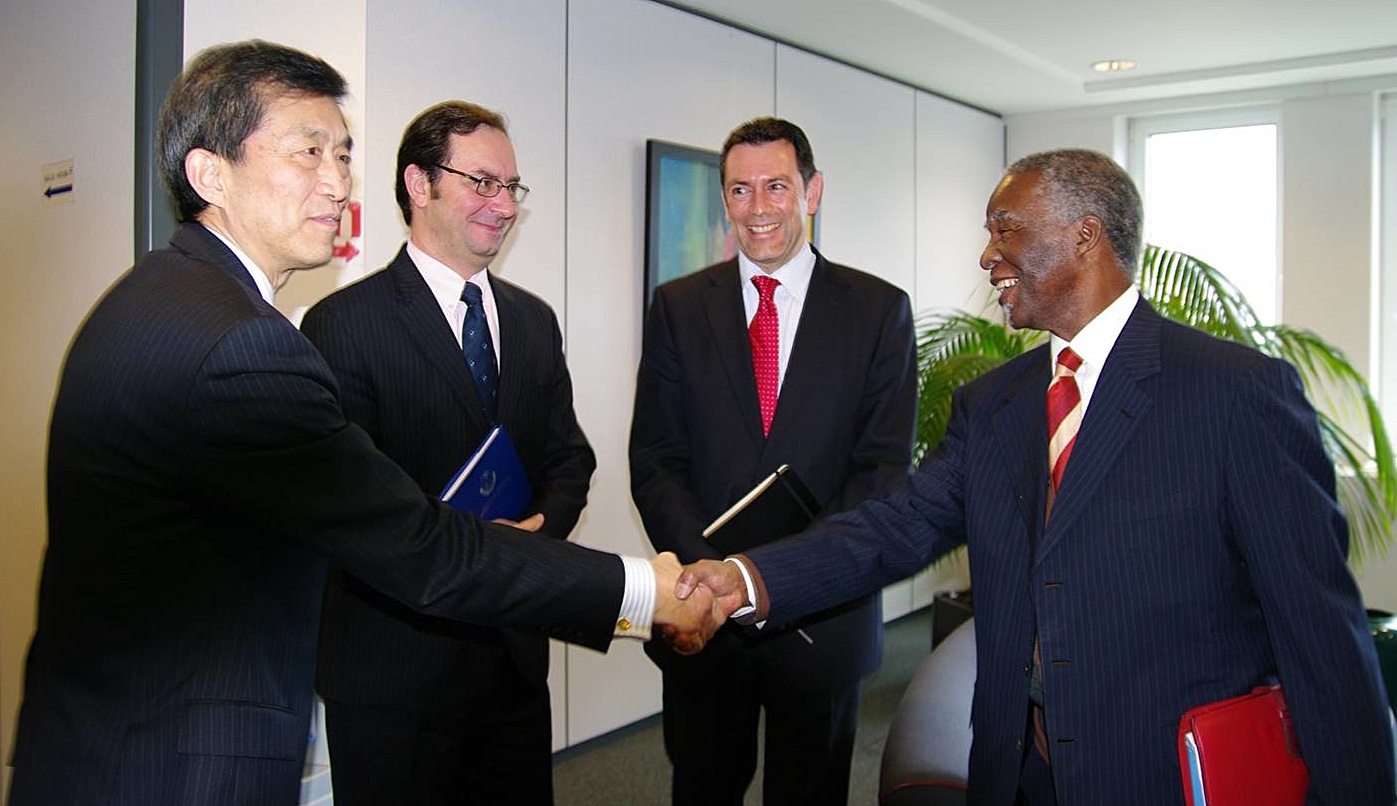
Senior WCO Management welcoming former South African President Thabo Mbeki, who is Chair of the High Level Panel on Illicit Financial Flows from Africa (WCO)
Members of the High Level Panel on Illicit Financial Flows from Africa, headed by former South African President Thabo Mbeki, visited WCO Headquarters on 11 February 2014 to obtain input for their report and recommendations to African countries in order to harness Africa’s hidden resources for development.
Secretary General Kunio Mikuriya explained the problems posed by cash couriers and trade-based money laundering (under-invoicing, over-invoicing, etc.) which had become major risk factors in Africa over the past decade as the continent had experienced economic growth largely based on the mining of its abundant natural resources. The Secretary General also referred to the need for countries to prioritize their policy regarding illicit financial flows and to provide adequate resources and a legal framework for Customs to establish controls in respect of free trade zones, thus enabling the Customs community to combat illicit trade and financial flows.
The discussion also covered, more broadly, the contribution of Customs to economic and social development in Africa, including regional economic integration. Mr. Mbeki and the High Level Panel members acknowledged the crucial part that Customs plays in improving the business climate by ensuring connectivity at borders, evidenced by the recent WTO Agreement on Trade Facilitation, as well as the role of Customs in ensuring transparency and security of the supply chain. They also appreciated the WCO approach of ownership-based capacity building which needed to be backed up by high-level political commitment. Source: WCO
Related articles
![Presidents Uhuru Kenyatta (Kenya), Paul Kagame (Rwanda) and Yoweri Museveni after the trilateral talks in Entebbe, Uganda. President Jakaya Kikwete of Tanzania and Pierre Nkurunziza of Burundi stayed out of the loop of the third infrastructure summit in Kigali, Rwanda on Monday. [Photo/PPS]](https://mpoverello.com/wp-content/uploads/2014/02/eac-sct-postponed.jpg)
Presidents Uhuru Kenyatta (Kenya), Paul Kagame (Rwanda) and Yoweri Museveni after the trilateral talks in Entebbe, Uganda. President Jakaya Kikwete of Tanzania and Pierre Nkurunziza of Burundi stayed out of the loop of the third infrastructure summit in Kigali, Rwanda on Monday. [Photo/PPS]
Kenya, Uganda and Rwanda have postponed the single customs territory (SCT) roll-out, giving Burundi and Tanzania more time to prepare for the shift.
East Africa Community (EAC) secretariat custom officer Ally Alexander told the committee on Communication, Trade and Investment in Mombasa that the implementation of the model would begin in June.
“We are looking at reducing the costs and number of days to clear the cargo from Mombasa to Kampala to take three days instead of the previous 18 days,” Mr Alexander said.
The SCT was initially planned to begin in January with the three countries moving their revenue staff to common entry and exit points to begin goods clearance. But Tanzania and Burundi protested their exclusion in the arrangement after Kenya announced in January that it was ready to start accommodating revenue officials from the two landlocked states in Mombasa, prompting the three States to go slow on their plans.
On Monday, Mr Alexander told East African Legislative Assembly that SCT would reduce the cost of doing business and bring efficiency in trade. He said for exports within the region, a single regional bond for cargo would be issued to cater for goods from the port of Mombasa to different destinations.
An electronic cargo tracking system would also be used to avoid diversion of goods into the transit market. Under the model, goods will be checked by a single agency on compliance to regional standards and instruments.
“We want to avoid agencies replicating checking on standards, when it is done once this will not be repeated,” he said.
Mr Alexander said goods would be released upon confirmation that taxes have been paid and customs procedures fulfilled.
However goods heading to the Democratic Republic of Congo which is not a member of EAC will be cleared on a transit basis.
The establishment of SCT has raised concerns among stakeholders, key among them the registration of clearing agents and job losses. Kenya Revenue Authority deputy commissioner customs Nicholas Kinoti said the concerns would be addressed through legislations. Source: http://www.businessdailyafrica.com
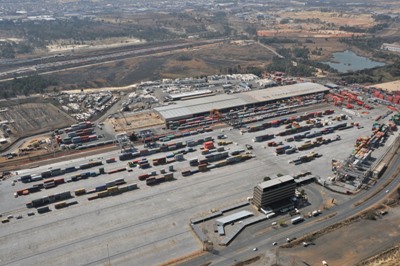
City Deep Container Terminal (Transport World Africa)
The controversial Customs Control Bill adopted by Parliament’s finance committee on Wednesday includes a “fallback” provision allowing for a return to the current customs control system should the new one fail.
A similar clause was included in the law that introduced value-added tax in 1991, allowing for a legal alternative to be implemented quickly if things do not work out as planned.
The committee also adopted the Customs Duty Bill and the Customs and Excise Amendment Bill as part of a total revamp by the South African Revenue Service (SARS) of the customs system. Visit this link for access to the Bills and submissions to the parliamentary committee.
The Customs Control Bill has been highly contentious as it will fundamentally change the way imported goods are cleared and released. The Democratic Alliance and Business Unity SA (Busa) opposed the original proposals on the grounds that doing away with manifests in the operations of City Deep would threaten the inland terminal in Johannesburg. SARS disputed this but nevertheless amended the bill.
Busa’s Laurraine Lotter yesterday welcomed the inclusion of the fallback clause but said she would have to see the details of the amendments introduced by SARS before commenting.
The fallback provision — which will automatically lapse five years after the effective date of the legislation — was included to be on the safe side, although SARS does not expect the proposed system to fail. It consulted widely on the bill, sought legal opinions about the legality of its amended proposals and ultimately secured the support of ship operators and agents, freight forwarders and Transnet for the amendments.
Implementation could be delayed by 12 months to allow the trade sufficient time to prepare.
SARS chief legal and policy officer Kosie Louw assured the committee this week the existence of City Deep would not be jeopardised. He urged adoption of the new system of customs control, saying the authorities needed more detailed information about incoming cargo to clamp down on fraud and illegal imports.
In terms of the bill, the submission by shipping lines of a manifest that provides only a general description of cargo will be replaced by a clearance declaration. This must contain information on the tariff, value and origin of the goods, and be submitted by the importer (which can be held accountable for its veracity) three calendar days before arrival at the first place of entry into South Africa.
Penalties will be levied only if the clearance is not submitted within three working days after the arrival of the goods. Containers will be provisionally released before arrival of the goods at the first place of entry and finally released at the first point of entry. To allow for seamless movement of goods, shipping lines will still issue multimodal contracts and through bills of lading.
“The revised proposal provides certainty and predictability to role players in the supply chain regarding the movement of goods,” Mr Louw said.
He said the new system would allow customs officials to undertake documentary inspections earlier, mitigating delays. High-risk containers would be identified before arrival, detained on arrival and held at the inland terminal for inspection. Containers with no risk would be able to move “seamlessly” to the inland terminals.
Mr Louw submitted that the objections to the proposal — that it would require traders to change their sale contracts; that sellers would be reluctant to sell under the new terms; that importers would be affected; that carriers would no longer issue a bill of lading to internal terminals; and that it would give rise to delays and congestion at ports — were found to lack foundation by international trade law expert Prof Sieg Eiselen and two advocates.
He said the proposed system would lay a solid and predictable framework for a modernised system of customs control that balanced the need for trade facilitation with the need to prevent imports of illicit goods. The current system was governed by an outdated, 1960s law. Source: Business Day
Related articles
 What Happened to the Portcullis?
You must be logged in to post a comment.