Thick Borders – Thin Trade

It’s quite amazing the number of reports featured in various african media across the continent pushing the ‘free trade’ agenda. The incumbent governments on the other hand are naturally concerned with dwindling tax collections, while at the same time increasing incidents of graft, collusion, and corruption run rampant at the border. While the following article states the obvious, unfortunately, nowhere will you find or read a practical approach which deals with increased ‘automation’ at borders and the consequential re-distribution of ‘bodies’ to other forms of gainful employment. Its jobs that will be on the line. Few governments wish to taunt their electorates – non-essential jobs are a fact of life and are destined to stay if that is what will earn votes and a further term in power. Moreover, there is no question of removing internal borders with the emphasis on costly ‘One-Stop Border’ facilities. To some extent the international donor community won’t mind this as there’s at least some profit and influence in it for them.

Poverty in Sub- Saharan Africa is a man-made phenomenon driven by internal warped policies and international trade systems. The continent cannot purport to seek to grow while it blocks the movement of goods and services through tariff regimes at the same time Tariff and non-tariff barriers contribute to inefficient delivery systems, epileptic cross-border trading and thriving of illicit/contraband goods.

This ultimately harms the local and regional economy. Delays at ports of delivery, different working hours and systems of control across the continent, unnecessary police roadblocks and poor infrastructure condemn countries to prisons of inter-regional and intra-regional trade poverty.

According to the United Nations Economic Commission for Africa, removal of internal trade barriers would lead to US$25 billion per year of intra-regional exports in Africa, an increase by 15,4 percent by 2022. Making African border points crossings more trade efficient would increase intra-regional trade by 22 percent come 2020. Trade barriers in East Africa Community alone increase the cost of doing business by 20 percent to 40 percent.

Such barriers include the number of roadblocks within each country, cross- border charges for trucks and weighing of transit vehicles on several points on highways. Kenya is grappling to reduce the number of its roadblocks from 36 to five and Tanzania from 30 to 15. Sub-Saharan Africa records an average port delay of 12 days compared to seven days in Latin America and less than four days in Europe. Africa is lagging behind!

In West Africa, Ghanaian exports to Nigeria are faced with informal payments and delays as the goods transit across the country borders whether there is proper documentation. In the Great Lakes Region, an exporter is faced with 17 agencies at the border between Rwanda and Democratic Republic of Congo each with a separate monetary charge sheet.

A South African retail chain Shoprite reportedly pays up to US$20 000 a week on permits to sell products in Zambia. Each Shoprite truck is accompanied with 1 600 documents in order to get its export loads across a Southern African Development Community border. Tariff and non-tariff barriers simply thicken the wall that traps Africans in economic poverty.

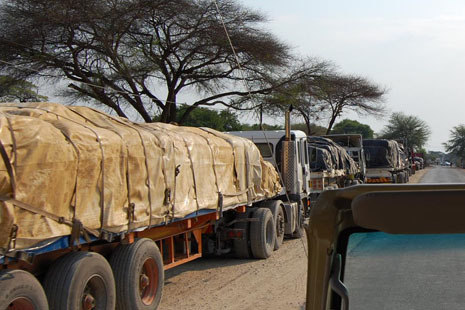
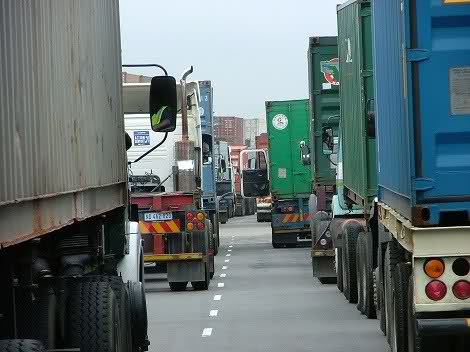
The new African Union chair should push for urgent steps to lower barriers to trade within Africa. Border control agencies need retraining and border country governments need to integrate their processes; long truck queues waiting to cross border points should not be used as an indicator of efficiency.

If it takes a loaded truck one hour to cover 100 kilometres; a four-hour wait at the border increases the distance to destination to another 400 kilometres. Increased distance impacts on the prices of goods at the retail end hence limiting access to products to majority of Africans. Limited access translates to less freedom of choice — similar to a locked up criminal prisoner.

With modern technology, goods should be declared at point of origin and point of receipt. Border points should simply have scanners to verify the content of containers. Protectionism, tariffs and non-tariff barriers within the continent sustains African market orientation towards former colonisers.

African entrepreneurs are subjected to longer travel schedules due to constant police checks and slow border processes. To fight poverty on the continent, African people would benefit from an African Union Summit that resolves to facilitate efficiency in movement of goods and services. Efficient delivery systems on the continent will tackle challenges of food insecurity, poor health care, conflicts and further promote diversified economies arising from competitive healthy trading amongst and between African nations.

Elimination of tariff and non-tariff barriers to trade will provide an opportunity for African entrepreneurs to adequately take their rightful places as relevant players in the global trade system. It is imperative that African countries re-orient their strategies to promote productivity by reviewing tariffs that hold back entrepreneurs from accessing the continent’s market. This calls for both a competitive spirit and a sense of integrated tariff and process compromise if the continent is to haul its population from poverty. Source: The Herald (Zimbabwe)

Namibian Ministry of Finance angers clearing agents

Below is a situation which might have been avoided if trader registration/licensing was properly addressed by the Namibian Authorities. With the likes of SADC and COMESA encouraging the implementation of regional transit guarantees, trade operators need to clearly address their obligations and liabilities. Moreover, any suggestion of authorised economic operator (AEO) programme in the Southern African region needs to fully align its requirements with the standards being applied by other countries across the globe. It is therefore clear that no preferred trader scheme can be implemented across the Trans-Kalahari Corridor or across SACU if such disparities of knowledge and practice exist. While one might have compassion for possible job redundancies and the pleas expressed by certain clearing agents, they evidently do not understand the game they are playing in and will drastically need to redress their understanding of the role they play in the supply chain. International clearing and forwarding is not a game for sissies, or people who want to try their hand at a quick buck. A bold stance by the Ministry of Finance.

The Namibian Ministry of Finance’s decision to ban clearing agents from using guarantees and bonds from third parties as security to move goods has caused an uproar among clearing agents. The Deputy Minister of Finance, Calle Schlettwein, explained that the decision that became effective on July 26 was taken to protect the taxpayer. Clearing agents aren’t closed down, and neither are they stopped from using their own security to move these goods, he said. As from July 26, the agents are simply not allowed to use a bond or guarantee issued to another clearing agent as security for their goods in transit, the ministry said.

Before the clampdown, clearing agent A used to ‘borrow’ guarantees or bonds, backed by financial or other institutions from clearing agent B to clear any goods coming through Namport and destined for landlocked countries such as Botswana, Zambia and Zimbabwe. However, should a problem develop with agent A’s consignment, the guarantee or bond would be worthless to Government, as the financial institution agreed to back only agent B’s guarantee or bond. “We don’t know how or when the practice started, but it is illegal,” a ministry spokesperson said.,

Schlettwein said Government stood to lose out on duties and customs through the practice, and the taxpayers would have ended up having to pick up the tab. The ministry’s announcement was met with considerable protest from the smaller clearing agencies, claiming that they didn’t have the money or financial backing to secure the necessary bonds or guarantees. Nampa reported that 76 small and medium enterprises (SMEs) operating as clearing agencies at the coast have been affected. At the Oshikango border post and at Helao Nafidi in the North, 30 agencies with more than 100 employees are affected.

Regina Amupolo of Pride Clearing and Forwarding Agent has called on the ministry to urgently look into this matter, because many trucks with goods and containers are stuck at the Oshikango border post, Walvis Bay harbour or at other border posts. Their customers have already complained that they are losing business because of this, Amupolo said. Amupolo said most SMEs don’t have the money to obtain bonds or guarantees. She said ministry officials said anyone who wants a bond must have collateral of N$1,6 million. “We are small business people, trying to employ ourselves and some of our fellow men and women in our societies, but now the Government, the Ministry of Finance, is making things difficult for us. How are we going to make a living if the ministry is cutting off our jobs in this way?” she asked.

In a letter written to all clearing agents at Oshikango, the controller customs and excise officer, Festus Shidute, said the practice of using third-party bonds or guarantees posed a serious challenge to customs administration and control of guarantees in the event of liabilities by third parties. Amupolo and Rejoice Nangolo from Flora Clearing Agent said they have already paid N$20 000 to obtain a clearing licence, while they have to pay Namport another N$20 000. She said they are losing thousands of dollars as a result of this unexpected prohibition by the ministry and are demanding an extension to allow them to take the matter up with the ministry.

Nangolo said her business has branches at other border posts like Omahenene, Katwitwi, Ngoma, Wenela, Trans-Kalahari, Ariamsvlei, Noordoewer, Walvis Bay, Hosea Kutako International Airport and Oshikango. Her Angolan customers have threatened to stop moving their goods through Namibia and only to use their own ports, she said. At Oshikango there are only two big companies, Piramund and CRN, that can guarantee bonds and assist them as SMEs clearing their work effectively. According to Amupolo and Nangolo, they started with their clearing business in Oshikango in 2000 and were doing well until the ministry imposed the ban.

Speaking to Nampa, Lunomukumo Taanyanda of Oluvanda Clearing and Forwarding Close Corporation (OCFCC) said his company has been operational for two years and deals mostly with car consignments from countries such as the United Kingdom (UK) and Dubai.Before clearing the consignments, OCFCC has to declare the consignment at the Namport customs desk. However, before they can fill in a customs declaration form to clear the transit goods, the goods need to be secured and this is where the company (OCFCC) requires the assistance of third parties such as Wesbank Transport, Transworld Cargo and Woker Freight Services.

These smaller companies acquire assistance from bigger companies (the third parties) as they experience problems when trying to obtain their own bonds and guarantees. According to Taanyanda, it is a very costly and time-consuming process. “We agents do not have enough collateral for bonds, which start at N$350 000, and now the ministry has stopped us from borrowing bonds from third parties,” he said. Source: The Namibian

Related Articles

http://www.namibian.com.na/news/marketplace/full-story/archive/2012/august/article/clearing-agents-want-answers-today/

Mozambique – New customs transit regulation

FTWOnline has published a letter it received from the CEO of Maputo Corridor Logistics Initiative (MCLI), the interim-CEO of Maputo Port Development Company (MPDC). Seems like an important ‘heads-up’ for all logistics operators. It reads as follows –

“The hardly-negotiated Mozambique customs transit regulation is concluded and the document sent to the minister of finance for approval. Approval and official gazetting is expected for the first week of August.

“Key features are:

  • All the unknown costs are replaced by a transit fee of 500.00-mts (+\- 18 US$) for general cargo and 10 cents of mts (0.036 US$) per for bulk cargo.Art. 13.
  • It is clarified that transit cargo is duty-free and subject to a guarantee that can be isolated (for a single transaction) or global (for transactions etween 3-month and 1-year). The bond covers only the duties and taxes at risk and is capped at 35% of duties and taxes. As an example, if the value of the good is US$1 000, the bond will be equal to 35% of 22% (7% of duties and 17% of vat), totaling around US$75. The bond is calculated on the basis of the value of transactions undertaken in the preceding year. Art. 14 to 19.
  • Transhipment is free-of-bond and the acquittal takes place only in the last port in the national territory. Art.23.
  • Acquittal period for areas where the single window is not yet in place is of 5 business days.”

The African transhipment race

Have you noticed the debate in the on-line Global Ports Forum about who will become the main container terminals in East and West Africa? Portstrategy.com has taken it upon themselves to score some of the suggestions.

Nigeria is strongly identified as a hub for the west coast of Africa – we score that 7 out of 10. It has the potential but will new port development be delivered in time? Will the off-take infrastructure development be implemented in concert with port development at places like Lekki? Will Lekki’s hub function be undermined by other deepwater facilities being delivered first on the African coast?

Generally, they agree with the view expressed by one wise head in the Forum that the race for hub status on the West African coast is now a fierce one. However, we don’t agree with the contention that Angola will have a serious say in becoming a major hub for West Africa. It will struggle for some time yet to meet its own port capacity needs let alone fulfil a regional function. We score this suggestion 2 out of 10; go to the bottom of the class!

South Africa as a hub for East and West Africa? Well to a limited extent it does already fulfil this role but when South Africa booms its priority has to be gateway cargo and it is limited in terms of its economic and geographical reach. It is also not ideal because of position; we won’t score the suggestion down but conversely we also won’t score it up because it is a fair point. We do, however, see as a negative the continuing emphasis on the public operation of this country’s ports – it spells very high cost comparatively speaking and coupled with this, ironically, not the best service.

Doraleh Container Terminal, Djibouti? Yes we would agree that this has a role to play in container transhipment for East Africa and particularly with its phase two expansion now underway. The price is right for transhipment here but the cost of cargo movement to the main transit destination of Ethiopia is coming in for increasing criticism. It also has a limited reach along the East Coast. Another score of 7.

Mombasa? Yes huge potential for the East Coast of Africa but as history shows no political will to deliver new port capacity in line with demand. Nine in theory but five in practice.

The new port of Lamu? Designed to act as an export gateway for South Sudan, construction has begun on the $23bn (£14.5bn) port project and oil refinery in south-east Kenya’s coastal Lamu region near war-torn Somalia’s border. With a planned multi-purpose port function, because it is a ‘clean slate’ it could take on the hub function. Another 7.

So what is Port Strategy’s view?

In West Africa, we note that new purpose-built, deep draft container port capacity has either recently been installed or is about to be installed in West Africa in six or seven locations. In Lome in Togo and Pointe Noire in the Congo, for example, new facilities are set to come on-stream by end 2014 at the latest which will be able to handle vessels of up to 7,000 teu. We therefore suggest that there will be a split of hubbing activity between all these locations but with the first two or three terminals on-line grabbing the main part of transhipment activity. We also see a continuing role in the short-term at least for hubs such as Algeciras that ‘face’ Africa.

In East Africa we cannot escape the logic of Mombasa and Dar es Salaam but will they pick up the pace quick enough to seize the opportunity? Sadly, not so far. Lamu, therefore, may have a big role to play. Source: Portstrategy.com

Revisiting the national transit procedure – Part 2

You will recall a recent challenge by trade to SARS’ proposed implementation of mandatory clearance of national transit goods inland from port of initial discharge – refer to Revisiting the national transit procedure – Part 1.

First, some background

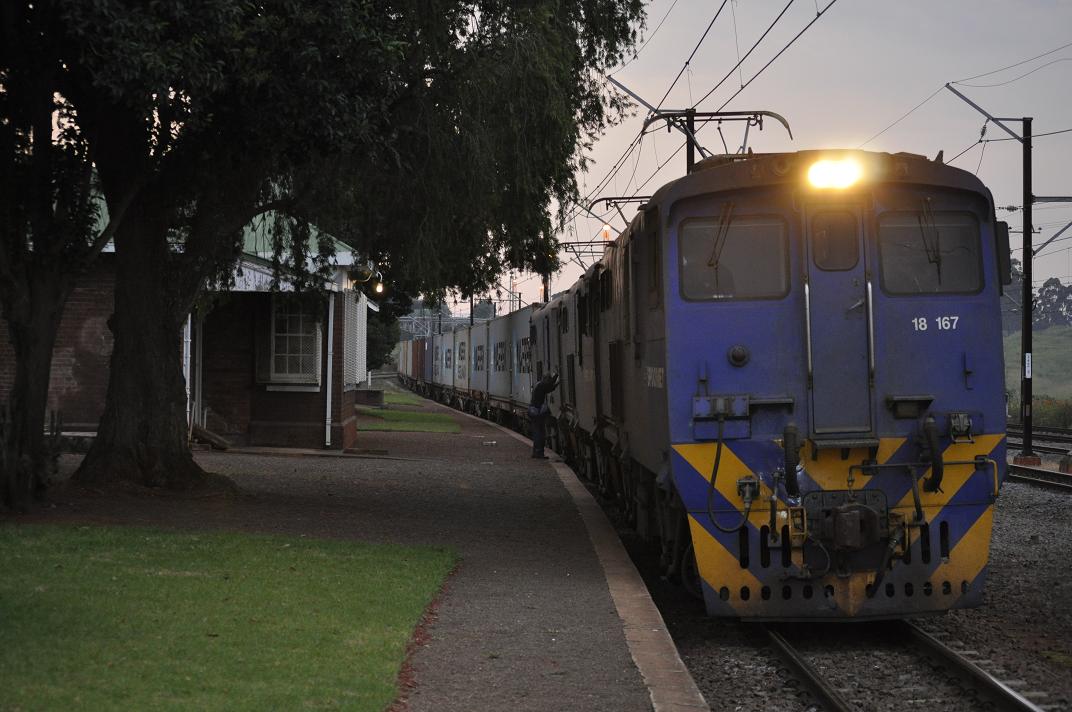
Now lets take a step back to look at the situation since the inception of containerisation in South Africa – some 30 years ago. Customs stance has always been that containerised goods manifested for onward delivery to a designated inland container terminal by rail would not require clearance upon discharge at initial port of entry. Containers were allowed to move ‘against the manifest’ (a ‘Through Bill’) to its named place of destination. This arrangement was designed to expedite the movement of containers from the port of discharge onto block trains operated by Transnet Freight Rail, formerly the South African Railways and Harbours (SAR&H) to the inland container terminal at City Deep. Since SAR&H operated both the national railway and the coastal and inland ports, the possibility of diversion was considered of little import to warrant any form of security over the movement of containers by rail. Moreover, container terminals were designed to allow the staging of trains with custom gantry cranes to load inland manifested containers within a ‘secure’ port precinct.

Over the years, rail freight lost market share to the emergence of cross-country road hauliers due to inefficiencies. The opening up of more inland terminals and supporting container unpack facilities, required Customs to review the matter. It was decided that road-hauled containers moved ‘in bond’ by road would lodge a customs clearance (backed with suitable surety) for purposes of national transit. Upon arrival of the bonded freight at destination, a formal home use declaration would be lodged with Customs. Notwithstanding the surety lodged to safeguard revenue, this has the effect of deferring payment of duties and taxes.

Diversification of container brokering, stuffing and multi-modal transport added to the complexity, with many customs administrations failing to maintain both control and understanding of the changing business model. Equally mystifying was the emergence of a new breed of ‘players’ in the shipping game. Initially there were so-called ‘approved container operators’ these being ocean carriers who at the same time leased containers. Then there were so-called non-approved container operators who brokered containers on behalf of the ocean carrier. These are more commonly known as non-vessel operating common carriers or NVOCCs. In the early days of containerisation there were basically two types of container stuffing – full container load (FCL) and less container load (LCL). The NVOCCs began ‘chartering’ space of their containers to other NVOCCs and shippers – this also helped in knocking down freight costs. This practice became known as ‘groupage’ and because such containers were filled to capacity the term FCL Groupage became a phenomenon. It is not uncommon nowadays for a single FCL Groupage container to have multiple co-loaders.

All of the above radically maximised the efficiency and distribution of cost of the cellular container, but at the same time complicated Customs ‘control’ in that it was not able to readily assess the ‘content’ and ownership of the goods conveyed in a multi-level groupage box. It also became a phenomenon for ‘customs brokers/clearing agents’ to enter this niche of the market. Customs traditionally licensed brokers for the tendering of goods declarations only. Nowadays, most brokers are also NVOCCs.  The law on the other hand provided for the hand-off of liability for container movements between the ocean carrier, container terminal operator and container depot operator. Nowhere was an NVOCC/Freight Forwarder held liable in any of this. A further phenomenon known as ‘carrier’ or ‘merchant’ haulage likewise added to the complexity and cause for concern over the uncontrolled inland movements of bonded cargoes. No doubt a disconnect in terms of Customs’ liability and the terms and conditions of international conveyance for the goods also helped create much of the confusion. Lets not even go down the INCOTERM route.

Internationally, customs administrations – under the global voice of the WCO – have conceded that the worlds administrations need to keep pace and work ‘smarter’ to address new innovations and dynamics in the international supply chain. One would need to look no further than the text of the Revised Kyoto Convention (RKC) to observe the governing body’s view on harmonisation and simplification. However, lets now consider SARS’ response in this matter.

SARS response to the Chamber of Business

Right of reply was subsequently afforded by FTW Online to SARS.

Concerns over Customs’ determination to have all goods cleared at the coast – expressed by Pat Corbin, past president of the Johannesburg Chamber of Commerce and Industry in last week’s FTW – have been addressed by SA Revenue Service.  “One of the main objectives of the Control Bill is the control of the movement of goods across South Africa’s borders to protect our citizens against health and safety risks and to protect the fiscus. “In order to effectively determine risk, SARS has to know the tariff classification, the value and the origin of imported goods. This information is not reflected on a manifest, which is why there is a requirement that all goods must be cleared at the first port of entry into the Republic.“It appears that Mr Corbin is under the impression that the requirement of clearance at the first port of entry has the effect that all goods have to be consigned to that first port of entry or as he puts it “to terminate vessel manifests at the coastal ports in all cases”. This is incorrect. “The statutory requirement to clear goods at the first port of entry and the contract of carriage have nothing to do with one another. Goods may still be consigned to, for example, City Deep or Zambia (being a landlocked country), but they will not be released to move in transit to City Deep or Zambia unless a declaration to clear the goods, containing the relevant information, is submitted and release is granted by Customs for the goods to move. The release of the goods to move will be based on the risk the consignment poses to the country.“It is definitely not the intention to clog up the ports but rather to facilitate the seamless movement of legitimate trade. If the required information is provided and the goods do not pose any risk, they will be released.”

So, where to from here?

The issue at hand concerns the issue of the ‘means’ of customs treatment of goods under national transit. In Part 3 we’ll consider a rational outcome. Complex logistics have and always will challenge ‘customs control’ and procedures. Despite the best of intentions for law not to ‘clog up the port’, one needs to consider precisely what controls the movement of physical cargo – a goods declaration or a cargo report? How influential are the guidelines, standards and recommendations of the WCO, or are they mere studies in intellectual theories?

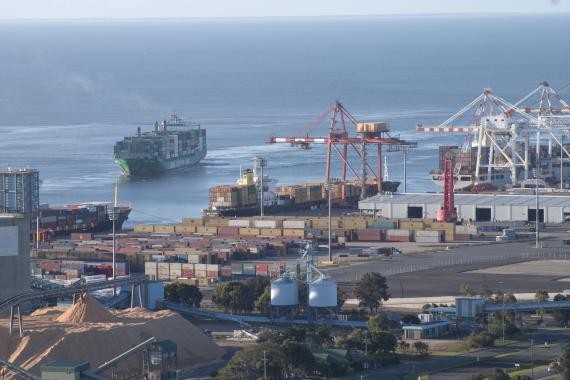
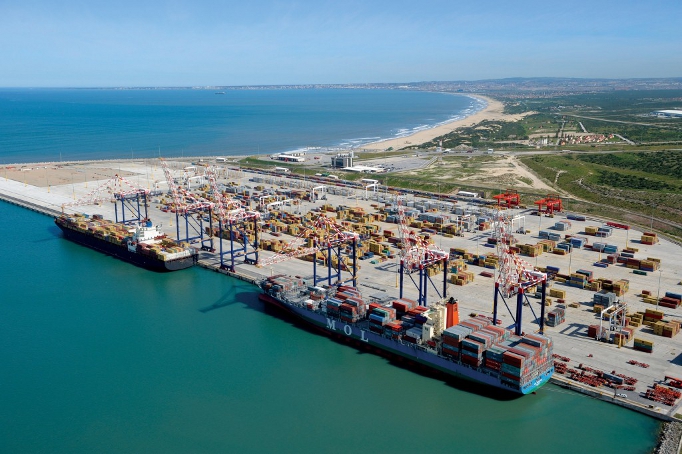
TPT to operationalise new Post Panamax cranes at Ngqura

Transnet Port Terminals has successfully completed testing of two Liebherr Super Post Panamax cranes at Ngqura Container Terminal, just north of Port Elizabeth. The Ship-to-Shore cranes (STS), which were delivered in January bringing the terminal’s fleet of STS cranes to eight, represent an investment of R150 million by the port operator.

The cranes will improve productivity by increasing Ship Working Hour (SWH) – the number of containers moved by the number of cranes working a vessel in one hour. A total of 78 additional operators have been trained and are ready to operate the equipment. Transnet’s newly formulated Market Demand Strategy will see Transnet SOC Limited invest R300 billion on freight infrastructure over the next seven years. Of this, TPT will invest R33 billion to boost port operations.

The portion allocated for the 600,000 m2 Ngqura Container Terminal includes just under R1.1 billion for its Phase 2 A expansion, which will increase container handling capacity from the current 800,000 TEU to 1.5 million TEU by 2013/14. A further R 808 million will be spent between 2015 and 2019 on the terminal’s Phase 2 B expansion to increase the terminal’s capacity to two million TEU. Source: Porttechnology.org

Transnet’s loco acquisition programme gaining traction

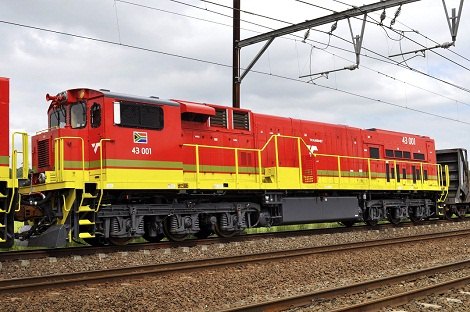
Ports.co.za reports that the US-based General Electric (GE) Transportation has announced that another locomotive, which forms part of a deal sealed with state-owned Transnet, was delivered with local content that exceeds the commitment from GE’s initial Transnet order of 100 locomotives.

The locomotive is the 42nd and is the most advanced diesel-electric locomotive ever built-in South Africa. Its official unveiling took place at an event held at Transnet Rail Engineering’s facilities in Koedoespoort, Pretoria, on Wednesday.

With this order, GE overshot its self-imposed target of 30% local content. The locomotives assembled in South Africa now have 37% local content.Transnet concluded an agreement with GE for a further 33 diesel-electric locomotives, over and above the 100 already being purchased under a deal concluded in 2009. In terms of the contract, 10 of the locomotives were manufactured in Erie and Grove City, Pennsylvania, USA and 133 are being assembled locally at Transnet Rail Engineering’s site in South Africa.

A total of 53 will be deployed in the Phalaborwa-Richards Bay corridor, 30 on the Sishen-Saldanha iron-ore corridor, 32 on the Witbank-Nelspruit-Komatipoort line and the remaining 28 will be used to transport coal to Eskom power stations. Source: ports.co.za

Revisiting the national transit procedure – Part 1

FTW Online last week ran an interesting article in response to a proposed change in Customs’ policy concerning the national transit movement of containers from coastal ports to inland container terminals and depots. In February 2011, I ran an article Customs Bill – Poser for Cargo Carriers, Handlers and Reporters alluding to some of the challenges posed by this approach. The following article goes a step further, providing a trade reaction which prompts a valid question concerning the practicality and viability of the proposed change given logistical concerns. I believe that there is sufficient merit in the issues being raised which must prompt closer collaboration between the South African Revenue Service and trade entities. For now it is sufficient to present the context of the argument – for which purpose the full text of the FTW article is presented below. In Part 2, I will follow-up with SARS’ response (published in this week’s edition of the FTW) and elaborate on both view points; as well as consider the matter  on ‘raw’ analysis of the ‘cargo’ and ‘goods declaration’ elements which influence this matter. Furthermore, one needs to consider in more detail what the Revised Kyoto Convention has to say on the matter, as well as how other global agencies are dealing and treating the matter of ‘security versus facilitation’.

Customs’ determination to have all goods cleared at the coast does not bode well for the South African trade environment, Pat Corbin, past president of the Johannesburg Chamber of Commerce and Industry (JCCI), said. Speaking at the Transport forum in Johannesburg Corbin said the Customs Bills have been on the cards for several years now and while consensus had been reached on most issues in the Nedlac process, the determination of Customs to not allow for any clearing to take place at inland ports will only add more pressure to the already overburdened ports in the country. “Customs maintains that despite the changes they propose it will be business as usual. We disagree. We have severe reservations about their intention to terminate vessel manifests at the coastal ports in all cases and have called for further research to be undertaken in this regard,” said Corbin. “By terminating the manifest at the coast it has severe ramifications for moving goods from road to rail. International experience has shown when you have an inland port and you have an adequate rail service where the vessel manifest only terminates at the inland port, up to 80% of the boxes for inland regions are put on rail while only 12% land on rail if the manifest terminates at the coastal port.” Corbin said the congestion at both the port and on the road would continue and have an adverse impact on quick trade flows. “It also raises issues around the levels of custom security and control at inland ports and then the general implications on the modernisation project.” According to Corbin, government’s continued response has been that no provision exists for inland ports and that goods must be cleared at the first port of entry. “They maintain that it is about controlling goods moving across our borders and thus the requirement that all goods must be cleared at the first port of entry. The security of the supply chain plays an important role to avoid diversion or smuggling of goods,” said Corbin. “Government says that the policy change will not clog up the ports or prohibit the seamless movement of trade. Labour organizations and unions seem to agree with them.” But, Corbin said, the Johannesburg Chamber of Commerce differs and is worried about the ramifications of this dramatic change to the 35-year-old option of clearing goods at an inland port or terminal. “With this policy change all containers will have to be reconsigned after not only Customs clearance on copy documents but also critically, completion of shipping lines’ requirements ie, payment of freight, original bill of lading presentation and receiving delivery instructions prior to their issuing a delivery order.” Corbin said the issue had been addressed directly with Transnet CEO Brian Molefe on two occasions, but that he had said he accepted Customs’ assurance that nothing would change and the boxes would still be able to move seamlessly once cleared. “It is not understood that the manifest will terminate at the coast where all boxes will dwell until they can be reconsigned,” said Corbin. Source: FTW Online – “New Customs Bill ruling will put pressure on port efficiency.”

Durban awaiting arrival of 11, 660 TEU container ship

Ports.co.za reports that  the largest ever container ship to enter a South African port on 1 July 2012 to work cargo will arrive in the Port of Durban, vindicating the recent widening and deepening of the harbour entrance.

The ship is the MSC SOLA (131,771-gt, built 2008) which is arriving from Port Louis and the Far East. Although she will not be fully laden the arrival of the 364 metre long ship becomes another justification for the recent harbour entrance channel project, which saw it widened by an additional 100m to a minimum width of 222m and deepened to a working draught of -16.5m. Once work on deepening at least one of the container terminal berths on Pier 2 has been completed ships of this size will be able to arrive or sail fully laden.

News from Angola

SEZ for Cunene Province

The government of Cunene province in southern Angola, has chosen the border town of Calueque, in Ombadja municipality, to set up the province’s Special Economic Zone (ZEE), the province’s governor, António Didalelwa said in Ondjiva speaking to Angolan news agency Angop. At the end of a meeting of the provincial government, the governor said that Calueque had been chosen due to its potential to drive agri-livestock activities based on the Cunene River’s hyrodgraphic basin and the Calueque hydroelectric facility. Its proximity to Namibia, its conditions in terms of available electricity and water, as well as access roads make it possible to set up economic and administrative facilities in order to drive production and job creation. The entities that attended the provincial government meeting concluded that the existing conditions at the new ZEE would attract investments and drive production by installing factories, retail and services areas. This follows last year’s fomalisation of the Luanda-Bengo Special Economic Zone (SEZ) between the towns of Viana and Cacuaco in Luanda province and the towns of Icolo-e-Bengo, Dande, Ambriz and Namboangongo in Bengo province. Watch a short video on the Luanda-Bengo ZEE here! Source: Macauhub.com.

Customs Modernisation

The Programme to Expand and Modernise Customs Services (PEMA) in Angola, which began in 2002 and officially ended Monday 21 May, cost US$315.5 million, Angolan weekly newspaper Expansão reported. The newspaper added that in a 10-year period the PEMA had led to US$17.7 billion going to the State’s coffers and thus the cost of the programme was just 1.8 percent of the revenues that it had made possible.

During the ceremony to mark the end of a partnership with Crown Agents, a UK company that specialises in modernising public services, the assistant director general of the National Customs Service, Maria da Conceição Matos, said that whilst the programme was being implemented customs revenues had increased steadily and significantly. Matos said that the Programme for Expansion and Modernisation of Customs Services had reformed the institution structurally across the whole of Angola, based on international best practices for the customs sector.Source: Macauhub.com.

Multimodal inland hubs to add to Gauteng’s container capacity

Engineering News reports that Gauteng will require additional container terminal capacity by 2016, when City Deep, in Johannesburg, will reach its full capacity. Container movements to the province was projected to grow to over three-million twenty-foot equivalent units (TEUs) a year by 2020, she said in her Budget Vote address at the Gauteng Provincial Legislature. Gauteng’s intermodal capacity currently stood at 650 000 TEUs a year and comprised the Pretcon, Vaalcon, Kascon and City Deep hubs.

Gauteng MEC for Economic Development, Qedani Mahlangu said the next generation of inland hubs would create an integrated multimodal logistics capability connecting air, road, rail and sea. Tambo Springs and Sentrarand, in Ekurhuleni, were identified to be developed into the new improved hubs.

By 2018, Tambo Springs would handle 500 000 TEUs and will focus on economic development and job creation, among others. “Tambo Springs will serve as an incubator to stimulate the establishment and growth of new ventures, create opportunities for small, medium-sized and micro enterprises and create 150 000 new jobs,” Mahlangu said.

She added that the department was working towards reaching an agreement with State-owned Transnet in September so that funding could be committed to start implementation by June 2013, for the first phase, which would comprise the railway arrival and departure terminal, to be completed by March 2014.

As per the Gauteng Employment, Growth and Development Strategy, freight and logistics were key drivers in stimulating sustainable growth in the province and the country. “Logistics efficiency will have positive spin-offs to the country‘s ability to export and import goods. In terms of freight, the intention is to move to rail… thereby reducing congestion on roads, air pollution and the impact on the surface of roads. The overall objective is to optimise Gauteng as the gateway to the emerging African market,” Mahlangu said. Source: Engineeringnews.co.za

‘State of Logistics’ survey – SA’s progress revealed

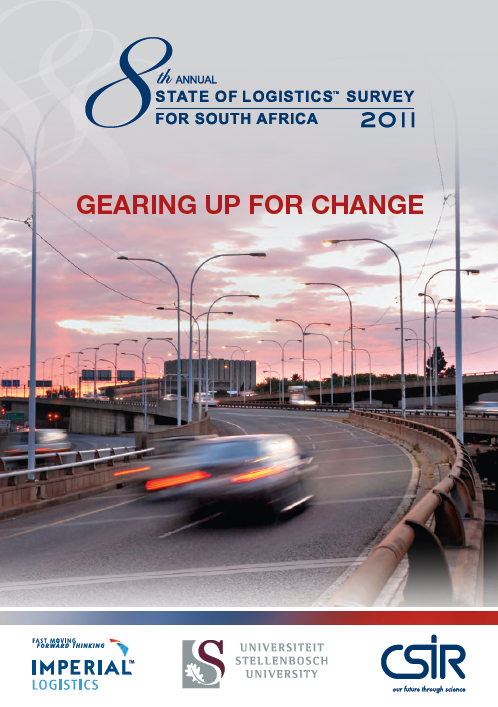
The 8th Annual State of Logistics Survey, a joint project by Imperial Logistics, the University and Stellenbosch and the CSIR reveals good news for South Africa. Logistics costs – as a percentage of GDP – have dropped to the lowest level ever at 12.7%. The in-depth report, which is available online at http://www.csir.co.za/sol/, provides some fascinating insights from some of the industry’s logistics thought leaders.

Transport costs are singled out as the most significant factor impacting the country’s logistics costs, comprising 53.2% of the logistics bill. “The marked impact of the 11% fuel price increase between 2009 and 2010 is no surprise considering the fuel price is the primary transport cost driver,” says Zane Simpson of the University of Stellenbosch. “Had the fuel price remained as it was in 2009, total transport costs in 2010 would have been R5.8billion less, consequently putting logistics costs as a percentage of GDP at an even more favourable 12.5%.” Transport costs as a percentage of total logistics costs would then have been 52% instead of 53%.

Globally, transport costs as a percentage of logistics costs are less than 40% which makes South Africa’s percentage relatively high. “For logistics to become a competitive weapon for South Africa, change is required,” said Cobus Rossouw, chief integration officer of Imperial Logistics. “South Africa is a leader in complex, dynamic logistics and has achieved success despite geographical impediments, severe skills shortages and lack of economies of scale “South Africans need to recognise that we are and can be counted among the best in logistics. And while we will always have much to learn from others, we need to recognise that we also have a lot to offer.” Source: CargoInfo.co.za

Enhancing South Africa’s and Africa’s development through Regional and Continental Integration

Hardly a week goes by without some or other African politician waxing lyrical about continental integration, continental trade diversification, and a wholesome analysis of the ‘barriers’ which prevent the African continent  from reaching its full economic potential. No doubt I’m a bit biased in relaying the recent ‘public lecture’ of our deputy President Kgalema Motlanthe at the University of Finlandread the full speech here! Plenty of insight clearly delineating a plethora of barriers; yet, are we African’s so naive not to have identified these barriers before? Evidently yes.

In recent weeks, on the local front, we have learnt that One Stop Border Posts (OSBPs) is the solution to non-tariff barriers. This topic was drilled amongst the press till it got boring. The focus soon thereafter shifted to the implementation of a border management agency (BMA) – all of government under one roof – so simple. The reality is that there is no silver-bullet solution to African continental integration. Of this, affected business, Customs administrations and the international donor community is acutely aware. While the WTO and the multitude of trade lawyers will ‘yadder’ on about ‘diversification’ in trade, the reality is that Africa’s raw materials are even more sought after today than at an any time before. Certainly those countries which contain vast resources of oil and strategic minerals are about to reap the benefits. So why would African countries be concerned about diversification when the petro-dollars are rolling in? Perhaps greed or lack of foresight for the medium to long-term well-being of countries and their citizens? The fact remains, without homegrown industries producing goods from raw materials, most of  Africa’s eligible working class will continue to be employed by foreign mineral moguls or the public service.

Several customs and infrastructure solutions have over the last few years emerged with the usual credential of “WCO or WTO compliant”. Africa has been a guinea pig for many of these solutions – ‘experiments’ if you prefer. Literally millions of dollars are being spent every year trying out so-called ‘best-of-breed’ technology which users unfortunately accept without much questioning. The cart is being placed before the horse. Why? because the underlying route cause/s are not being identified, understood (sufficiently) and prioritized. Insofar as there exists no silver bullet solution, neither is there a single route cause in most cases. Unfortunately, donor aid often comes with its own pre-conceived outcomes which don’t necessarily tie in with those of the target country or the well-being of the continent.

While governments like to tout the ‘big-hitting’ projects, there are several ‘less exciting’ (technical) areas which countries can address to kick-start the process. One of these has even been recognised by the likes of the World Bank and OECD notwithstanding capital-intensive programs which promised much and have not delivered fully on their promise.  The issue at hand is the harmonisation of customs data. It might at first sound irrelevant or trivial, yet it is the key enabler for most Customs Modernisation initiatives. While there is still much anticipation in regard to the forthcoming deliberation and outcome of the WCO’s Globally Networked Customs (GNC) initiative at June’s WCO Policy Commission session in Brussels, there is significant support for this approach on the African continent. The momentum needs to be maintained.

 Related articles

Importers and Exporters may see doubled freight rates by 2015

Get ready for a crazy roller coaster ride…As is already well known, the current situation in the shipping world is that there is a large lack of demand against the current overall supply of container space. Today, the current fleet capacity is around 15.5 million TEUs. Since 2005, the total capacity has roughly doubled – literally.

Because of the imbalance of supply/demand, carriers are losing blood and even declaring a negative balance sheet for end of 2012. This situation pushes them to the dilemma of getting bigger or getting smaller. Getting bigger means buying new, larger ships. These ships allow carriers to improve their cost effectiveness, work with smaller crews and lower their capital costs. On the other hand, some carriers are getting smaller; serving more niche markets where larger vessels will not call since that will reduce the efficiency of the vessel. You can imagine that a 15,000 TEU ship will not make 3 ports in the same country – if that country is not China.

These are the things we see and hear everyday. However a more important game is being played behind the scenes which has a crucial effect on the whole industry. According to Bloomberg; DNB ASA, the world’s largest arranger of shipping loans, expects the shipping industry to have a funding gap of $100 billion by 2015, as European banks are reducing their support to maritime transport. Even if US and Asian banks have an increased interest on maritime loans; EU banks account for 90% of the global ship lending. Considering net shipping loan losses at Nordea Bank AB (NDA), the world’s No. 4 shipping lender, tripled to 135 million euros ($179 million) last year because of “weak market conditions” and “a general decline in vessel values”, everyone will be thinking twice before granting a loan. In addition to that, since there will be less vessel orders with reduced prices, it will be forcing some yards to close in the following 12 to 18 months.

How is this going to affect exporters/importers? That’s our major question of course. Considering several factors; the EU Crisis, US getting out of recession, Arab spring is over; it will take another couple of years to get on track for sure. According to HSBC Global Connections, despite the current climate, the overall trend for international trade is positive with growth acceleration sooner than expected from 2014, than 2015. Over the next 5 years an annualized growth rate of %3.78 is forecasted for international trade. The main countries that will be carrying the growth are China and India, and China is expected to have an annualized growth of 6.60% in imports and 6.61% on exports; while India is expected to have 6.81% growth in imports and 7.60% in their exports from 2012 to 2016.

Now, according to 2010 stats, worldwide container traffic reached 560 million TEUs – an all-time high. China & Hong Kong Ports handle close to 169 milllion TEUs, 18% of this traffic. We need to keep in mind though, this is not only China exports/imports but also transshipped cargo that goes via those ports to other Asian nations.

With that in mind, if we take the growth rate with an average 6% for that region and multiply this with 169 million, we come up with a possible increase of 30 million TEUs annually and 500,000 TEUs weekly basis increase only in the region that handles %18 of global trade.Now, lets go back to the supply side. The major banks will be reducing loans, there will be less ship orders and there will be less ship yards to build new ships. How is this going to affect the years 2014-15 and later?

Can Fidan believes very tough years will come for exporters/importers in the sense of shipping costs and finding available space. Prepare to see more of the complaints from exporters not being able to find space and getting asked to pay very high freight charges like we were seeing in 2010. However, this time the difference will be, there won’t be any idle vessels sitting in Singapore or any new ordered vessels to come in and let everyone breath. Considering today, this sounds improbable… Well? the facts are out there and they show that the roller coaster ride we are on will just get crazier. Source: Can Fidan, MTS Logistics

Zimbabwe: Dependence on SA Imports ‘Risky’

ZIMBABWE’S export trade promotion body, ZimTrade, has warned against over-reliance on South African imports, stressing that Harare could plunge into a serious economic crisis should its southern neighbour experience unexpected production and supply challenges. South African producers of basic commodities, automobile services, chemicals, agricultural inputs and farm produce have taken advantage of a significant weakness in Zimbabwean firms’ capacity to service the domestic market, which has triggered widespread shortages of locally manufactured goods.

South Africa and Zimbabwe have intensified trade relations, but the balance of trade has always been in favour of South Africa, Africa’s largest economy. In March, South Africa’s Deputy Minister of the Trade and Industry, Elizabeth Thabethe, flew into Zimbabwe with a delegation of 45 businesspeople to intensify the hunt for new markets for her country’s companies north of the Limpopo. The business delegation comprised companies in the infrastructure (rail, telecommunication and energy), manufacturing, agriculture and agro-processing, mining and mining capital equipment, as well as information and communication technology.

Zimbabwe labour unions are reportedly facing tremendous pressure from workers to campaign against an overflow of South African products into Zimbabwe to allow for the resuscitation of local industries to create jobs, have said Harare had “turned into a supermarket” for South African products. (Huh? strange since so many of the eligible working Zimbabweans have gainful employment in South Africa. Sounds more like labour union politicking)

If South Africa, for example, is to experience a supply hitch, this will be transmitted directly into Zimbabwe’s production and consumption patterns. The appreciation of the rand in the second quarter of 2011, for instance, resulted in price increases on the domestic market.In other words, heavy dependency on imports will leave an economy susceptible to world economic shocks, according to ZimTrade.

Statistics provided by the Department of Trade and Industry (dti) of South Africa in March, indicated that exports to Zimbabwe increased to R15,5 billion in 2011, from R15,1 billion in 2010, while Zimbabwe’s exports to that country increased to R2,9 billion in 2011, from R1,3 billion in 2010. The statistics indicate that South Africa imported US$1 billion worth of goods and services from the Southern African Development Community trade bloc, with 37 percent of the imports coming from Zimbabwe. The dti said imports from South Africa represented 45 percent of Zimbabwe’s total imports. Therefore, according to ZimTrade, “A growing trade deficit could increase the country’s risk of imported inflation and a direct transmission of shocks into the economy.

South Africa has also been Zimbabwe’s major source market for industrial inputs. The United States, Kuwait, China, Botswana and Zambia were Zimbabwe’s other major trading partners in 2011.However, the dti statistics indicated that Harare had narrowed its trade deficit with Africa’s largest economy in 2011 to R12,6 billion, from R13,7 billion in 2010. This translates to about US$12 million and US$13 million respectively

The dti deputy minister, Thabethe acknowledges that “South Africa and Zimbabwe are not only geographical neighbours. The two countries share historical and cultural linkages. Furthermore, South Africa’s economy is inextricably linked to Zimbabwe’s economy due to its geographical proximity to Zimbabwe whose political and economic welfare has a direct impact on South Africa”. Source: The Herald (Zimbabwe)