Durban Harbour – a Pictorial History from 1835 to the Present Day

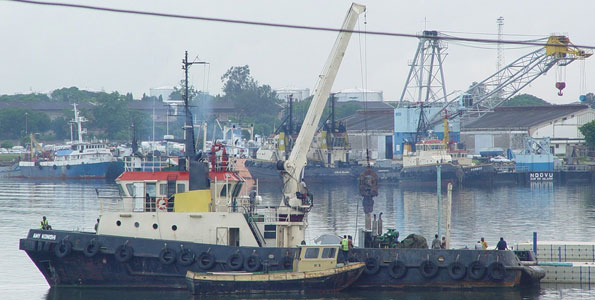
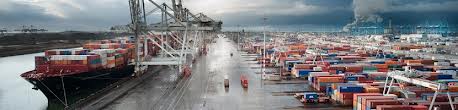
During December 2013, I received a fabulous book from a business acquaintance. Titled ‘Durban Harbour’, this special souvenir issue tells the fascinating history of Durban Harbour from 1835 to the present day. It reveals the extraordinary engineering skills and resilience that shaped Durban harbour into the largest and busiest harbour on the African continent and a major player in Global trade.

Recently another milestone was achieved for Durban harbour with the arrival in Durban of the largest container ship to dock in South African waters the MSC Sola – a giant of 131,771 tons and capable of carrying 11,660 containers, with a length of three and a half rugby fields. The ship’s visit to Durban was as a result of the widening and deepening of the port in 2010. See post – Durban awaiting arrival of 11, 660 TEU container ship.

But the story of Durban as a viable deepwater port is weaved in rich history and as Durban harbour approaches its second century – it is also time to toast the entrepreneurs for their innovation and the workers, harbour pilots, tug and train crews who played such a vital part in the day to day operations of the harbour.

For more information regarding the publication, and details of purchasing it visit the author, Stuart Freedman’s website – History of Durban Harbour.

Related articles

Construction of Bagamoyo port to commence – January 2014

An aerial view of Dar es Salaam port, whose limitations stakeholders hope the new Bagamoyo port will replace. (Tanzania Daily News)

An aerial view of Dar es Salaam port, whose limitations stakeholders hope the new Bagamoyo port will replace. (Tanzania Daily News)

Construction of Bagamoyo port is expected to commence early this month, the government has revealed.

Scheduled for completion in 2017, the Bagamoyo port will have the capacity to handle twenty times more cargo that of Dar es Salaam Port, which is currently the country’s largest port.

This was revealed recently in Dar es Salaam by the Permanent Secretary in the Ministry of Finance, Dr Servacius Likwelile during the signing of two framework agreements and two exchanges of letters between the government of Tanzania and the People’s Republic of China which granted 89bn/- to finance implementation of various projects in the country.

“The construction of Bagamoyo port will commence on January 6, this year after the signing of the construction agreement between Tanzania and China on that same day,” noted Dr Likwelile.

The construction of Bagamoyo port comes almost in time as Tanzania is losing a lot of trade and commerce opportunities because of inefficiency of the Dar es Salaam port.

According to Tanzania’s Ambassador to China Philip Marmo, the over USD10 bn/- Bagomoyo port project will add to the economy as the port will have the capacity to handle 20 million containers a year compared to the Dar es Salaam port which handles only 800,000 containers a year.

“The Bagamoyo port construction project will entail the building of a 34 kilometre road joining Bagamoyo and Mlandizi and a 65 kilometres of railway connecting Bagamoyo with the Tanzania-Zambia Railway (TAZARA) and Central Railway. The port will be of high standard. We are building a fourth generation port,” said Marmo.

According to Marmo, the Chinese stand to gain from Tanzania’s future Bagamoyo port because it will facilitate China-bound shipments of minerals from Zambia, Zimbabwe and the Democratic Republic of Congo (DRC) via the Indian Ocean.

The construction of the Bagamoyo port is among the 16 recently signed development projects agreement between Tanzania and China, orchestrated by President Jakaya Kikwete and Chinese President Xi Jinping during Xi’s state visit to Dar es Salaam in March last year.

Speaking of the recently 89bn/- Chinese financial aid for implementation of various projects in the country, Likwelile said it involved the first framework agreement on economic and technical cooperation between Tanzania and China under which a gratuitous aid amounting to 52bn/- will be provided to support implementation of projects that will be agreed upon by the two governments at a later stage.

“Under the second framework agreement, the government of China will make available to the Tanzanian government an interest free loan amounting to 26bn/ to support implementation of projects also to be agreed upon by the two governments,” he added.

He further mentioned the Chinese donation of furniture and equipment worth 1.3bn/- to the Mwalimu Nyerere International Convention Centre as well as equipment worth 400m/- donated to the Prevention and Combating of Corruption Bureau (PCCB) office.

During the signing function, the Chinese government also donated to the ministry of Foreign Affairs and International Cooperation 91 vehicles worth 9bn/- including 45 limousines and 46 buses. Source: The Guardian & ippmedia.com

Related articles

Port of Santos’ new 1.2 million TEU capacity container terminal

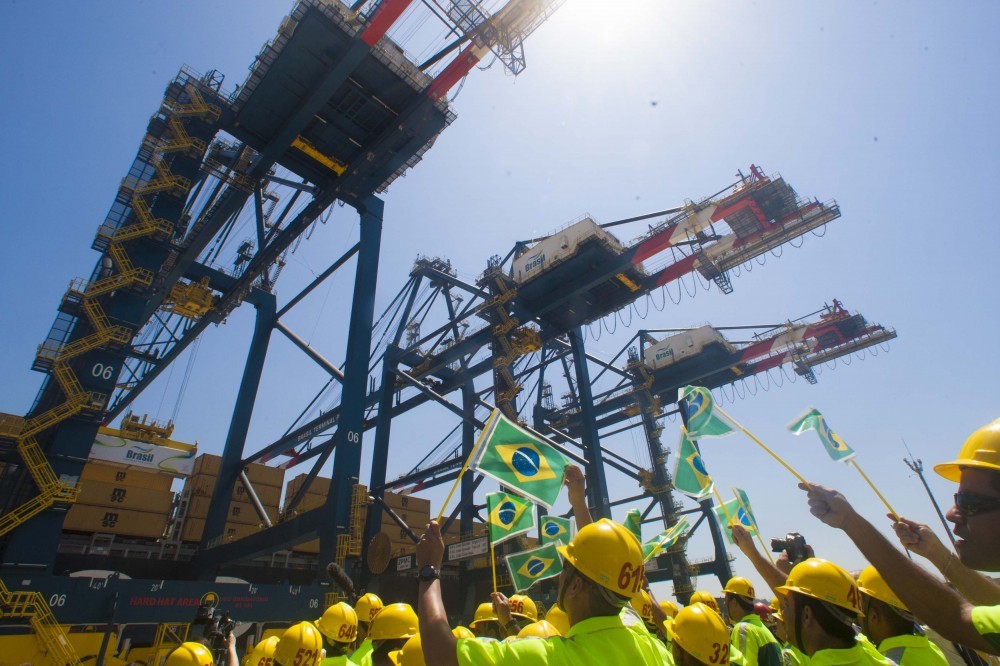
A gala ceremony was held last week to celebrate the official opening of BTP in Santos, Brazil, last week. (Image: APM Terminals)

A gala ceremony was held last week to celebrate the official opening of BTP in Santos, Brazil, last week. (Image: APM Terminals)

“Another BRIC in the Wall” – Brasil Terminal Portuário (BTP) was officially opened last week with a gala ceremony held at the Port of Santos’ new 1.2 million TEU capacity container terminal.

The development of BTP began back in 2007, with APM Terminals acquiring a 50 percent share from Terminal Investment Limited (TIL) in 2010. APM Terminals will operate the terminal alongside TIL for a 20-year period, whilst investing over US$20 billion into the project during this time span.

Although fully equipped and operational since March, commercial operations at BTP could not commence until the terminal was issued International Ship and Port Facility Security (ISPS) Certification in April, and granted an operating license from the Brazilian Institute of Environmental and Renewable Natural resources in July.

The first commercial vessel call took place in August, and with scheduled dredging having been completed in October, BTP has become fully operational with 1,108 metres of quay and a 15 metre depth, capable of serving three 9,200 TEU capacity vessel calls simultaneously.

The Port of Santos, the busiest container port in South America, handled 3 million TEU during the 2012 calendar year. Source: Port Technology International


Dumping Ships From East-West to North-South Trade Lanes Nearing ‘Saturation’

Trade Lanes (The Jouranal of Commerce)

Trade Lanes (The Jouranal of Commerce)

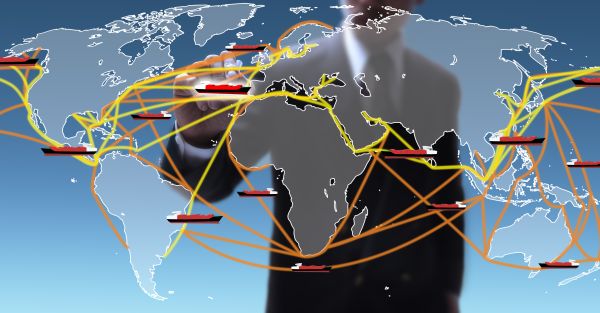
Ocean carriers’ tactic of shifting surplus capacity from east-west trades to north-south routes is nearing “saturation point,” according to Drewry Maritime Research.

The “endless” cascading of tonnage from the main haul trades to regional routes is now “seriously haemorrhaging” freight rates in north-south services, and the rate of decline in the second quarter suggests carriers are running out of options to soak up surplus capacity, the London-based consulting firm said.

All-in prices from Asia to Australia, West Africa, South Africa, India and both the east and west coasts of South America based on forwarder buy rates for spot cargo declined significantly during the second quarter. Rates from Asia to India and the west coast of South America rose in July, but Drewry said it “remains to be seen if the increases are sustainable, as there have been many false dawns in other trade lanes.”

The average all-in spot rate from Shanghai to Santos, Brazil, in July was down 51 percent from January, and was 19 percent and 32 percent lower on services to Durban, South Africa, and Melbourne, Australia, respectively.

“This adversarial situation helps to explain why ocean carriers appear to have returned to war with each other over market shares between Asia and Europe since August,” Drewry noted.

The “apparent” benefit of cascading is that average vessel utilization from Asia to the west coast of North America and Europe has usually remained above 85 percent since the second quarter, thus helping to support freight rates.

“It’s been a yo-yo ride nevertheless, but freight rates are still a lot higher than they were at the beginning of the year,” Drewry explained.

Fourteen new vessels averaging 12,713 20-foot-equivalent units were delivered into existing Asia-to-North Europe schedules in the second quarter, but the overall average capacity of all ships on the route increased by just 1.7 percent from the beginning of the year to 10,456 TEUs, as carriers cascaded surplus vessels to other routes.

Drewry said further restructuring on north-south routes via alliances and consortia appears inevitable, particularly as world fleet growth of just over 7 percent in 2014 is again expected to significantly exceed cargo growth. Source: The Journal of Commerce

Walvis Bay Container Terminal – AfDB and Namibia sign loan agreement

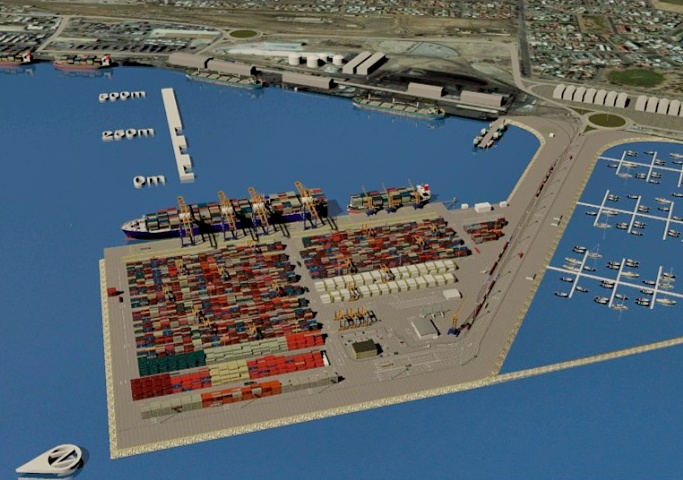
NamPort ExpansionThe African Development Bank Group (AfDB) and Namibia on Friday, November 8, 2013 signed a ZAR 2.9 billion (US $338 million) sovereign guaranteed loan to the Nambian Ports Authority (Namport) to finance the construction of the new container terminal at Port of Walvis Bay and a UA 1.0 million grant (US $1.5 million) to the Government of Namibia for logistics and capacity building complementing the port project loan. The project was approved by the AfDB Group in July 2013.

The project is expected to enable Namport to triple the container-handling capacity at the Port of Walvis Bay from 350,000 TEUs to 1,050,000 TEUs per annum. It will also finance the purchase of up-to-date port equipment and the training of pilots and operators for the new terminal. The grant component will fund the preparation of the National Logistics Master Plan study, technical support and capacity-building for the Walvis Bay Corridor Group and training of freight forwarders.

According to the AfDB Director of Transport and ICT, Amadou Oumarou: “Through this project which potentially serves up to seven major economies in the SADC region, the Bank is assisting in the diversification and distribution of port facilities on the southwest coast of Africa, and provides the much-needed alternative for the region’s landlocked countries.”

The project will stimulate the development and upgrade of multimodal transport corridors linking the port to the hinterland while improving the country’s transport and logistics chains. It will also boost competition among the ports and transport corridors in the region with the ripple effect on reductions in transportation costs and increased economic growth.

The projected project outcomes include improvement in port efficiency and increase in cargo volumes by 70% in 2020 as a result of increased trade in the region. The benefits of the project will include among others, the stimulation of inter-regional trade and regional integration, private sector development, skills transfer and most importantly employment creation, leading to significant economic development and poverty reduction in Namibia, and the SADC region. Source: African Development Bank

Related articles

Preparing for legislation on verification of container weights

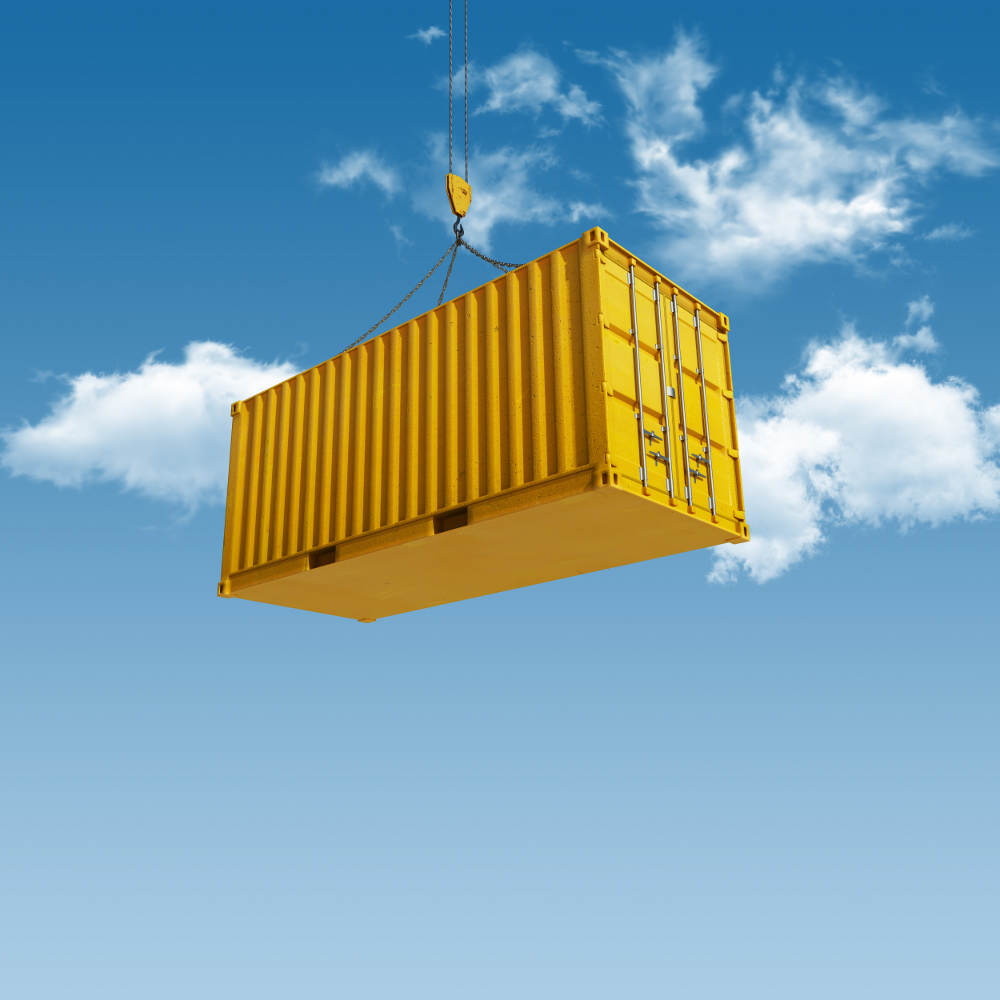
High quality 3D render shipping container during transportPort Technology International – The work by the Maritime Safety Committee (MSC), within the auspices of the International Maritime Organization (IMO), on the verification of container weights prior to loading on to a ship is progressing. Currently, expectations are that legislation will come into force in 2017 at the latest, and possibly in 2016.

Many terminal operators are concerned about how to comply with the upcoming legislation, and how it will impact on logistic flows in terminals.

One of the challenges facing terminals is how to weigh containers with little or no impact on operations. Transferring containers to separate weighing stations will affect productivity. Terminals are likely to need additional space and transportation capacity to cope effectively.

Solutions that weigh containers as part of existing logistic flows and operations will therefore deliver significant advantages for terminal operators.

Weighing alternatives

This article outlines technologies that are available for managing weighing or verifying weight. It should be noted that requirements for weight accuracy is not included in the current draft text from the IMO and will likely put further constraints on available options. The discussion here indicates what level of accuracy can be expected from the various options available.

Three different types of weighing or load measurement devices will be discussed: commonly available weigh bridges; load sensing devices in cranes and other lifting equipment and load sensing devices fitted to, or integrated into spreader twistlocks.

Weigh bridges

The first system that comes to mind when looking at weighing a container is the weigh bridge. Weigh bridges are a longestablished and recognised technology to measure the weight of a vehicle. When the weight of the container being carried by a vehicle is of interest, the tare weight of the vehicle must be deducted. The measuring accuracy of the weigh bridge is very high but the tare weight deduction process either introduces additional inaccuracies or becomes complicated and time consuming.

If a standard vehicle tare weight is used, the inaccuracy comes from such things as variations in fuel level, driver weight and the weight of miscellaneous materials also loaded in the vehicle. These may seem like minor aspects when considering a truck carrying a 40ft container, but it easily adds up to a few hundred kilos, thereby significantly affecting the accuracy of the container weighing process. The alternative to using a standard tare weight is to include weighing of the unloaded vehicle in the process. This will give an accurate vehicle tare weight and ultimately, an accurate container weight, but it adds steps to the process which takes time and uses terminal resources.

Using weigh bridges to weigh containers is likely to result in changes to the internal logistics of most existing terminals. All containers entering terminals by road would have to pass through the weighing station. The most critical factor in this scenario would be to have sufficient weigh bridges to avoid the bottlenecks and resulting congestion.

Containers arriving by train or sea (for transhipment) would have to be sent to a weighing station, a step which is uncommon in terminal logistics today. This additional step would tie transporting vehicles to specific containers for longer periods of time ultimately resulting in additional resources being needed to handle the same container volumes. Sufficient resources in terms of weigh bridges and transportation space therefore need to be allocated to avoid congestion
and delays.

Another situation which would require a specific process to be in place is where vehicles arrive at the terminal gate with two twenty-foot containers loaded. Weigh bridges can only determine combined weight. Because containers have to be weighed separately, this would imply a relatively complicated process involving not only the truck carrying the equipment but also terminal resources to facilitate the loading and unloading of the containers.

Load sensing devices in cranes or other lifting equipment

The second type of load measuring device is, in effect, several devices with common features. This group includes load sensors and devices on ship-to-shore (STS) cranes; rubber-tyred gantry (RTG) cranes; railmounted gantry (RMG) cranes; mobile harbour cranes; reach stackers; straddle carriers and so on. Most of the load sensing devices in this group are used for safety and/or stability systems, but the information is available to provide weight information with some limitations as outlined below.

The biggest question mark related to these systems is accuracy. Will the accuracy of these systems meet the requirements to come? The answer is most probably no, but until the requirements are defined, this option should be mentioned. Sensors in these devices are typically fitted to rope and chain anchors, in trollies or on booms. Distance from the container, and the dynamic effect this introduces adds to inaccuracy. These systems will typically have a measuring accuracy of plus or minus five percent. Source: Port Technology International

What Optimisation means for Terminals and Ports

Container terminal (CT1) with Nordschleuse in ...

Container terminal (CT1) with Nordschleuse in the foreground, Bremerhaven (Photo credit: Wikipedia)

Port Technology International’s article is perhaps poignant to current logistics developments in South Africa. Optimisation at the terminal does not only mean improving productivity and reducing operational costs. Optimisation represents a new approach to managing container terminals; it is the most significant driving factor in changing the traditional operational approach and methodology applied at container terminals. It also allows terminals to have a focus on efficiency which needs to address the trade-off between vessel service time, terminal capacity, and cost per move.

In terms of the marine shipping industry, one of the most accurate definitions of optimisation is: “The act of making a system, design or decision as effective or functional as possible.” Optimisation as a discipline is an ancient science best illustrated over time.

The history of optimisation

Greek mathematicians used to solve optimisation problems related to geometrical studies. After the invention of calculus, mathematicians were then able to address more complex optimisation problems. Following the start of the World War II and the advent of the operations research field, the concept and practice of optimisation began to develop and received significant academic and industrial focus. Mr J. Von Neumann, a leading individual behind the development of operations research, contributed substantially to the field of algorithmic research. And in the 60s and 70s, complexity analysis began to further support the use of optimisation. Then, in the 80s and 90s as computers became more efficient, algorithms for global optimisation with the purpose of solving large-scale problems began to gain momentum and credibility.

Considering the present

The continual advancements in technology with respect to computing power along with significant research in applied mathematics and computer science have solidified the value of optimisation to the industry and the end user. This has enabled advanced theory to be applied in a way that has sometimes invisibly improved our lives during last 20 years. The progress is amazing. Today, companies such as UPS and Federal Express utilise complex routing algorithms for resource allocation and supply chain distribution to deliver an item to our door with seamless efficiency. Their results have in turn changed the way millions of us find information, shop, and even do our jobs.

Today, many industries use optimisation as a more general term that covers areas from manufacturing process efficiency to improved distribution techniques. The core objective of optimisation is improving and controlling the process – whatever it may be – and allowing people with responsibilities in those areas to make better decisions. Operations research, for example, is a discipline that deals with the application of advanced analytical methods to help make better decisions at the right time and within the time constraints of a live operation.

As with other industries, the shipping and container space is currently going through its own step change to achieve new levels of operational productivity in response to mega-trends, such as globalisation and sustainable operations. To compete, ports and terminals have decided they need to adapt to their changing demands by optimising their activities in areas such as berthing allocation, vessel planning, fleet size optimisation, shift resource planning and equipment scheduling. All of these areas are critical for minimising the cost per move factors and maximising overall terminal performance and throughput.

Optimisation also provides the intelligence and the tools to support this changing industry, but it is not meant to be a black box. A container terminal is a very complex system with many unpredictable variables. Those focused on achieving optimisation will need to be able to control, monitor and configure the behaviour of this intelligence behind the machine and systems, filling any critical gaps between the planning and execution.

Containerised cargo makes up about 60 percent of all dry cargo trade in the world; since the advent of the cargo container more than 50 years ago, this number continues to grow. The appeal of containerised cargo is well known – cargo can be seamlessly transported from origin to destination via a variety of modes without the need to unload and reload its contents. The marine container terminal is at the junction of water, rail and truck transport modes. And as a consequence, marine container terminals are some of the most essential, yet challenging, links in the global supply chain. Source: Port Technology International

Parliament Postpones Customs Bills

Thaba Mufamadi, chairman of Parliament’s finance committee. Picture - Financial Mail

Thaba Mufamadi, chairman of Parliament’s finance committee. Picture – Financial Mail

Parliment’s standing committee on finance (SCoF) has decided to postpone its deliberations on two draft customs-related bills until next year to allow importers and the freight-forwarding industry more time to comment on the proposals which threaten the status of City Deep as an inland port. This followed an appeal by the South African Association of Freight Forwarders that it had had insufficient time to consider the substantially revised draft Customs Control Bill and Customs Duty Bill, which required that imported goods would have to be cleared at the first point of entry.

The association, supported by a range of other business organisations, including the Johannesburg Chamber of Commerce and Industry, warned that the bills could be challenged on constitutional grounds if the process of consultation was deficient. All political parties supported the proposal by finance committee chairman Thaba Mufamadi on Wednesday that the deliberations on the bills be postponed until next year. He instructed stakeholders to make their submissions to the South African Revenue Service (SARS) by December 15.

Mr Mufamadi also took cognisance of concerns raised by Business Unity South Africa that parliamentary processes did not allow sufficient time to comment, for example, on the medium-term budget policy statement. Industry has warned of port delays and trade disruption if the proposals were to be adopted. The Customs Control Bill proposes that goods be cleared at the first port of entry into South Africa. This will mean that inland ports such as City Deep in Johannesburg would no longer be designated places of entry or exit for customs purposes. In the past, containerised cargo could move directly to inland ports on arrival in the country under cover of a manifest. A new declaration — of the nature, value, origin and duty payable on the goods — would replace the manifests.

SARS said these did not provide sufficient information to undertake a risk assessment. Another bone of contention for industry was the “extremely severe” penalties proposed in the draft Customs Duty Bill. Following the uproar about the proposals SARS offered a compromise earlier this week as a way out of the impasse. Instead of a clearance at the port of entry, a mandatory advance customs clearance of the goods three days before their arrival at the first port of entry would be required. Goods consigned to inland terminals such as City Deep would be released conditionally. The system would be tested for the whole of next year to iron out any problems.

An alternative option would be for the goods to undergo a lesser form of clearance at the first point of entry. This would still entail providing customs authorities with the same level of information on the tariff, value and origin of goods, which would be submitted by electronic data interchange. The importer would be held accountable for the information that was provided. SARS official Kosie Louw said that because this document would not have the formal status of a clearance certificate, it would not disrupt existing legal contractual arrangements, as claimed. The goods would still move CIF (cost insurance and freight) from the port to City Deep. SARS has also proposed softening the penalty provisions so that errors not resulting in any prejudice to customs revenue will be subject to penalties only after three warnings. These penalties will be discretionary and applied leniently in the first 12 months of the bill coming into force to allow business time to properly prepare for the change. An appeal process has been included. Source: Business Day Live. 

Port of Rotterdam develops app to end transport of empty containers

downloadInlandLinks, the port of Rotterdam’s online intermodal platform, has developed an application to substantially reduce the transport of empty containers, the Dutch port announced on Tuesday.

Currently an estimated 25 percent of all containers shipped by road, rail or inland shipping are empty. Empty containers are returned to the owners and subsequently shipped directly back empty into the hinterland.

This results in extra costs, inefficient and unnecessary transport and also affects the environment. InlandLinks claims to have achieved a breakthrough in terms of efficiency and sustainability for the entire logistical chain.

The new online application to reduce the transport of empty containers, called ’empty depot tool,’ inland terminals where shippers and logistical service providers can pick up and deposit empty containers, and later reuse these containers for a new load. The new method allows containers to remain on the inland terminal to be reused for export cargo, instead of being returned empty.

“It is not mandatory to bring containers back immediately but the owners of the containers, the shipping companies, normally want to reuse them as soon as possible,” said Sjaak Poppe, spokesman of the Port of Rotterdam.

“Currently oweners let containers return empty if they stay in the hinterland too long. The longer containers remain unused, the larger the needed amount of containers for shipping companies will be.”

With the new tool leads to lower costs and lower CO2 emissions. A large number of shipping companies have already joined the platform, Poppe added. Source: news.xinhuanet.com

Major Multimodal Logistics Hub in Belgium

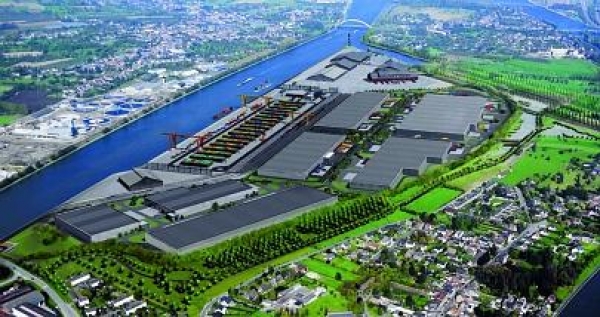
Liege Trilogiport is scheduled to open for business in the final half of 2015 (Picture: Liege Ports Authority)

Liege Trilogiport is scheduled to open for business in the final half of 2015 (Picture: Liege Ports Authority)

Work is underway on a major multimodal logistics hub project in Belgium. Piloted by the inland port of Liège, it is designed to serve as an “extended gateway” to the seaports of Rotterdam, Antwerp and Zeebrugge.

The project will attract around €45 million of public funding from the Belgian authorities and the European Union to finance infrastructure requirements, while initial investment from the private sector is estimated at approximately €115 million.

Located on a 120 hectare site on the banks of the Canal Albert, the Trilogiport project is scheduled to be operational in the second half of 2015. It is expected to create more than 2,000 direct or indirect jobs.

Described as “a tri-modal (river, rail and road) logistics village,” it will comprise a 15ha container terminal, with 1,850 metres of quayside, operated by Luxembourg-based Euroports and its partner, DP World.

Provision is made too to build a rail freight terminal with 700 metres of track to connect Trilogiport with the national rail network. Construction of a road bridge is also planned to provide access to the motorway system around Liège.

Trilogiport will also incorporate 200,000 sq metres of warehousing and distribution space at full build-out. Source: Porttechnology.com


SARS to address Stakeholders on Customs Control proposals

SARS chief officer of legal and policy Kosie Louw (Picture: Robert Botha/Business Day Live)

SARS chief officer of legal and policy Kosie Louw (Picture: Robert Botha/Business Day Live)

The South African Revenue Service (SARS) has committed itself to further engagements with importers of all sizes in a bid to improve its proposals to transform the customs control regime.

Consultations have already taken place with organised business on the proposed Customs Duty Bill and the Customs Control Bill, and the process would now be taken to the level of traders to find out whether the proposals presented them with any problems. Amendments have also been proposed to the Customs and Excise Act to provide for the transition to the new system.

“We want to understand the situation at a micro level. We will sit around the table until we find a solution which will guarantee to us that we get the information we require but which will also facilitate trade.

“We do not want to clog up the ports,” SARS chief officer of legal and policy Kosie Louw said in an informal briefing on the proposals to Parliament’s standing committee on finance on Wednesday.

The customs bills are mainly concerned with improving the information about imported and exported goods so that customs officials can exercise greater control.

Business has expressed concern that the requirement of the Customs Control Bill that they submit a national in-transit declaration of goods at the first port of entry before they are sent to internal terminals, or depots such as City Deep, would cause delays.

The new declaration — of the nature, value, origin and duty payable on the goods — would replace the limited manifest used to declare goods and would include information on the tariff, value and origin of goods.

Business has argued that the manifest allowed goods to move seamlessly from the exporting country to the inland port or depot, and would change the contractual relationships between exporter and importer in terms of when duty is paid.

However, Mr Louw did not believe the provision would cause delays and had obtained legal advice that the contractual relationships and method of payment of duties would not change. The problem with manifests, he said, was that they provided very limited information and did not allow SARS to prevent the inflow of unwanted goods. Nevertheless, he said that SARS would discuss the matter with traders.

Mr Louw said the proposed system would “improve SARS’s ability to perform risk assessment and intervene in respect of potentially high risk, prohibited and restricted consignments at the ports”.

The bills have been in the pipeline for about four years and have been extensively canvassed with the Southern African Customs Union and business. They were needed, Mr Louw said, so that South Africa kept pace with global trends in trade, international conventions and advances in technology.

Anti-avoidance provisions have also been introduced into the bill which sets out the offences and associated penalties for noncompliance and attempts to avoid paying customs duties.

SARS group executive for legislative research and development Franz Tomasek said the Customs Control Bill would introduce a new advance cargo loading notice for containerised cargo to prevent the loading of prohibited or restricted goods on board vessels bound for South Africa. However, to reduce the administrative burden on carriers, information submitted in advance will no longer be required on arrival or prior to departure. Source: Business Day Live


EC proposes measures to get more freight onto Europe’s waterways

waterwaysforward-wordpress-com_SnapseedThe European Commission (EC) has announced new measures to get more freight onto Europe’s rivers and canals.

It underlines that barges are amongst the most climate-friendly and energy efficient forms of transport but currently they only carry about 6% of European cargo each year.

The new proposals intend to realise the “unused potential” of Europe’s 37,000 km of inland waterways, enabling freight to move more easily and lead to further greening of the sector, as well as encouraging innovation and improving job opportunities.

“We already send 500 million tonnes of freight along our rivers and canals each year. That’s the equivalent of 25 million trucks. But it’s not enough. We need to help the waterway transport industry develop over the longer term into a high quality sector. We need to remove the bottlenecks holding it back, and to invest in the skills of its workforce,” said the EC’s Vice President, Transport, Siim Kallas.

The Commission is proposing to remove significant bottlenecks in the form of inadequately dimensioned locks, bridges or fairways and missing links such as the connection between the Seine and the Scheldt river systems which are hampering the sector’s full development potential.

In August last year, Lloyd’s Loading List reported that a multi-billion euro project, the Seine-Nord Europe (SNE) Canal, to build a 106km, 54-metre wide canal to link the Seine and Scheldt rivers by the end of the decade, had suffered a serious setback, with doubts cast over private investment in the project.

The French government continues to support the SNE Canal despite the conclusions of an audit into its financial feasibility which recommended that it be postponed indefinitely.

It commissioned the over-hauling project which could be presented to the European Commission in its new form in the first quarter of 2014, the aim being to secure greater EU funding than that granted under the initial plans.

The Commission is also proposing action to encourage investment in low emission technologies and to support research and innovation. Source: Lloyds.com

CINS reveals cargo mis-declaration and packing issues

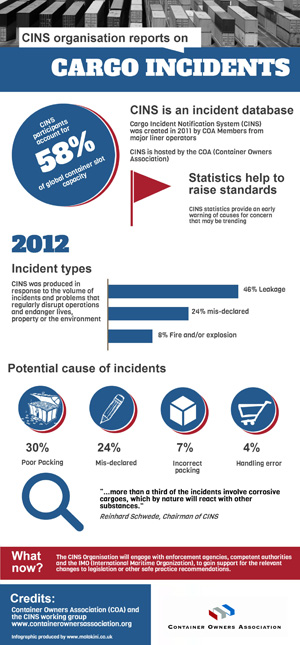
CINS Cargo Incident Visual GraphicPoor or incorrect packing accounts for 37 per cent of cargo incidents in the supply chain, according to data released by the Cargo Incident Notification System (CINS).

And 24 per cent of incidents cases are due to mis-declaration of the cargo, it found. The organisation is managed by the Container Owners Association (COA), and was set up by members from five of the COA’s top 20 liner operators; CMA CGM, Evergreen Line, Hapag-Lloyd, Maersk Line and the Mediterranean Shipping Company.

It was created to capture key data, after an increase in incidents that regularly disrupt operations and endanger lives, property or the environment.

CINS’ analysis revealed that 80 per cent of substances involved in cargo incidents are dangerous goods, with half relating to leakage and a further quarter announced mis-declared.

It also showed that incidents relating to mis-declared cargo have increased significantly within the first four months of 2013, compared to the previous 18 months, which the company says has led it to aspire to identify ways to make the supply chain safer.

“We have identified that 24 per cent of all incidents involve mis-declaration and this is probably the first time that this ‘iceberg’ risk has been quantified, said Reinhard Schwede, chairman of CINS.

“Poor or incorrect packaging are persistent causes, accounting for almost 40 per cent of incidents over nearly two years. This is all the more concerning when we recognise that more than a third of the incidents involve corrosive cargoes, which by nature will react with other substances.

“With these findings, the CINS Organisation will engage with enforcement agencies, competent authorities and the IMO to gain support for the relevant changes to legislation or other safe practice recommendations.” Source: Container Owner Association

China ‘VAT’ Syndrome – Uncertainty for International Forwarders

VAT-TAXGreg Knowler, of maritimeprofessional.com reports, “Whenever there is uncertainty in a particular trade, the container lines resolutely stick with the “shipper pays” principle. That’s understandable considering the state of the industry, but not exactly fair on their customers”.

For the last couple of decades shippers have been complaining that the host of extras they are charged – more than 100, according to the HK Shippers’ Council – should be built into the freight rates that are negotiated between them and the lines.

From this month [August 2013] there will be another charge levied – a six percent VAT charge on top of all charges payable in China, according to Lloyd’s List. Many of the major carriers have informed their customers, but the news has not been received with much enthusiasm.

China is changing its tax system from a turnover tax on companies’ gross revenue to a VAT, which is levied on the difference between a commodity’s pre-tax price and its cost of production.

Beijing rolled out a VAT pilot programme to test the market and iron out the bumps, starting in Shanghai in January last year. In September Beijing was included followed by a gradual nationwide rollout before the new system kicks in tomorrow.

But there is still major uncertainty in this new tax regime, and that is providing great consternation for shippers and the carriers. International shipping is not liable for VAT, so why should carriers impose a six percent VAT levy on customers, asks Sunny Ho of the HK Shippers’ Council.

The problem is that international container lines are not sure whether they are exempt from VAT or not. All the carriers have China offices and as that is where the billing of mainland shippers originates, so they fear Beijing may treat them as agents instead of international shipping services, which means their business will be eligible for the tax.

Maersk Line has decided to wait until mid-August before levying the six percent VAT on mainland charges to see how the situation unfolds. That is a welcome gesture and one that should be followed by all the international shipping lines.

With so much uncertainty surrounding the nationwide rollout of the new tax regime, how can carriers justify slapping customers with a VAT levy before the actual impact of that VAT can be measured?

It is a grasping approach that the lines instinctively default to when faced with the possibility of rising costs. It may serve to protect the bottom line, but it continues to reinforce the traditional unhealthy and antagonistic relationship between them and their customers.

The lines should wait until the costs of China’s VAT have been established and those costs should then be built into the freight rates. Surely that is the only reasonable approach. Source: www.maritimeprofessional.com

20 Rescued After Coal Ship Runs Aground Off South Africa

More than 20 crew members were rescued by helicopter from a cargo ship carrying coal that ran aground in rough seas off of South Africa’s Richards Bay port, maritime authorities said on Monday.

Tugboats were trying to pull the 230 metre-long ship named SMART off a sandbank, National Sea Rescue said in a statement, adding that “the structural integrity of the ship was compromised”.

The single-hull, 151,279 tonne ship is registered to Alpha Marine Corp and flies a Panamanian flag. It was supposed to deliver its cargo to the Fangcheng port in China, according to Thomson Reuters data.

No injuries have been reported. The Richards Bay port is on the Indian Ocean.

This is the second cargo ship to run aground off South Africa this month. The other was the 165 metre-long Kiani Satu, which hit ground off the southern coast. Source: Reuters