 Zimbabwe’s Deputy Finance and Economic Planning Minister Terrence Mukupe has estimated that the country has lost an estimated $20 million in revenue receipts since ZIMRA’s automated Customs processing system (ASYCUDA World) collapsed in the wake of server failure on 18 December 2017.
During a site visit of Beit Bridge border post earlier this week, it was revealed that ZIMRA collects an estimated $30million per month in Customs duties at its busy land borders. The Revenue Authority has since instituted manual procedures. Clearing agents are submitting their customs documents accompanied by an undertaking that they will honour their duties within 48 hours. That is, when the ASYCUDA system is finally resuscitated and this is totally unacceptable.
Furthermore, Zimbabwe lies at the heart of the North-South Corridor which handles a substantial volume of transit traffic. The threat of diversion due to lack of proper Customs control and opportunism will also create both a fiscal and security headache. The deputy minister stated that the government was considering abandoning the Ascyuda World Plus system to enhance efficiency and the ease of doing business. “We need to benchmark it with what our neighbours in the region are using”.
It has also been suggested that the ZIMRA board have been complacent in their oversight of the affair. While it is a simple matter to blame systems failure, the lack of management involvement in taking proactive steps to ensuring redundancy of the country’s most crucial revenue collection system has been found wanting.
This calamity undoubtedly signals a huge concern for several other African countries who are likewise supported by UNCTAD’s ASYCUDA software. Many question post implementation support from UNCTAD, leaving countries with the dilemma of having to secure third party vendor and, in some cases, foreign donor support to maintain these systems. The global donor agencies must themselves consider the continued viability of software systems which they sponsor. Scenarios such is this only serve to plunge developing countries into a bigger mess than that from which they came. This is indeed sad for Zimbabwe which was the pioneer of ASYCUDA in sub-Saharan Africa.
This development must surely be a concern not only for governments, but also the regional supply chain industry as a whole. While governments selfishly focus on lost revenue, little thought is given to the dire consequence of lost business and jobs which result in a more permanent outcome than the mere replacement of two computer servers.
Under such conditions, the WCOs slogan for 2018 “A secure business environment for economic development” will not resonate too well for Zimbabwean and other regional traders tomorrow (International Customs Day) affected by the current circumstances. Nonetheless, let this situation serve as a reminder to other administrations that management oversight and budgetary provisioning are paramount to maintaing automated systems – they underpin the supply chain as well as government’s fiscal policy.



 The implementation of the Government’s new pre-shipment regulations under the Consignment Based Conformity Assessment (CBCA) programme (essentially a fancy term for plain old pre-shipment inspection – who they trying to fool?) took off with host of challenges last Tuesday. The new regulations that were gazetted into law on 18 December last year and requires that goods be tested for conformity with required standards prior importation into Zimbabwe, went into operation on 1 March.
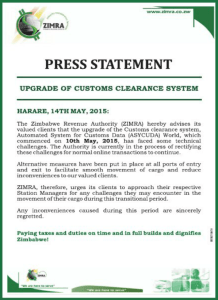 The movement of commercial cargo has relatively improved at most of the country’s ports after the Zimbabwe Revenue Authority (Zimra) addressed some of the teething challenges affecting its customs online clearance system. Zimra is now using an advanced Automated System for Customs Data (Asycuda) for clearing commercial cargo entering or leaving the country.
 Zimbabwe has introduced custom-control measures aimed at reducing the inflow of smuggled and inferior goods, and boosting its revenue from customs duty. Goods being exported to Zimbabwe will have to undergo consignment verification from May 16.
 Zimbabwean Customs (ZIMRA) seized 48 kg illicit gold worth R 20 million and arrested 46 people for initial investigations. Forged gold serial-number stamps, specially designed armoured vehicles, clandestine refineries, fake customs clearance papers and documents with links to the black market.
 Three Zimbabweans and a South African were arrested in Limpopo province for allegedly teaming up and smuggling cigarettes worth $200,000 into the neighbouring country. The Zimbabwean trio, Takuzo Mutswiro, 22, Tatenda Nyamhunga, 31, Joseph Mhembwe, 27 and Gilbert Mamburu, 54, a South African from Tshiozwi village in Limpopo province, were arrested last week at Tshilwavhusiku near Thohoyandou after police intercepted a truck they were using to transport the cigarettes.
 An intricate web of smugglers, which reportedly involves manufacturers and middlemen, has been illegally carting cigarettes worth millions of dollars out of the country over the years, prejudicing the treasury of vital revenue.


 Beitbridge border post is experiencing a significant decline in volumes of imported used cars following a 20 percent increase in excise duty which took effect on November 1. “We are processing documents for less than 40 vehicles per day compared to the previous month when we would deal with over 150 cars,” said a ZIMRA official.
 There is a drastic increase in motor vehicle imports through Beitbridge border post as dealers are rushing to buy cars before the proposed 20 percent customs duty increase on imported motor vehicles comes into effect on November 1.


 What Happened to the Portcullis?
You must be logged in to post a comment.