Euromonitor’s latest insight on the Tobacco industry

World Tobacco

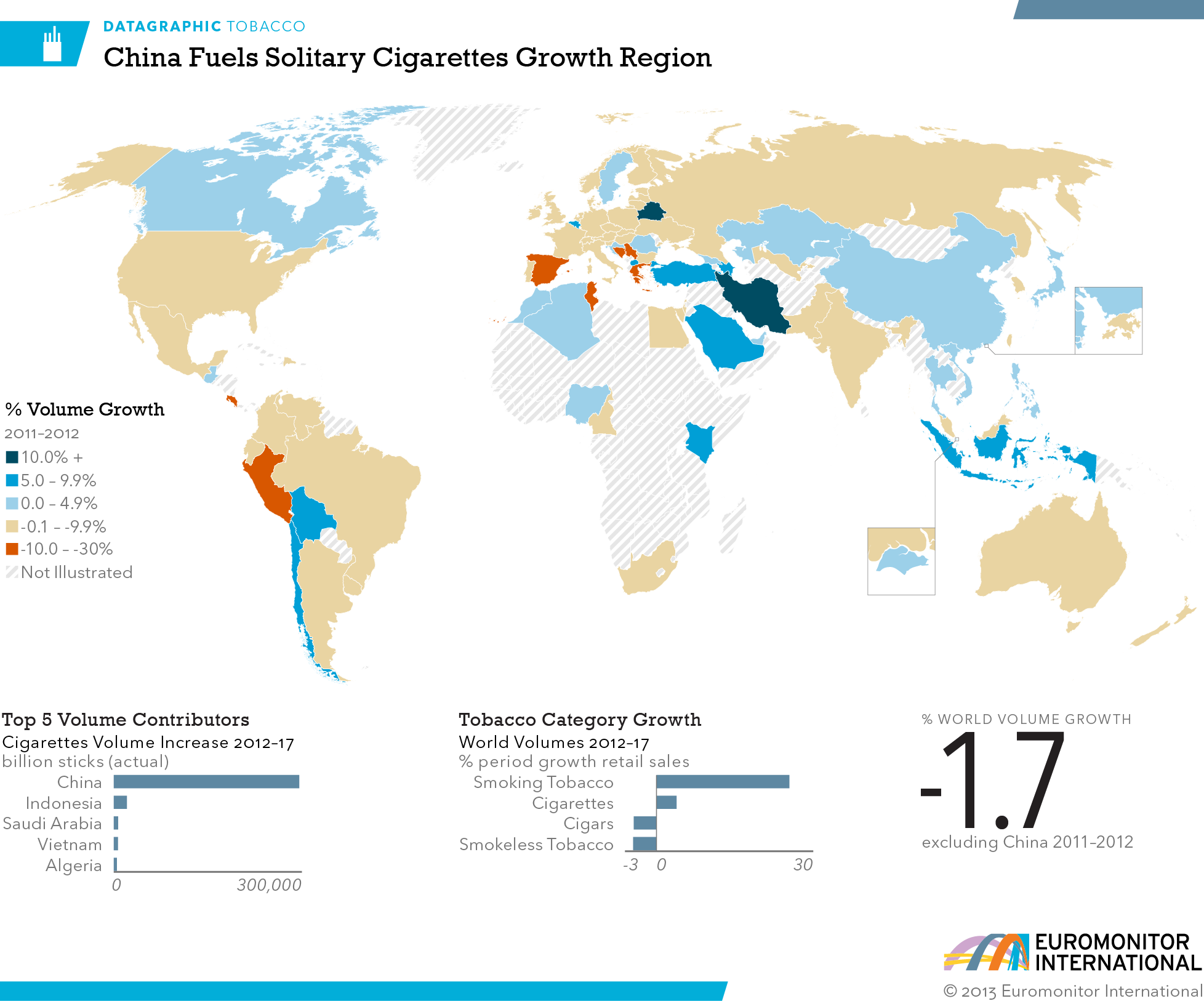
Euromonitor International‘s latest global Tobacco market research provides the latest insight on how the Tobacco industry performed in 2012 and identifies the key prospects through to 2017. The double whammy of continued global economic uncertainty and increasing tobacco control took its toll as the industry posted a year of weak growth, in which no region experienced volume increases with the solitary exception of Asia Pacific, itself bolstered by the cigarettes behemoth that is China. World cigarettes values, normally propelled by growing unit prices and consumer uptrading, also took a battering, unprecedentedly growing by the same amount as global illicit trade volumes. With the current debate surrounding the reduced risk credentials of non-combustible products such as electronic cigarettes and their classification (pharma vs tobacco), the industry finds itself at a crossroads, pursuing cigarette alternatives whilst maintaining its cash cow.

  • Worldwide, 5.8 trillion cigarettes were consumed in 2012, representing 0.19% growth on the previous year, though this was due to the effect of the world’s largest cigarettes market, China. Without China, the world witnessed a -1.7% decline in 2012 versus 2011.
  • Every region in the world, save for Asia Pacific, saw falls in cigarettes volume sales in 2012 (vs 2011), a decline expected to continue to 2017, with the sole exception of Middle East & Africa, which is expected to return to growth once political turmoil stabilises.
  • None of the BRIC markets registered cigarettes volume growth in 2012 (with the sole exception of China), a trend which will continue into 2017.
  • World cigarette value sales grew by almost the same amount in 2012 as global illicit trade volumes – at around 2.5% each. Values decreased in three regions – Western Europe, North America and Latin America – reflecting consumer down-trading.
  • Sales of premium cigarettes grew by nearly 10% globally in 2012, on the back of China’s double-digit premium growth, though this will not be sustained at the global level in the long term. For whilst China will grow its premium brands by nearly 30% over the next five years to 2017, world premium sales will register a 5% fall.
  • World RYO volumes conversely grew by 6% in 2012 (vs 2011), registering growth in all regions, particularly Eastern Europe where it saw double-digit growth. Growth will continue to 2017, albeit at a declining rate.
  • Sales of cigars and smokeless tobacco both saw volume declines of around 3% in 2012, affected by a combination of poor economic performance and declines in its major markets.

Source: Euromonitor International

The Tobacco Industry at a Crossroads – The Decline of Cigarettes and the Rise of Alternatives

burning20cigarettesEuromonitor International’s latest global tobacco market research shows world cigarette volumes have been kept afloat only by China, as global economic uncertainty and increasing tobacco control continues to take its toll. No region experienced volume increases in 2012 apart from Asia Pacific while world cigarettes values, normally propelled by growing unit prices and consumer upgrading, also took a battering, growing by only the same amount as global illicit trade volumes.

With the industry debating the reduced risk credentials of non-combustible products such as electronic cigarettes and their classification, the industry finds itself at a crossroads, pursuing cigarette alternatives while maintaining its cash cow. But can cigarette alternatives deliver? Does the slowdown in cigarette values suggest pricing strength is over? What is happening to innovation and premiumisation?

Euromonitor International’s webinar will aim to answer these questions while setting the global tobacco market in context, reviewing overall performance by region alongside country case studies, related trends in duty-paid volume sales, smoking populations and illicit penetration. Click this link to register for the webinar. Market performance will be reviewed against legislative changes, manufacturer strategies, and trends in product innovation, with a view to what the industry can expect to 2017.  Source: Euromonitor International


10 Downing Street accused of ‘caving in’ to cigarette lobby as plain packs put on hold

English: The Globe House, headquarters of Brit...

The Globe House, headquarters of British American Tobacco in London, as seen from River Thames (Photo Credit: Wikipedia

Anti-smoking campaigners have accused the UK government of caving in to pressure from the tobacco lobby and running scared of Ukip after plans to enforce the sale of cigarettes in plain packs failed to make it into the Queen’s speech. Minutes released by the Department of Health show that one of the industry’s leading players had told government officials that, if the move went through, it would source its packaging from abroad, resulting in “significant job losses.”

Cancer charities and health experts were expecting a bill to be introduced last week that would ban branded cigarette packaging, following a ban introduced in Australia last December. The plain packaging idea comes from Australia, the country where it was first tried out. Cigarettes there have to be in a drab olive-coloured packaging, and the brand name is in a uniform typeface. The packets are also adorned with graphic images of the effects of lung cancer.

At least one health minister had been briefing that the bill would be in the Queen’s speech. But the bill was apparently put on hold at the last minute with the government saying it would be a distraction from its main legislative priorities.

It has emerged that senior Department of Health officials held four key meetings with the industry’s leading players in January and February, when at least one of the tobacco giants spelled out to the government that its plan would result in thousands of jobs going abroad.

Department of Health minutes released last week reveal that Imperial Tobacco, British American Tobacco (BAT), Philip Morris International and Japan Tobacco International were each invited to make representations to the government, in which they attacked the plan and its impact on the UK economy.

Only the minutes of the meeting with Imperial have been released. They record that Imperial warned if plain packs were introduced it would source packaging from the Far East resulting “in significant job losses in the UK.” (Hmm….the Brits thought little of this when imposing new packaging and labelling for UK bulk-liquor imports from abroad, which will have similar consequential effects (job losses) on foreign economies. Rather hypocritical I would think!)

A tobacco giant, Imperial, also outlined how its packaging research and development department supported small and medium-sized enterprises in the UK and argued that standard packs would “result in some of these being put out of business”.

It added that the plan would boost the illicit trade in cigarettes, which already costs the Treasury £3bn in unpaid duty and VAT a year. And it noted that 70,000 UK jobs rely on the tobacco supply chain, implying some of these would be threatened if the illicit market continued to grow. When asked to hand over its assessment of the impact of the plan, Imperial refused, citing commercial sensitivity.

The decision to delay the introduction of plain packs is a major success for the tobacco lobby, which has run a ferocious campaign against the move. Cigarette makers fear that the loss of their branding will deprive them of their most powerful marketing weapon. The industry has backed a series of front campaign groups to make it appear that there is widespread opposition to the plan, a practice known in lobbying jargon as “astroturfing”. Many of the ideas were imported from Australia, where the tobacco giants fought a bitter but ultimately unsuccessful campaign to resist plain packs. Much of the Australian campaign was masterminded by the lobbying firm Crosby Textor, whose co-founder Lynton Crosby is spearheading the Tories’ 2015 election bid.

Crosby was federal director of the Liberal party in Australia when it accepted tobacco money. Crosby Textor in Australia was paid a retainer from BAT during the campaign against plain packs. Some anti-smoking campaigners are now questioning whether the decision to drop the plain packs bill was as a result of shifting allegiances at Westminster.

“It looks as if the noxious mix of right-wing Australian populism, as represented by Crosby and his lobbying firm, and English saloon bar reactionaries, as embodied by [Nigel] Farage and Ukip, may succeed in preventing this government from proceeding with standardised cigarette packs, despite their popularity with the public,” said Deborah Arnott, chief executive of the health charity Action on Smoking and Health. A Department of Health spokeswoman denied that tobacco lobbying had been a factor in the decision to pull the bill. “These minutes simply reflect what the tobacco company said at the meeting, not the government’s view,” she said. “The government has an open mind on this issue, and any decisions to take further action will be taken only after full consideration of the evidence and the consultation responses.” Source: The Guardian, UK

Tobacco in South Africa

smoke-cigaretteCigarette volume sales increase in 2011 – Retail volume sales grew by 1% in 2011, following declines throughout the review period. Retail value sales grew significantly due to a general price increase to cater for taxation increases, as well as rising production costs for manufacturers.

Porous borders continue to influence the growth of illicit cigarette sales – Volume sales of illicit cigarettes continued to grow during 2011, despite efforts by the police and tobacco industry stakeholders to combat illicit trade. Porous borders have been identified as the key factor behind the rise in the amount of illegal cigarettes being smuggled into the country. The Beitbridge border post between South Africa and Zimbabwe was identified as the main point of entry for illicit cigarettes from Zimbabwe.

High import duties restrict the growth of the cigars category – The performance of the cigars category remains suppressed due to high import duties on all cigars. The unit price on most cigars increased significantly in 2011 to accommodate import duty increases. Local distributors were reluctant to import new cigar brands due to a low turnover for existing brands. Consumption of cigars declined in 2011 due to higher unit prices for leading brands, with only festive seasons seeing some respite.

Consumers continue to favour buying tobacco products from supermarkets – The supermarkets channel remains the major point of access for most tobacco products in South Africa. Supermarkets tend to sell tobacco products at relatively low profit margins when contrasted with other channels, such as tobacco specialists. With the rising cost of living, smokers still prefer to use supermarkets to buy tobacco products due to the lower prices.

Retail volume sales expected to decline over the forecast period – Slower but relatively stable growth is expected for retail plus illicit volume sales over the forecast period, however retail sales alone are expected to decline. Category performance is expected to be restricted by legislative restrictions, such as a ban on the advertising of tobacco products in any way other than at points of sale. The Government of South Africa is also considering a total ban on the display of tobacco products at points of sale. Thus, retail volumes are expected to decline, while illicit sales will continue to rise during the forecast period.

For a meagre sum of US$1,900 why not purchase the full report Discover the latest market trends and uncover sources of future market growth for the Tobacco industry in South Africa with research from Euromonitor‘s team of in-country analysts. Find hidden opportunities in the most current research data available, understand competitive threats with detailed market analysis, and plan your corporate strategy with expert qualitative analysis and growth projections. If you’re in the Tobacco industry in South Africa, this research will save time and money, empowering informed, profitable decisions – so the blah says.

Source: Euromonitor.com

US$500 000 cigarette bootleg seized in raid

Police and Zimra officials remove cigarettes from an illegal “warehouse” in Tshapfuche, Beitbridge

Zimbabwean Customs and Police have smashed a cigarette smuggling syndicate and recovered a bootleg of export quality cigarettes worth almost US$500 000 in Tshapfuche. The 1 081 boxes of assorted local cigarettes brands were kept at Edzisani Muleya’s homestead. Police said the house had become an illegal transit warehouse.

Muleya disappeared and police have since launched a manhunt. The Ferret squad, made up of the ZRP, Zimbabwe Revenue Authority and other security agents raided the homestead on Thursday afternoon during an operation code-named Sukani Emanzini (Get out of the Limpopo River). Two men and a woman were arrested after police found them taking a nap on top of the cigarette boxes. The suspects kept their “merchandise” in five rooms. By end of day on Thursday, armed police had cordoned off the homestead. Several homesteads in the area were deserted when police arrived.

Police believe the homestead was a transit point for criminals who would then smuggle the cigarettes into South Africa through the Limpopo River. They said South Africa is a choice destination for regional cigarette smugglers who repackage them for export to Asia and other European markets. Another 107 boxes of Newbury cigarettes were recovered in Lutumba on the same day. Police intercepted a suspect attempting move the contraband to “safety”.

Police officer commanding Beitbridge district Chief Superintendent Lawrence Chinhengo yesterday said the raids were made after a tip-off. He said they recovered 311 boxes of Remmington Gold, 442 Cevils, 221 Dullas and 107 Newbury cigarettes. “We received a tip-off to the effect that Edzisani Muleya’s homestead in Tshapfuche area had been turned into an illegal warehouse for cigarettes”.

“We then raided the area on Thursday afternoon, where we found two men who had been hired as security guards sleeping on top of the boxes.” Chief Supt Chinhengo said police recovered documents with the movement, list of suppliers and other people who are part of the syndicate. He said investigations were under way. Last week, a 43-year-old Malawian trucker was fined US$1 000 for attempting to smuggle 262 boxes of export quality cigarettes worth US$35 000 through Beitbridge Border Post. Source: The Herald (Zimbabwe)