African Rhino poaching reaches new record

A record number of African rhinos were illegally killed in South Africa this year, driven by the use of their horns in Chinese medicine and a spreading belief in Southeast Asia, unfounded in science, that they may cure cancer. The street value of rhinoceros horns has soared to about $65 000 a kilogramme, making it more expensive than gold.

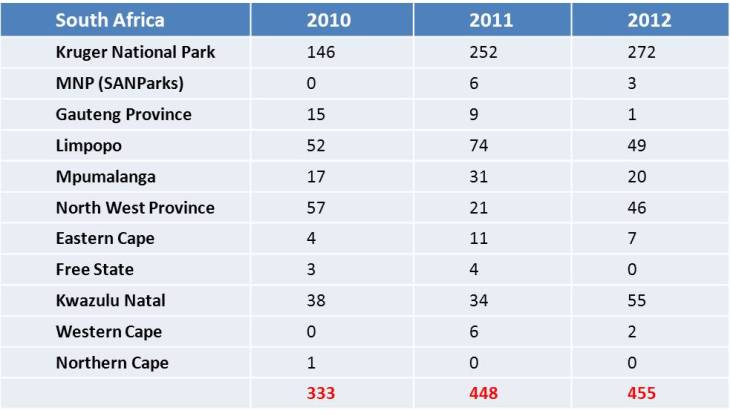
South Africa, home to more than 20 000 rhinos, or about 90% of all the rhinos in Africa, lost 455 rhinos to poachers, as of Tuesday, to eclipse the 448 killed in all of 2011, the environment ministry said in a statement. Around 15 animals a year were lost a decade ago, showing the impact of rising demand from Asia.

The number of rhinoceroses dying unnatural deaths in South Africa, either through illegal poaching or legal hunts, has now reached a level likely to lead to population decline, according to a study by Richard Emslie, an expert in the field. Poaching increased dramatically from about 2007 as a growing affluent class in China, Vietnam and Thailand began spending more on rhino horn for traditional medicine, where it was once used for ailments such as devil possession.

About half of poaching takes place in Kruger National Park, the country’s flagship park covering an area about the size of Israel, where soldiers and surveillance aircraft have been deployed in recent months to slow the carnage. The park has been the focal point of an arms race as gangs of poachers sponsored by international crime syndicates have used high-powered weaponry, night vision goggles and helicopters to hunt the animals, investigators said. Source: Polity.org.za

Mauritius Customs turns 200

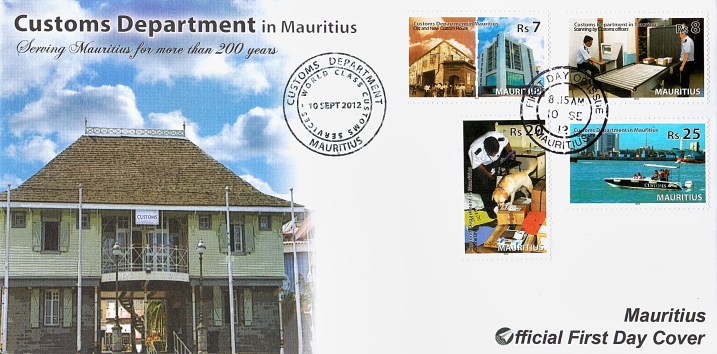
Mauritius Customs 1st Day CoverOn the ocassion of my 300th post, join me in raising the Portcullis for Mauritius Customs! During September, the Mauritius Revenue Authority (MRA) marked the bicentenary celebrations of Customs services in Mauritius by launching a special First Day Cover with four stamps on the Customs Department to mark the bicentenary celebrations of Customs Services in Mauritius. The issue of these new stamps is an acknowledgement of the significant contribution of the Customs services to the economic and social life of the country for more than 200 years. The four stamps depict the Customs Services in different fields with denotation of Rs 7, Rs 8, Rs 20 and Rs 25 illustrating some of the areas where the customs services are involved in their fight against crime and fraud prevention through the use of people, animals and state-of-the-art technology.

On 18 August 1797, a ‘bureau de Douane’ was established for the purpose of raising revenue in a context of war and blockade. It became a major financial institution contributing towards 50% of total revenue. The British took over in 1811 and installed the first Collector of Customs.British Customs practices were gradually introduced in the colony in line with British commercial law.

In modern times, the MRA Customs Department has set as one of its main objective to combat the illicit trade of drug and other illicit substances. The MRA has a team of 6 drug detector dogs handled by certified dog handlers trained by the French Customs and the South African Revenue Services (SARS). Our dogs have been selected carefully from examined litters and were declared competent drug detector dogs as per SAQA Unit Standard in the handling of a service to detect illicit substances.

Since 2008, our sniffer dogs have detected drugs in 25 instances involving the import of Cannabis, Heroin, Hashish, Subutex and other illegal substances worth around Rs 42,530,543. The Drug Detector Dog squad operates at the courier services, Parcel Post Office, Vehicle Search at Airport, Port and Freight Stations, Port area, Airport (Plaisance Air Transport Services & Luggage on carrousels at SSR Int. Airport and Aircraft search) as well as at the seaport for search of vessels. Source: Mauritius Revenue Authority

Most African countries to be middle income by 2025?

As many as 38 of sub-Saharan Africa’s 48 countries could be regarded as ‘middle income’ by 2025, but World Bank chief economist for Africa Shantayanan Devarajan warned that such an advancement would not necessarily translate into a reduction in poverty. Currently, 21 countries, collectively with 400-million citizens, have middle-income status, which the World Bank defines as countries with yearly per-capita income levels of higher than $1 000.

Speaking following the release of the October edition of the bank’s ‘Africa Pulse’ publication, Devarajan noted that at least ten countries, representing 200-million people, were poised to transition to middle-income status over the coming 13 years on the back of prevailing growth rates. Included in the list are countries such as Zimbabwe and Comoros, which would require both growth and stablisation.

Over the past 15 years, the continent had expanded at a rate of two percentage points better than the average global growth rate, and the bank was still expecting sub-Saharan Africa to expand by 4.8% in 2012 – excluding slow-growing South Africa, the region’s largest economy, average growth for the region was forecast at closer to 6% for the year.

But there was potential for a further seven countries, with 70-million citizens, to be included in the middle-income mix over the period if rates of growth accelerated beyond levels achieved over the past 15 years. Only ten African countries, representing 230-million people, almost certainly will not achieve middle-income status by 2025.

But while Africa’s recent growth spurt had resulted in the first overall reversal in the continent’s poverty rate since the 1970s – from 58% in 1999 to 47.5% in 2008 – the bank cautioned that continued progress would depend on continued macroeconomic prudence and improved governance, particularly in the area of natural resources.

Africa Pulse showed that resource-rich countries had seen a strengthening of economic growth, while poverty rates and inequality levels had not performed as impressively. “Some countries, such as Angola, Republic of Congo and Gabon have actually witnessed an increase in the percent of the population living in extreme poverty.”

“Resource-rich African countries have to make the conscious choice to invest in better health, education, and jobs, and less poverty for their people because it will not happen automatically when countries strike it rich,” Devarajan said. “Gabon, for example, with a per-capita income of $10 000 has one of the lowest child immunisation rates in Africa.”

To ensure that the benefits of rising growth were “pro poor”, more jobs would need to be created. And, in the context of high levels of informal sector employment, efforts would also need to be made to improve access to finance and skills, in the informal sector. Source: Engineeringnews.co.za


Trade Facilitation Implementation Guide

UNECE-Trade Facilitation Implementation GuideHaving spent the better part of the last fortnight amongst customs authorities and implementors of Single Window, I’m compelled to share with you a site (if you have not already been there) which attempts in a simple but comprehensive way to articulate the concept and principles of Trade Facilitation and its relationship and connotation with Single Window. The UNECE Trade Facilitation Implementation Guide should come as a welcomed resource, if not a companion, to trade facilitation practitioners and more specifically Customs Authorities wishing to embark on a trade facilitation approach. Of course it is a very useful reference for the many avid scholars on customs and trade matters across the global village. Of particular interest are the case studies – two of which feature African countries (Mozambique and Senegal) – providing a welcomed introduction of trade facilitation and Single Window on our continent. It is good to note that Single Window has less to do with technology and more to do with inter-governmental and trade relationships and an understanding of how these are meant to co-exist and support one another  – Enjoy!

Trade facilitation is emerging as an important factor for international trade and the economic development of countries. This is due to its impact on competitiveness and market integration and its increasing importance in attracting direct foreign investments. Over the last decade, it has gained prominence in the international political agenda as part of the ongoing WTO multilateral trade negotiations as well as of wide international technical assistance programs for developing and transition economies.

The primary goal of trade facilitation is to help make trade across borders faster and cheaper, whilst ensuring its safety and security. In terms of focus, it is about formalities, procedures, and the related exchange of information and documents between the various partners in the supply chain. For UNECE and its UN Centre for Trade Facilitation and Electronic Business (UN/CEFACT), trade facilitation is “the simplification, standardization and harmonization of procedures and associated information flows required to move goods from seller to buyer and to make payment”. Such a definition implies that not only the physical movement of goods is important in a supply chain, but also the associated information flows. It also encompasses all governmental agencies that intervene in the transit of goods, and the various commercial entities that conduct business and move the goods. This is in line with discussions on trade facilitation currently ongoing at the WTO. Source: UNECE

Grindrod – coastwise feeder expansion to extend services between Durban and Angola

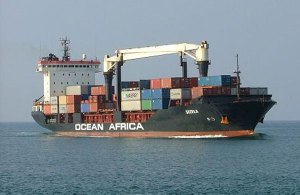
South African logistics and shipping firm Grindrod has continued its expansion programme, with the purchase of Safmarine’s 51% stake in Ocean Africa Container Lines. Grinrdod gave no details of the price paid for Safmarine’s stake in Ocean Africa Container Lines (OACL), but Grindrod now fully owns the company, which operates a feeder service with four vessels between Durban and Angola, calling at several ports in between, including in Namibia and Angola.

OACL’s former COO, Mahmood Simjee, has now been appointed CEO. Grindrod hopes that OACL can continue to benefit from close ties with Safmarine and the latter’s parent company, Maersk. OACL could take advantage of Ngqura’s growing role as a transhipment port, particularly with Angolan ports. The shipping line previously operated between Durban and Mozambican ports and could again resume this role.

Röhlig-Grindrod, a joint venture between Grindrod Limited and Röhlig International, has also acquired Sturrock Group’s clearing and freight forwarding division in exchange for a 15% stake in Röhlig-Grindrod, leaving the founding partners with 42.5% equity each in the venture. The inclusion of black empowerment partners in Sturrock Group helps Röhlig-Grindrod to fulfil its empowerment requirements.

Hylton Gray, the CEO of Grindrod Logistics, said: “We are very pleased with the merger of the businesses and the introduction of the empowerment partners. Calulo, a partner in the Sturrock Group, already has a stake in Grindrod’s South African operations and has contributed significantly by way of existing relationships and experience in niche markets.” Source: worldcargonews.com

WCO receives gift of historical significance to Customs from Egypt

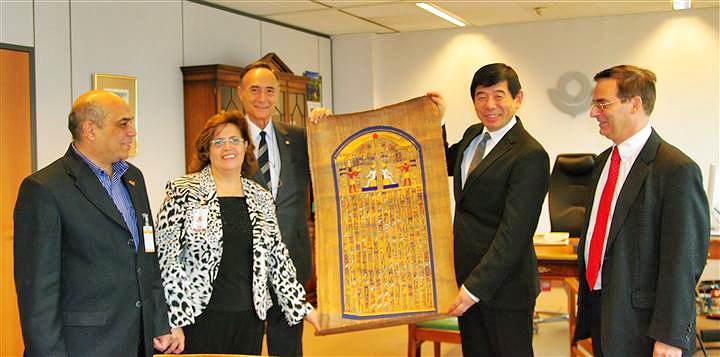
An Egyptian delegation to the WCO Harmonized System Committee, on behalf of the Director General of Egyptian Customs, Mohamed Elalhawy, presented the Secretary General of the WCO, Kunio Mikuriya, with a colour papyrus copy of the Customs tariff applied in Egypt during the time of the Pharaohs some 2000 years B.C. The original tablet is to be found in a museum in Egypt. You can view a photograph of the Egyptian tablet by clicking here!

The Secretary General thanked Egyptian Customs for this impressive gift full of significance which clearly illustrated the historic nature of Customs tariffs dating back more than 4000 years. He expressed the hope that one day he would be able to see the original stone tablet in Egypt. The papyrus will be displayed at WCO Headquarters. Source: http://www.wcoomd.org

Regional Blocs seek to remove Trade Barriers

THREE regional economic communities (Recs) have taken the lead as Africa seeks to remove trade barriers by 2017. The establishment of a Continental Free Trade Area (CFTA) was endorsed by African Union leaders at a summit in January to boost intra-Africa trade. Sadc, Common Market for Eastern and Southern Africa (Comesa) and the East African Community (EAC) have combined forces to establish a tripartite FTA by 2014.

Willie Shumba, a senior programmes officer at Sadc, told participants attending the second Africa Trade Forum in Ethiopia last week that the tripartite FTA would address the issue of overlapping membership, which had made it a challenge to implement instruments such as a common currency. “…overlapping membership was becoming a challenge in the implementation of instruments, for example, common currency. The TFTA is meant to reduce the challenges,” he said.

Countries such as Zimbabwe, Tanzania and Kenya have memberships in two regional economic communities, a situation that analysts say would affect the integration agenda in terms of negotiations and policy co-ordination. The TFTA has 26 members made up of Sadc (15), Comesa (19) and EAC (5). The triumvirate contributes over 50% to the continent’s US$1 trillion Gross Domestic Product and more than half of Africa’s population. The TFTA focuses on the removal of tariffs and non-tariff barriers such as border delays, and seeks to liberalise trade in services and facilitation of trade and investment.

It would also facilitate movement of business people, as well as develop and implement joint infrastructure programmes. There are fears the continental FTAs would open up the economies of small countries and in the end, the removal of customs duty would negatively affect smaller economies’ revenue generating measures.

Zimbabwe is using a cash budgeting system and revenue from taxes, primarily to sustain the budget in the absence of budgetary support from co-operating partners. Finance minister Tendai Biti recently slashed the budget to US$3,6 billion from US$4 billion saying the revenue from diamonds had been underperforming, among other factors.

Experts said a fund should be set up to “compensate” economies that suffer from the FTA. Shumba said the Comesa-Sadc-EAC FTA would create a single market of over 500 million people, more than half of the continent’s estimated total population. He said new markets, suppliers and welfare gains would be created as a result of competition. Tariffs and barriers in the form of delays have been blamed for dragging down intra-African trade.

Stephen Karingi, director at UN Economic Commission for Africa, told a trade forum last week that trade facilitation, on top on the removal of barriers, would see intra-African trade doubling. “The costs of reducing remaining tariffs are not as high; such costs have been overstated. We should focus on trade facilitation,” he said.

“If you take 11% of formal trade as base and remove the remaining tariff, there will be improvement to 15%. If you do well in trade facilitation on top of removing barriers, intra-African trade will double,” Karingi said. He said improving on trade information would save 1,8% of transaction costs. If member states were to apply an advance ruling on trade classification, trade costs would be reduced by up to 3,7%.He said improvement of co-ordination among border agencies reduces trade costs by up to 2,4%.Karingi called for the establishment of one-stop border posts.

Participants at the trade forum resolved that the implementation of the FTA be an inclusive process involving all stakeholders.They were unanimous that a cost-benefit analysis should be undertaken on the CFTA to facilitate the buy-in of member states and stakeholders for the initiative. Source: allAfrica.com

Exporters Blast ZIMRA and RBZ Red Tape


Zimbabwe‘s export procedures have come under severe criticism as they are said to be contributing to the country’s poor export performance. Local manufacturers have lamented delays in documents processing by the Zimbabwe Revenue Authority and the Reserve Bank of Zimbabwe, which they say is constraining the movement of goods into regional and international markets.

Latest official statistics show that the country’s trade deficit stands at around US$2,9 billion due to the underperformance of the export sector. Surface Investments executive director Mr Narottam Somani says although they have lodged complaints with ZIMRA over the issue there have been no positive outcome.

“The CD1 approval procedures and ZIMRA Bill of entry procedures are too lengthy and as such they spoil the whole momentum of exports. Government, ZIMRA and the RBZ need to appreciate the value of reducing period of these procedures. “We have engaged officials from ZIMRA and the RBZ over the need to file our CD1 and bill of entry forms online which will help reduce the time period to one day. They say that they appreciate our concerns but nothing has materialised,” he said. (Note for South African readers – CD1 refers to a ZIM exchange control document and not the SARS’ new electronic declaration form)

Surface Investments is the country’s largest multi-oilseed processing firm and it exports crude oil to Malawi and cotton linters, and cotton hulls to South Africa and Europe.

Both exporters and importers contend that the country’s export transit procedures have not improved significantly despite ZIMRA’s rollout from last year of the ASYCUDA World version 4.0.21 to over 14 of its stations. Implementation of the system was largely expected to expedite clearance procedures at the country’s border posts. ASYCUDA 2.3 was the earliest version to be introduced in Zimbabwe in 1992 and was upgraded to versions 2.5 and 2.7. ASYCUDA++ later came on board in the form of version 1.15 and 1.18. An expert in the field of transit procedures yesterday said improving these processes would take a wider regional approach.

“Transit operations of most countries in the region typically suffer from a number deficiencies such as lack of simplified and standardised customs procedures, documents and data processing that generally yield costly implications such as delays at border posts, opportunities for theft and corruption practices, and inflated transit transport costs.

“The key area that needs to be addressed therefore relate to regional harmonisation of transit procedures.” Source: The Herald (Harare)


Kenyan importers to be penalised for delays

Nothing like giving stakeholders fair warning of impending fines. Given that the authorities appear to have agreed on ‘all details’ except the cost, lets hope the latter aspect does not come as a nasty surprise when the single window system becomes operational. One would think that price/cost would be one of the first criteria for consideration and approval, not the last.

The government plans to impose penalties on importers who fail or delay to lift their cargo from the port in Mombasa in the ongoing reforms to de-congest the port. Transport minister Amos Kimunya said this is part of the measures being drafted to ensure the port operations are not slowed down by deliberate delays by importers.

“This will encourage people to quickly remove their cargo from the port as soon as it cleared by the authorities” Kimunya told the KPA annual summit in Nairobi on Wednesday. He said this is aimed at reducing the 40 per cent extra cost to consumers, caused by inefficient flow of goods from ports of entry.

The penalties come ahead of the single window system which is expected to facilitate fast and easy flow of export and exports through a seamlessly interconnected platform. According to the chairman of Kenya Trade Network Agency Joseph Kibwana, the single window implementing agency, all the details of the project have been agreed on, except the cost.

Implementation of the first phase for sea and air manifest will start in June 2013 to be followed by the second and third phases in six months intervals. Source: The Star (Nairobi)

Car importers slam KRA transit vehicles rule

Is the time for a regional transit bond nigh? Given prevailing draconian measures to ensure security and surety, the message is clear that customs brokers, freight forwarders or clearing agents need to demonstrate financial security over and beyond what they are accustomed to. Question – is the transit business lucrative for agents? Why not refuse the business – its just not worth the risk.

A requirement by the Kenya Revenue Authority demanding that all imported transit vehicles above 2000cc be cleared against cash bonds or bank guarantees has been opposed by clearing agents in Mombasa. The agents, under their umbrella Kenya International Freight and Warehousing Association, have threatened not to pay taxes if the regulations are not withdrawn by the tax collector. The agents said that the stringent measures by KRA may stifle trade in the region and may also see the port of Mombasa losing some foreign importers to the port of Dar es Salaam in Tanzania. “We as clearing agents cannot pay the bonds for the importers”.

On August 31, KRA directed all clearing agents that with effect from September 1, all transit vehicles exceeding 2000cc would be cleared against a cash bond or bank guarantees paid by the agents. The forwarders also said that Uganda, Rwanda and DR Congo business class was considering ditching Kenya as an import avenue for Dar es Salaam port. Source: The Star (Nairobi)

Regional IT inter-connectivity takes another step

Delegates from at least 20 African Customs Administrations met in Pretoria, South Africa between 13 and 15 August to advance developments towards a common framework and approach to IT inter-connectivity and information exchange in the region. Convened by the SADC secretariat in consultation with COMESA and Trademark Southern Africa (TMSA), the three day work session focussed on uniform acceptance of the WCO‘s Globally Networked Customs (GNC) methodology, regional awareness of customs developments in the Southern and East African region, as well as joint agreement on customs data to be exchanged between the member states.

Mauritius Revenue Authority (MRA) shared its experience with delegates on the launch of its Customs Enforcement Network (CEN). Kenya Revenue Authority will soon be sharing enforcement information with its MRA counterpart. At least 22 African countries are expected to link up with the CEN network over a period of time. Customs enforcement information is the second pillar of the WCO’s GNC information exchange methodology; the first pillar being Customs information exchange. The latter provides for a holistic approach to the dissemination of common customs data derived from supply chain exchanges, for example declaration information, cargo information, and AEO information to name but a few. This information is vital for trading countries to administer advance procedures and better validate the information being provided by the trade.

Rwanda Revenue Authority introduced it’s RADDex programme which is a web-based IT solution for the exchange of cargo manifest information between participating states in the East African Community (EAC) – see related article below.

SADC and COMESA are rallying their members to participate in the initiative. At the current juncture, various member states have expressed keen interest to participate. While the regional intention is the linking of all customs administration’s electronically, initial developments envisage bi-lateral exchanges between Customs administrations which are ready to engage. The importance of the adoption of the GNC methodology is to ensure that customs connectivity and information exchange is harmonised and consistent across the Southern and East African region irrespective of whether countries are ‘early adopters’ or not.

South Sudan: The roles of Commerce and Customs

The newly formed state of South Sudan, demonstrates a painful understanding of trade and customs. Evidently this is the product of political thinking, or poor journalism, or zero understanding of economics and administration. I wonder what Customs role really is?

The Director General of Trade in the Ministry of Commerce, Industry and Investment Stephen Matatia said that his office is not for collecting tax revenue but only for imposing penalties on those who break the law and order. He said it is the Customs Service staff who have the responsibility of collection revenues. The ministry of Commerce staff are only there to collect the penalties from those traders who break the laws and orders of the land related to trade and commerce. He said their other function is the imposition of laws on prohibited goods.

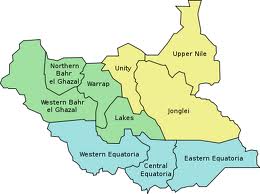
Staff of ministry of Commerce stationed in Nimule border checkpoint report to headquarters in Juba every 15 days to present comprehensive report on their duties. He said the Ministry is preparing to open more offices in other parts of Greater equatorial and in Greater Upper Nile in the border with Ethiopia.In Western Equatoria, Greater Bahr Ghazal, Unity State, bordering with Sudan, Central Africa Republic, Congo, will need offices,” he declared. Matatia observed that in some countries of Africa a lot of ministries of commerce are being classified together with industry thus they have ministries for industry, commerce, supply and cooperatives. Source: AllAfrica.com

Thick Borders – Thin Trade

It’s quite amazing the number of reports featured in various african media across the continent pushing the ‘free trade’ agenda. The incumbent governments on the other hand are naturally concerned with dwindling tax collections, while at the same time increasing incidents of graft, collusion, and corruption run rampant at the border. While the following article states the obvious, unfortunately, nowhere will you find or read a practical approach which deals with increased ‘automation’ at borders and the consequential re-distribution of ‘bodies’ to other forms of gainful employment. Its jobs that will be on the line. Few governments wish to taunt their electorates – non-essential jobs are a fact of life and are destined to stay if that is what will earn votes and a further term in power. Moreover, there is no question of removing internal borders with the emphasis on costly ‘One-Stop Border’ facilities. To some extent the international donor community won’t mind this as there’s at least some profit and influence in it for them.

Poverty in Sub- Saharan Africa is a man-made phenomenon driven by internal warped policies and international trade systems. The continent cannot purport to seek to grow while it blocks the movement of goods and services through tariff regimes at the same time Tariff and non-tariff barriers contribute to inefficient delivery systems, epileptic cross-border trading and thriving of illicit/contraband goods.

This ultimately harms the local and regional economy. Delays at ports of delivery, different working hours and systems of control across the continent, unnecessary police roadblocks and poor infrastructure condemn countries to prisons of inter-regional and intra-regional trade poverty.

According to the United Nations Economic Commission for Africa, removal of internal trade barriers would lead to US$25 billion per year of intra-regional exports in Africa, an increase by 15,4 percent by 2022. Making African border points crossings more trade efficient would increase intra-regional trade by 22 percent come 2020. Trade barriers in East Africa Community alone increase the cost of doing business by 20 percent to 40 percent.

Such barriers include the number of roadblocks within each country, cross- border charges for trucks and weighing of transit vehicles on several points on highways. Kenya is grappling to reduce the number of its roadblocks from 36 to five and Tanzania from 30 to 15. Sub-Saharan Africa records an average port delay of 12 days compared to seven days in Latin America and less than four days in Europe. Africa is lagging behind!

In West Africa, Ghanaian exports to Nigeria are faced with informal payments and delays as the goods transit across the country borders whether there is proper documentation. In the Great Lakes Region, an exporter is faced with 17 agencies at the border between Rwanda and Democratic Republic of Congo each with a separate monetary charge sheet.

A South African retail chain Shoprite reportedly pays up to US$20 000 a week on permits to sell products in Zambia. Each Shoprite truck is accompanied with 1 600 documents in order to get its export loads across a Southern African Development Community border. Tariff and non-tariff barriers simply thicken the wall that traps Africans in economic poverty.

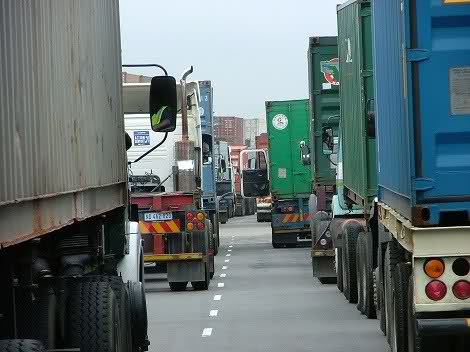
The new African Union chair should push for urgent steps to lower barriers to trade within Africa. Border control agencies need retraining and border country governments need to integrate their processes; long truck queues waiting to cross border points should not be used as an indicator of efficiency.

If it takes a loaded truck one hour to cover 100 kilometres; a four-hour wait at the border increases the distance to destination to another 400 kilometres. Increased distance impacts on the prices of goods at the retail end hence limiting access to products to majority of Africans. Limited access translates to less freedom of choice — similar to a locked up criminal prisoner.

With modern technology, goods should be declared at point of origin and point of receipt. Border points should simply have scanners to verify the content of containers. Protectionism, tariffs and non-tariff barriers within the continent sustains African market orientation towards former colonisers.

African entrepreneurs are subjected to longer travel schedules due to constant police checks and slow border processes. To fight poverty on the continent, African people would benefit from an African Union Summit that resolves to facilitate efficiency in movement of goods and services. Efficient delivery systems on the continent will tackle challenges of food insecurity, poor health care, conflicts and further promote diversified economies arising from competitive healthy trading amongst and between African nations.

Elimination of tariff and non-tariff barriers to trade will provide an opportunity for African entrepreneurs to adequately take their rightful places as relevant players in the global trade system. It is imperative that African countries re-orient their strategies to promote productivity by reviewing tariffs that hold back entrepreneurs from accessing the continent’s market. This calls for both a competitive spirit and a sense of integrated tariff and process compromise if the continent is to haul its population from poverty. Source: The Herald (Zimbabwe)
Customs Modernisation – some benefits in the offing


Its been a while since I penned some comment on the customs modernisation programme in South Africa. Amongst the anxiety and confusion there are a few genuine ‘nuggets’ which I would hope will not go unnoticed by the business community. With stakes high in the area of business opportunity and competitiveness, such ‘nuggets’ must be adopted and utilised to their fullest extent. Lets consider two such facilities.

The widespread implementation and adoption of electronic customs clearance has allowed brokers to file declarations for any customs port from the comfort of their desks. Brokers can now consider centralised operations especially for customs clearance purposes. Likewise the withdrawal of the annoying goodwill bond should also come as a welcome decision. Hopefully this may translate into cost-savings over time.

As of 11 August 2012, the business community will also be glad to learn that imported goods which do not fully meet all national regulatory requirements can be entered into bond on a warehouse for export (WE) basis. While this may not sound like anything new, the provisions which come into effect, will accord the identical treatment of such goods as if they were being entered for warehousing. In short the new provisions will allow more flexibility with the ability to re-warehouse WE goods; the ability to change ownership on WE goods; and the ability to declare WE goods for another customs procedure.These provisions can be considered a relaxing of the original approach which mandated compulsory exportation. All government regulatory requirements (i.e. permits, certificates, etc.) will however be strictly enforced upon clearance of WE goods for home use or another customs procedure. The apparent relaxation forms part of ongoing alignment of customs procedures with the Customs Control Bills, which are in the process of finalisation.

For those who have enquired about the followup to the national transit procedure, I have not forgotten about it. The ‘touchy’ nature of the subject requires a mature and fair response. Please bear with me.


Mozambique – New customs transit regulation

FTWOnline has published a letter it received from the CEO of Maputo Corridor Logistics Initiative (MCLI), the interim-CEO of Maputo Port Development Company (MPDC). Seems like an important ‘heads-up’ for all logistics operators. It reads as follows –

“The hardly-negotiated Mozambique customs transit regulation is concluded and the document sent to the minister of finance for approval. Approval and official gazetting is expected for the first week of August.

“Key features are:

  • All the unknown costs are replaced by a transit fee of 500.00-mts (+\- 18 US$) for general cargo and 10 cents of mts (0.036 US$) per for bulk cargo.Art. 13.
  • It is clarified that transit cargo is duty-free and subject to a guarantee that can be isolated (for a single transaction) or global (for transactions etween 3-month and 1-year). The bond covers only the duties and taxes at risk and is capped at 35% of duties and taxes. As an example, if the value of the good is US$1 000, the bond will be equal to 35% of 22% (7% of duties and 17% of vat), totaling around US$75. The bond is calculated on the basis of the value of transactions undertaken in the preceding year. Art. 14 to 19.
  • Transhipment is free-of-bond and the acquittal takes place only in the last port in the national territory. Art.23.
  • Acquittal period for areas where the single window is not yet in place is of 5 business days.”