Johburg Chamber to meet Parliment over Customs Bill

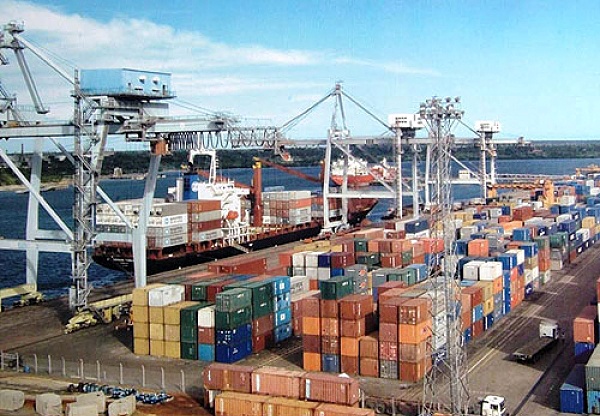
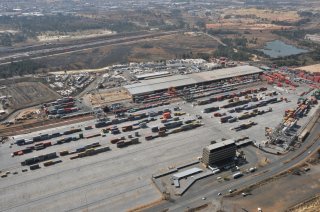
City Deep Container Terminal, Johannesburg

City Deep Container Terminal, Johannesburg

Online media company Engineering News reports that the Chamber of Commerce and Industry Johannesburg (JCCI) would take its objections of certain aspects of the recently tabled Customs Control Bill to Parliament and called on South African business and interested stakeholders to provide input as well.

The South African Revenue Services’ (Sars’) newly drafted Customs Control Bill, which, in conjunction with the Customs Duty Bill, would replace the current legislation governing customs operations, declared that all imported goods be cleared and released at first port of entry.

“The Customs Bill, cancelling the status of inland ports as a point of entry, will be before Parliament very soon, and only a short notice period for comment is expected,” JCCI former president Patrick Corbin said.

While all other comments and suggestions relating to the Bill were adequately dealt with, this remained the one disagreement that had not been satisfactorily resolved, he stated.

Corbin invited all parties to voice their concerns to ensure “all areas of impact and concern were captured”, adding further weight to the JCCI’s presentation. The implementation of the new Bill would directly impact the City Deep container terminal, which had been operating as an inland port for the past 35 years, alleviating pressure from the already-constrained coastal ports.

Despite customs officials assuring the chamber that the operations and facilities at City Deep/Kaserne would retain its licence as a container depot, Corbin stated that the Bill had failed to recognise the critical role City Deep played as an inland port and the impact it would have on the cost of doing business, the country’s road-to-rail ambitions, the coastal ports and ease of movement of goods nationally and to neighbouring countries.

“The authorities do not accept the fact that by moving the Customs release point back to the coast, a vessel manifest will terminate at the coastal port. There will not be the option of a multimodal Bill of Lading and seamless inland movements, as all boxes or the unpacked contents will remain at the coast until cleared and released by the line before being reconsigned,” he explained.

Citing potential challenges, Corbin said that only the containers cleared 72 hours prior to arrival would be allocated to rail transport and that those not cleared three days before arrival would be pushed onto road transport to prevent blocking and delaying rail operations.

This would also result in less rail capacity returning for export from Johannesburg, leading to increased volumes moving by road from City Deep to Durban.

He warned of the Durban port becoming heavily congested with uncleared containers, causing delays and potential penalties, while hampering berthing movements and upsetting shipping lines’ vessel schedules.

The release of the vessel manifest at the coastal port also placed increased risk on the shipping operators delivering cargo to Johannesburg following the clearance of goods at customs and required reconsignment at the country’s shores.

However, Transnet remained committed to investing R900-million for upgrading the City Deep terminal and the railway sidings, while Transnet CEO Brian Molefe had accepted the assurances from customs that “nothing would change and the boxes would still be able to move seamlessly once cleared”.

The Gauteng Department of Roads and Transport Department had allocated R122-million for the roadworks surrounding the inland port, while Gauteng MEC for Roads and Transport Dr Ismail Vadi said the department’s focus this year would narrow to the expansion and development opportunities at City Deep/Kaserne.

The department was also progressing well with the development of a second inland port, Tambo Springs Inland Port and Logistics Gateway, expected to be completed by 2017.

Vadi recently commented that the Gauteng Department of Roads and Transport, which was currently developing a terminal master plan for the project, would link the freight hub through road and rail transport to and from South Africa’s major freight routes and other freight hubs, including City Deep, which was about 33 km away.

The National Economic Development and Labour Council, under which the Bill had been drafted during a three-year development process, had agreed to fund an impact assessment study, led by Global Maritime Learning Solutions director Mark Goodger. The study was “close to completion” and would be presented alongside JCCI’s objections in Parliament. Source: Engineering News
Chinese President has sealed Tanzania’s Bagamoyo ‘mega-port’ project

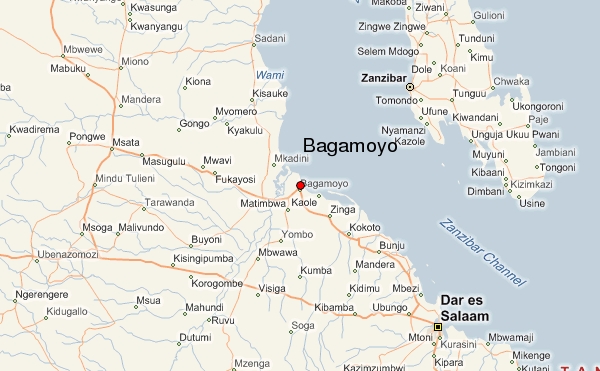
bagamoyo-mapThe Chinese President has sealed Tanzania’s Bagamoyo project. Tanzania has laid down its claim for a future large slice of regional trade through a deal with China to build the new port of Bagamoyo in its Mbegani area, north west of Dar es Salaam, at a total cost of $10bn.

The deal was announced by the President of China, Xi Jinping, while recently visiting Dar es Salaam and forms part of a major investment by the China in the infrastructure of the Mbegani area and East African seaboard – a project to be completed by 2028 with the expectation that Bagamoyo port will supersede Dar es Salaam port as the country’s main port and container handling centre.

The new port will be built with a draft sufficient to accommodate higher capacity container vessels up to 10,000 teu and beyond, as well as possess specialised roll-on roll-off berths and other cargo berths.

The overall scale of the planned development is such that it will provide a highly competitive solution to Kenya’s port expansion plans in Mombasa and Lamu which, as well as catering for national trade, are focused on meeting the needs of surrounding landlocked countries such as Uganda, Rwanda and Burundi.

Kenya has ground out plans for a new deep water container terminal in Mombasa – now under construction – and has embarked upon major new port development at Lamu, but the Bagamoyo port plan has a stronger profile and coherence to it. The money is down and in the background are new offshore gas discoveries for Tanzania which promise to play their part in promoting a strong and enduring relationship with China.

The first-phase development of Bagamoyo port is expected to be in operation by 2017 with construction undertaken by China Merchant Holdings of Hong Kong.

There has been no discussion to-date of whether the new port will feature cargo handling terminals operated by the private or public sector. As in Kenya, this subject remains something of a ‘hot potato’ with some Tanzania Port Authority executives suggesting it was a mistake to introduce the private sector as the operator of the Dar es Salaam Container Terminal. As in Mombasa, there is a belief that the public sector could have done as well as private interests in seeking to achieve efficient container terminal operation.

This belief persists in certain circles despite the TPA taking steps to raise the calibre of executives in its organisation through the introduction of executives from the private sector and a greater overall focus on human resources.

Dar es Salaam currently handles over 9m tons of cargo per year which is equivalent to about 95% of all Tanzania’s import and export volumes. In container trade alone, growth has been over 12% per annum since 2000. Despite this, the cost of shipping to Tanzania is about 25% higher than rates to the larger competing ports in southern Africa. This is mostly attributable to port inefficiencies brought about by inadequate investment in port infrastructure.

These costs are compounded when the effects of congestion and delay are added to the total freight bill, which can account for between 20%-70% of the total delivered price, inflating the price of imports and undermining global and regional export competitiveness.

The rationale for the introduction of major new port capacity in Tanzania is self-evident – demand is outstripping available capacity. It is to be hoped, however, that new capacity will be introduced supported by a modern port management model and institutional arrangements to facilitate optimum use of this capacity at the lowest cost. Source: PortTechnology.com

Freight-forwarder liability at a glance

services_import_SnapseedActually, this is a view from the Ukraine. In modern practice, the organisation of the transport process often necessitates direct international multimodal transportation, in which case the freight forwarder carries out the contract of carriage as a multimodal transport operator, even if it does not directly own any vehicles. However, a trend has arisen in which the functions of the carrier and forwarder are combined. Under this model, traditional carriers diversify their activities by creating a forwarding unit within their companies, or forwarding agents acquire vehicles or create dependent carriers. Furthermore, forwarders often hire subcontractors to undertake the shipment; as a result, cases of loss or shortage of goods and claims against forwarding agents can become quite complicated. 

General provisions

Ukrainian legislation does not provide detailed rules governing freight-forwarding activities. The Law on Freight-Forwarding Activities, the Civil Code and the Economic Code stipulate only the general regulations of freight forwarding.

In accordance with Clause 1 of the Law on Freight Forwarding Activities, the contract of freight forwarding is a contract in which the freight forwarder agrees, at the client’s behest, to perform or arrange for the performance of certain contract work related to the transportation of goods. The forwarding agent is entitled to engage other parties for the execution of certain work under the contract (eg, transportation, storage, loading and unloading).

The law includes only general provisions under which the freight forwarder may be held liable to the customer (unless provided otherwise in the contract) for:

  • the number of packages;
  • the weight of the packages (if the weighing was conducted in the presence of the carrier and confirmed with its signature); and
  • packaging requirements under the related shipping documents (signed by a representative of the carrier).

Issues regarding the forwarder’s liability are also governed by the general provisions of the Civil Code, which provides for liability for breach of obligations under the contract. Thus, Article 623 of the code provides that a debtor in breach of its obligations must compensate the creditor for losses caused.

Where the freight forwarder engages third parties to fulfil its obligations under the contract of freight forwarding, the forwarding agent will be held fully responsible for the actions and omissions of the third parties.

Ukrainian law lacks specific rules that directly limit the freight forwarder’s liability to the client. Detailed rules governing the forwarding agent’s liability to the customer, as well as grounds and limitations of such liability, are fixed by the parties in the contract of freight forwarding.

At the same time, Ukrainian legislation contains general rules that allow for the release of the freight forwarder from liability. In accordance with Clause 614 of the Civil Code, a party that has violated its obligations will be held responsible only if found guilty (intently or negligently), unless otherwise agreed in the contract. Disputes in connection with claims against freight forwarders for loss of cargo in transit are common in Ukraine, so there is ample case law in the area. However, since Ukrainian legislation provides only general provisions on the freight forwarder’s liability, court practice for such disputes is often ambiguous and contradictory. In particular, there have been separate cases with similar circumstances in which the court variously found the freight forwarder both liable and not liable for cargo loss in transit. Continue reading →

What’s In Store for ACE?

ACE_image_csonLast week, the National Customs Brokers & Forwarders Association of America, Inc. (NCBFAA) hosted a conference in Baltimore, MD targeting software developers interested in obtaining more information about US Customs and Border Protection’s (CBP’s) Automated Commercial Environment (ACE) and upcoming technical changes related to the PGA Message Set, Entry Summary Edits, Automated Corrections/Cancellations and AES Re-Engineering/Manifest Baseline development. During the conference, CBP made two important announcements which were heard and noted first hand from an Integration Point representative. These two announcements included:

  • CBP announced that it plans to mandate the use of manifest and cargo release in ACE by December 31, 2015 and mandate the use of ACE by December 31, 2016. CBP also provided a tentative release schedule for seven deployments that will lead up to this mandate.  Each deployment will consist of one or two increments, and each increment will span over a period of twelve to thirteen weeks. On this road map, CBP announced some exciting functionalities to be released in the near future such as automated cancellation and/or correction of entries, integration of simplified entry with other modes of transport and certifying simplified entry through summary. In addition to the enhanced simplified entry process, CBP also gradually plans to include the validations that were not initially included in ACE entry summaries.
  • CBP is also working on the reengineering of AES and pilot programs of entry data collection for various Participating Government Agencies such as the US Environmental Protection Agency (EPA) and US Food Safety and Inspection Service (FSIS) and CBP plans to deploy this later on in 2013 and early in 2014.

Now there is relevance in all of this. It reinforces the growing importance of Customs’ focus on “cargo management”.  Far too much emphasis is placed on the goods declaration alone. This is not only short-sighted but demonstrates an ignorance of the global supply chain. Without the ‘cargo report’ (manifest) the goods declaration is little more than a testament of what is purported to have been imported and exported.

Preparing ports for the future –

Siim Kallas - Europe’s ports must be better connected across the wider transport network.

Siim Kallas – Europe’s ports must be better connected across the wider transport network.

The following article featured in Port Stratetgy and penned by Siim Kallas, Vice-President of the European Commission in charge of transport policy, offers some sound views on how ports and regional networks ought to harmonise to ensure their competitiveness.

Europe’s prosperity has always been linked to sea trade and ports, which have great potential for sustaining growth in the years ahead. As gateways to the EU’s entire transport network, they are engines of economic development. And more cargo, cruise ships and ferries in our ports mean more jobs.

Europe depends heavily on its seaports, which handle 74% by volume of the goods exported or imported to the EU and from the rest of the world. Not only are they important for foreign trade and local growth, ports are the key for developing an integrated and sustainable transport system, as we work to get trucks off our saturated land transport corridors and make more use of short sea shipping.

Need to adapt

Even with only modest assumptions of economic growth, port cargo volumes are expected to rise by 57% by 2030, almost certainly causing congestion. In 20 years, Europe’s hundreds of seaports will face major challenges in performance, investment needs, sustainability, human resources and integration with port cities and regions.

So our ports need to adapt. Take the next generation of ultra-large vessels that carry 18,000 containers. Put onto trucks, these containers would stretch in a single line from Rotterdam to Paris. To accommodate them, ports need to provide the adequate depth, crane reach and shipyard space. There is also a growing need for gas carriers and gasification facilities.

Efficiency and performance vary a great deal around Europe. Many EU ports perform very well – take Rotterdam, Antwerp and Hamburg, which handle 20% of all goods. But not all ports offer the same high-level service. Port network connections and trade flows are well developed in northern Europe, but much less so the south.

A chain is only as strong as its weakest link: if a few ports do not perform well, it affects the sustainable functioning of Europe’s entire transport network and economy – which needs to recover and see long-term growth.

Preparing for the future

Ports must be prepared for the future. This means improving local connections to the wider road, rail and inland waterways networks; fully optimising services to make the best use of ports as they are now; and creating a business climate to attract the investments that are so badly needed if capacity is to expand, as it must do.

Unlike other transport sectors, there is almost no EU ports legislation, on access to services, financial transparency or charging for infrastructure use. Experience from the last 15 years shows that the market cannot solve the problem itself; the lack of equal competition conditions and restrictions to port market access are barriers to improving performance, attracting investments and creating jobs. We need to act.

Our proposal to review EU ports policy focuses on the ports of the trans-European Transport Network, which accounts for 96% of goods and 95% of passengers transiting through the EU ports system. Firstly, if ports are to adapt to new economic, industrial and social requirements, they must have a competitive and open business environment.

Freedom to provide services, with no discrimination, should be a general principle; although in cases of space constraints or public interest, the responsible port authority should ensure that decisions granting market access are transparent, proportionate and non-discriminatory. Transparency of public port financing should also be improved, to avoid distortions of competition and make clear where public money is going. This will encourage more private investors, who need long-term stability and legal certainty.

On charging for using infrastructure, where there is no uniform EU model, port authorities should be more autonomous and set charges themselves. But this must be done based on objective, non-discriminatory and transparent criteria. Ports should also be able to reduce charges for ships with better environmental performance.

Staying competitive

We also plan to help our ports stay competitive by cutting more red tape and administrative formalities to boost their efficiency even further. As in many other economic sectors, staffing needs in ports are changing rapidly and there is a growing need to attract port workers. Without a properly trained workforce and skilled people, ports cannot function. The Commission estimates that up to 165,000 new jobs will be created in ports by 2030.

Modern port services and a stable environment must also involve modern organisation of work and social provisions. Many countries have reformed and the benefits of doing so can be clearly seen. Experience in Member States which have implemented ports reforms show that open and proper discussions between the parties involved can make a real difference. So we want to give this a chance first, over three years, to see what can be achieved. If that does not produce results, we will have to consider taking action.

To stimulate resource-efficient growth and trade, Europe’s ports must be better connected across the wider transport network. They must make sure they are able to develop and respond to change. This is what the European Commission aims to achieve, for the long-term benefit of the ports sector, local business and the environment. Source: Portstrategy.com

Nigeria to Change from FOB to CIF

Trade policy - a balancing actThe Federal Government of Nigeria is set to change its trade policy from the present Free on Board (FOB) to Cost, Insurance and Freight (CIF) which most countries across the world use because of its economic benefits, before the end of the year. FOB makes it mandatory for the buyer to determine who ships and insures the goods to his port of destination while the CIF ensures that the seller determines who ships and who insures the goods brought from him. Presently, goods bought from Nigeria are on FOB basis while Nigerian trade with other nations is on a CIF basis.

Disclosing the position of the federal government to Vanguard in Houston, Texas at the ongoing Offshore Technology Conference (OTC), Leke Oyewole, Special Adviser to President Goodluck Jonathan, said work has been completed on the document for a change in policy so as to help indigenous operators. (?)

The Economic Management Team (EMT) is to take a final look at the policy before returning it to the President for it to be signed into law.

Asked whether the policy would be reversed before the end of the year, the Special Adviser to the President said, ” I am hopeful, am very hopeful, but you also know that if today the President signs the policy into law, Nigerians would not begin by tomorrow. We need to give time sufficient enough for Nigerians to acquire vessels to begin to carry.”

He noted that the country presently “operates on FOB, in which case, as soon as we put cargo onboard the ship, foreign funds are released to Nigeria. When we go on CIF, it will mean waiting until delivery of cargo, before the money will come into Nigeria. There will be a gap, that gap most not be too wide otherwise it will hamper the national funding because we get most of our revenue from these products (petroleum products). Source: Vanguard, Lagos.

Ambitious Port Plan for Walvis Bay


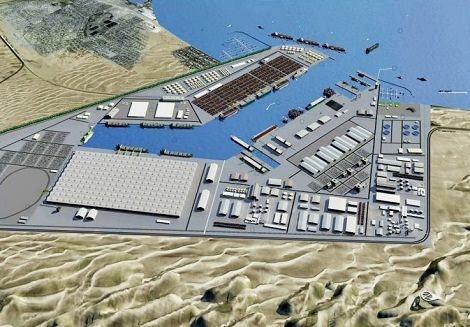
Computer-generated imagery of what the Walvis Bay North Port will look like when built. Image courtesy Namport.

Computer-generated imagery of what the Walvis Bay North Port will look like when built. Image courtesy Namport.

Far from simply developing a new container terminal, Namport could be bringing forward plans to build an ambitious new port at Walvis Bay to accommodate an expected increase in container and other traffic in the near future.

Originally intended as a long-term proposal for the Port of Walvis Bay, the plans may have to be brought forward and, coupled with finance that could come from China, the Namibian port is set to become a real rival for business in the southern and central African region.

According to reports in The Namib Times the cabinet has discussed and in principle given the go-ahead to create a new harbour on the northern side of the existing port. It said the new harbour is part of Namport’s strategy of positioning Walvis Bay as the premier port in the region. The plans will require dredging of a deep entrance channel and excavating the land to clear space for the new deepwater basin along with 10 kilometres of quayside for ships to berth.

If it was necessary to have proof that this development has the potential of shaking up the southern African region, it came in the form of a warning given yesterday by Transnet Chief Executive Brian Molefe at a community briefing session in Durban, in which he said, while justifying the need for the Durban dig-out port to go ahead, that if it was delayed or not built then Durban would lose out to other African ports. As an example he cited Walvis Bay where he said ambitious plans to build a large container port had been given the go-ahead. Source: Ports.co.za

Mozambique Could Drive the Need for 35 More LNG Carriers

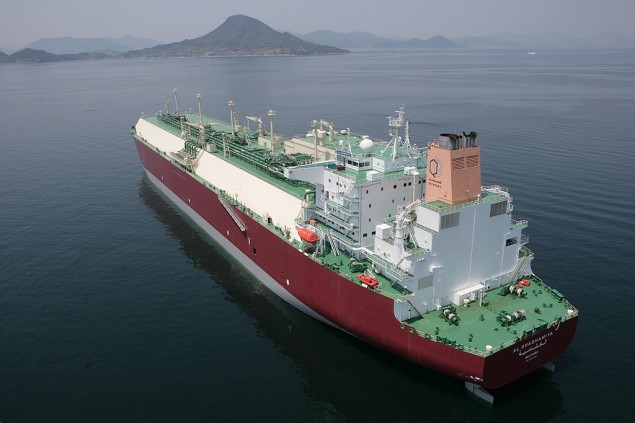
Image credit: Nakilat

Image credit: Nakilat

With soaring energy costs, Japan appears to have a pretty uniform goal, to invest as much as possible in other sources of energy and energy supply chains around the world. Many others like Qatar and Saudi Arabia are following suit and hedging themselves for what is turning out to be a reversal of their business model. Even the Louisiana Offshore Oil Port, which connects the world’s largest oil tankers with over half of the United States’ refining capacity is readjusting its business model for the changing flow of energy. With the eventual opening of the Liquefied Natural Gas (LNG) flood gates from the US however, coupled with Free Trade Agreements to places such as Japan, American energy firms and tax payers stand to cash in on the huge price gap that exists between the price of gas in the U.S. versus that which exists overseas.

At the moment, there’s a fairly good balance between supply and demand when it comes to the supply of ships and the demand for LNG product to be carried. Qatar, for example, uses 54 LNG carriers to transport their 77 million metric tons per year of LNG. Qatar also has a 70% stake in the Golden Pass LNG terminal in Texas. Additional exports from the US Gulf Coast will directly equal increased demand for more LNG carriers.

While regulators in the US trudge through the LNG export approval process, energy firms like Anadarko charge ahead with an ambitious LNG agenda offshore Mozambique in a field which was recently found to have at least 65 trillion cubic feet of recoverable reserves. Places like Mozambique, and offshore Israel, have the potential to really change the LNG marketplace given the sheer size of their fields and their proximity to the Asian and European markets respectively.

In Mozambique, two 5 million metric tons per annum (mtpa) LNG trains are currently under construction to support the huge conventional gas finds located 25 miles offshore. Their partners on the project include Mozambiquan state oil company, Empresa Nacional de Hidrocarbonetos, E.P., India’s state-owned Bharat PetroResources Ltd, Indian private equity firm Videocon Hydrocarbon Holdings, Ltd, Thailand’s PTT Exploration & Production, and Mitsui & Co. Considering the partners involved, their target market will predominantly be India and Japan. First LNG production is planned for 2018 and their plans are to eventually ramp up production to 50 million mtpa, or 2/3rds of the current production of Qatar.

What does that mean for LNG shipping? A lot more ships. To handle 50 million mtpa, upwards of 35 LNG carriers may be needed for transportation if you compare the ratio between Qatar’s fleet size and their total LNG exports. Source: gcaptain.com

Airport Cities – a view to a different trading environment for South Africa?

ace_skyscraper_237x352aerotropolisThis past week witnessed the first Airport Cities Convention in South Africa. It came at the timely announcement of the country’s first aerotropolis earmarked for development around Oliver Tambo International airport (ORTIA) and the surrounding industrial complex. While the City of Ekurhuleni gets prized possession of the ‘aerotropolis’ (in title) by virtue of the location of ORTIA, Johannesburg is set to benefit perhaps more greatly due to it being the epi-centre of South African commerce and trade. This represents significant ‘hinterland’ development which bodes well for future multi-modal transport and shipping activity for the Gauteng region and the country as a whole.

In support of government’s National Infrastructure Plan, is Strategic Integrated Project (SIPs) 2, otherwise known as the Durban-Free State-Gauteng logistics and industrial corridor. Infrastructure upgrades are already occurring to road and rail networks linking to the key cargo and distribution hub, City Deep. While the express purpose of an inland port, terminal or logistics hub is to provide relief for congested seaports, it likewise creates possibilities and opportunities to synergise with other transport forms. This serves to maximise capacity through integration offering local suppliers and foreign customers a host of trade, shipment and logistics options.

Foremost, an inland port is a hub designed to move international shipments more efficiently and effectively from maritime ports inland for distribution throughout the heartland. Think of the logistics of inbound freight as a barbell. At one end, inbound containers flood into a seaport, spreading across local storage facilities as they are unloaded. If they aren’t moved quickly enough from the port, they create a bottleneck that bogs down the entire distribution cycle as containers wait longer to get off ships, to get into warehouses, and to get back out and onto trucks and trains for final shipment. The Emergence of the Inland Port (credit: Jones, Lang, LaSalle)

In a world of increasing global integration, focussing more on global distribution of goods and services, it behoves our country to understand the dynamics of global trade and what in fact makes commerce tick. Today’s number 1 spot is not going to remain intact without continuous re-evaluation and innovation. It would indeed be arrogant (if not suicidal) of us to think that our current prominence and strength in the sub-saharan region will remain without innovation for the future. At the same time South Africa should welcome increased competition from its neighbours, both immediate as well as further north in Africa. The latest fDI 2013 Report indicates a decrease in foreign direct investment in South Africa (-5%) and Kenya (-9%), while at the same time a significant increase in foreign investment in Nigeria (+20%) and Egypt (+20%), respectively. True, the latter countries are far removed from South Africa’s immediate ‘playing field’, however do we fully understand the drivers which cause the named countries to attract FDI at such an increasing rate – are they capitalising somehow on our deficiencies, shortcomings, or lack of opportunism?

The National Infrastructure Plan can only be seen as a single cog in the machinery to keep South Africa competitive. And, while it is encouraging to witness these developments, a corresponding economic and commercial enterprise on both government and private sector is required to maximise these developments. Some smidgen of hope could lie in the Department of Trade and Industry’s economic principles which support Industrial Policy Action Plan (IPAP) and Special Economic Zones (SEZs), for example, however, several business commentators have already voiced concerns on exactly how these support the Infrastructure Plan. A further question lies in our country’s ability to facilitate trade, not only at our ports, but more importantly the ‘hinterland’ of our country and the neighbouring regions. Do our existing and future laws adequately provide for expeditious and facilitative procedures in the treatment of import and export goods? Are we sure that we are addressing all real and potential trade barriers?

Anyone desiring more information on the ‘aerotropolis’ concept should find some interest at the following websites – Aerotropolis.com, and the City of Ekurhuleni

Durban Dig-Out Port – First Stakeholder Engagement Concluded

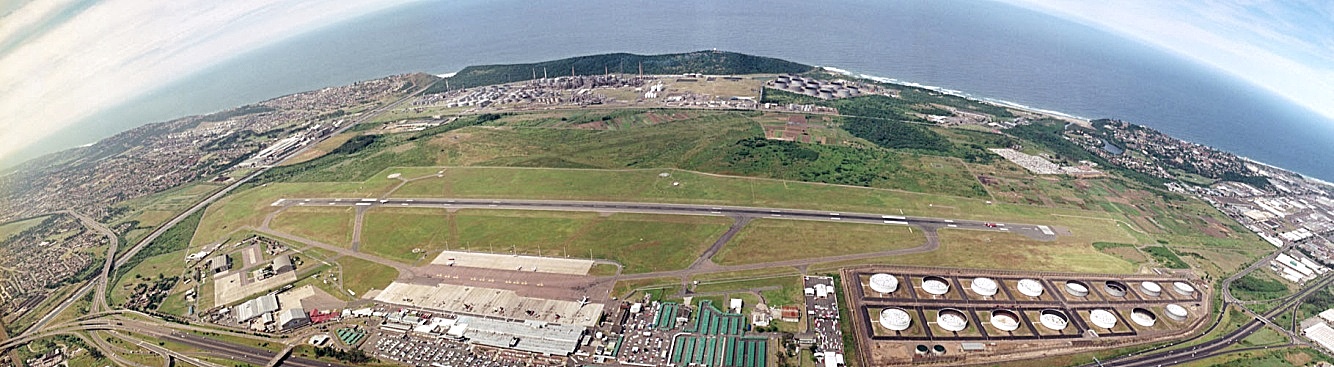
Old Durban airport - site for new Dig Out Port (Picture credit: ACSA)

Old Durban airport – site for new Dig Out Port (Picture credit: ACSA)

Transnet has concluded the first in a series of early stakeholder engagement sessions with local organisations on the proposed Durban dig-out port project. If built, the new port will be to the south of Durban on the site of the former Durban International Airport and 15 minutes by car from the existing port. It has been proposed that it will consist of 16 container berths, three Ro-Ro berths for the automotive business, and several oil and product tanker berths.

The engagement sessions just concluded form an integral part of the project’s concept phase which includes the development of a Sustainable Port Development Framework (SPDF) that will inform all future designs as well as operations. Transnet commenced with high-level technical and environmental studies in 2012 as part of the proposed Durban dig-out port project process. The current concept phase is scheduled to conclude in July this year, and comprises the generation of a number of technical design options.

The engagement sessions involved key representatives from local business, property, environmental and civic associations who met in order to comment on a discussion document which was distributed to them in mid-February 2013. The discussion document included important information on the background to, and process involved in, validating the viability of constructing a major container port on the site of the old Durban International Airport.

The sessions were held at various public venues and were facilitated by an independent sustainability consultancy. All feedback obtained during the engagement sessions was captured and will be factored into the development of the SPDF which will ensure the effective implementation of sustainability objectives throughout the life cycle of the proposed port project.

Along with promoting the long-term sustainability and operational excellence of the port, the framework also seeks to integrate environmental and social principles into the planning process. The series of engagement sessions, which will continue throughout the project’s lifespan, will also form part of the Department of Transport’s requirement for engagement during the strategic level environmental assessment as part of the legislative requirement for the promulgation of the port.

The process of moving from the current concept phase through the pre-feasibility and feasibility phases, and finally to actual implementation is anticipated to take approximately four years. The next phase, which is the pre-feasibility phase, is expected to proceed in July this year when the viability of the preferred design option will be thoroughly investigated.

The proposed port forms a key pillar of Government’s Strategic Integrated Projects (SIPs) to upgrade the Durban-Free State-Gauteng Freight Corridor (otherwise known as SIP2 in the National Infrastructure Plan). Source: Ports.co.za

Serious Regional Competition – China to build Africa’s largest port

Port of Dar es Salaam, Tanzania, West Africa. Image credit: TPA

Port of Dar es Salaam, Tanzania, West Africa. Image credit: TPA

China has announced plans for a new US$10 billion mega port in the Tanzanian town of Bagamoyo.

The new port, boasting an annual capacity of 20 million TEU, will not only become Africa’s largest box facility but will also rival the major ports of the Persian Gulf.

Dwarfing Tanzania’s current largest port in Dar es Salaam, which handles an estimated 800,000 TEU a year, the new port, northwest of the capital, will be used as a transhipment hub for raw materials coming in and out of landlocked Malawi, Zambia, Congo, Burundi, Rwanda,and Uganda.

China will also help to establish new road and rail networks in the area, whilst contributing to the upgrade of existing links. Source: Port Technology International.

MSC ship sets Durban Container Terminal record

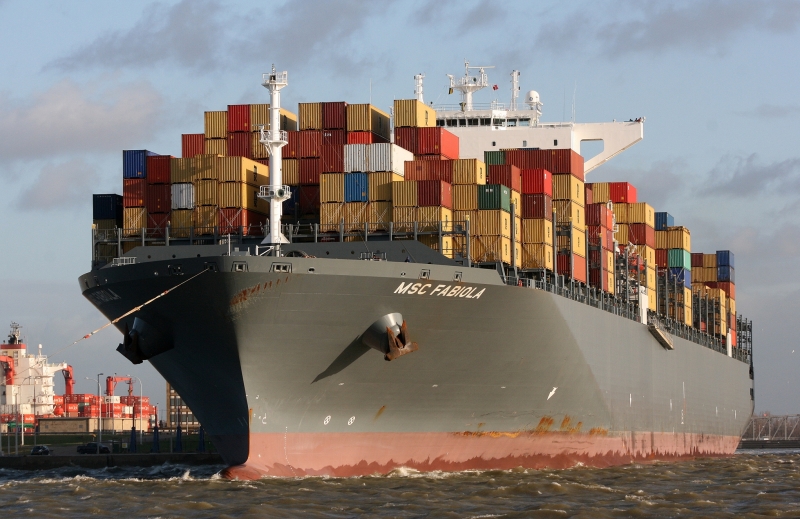
MSC Fabiola - sets new record for Durban container vessel capacity

MSC Fabiola – sets new record for Durban container vessel handling capacity


The visit to Durban, a fortnight ago, of the MSC FABIOLA has again raised the limit in terms of container ship sizes to call at the port. The previous largest box ship to call at Durban was the 11,660-TEU MSC Luciana, whereas MSC Fabiola can carry up to 12,562-TEU.

Obviously the ship was not fully laden otherwise the port would not have been able to accommodate the ship. The deepest berths at the Durban Container Terminal are 12.8m and those at Pier 1 are about the same.

MSC Fabiola is a charter vessel and is currently deployed on MSC’s pendulum service between Northern Europe and Singapore via Durban, Cape Town and Ngqura. The rotation is Northern Europe ports, Cape Town, Ngqura, Durban, Singapore, Durban, Ngqura, Northern Europe.

The next objective to aim at is to have the 14,000-TEU box ships deployed on the South African service, defying all previous projections, as indeed has been the case with the 12,500-TEU MSC Fabiola.

Of course, the main obstacle in having these post panamax ships calling at Durban is that the country’s main container port lacks a deepwater berth. This is despite the entrance channel having been dredged and widened several years ago to -19m decreasing to – 16.5m in the harbour inside entrance. In the process South Africa has once again been exposed by rapidly moving circumstances and questions need to be asked as to why the process of providing Durban with deep water berths is being delayed. Source: SAPorts.co.za

Discovery Channel to air six-part series on construction of the world’s biggest container ship

Triple E - Picture courtesy: Mearsk

Triple E – Picture courtesy: Maersk


A TV channel is to broadcast a series of six programmes showing how the world’s largest vessels – Maersk Line’s 18,000teu Triple-E containerships were built.

Maersk has given the Discovery Channel access to every stage of the Triple-E build; from the design of the vessel’s unique hull to the construction of the enormous engines and propellers, from the environmental improvements and safety systems to the ship’s naming ceremony and maiden voyage on the Asia-Europe route.

The series will also focus on lives of some of the people involved, including the naval architect, the site team supervising the build and the captain as he prepares for the maiden voyage.

“The Triple-E is an exceptional ship, in terms of its size as well as its energy saving technology and design. We’re excited about these vessels and proud to have Discovery Channel as a partner for showing how it is built and the people and passion behind it,” says Morten Engelstoft, Chief Operating Officer, Maersk Line.

The World’s Largest Ship will air on Discovery Channel in November, but to save you waiting all that time, Maersk Line has made available a time lapse video of the building of the Triple-E, that consists of 50,000 photos taken over a three-month period. Click here to watch video clip!

Why 2013 Is the Time to Adopt e-Invoicing

e-Invoicing INTTRA

Rod Agona, Managing Director, Electronic Invoicing, INTTRA explains three reasons why it is time for ocean carriers and shippers to say goodbye to paper. This follows the recent announcement by IATA on the introduction of its eAWB initiative.

In a digital age where a delay of seconds or one human error can be the cause of lost revenue, wasted resources or unhappy customers, good technology becomes critical to run a business.

Twelve years after the ocean shipping industry adopted e-commerce tools that resulted in an average savings of $100,000 per year and hundreds of thousands of labor hours per week, the final step in the shipping process – invoicing and payment – are still catching up. Surprisingly, invoices are still largely processed by hand in the ocean shipping sector. Considered the most tedious and costly step in the shipping process, manual invoicing can take days to complete and is often riddled with disputes and errors. And the amount of time it takes to manage disputes is more than anyone is comfortable admitting – knowing each delayed payment impacts carrier cash flow and creates dissatisfied shipping customers.

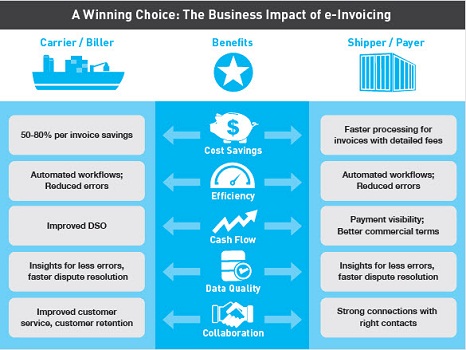
With electronic invoicing (e-Invoicing), there is a potential 50-80 percent cost savings according to the E-Invoicing/E-Billing 2012 Report from the international e-billing firm, Billentis, and the payment process is significantly shortened with DSO (days sales outstanding) typically decreasing by up to 10 days. Error rates are also greatly reduced, and customer satisfaction increased.

Although e-Invoicing as a trend has picked up rapidly in government and commercial sectors in the past three years (growing at a rate of 20 percent last year, according to the Billentis report), many in the ocean shipping sector are just catching wind of the benefits. Popularity among players is expected to grow this year – both on the biller and payer sides. Three reasons for the industry’s recent e-Invoicing surge are:

1. Demand Is at a Record High

At least 81 percent of the world’s largest shippers are requesting electronic invoices from their carriers in 2013, says a 2012 global shipping study conducted by INTTRA, the world’s largest ocean shipping network. The demand to move away from paper invoicing has never been greater, with shippers claiming to be “ready now and actively seeking e-Invoicing from their business partners.”

2. Proven to Lower Costs and Speed Internal Operations

Shippers’ biggest complaints with paper invoicing are 1) managing disputes, 2) the time and costs required to process invoices, and 3) correcting invoice inaccuracies. e-Invoicing is proven to alleviate these concerns by streamlining the entire settlement process, improving accuracy, and reducing the costs and labor required to process manual invoices. Payers end up happier as a result, receiving faster and improved communications and lowering the true total cost of doing business. For carriers, e-Invoicing is proven to cut costs and improve cash flow and working capital – and investments are often gained back within six months.

Both shippers and carriers want a solution to better manage high-volume transactions. Imagine spending millions of dollars on a global SAP (or equivalent) rollout and still manually keying in a half-million invoices per year. There is a better way.

3. It May Soon Be Mandatory (if it isn’t already)

Shipping companies are trying to keep up with rapidly changing local and international trade regulations, and e-commerce shipping is the smart way to stay compliant. Countries like Mexico, Brazil, Norway, Sweden, Finland and Denmark have already made electronic invoicing mandatory for all business-to-government transactions. Most others in Europe, North America and Australia are increasingly adopting electronic invoicing due to its cost-saving benefits.

Companies that act today put themselves at a competitive advantage as they are able to put their savings back to work and redirect employees engaged in manual processing to higher value tasks.

Looking Forward – 2013 and Beyond

The tipping point for when a technology ‘best practice’ becomes a ‘must have’ is never clear-cut – until an industry struggles as much as ours has. Change is hard, but for an industry with few proven solutions to remove costs, e-Invoicing is a viable, must-have solution.

2013 is a critical year for the ocean shipping industry. It is expected to be a year of major change in the way carriers and shippers do business. Competition is growing fiercer, and the industry continues to consolidate. e-Invoicing is one way to cut costs and reallocate dollars to where they are needed most in today’s challenging environment. Source: Maritime-Executive.com

For information, visit http://www.inttra.com/e-invoicing.

Supply Chain Foresight – a Perspective on BRICS and the South African Supply Chain

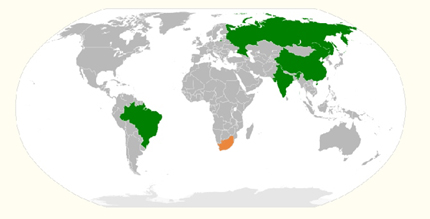
To reap the benefits of its recent membership of BRICS, South African businesses are looking at gaining a competitive edge through achieving global-standard supply chain performance, according to Supply Chain Junction, Manhattan Associates' Geo Partner in South Africa.

To reap the benefits of its recent membership of BRICS, South African businesses are looking at gaining a competitive edge through achieving global-standard supply chain performance, according to Supply Chain Junction, Manhattan Associates‘ Geo Partner in South Africa.

To reap the benefits of its recent membership of BRICS, South African businesses are looking at gaining a competitive edge through achieving global-standard supply chain performance, reports Supply Chain Junction, Manhattan Associates’ Geo Partner in South Africa. Unlike many other countries, South Africa was cushioned from the full impact of the world financial crisis thanks to the strict pre-existing credit controls it had in place. There were some knock on affects from close trading economies but over the last 15 months South Africa has enjoyed a growth economy. The International Monetary Fund (IMF) say this group will account for 61 per cent of global growth in three years time.

While South Africa’s economy (£506.91bn GDP) is dwarfed by those of the original BRIC constituents, the country is seen as the gateway to the continent of Africa, which as a whole has an equivalent sized economy ($2,763bn GDP), a population of one billion and rich resources. This has all made it a valued investment region for China in particular.

However, there are many cultural, logistical and geographical challenges the further one travels North from South Africa towards the Sahara. As an example, while there is 24,487 km of rail track in South Africa, there is just 259 km in Uganda; there are 92 mobile phones per 100 people in South Africa but just two per 100 in Eritrea. However, there is a great deal of raw potential, especially in countries such as Angola and Nigeria.

Participation in BRICS will drive a new competitiveness for South Africa and a key factor will be developing world-class supply chain management. Unlike in Europe, the US and Australia, few supply chain directors in South Africa sit on the board, which makes it harder for them to demonstrate how effective management of the supply chain can deliver competitive advantage. But this is likely to change as companies realise that they must align their supply chain and business strategies. If the recession failed to drive home the need for this, then the presence of Chinese companies in Africa will create significant pressure to do so.

This was an observation of the 2011 Supply Chain Foresight survey, conducted by Frost & Sullivan, which annually samples the opinions of South African supply chain executives. It found that while over three quarters of the respondents feel that the supply chain and business strategies of their companies are aligned, less than a third felt that the supply chain and logistics operations are fully optimised. Businesses are looking at how to optimise their distribution networks through building new facilities, streamlining existing processes or collaboration between trading partners. This has seen a lot of current activity surrounding warehouse management systems, forecasting, planning, replenishment and collaboration technologies, in particular.

Two thirds of respondents are considering investment in technology to enable collaboration with service providers. With the recession claiming many key suppliers the environment is changing from one where major companies squeeze suppliers on cost to one where they adopt a more collaborative approach. Cost reduction was the focus of the past recession, but now the objective is to satisfy customer expectations and to deliver value. Just over half of respondents to the Supply Chain Foresight survey cited customer service as the top supply chain objective. Reducing waste and improving efficiency in the supply chain are the perennial shorter term challenges with companies looking for better forecasting and planning tools to bring down inventory and shorten lean times. One interesting aspect of South African supply chain technology is the large number of in-house designed legacy systems, which is a consequence of the country’s isolation during the times of Apartheid. A propensity towards in-house designed systems remains today.

In terms of industry sectors, retail dominates but it remains firmly entrenched in the traditional channels. While some retailers have online retail websites, online and multi-channel is by no means a significant part of the current retail picture. Internet use is still quite low compared to other countries there are 4.42 million internet users in a population of 49 million and this figure is expected to remain low for some time yet. A further obstacle to the expansion of online sales is a high crime rate which leads to security issues in delivering goods to customers.

Wholesale distribution is quite small in size and complexity so the supply chain challenges tend not to be too complicated. There remain companies that feel they have been reasonably successful – being self-sufficient – and want to maintain that approach, along with a general tendency to look within, when it comes to benchmarking supply chains. However, a growing number of companies in South Africa recognise that there are other organizations across the globe doing similar things, but perhaps, a lot more efficiently.

Supply chain managers within these businesses are evolving a mindset focused on global best practice and the means of achieving it. These South African companies want to be best in their class. By building knowledge, benchmarking and improving against those benchmarks the win for this retailer is a supply chain that gives competitive advantage. As in other countries, companies looking to benefit from external expertise and a reduction in their capital costs will often outsource their logistics to third party logistics (3PL) operators. South Africa has numerous small local players and a handful of large lead logistics providers who tend to drive innovation. It is a small but highly competitive market. Logistics infrastructure and skills shortage in the supply chain continue to be huge issues in South Africa. The Supply Chain Foresight survey found that to deal with the skills shortage, in almost all areas companies either expose employees to new jobs through rotation, or development programs, or mentoring. These are generally in-house driven schemes. South Africa is an emerging market that is growing fast and offers a tremendous wealth of opportunities. In fact, the country has a great many successful businesses, and while many talk about becoming world class, many have already achieved it. Source: Supply Chain Junction