How China’s Cheap Phones Make Their Way to Africa

The following article (forgive the length), comes courtesy of Think Africa Press. It details a fascinating story about one of Hong Kong’s most notorious buildings – “Chungking Mansions”. The down-market building situated on some of the world’s most expensive real estate is home to some of the best South Asian restaurants, several $20-a-night guesthouses, and a mall that at one point, sold a fifth of all the cell phones that ended up in sub-Saharan Africa.

Nathan Road is Hong Kong’s busiest shopping street. It is lined with skyscrapers and decorated with neon signs of every size, colour and shape. Most of the logos are familiar: McDonald’s, KFC, Samsung, Rolex, Carlsberg, 7-Eleven, Standard Chartered. This is Asia’s Times Square, a luminous roll call of the world’s biggest companies and products, a shrine to consumer culture in the modern world. Workers, tourists and others cram the neon shadows of the sidewalks, clutching engorged wallets and sleek plastic bags. The luxury goods in the shop fronts of polished glass and mood lighting beckon their business. Lots of money changes hands. Many shiny new items are purchased. This is the apotheosis of globalisation as we know it best: big companies, handsome profits, fancy boardrooms, high-flying executives, top quality goods. But this is not the globalisation I have come to Nathan Road to see. I know I am getting closer to my destination when an Asian gentleman outside a Rolex store approaches. “Want nice watch? Mister, nice Rolex for you? I give you best price.” Despite admiring his brazen attempts to shift fakes not a metre outside a shop displaying the genuine articles, I shrug him off and turn into a narrow passage that takes me to the heart of a building called – in Hong Kong’s typically optimistic style – Chungking Mansions. This three-towered utilitarian block is one of Hong Kong’s most notorious buildings. Unlikely as it may seem, it is one of the major drivers of Africa’s technological revolution. The building’s history is infamous. Erected in 1961 to fulfil Hong Kong’s insatiable need for low-cost housing, it soon turned into one of the most legendary stops on Asia’s hippy backpacker trail, thanks to the proliferation of tiny, cheap guesthouses on its upper floors, many of which are still operating. These cheap tourists enticed merchants of tacky goods, whose stalls swamped the building’s lower floors. In turn, this activity attracted illegal immigrants, drug dealers and prostitutes, turning Chungking into Hong Kong’s seediest underbelly; a place that locals avoided completely and even police feared to tread. In recent years, the place has cleaned up its act somewhat, but still offers the city’s cheapest accommodation. It is home to a large South Asian community (primarily Indians, Pakistanis and Bangladeshis) and plenty of cheap tat: luggage, souvenirs, fake football shirts, etc. But in the last decade or so, shopkeepers have introduced a new product which has kept Chungking Mansions ticking: the mobile phone. Continue reading →

Invisible Patterns – to thwart clothing counterfeiters

Invisible textile patternWondering whether the $50 Armani suit you bought in that alley in Hong Kong is the genuine article? Soon, there may be a definitive way of knowing. A new system has been developed, in which designer-specific invisible patterns can be woven into fabric. Professor Christian Müller, at Sweden’s Chalmers University of Technology, started by applying a special dye to a polyethylene thread. The dye absorbs visible light, but can be seen using a polarizing filter. The idea is that each designer would have their own unique pattern that would be woven into their garments, that people such as customs officials could see using simple equipment.

That’s all very well and good, but what would stop counterfeiters from just reading and then copying those patterns? A number of different types of the dye can be used, and they can be bonded not only to polyethylene, but also to a variety of other synthetic and natural fibres. Depending on the specific combination of dye and fibre types, the optical spectrum of the pattern is different. Unless the counterfeiters knew the secret combination used, they wouldn’t be able to copy the exact look of an existing pattern – it’s not unlike the technology presently used on some banknotes. According to Müller, it would be relatively easy and inexpensive for clothing companies to manufacture their own custom dyed threads for use in the system. Source and picture: gizmag.com

Parallel imports in South Africa – Some sound advice

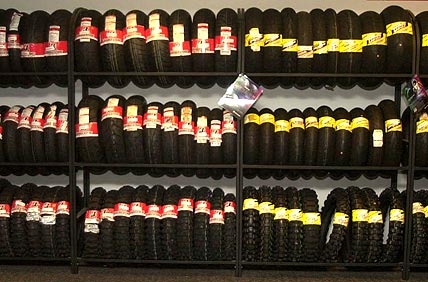
newTyres_m_mThe following article was penned by lawfirm Edward Nathan Sonnenberg and featured on Lexology.com. It was reported recently that bikers had protested outside Parliament about proposed measures which would have the effect of making life very difficult for those businesses who are involved in the parallel importation of motorbikes. The report did not make it clear exactly what the proposed measures comprised, but it did suggest that they involved special testing of bikes that are brought into the country by parallel importers, together with some system of issuing certificates for such bikes. Measures that, the report suggested, would not only require parallel importers to raise their prices, but might even put them out of business altogether, leaving authorised suppliers as the only source of motorbikes in the future. Amongst the protesters were the Parallel Importer of Motorcycles Traders Association of SA and Cosatu, which said that it was worried about job losses.

So just what are parallel imports, or ‘grey goods’ as they are sometimes known? Well, a foreign manufacturing company will normally appoint an authorised distributor for its product in South Africa. That distributor is then responsible for sales of the product, after-sales service and, of course, marketing, advertising and all those other good things that go into brand-building. A parallel importer is someone who buys that same manufacturer’s product in another country and imports it into South Africa for resale. The reason why the parallel importer bothers to do this is quite simple- the product is often so much cheaper abroad that the parallel importer can undercut the authorised distributor and still make a profit.

Needless to say the authorised distributor does not like the parallel importer, because the parallel imports threaten the authorised distributor’s business. The manufacturer generally doesn’t like the parallel importer much either – not only does it have to deal with complaints from an unhappy authorised distributor, but it also has no control over what the parallel importer does with the brand. But can the manufacturer or the authorised distributor actually do anything to stop the parallel imports?

Parallel importation is certainly legal under trade mark law. That’s because Section 34 (2) (d) of the Trade Marks Act provides that a trade mark registration is not infringed by ‘the importation into, or distribution, sale or offering for sale in the Republic, of goods to which the trade mark has been applied by or with the consent of the proprietor.’ This makes perfect sense if you bear in mind that a trade mark is essentially an indicator of origin, and that trade mark law is basically there to ensure that there is no consumer confusion. In the case of a parallel import, the consumer gets exactly what they expected, namely a product that was made by or under the control of the company that owns the trade mark – contrast this with the situation where the consumer buys a rip-off or counterfeit, where they get something very different from what they expected.

There is a proviso to this, and that is that the parallel importer must be quite open about the fact it is not an authorised distributor. That’s because Section 25 (2) of the Consumer Protection Act provides that ‘a person who markets any goods that bear a trade mark, but have been imported without the approval or licence of the registered owner of that trade mark, must apply a conspicuous notice to those goods in the prescribed manner and form.’

So, if you’re a parallel importer you should be OK provided that you make it clear that you are not the authorised distributor of the product. But there are other legal matters to consider, and the first of these is copyright. Copyright might be an issue where the product that’s being imported bears a trade mark that consists of more than just a name, but also something that could be described as an artistic work – this might be a logo, or it might simply be a stylised form of a name. There was a case a number of years back where a foreign manufacturer successfully used copyright law to stop parallel importation of cassette tapes. But it was an extraordinarily contrived thing: time to concentrate hard…

The Copyright Act provides that copyright is infringed where someone imports an article into South Africa in circumstances where they knew that the making of that article would have been an infringement if the company that made it had in fact made it in South Africa. To use this provision, the cassette tape manufacturer had to go through a number of hoops: it had to assign the South African copyright in the label to the authorised distributor; it then had to warn the parallel importer that it was importing articles that – had they been made by the manufacturer in South Africa – would have infringed the authorised distributor’s copyright; finally when the parallel importer ignored the warning (probably because it didn’t understand it!) it could sue for infringement. There has, as far as I’m aware, never been another case like this and one wonders whether – in an age where intellectual property law is considered in the light of constitutional and competition law and policy – the same result would be achieved if a similar case ever went to the highest court.

Finally it’s worth remembering that, in the fairly rare event of the product that’s imported being covered by a patent or a design registration, there may well be an issue. Section 45 of the Patents Act says that a patentee has the ‘right to exclude others.. from importing the invention’, whereas Section 20 (1) of the Designs Act says that the owner of a design registration has the right to exclude ‘other persons from …importing … any article included in the class in which the design is registered and embodying the registered design.’

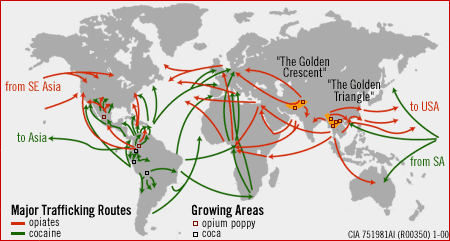
Southern African Narcotic Trafficking Landscape

Drugroutemap

See what the CIA’s Factbook has to say about Southern African countries and their role in the international narcotics supply chain –

Zimbabwe A transit point for cannabis and South Asian heroin, mandrax, and methamphetamines en route to South Africa
Zambia A transshipment point for moderate amounts of methaqualone, small amounts of heroin, and cocaine bound for southern Africa and possibly Europe; a poorly developed financial infrastructure coupled with a government commitment to combating money laundering make it an unattractive venue for money launderers; major consumer of cannabis
South Africa A Transshipment center for heroin, hashish, and cocaine, as well as a major cultivator of marijuana in its own right; cocaine and heroin consumption on the rise; world’s largest market for illicit methaqualone, usually imported illegally from India through various east African countries, but increasingly producing its own synthetic drugs for domestic consumption; attractive venue for money launderers given the increasing level of organized criminal and narcotics activity in the region and the size of the South African economy
Mozambique Southern African transit point for South Asian hashish and heroin, and South American cocaine probably destined for the European and South African markets; producer of cannabis (for local consumption) and methaqualone (for export to South Africa); corruption and poor regulatory capability make the banking system vulnerable to money laundering, but the lack of a well-developed financial infrastructure limits the country’s utility as a money-laundering center
Angola Used as a transshipment point for cocaine destined for Western Europe and other African states, particularly South Africa

Should the Rhino horn trade be legalized?

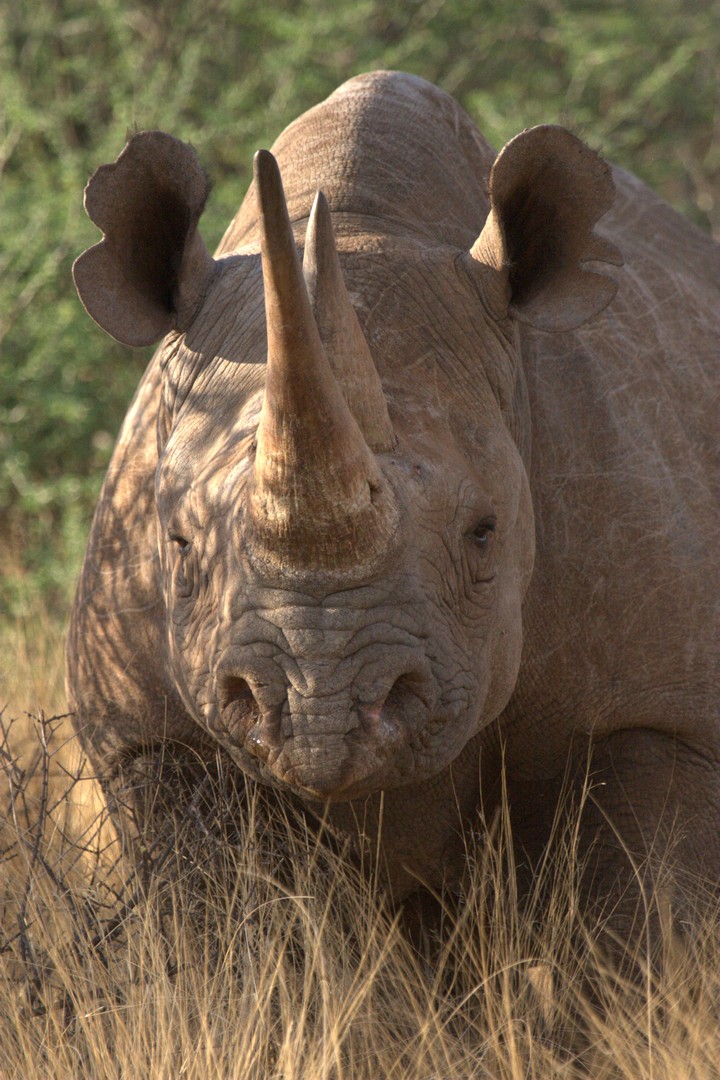
black-rhino-2Rampant poaching in Africa is a cause of major concern to wildlife organizations. Many rhinos are killed every year mainly for Asian markets. In Vietnam, rhino horn is believed to be miraculous, able to heal cancer.

A total of 158 rhino have been poached since the beginning of the year, according to the South African Department of Environmental Affairs. Over 630 rhino were killed by poachers in South Africa during 2012.

If the killing of rhinos continues to increase, African wild rhinos could disappear within a few years. The best protected rhinos live in Kenya. Four of them, known as northern white rhinos, are the last of their kind. Each one of them has four bodyguards to guarantee its survival. But most of the other 25,000 rhinos in Africa do not enjoy such protection. The trade in rhino horn is illegal. However it is flourishing, most of the horn coming from South Africa, where most rhinos live. Hunters are willing to pay up to 20,000 euros ($26,000) to shoot a rhino and take the trophy home.

Rhino poaching on the rise

Rhino poaching has increased tenfold in the last five years, according to the nature and animal protection organization World Wide Fund for Nature (WWF). The conference singled out Vietnam as the main importing country and Mozambique as a major transit country for rhino trafficking. This is the first time that countries were named at CITES.

Vietnamese believe that rhino horn powder can cure cancer

The two countries now have a few months’ time to address the problem constructively. Mozambique is poor but CITES’ regulations are also valid there. To learn how to fight against poachers effectively, the country may seek advice from environmental and conservation organizations. In the case of Vietnam, lack of political will seems to be the major problem. Even Vietnamese embassy staff were involved in the illegal horn trade. Vietnam is now under pressure. By January 2014, Vietnam as well as Mozambique have to prove that they are able to fight against horn trafficking from southern Africa, or else sanctions will be imposed.

Superstition hikes the price

In addition to stricter controls, the WWF and other animal welfare organizations are implementing awareness campaigns. In Vietnam there is a belief that the powder from the horn of the rhinoceros can help against fever, prevent a hangover or even cure cancer. These claims however, are dismissed by scientists. The horn consists of the same material as fingernails and hair. Nevertheless, Vietnamese are willing to pay more than 40,000 euros per kilogram, more than the price of gold.

Thousands of wild rhinos have been killed and their horns trafficked to Asia

South African biologist Duan Biggs says awareness campaigns and banning illegal trade control will not help to solve the problem. Shortly before the CITES conference, Biggs, together with three other scientists, wrote in the journal “Science”, calling for the legalization of the horn trade. “We have a buffer of a very healthy population of rhinos to work with,” Biggs said. He is convinced legalization is the right course to take. If that doesn’t work, it can always be stopped again. “If we wait longer and the current situation continues, we will lose the opportunity to try an alternative strategy.”

Legal breeding instead of illegal slaughter

Since horn grows like fingernails, rhinos should be bred specifically for the horn trade. The horn could be cut off when the animal is under anaesthetic. That way the animal doesn’t suffer pain. This is done to a quarter of the animals living in South African private game reserves, where dead animals’ horns are not allowed to be sold. If these horns are legally harvested and put on the market, prices and poaching would decrease, argues Biggs.

The WWF and many other organizations vehemently opposed the legalization theory. A boom in demand and even worse poaching could result if horns are on the market in large quantities and at cheaper prices. “A change from the elite-trend to mass-trend will be like lighting a fire that will be difficult to extinguish”, said a WWF spokesperson.

The dynamics of illegal rhino poaching paint a vivid reality. Is this really any different of narcotics and money-laundering, human-trafficking and counterfeiting? I think not. In many instances its the same ‘operators’ at play preying on weak human instinct and a complete lack of morals!  On the other hand I suppose, based on the reasoning of scientist Biggs, one could say legalising narcotics and prostitution would be the ‘right thing to do’ since we have a “buffer of healthy unemployed woman and youth” ???

Mozambique – Huge Heroin Seizure with South African Connection

00013ee0-314The Mozambican police claims that it has seized almost 600 kilos of heroin, at Namoto, in the northern province of Cabo Delgado, on the border with Tanzania.

The drugs were found on Sunday in the possession of two citizens of Guinea-Conakry, who are now under detention in the Cabo Delgado, provincial capital, Pemba. The drugs are being stored in the warehouses of the provincial attorney’s office.

According to Malva Brito, the spokesperson of the provincial police command, cited in Wednesday’s issue of the Maputo daily “Noticias”, the final destination of the heroin was South Africa.

Brito said the drug was concealed in an otherwise empty seven tonne pick-up truck. The Guineans had improvised a type of hold within the truck’s bodywork. But alerted by a strange smell and the odd size of the stowage area, the police searched the truck, and found the heroin in 118 plastic bags of about five kilos each (which is a total of 590 kilos).

When the heroin was found, the Guineans first claimed that it was fertilizer that they were taking to South Africa. When that didn’t work, they tried to bribe the frontier guards, offering them 60,000 US dollars. The bribe was not accepted.

The Guineans had started their journey in the Kenyan capital, Nairobi, last Friday, and crossed Tanzania before entering Mozambique. The Toyota pick-up bore a number plate from the Democratic Republic of Congo, and supposedly belongs to a Congolese named Sidiki Sano, who is resident in Mozambique. The owner of the heroin is believed to live in Johannesburg.

If the police figures are accurate, this is an enormous drugs bust. According to the United Nations, heroin was selling in South Africa in 2012 for 35 dollars a gram. So 590 kilos would sell in Johannesburg for 20.65 million dollars. Source: Mozambique News Agency (Agência de Informação de Moçambique).

Botswana Tightens Car Exports to Namibia

2nd hand carsThe New Era (Windhoek) reports that Botswana has tightened the screws on the importation of second-hand vehicle older than five years, effectively removing the loophole exploited by Namibian motorists to import such vehicles.

Botswana’s customs, the Botswana Unified Revenue Service (BURS), is now enforcing the Southern Africa Customs Union (SACU) agreement that prohibits the registration of imported second-hand vehicles older than five years. Previously Namibian traders in imported second-hand cars would register vehicles in Botswana, from where they would enter Namibia as Botswana registered vehicles instead of imported vehicles.

The process had made it easy to register such cars in Namibia and in other SACU member states, which prohibit the registration of imported vehicles older than five years.

“BURS, in the spirit of good neighbourliness and adherence to the provision of the SACU agreement, wishes to assist Namibia in curtailing the irregularities prevalent in the movement of second-hand vehicles through the two countries,” reads a statement from the Namibian Ministry of Finance’s customs that relayed the decision by the Botswana customs authorities.

However, ingenious Namibian traders in second-hand vehicles told New Era yesterday that the decision by Botswana customs is simply a temporary deterrent as they are now considering using Swaziland’s leniency on the matter to circumvent the very same SACU provisions. Besides the SACU provisions, Angola – a non-SACU member – has also banned the importation of second-hand vehicles older than five years. Second-hand vehicle imports contributed at least N$150 million to the economy during 2012, with a record 20 000 vehicles recorded.

Some of the vehicles have also gone through to neighbouring countries. South Africa does not allow imported second-hand vehicles older than five years to drive on its road network. Importers of such cars are forced to load vehicles on trucks or use the port of Walvis Bay. To register the cars in Namibia, the traders would take the vehicles to Botswana where they would be registered for a short period of time and bring them back to Namibia as Botswana registered vehicles.

The process enables the cars to be registered on the Namibian vehicle registration system, which ordinarily would not allow the cars to be registered for local use within SACU states. Botswana customs says persons attempting to circumvent the SACU provisions would be subject to a fine of P40 000 (N$44 579.85) or three times the value of the vehicles or imprisonment of not more than ten years. Source: New Era

Simple solution – SACU countries should unilaterally invoke the prohibition on the importation and registration of second-hand motor vehicles at all external borders of the customs union. Is it not time for the member states to act for once like a custom union?

Mastermind Steps Up War Against Counterfeit Goods

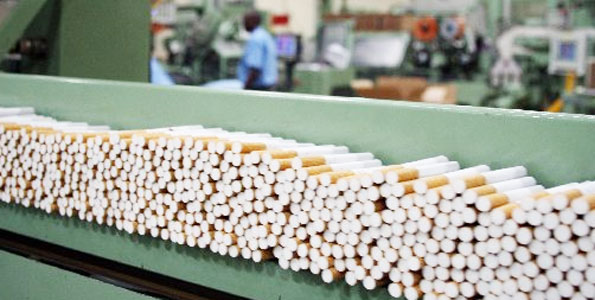
cigaretteNow isnt this a surprise? – Mastermind Tobacco has stepped up the fight against counterfeit cigarettes in the Kenyan market, it announced yesterday (February 27, 2013). It said it has set up security teams in Nairobi, North Lake Zone, South Lake Zone, Meru, Central and Rift Valley. Focus will also be on borders such as Malaba, Chepkube and Lokichogio, the airports and ports.

“The investment in supply chain preventive security measures from the point of manufacture to the point of distribution has seen an improvement in preventing legitimate trade from being infiltrated by counterfeits,” said Mastermind in a statement. Quite rich for a company which was persona non-grata in South Africa for instance. Security teams for what? To assist delinquent Customs officials on what they do when the Mastermind truck arrives at the border?

Just a month earlier (January 2013) Mastermind featured a job advert on jobskenya24.com  (click hyperlink to read the job criteria) wherein one of the key criteria under qualifications and experience reads as follows –

“At least 10 years experience in Kenya Police Service, five (5) of which should have been as Assistant Commissioner of Police (ACP) especially in the Criminal Investigations Department or Anti-Bank Fraud Unit.”

So there you have it, somebody on the inside of government ear-marked for the job of overseeing investigations and no doubt border operations. See links below  on Mastermind’s historical exploits –


Inside track to the local Tobacco ‘Cabal’

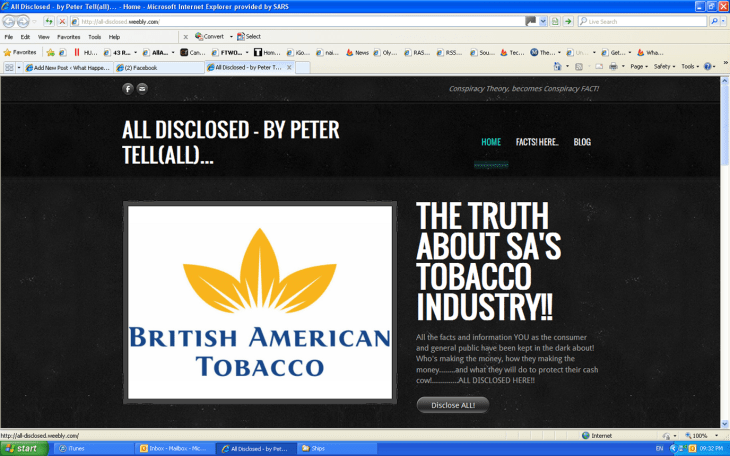
Peter Tell-AllWith much international focus on tobacco and tobacco products its great to read something outside of the mainstream media. Evidently this guy has some real insight in the tobacco industry and he sure is passionate about his views. This is a fine example of ‘Social Media’ providing what your average Google search-and-hit will never reveal. Conspiracy theory or not, this is a site dedicated to one thing – exposing the ‘Anglo-American tobacco cabal’. Aptly titled “All Disclosed by Peter Tell(all)” he invites you………

…………… to browse, interact and explore my website dedicated to the exposure of facts, truths and the responsible sharing of the information contained within these pages, about South Africa’s Tobacco Industry! The compilation of articles and also unpublished fact sheets about how this very lucrative and secretive industry operates has up until now been a very dark and well-kept secret! Why would all this information be kept from us? Why would they not want us to know how much money is being made? Why does the Government play both sides of the fence? Who pulls the strings of the authorities? THESE ARE THE QUESTIONS WE SHOULD BE ASKING!!

How the Groenewald Gang made millions off illicit wildlife trafficking

rhino-1Dawie Groenewald of South Africa and 11 conspirators were arrested in September of 2010 on 1,872 counts of racketeering, including illegal trade of rhino horns. Among those arrested are two veterinarians, Karel Toet and Manie Du Plessis, as well as several professional hunters. This case is one of the biggest wildlife cases seen in South Africa and has been postponed several times since 2010. It is currently scheduled for early May 2013.

Groenewald owns a big game farm in Polokwane, South Africa as well as Out Of Africa Adventurous Safaris. A burial site of over a dozen horn-less rhinos was found on his property in 2010. Investigators show that these rhinos are thought to have been purchased from the South African National Parks in 2007-2010. In order to increase his profit margin, Groenewald decided to slaughter the rhinos after removing their horns; thus eliminating any upkeep costs associated with live rhinos.

Rhino horns are worth up to $60,000 per kilo in parts of East Asia, namely China and Vietnam. They are thought to possess medicinal value, including curing cancer and small ailments such as fevers and headaches.  Rhino poaching in South Africa has been rising steadily over the past several years. According to South Africa’s Department of Environmental Affairs, approximately 588 rhinos were poached in 2012. One could point to China and Vietnam’s increased affluence as having increased this demand.

Investigators have so far seized $6.8 million in assets from Groenewald, Toet, and Du Plessis. They also uncovered Valinor Trading CC, a “closed company” Groenewald used to launder money. However, this was not Groenewald’s first run in with the law. Groenewald is a former police officer and was discharged because of his ties to a car smuggling ring allegedly outfitted by ZANU PF, the ruling party of Zimbabwe’s notorious Robert Mugabe. Groenewald was arrested in Alabama in April 2010 for importing an unlawfully hunted leopard trophy. He was banned from the U.S. and ordered to pay a $30,000 fine as well as a $7,500 fee to the buyer in Alabama.

There is some evidence that the Groenewald Gang is part of a bigger international syndicate of illegal wildlife trafficking headed by high-ranking officials in Zimbabwe.

Groenewald and his associates are out of business, but many more like them remain. Poaching is a big business, and like any illicit business only exists at the scale it does because of the global shadow financial system. Money that Valinor Trading CC conceals becomes an illicit financial flow, and eventually must be deposited in a financial institution somewhere. Authorities have frozen $6.8 million of Groenewald’s assets, but who knows how much more is hiding behind a shell company’s bank account in some far-off tax haven.

It makes no sense that while Western countries work to protect endangered and threatened species from people like Groenewald and his clients, they simultaneously undermine these same policy goals by allowing money to be easily concealed. Article by Regina Morales who is a Policy Intern at Global Financial Integrity.

Counterfeit luxury products not simply a question of trademark infringement

stock-photo-intellectual-property-and-related-words-in-word-collage-100324247Smart, Biggar, and Fetherstonhaugh, a Canadian law firm practising exclusively in intellectual property and technology law, advises that deterring counterfeiters is particularly important to luxury brand owners. For this reason, they should always keep in mind that augmented damage awards may be available when seeking concurrent relief for copyright infringement as well as trademark infringement. Similarly, brand owners in copyright industries should keep this in mind and consideration should be given to seeking both copyright and trademark relief in all counterfeiting and pirating scenarios in Canada. Considering the question from the point of view of luxury brand owners exemplifies the point.

Copyright aims to protect against the unauthorised reproduction of original literary, dramatic, musical and artistic works. Logos and designs or patterns used by luxury brands may constitute artistic works in which copyright subsists in Canada. Further, in the case of a counterfeit item, such works are clearly reproduced without the consent of the copyright holder.

Smart & Biggar states that even though trademark and copyright law each protect different interests, they are not mutually exclusive and in many cases the sale and distribution of a counterfeit product or a pirated copyright work may constitute both trademark and copyright infringement. In such circumstances, they recommend brand owners to be mindful of the possibility of claiming both trademark infringement and copyright infringement not only to maximise their damages but, ultimately, to have an increased deterrent effect on counterfeiters [in Canada]. Source: Smart & Biggar/Fetherstonhaugh

Malaysian Customs Ivory Bust in pictures

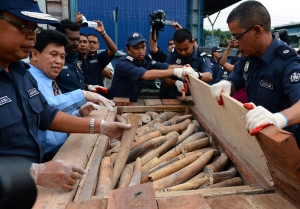
1,500 pieces of tusks seized at the Royal Malaysian Customs were hidden in wooden crates, purpose-built to look like stacks of sawn timber! The following pictures illustrate the Malaysian Customs ivory bust in progress. Pictures courtesy of WWF Singapore (their Facebook Page) – . Also see full report at  http://www.traffic.org/home/2012/12/11/massive-african-ivory-seizure-in-malaysia.html.

Related articles

Massive Ivory Stash Seized In Malaysia


Malaysian Customs officers uncovered illegal ivory concealed within secret compartments in a shipment. (Getty Images)

Malaysian Customs officers uncovered illegal ivory concealed within secret compartments in a shipment. (Getty Images)

The Royal Malaysian Customs has received congratulatory messages from South Africa and the World Customs Organisation after thwarting one of the biggest ivory smuggling operations in recent memory. On Monday, Selangor Customs had seized 24 tonnes of elephant tusks and ivory worth US$20 million (RM60 million) in Port Klang from a China-bound ship that is believed to have sailed from Togo.

It is estimated that 750 elephants were killed to produce the quantum of tusks and ivory that was seized. To date, this is the biggest seizure of its kind in Malaysia. Confirming the seizure, Selangor Customs corporate communications chief Mohd Zhafri Johari explained:  “In the China market, ivory could fetch a price of approximately US$25,000 per kilogramme”.

Those arrested will be charged in court under Section 133(1)(a) of the Customs Act 1967 for false declaration and under the Convention for International Trade in Endangered Species of Wild Fauna and Flora. This international treaty was drawn up in 1973 to protect wildlife against over-exploitation and to prevent international profiteering which involved threatening of species.

Zhafri also noted that the smuggling of ivory through Port Klang was a rare occurrence prior to 2011. Since then, however, customs have made at least three major seizures. The seized ivory is now considered government property and will be destroyed upon completion of investigation and prosecution of the suspected parties. The 1,500-odd tusks were found in two containers. Although shipping documents listed the containers’ final destination as Port Klang, customs intelligence said the containers were planned to be sent to China. Source: Thesundaily.com

Tobacco industry uses trade pacts – to snuff out anti-smoking laws

Anti-tobaccoAs countries around the world ramp up their campaigns against smoking with tough restrictions on tobacco advertising, the industry is fighting back by invoking international trade agreements to thwart the most stringent rules.

A key battlefront is Australia, which is trying to repel a legal assault on its groundbreaking law requiring cigarettes to be sold in plain packs without distinctive brand logos or colors. Contesting the law, which came into effect Dec.1, are the top multinational cigarette makers and three countries — Ukraine, Honduras and Dominican Republic — whose legal fees are being paid by the industry.

The dispute underlines broader concerns about trade provisions that enable foreign companies to challenge national health, labor and environmental standards. Once a country ratifies a trade agreement, its terms supersede domestic laws. If a country’s regulations are found to impose unreasonable restrictions on trade, it must amend the rules or compensate the nation or foreign corporation that brought the complaint. In the case of Australia’s plain packaging law, the tobacco industry and its allies are challenging the measure as a violation of intellectual property rights under trade agreements the nation signed years ago.

Public health advocates fear the legal attack will deter other countries from passing strong measures to combat the public health burdens of smoking. The “cost of defending this case, and the risk of being held liable, would intimidate all but the most wealthy, sophisticated countries into inaction,” said Matthew L. Myers, president of the Campaign for TobaccoFree Kids in Washington D.C.

The advocates also say countries should be free to decide how best to protect public health, without being second-guessed by unelected trade panels. Moreover, they argue, tobacco products, which kill when used as intended, should not be afforded the same trade protections as other goods and services. Worldwide, nearly 6 million people a year die of smoking-related causes, according to the World Health Organization, which says the toll could top 8 million by 2030. With fewer people lighting up in wealthy nations, nearly 80 percent of the world’s 1 billion smokers live in low and middle-income countries.

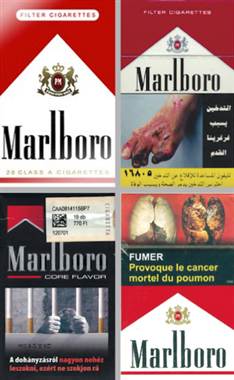
Marlboro, the world’s top-selling brand, packaged under labeling laws of (clockwise) the U.S., Egypt, Djibouti, Hungary/Photos of non-U.S. packs, Canadian Cancer Society

Marlboro, the world’s top-selling brand, packaged under labeling laws of (clockwise) the U.S., Egypt, Djibouti, Hungary/Photos of non-U.S. packs, Canadian Cancer Society

Countries have been emboldened to pass more stringent measures by the Framework Convention on Tobacco Control. In effect since 2005, the treaty has committed about 175 nations to pursue such measures as higher cigarette taxes, public smoking bans, prohibitions on tobacco advertising, and graphic warning labels with grisly images such as diseased lungs and rotting teeth (The U.S. has signed the treaty, but the Senate has not ratified it. The U.S. Food and Drug Administration has ordered graphic warnings for cigarette packs, but an industry court challenge on 1st Amendment grounds has stalled the rule.)

Cigarette makers say they acknowledge the hazards and the need for regulations. “We actually support the vast majority of them,” said Peter Nixon, vice president of communications for Philip Morris International, which has its headquarters in New York, its operations center in Switzerland, and is the biggest multinational cigarette maker with 16 percent of global sales.

But the industry has watched with growing concern as more than 35 countries have adopted total or near-total bans on cigarette advertising. Its big profits depend on consumer recognition of its brands. Yet in many countries, the once-ubiquitous logos and imagery are receding, leaving the cigarette pack as a last refuge against invisibility.

Now the pack, too, is under attack. Along with plain packaging laws such as Australia’s, countries are weighing retail display bans that keep cigarette packs out of view of consumers, and laws requiring graphic health warnings so large that there is barely any room for trademarks. Tobacco companies contend that countries enforcing such rules are effectively confiscating their intellectual property and must pay damages.

The industry also claims that measures like plain packaging are counterproductive. “We see no evidence — none at all — that this will be effective in reducing smoking,” Nixon of Philip Morris International said in an interview. In fact, he said, generic packaging likely will increase sales of cheap, untaxed counterfeit smokes, thus increasing consumption (my emphasis added).

Comment: And for me this is the bottom line. Governments are happy to collect the ‘sin tax’ every year, most increasing it annually under the pretext of curbing the use of alcohol or tobacco products. Forcing draconian law will only increase the contraband ‘underground’ which these same governments have little control over. The worldwide push under the WHO banner appears to have more of a ‘social conditioning’ connotation than a health one.

Zambia – government to crack whip on crossborder smuggling

New Kasumbalesa border post facility - time to jack up cross-border security

New Kasumbalesa border post facility – time to jack up cross-border security

Copperbelt Permanent Secretary Stanfold Msichili says Government will enhance security measures to curb rampant illegal activities at Kasumbalesa Border Post which threaten public security. Mr Msichili has also directed Chililabombwe acting District Commissioner, Frank Siatwinda, to establish how Congolese managed to set up a booming trading place on the Zambian soil where assorted wares were being sold.

He said the Government would find a lasting solution to combat rampant illegal activities which threatens public security and that there were plans to engage concerned parties from the Democratic Republic of Congo (DRC). The Open Market has been built on our land because of its proximity to the trading area. It will not be easy to control the situation but Government is committed to finding a long-term solution.

Mr Msichili was saddened that scrap metal from DRC, which was banned for export in that country, was being smuggled into Zambia and reloaded for onward transportation to South Africa. He’s adamant that these issues should be addressed by the police, customs and immigration because we are allowing scrap metal to pass through the country. Earlier, Zambia Revenue Authority (ZRA) Kasumbalesa Border station manager Levy Simatimbe told Mr Msichili’s delegation that illegal activities were rampant at the border with some Congolese traders at the controversial Open Market on the Zambian side selling the banned alcohol, ‘Tujilijili’.

During the tour, Kasumbalesa police assistant superintendant Anthony Mphanza said the existence of the Bilanga Township, a few metres from the Zambian side where the population of foreigners was swelling posed a security threat. The Bilanga Township may encroach the Zambian side because its population of foreigners was concentrating along the areas where there was potential for trading in essential basic commodities, like maize meal, cooking oil, sugar, timber, household items, among other items. Illegal trade in cement was becoming a huge public concern at the border. It is estimated that about five tonnes of cement was illegally sold to DRC everyday. Congolese freely come to Comesa Market at Kasumbalesa Border to sell and buy different items. They carry about 10 bags of 25 kilogrammes on a bicycle. Source: The Times (Zambia)