Ready for a cock-fight?

Brazil has taken the first legal step at the World Trade Organisation to challenge South Africa’s use of anti-dumping measures on shipments of Brazilian poultry meat, the global trade body said in a statement on Friday. Brazil has “requested consultations” with South Africa over South Africa’s accusation that Brazilian imports were “dumped”, or sold at an unfairly low price that damaged South Africa’s own poultry sales, the WTO said. If the consultations fail to resolve the issue, in 60 days’ time Brazil could ask the WTO to set up a panel to adjudicate.

The statement did not give any more details, but South Africa’s International Trade Administration Commission (ITAC) has imposed anti-dumping duties on frozen chickens and chicken meat imported from Brazil after investigating suspected dumping in 2008-2010. In 2010, Brazil accounted for 94.2% of South Africa’s total 26,916 tonnes of boneless chicken imports and 44.6% of the total 29,039 tonnes of whole chicken imports, ITAC’s investigation report said in January.

After calculating the extent of the unfair competition, South Africa put a provisional anti-dumping duty of 62.93% on whole chickens and 46.59% on boneless cuts from Brazil, except for boneless cuts from Aurora Alimentos, which would incur a duty of 6.26%.  The dispute is the first between Brazil and any African country and only the fourth brought against South Africa at the WTO.

All of the previous three cases, brought by India, Indonesia and Turkey, also concerned South Africa’s use of anti-dumping measures to protect its market from unwanted imports. None of those three disputes advanced to the panel stage. India and Turkey did not press their cases and Indonesia withdrew its challenge after South Africa withdrew its anti-dumping measures. Source: News24

Global union body seeks box weigh-ins before stacking rules change

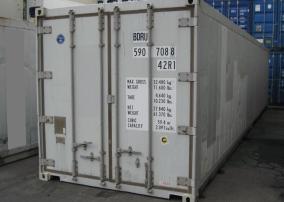
Container weight misdeclarations will compromise safety if new rules are accepted to allow 10 per cent more cargo aboard ships in the 4,000- to 16,000-TEU range, says the International Transport Workers’ Federation (ITF).

The Lloyd’s Register liberalisation proposals to increase the stacking of boxes on board is backed by the forwarding lobby FIATA (Federation Internationale des Associations de Transitaires et Assimiles), but ITF port representative Albert Le Monnier says the measure is “absurd” without the verification of weights of laden containers before loading. “Look at the problem of misdeclaration we’re experiencing,” said Mr Le Monnier, former vice-president of Canada’s west coast section of the International Longshore and Warehouse Union (ILWU).

“As a rule, self regulation has a very poor record.” The World Shipping Council (WSC), the Baltic and Maritime Council (BIMCO) and International Chamber of Shipping (ICS) as well as the US, Denmark and the Netherlands are seeking verification of weight of loaded containers as a pre-loading condition for ships.

The practice needs to be shared or to be assigned to the shipper, consignor or consolidator through a system of roadside weigh bridges en route or have a weigh bridges at the terminal, said Mr Le Monnier, reported the London’s Loadstar.

The cost to the terminal operator would be passed on to carriers, then on to the shipper, and ultimately end up in a negligible consumer end-price, said Mr Le Monnier. It is essential, he said, that any weighing verification of loaded containers isn’t rushed through without careful thought by the IMO “correspondence group” due to report back by June 2013, ahead of the deadline for deliberation in September on the issue.

Stacking weights differently aboard could increase cargo 10 per cent for 18,000-TEU vessels allowing for operational flexibility, said the Lloyds Register marine director Tom Boardley. “These results indicate clearly that we will be able to allow much higher cargo weights and enable more operational flexibility – and to do this in safety,” he said. “The potential in cargo increase is considerable.” Source: http://www.seanews.com.tr

Border Madness!

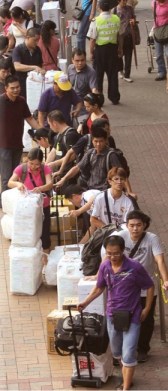
Mainland Chinese visitors line up and wait for check in outside Hong Kong’s Sheung Shui train station with packages of diapers to be parallel imported into Shenzhen for resale.

While communist China bears the brunt of criticism for its exportation of low cost and in many cases inferior products to the rest of the world, the following article suggests one should spare a thought for the Chinese citizens themselves given what they have to put up with from the authorities between Hong Kong and Shenzhen.

The recent hard crackdown on smugglers and couriers across the boundary between Hong Kong and Shenzhen has cut deeply into the business of parallel trading on both sides of the border, and thus far, appears to have reduced the nuisance problem caused to residents of the northern New Territory. However, with the crackdown on-going and the Mass Transit Railway Corporation (MTR) adding further pressure by restricting the dimensions and weight of passenger luggage going across the border, complaints have started buzzing, that the move may have frightened away the passenger couriers, but not the syndicates coordinating them behind the scenes.

Effective 9 October 2012, the Mass Transit Railway Corporation (MTR) imposed a maximum weight limitation of 32 kilograms or 130 centimetres in length for passenger luggage on the East Rail Line, under a three-month trial scheme. Could you just imagine this at an African border crossing? Passengers are allowed only one piece of baggage. All their small parcels and suitcases are required to be bundled up into a single “package,” all part of the bid to curb the passenger-couriers whose clamouring and crowding had become a serious issue for neighbours of MTR in New Territories.

The restrictions were seen as MTR’s contribution to the collaborative effort that involved governments on both sides of the border, to cut down on so-called parallel traders and smugglers. MTR’s new rule has, in general, earned praise from residents of northern New Territory because the nuisance problem caused by the traders/smugglers has been alleviated. However, for residents of Shenzhen, who travel back and forth every day, or residents of `other parts of the mainland who come to Hong Kong for shopping, the size and weight limitations seem be “unnecessary” and “troublesome”.

“I was often asked to buy things in Hong Kong on my way home: cooking oil, rice, baby formula, tissues, etc. I really don’t have time to care about how heavy they are or how long they are,” said Go, a resident of Shenzhen. He Hua, also a Shenzhen resident living in Luohu district who comes to Hong Kong to go shopping two to three times a month, also doesn’t like the new limitation. “I came to Hong Kong regularly to buy things for myself and my family. I paid my money and followed regulations of the Customs, why should I worry about my weight and length? If the goods are all legal, why can’t I take them on the train at one time?” said Hua, who had carried six cans of baby formula with her, which she claimed were for her elder sister’s baby.

Recently, there has been a strengthened effort to combat parallel trade, with a collaborative effort between the Customs and Excise Department of the SAR and the Shenzhen Anti-Smuggling Bureau. The action uncovered 120 cases of parallel trading and made 123 arrests, with the unpaid taxation of the confiscated goods amounting to one million yuan. On the other side of the border, business associated with cross boundary goods was also affected. In North Huaqiang district in Shenzhen, which had been long recognized as the “centre of parallel trading” of “grey goods” from Hong Kong, business has shrunken since the crackdown.

A shop owner in North Huangqian area told China Daily that he had expected to make a huge profit by selling iPhone 5, the latest release by Apple Corporation. It never happened, because his Hong Kong supplier informed him that it was too difficult and that it was risky to get the iPhone 5 across the border. And the seller couldn’t get the supply he had counted on.

“The whole business chain of parallel trading depends on the ‘suppliers’ to smuggle goods from Hong Kong to Shenzhen, especially electronic goods. Now the suppliers have trouble getting through the border, (so) we have trouble getting the goods,” said the anonymous shop owner. Because of serious supply shortage, the price of “grey goods” has soared significantly on the mainland side of the border. The best example was iPhone, which sold originally at HK$5,688 (US$733.8) at the Apple Store in Hong Kong, but was priced at 8,000 yuan (US$1276.5) at the anonymous shop owner’s store. Insiders of the courier industry also told China Daily that the price for smuggling goods across the border with “ant house-moving” tactics had increased from 22 yuan per kilogram to a record high of 50 yuan per kilogram.

The business of stores that sell Hong Kong goods in Shenzhen has picked up since the crackdown, as people who live along the border in Shenzhen choose to buy daily-use goods in local stores – like cooking oil, rice and baby formula, instead of going to Hong Kong by themselves. “We have adequate Hong Kong goods, don’t worry; they are all fresh and delivered to us fresh every day,” said the owner of a store selling Hong Kong goods in Shatoujiao, or Sha Tau Kok in Cantonese, in eastern Shenzhen. The store owner refused to answer how he managed to get “adequate supply” from Hong Kong every day.

The crackdown on smugglers, especially the MTR weight limitation, had stopped individual couriers; however, it didn’t shut down the syndicates coordinating behind the scenes. What’s more, there are some 157 online stores that sold Hong Kong goods on Taobao, the biggest online shopping market in the mainland. The record on the website showed that one of the big shops had sold out 1,357 pieces of Hong Kong goods in the past week, 90 percent of which are daily use goods and food. Source: The China Daily

“Blood Ivory” – Huge seizure of Illegal Ivory in Hong Kong

An emperor, faced with the task of selecting a successor, devises a test: he lays out an array of valuable artifacts — items of gold, jade and ivory — and asks each of his sons to choose one treasure. One prince ponders his options for a while, before selecting an ivory scepter. The emperor is pleased. Ivory is valuable, he says, and also imbued with wisdom. The son with the scepter will rule. This, of course, is merely a fable. But the tale of the emperor and his son hints at ivory’s enduring lure in China. For millennia, it has been seen as a symbol of wealth, a source of wisdom and a sign of nobility. This helps explain why more than 20 years after an international ban on the trade of elephant ivory, the business is booming. “With more disposable income in mainland China, many people are flaunting their wealth, and ivory is seen as a luxury product that confers status,” says Tom Milliken of the Wildlife Trade Monitoring Network. “We are seeing the worst poaching of elephants and the worst illegal trade in ivory over the last 23 years.”

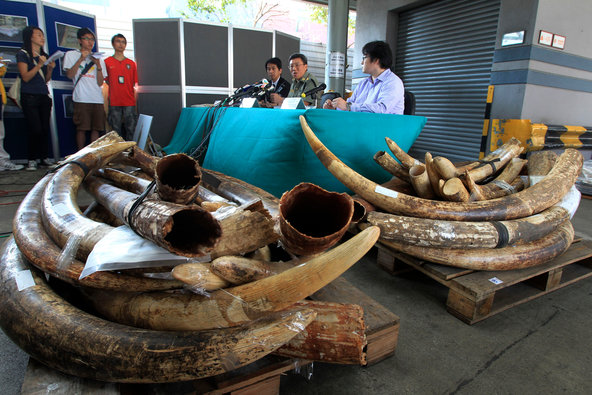
Authorities in Hong Kong have intercepted one of the largest shipments of illegal ivory in history – 1,209 elephant tusks and ivory ornaments weighing more than 8,400 pounds. The Hong Kong Customs and Excise Department announced the seizure on Saturday of 3,813 kilograms of ivory hidden inside two containers shipped from Tanzania and Kenya. One container was labeled as carrying plastic scrap, the other was marked as dried beans.

It was the largest-ever seizure of contraband ivory in Hong Kong. Even within the context of soaring wildlife poaching, the numbers are staggering: the equivalent of more than 600 dead elephants. So lucrative is the ivory trade now that well-armed mafias have gotten in on the act. Hong Kong officials estimated the value of the seizure at 26.7 million Hong Kong dollars, or just under $3.5 million.

The customs agency, which said in a statement that it had “smashed” the ivory smuggling case, reported no arrests. But the South China Morning Post reported that seven people in China were arrested in connection with the seizure. Demand from an increasingly affluent Asia, improved international transport and trade links, and weak enforcement and feeble penalties (in many countries) have caused wildlife poaching to jump over the past decade or two.

More than 300 elephants were killed in Cameroon alone early this year. A video from the World Wildlife Fund shows some of that grim slaughter. In this article, published in September, Jeffrey Gettleman reported that ivory — like blood diamonds from Sierra Leone or plundered minerals from Congo — is now a “conflict resource,” used to help finance conflicts across the African continent.

“Some of Africa’s most notorious armed groups, including the Lord’s Resistance Army, the Shabab and Darfur’s janjaweed,” he wrote, “are hunting down elephants and using the tusks to buy weapons and sustain their mayhem.” Members of some of the African armies backed by the U.S. government, Jeffrey reported, also have been implicated in poaching elephants and dealing in ivory. Source: New York Times

Related Articles

Mauritius Customs turns 200

Mauritius Customs 1st Day CoverOn the ocassion of my 300th post, join me in raising the Portcullis for Mauritius Customs! During September, the Mauritius Revenue Authority (MRA) marked the bicentenary celebrations of Customs services in Mauritius by launching a special First Day Cover with four stamps on the Customs Department to mark the bicentenary celebrations of Customs Services in Mauritius. The issue of these new stamps is an acknowledgement of the significant contribution of the Customs services to the economic and social life of the country for more than 200 years. The four stamps depict the Customs Services in different fields with denotation of Rs 7, Rs 8, Rs 20 and Rs 25 illustrating some of the areas where the customs services are involved in their fight against crime and fraud prevention through the use of people, animals and state-of-the-art technology.

On 18 August 1797, a ‘bureau de Douane’ was established for the purpose of raising revenue in a context of war and blockade. It became a major financial institution contributing towards 50% of total revenue. The British took over in 1811 and installed the first Collector of Customs.British Customs practices were gradually introduced in the colony in line with British commercial law.

In modern times, the MRA Customs Department has set as one of its main objective to combat the illicit trade of drug and other illicit substances. The MRA has a team of 6 drug detector dogs handled by certified dog handlers trained by the French Customs and the South African Revenue Services (SARS). Our dogs have been selected carefully from examined litters and were declared competent drug detector dogs as per SAQA Unit Standard in the handling of a service to detect illicit substances.

Since 2008, our sniffer dogs have detected drugs in 25 instances involving the import of Cannabis, Heroin, Hashish, Subutex and other illegal substances worth around Rs 42,530,543. The Drug Detector Dog squad operates at the courier services, Parcel Post Office, Vehicle Search at Airport, Port and Freight Stations, Port area, Airport (Plaisance Air Transport Services & Luggage on carrousels at SSR Int. Airport and Aircraft search) as well as at the seaport for search of vessels. Source: Mauritius Revenue Authority

Car importers slam KRA transit vehicles rule

Is the time for a regional transit bond nigh? Given prevailing draconian measures to ensure security and surety, the message is clear that customs brokers, freight forwarders or clearing agents need to demonstrate financial security over and beyond what they are accustomed to. Question – is the transit business lucrative for agents? Why not refuse the business – its just not worth the risk.

A requirement by the Kenya Revenue Authority demanding that all imported transit vehicles above 2000cc be cleared against cash bonds or bank guarantees has been opposed by clearing agents in Mombasa. The agents, under their umbrella Kenya International Freight and Warehousing Association, have threatened not to pay taxes if the regulations are not withdrawn by the tax collector. The agents said that the stringent measures by KRA may stifle trade in the region and may also see the port of Mombasa losing some foreign importers to the port of Dar es Salaam in Tanzania. “We as clearing agents cannot pay the bonds for the importers”.

On August 31, KRA directed all clearing agents that with effect from September 1, all transit vehicles exceeding 2000cc would be cleared against a cash bond or bank guarantees paid by the agents. The forwarders also said that Uganda, Rwanda and DR Congo business class was considering ditching Kenya as an import avenue for Dar es Salaam port. Source: The Star (Nairobi)

South Sudan: The roles of Commerce and Customs

The newly formed state of South Sudan, demonstrates a painful understanding of trade and customs. Evidently this is the product of political thinking, or poor journalism, or zero understanding of economics and administration. I wonder what Customs role really is?

The Director General of Trade in the Ministry of Commerce, Industry and Investment Stephen Matatia said that his office is not for collecting tax revenue but only for imposing penalties on those who break the law and order. He said it is the Customs Service staff who have the responsibility of collection revenues. The ministry of Commerce staff are only there to collect the penalties from those traders who break the laws and orders of the land related to trade and commerce. He said their other function is the imposition of laws on prohibited goods.

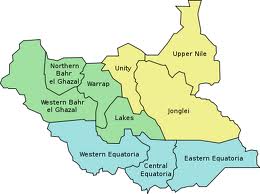
Staff of ministry of Commerce stationed in Nimule border checkpoint report to headquarters in Juba every 15 days to present comprehensive report on their duties. He said the Ministry is preparing to open more offices in other parts of Greater equatorial and in Greater Upper Nile in the border with Ethiopia.In Western Equatoria, Greater Bahr Ghazal, Unity State, bordering with Sudan, Central Africa Republic, Congo, will need offices,” he declared. Matatia observed that in some countries of Africa a lot of ministries of commerce are being classified together with industry thus they have ministries for industry, commerce, supply and cooperatives. Source: AllAfrica.com

Customs Modernisation – some benefits in the offing


Its been a while since I penned some comment on the customs modernisation programme in South Africa. Amongst the anxiety and confusion there are a few genuine ‘nuggets’ which I would hope will not go unnoticed by the business community. With stakes high in the area of business opportunity and competitiveness, such ‘nuggets’ must be adopted and utilised to their fullest extent. Lets consider two such facilities.

The widespread implementation and adoption of electronic customs clearance has allowed brokers to file declarations for any customs port from the comfort of their desks. Brokers can now consider centralised operations especially for customs clearance purposes. Likewise the withdrawal of the annoying goodwill bond should also come as a welcome decision. Hopefully this may translate into cost-savings over time.

As of 11 August 2012, the business community will also be glad to learn that imported goods which do not fully meet all national regulatory requirements can be entered into bond on a warehouse for export (WE) basis. While this may not sound like anything new, the provisions which come into effect, will accord the identical treatment of such goods as if they were being entered for warehousing. In short the new provisions will allow more flexibility with the ability to re-warehouse WE goods; the ability to change ownership on WE goods; and the ability to declare WE goods for another customs procedure.These provisions can be considered a relaxing of the original approach which mandated compulsory exportation. All government regulatory requirements (i.e. permits, certificates, etc.) will however be strictly enforced upon clearance of WE goods for home use or another customs procedure. The apparent relaxation forms part of ongoing alignment of customs procedures with the Customs Control Bills, which are in the process of finalisation.

For those who have enquired about the followup to the national transit procedure, I have not forgotten about it. The ‘touchy’ nature of the subject requires a mature and fair response. Please bear with me.


Cloud Computing update

Cliffe Dekker Hofmeyr offers an appraisal on the Working Paper on Cloud Computing – Privacy and Data Issues, recently published by International Working Group on Data Protection in Telecommunications. Although the guidelines detailed in the Working Paper are not mandatory, it appears that the intended approach to data protection in the cloud is one of uniformity, with a view to ultimately developing best practice based processing of personal information. It would be interesting to understand to what extent S ATrade Hub  and Microsoft, in conjunction with the Customs of Namibia and Botswana, considered any such guideline in regard to their cloud computing initiative on the Trans-Kalahari Corridor?

The recommendations under the Working Paper highlight some of the risks and complexities associated with cloud computing. The overreaching nature of the Working Paper will serve to ensure that there is no lowering of general data protection standards for processing personal data in the cloud. The Working Paper specifically advocates the following general recommendations:

  • Carrying out privacy impact and risk assessments prior to embarking on cloud computing projects.
  • Development of practices by cloud service providers to ensure greater transparency, security and accountability regarding information on potential data breaches; and also more balanced contractual clauses to promote data portability and data control by cloud users.
  • Research, third-party certification, standardisation, privacy by design technologies and other related schemes in order to achieve a desired level of trust in cloud computing.
  • Legislative reassessment of the adequacy of existing legal frameworks allowing cross border transfer of personal information and consideration of additional privacy safeguards.
  • Accounting for independent audit trails with regards to the location of the personal information. Continuity in the provision of information by data controllers to privacy and data protection authorities. These recommendations are aligned to the general principles set out in the European Union and Safe Harbor data privacy frameworks.

The Working Paper also provides more specific recommendations, on ‘best practice’, ‘controllers’, ‘cloud service providers’ and ‘auditing’. These specific recommendations contemplate the implementation of technical measures that can be used to determine the exact physical location where personal information is held and stored, with an audit trail specifying any copying and/or deletion of personal information. In addition, the Working Paper includes a suggestion for encryption of all personal information (both at rest and in transit) and also recommends the conclusion of agreements between data controllers and cloud service providers to expressly designate and limit the physical locations where personal information will be processed. The Working Paper specifically provides that the cloud service provider should not be entitled to use personal information in the cloud for its own purposes.

It is likely that significant steps will need to be taken by cloud service providers in order to comply with the recommendations under the Working Paper and/or applicable data protection laws, which may potentially require substantial financial resources, including for procuring and implementing the appropriate technology required to give effect to the recommendations and/or laws.

In the South African context, the principles under the current draft of the Protection of Personal Information Bill(PPI) (in particular, the provisions which relate to the conditions for lawful processing of personal information and transborder information flows) can be aligned to the recommendations under the Working Paper. The real test for cloud service providers and their customers will however be in the practical implementation of the principles under PPI. Many of the recommendations under the Working Paper will serve to provide guidance in this respect, particularly in the measures which need to be implemented to maintain a level of transparency in the supply chain of personal information in the cloud. Source: www.cliffedekkerhofmeyr.com

RELATED ARTICLES

WCO 2012 Photo Competition winner

This year’s entries provide a wealth of historic and ‘yesteryear’ character in testimony to the traditional role of customs officers. I for one feel this portrayal is the more lasting impression that real customs officers will remember. While the modern border officer certainly has a lot more gizmo’s and sophisticated gadgetry at his/her disposal, it somehow offers little more than superficial value. Even the digital photographs of today require manipulation to introduce period artefacts or correction to create the desired result.

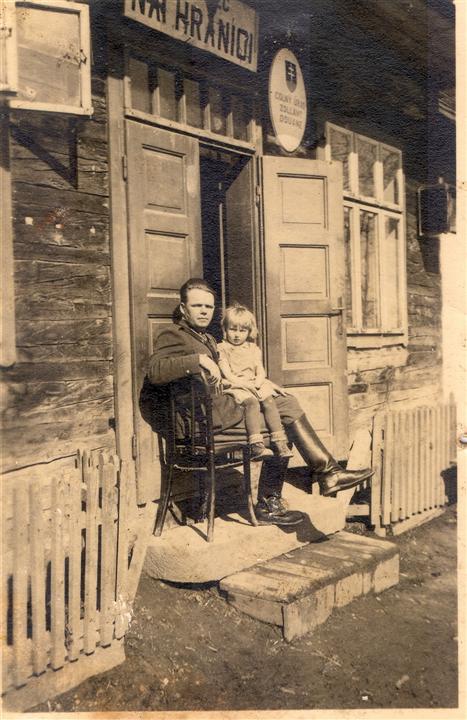
This years winning entry was submitted by Slovakia Customs. It depicts a fulltime customs officer of the Financial Guard on duty at the Klokočov road crossing point on the border between Slovakia and the Protectorate of Bohemia and Moravia, sitting with his young daughter on his lap.

The modern world’s seeming disdain of family values is in stark contrast to the natural warmth of a father and child in this picture. This would be unheard of in many jurisdictions of paranoia we call the customs and border control environment today. We grow evermore suspicious and untrusting of our fellow citizens to the danger that the essential purpose and physical portrayal of public service is an after-thought.

The WCO has put together a wonderful compendium of all this year’s entries. This is a competition not so much about a winner, but a celebration of the wealth and depth of customs tradition accross the globe. Click here to view all the entries!

WCO News – 60 year Anniversary Edition

The Organization is celebrating its 60th anniversary, an occasion which gives the global Customs community the chance to reflect on where the WCO began, where it is now, and where it hopes to go in the future. This issue highlights some of the WCO’s milestones past and present, we take a brief look at the WCO’s historical beginnings and subsequent development, follow one man’s forty year Customs journey, look at the history of containerization: the box that changed the world, and even step back to 1969 when the Apollo 11 touched down on the surface of the moon. In this dossier, not only does the WCO look back with pride, but also looks forward with optimism, conscious of the fact that the WCO has served the global Customs community with dedication for sixty years, and will continue doing so to ensure that Customs administrations remain well-positioned to deliver effective and efficient services around the world. Also in this issue –

  • Doorless containers now a reality,
  • US/EU mutual recognition programme,
  • New guidelines included in WCO Revenue Package,
  • Globally Networked Customs,
  • GS1 and the WCO,
  • Algeria Customs and performance management,
  • Georgia’s success in rooting out corruption,
  • Hong Kong moves forward with its e-Lock plans.

Source: http://www.wcoomd.org

Revisiting the national transit procedure – Part 1

FTW Online last week ran an interesting article in response to a proposed change in Customs’ policy concerning the national transit movement of containers from coastal ports to inland container terminals and depots. In February 2011, I ran an article Customs Bill – Poser for Cargo Carriers, Handlers and Reporters alluding to some of the challenges posed by this approach. The following article goes a step further, providing a trade reaction which prompts a valid question concerning the practicality and viability of the proposed change given logistical concerns. I believe that there is sufficient merit in the issues being raised which must prompt closer collaboration between the South African Revenue Service and trade entities. For now it is sufficient to present the context of the argument – for which purpose the full text of the FTW article is presented below. In Part 2, I will follow-up with SARS’ response (published in this week’s edition of the FTW) and elaborate on both view points; as well as consider the matter  on ‘raw’ analysis of the ‘cargo’ and ‘goods declaration’ elements which influence this matter. Furthermore, one needs to consider in more detail what the Revised Kyoto Convention has to say on the matter, as well as how other global agencies are dealing and treating the matter of ‘security versus facilitation’.

Customs’ determination to have all goods cleared at the coast does not bode well for the South African trade environment, Pat Corbin, past president of the Johannesburg Chamber of Commerce and Industry (JCCI), said. Speaking at the Transport forum in Johannesburg Corbin said the Customs Bills have been on the cards for several years now and while consensus had been reached on most issues in the Nedlac process, the determination of Customs to not allow for any clearing to take place at inland ports will only add more pressure to the already overburdened ports in the country. “Customs maintains that despite the changes they propose it will be business as usual. We disagree. We have severe reservations about their intention to terminate vessel manifests at the coastal ports in all cases and have called for further research to be undertaken in this regard,” said Corbin. “By terminating the manifest at the coast it has severe ramifications for moving goods from road to rail. International experience has shown when you have an inland port and you have an adequate rail service where the vessel manifest only terminates at the inland port, up to 80% of the boxes for inland regions are put on rail while only 12% land on rail if the manifest terminates at the coastal port.” Corbin said the congestion at both the port and on the road would continue and have an adverse impact on quick trade flows. “It also raises issues around the levels of custom security and control at inland ports and then the general implications on the modernisation project.” According to Corbin, government’s continued response has been that no provision exists for inland ports and that goods must be cleared at the first port of entry. “They maintain that it is about controlling goods moving across our borders and thus the requirement that all goods must be cleared at the first port of entry. The security of the supply chain plays an important role to avoid diversion or smuggling of goods,” said Corbin. “Government says that the policy change will not clog up the ports or prohibit the seamless movement of trade. Labour organizations and unions seem to agree with them.” But, Corbin said, the Johannesburg Chamber of Commerce differs and is worried about the ramifications of this dramatic change to the 35-year-old option of clearing goods at an inland port or terminal. “With this policy change all containers will have to be reconsigned after not only Customs clearance on copy documents but also critically, completion of shipping lines’ requirements ie, payment of freight, original bill of lading presentation and receiving delivery instructions prior to their issuing a delivery order.” Corbin said the issue had been addressed directly with Transnet CEO Brian Molefe on two occasions, but that he had said he accepted Customs’ assurance that nothing would change and the boxes would still be able to move seamlessly once cleared. “It is not understood that the manifest will terminate at the coast where all boxes will dwell until they can be reconsigned,” said Corbin. Source: FTW Online – “New Customs Bill ruling will put pressure on port efficiency.”

News from Angola

SEZ for Cunene Province

The government of Cunene province in southern Angola, has chosen the border town of Calueque, in Ombadja municipality, to set up the province’s Special Economic Zone (ZEE), the province’s governor, António Didalelwa said in Ondjiva speaking to Angolan news agency Angop. At the end of a meeting of the provincial government, the governor said that Calueque had been chosen due to its potential to drive agri-livestock activities based on the Cunene River’s hyrodgraphic basin and the Calueque hydroelectric facility. Its proximity to Namibia, its conditions in terms of available electricity and water, as well as access roads make it possible to set up economic and administrative facilities in order to drive production and job creation. The entities that attended the provincial government meeting concluded that the existing conditions at the new ZEE would attract investments and drive production by installing factories, retail and services areas. This follows last year’s fomalisation of the Luanda-Bengo Special Economic Zone (SEZ) between the towns of Viana and Cacuaco in Luanda province and the towns of Icolo-e-Bengo, Dande, Ambriz and Namboangongo in Bengo province. Watch a short video on the Luanda-Bengo ZEE here! Source: Macauhub.com.

Customs Modernisation

The Programme to Expand and Modernise Customs Services (PEMA) in Angola, which began in 2002 and officially ended Monday 21 May, cost US$315.5 million, Angolan weekly newspaper Expansão reported. The newspaper added that in a 10-year period the PEMA had led to US$17.7 billion going to the State’s coffers and thus the cost of the programme was just 1.8 percent of the revenues that it had made possible.

During the ceremony to mark the end of a partnership with Crown Agents, a UK company that specialises in modernising public services, the assistant director general of the National Customs Service, Maria da Conceição Matos, said that whilst the programme was being implemented customs revenues had increased steadily and significantly. Matos said that the Programme for Expansion and Modernisation of Customs Services had reformed the institution structurally across the whole of Angola, based on international best practices for the customs sector.Source: Macauhub.com.

Awarding the SKA

So what does the awarding of the Square Kilometre Array (SKA) and Customs have in common? Sweet blow all as far as I was concerned until a colleague of mine, Roux Raath, pointed out one of the criteria on which the award was made. Reading the actual report one realises this has more to do with the fact that six African countries will be involved and the cross border movements are foreseen to be complex in contrast to movements between Australia and NZ. Therefore, this has less to do with the South African Customs administration than the Southern African geographical environment. The report also refers to duty and tax structures and these issues should perhaps find a home with the DTI as customs does not dictate these. Nonetheless, the fact remains that certain issues have been raised and these should be considered when strategies are devised to support the SKA project.

The SKA Site Advisory Committee (SSAC) reviewed the various customs systems and duty rates, the excise tax regimes and tax rates, and related issues such as import and export processes that will impact the SKA over its lifetime. A wide range of issues was considered since the SKA involves a large multinational investment of funds, materials, and services, including the provision of scientific and technical equipment, and personnel in various remote locations.

The SSAC reviewed the issues presented by the two candidates, including details related to the six diverse South African member countries; cross-border coordination and logistical issues presented by the South African proposal; and the diverse customs, excise, and regulatory structures in the two candidate sites. The SSAC also considered the long-standing Australia–New Zealand Closer Economic Relationship Trade Agreement (ANZCERTA) free-trade and economic cooperation agreement (allowing for the free flow of goods, services, and people between the two countries) and the absence of overall free-trade agreements among the six members of the South African consortium. The SSAC also reviewed the customs, free-trade, economic, and business environments in Australia and New Zealand and considered the written confirmation from the Australian government that there will be no Goods and Services Tax (GST) payable by the SKA in Australia. On the factor of Customs & Excise, the SSAC awarded the following points for each of the contending consortia – 13.3 for ANZ and 6.7 for South Africa.

To read the full report, download here!

 Related articles

Dumb, dumber’er, or just plain downright stubborn?

A US statutory requirement to scan all incoming containers at foreign ports will take effect at the beginning of July, a date thrown into sharp relief as the House of Representatives homeland security committee approved a revamped bill that retains the clause.

The draft bill gave the industry minor cause for cheer for unrelated reasons, as it will postpone the requirement for workers to renew their transportation worker identification cards in the absence of Department of Homeland Security regulations on biometric card readers. But the 100% scanning requirement has proved its resilience yet again.

Since 2006 shippers, spearheaded by associations that include the National Retail Federation, have been campaigning to get the requirement eliminated on grounds that it is impractical and costly and could trigger foreign government retaliation against cargoes originating from the US. US homeland security secretary Janet Napolitano has pointed out the impracticality of the law and proposed a two-year postponement.

These calls went unheeded in the house, as the homeland security committee on Wednesday approved the Securing Maritime Activities through Risk-based Targeting for Port Security Act, known as the Smart Port Security Act. The Smart Port Security Act reauthorises the Security and Accountability for Every Port Act, known as the Safe Port Act, which became law in 2007.

The Safe Port Act implements the 9/11 Commission’s recommendations, including the contentious provision that all US-bound containers will be scanned at origin from July 2012. A fig leaf in the Safe Port Act allows the homeland security secretary to grant waivers to individual ports, under conditions that are somewhat vague. Last year, a Safe port reauthorisation draft in the Senate proposed a broad waiver of the 100% scanning requirement.

With the clock now ticking to July 1, shippers were particularly anxious to get the house bill to remove the 100% scanning clause permanently.

The homeland security committee passed a version that allows DHS to recognise other countries’ trusted shipper programmes and allows the US Coast Guard to recognise other governments’ port security threat assessments, but stops short of jettisoning the 100% scanning clause.

Republican congresswoman Candice Miller, chair of the subcommittee on border and maritime security, hailed the new bill, saying: “Securing our waterways is an essential component of a layered approach to security.

“This bill enhances risk-based security measures overseas before the threat reaches our shores, emphasising a stronger collaborative environment between customs and border protection and the US Coast Guard in sharing port security duties and leveraging the maritime security work of our trusted allies.”

Comment: Huh!, to whom does this refer? Such a statement flies in the face of its own C-TPAT program and bilateral overtures with foreign ports (supposedly based on risk). Perhaps its time for the ‘trusted allies’ to deport CSI teams who have not necessarily endeared themselves to their respective host nations.

Source: Lloydslist.com