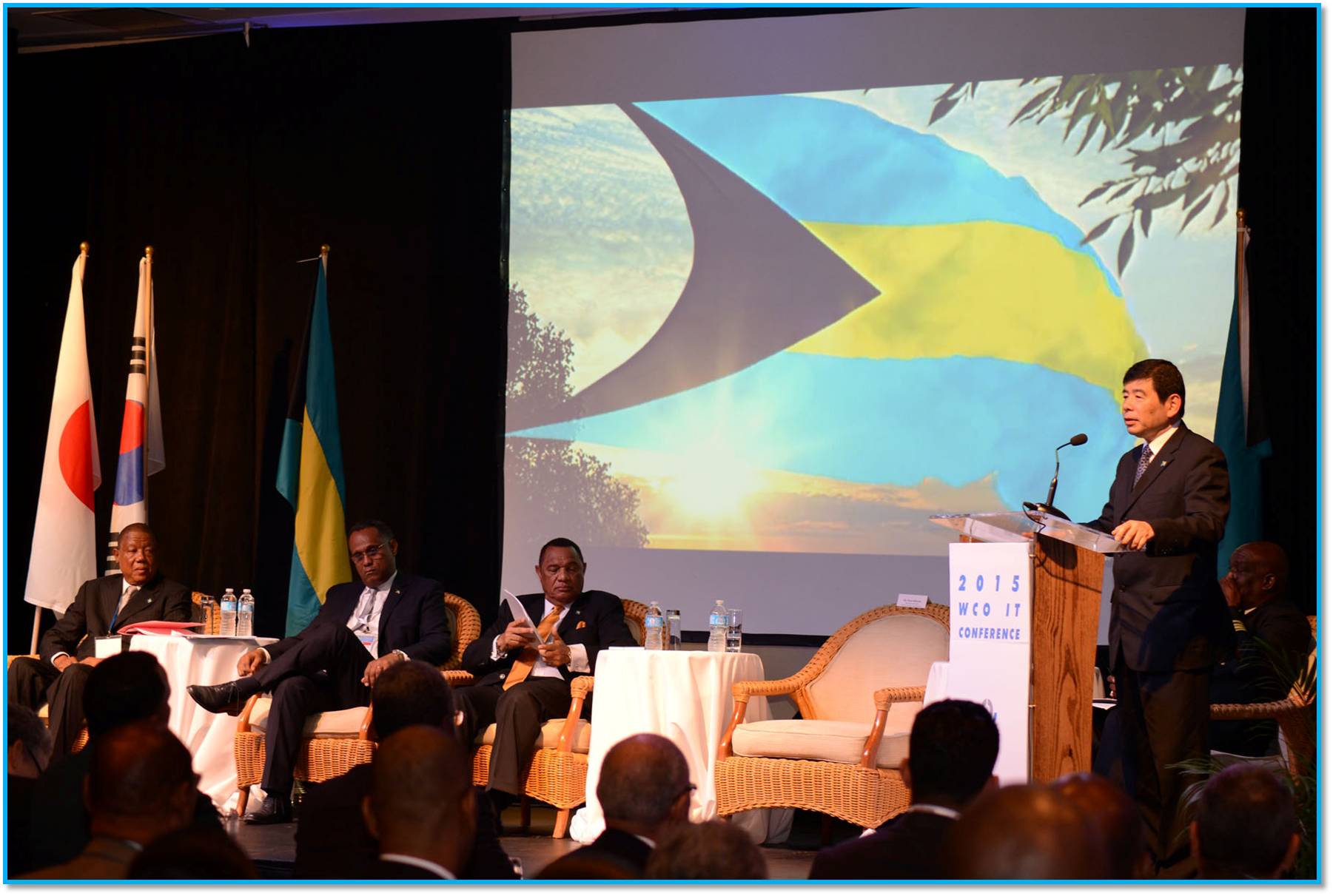
Inclusiveness Through Information Technologies – Launch of the 14th IT Conference & Exhibition

Secretary General of the WCO, Mr. Kunio Mikuriya, welcomes  delegates to what is now one of WCO’s premium external events bringing together representatives of the software industry and Customs policy makers.

Secretary General of the WCO, Mr. Kunio Mikuriya, welcomes delegates to what is now one of WCO’s premium external events bringing together representatives of the software industry and Customs policy makers.

The 14th annual WCO IT Conference & Exhibition was officially opened on 6 May 2015 in Freeport (Bahamas). Senior Government representatives of The Bahamas Government opened the 3-day Conference in the presence of over 400 participants from 75 countries.

The Right Honorouble Perry Gladstone Christie, Prime Minister and Minister of Finance of the Commonwealth of The Bahamas thanked the WCO for choosing The Bahamas for this very important global Conference. The hosting of this WCO event is an example of the government’s commitment to bring business opportunities to Grand Bahama!

The Prime Minister further continued by reminding the delegates that the WTO concluded negotiations on a Trade Facilitation Agreement at the Bali Ministerial Conference in December 2013 and about its potential of reducing international trade costs of approximately 12%. He underlined that the WTO Trade Facilitation Agreement owes much to the technical work that had already been carried out at the World Customs Organization.

In his speech, the Prime Minister stressed: “Our efforts are very much consistent with the theme of this Conference “Inclusiveness Through Information Technology”. It is in our interest here in The Bahamas to pursue an inclusive approach to the introduction of the new IT systems. These new systems must bring benefits, not only to government, but also to commercial operators and to the general public who will use these services. We recognize that with the introduction of these IT systems we must adopt a more client focused and customer orientated approach to make it easier to conduct business.”

The Secretary General of the WCO, Mr. Kunio Mikuriya, welcomed the delegates to what is now one of WCO’s premium external events bringing together representatives of the software industry and Customs policy makers. The Secretary General emphasized the theme of this year’s Conference “Inclusiveness Through Information Technologies”, adding that it addresses three key priorities of the WCO Members – Implementation of the WTO Trade Facilitation Agreement, Regional Economic Integration and Coordinated Border Management.

Mr. Charles Turner, Comptroller of Customs and Excise Department of the Commonwealth of The Bahamas, stressed that the IT Conference & Exhibition comes at an important juncture for The Bahamas as the Customs Department implements the Trade Sector Support Program. Having such a broad range of exhibitors and international delegates provides a rare opportunity to share ideas and learn from the experiences of others. Source: WCO

Dubai Customs Receives Enterprise Architecture Award

main_building_of_Dubai_CustomsDubai Customs (DC) has earned the coveted Enterprise Architecture Award 2015, presented by Frost & Sullivan; a world leader in growth consulting and the integrated areas of technology research, market research, mega trends, economic research, customer research, competitive intelligence, and corporate strategy.

The award was presented to Dubai Customs to recognise its Business Capability Management, developed by the Business Process and Enterprise Architecture at the Customs Development Division to upgrade corporate capability at Dubai Customs.

Commenting on the advantages of the Business Capability Management, Juma Al Ghaith, Executive Director of Customs Development Division, said that the project provides a comprehensive connected view of DC’s business capability and determines the gaps and requirements of business units while putting forth a plan to fill these gaps. It also pinpoints strength and weakness points to help make informed decisions, offers improvement recommendations for business capabilities and devises an action plan for implementing these recommendations.

Creatively upgrading the enterprise architecture helps create a conducive environment for divisions and departments in DC to bond and better manage capabilities, allowing DC to determine its structural strategy and formulate a clear road map and initiatives for corporate changes.

The Enterprise Connected View links and documents all corporate components, allowing a more accurate and speedy decision making process and facilitating an effective change management.

Counting Frost & Sullivan’s EA Award 2015 in, Dubai Customs has scooped three global awards for its “Business Capability Management and Enterprise Architecture” in 2014 and 2015,The Business Capability Management focuses on four aspects: People, Process, Technology and Information.It identifies capabilities and measures them against world-class criteria to ensure optimal performance, revenue and sustainability.

Frost & Sullivan’s Best Practices Awards recognize companies throughout a range of regional and global markets for superior leadership, technological innovation, customer service, and strategic product development. Frost & Sullivan, founded in 1961, has more than 40 global offices with more than 1,800 industry consultants, market research analysts, technology analysts and economists. Source: CustomsToday.pk

WCO – Sub-Saharan Africa Customs Modernization Programme Newsletter

WCO Sub-Saharan Customs Modernisation Programme NewsletterHerewith a new newsletter informing about developments of Capacity Building Projects in Sub- Saharan African Customs Unions as sponsored by the government of Sweden. The project includes the WCO- EAC CREATE Project, the WCO- WACAM Project, The SACU Connect Project and the WCO INAMA Project.

With this newsletter we share with you updates about ongoing activities as well as an outlook for the events of the upcoming months. Click this hyperlink to download the newsletter.

Whilst this newsletter can only provide a snapshot of key developments, it may raise your awareness and encourage you to address us for more detailed publications or to contact us. Source: WCO

Feature – Côte d’Ivoire Single Electronic Window for Trade

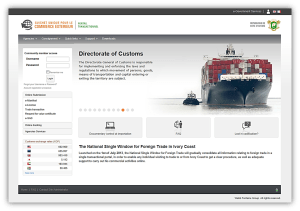
Ivory Coast SEW2As Customs and Border regulatory authorities ramp up their commitment to international agreements, such as the WCO Revised Kyoto Convention, SAFE Framework of Standards and the more recent WTO Trade Facilitation Agreement, more countries will offer a single point of entry through which traders, international carriers and logistics providers can access and comply with the resident customs and other government regulatory regimes.

The concept of a Single Window is borne out of the fact that traditional import/export and related regulatory requirements pose a barrier to market entry for international goods. There are many derivatives of Single Window in operation globally. Perhaps the best resource for this can be found on the UNECE’s interactive Trade Facilitation Implementation Guide webpage. One can navigate to the case studies page to read up on a country-by-country experience on various trade reforms including Single Window developments.

Côte d’Ivoire (Ivory Coast) is one of many African countries who have introduced Single Window as a facilitation measure whereby international trade can interface with Customs in a number of ways. It consists of a web-based trade portal (operated by Webb Fontaine) which interfaces with AsycudaWorld (AW), Côte d’Ivoire Customs’ management system. The portal allows traders to key-in advance import/export information within an electronic document called TVF (Trade Virtual Folder). Customs declarations are then subjected to tariff classification  and valuation, thereafter routed for commercial/risk assessment and revenue accounting on AsycudaWorld, or Sydam World as it is known in Côte d’Ivoire.

Commercial banks use the TVF within the Single Window to endorse the settlement of each import; the Ministry of Commerce subsequently authorizes the overall transaction through the system.

The Single Window provides an entry point for traders and supply chain operators to accomplish various Customs formalities such as –

  • Customs Declaration processing – allowing importers and exporters to electronically file clearances.
  • Manifest operations – used by all carriers to upload their XML manifests and register the same through the trade portal directly into AsycudaWorld. The facility also allows the amendments of waybills (e.g. excess and shortages) and automatically synchronizes the operations with the AW system. The Port Authority IT systems, including the Port of Abidjan and the Port of San Pedro, automatically receive and integrate the manifests submitted by carriers.
  • License module – allows traders to request import/export licenses (regulatory permits) that are later on approved online by the relevant ministries. Each license comprises a list of regulated products, quota allowable amount based on a predefined scheme (gross mass, net mass, FOB, Unit of measurement or unlimited quota). Further developments will include the automatic write-off of license quota by declarations using the Declaration module.

Source: Webb Fontaine

Kenya Single Window Agency accuses KRA of Sabotage

KentradeThe Kenya Trade Network Agency, operator of the National Electronic Single Window System, has refuted claims by some clearing agents that the platform is lapsing. KenTrade has instead blamed slow integration of its system on the continued parallel use of the Kenya Revenue Authority’s systems – the Orbus and Simba. Currently, importers are using both systems to process documents such as import permits.
Project director Amos Wangora said there is need to retire Orbus system for agents to embrace the Single Window System, particularly in filing Import Declaration Forms. Kentrade accused KRA officials of avoiding the Single Window System.

“We don’t have any problem in the use of the Single Window System. It’s only people who don’t want to embrace the new system. Those using it are doing good only for some KRA officials who still want to use the Orbus system,” said Wangora in an interview on Friday.

KenTrade is the state agency tasked with facilitating cross-border trade through the Single Window System.

Wangora said only three modules remain for the Single Window System to be completed fully – include on declaration submission, bonds and exemption. Testing of the declaration submission module is on and is expected to be completed by 20 January 2015.

A section of clearing agents had raised concerns over delays in cargo clearance at the port of Mombasa under the Single Window System. Yesterday, the Kenya International Freight and Warehousing Association, Mombasa chapter, said KRA officials prefer their own system, which “lacks transparency”.

A clearing agent told the Star that one has to personally push for services, which involves handouts, under the KRA system. Kentrade has since written to KRA commissioner-general to halt the Orbus system on January 31.

The Single Window System integrates about 24 government agencies’ functions, offering a one-stop shop for processing import and export permit documents.  More than 6,000 imports and exports permits were issued under the new system last year, including permits from Kenya Bureau of Standards and Ministry of Health’s veterinary and pharmaceutical departments.

About 1,200 clearing agents, shipping agents, consolidators and partner government agencies will be trained on the remaining modules. Kentrade targets to have the system fully embraced by all stakeholders by July, with the country set to go paperless by 2015. Source: The Star (Kenya)

South African Customs launches new X-Ray Inspection Facility in Durban

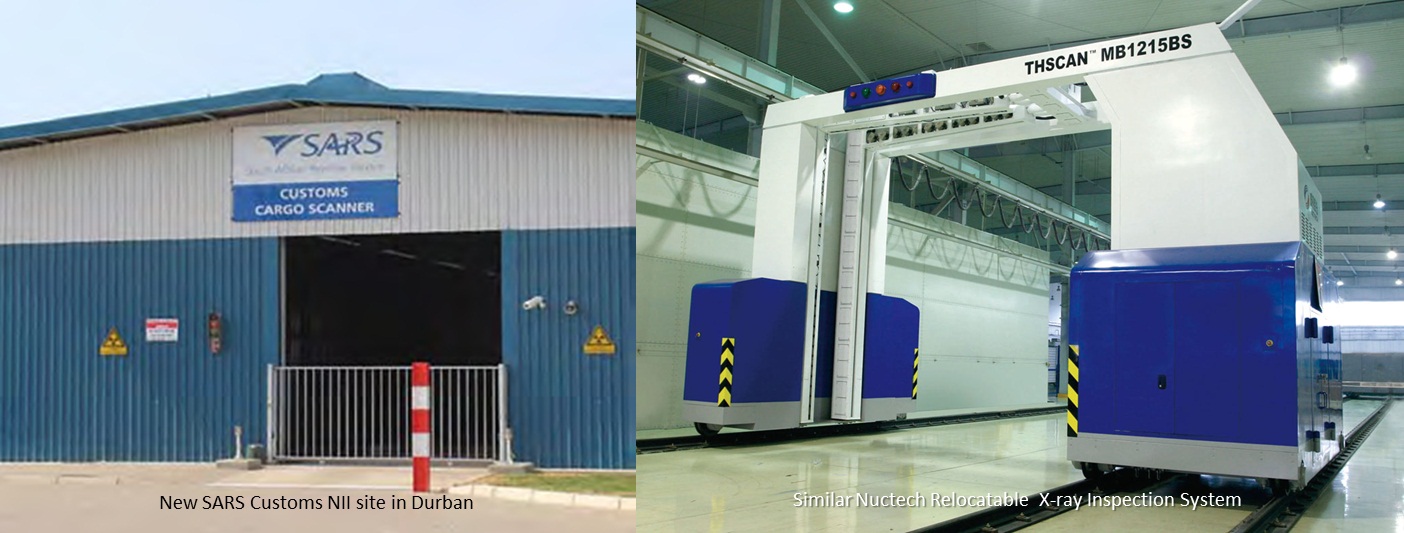
SARS Customs New NII Ste - DurbanSARS Customs recently launched its new X-Ray cargo inspection facility adjacent to the Durban Container Terminal in the Port of Durban. Following the trend as in other countries, SARS has identified non-intrusive inspection capability as part of its ‘tiered’ approach to risk management.

In 2008, SARS introduced its very first mobile x-ray scanner which was located inside the Durban container terminal precinct as part of South Africa’s participation in the US Container Security Initiative (CSI). While it has proven itself in the development of Customs NII capability, its location and lack of integration with other Customs automated tools has limited its success.

The new Customs inspection facility is a step-up in technology and automation – a Nuctech MB 1215HL Relocatable Container/Vehicle Inspection System. It has some significant advantages over the original mobile version namely –

  • An efficient and cost-effective security solution with a relatively small footprint (site size).
  • 6 Mev dual energy X-Ray technology with high penetration (through 330 mm of steel).
  • High throughput of 20-25 units of 40ft container vehicles per hour.
  • A unique modular gantry design which improves system relocatability.
  • Self-shielding architecture which requires no additional radiation protection wall.
  • Advanced screening and security features such as organic/inorganic material discrimination.
  • High quality scanning image manipulation tools allowing the customs image reviewer the ability to verify and distinguish the contents of a vehicle or cargo container.

Since its launch more than 350 scans have been performed. Suspect containers were sent for full unpack resulting in various positive findings.

The new relocatable scanner is easier to operate and significantly faster than the mobile scanner. In addition, scanned images are now automatically integrated into SARS Customs case management and inspection software making case management both seamless and efficient.

It is anticipated that until October 2014, both the new scanner and the existing mobile scanner operations will co-exist. During this time, the new scanner will operate risk generated cases directly from SARS automated risk engine. Unscheduled or random interventions will continue to occur at the old scanner site, which operates 24/7.

Plans are in place to decommission the mobile scanner after October 2014. The new scanner will then operate on a 24/7 basis.

Lesotho Revenue Authority to acquire two AS&E ZBV Mobile Screening Systems

AS&E's Cargo and vehicle screening system deployed in 55 countries

AS&E’s Cargo and vehicle screening system deployed in 55 countries

American Science and Engineering, Inc. (“AS&E”), has announced the receipt of an order for two ZBV® mobile screening systems from a new international customer, the Kingdom of Lesotho. The ZBV systems will screen vehicles and cargo for threats and trade fraud on its border with South Africa to facilitate trade and counter smuggling.

The Lesotho Revenue Authority (LRA) has launched a Customs Modernization Program aimed at simplifying border procedures while speeding up the inspection process. The ZBV systems, with its safe and effective technology, ease-of-use, and high-throughput capability will greatly support this initiative.

“We are delighted to have the opportunity to support the LRA in its Customs Modernization Program and to help secure the Kingdom of Lesotho,” said Chuck Dougherty, AS&E’s president and CEO. “The ZBV system has been proven effective for anti-smuggling programs, with one customer recently reporting a 54% increase in tobacco seizuresi in a four month period. With the ZBV system’s outstanding field reports, we continue to add new countries to our installed base in key geographic markets and expand our market penetration of Z Backscatter® technology in Africa.”

LRA spokesperson Mr. Pheello Mphana says, “The LRA is pleased to acquire this advanced technology to support our modernization process. Following our detailed examination of non-intrusive inspection systems, the ZBV provides the optimum solution to deploy on our borders to facilitate trade by reducing inspection delays and the cost of compliance, improve border control and detect illicit cross-border movement.”

The highly mobile ZBV® system screening system allows for immediate deployment and rapid inspection to reveal explosives, drugs, currency, alcohol, cigarettes and other organic threats or contraband. With over 730 systems sold to date, AS&E’s ZBV system is used by leading government agencies, border authorities, law enforcement, military organizations, and security agencies in more than 64 countries. Source: AS&E

Australian Border Force – Big changes ‘down under’!

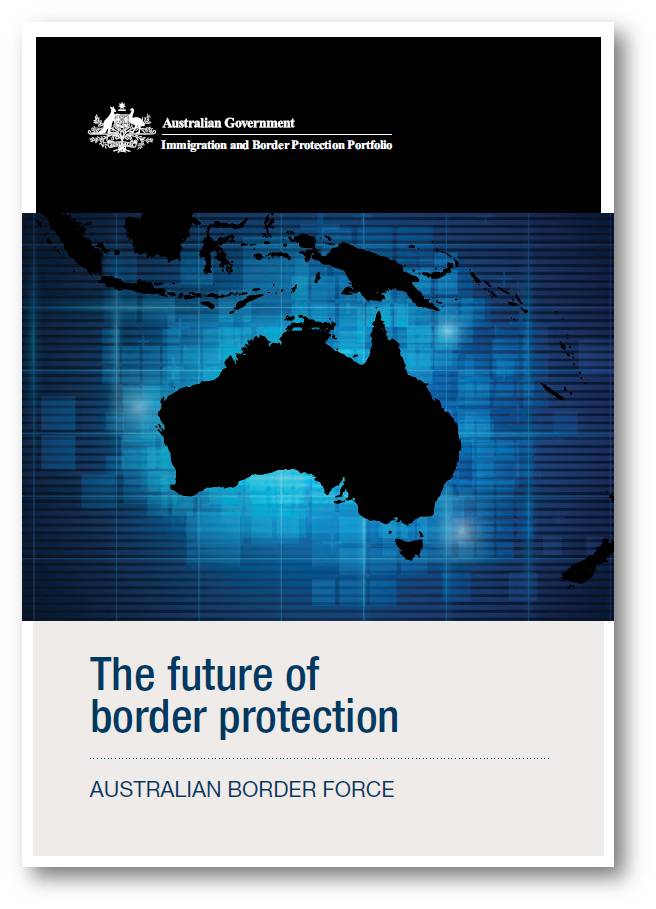
Australian Border ForceThe Australian Government has announced changes to the immigration and border protection portfolio in relation to future border protection arrangements.

From 1 July 2015, the Department of Immigration and Border Protection and the Australian Customs and Border Protection Service will be consolidated into a single Department of Immigration and Border Protection. At this time, the Australian Border Force, a single frontline operational border agency, will be established within the department.

The Australian Border Force will draw together the operational border, investigations, compliance, detention and enforcement functions of the two existing agencies. Policy, regulatory and corporate functions will combine within the broader department.

The name, in itself, marks a distinct shift in world customs operation. Unless I’m mistaken, it’s the first customs and border authority called a ‘force’. The demise of traditional ‘Customs & Excise Departments’ in the wake of 9/11 appears set to continue as sovereign states seek new ways to combat cross-border crime. There is in reality no ‘bench mark’ nowadays. Developing countries tend to favour the revenue authority model (as dictated by their sponsors) – mainly due to the fact that customs revenue remains a critical component of their economies. Developed countries are migrating in ever-increasing number to border agencies with more focus on security issues.

For more information about the changes, read the Minister for Immigration and Border Protection’s speech announcing the new arrangements on 9 May 2014 and the Australian Border Force booklet.

Source: Australian Customs Service

Getting to Grips with the Future Customs Control Act

Having recently introduced a whole new integrated customs business solution last year the South African Revenue Service (SARS) has spent the last six months stabilising its system. At the heart of the system is the Interfront Customs and Border management (iCBS) engine which takes care of all customs declaration processing.

CCB

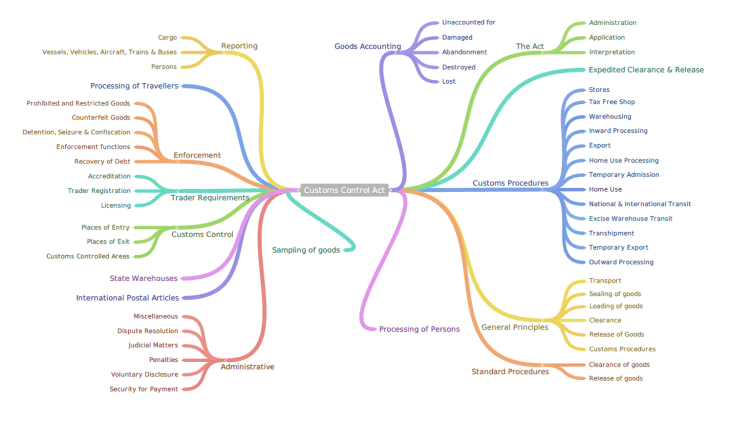
Click on the image to download the Infogram

A new ‘state-of-the-art’ EDI Gateway infrastructure is at an advanced stage of development and configuration, and will be subjected to a series of rigorous testing both internally and with industry service providers over the next few weeks. The gateway is an important component of the organisation’s future aspirations in C-2-C, C-2-B and C-2-G information exchange with it’s stakeholders.

Over the last 2 years, SARS has been a key participant in the WCO’s Globally Networked Customs (GNC) initiative which seeks to develop standardised electronic information exchanges of commercial customs data and common border procedures between customs administrations. This is ‘greenfield development’ and requires innovative thinking between potential customs partners. In this specific area SARS has engaged both Mozambique and Swaziland Customs as willing partners in such an initiative. Developments with Mozambique are at an advanced stage and will shortly become a reality with the conclusion of the bilateral One Stop Border Post (OSBP) agreement that includes provision for electronic data exchange between the two administrations. More on this in a future post.

Technology aside, perhaps the most daunting task on the horizon is the introduction of the new Customs Duty and Control Acts which are currently in the parliamentary process. Much publicity and robust argument was aired in the printed media over the last year, all of which culminated in the parliamentary hearings overseen by parliament’s Standing Committee on Finance (SCoF) during November and December 2013. While an agreement was reached with the freight forwarding sector of the local supply chain and logistics industry on certain aspects of the Control Bill, there still lies much work and clarification to be addressed in these and other areas.

Notwithstanding the signing into law of the Customs Bills, operational enactment thereof can only occur once the ‘rules’ to execute this legislation are circulated for comment, finalised and gazetted. Even considering the legal and approvals process in a simplistic form, the implementation of this new legislation is just too complex to introduce in a once-off, big-bang approach.  Due consideration must be given to a transitional approach taking into account the practicalities thereof as well as economic and logistical consequences of such approach.   It is no understatement that the impact of the new legislation, its incorporation into current automated systems, policies and procedures as well as the necessary re-adjustments to be made by every entity engaged in business with SARS Customs is no small feat.

Furthermore, the implications of the recently concluded WTO Agreement on Trade Facilitation for South African Customs and Trade also needs to be determined and understood. While a large proportion of its content is encapsulated within the Revised Kyoto Convention, it is the first time ever that such requirements are subject to the conditions of a trade agreement.

It’s been some time since I last penned thoughts on the Customs Modernisation initiative. In retrospect and thinking ahead, the underlying bottom line to its longer term success lies in increased ‘communication’ with stakeholders – ironically, the World Customs Organisation’s adopted theme for 2014!

Please feel free to download the infogram on the future Customs Control Act by clicking on the picture above. Official links to the Customs Control and Duty Bills are included below. It would also be wise for parties involved in Excise to consider the contemplated changes contained in the Excise Duty Bill (Customs and Excise Amendment Bill).

Related documents

Lesotho Revenue Authority launches Trade Portal

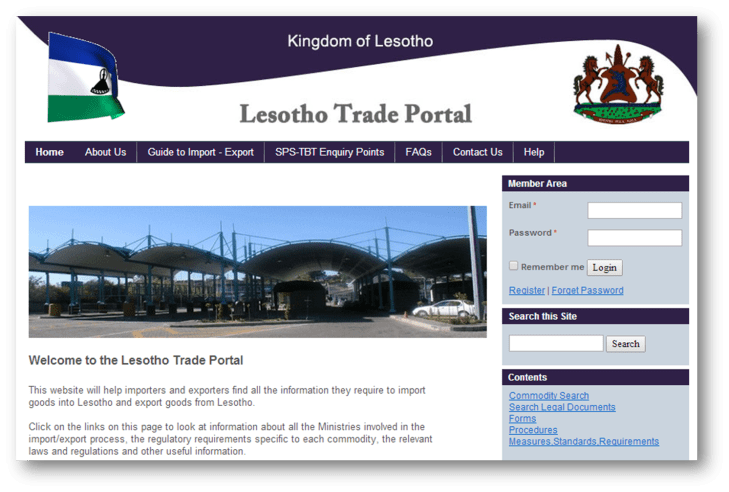
LRA Trade PortalThe Lesotho Revenue Authority (LRA) has undertaken an extensive Customs Modernisation Programme aimed at simplifying the processes and reducing the costs of ‘doing business’ at the border. Earlier this week, the LRA launched the Lesotho Trade Portal as an introduction of the first portion of these reforms which brings a commitment to transparency for all border users on expectations and procedures.  The launch of the portal will be followed by an introduction of simplified border procedures supported by the implementation of modern computerised systems using ASYCUDA World.

The LRA has been reorganising its structure the past year aligning it with organisational strategy, and alongside that as a result of the modernisation, there will be extensive restructuring to promote efficiency and professionalism in customs and across the LRA. Staff members are undergoing extensive training to prepare for the introduction of the new systems.

To facilitate legitimate trade and enhance compliance LRA will introduce risk based controls to enable legitimate trade to pass more freely through the border posts and following the recent pilot project, there will be a full introduction of a ‘Preferred Trader Scheme’ offering additional facilitation benefits to compliant traders.

Through use of modern technology LRA will speed up the inspection process as they will be coordinated and organised from dedicated inspection areas. There will eventually be an introduction of inland clearance to improve service delivery and clearance time.

To protect legitimate trade and reduce market distortion, there will be targeted anti-smuggling activities. This will be for deterrence of illicit and illegal goods as well as to protect the nation from prohibited importation of goods.

The Lesotho Business Partnership Forum has also voiced its unanimous approval of the Lesotho Trade Portal. It believes this milestone represents a major breakthrough in the relationship between business and government. It reveals a level of transparency in procedures and processes which business can only welcome as a sign of a more constructive and open approach to the management of government affairs.

Similarly, the traders and general public will participate in an extensive publicity campaign with announcement in the media as to how to get involved and benefit from the reforms.  A key tool in this process to keep everyone on the loop, will be the News section of Lesotho Trade Portal itself. This will be supported by an extensive communications programme and an education programme targeted at regular border users. Source: Lesotho Revenue Authority

Vietnam Customs to Push Ahead with New e-Customs System

Picture1The Japanese-funded e-Customs system known as “VNACCS/VCIS” (Vietnam Automated Cargo and Port Consolidated System and the Vietnam Customs Information System) is set to “go live” on April 1, 2014.

Based on the NACCS/CIS of Japan, VNACCS/VCIS is intended to handle e-Declaration, e-Manifest, e-Invoice, e-Payment, e-C/O, selectivity, risk management/criteria, corporate management, goods clearance and release, supervision and inspection.

With the launch of the VNACCS/VCIS, Vietnam Customs is trying to simplify customs clearance procedures, reduce clearance time, enhance the management capacity of customs authorities in line with the standards of modern customs, as well as to cut costs and facilitate trade. VNACCS/VCIS also purports to ensure Vietnam’s compliance with the ASEAN “single window” initiative.

VNACCS/VCIS is intended to improve on the current e-Customs system. For example, the VNACCS/VCIS provides new procedures for the management of pre-clearance, clearance and post-clearance processes, adds new customs procedures such as registration of the duty exemption list, introduces a combined procedure for both commercial and non-commercial goods, simplifies procedures for low unit value goods and offers new management procedures for temporarily exported/imported goods, etc.

After the testing phase (which took place from November 2013 until the end of February 2014), users have been raising concerns regarding the VNACCS/VCIS system’s complexity. VNACCS/VCIS provides a declaration process with 109 export and 133 import data fields, compared to the current 27 export and 38 import declaration fields. Many of them are not compatible with the actual systems of companies, and appear to require from declarers an extensive knowledge of customs-related matters.

Comment – from an outsider’s perspective, besides systems testing, it would seem to appear that insufficient time has been allocated for alignment of industry systems to Vietnam Customs’ new data requirements. This, and the fact that no ‘grace period’ (waiver of sanctions or penalties) will be considered by the customs administration does not bode well for a smooth transition.

VNACCS/VCIS employs the quantity reporting mechanism in the official Units of Measures (“UOMs”), often used in international trade statistics, yet creates significant obstacles to companies that do not have compatible manufacturing, inventory planning and control systems. Vietnam Customs has stated that it will work on improving this issue.

VNACCS/VCIS also applies the declaration of customs values at the unit level. Since unit costs and unit prices used in financial systems of companies may not always be identical to declared values, companies may fail to comply with such requirement. Sanctions may be applied from day 1 of the new systems activation.

Technical difficulties are also a matter of great concerns to business community, e.g. with asset tracking. Currently under VNACCS/VCIS, reporting is limited to 7 digits, incompatible with many companies having asset tracking systems with identification numbers of up to 20 digits. To address concerns raised by the business community about the new system, Japanese experts have agreed to support Vietnam Customs 1 year after the official implementation date of the system.

There are concerns for potential risks of non-compliance for wrong declaration due to lack of an adequate understanding of VNACCS/VCIS. Vietnam Customs has rejected a proposal for “grace period” before applying sanctions upon violations, but encourages companies to actively participate in training programs organized by customs authorities to better avoid potential non-compliance risks.

Another concern is the chance of system failure which may lead to severe interruptions and delays in clearance procedures. Vietnam Customs has ensured business community that they have a back-up contingency mechanism in place to support customs procedures in the event that VNACCS/VCIS fails to operate properly. In the meantime, a new circular detailing the implementation of VNACCS/VCIS is being drafted and should come into effect by the launch date. Various business associations are still trying to find ways to mitigate the likely disruption from the sudden transition to the new system. Source: Baker & McKenzie (Vietnam)

New Philippines Customs Chief Cracks Down on Corruption

To fix the Bureau of Customs, President Benigno S. Aquino III needed a numbers guy, someone who could make sense of the thousands of shipments and billions of pesos passing daily through the Philippines’ ports. He turned to John P. Sevilla. Three months after taking over as commissioner in December, Mr. Sevilla told The Wall Street Journal he had been “shocked” by the Bureau’s failure to analyze the rich data it received, information that held vital clues to its endemic corruption problems.

“I’m amazed that nobody bothered to put the data together until about a month ago,” Mr. Sevilla said. “But we found out that we open up less than 1% of [shipping] containers, but of the containers that we open, 90% have problems.”

He was also incredulous that Customs lacked a single reference source to help examiners make complex calculations about duties and fees incurred by traders. One is now being compiled, Mr. Sevilla said, “to make it easier for people to do their jobs…so that they have no excuse” for undercharging importers, a common practice rewarded with illegal payments.

Customs is tasked with collecting revenue at the nation’s 17 major and 43 minor ports. But it has a history of missing targets: It pulled in 304.5 billion pesos ($6.8 billion) in 2013 — over a fifth of all government revenue, but still 35 billion shy of its goal. The under-invoicing of traded goods has cost the country $23 billion in lost tax revenue since 1990, according to a February report by Global Financial Integrity, a U.S. research firm. The Aquino administration’s keynote policy of improving governance thus made Customs a prime target for reform. A far-reaching overhaul was ordered last October, and Mr. Sevilla, a former finance undersecretary, was parachuted in soon after.

Before entering government in 2006, Mr. Sevilla held directorships at investment bank Goldman Sachs and ratings agency Standard & Poor’s, having earned degrees at Cornell and Princeton. His boss, Finance Secretary Cesar Purisima, hailed him as the right person to untangle the mess, “someone who is results-oriented.”

Not everyone was convinced: In January, Senate Minority Leader Juan Ponce Enrile said Mr. Sevilla was “in the dark” about how turn Customs around. Undeterred, the studious-looking commissioner has spent the last three months poring over reams of customs data in which the dealings of smugglers and corrupt officials have long lain hidden.

All import-export transactions were now being published online for public scrutiny, Mr. Sevilla said, “I think we’ve turned from being the most secretive government agency to being by far the most transparent.”

At the Port of Manila, one of three ports in the capital, importers and brokers crowded around glass service windows, an innovation from before Mr. Sevilla’s time designed to block access to officials and make them harder to bribe. Inside, on computers surrounded by mountains of paperwork in what remains a semi-automated operation, customs examiners placed their electronic signature on each shipment after calculating the requisite duties and fees.

The electronic signature system also predates Mr. Sevilla. The difference now, he said, is that he is actively policing it, cross-referencing signatures against undervalued shipments, and punishing the officials responsible. He said the threat of being caught was critical when front-line staff are offered bribes equivalent to their monthly salaries “a couple of times a day.”

Likewise, the credible threat that your container might be physically inspected is the best deterrent against false import declaration, Mr. Sevilla argued. But with 18,000 containers piled up at Manila International Container Port alone, the challenge is to open the right ones.

The Bureau has 3,600 staff, but aims to hire nearly 3,000 more, partly to increase the inspection rate. Around a fifth of shipments are flagged for further examination. Some of these are X-rayed and, if necessary, physically inspected.

Mr. Sevilla said he is seeking an extra 250 million pesos for more inspections after figuring out that Customs collects an average of 125,000 pesos per opened container, against a cost of 10,000 pesos for conducting the inspection — making the process “a no-brainer.”

The Bureau also regularly auctions off seized items to further boost revenues. At one such auction in mid-February, buyers snapped up everything from a smuggled Harley Davidson to batches of animal feed. Other illegal shipments are sent straight back to their point of origin, such as the 50 containers of rotting garbage — declared as “recyclable plastic” -from Canada last month.

The new regime is already producing results, Mr. Sevilla said, citing a 19.3% year-over-year increase in collections to 81.3 billion pesos in November to January. Further improvements will be needed: Customs has been tasked with collecting 408.1 billion pesos this year, far more than it has ever managed before. The true test of the Bureau’s progress under Mr. Sevilla will lie, fittingly, in the numbers. Source: The Wall Street Journal

Customs reform in Nigeria continues after the termination of the Destination Inspection service

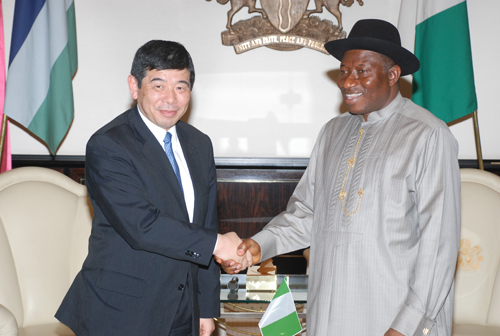
Secretary General Mikuriya during a courtesy visit paid to the President of the Republic of Nigeria, Mr. Goodluck Jonathan (WCO)

Secretary General Mikuriya during a courtesy visit paid to the President of the Republic of Nigeria, Mr. Goodluck Jonathan (WCO)

At the invitation of the Comptroller-General of the Nigeria Customs Service (NCS), Mr. Abdullahi Dikko Inde, the WCO Secretary General Kunio Mikuriya visited Nigeria on 17 and 18 February 2014 to observe Customs transformation activities after the termination of Destination Inspection contracts on 1 December 2013.

In Lagos, the Secretary General went to Apapa Port, Nigeria’s major port, to see Customs operations and also to visit the Customs Training Centre for a mentorship talk with young officers: the NCS has recruited many recent university graduates and trained them in computer and other necessary skills.

Secretary General Mikuriya also presided over a Stakeholder Forum to interact with the private sector. The business community were supportive of the ongoing Customs transformation programme that was enhanced by an improved communication strategy for Customs, the use of information technology – the Nigeria Trade Hub – and the implementation of modern Customs methods, such as risk management.

The private sector also suggested better use of a database for risk management purposes, including valuation, and expressed their hope for the introduction of coordinated border management and a Single Window to simplify the multiplicity of regulations and inspections at borders.

The Secretary General also travelled to Abuja, Nigeria’s capital city, and was joined by three heads of Customs from neighbouring countries, namely Benin, Ghana and Niger, who wanted to learn from NCS’s experience and obtain Nigeria’s support, as well as that of the WCO, for terminating contracts with inspection companies in order to regain ownership of core Customs functions.

The Secretary General also paid a courtesy visit to the President of the Republic, Mr. Goodluck Jonathan.  As a former Customs official early in his career, the President talked fondly of his visit to the WCO to attend the 2012 Council Sessions and particularly noted the WCO’s strong and inspirational leadership. He also acknowledged the economic and social contribution of Customs to the nation, and promised to continue to support Customs reform in Nigeria and provide guidance and influence at the regional level. Source: WCO

Customs Bill gets escape clause – fallback to old system

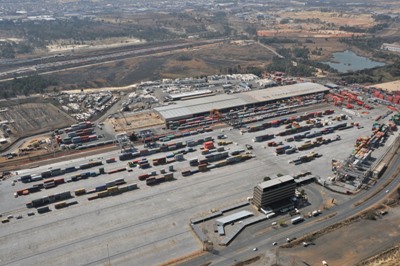
City Deep Container Terminal (Transport World Africa)

City Deep Container Terminal (Transport World Africa)

The controversial Customs Control Bill adopted by Parliament’s finance committee on Wednesday includes a “fallback” provision allowing for a return to the current customs control system should the new one fail.

A similar clause was included in the law that introduced value-added tax in 1991, allowing for a legal alternative to be implemented quickly if things do not work out as planned.

The committee also adopted the Customs Duty Bill and the Customs and Excise Amendment Bill as part of a total revamp by the South African Revenue Service (SARS) of the customs system. Visit this link for access to the Bills and submissions to the parliamentary committee.

The Customs Control Bill has been highly contentious as it will fundamentally change the way imported goods are cleared and released. The Democratic Alliance and Business Unity SA (Busa) opposed the original proposals on the grounds that doing away with manifests in the operations of City Deep would threaten the inland terminal in Johannesburg. SARS disputed this but nevertheless amended the bill.

Busa’s Laurraine Lotter yesterday welcomed the inclusion of the fallback clause but said she would have to see the details of the amendments introduced by SARS before commenting.

The fallback provision — which will automatically lapse five years after the effective date of the legislation — was included to be on the safe side, although SARS does not expect the proposed system to fail. It consulted widely on the bill, sought legal opinions about the legality of its amended proposals and ultimately secured the support of ship operators and agents, freight forwarders and Transnet for the amendments.

Implementation could be delayed by 12 months to allow the trade sufficient time to prepare.

SARS chief legal and policy officer Kosie Louw assured the committee this week the existence of City Deep would not be jeopardised. He urged adoption of the new system of customs control, saying the authorities needed more detailed information about incoming cargo to clamp down on fraud and illegal imports.

In terms of the bill, the submission by shipping lines of a manifest that provides only a general description of cargo will be replaced by a clearance declaration. This must contain information on the tariff, value and origin of the goods, and be submitted by the importer (which can be held accountable for its veracity) three calendar days before arrival at the first place of entry into South Africa.

Penalties will be levied only if the clearance is not submitted within three working days after the arrival of the goods. Containers will be provisionally released before arrival of the goods at the first place of entry and finally released at the first point of entry. To allow for seamless movement of goods, shipping lines will still issue multimodal contracts and through bills of lading.

“The revised proposal provides certainty and predictability to role players in the supply chain regarding the movement of goods,” Mr Louw said.

He said the new system would allow customs officials to undertake documentary inspections earlier, mitigating delays. High-risk containers would be identified before arrival, detained on arrival and held at the inland terminal for inspection. Containers with no risk would be able to move “seamlessly” to the inland terminals.

Mr Louw submitted that the objections to the proposal — that it would require traders to change their sale contracts; that sellers would be reluctant to sell under the new terms; that importers would be affected; that carriers would no longer issue a bill of lading to internal terminals; and that it would give rise to delays and congestion at ports — were found to lack foundation by international trade law expert Prof Sieg Eiselen and two advocates.

He said the proposed system would lay a solid and predictable framework for a modernised system of customs control that balanced the need for trade facilitation with the need to prevent imports of illicit goods. The current system was governed by an outdated, 1960s law. Source: Business Day

Related articles

SRA to migrate to ASYCUDA World before year end

SRA-logoThe Swaziland Revenue Authority (SRA) will before the end of the year migrate from the Automated System of Customs Declaration Administration Plus (ASYCUDA) to ASYCUDA World. ASYCUDA Plus is about 25 years old and sits on very old technology. The migration to a more modern web based system would improve the processes of customs clearance. Ministry of Commerce, Industry and Trade acting Principal Secretary Titus Khumalo said this change would also improve data collection as well as reconciliation, particularly with the country’s major trading partner South Africa in the context of the Southern African Customs Union (SACU) revenue sharing formula.

He said the Common Market for Eastern and Southern Africa (COMESA) Fund had provided SRA with funding and technical assistance for the migration to take shape and be fully implemented.

“The ministry is eagerly looking forward to full implementation of the migration of ASYCUDA Plus to ASYCUDA World, which will greatly improve our systems of customs clearance. We are looking forward to implementation of the findings of the Time Release Study (TRS) which was funded by the World Bank. The TRS is aimed at improving the movement of trucks and the clearance of goods across our borders as well as in our inland and dry port in Matsapha,” he said during the International Customs Day celebrations hosted by the SRA on Friday evening at the Royal Swazi Convention Centre.

Khumalo said they welcomed the substantial progress made on the trade facilitation negotiations by the World Trade Organisation (WTO) during the ministerial conference that was held in Bali, Indonesia in December 2013. The acting PS said agreements of the meeting included transit of goods as well as fees and formalities in relation to exportation and importation. He said the framework also spoke to issues of publication and administration of trade regulations.

“Another section deals with the necessary technical assistance that may be required by developing members of the WTO including Swaziland to implement the trade facilitation agreement. We were very fortunate as a country that before the ministerial conference in Bali, we hosted a workshop with the assistance of TradeMark Southern Africa (TMSA), which focused on self-assessment and priorities for Swaziland in the area of trade facilitation in the context of the WTO negotiations,” he said.

Khumalo said the report on the workshop identified trade facilitation needs for Swaziland, which would trigger funding from cooperating partners in line with provisions of the Multilateral Trade Facilitation Agreement. Source: Swaziland Observer