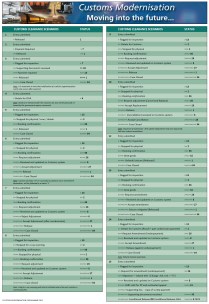
Customs Modernisation Release 3 – SACU

Saturday 11 February 2012 sees the implementation of new modernised customs procedures and formalities at South Africa’s first SACU land frontier office – Kopfontein – border between South Africa and Botswana.  While enhancements are slanted more in terms of internal SARS customs procedure, SACU traders will no doubt experience some anxiety with the transition. For the first time SARS Customs Modernisation impacts directly on traders and neighbouring Botswana Customs operational procedures in a significant way, which will fashion operations at all remaining inland border posts of the Customs Union. Over the last few months SARS has worked with trade, the Botswana customs authority as well as the business chamber in Botswana concerning the intended changes and their impact on stakeholders. The implementation ushers in cross-cutting changes for customs staff operationally, new technology as well as legal and policy changes. In the case of the latter, a further element of the draft Customs Control Bill is introduced whereby foreign business operators (importers, exporters and road carriers) must be registered with SARS to perform customs transactions in South Africa. This is perhaps the single issue which has had ramifications for parties who regularly cross the border between Botswana and South Africa. Hopefully recent iterations of notices and explanations have helped clarify the SARS requirements. (See the SARS Customs Modernisation webpage).

Other modifications and changes include –

Elimination of paper clearance documents – this is a significant departure from traditional SACU processing where all member countries have relied on the Single Administrative Document (SAD) to facilitate intra-SACU clearance. With the bulk of clearances expected to be electronic, SARS will now only print a customs notification (CN1) which will specify the status and outcome for each clearance. This the trader will use in support of customs clearance in Botswana. SARS will therefore no longer stamp and authorise hardcopy SAD500 clearance documents. Of course, there is nothing which stops a trader printing the SAD500 for cross border purposes, only SARS will no longer attest these. As concerns SARS VAT requirements, arrangements will be made for traders to submit the CN1 for purposes of VAT returns. Details on this to follow.

Electronic supporting documents – already tried and tested at sea and airports across South Africa, traders no longer need to carry on their person hard copy clearance supporting documentation , i.e. invoices, worksheets and packing lists. These are only required should SARS indicate via electronic message that a consignment requires further scrutiny. Customs brokers and traders using EDI will in most cases have the SARS e@syScan facility available on their computer systems which makes it relatively simple and easy to scan, package and submit to SARS. In the event a trader cannot perform this electronically, he may approach any of the 4 Customs Hubs (Alberton, Cape Town, Durban, and Doringkloof) across the country, to have these scanned and uploaded by SARS. Alternatively, these can of course be delivered to the border post for manual processing and finalisation of a customs intervention. Supporting documents are linked to a unique case number which SARS notifies to the trader in the event of a risk.

Clearance processing – SARS has centralised its backend processing of clearances where goods declarations are now processed off-site at one of the 4 Hubs. No longer are clearances processed at customs branch office. All goods declarations – whether electronically submitted or manually captured – are routed to a central pool for validation, verification and assessment if flagged by the risk engine. In the case of land borders all clearances once successfully processed will receive a ‘Proceed-to-border’ message implying that the road carrier may commence delivery to the border. A key feature of the new clearance process is the availability of Customs Status Codes. These codes are initiated by the customs system at specified points in the process to alert the declarant of the status of his/her transaction. These status’s also indicate the follow-up required of the declarant to bring the transaction to a state of finality.

Automated Cargo Management (ACM) – All road carriers are now required to submit their road manifests electronically, via EDI, to the Customs ACM system. For now, SARS will not electronically match the manifest against the declaration, but will monitor compliance and data quality of electronic manifest  for a period of time before initiating real-time matching and acquittal. This will invoke a significant responsibility on both trader and road remover to ensure that they both provide credible data to customs otherwise delays will occur. Upon arrival of the cargo at the border, the driver presents a printout of his electronic manifest. The manifest number is ‘checked in’ by a customs official which in seconds brings up all associated goods declarations linked to the manifest number on the system. The customs officer is able to determine the overall risk status of the vehicle. Where no risks are present a status notification (CN1) is printed for each goods declaration, and a gate pass (CN2) is handed to the driver permitting him to exit the customs controlled area. The future real-time matching will comprise a combined risk assessment of both manifest and declaration information that will result in a single risk outcome. Such risk assessment will include both fiscal and security compliance features thereby bringing SARS in line with international supply chain security standards. Going forward, risk assessment will accommodate ‘all-of-government’ requirements ensuring that all regulatory measures and associated risks are administered in a single instance obviating the need for successive, time-consuming inspections and costly delays.

Automated Customs Inspection – Following its recent introduction at the Beit Bridge border post, the new hand-held inspection tool, conveniently developed on an iPod, allows the customs border control official to electronically access, capture and upload an inspection outcome to the central customs system. This significantly improves the efficiency for this time-intensive activity where the officer can initiate a status up date electronically at the inspection site, where previously the declarant would have to wait for the outcome of the manual inspection report and release note. What’s more, the customs officer has access to the underlying clearance data and can even activate the camera function and capture visuals of suspect cargo which can be appended to an inspection case for verification by higher authority or historical reference value.

There are additional features and functionality to be introduced at Kopfontein and all remaining border posts over the next few months. These relate to improved revenue accounting, new trader registration and licensing system offering online application and approval, and a new traveller and temporary import/export processing. More about this in a future post.  For traders, the benefits of the new solution at SACU land borders aim to remove random and unwarranted intervention by customs. All activities are risk driven via a secure ‘get next’ selection function ensuring that internal integrity is maintained and only ‘risk-related’ consignments/transactions are dealt with. Please visit the SARS Modernisation webpage for all the latest updates and notices on modernisation releases.

New Zealand releases trade implementation guidelines for GOVCBR

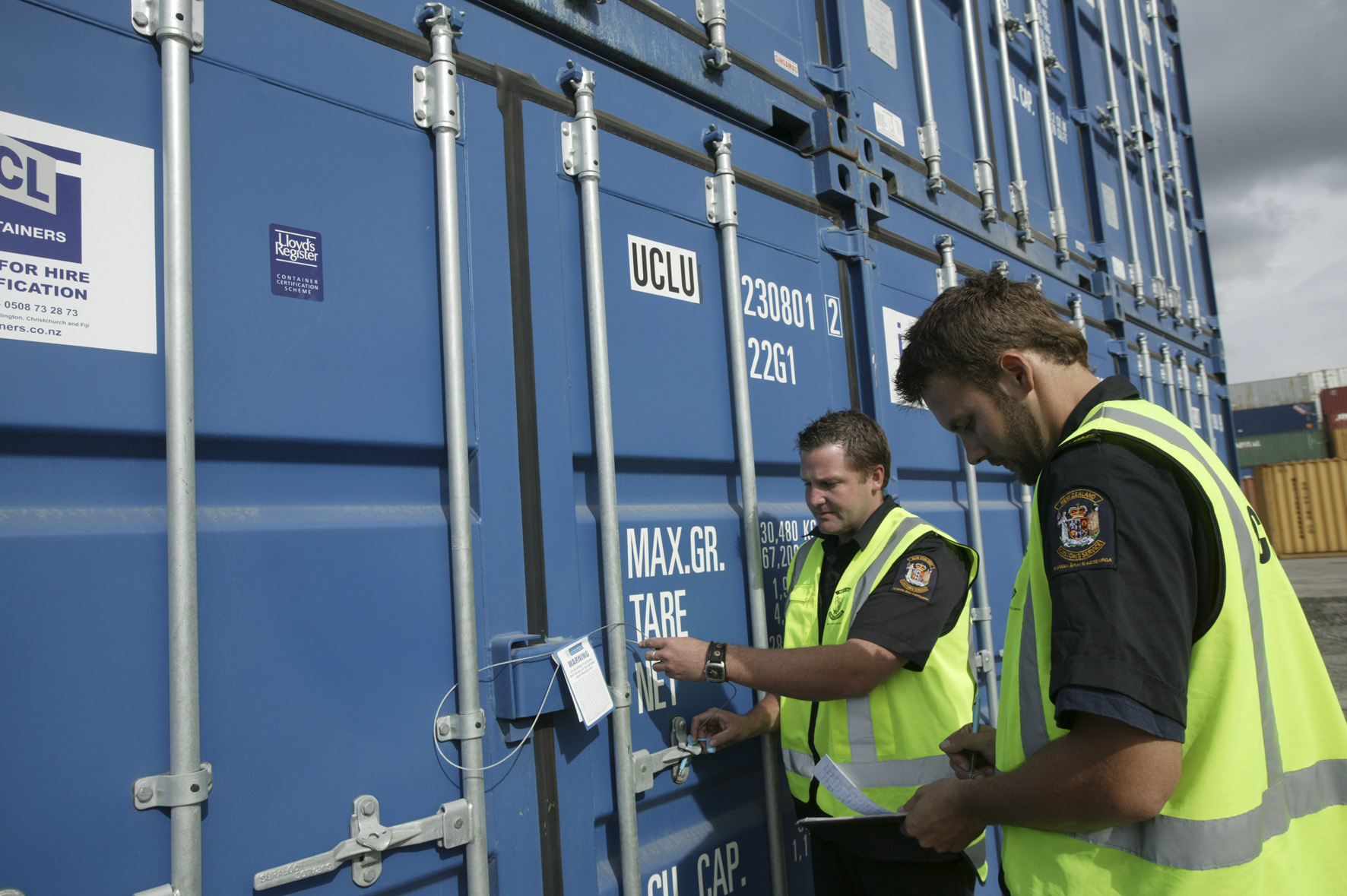
New Zealand Customs ServiceThe New Zealand Customs Service has recently released draft guidelines for it’s Trade Single Window (TSW), which is currently under development. This will require all potential users to be able to send and receive electronic messages. The introduction of the TSW therefore means that organisations will need to submit lodgement messages that meet the WCO3 data model. Current message format for import entries, export entries, inward and outward cargo reports, will be accepted for 18 months after TSW is introduced (likely to be in the first quarter of 2013). However, following that 18-month period, all users of TSW will need to have adopted the new NZ WCO version 3 data model for messages.

New Zealand Customs expects that some users of TSW may adopt the new messages earlier to take advantage of the benefits, which include the ability to submit cargo manifest and Customs data in one message.To understand the new messages, a draft set of message implementation guidelines is now available for consultation and feedback from software developers and companies intending to use the TSW on the following draft messages:

  • Advance Notice of Arrival
  • Advance Notice of Departure
  • Cargo Report Export
  • Excise Declaration
  • Inward Cargo Report
  • Import Declaration
  • Outward Cargo Report
  • Border Agency Response Message.

Message implantation guidelines for the new export declaration is still be drafted, and will be made available as soon as possible.

Five main government agencies operate at the border – the Customs Service, the Ministry of Agriculture and Forestry, the Department of Labour, the Ministry of Transport, and the Department of Internal Affairs. With the participation of almost 20 other associated agencies, they work to prevent the traffic of prohibited goods and materials in and out of the country. They also collect government revenue, promote travel and trade, support New Zealand’s national interests, and uphold international laws and agreements. Now, as the border sector grows more complex and volumes of goods and travellers increase, a new era of inter-agency collaboration aims for more control, easier flows, and greater efficiency. Source – New Zealand Customs Service

Pre-shipment Inspection (PSI) – an antiquated approach

Recently, an organisation called Global Inspection Group (GIG) has advocated PSI – an import verification system – as a solution to counteract South Africa’s trade deficit. The article Import verification would outlaw customs fraud’ alludes to the apparent success of these mechanisms in other African states to support quality and import standards in those countries, respectively. Because South Africa has no verification of imports system ‘it is easy to systematically under-declare goods’, the article states. Furthermore, it mentions that a Finance ministry would benefit from such a system ensuring the collection of the correct duties. [Really? how naive].

South Africa is a free country, and it follows that organisations will go to extremes to secure a business foothold in the country. The question is – to what length and to what end? If any ministry of finance were to rely on a PSI company, it would first disband its customs department, because there is evidently no trust in its frontline and post clearance capability.  Most governments (if not all) are pretty much aware of the broader international customs developments championed by the WCO. In recent years, the WCO has developed several diagnostic studies and programmes – with the option of donor funding if required. There would therefore be no sense or credibility in a government that would persist in pursuance of PSI services for fiscal assurance.

Any trade practitioner and supply chain operator in South Africa will readily confirm the hectic ‘change’ programme which is being pursued under Customs Modernisation. These changes and their associated systematic innovations and efficiencies are by no means the result of government capitulating in the face of illegitimate trade. No, it’s a conscious decision to take responsibility for the problem, and together with the allied trade to improve the situation.

It is therefore high time that such organisations which front themselves with the ‘be-all and end-all’ systems in Customs’ tariff and valuation appraisal rather seek a more practical and benefit-delivering model than one which not only scams governments for service and inspection fees, but also offers no benefit to trade. Included are those BOT vehicles offering governments ‘free’ cargo scanning equipment in exchange for a lucrative inspection fee. None of this is based on risk management and is purely profit focussed. The concept forgoes most if not all, the modern customs principles and standards promoted by the WCO. The buzz word is ‘Capacity Building!’

The reality in all of this should be clear. No private sector entity can replace Customs. Outsourcing in any event would require government to set up a vehicle of its own to ‘ensure’ that the outsourcer is doing his job. If there is a dearth in knowledge and skills, then it is up to government to rectify the situation.  Source: FTW Print version.

New Mozambique Customs System will reduce processing time

Customs processing times for goods imported into Mozambique will be lowered from the current minimum of three days to just a few hours with the introduction of a modern customs processing system, Mozambican daily newspaper Notícias reported.

Known as the Single Electronic Window, the new tool is made up of two computer systems – the integrated customs management system and the operators’ mechanism.

Via the Single Electronic Window importers are able to submit the customs declaration and pay all fees via a retail bank before the actual unloading of the goods, which will reduce their processing time.

Rosário Fernandes, chair of the Mozambican Tributary Authority said that the transmission network for the Single Window (Janela Única), managed by MCNet (Mozambique Community Network), would show the cargo manifest and customs declaration from carriers or owners of the goods, processing, payments inspection and management of the output of imported goods.

MCNet is 60 percent-owned by the Escopil Internacional and SGS Moçambique consortium and by the State and Confederation of Economic Associations (CTA), each with a 20 percent stake. Source: macauhub

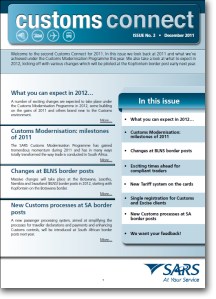
Customs Connect 2 – SA Customs Modernisation

Customs Connect 2The year 2011 has proven both challenging and beneficial for many in the South African Customs community. New business opportunities offered via the Customs Modernisation Programme materialised and provided the service providers ample scope to improve their service offerings to clients in the freight forwarding and clearance space. Leveraging off tried and tested technology tools already employed by SARS in the Tax business, the implementation of E@syScan provided significant efficiencies in the customs clearance processing response times, although the jury is still out on whether such efficiencies have in fact translated into cost-savings for the customs trade. In this regard it is up to trade itself to assess if the traditional cost of printing reams of paper and employing a runner to deliver manual documents to Customs is significantly reduced by the new electronic supporting document process. Could be an interesting exercise.

On the SARS front, the implementation of a new automated case management, and inspection workflow is nothing short of a revelation in so far as traceability and improved efficiency. Similarly, such efficiency needs to translate into cost savings. Certainly there are less manual interventions in the process, the emphasis now moves to working more smartly as regards the booking and conducting of physical inspections. True this has been a huge learning curve for all. Refinements and fine-tuning of the process moving forward will undoubtedly release the expected results to the point where most will wonder how they ever managed in ‘manual mode’ in the past.

To close off the year, SARS has just published its second edition of its electronic Customs bulletin – Customs Connect. Please take the time to read and digest.

Another WCO resource for the Customs and Trade Professional

The WCO developed the Revenue Package in response to Members’ concerns in regard to falling revenue returns in the light of the global financial crisis and declining duty rates.

Revenue PackageCollection of revenue has historically been the cornerstone of a Customs administration’s responsibilities. For a number of years, Customs has been actively involved in protection of society and trade facilitation initiatives. More recently, the role of Customs has expanded; issues such as the fight against counterfeiting, counter-terrorism activities and the protection of the environment have featured high on the agenda of international Customs work programmes. Alongside these important topics, revenue collection continues to be an area of concern for Customs administrations. The global financial crisis has led to a downturn in international trade which has inevitably hit government revenues. Additionally, the global trend in the reduction of Customs duty rates, through unilateral, regional, and multilateral trade liberalizations, can potentially have the same effect.

The Revenue Package currently consists of all available tools and instruments relevant to revenue collection. This includes, inter alia, formal instruments and Conventions, guidance notes and training material. Members are encouraged to consult the Package to ensure that necessary requirements have been met and that all relevant material has been obtained by the administration and is being utilized as appropriate.

The Revenue Package is divided into six topics :

  • Topic 1. Facilitation and Procedures
  • Topic 2. Customs Valuation
  • Topic 3. Harmonized System/Nomenclature
  • Topic 4. Origin
  • Topic 5. Compliance and Enforcement
  • Topic 6. Capacity Building and Training

Under each topic, the prime text is referenced, where appropriate. For example, for Topic 1 (Facilitation and Procedures), the Revised Kyoto Convention is the prime text. This is followed by a list of supporting instruments and tools for that topic, providing information on content and availability. Web links are included to provide convenient access to the relevant material, which is either freely available to download or available for purchase from the WCO’s Online Bookshop. Source: WCO.

SARS “Trusted Trader” programme under the spotlight

With the implementation of the SARS Customs Modernization Program, accreditation has been revisited and SARS has taken a more robust approach.

South Africa is currently focusing on accreditation for customs procedures only. The Self-assessment Questionnaire was reworked and sent to a number of large importers, inviting them to participate in the “Preferred Trader Pilot Program.” Now more customs accreditation initiatives are underway.

In terms of a future focus on mutual recognition, bilateral discussion between EU and South Africa has commenced. The parties recently agreed to launch a customs project, financed under the Trade, Development and Cooperation Agreement (TDCA) facility, covering the implementation of the WCO SAFE Framework in South Africa. South Africa intends to align its Authorized Economic Operator (AEO) strategy with that of the EU to ensure that standards for both compliance and security match those of the EU.

The EU is South Africa’s main trading partner. The TDCA is the legal basis for relations between the EU and South Africa and provides the framework for cooperation in the social, economic, political and cultural field. Please click here for the full report – refer to  pages 32 -33 for South African AEO article. Source: Ernst & Young

Who’s data is it, anyway?

What with increased automation and the plethora of services becoming available to brokers, traders and specialist duty/tax recovery consultants, it would seem that the virtual nature of business has overlooked some key criteria which is cardinal for trader compliance with Customs. Lets deal with one of these – customs clearance (goods declaration) and cargo reporting (cargo manifest) information. Before I forget, as of June 2011, this also includes supporting documents. South African Customs law prescribes an obligation on traders to maintain documents (which includes any electronic transcription/version thereof)  for a statutory period of 5 years. This applies to all customs’ registrants and licensees.

While service providers (computer bureaus) provide a vital service in the provision and maintenance of software, hardware and communication services to the trade, site should not be lost of the fact that at any point in time, the trader may need to access, produce or submit documentation to support a claim or proof of their compliance in any customs matter. As one ‘provider’ recently exclaimed – since the inception of SARS’ electronic supporting document facility E@syScan, ‘gigabytes’ are now being transmitted over the internet. No doubt SARS endeavours have (or are) making service providers more profitable, but these also require a fair measure of support and ongoing maintenance to ensure such facility work at optimum performance. But, I’m digressing somewhat.

My point is that traders must have full rights, access and ownership of such data, including so-called product libraries. SARS has not imposed any view or directive on this matter, and has left it to the terms and conditions of the commercial agreement between the trader, broker and the service provider. Should a broker/trader wish to terminate his/her relationship with a service provider, the agreement should provide for a transfer of ‘customs transactional data’ from the service provider to the trade entity. There are no doubt instances of breach of contract which may cause either or both parties to sever the commercial relationship under a cloud. Nonetheless, my advice to the trader/broker is to ensure that their contractual agreement includes a clause which provides for the availability or transfer of ‘data’ to the trading entity in the event of a termination of the agreement. A ‘can’ of worms? Speak to me!

SARS Customs officials graduate

Customs Canberra Graduates 2011Twenty-four SARS officials, including senior managers and team leaders, were awarded certificates, diplomas and degrees by the University of Canberra following their successful completion of International Customs Law and Administration programmes. Professor Creck Buyonge of the University of Canberra and members of the SARS executive attended the ceremony. The graduates, from HR, Customs Operations, Customs Border management and Legal and Policy, were presented with their awards by Professor Buyonge and SARS executives at a special ceremony. (Creck Buyonge regularly authors articles on customs developments in Africa for WCONews)

Professor Creck Buyongi - Canberra UniversityProfessor Buyonge, who heads up the programme, said the ceremony was a special moment for the graduates and the culmination of their hard work and commitment. He thanked SARS for the support given to the candidates and said that this showed how SARS values its people.

The postgraduate courses offered by the Canberra University are for people who wish to pursue a career in customs and border management. They cater for current and future managers of customs administrations and other trade professionals who wish to expand their knowledge of international trade and customs issues. The courses provide the necessary skills and knowledge to help organisations meet the demands of today’s dynamic global economy. The latest theory and practice in international trade, customs and excise management, and ongoing research activities, ensure that the courses reflect the business of customs. No pre-existing legal qualification or experience is required to undertake these courses. Check out the University of Canberra website at http://customscentre.canberra.edu.au/ Source: SARSNews.

Exports – Dispelling a fallacy

Following my previous post on ’empty container depots’, its time to dispel a long time myth basically perpetuated to safeguard the cargo handler’s imagined responsibility that goods delivered to be packed for export must be first cleared through Customs. There is no current law, rule or policy which supports this notion, and neither is there any liability on stuffers, consolidators, container depot, transit shed operators, empty container depot operators to ensure that goods they receive under instruction to pack for export have been pre-cleared with Customs.

Let’s first consider what a Customs export declaration implies. Generally, a declaration for export is lodged with Customs subsequent to the conclusion of a sales agreement between a local supplier and a foreign buyer via the commercial bank. The forwarding agent will arrange foreign shipment with a carrier, obtain commercial documents (pro forma invoice, required regulatory permits/certificates, etc.) and prepare a declaration for submission to Customs on behalf of the exporter.

The acceptance, by Customs, of an export declaration is no more than a formal notification of an exporter’s intention to exportnothing more. It is therefore untrue that an ‘approval to export’ or ‘release for export’ notification is the last word from Customs. Moreover, it is also incorrect to reason that Customs has no right to intervene in a ‘transaction’ subsequent to clearance. In essence the notion of an export ‘consignment’ only materialises once the goods are packed, sealed and ready for delivery to the point of international cartage ; or, more accurately, when the ‘secured goods’ are reported for delivery to the place/port of export. Only at this point can risk be evaluated in all its dimensions and a final decision by Customs (load/no-load) be pronounced.

The advent of advance information, post 9/11 and subsequent proliferation of ‘secure export’ initiatives means that ‘risk’ in relation to international cargo movements encompasses three key areas – information, conveyance and cargo. To merely accept whats declared on the export is insufficient for Customs. Other potential risks involving a multitude of people with a lesser liability, little appreciation for accuracy, and little or no sensitivity towards the safety and security of goods in their custody may compromise the ‘compliant’ intent of the exporter and clearance broker at time of initial customs clearance.

It is therefore plain to see why SARS Customs is modernising not only its procedures and systems, but also its enabling legislation.  A new export clearance and cargo reporting dispensation is envisaged, to be accompanied by the licensing of cargo handlers and their premises and the implementation of a seal integrity programme.

Empty container depots adding to industry’s costs?

FTW published an article recently in regard to ‘empty container depots’ and their apparent negative impact on cost and response to industry needs. It was duly noted that while so much focus was accorded to Port delays, little is said about the additional costs caused by empty container depots. Many of these in fact hold, clean and distribute empty containers on behalf of shipping lines some of whom are not equipped to service the industry due to ill-equipped facilities.

Shipping lines complain about the turnaround of their vessels at the port, but take little interest in ensuring a quick turnaround of vehicles at their appointed container depots. The report continues: “Transporters are delayed for hours at major depots while waiting for containers to be turned in, cleaned and then released for export cargo. Most of these depots do not work 24 hours in line with the port and transporters, which further limits the ability of transporters and industry to perform”. I think this deserves some further thought and consideration, and for this I’ll provide a customs-slanted view.

Firstly, in other parts of the world, the same mentality prevails whenever a port or customs system is replaced or upgraded – an avalanche of vitriolic sentiment, followed by line operators threatening to institute port delay surcharges and the like. To place matters into true perspective – yes, the port and customs services are there for the benefit and support of the supply chain, and should run and be maintained to offer efficient operation even in the event of catastrophe or a burgeoning logistics market demanding increased capacity and responsiveness. 9/11 provided a catalyst for Customs Inc. to initiate an unheard of demand on trade to increase its internal security mechanisms and even provide information in advance of the lading of a vessel at a foreign port. The US lines were the first to climb on the band wagon in support of heightened security and quickly acted to ensure that their regional offices were able to assist foreign shippers in supplying the required ‘advanced information’ at a nominal charge – varying between $25 and $60 per bill of lading. Sure, this was the cost necessary to ensure lines met their new stringent reporting requirements to the US Homeland Security to obviate possible penalties of $5,000 and up. Nonetheless, the same lines, when asked to provide the local authorities the same courtesy, recoil and look for all sorts of excuses to avoid the subject. Sure, it is understood that only the US has the right to make such demands, not any anyone else. I have followed most other advance cargo reporting requirements with similar amusement.

You see, lines were prepared to make suitable arrangements for US-bound containers such as pre-booking empty containers. Now when the requirement is extended to other parts of the world there is an immediate issue. Simply, and as the article correctly deduces, supply chain security implies that everyone changes – even the empty container depots.

As the local port authorities and your customs service are spending millions in upgrades to meet the demands of the future, so too is the same required of trade. Unlike commercial entities, your customs service remains one of the few who in the world that has not instituted a customs service fee. Certain traders and intermediaries in the industry might complain that recent developments at SARS have seen their costs increase due to new transactional requirements, for example the electronic supporting document issue. This I will discuss on its own in a separate post. The bottom line is that the FTW article is an important cue for those container depots concerned to get their act together. The heat will undoubtedly be turned up on them once SARS introduces its new export clearance and cargo reporting requirements. South Africa needs smaller to medium enterprises offering dedicated services. Perhaps it’s time for the lines (those who operate such facilities) to consider outsourcing these activities to more dedicated enterprises. Read the FTW article here!

Customs Status Codes – more visibility for traders

An update of Customs Modernisation Release 2 will be implemented at participating Customs branch offices on 24 September 2011. Amongst several enhanced features and bug-fixes, a set of new Customs status codes are included to provide improved visibility for traders as concerns the processing of their goods declarations on the Customs’ system. A year ago, few would have anticipated a fully automated process. This undoubtedly signals less and less human contact between trader and Customs with a gradual, but purposeful intention to re-focus Customs’ effort towards trader management and post clearance audit – in other words before and after the transaction. While some would contest the phasing out of customs human intervention and intuition, this is unfortunately trade-off that needs to be made in order to ensure that scarce resources and skills be freed up to address the new non-transactional facet of the modernisation programme. Another significant fact is that while all these changes occur on current existing systems. Future transition to a more modern integrated technology solution should therefore pose no significant impact to trade as the bulk of the work and effort is being accomplished in these early phases.