Dubai Customs Receives Enterprise Architecture Award

main_building_of_Dubai_CustomsDubai Customs (DC) has earned the coveted Enterprise Architecture Award 2015, presented by Frost & Sullivan; a world leader in growth consulting and the integrated areas of technology research, market research, mega trends, economic research, customer research, competitive intelligence, and corporate strategy.

The award was presented to Dubai Customs to recognise its Business Capability Management, developed by the Business Process and Enterprise Architecture at the Customs Development Division to upgrade corporate capability at Dubai Customs.

Commenting on the advantages of the Business Capability Management, Juma Al Ghaith, Executive Director of Customs Development Division, said that the project provides a comprehensive connected view of DC’s business capability and determines the gaps and requirements of business units while putting forth a plan to fill these gaps. It also pinpoints strength and weakness points to help make informed decisions, offers improvement recommendations for business capabilities and devises an action plan for implementing these recommendations.

Creatively upgrading the enterprise architecture helps create a conducive environment for divisions and departments in DC to bond and better manage capabilities, allowing DC to determine its structural strategy and formulate a clear road map and initiatives for corporate changes.

The Enterprise Connected View links and documents all corporate components, allowing a more accurate and speedy decision making process and facilitating an effective change management.

Counting Frost & Sullivan’s EA Award 2015 in, Dubai Customs has scooped three global awards for its “Business Capability Management and Enterprise Architecture” in 2014 and 2015,The Business Capability Management focuses on four aspects: People, Process, Technology and Information.It identifies capabilities and measures them against world-class criteria to ensure optimal performance, revenue and sustainability.

Frost & Sullivan’s Best Practices Awards recognize companies throughout a range of regional and global markets for superior leadership, technological innovation, customer service, and strategic product development. Frost & Sullivan, founded in 1961, has more than 40 global offices with more than 1,800 industry consultants, market research analysts, technology analysts and economists. Source: CustomsToday.pk

WCO – Sub-Saharan Africa Customs Modernization Programme Newsletter

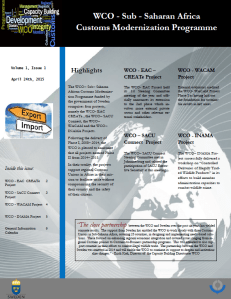
WCO Sub-Saharan Customs Modernisation Programme NewsletterHerewith a new newsletter informing about developments of Capacity Building Projects in Sub- Saharan African Customs Unions as sponsored by the government of Sweden. The project includes the WCO- EAC CREATE Project, the WCO- WACAM Project, The SACU Connect Project and the WCO INAMA Project.

With this newsletter we share with you updates about ongoing activities as well as an outlook for the events of the upcoming months. Click this hyperlink to download the newsletter.

Whilst this newsletter can only provide a snapshot of key developments, it may raise your awareness and encourage you to address us for more detailed publications or to contact us. Source: WCO

New Singapore Mega Port Will Have 20 Deep Water Berths

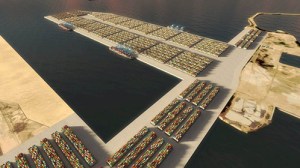
TArtist's Illustration -DEME Grouphe Maritime and Port Authority of Singapore (MPA) has signed a milestone contract for the construction of the first phase of a new $1.82 billion mega port in Singapore.

The contract was awarded to a joint venture between the Dredging International Asia Pacific Ltd., a subsidiary of Belgium’s DEME Group, and South Korea’s Daelim.

The project, formally known as the Tuas Terminal Phase 1 Reclamation, Wharf Construction and Dredging Project, entails the construction of a new port terminal with 20 deep-water berths having a total capacity of 20 million twenty-foot equivalent units (TEUs) per annum. The Joint Venture will be responsible for the construction of an 8.6-kilometer quay wall and its foundation, the dredging of the fairway and basins, as well as the reclamation of 294 hectares of new land.

This major project is expected to complete within six years, and has been awarded to the Joint Venture for a Contract value of SGD 2.42 billion (or approximately US $1.82 billion).

Beginning in 2030, the Government of Singapore will start to consolidate its container port facilities at Tuas. New technology will be introduced at the greenfield site to create a hypermodern, innovative and largely automated logistics hub. The consolidation will also free up existing port land near the city centre for future urban redevelopment.

The Tuas Terminal Project is anticipated to ensure that Singapore’s leading global hub port continues to have sufficient capacity in the long term to meet industry demand.

Singapore ranks as the world’s second busiest container port handling 33.9 million 20-foot containers in 2014, according to the MPA. The Port of Shanghai ranks as number 1 with 35.2 million TEU in 2014. Source: Gcaptain.com

Tobacco Taxes or Cigarette Smuggling – Which Is Worse?

Cigarettes+XXX+smokingRampant cigarette smuggling isn’t the problem in New York–“sky-high” tobacco taxes are, according to an op-ed by Patrick M. Gleason, director of state affairs at Americans for Tax Reform, in The Wall Street Journal.

Gleason’s opinion piece, titled “A Laffer Curve for Smokes,” digested here, takes the city and state of New York to task for their $180-million lawsuit against UPS over what officials allege was unlawful delivery of nearly 700,000 cartons of cigarettes. (A Laffer curve, named for economist Arthur Laffer, shows the relationship between rates of taxation and levels of government revenue.)

“This misguided lawsuit demonstrates once again that too many in government do not understand the root cause of cigarette smuggling. New York state levies the highest cigarette tax in the nation, $4.35 per pack, and New York City tacks on an additional $1.50 local tax. All told, the cost of one pack there can run to $12 or more.

“The result? Most of the cigarettes smoked in New York, 58%, are smuggled in from out of state, according to the nonpartisan Tax Foundation. The higher that revenue-hungry politicians raise tobacco taxes, the more profit smugglers can make.

“Politicians never learn. Of the 32 state tobacco tax increases that went into effect between 2009 and 2013, only three met or exceeded revenue projections, according to industry data.

“Lawmakers can claim they’re raising taxes on cigarettes to reduce smoking and improve public health. That talking point is belied by the recent imposition of taxes on electronic cigarettes, which are saving lives by delivering nicotine in puffs of water vapor instead of chemical-filled smoke. There are more than 15 tax bills pending across the country for currently untaxed e-cigarettes. Hawaii is proposing a tax of 80%, New York of 75%, Oregon of 65% and Ohio of 60%.

“For politicians, cigarette taxes are—and have always been—about one thing: money.

“New York state officials claim that the cigarette smuggling via UPS cost the treasury $29.7 million in lost tax revenue. That’s less than 0.03% of the state budget. The $4.7 million allegedly lost by New York City represents less than 0.006% of its budget.

“For a mere rounding error, state and city officials want to grab $180 million from UPS. That’s $180 million UPS could use to hire new workers, give employees raises, or invest back into its business. The leaders of New York and New York City should drop this silly lawsuit and find a more productive use of their time.”

Click here to view the full Wall Street Journal opinion piece.

Xenophobia Backlash – Mozambique/South African Border closed

Lebombo border post has been closed until further notice Friday17 April 2015 after an unruly mob barricaded the N4 near Ressano Garcia, targeting trucks with South African registration numbers [Picture: Sowetan]

Lebombo border post has been closed until further notice Friday17 April 2015 after an unruly mob barricaded the N4 near Ressano Garcia, targeting trucks with South African registration numbers. [Picture: Sowetan]

The border post between South Africa and Mozambique has been closed until further notice Friday after an unruly mob barricaded the N4 near Ressano Garcia, targeting trucks with South African registration numbers.

This also came just as immigration officials from Mozambique early in the morning began the blocking of all vehicles coming from South Africa under unexplained circumstances. Witnesses told ZimEye.com the situation at the border is both shocking and desperate with drivers voicing their frustration at the hands of Mozambican border officials.

Lebombo border post has been closed until further notice Friday17 April 2015 after an unruly mob barricaded the N4 near Ressano Garcia, targeting trucks with South African registration numbers..

“Trucks with South African registration plates have been stoned in Mozambique. A volatile crowd of about 200 Mozambicans has barricaded the N4 about four kilometres east of the Resano Garcia border post, where there is a truck stop,” reported Corridor Gazette on Friday.

“It is suspected that this action in related to the Xenophobic attacks which have erupted in various areas of KwaZulu-Natal and Gauteng this week.”

Trac, a company which is responsible for the 570km of the road between Solomon Mahlangu off-ramp in Tshwane and the Port of Maputo in Mozambique, placed a warning on the protest action on its website.

A traveller who en route to Nelspruit from Maputo at around 9:30 on Friday morning told the website that: “The crowd let us pass because we had a Mozambican-registered car.

South Africa and Zimbabwe sign milestone Customs Mutual Assistance Agreement

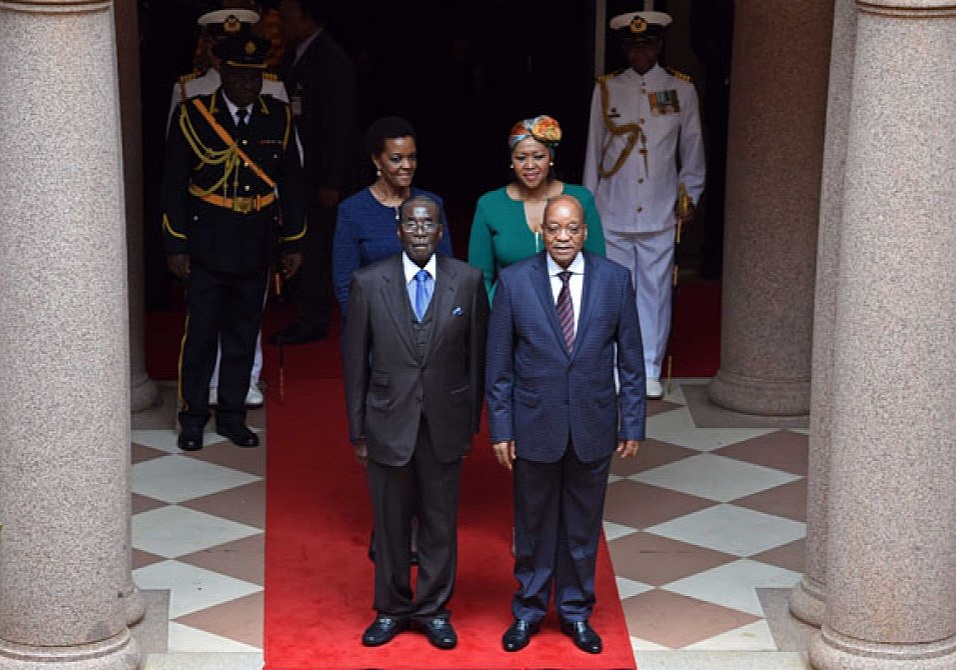
robertmugabejacobzuma2015govtza_SnapseedSouth Africa and Zimbabwe have elevated bilateral relations with the signing of five agreements set to benefit both countries. The agreements were signed on Wednesday during President Robert Mugabe’s state visit to South Africa at the invitation of President Jacob Zuma. An agreement regarding mutual assistance between customs administrations between the two countries was also signed, which will further cooperation towards the establishment of a one-stop border post. This is viewed as a crucial milestone.

Zimbabwe tightens border controls on imported goods

Zimbabwe-flagZimbabwe has introduced custom-control measures aimed at reducing the inflow of smuggled and inferior goods, and boosting its revenue from customs duty. Goods being exported to Zimbabwe will have to undergo consignment verification from May 16.

The government’s customs officials are also tightening up inspections at the Beitbridge border post to stem the flow of cheap, illegal goods, which Zimbabwean companies blame for their financial woes.

Executive chairman of the European Union Chamber of Commerce and Industry of Southern Africa Stefan Sakoschek said on Thursday that “the general idea is for Zimbabwe to protect its borders from substandard goods, as well as from undervaluation”.

Mr Sakoschek said the consignment-based conformity assessment programme fell within the framework of the World Trade Organisation’s technical barriers to trade as well as the regulations of the General Agreement on Tariffs and Trade.

Exporters and clearing agents have been informed of the new consignment verification measures, which will ensure conformity to standards and the value of goods declared. A certificate will be issued for the consignments for presentation to customs officials on arrival in Zimbabwe. Goods without a certificate will be refused entry.

Targeted products include food and agricultural goods, building and civil engineering products, timber and timber products, petroleum and fuel, packaging materials, electrical and electronic appliances, body care products, automotive and transportation goods, clothing and textiles, engineering equipment, mechanical appliances and toys.

Trade Law Chambers director Rian Geldenhuys said the pre-shipment verification process would entail additional costs but should not contribute to further delays in shipment. Consignment verification was widely practised especially in developing countries as a way to ensure the collection of customs duty revenue, Mr Geldenhuys said.

“Underinvoicing is a huge problem throughout the world, especially least developed and developing countries which Zimbabwe is one of,” he said.

Trade Law Centre researcher Willemien Viljoen also said the assessments would entail additional costs. Much of the effect would depend on how the conformity assessments were implemented and the standards that would be applied, Ms Viljoen said.

The Zimbabwean government has appointed well-recognised French company Bureau Veritas as the conformity assessment company for verification purposes, and has given the assurance that “compliant exporters will be able to benefit from fast-track procedures reducing systematic intervention on their frequent exports to Zimbabwe.”

Zimbabwean Industry and Commerce Minister Mike Bimha was quoted by the Zimbabwean press as saying that Zimbabwe was being “flooded with sub-standard imports which do not meet quality, safety, health and environmental standards”.

These goods had a negative effect on the country’s economic development and the competitiveness of its industries, Mr Bimha said.

In terms of its four-year agreement with Bureau Veritas the Zimbabwean government will receive monthly royalty fees equivalent to 5% of all monies received for its services. This arrangement will eventually lapse when the Zimbabwe Standards Regulatory Authority is established to monitor and control imports, exports and local goods to ensure compliance with quality, health, safety and environmental standards. Bureau Veritas operates in 140 countries and offers pre-shipment services to SA, Ethiopia, Kenya, Somalia, Uganda and Côte d’Ivoire. Source: BDLive (Reporter: Linda Ensor)

Read also the following articles, published in Zimbabwean Situation – Govt moves to tighten border controls (September 2014) as well as Zim mulls one-stop border post (November 2014) which might suggest that entry arrival procedures at Zimbabwean ports of entry may not be that expeditious given a prominent focus on revenue collection.

Event – Role of the Private Sector in Support of the Trade Facilitation Agreement

international-trade1The role of the private sector in the implementation of the World Trade Organization’s (WTO) Trade Facilitation Agreement (TFA) will be the focus of the 2015 edition of the Global Facilitation Partnership for Transportation and Trade (GFP) meeting. With the world’s customs administrations currently identifying their respective TFA  implementation commitments and setting up National Trade Facilitation Committees, trade and logistics operators can learn how they can participate in such initiatives by attending these sessions.

The GFP meeting will be held at Palais des Nations, Geneva, on 22 April, and will be divided into three thematic sessions.

The first session, ‘Governments’ Priorities: Strategies for Fostering Private Sector Participation in the TFA Implementation Process’ will look at how governments are planning to implement the TFA.

It will focus on how the private sector is consulted and how an effective participation of the private sector can be facilitated to implement the Agreement.

The second session, ‘Priorities, Perspectives, and Expectations from the Private Sector on TFA Implementation’ will assess how the private sector – including large corporates and small and medium-sized enterprises – view TFA implementation. It will look at the potential benefits from a private-sector perspective, and how the sector can contribute to national and international initiatives to implement the agreement.

The third session, ‘International Organizations’ Co-ordination and Partnership for Supporting TFA Implementation’, will provide an opportunity to share information and experiences on how the TFA can be implemented with public-private partnerships in mind, as how national trade facilitation committees can better support this process.

ITC invites all interested stakeholders to join the GFP meeting at the Palais des Nations on 22 April from 9:00. Click here for link to online registration.

Source: International Trade Centre (Geneva)

Feature – Côte d’Ivoire Single Electronic Window for Trade

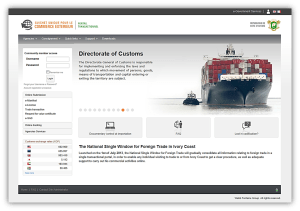
Ivory Coast SEW2As Customs and Border regulatory authorities ramp up their commitment to international agreements, such as the WCO Revised Kyoto Convention, SAFE Framework of Standards and the more recent WTO Trade Facilitation Agreement, more countries will offer a single point of entry through which traders, international carriers and logistics providers can access and comply with the resident customs and other government regulatory regimes.

The concept of a Single Window is borne out of the fact that traditional import/export and related regulatory requirements pose a barrier to market entry for international goods. There are many derivatives of Single Window in operation globally. Perhaps the best resource for this can be found on the UNECE’s interactive Trade Facilitation Implementation Guide webpage. One can navigate to the case studies page to read up on a country-by-country experience on various trade reforms including Single Window developments.

Côte d’Ivoire (Ivory Coast) is one of many African countries who have introduced Single Window as a facilitation measure whereby international trade can interface with Customs in a number of ways. It consists of a web-based trade portal (operated by Webb Fontaine) which interfaces with AsycudaWorld (AW), Côte d’Ivoire Customs’ management system. The portal allows traders to key-in advance import/export information within an electronic document called TVF (Trade Virtual Folder). Customs declarations are then subjected to tariff classification  and valuation, thereafter routed for commercial/risk assessment and revenue accounting on AsycudaWorld, or Sydam World as it is known in Côte d’Ivoire.

Commercial banks use the TVF within the Single Window to endorse the settlement of each import; the Ministry of Commerce subsequently authorizes the overall transaction through the system.

The Single Window provides an entry point for traders and supply chain operators to accomplish various Customs formalities such as –

  • Customs Declaration processing – allowing importers and exporters to electronically file clearances.
  • Manifest operations – used by all carriers to upload their XML manifests and register the same through the trade portal directly into AsycudaWorld. The facility also allows the amendments of waybills (e.g. excess and shortages) and automatically synchronizes the operations with the AW system. The Port Authority IT systems, including the Port of Abidjan and the Port of San Pedro, automatically receive and integrate the manifests submitted by carriers.
  • License module – allows traders to request import/export licenses (regulatory permits) that are later on approved online by the relevant ministries. Each license comprises a list of regulated products, quota allowable amount based on a predefined scheme (gross mass, net mass, FOB, Unit of measurement or unlimited quota). Further developments will include the automatic write-off of license quota by declarations using the Declaration module.

Source: Webb Fontaine

Dubai Customs arrests South African carrying cocaine

cocaineDubai customs arrested a woman who was trying to smuggle 2.3 kilograms cocaine in her shorts at Dubai International Airport. Customs officers stopped the 31-year-old South African passenger when she arrived at the airport’s transit terminal.

One of the officers suspected the woman passenger and took her inside a private search room as she seemed perplexed. She was reportedly found to be smuggling 16 pouches of cocaine that were secretly stitched inside her mini-shorts.

The Dubai Court of First Instance convicted the South African of smuggling cocaine in transit and jailed her for 10 years. When she appeared in court, the defendant admitted that she smuggled the substance in her clothes but maintained that she did not know that she carried a banned substance.

She confessed that she agreed to carry the substance for money [the amount was not specified] but did not realize that she was carrying cocaine. The passenger claimed in court that she had intended to take the substance to her homeland and not to Dubai. The court fined her Dh50,000 (US$13, 000) and will be deported after serving her punishment. The defendant was cited confessing to prosecutors that she smuggled the drugs via Dubai in transit. Source: customstoday.com.pk

Zimbabwean Customs seizes 48kg illicit South African gold worth R20m

goldZimbabwean Customs (ZIMRA) seized 48 kg illicit gold worth R 20 million and arrested 46 people for initial investigations. Forged gold serial-number stamps, specially designed armoured vehicles, clandestine refineries, fake customs clearance papers and documents with links to the black market.

These and other pieces of evidence are the keys that the Hawks believe link a Zimbabwean and South African gold-smuggling syndicate to scores of buyers in Europe masquerading as dealers in precious metals. For two years police have been zeroing in on the syndicate, whose roots are in illegal gold mining in Zimbabwe. Inside were 48kg of gold bars valued at R20-million.On Friday, they acted. In the early hours teams from the Hawks, the Special Task Force and Crime Intelligence raided luxury homes and farms across Gauteng and the North West.

In one of the raids police discovered a walk-in vault at a warehouse outside OR Tambo International Airport. Inside were 48kg of gold bars valued at R20-million. They were being prepared for stamping with official South African gold serial numbers designating that the metal had been officially mined and refined in the country. Police sources say the gold was to have been flown to at least three European countries at the weekend before being smelted, re-refined and distributed.

A source with knowledge of the investigation has revealed the inner workings of the syndicate, from how and where the gold is mined to how corrupt customs and mining officials facilitate the metal’s passage across borders.(Now should’nt this prompt some serious cause for concern, if true?)

“The amount this syndicate has handled is immeasurable. We have known about them for two years and in that short time we have recovered R40-million,” he said.

“They have operated both in South Africa and Zimbabwe as well as other SADC [Southern African Development Community] countries for years, well before we even discovered them”

Illegal miners in Zimbabwe supplied the syndicate. “With the instability and corruption there [South Africa?] it’s dangerous but easy. Once they have the gold, runners take it to the border where, through corrupt officials, it is smuggled across disguised as things such as household products.”

The gold was taken to farms in and around Modimolle in Limpopo where illicit refineries smelted and refined it, the source said. With the help of South African mining officials, gold clearance documentation and special serial and insignia stamps were sourced.

“Once stamped you would never know the difference. We have placed it next to legitimate bars and it looks and feels the same.” He said the gold was distributed through legitimate channels in Europe.

“Those running the syndicate know what they are doing. They are well-connected and influential businessmen with ties to Africa, Europe, the US and Asia”.

“They are linked to the gold powerhouses of the world. These are not ‘mickey-mouse’ people. They are immensely powerful and extremely well connected to some of the world’s top legal firms. Within hours of Friday’s raids lawyers were arriving at their clients’ homes and businesses.”

He said police seized hundreds of official gold clearance documents, serial stamps and other paperwork with links to mines and importers and exporters. Source and picture: CustomsToday.com

Contraband Cigarettes – 3 Zimbabweans and a South African arrested

cigarettes1Three Zimbabweans and a South African were arrested in Limpopo province for allegedly teaming up and smuggling cigarettes worth $200,000 into the neighbouring country. The Zimbabwean trio, Takuzo Mutswiro, 22, Tatenda Nyamhunga, 31, Joseph Mhembwe, 27 and Gilbert Mamburu, 54, a South African from Tshiozwi village in Limpopo province, were arrested last week at Tshilwavhusiku near Thohoyandou after police intercepted a truck they were using to transport the cigarettes.

Limpopo provincial spokesperson Colonel Ronel Otto, in a statement, said police followed up on information they received about suspicious activities at Mamburu’s house. Upon arrival at the scene, the three Zimbabweans attempted to run away, but were apprehended. Cigarettes with an estimated value of more than R2 million were found hidden in a small truck as well as a light delivery truck. It is suspected the cigarettes were smuggled from Zimbabwe, however their origin and destination is still being investigated.

Lately there has been an increase in the number of cigarette smugglers being arrested in the neighbouring country. Some of the cigarettes are smuggled out of the country through undesignated entry points along the crocodile-infested Limpopo River while others find their way into South Africa through Beitbridge Border Post despite the presence of Zimbabwe Revenue Authority (ZIMRA) scanners.The machines are able to detect concealed goods hidden in sealed containers.

The South Africa reportedly charges high rates on cigarette imports, which has resulted in a marked increase in cases of smuggling between Zimbabwe and South Africa. Most of these cigarettes are repackaged when they get to South Africa before being shipped to either Europe or Asia.

According to the South African Revenue Services (SARS), Beitbridge Border Post accounts for 70 percent of the cigarettes which are smuggled into that country. A recent statement from the South African Police Service said cigarette smuggling from Zimbabwe was being prioritised after it emerged the country supplied 55 to 70 percent of the 10 billion cigarettes reaching the neighbouring country’s black market. Source: The Chronical (Zimbabwe) & Customstoday.com

Time to pull the plug on SACU?

SACU logoPeter Fabricus, Foreign Editor, Independent Newspapers through the Institute of Security Studies writes an insightful and balanced article on the history and current state of the Southern African Customs Union (SACU).

The formula that determines how the customs and excise revenues gathered in the Southern African Customs Union (SACU) are distributed among its members looks, to a layperson, dauntingly complex. But this formula has had an enormous impact on the economic and even political development of the five SACU member states; South Africa, Botswana, Lesotho, Namibia and Swaziland.

The impact has arguably been greatest on South Africa’s neighbours, the four smaller member states that are often referred to simply as the BLNS. But it has also had an impact on South Africa.

SACU was founded in 1910, the year the Union of South Africa came into existence, and is the oldest surviving customs union in the world. Originally it distributed customs revenue from the common external trade tariffs in proportion to each country’s trade..

So, South Africa received nearly 99%. Surprisingly, South Africa’s apartheid government radically revised the revenue-sharing formula (RSF) in 1969 after Botswana, Lesotho and Swaziland had become independent. This gave each of the BLS members first 142% and later 177% of their revenue dues, calculated on both external and intra-SACU imports, with South Africa receiving only what was left. But this apparent economic generosity from Pretoria almost certainly masked a political intention to keep its neighbours dependent and in its fold, as the rest of the world was increasingly turning against it.

However, as Roman Grynberg and Masedi Motswapong of the Botswana Institute for Development Policy Analysis pointed out in their paper, SACU Revenue Sharing Formula: The History of An Equation, the 1969 formula became increasingly unviable for South Africa as it had been de-linked from the common revenue pool. This threatened to burden Pretoria with a commitment to pay out to the BLS states more than the total amount in the pool.

The African National Congress government saw the dangers when it took office in 1994 and soon began negotiations with the BLNS states for a new formula. That was agreed in 2002 and implemented in 2004. But although the 2002 RSF eliminated the risk that the payouts to the BLNS might exceed the whole revenue pool, it actually increased the share of the pool accruing to the BLNS at the expense of South Africa – as Grynberg and Motswapong also observe.

The new RSF was based on three separate components. The first divided the customs revenue pool proportional to each member state’s share of intra-SACU imports. Because of the growing imports of the BLNS states from the ever-mightier South Africa, this meant most of the common customs pool went to the BLNS. This proportion is increasing – but never to more than the entire pool.

The second component of the RSF divided 85% of the pool of excise duties (the taxes on domestic production) in direct proportion to the share of the gross domestic product (GDP) of each of the SACU members. The remaining 15% of the excise duties became a development component, distributed in inverse proportion to the GDP per capita of each member. So the poorest members of SACU would receive a disproportionate share of this element of the excise.

Over the years the BLNS countries have grown increasingly dependent on the SACU revenue. It now funds 50% of Swaziland’s entire government revenue, 44% of Lesotho’s, 35% of Namibia’s and 30% of Botswana’s. Because of its own growing fiscal constraints, Pretoria launched a review of the formula in 2010. But this review got bogged down over major disagreements and seems to have gone nowhere.

In his budget speech this month, Finance Minister Nhlanhla Nene raised the issue again, calling for a ‘revised and improved revenue-sharing arrangement,’ and Parliament’s two finance committees examined it. National Treasury spokesperson Jabulani Sikhakhane told ISS Today that while efforts to reform the SACU formula are ongoing, ‘progress has unfortunately been arduously slow.’

Budget documents show that in 2014-15, South Africa paid out some R51.7 billion to the BNLS countries out of a total estimated revenue pool of R80 billion, and was projected to pay out R51 billion again in 2015-16. Kyle Mandy, a PricewaterhouseCoopers technical tax expert, told Parliament’s two finance committees last week that South Africa was paying about R30 billion a year more than it would otherwise under the SACU RSF. He said South Africa contributed about 97% of the customs revenue pool and received only about 17% of it.

The R51.7 billion payout to the BLNS this year represents about 5% of South Africa’s total of R979 billion in tax revenue, a substantial ‘subsidisation’ that was no longer affordable at a time of growing fiscal constraint, which had forced Nene to increase taxes, Mandy said.

He noted that the SACU revenue had allowed all but Namibia of the BLNS countries to set their taxes below South Africa’s. ‘This means South Africa is subsidising the BLS countries to compete with South Africa for investment with their more attractive taxes,’ he said in an interview.

‘This is not sustainable for anyone. It locks the BLNS countries into dependency on South Africa. They have neglected their own fiscal systems. But the moment that the revenue fluctuates, [as Nene’s budget predicted it would in 2016-17, dropping to R36.5 million], it puts them in a difficult position. When South Africa sneezes, they catch flu.’

But what to do about this? Some, like political analyst Mzukisi Qobo, have called for a total overhaul of the SACU agreement, which would make explicit that SACU is a disguised South African development project. The development aid would become transparent and could be tied to conditions such as democratic government.

That is on the face of it an attractive solution, offering the opportunity of leveraging democracy in Swaziland, in particular, by placing a conditional foot on its lifeline of SACU revenues. But Grynberg warns that a sudden withdrawal of the vital direct budgetary support which SACU customs and excise revenues provides, could implode both Swaziland and Lesotho and provoke economic crises in Namibia and even Botswana.

He also points out that the RSF is not plain charity by South Africa to its smaller neighbours. The formula has essentially just compensated them for the cost-raising and polarising effects of SACU – that the BLNS countries have generally had to pay more for imported goods over the years than they would have otherwise done because of import tariffs designed to protect South African industries; and because the duty-free trade within SACU has tended to attract investment to larger South Africa.

Meanwhile, South Africa has benefitted from a ready market for its much larger manufacturing machine. Grynberg wrote in a more recent article for the Botswana journal, Mmegi, that the South African government was thinking of pulling out of SACU because it couldn’t get its way in the negotiations to revise the RSF; and because the 2005 Southern African Development Community Free Trade Agreement now gave it duty-free access to the BLNS countries without the need to pay the re-distributive SACU customs revenues.

It was only President Jacob Zuma who was preventing this, because he didn’t want to go down in history ‘as the man who crippled the Namibian and Botswana economies and created two more “Zimbabwes” – i.e. Swaziland and Lesotho – right on the country’s border.’ Pretoria’s decision had turned SACU into a ‘dead man walking, just waiting for someone to pull the switch and end its life.’

Grynberg strongly advised the BLNS to prevent this by accepting that the political reality that underpinned the RSF of SACU no longer existed. He says that it should be transformed into a purely development community without the formula, but with mutually agreed spending on development – mainly in the BLNS. He suggested, though, that this radical change would take at least 10 to 15 years to phase in.

All very well. But isn’t that what SADC is supposed to be already? Which suggests that it might be time to take the 105-year-old dead man off life support.

Source: Institute of Secutity Studies (ISS)

Related articles

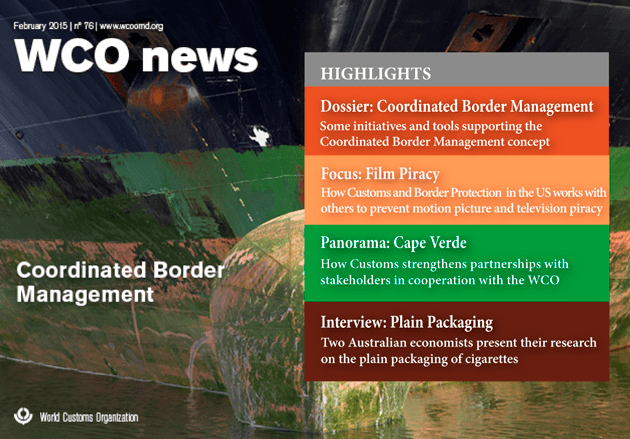
WCO News – February 2015 Edition

WCO News - Coordinated Border Management Feb 2015Check out the latest WCO News – per usual a wealth of interesting customs and supply chain information:

  • WCO launches IRIS, an application exploiting open source information
  • Harmonized System amendments effective from 1 January 2017
  • Beginning the CBM process: the Botswana experience
  • Inter-institutionality – a distinctive feature of the Colombian AEO model
  • WCO Data Model: the bridgehead to connectivity in international trade
  • Implementing New Zealand’s Joint Border Management System

and a whole lot more…

Source: WCO

World Wildlife Day – 2015

A Kenya Wildlife Services officer stands near a burning pile of 15 tonnes of elephant ivory seized in Kenya at Nairobi National Park [Picture - Carl de Souza - AFP]

A Kenya Wildlife Services officer stands near a burning pile of 15 tonnes of elephant ivory seized in Kenya at Nairobi National Park [Picture – Carl de Souza – AFP]