Bali Package has grievous implications for Africa’s people

Africa Trade Network, comments that: “Whatever the expectations with which African countries came to Bali, they are leaving virtually empty-handed. There is hardly anything of substance in the just adopted Bali package that addresses Africa’s developmental imperatives….We will expect our States to wake up, go back to the drawing board, take the negotiations seriously as having grievous implications for their people…”

Read Africa Trade Network’s conclusions in full.


WTO Bali – Trade Facilitation Agreement

WTO-globalvoices_org__au_The draft text relating to the outcome on a Trade Facilitation Agreement at 9th Ministerial Conference of the WTO can be located here!   It reveals some significant impact and far-reaching implications for the Customs administrations, but to a great extent it will probably be welcomed by the world’s trading community. In the South African context, readers may find Article 11 on “Freedom of Transit” extremely interesting, if not controversial by some members of the establishment. In essence it’s all about being transparent! Source: World Trade Organisation.

Experts Caution Against Rush into Trade Facilitation Agreement

Bali 2013A rather lengthy article published by Third World Network, but entirely relevant to trade practitioners and international supply chain operators who may desire a layman’s understanding of the issues and challenges presented by the WTO’s proposed agreement on ‘Trade Facilitation’. I have omitted a fair amount of the legal and technical references, so if you wish to read the full unabridged version please click here! If you are even more interested in the subject, take a look through the publications available via Google Scholar.

A group of eminent trade experts from developing countries has advised developing countries to be very cautious and not be rushed into an agreement on trade facilitation (TF) by the Bali WTO Ministerial Conference, given the current internal imbalance in the proposed agreement as well as the serious implementation challenges it poses.

“While it may be beneficial for a country to improve its trade facilitation, this should be done in a manner that suits each country, rather than through international rules which require binding obligations subject to the dispute settlement mechanism and possible sanctions when the financial and technical assistance as well as capacity-building requirements for implementing new obligations are not adequately addressed.”

This recommendation is in a report by the Geneva-based South Centre. The report, “WTO Negotiations on Trade Facilitation: Development Perspectives”, has been drawn up from discussions at two expert group meetings organised by the Centre.

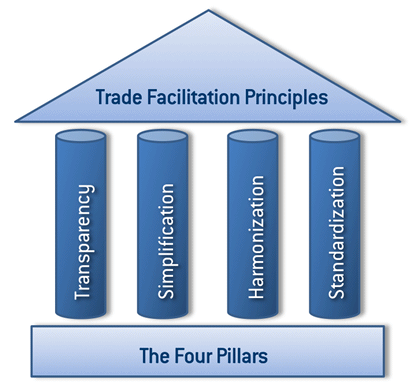
Noting that an agreement on trade facilitation has been proposed as an outcome from the Bali WTO Ministerial Conference, the South Centre report said that the trade facilitation negotiations have been focused on measures and policies intended for the simplification, harmonization and standardization of border procedures.

“They do not address the priorities for increasing and facilitating trade, particularly exports by developing countries, which would include enhancing infrastructure, building productive and trade capacity, marketing networks, and enhancing inter-regional trade. Nor do they include commitments to strengthen or effectively implement the special and differential treatment (SDT) provisions in the WTO system”.

The negotiations process and content thus far indicate that such a trade facilitation agreement would lead mainly to facilitation of imports by the countries that upgrade their facilities under the proposed agreement. Expansion of exports from countries require a different type of facilitation, one involving improved supply capacity and access to developed countries’ markets.

Some developing countries, especially those with weaker export capability, have thus expressed concerns that the new obligations, especially if they are legally binding, would result in higher imports without corresponding higher exports, which could have an adverse effect on their trade balance, and which would therefore require other measures or decisions (to be taken in the Bali Ministerial) outside of the trade facilitation issue to improve export opportunities in order to be a counter-balance to this effect.

According to the report, another major concern voiced by the developing countries is that the proposed agreement is to be legally binding and subject to the WTO’s dispute settlement system. This makes it even more important that the special and differential treatment provisions for developing countries should be clear, strong and adequate enough. The negotiations have been on two components of the TF: Section I on the obligations and Section II on special and differentiated treatment (SDT), technical and financial assistance and capacity building for developing countries.

Most developing countries, and more so the poorer ones, have priorities in public spending, especially health care, education and poverty eradication. Improving trade facilitation has to compete with these other priorities and may not rank as high on the national agenda. If funds have to be diverted to meet the new trade facilitation obligations, it should not be at the expense of the other development priorities.

“Therefore, it is important that, if an agreement on trade facilitation were adopted, sufficient financing is provided to developing countries to meet their obligations, so as not to be at the expense of social development,” the report stressed.

The report goes on to highlight the main issues of concern for a large number of developing countries on the trade facilitation issue. It said that many developing countries have legitimate concerns that they would have increased net imports, adversely affecting their trade balance. While the trade facilitation agreement is presented as an initiative that reduces trade costs and boosts trade, benefits have been mainly calculated at the aggregate level.

Improvements in clearance of goods at the border will increase the inflow of goods. This increase in imports may benefit users of the imported goods, and increase the export opportunities of those countries that have the export capacity.

However, the report noted, poorer countries that do not have adequate production and export capability may not be able to take advantage of the opportunities afforded by trade facilitation (in their export markets).

“There is concern that countries that are net importers may experience an increase in their imports, without a corresponding increase in their exports, thus resulting in a worsening of their trade balance.”

Many of the articles under negotiations (such as the articles on ‘authorized operators’ and ‘expedited shipments’) are biased towards bigger traders that can present a financial guarantee or proof of control over the security of their supply chains. There is also the possibility that lower import costs could adversely affect those producing for the local markets.

“The draft rules being negotiated, mainly drawn up by major developed countries, do not allow for a balanced outcome of a potential trade facilitation agreement,” the report asserted.

New rules under Section I are mandatory with very limited flexibilities that could allow for Members’ discretion in implementation. The special and differential treatment under section II has been progressively diluted during the course of the negotiations. Furthermore, while the obligations in Section I are legally binding, including for developing countries, developed countries are not accepting binding rules on their obligation to provide technical and financial assistance and capacity building to developing countries.

The trade facilitation agreement would be a binding agreement and subject to WTO dispute settlement. The negotiating text is based on mandatory language in most provisions, which includes limited and uncertain flexibilities in some parts.

Therefore, if a Member fails to fully implement the agreement it might be subject to a dispute case under the WTO DSU (Dispute Settlement Understanding) and to trade sanctions for non-compliance.

“Many of the proposed rules under negotiations are over-prescriptive and could intrude on national policy and undermine the regulatory capacities and space of WTO Member States. The negotiating text in several areas contains undefined and vague legal terminology as well as ‘necessity tests’, beyond what the present GATT articles require.”

Continue reading →
India Seeks Binding Trade Facilitation Agreement and Mandatory Exchange of Customs Information

TFPrinciples tfig.unece.org

India has proposed changes in the trade facilitation agreement to address the concerns of developing countries in the proposal that tops the agenda of the WTO‘s Bali ministerial scheduled for early December.

The trade facilitation agreement aims to smoothen cross-border trade by removing red tape, improving infrastructure and harmonising Customs procedures. Seen as the developed countries’ agenda, the emerging economies have sought relaxations in the legally binding clauses like clearing shipments within three hours.

“We have informed WTO that there needs to be some restriction on the scope of expediting shipment, and should be only limited to air cargo and that too very urgent ones,” a commerce department official told ET.

The country should also be allowed to restrict it to courier services, as the ones very urgent. WTO has subsequently agreed to relax the clause to make expediting shipments within six hours or as rapidly as possible instead of three hours.

Negotiators from 159 countries have held several rounds of talks since September in Geneva to forge a consensus on the multilateral agreement.

Although talks started in 2001 in Doha, lack of consensus between the developed and developing countries has lead to an impasse.

The ninth ministerial round in Bali is being seen as the last attempt to renew the global trade agreement agenda by focusing on the low hanging fruit such as trade facilitation.

India’s commerce & industry minister Anand Sharma told WTO director-general Roberto Axevedo during his Delhi visit in October that India was in support of the trade facilitation agreement, “but needs a balance in the pact”.

India along with other developing countries had raised objection to the clause, which calls for a sufficient time gap between the announcement of change in tariff to its coming into effect. This would be against India’s constitution, since most of the budget announcements related to tariffs come into effect within 24 hours. “We cannot change our constitution for WTO,” said the official, adding that India has submitted an alternative proposal to this effect, wherein, budget-related announcement should be kept out of this clause since they need to become applicable immediately. “Deliberations are still on, we need to be given flexibility,” he added.

Besides, India has sought a binding agreement on Customs cooperation under trade facilitation, which will ensure mandatory exchange of information between Customs administrations (on request) so as to prevent under-invoicing, overvaluation, tax evasion and illicit capital flows.

However, the developed countries want to agree to it only on ‘best endeavour basis’. “It is important for us, and has been on the table for over 20 year. It is only for cross checking, as information is available at both ends. However, developed countries are putting in so many conditions, confidentiality laws, secrecy. So, we are not sure in what form it will finally look like,” said the official.

India has also been pushing for a binding technical and financial assistance by the developed countries to the developing countries to accept TF agreement. Source: Economic Times (India)

The Material Footprint of Nations and ‘True’ Material Cost of Development

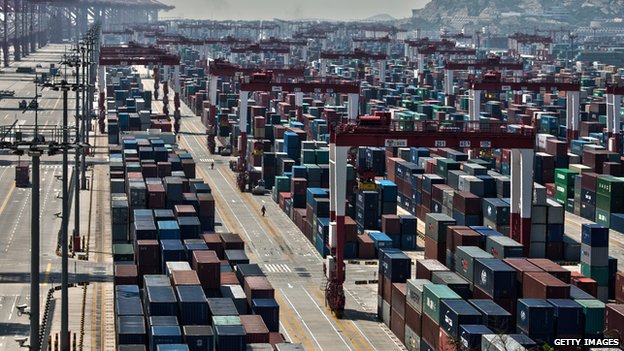
High Density Container Terminal  (Picture credit - Getty Images)

High Density Container Terminal (Picture credit – BBC News/Getty Images)

Thanks to the kind reader who passed me this story. BBC News Environment correspondent, Matt McGrath, reports that current methods of measuring the full material cost of imported goods are highly inaccurate. In a new study, researchers have found that three times as many raw materials are used to process and export traded goods than are used in their manufacture.

Richer countries who believe they have succeeded in developing sustainably are mistaken say the authors. The research has been published  (click hyperlink to access the report) in the Proceedings of the National Academy of Sciences.

Many developed nations believe they are on a path to sustainable development, as their economic growth has risen over the past 20 years but the level of raw materials they are consuming has declined.

According to  Dr Tommy Wiedmann University of New South Wales “We are saying there is something missing, if we only look at the one indicator we get the wrong information”. This new study indicates that these countries are not including the use of raw materials that never leave their country of origin.

The researchers used a new model that looked at metal ores, biomass, fossil fuels and construction materials to produce what they say is a more comprehensive picture of the “material footprint” of 186 countries over a 20 year period.

“The trade figure just looks at the physical amounts of material traded, but it doesn’t take into account the materials that are used to produce these goods that are traded – so for something like fertiliser, you need to mine phosphate rocks, you need machinery, so you need extra materials.”

In this analysis, the Chinese economy had the largest material footprint, twice as large as the US and four times that of Japan and India. The majority comes from construction minerals, reflecting the rapid industrialisation and urbanisation in China over the past 20 years.

The US is by far the largest importer of these primary resources when they are included in trade. Per capita, the picture is different, with the largest exporters of embodied raw materials being Australia and Chile.

According to the model, South Africa was the only country which had increased growth and decreased consumption of materials.

The researchers believe their analysis shows that the pressure on raw materials doesn’t necessarily decline as affluence grows. They argue that humanity is using natural materials at a level never seen before, with far-reaching environmental consequences.

They hope the new material footprint model will inform the sustainable management of resources such as water. The authors believe it could lead to fairer and more effective climate agreements.

“Countries could think about agreements where they help reduce the emissions at that point of material use,” said Dr Wiedmann. “That’s where it is cheapest to do, where it is most efficient, where it makes more sense.” Source: BBC News

Trade Information Portal to Improve Trade Facilitation in Namibia

Namibia flagThe World Trade Organization General Agreement on Tariff and Trade (GATT) 1994 Article X on Trade Facilitation calls for member country trade regulations to be clearly published. The WTO Self-Assessment Guide (2009) outlines the basic standard for internet Publication as: “A Member shall publish all trade related legislation, procedures and documents on a national official internet site or sites”. Usually called a “Trade Repository” or a “Trade Information Portal” the site facilitates awareness, via the internet, of requirements to enable compliance with customs and other agency requirements for the import or export of goods, using the HS classification of goods as the primary organizing principle for cataloguing and retrieving information

USAID Southern African Trade Hub reports that the government of Namibia expects to have its Trade Information Portal up and running by early 2014. The development of portal is supported by the USAID Southern Africa Trade Hub, under its Partnership for Trade Facilitation facility. The Trade Hub recently supported Namibia in a detailed legislative review of the country’s Customs and Excise Act to align it with global and regional legislation and to provide the legislative foundations for electronic trade facilitation measures, including the Trade Information Portal.

Currently trade-related information is made available across number of websites maintained by each government agency responsible for a particular aspect of trade regulation. The Trade Information Portal will provide a single platform where all trade related information for Namibia is collected in one system and readily available for searching and viewing, which will save time and expense for the trading community. The Trade Information Portal uses the latest technology to provide a comprehensive, accurate and up-to-date source for all regulatory information, which will result in tangible benefits for trade facilitation. No longer will it be necessary to seek advice in person from multiple agencies. Furthermore, conflicting advice and guidelines will be avoided by creating a single authoritative reference point. The savings in time and expense will lessen the overall cost of doing business and reduce the time to import or export goods, contributing to Namibia’s improved standing in doing business indexes and transparency.

A significant part of the coordination and development work in setting up the Trade Information Portal will facilitate and shorten the road map towards implementing an electronic National Single Window which is also under consideration by the Namibia government. Source: satradehub.org

SA Ratifies the Sanitary and Phytosanitary Annex to the SADC Protocol On Trade

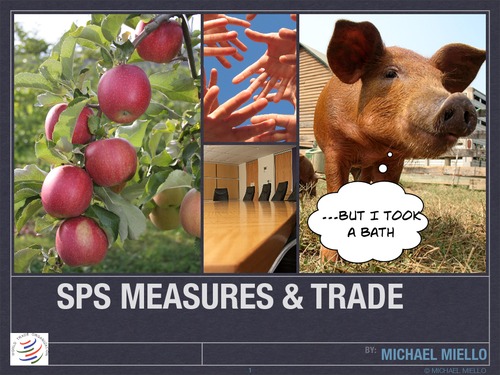
WTO-SPS-Measures-Presentation-Transcript-23698Cabinet approved South Africa’s ratification of the Sanitary and Phytosanitary (SPS) Annex to the Southern African Development Community‘s (SADC) Protocol on Trade and for this to be submitted to Parliament.

Agriculture is one of the key sectors in the SADC region due to the sector having the highest potential for growth in terms of export. SADC realises, however, that the sector can only grow significantly if producers are able to access markets for agricultural products. To facilitate market access and promote intra Africa trade it is critical that border trade policies, including SPS measures be harmonised in line with international standards and guidelines in the interest of improving the movement of goods and services in the region. (Read in more red tape)

The SADC Protocol on Trade to which SA has acceded, serves to promote regional cooperation and integration amongst member states for trade in goods and services within the region, including agricultural products.

Article 16 of the Protocol encourages member states to base their Sanitary and Phytosanitary (SPS) measures on international standards, guidelines and recommendations so as to harmonise SPS measures for plant health, animal health and food safety.

To give effect to the provisions of Article 16 of the Protocol, an SPS annex to the SADC Protocol on Trade was drafted and consequently adopted by the SADC Committee of Ministers of Trade (CMT), in July 2008.  Annex VIII to the SADC Protocol on Trade concerning SPS measures represents an enabling regional strategy to promote cooperation in SADC with regards to issues of food safety, plant health and animal health.

In addition, most SADC member states are also signatory members to the World Trade Organisation‘s Agreement on Sanitary and Phytosanitary measures (WTO-SPS) which places obligations on member states to ensure that the SPS measures they implement are least restrictive to trade, while being scientifically justifiable for the protection of human, animal or plant life and health.

The ratification and implementation of the SPS Annex will therefore facilitate improved mechanisms and institutional arrangements in conformity with obligations under the WTO-SPS agreement so as to minimise SPS related issues that impact the trade of agricultural and services trade within the region. Source: SA Government

Want to understand more on the WTO Agreement on Sanitary and Phytosanitary MeasuresClick here!


EAC Way Ahead in African Trade Integration

English: Pascal Lamy.THE outgoing World Trade Organisation director general Pascal Lamy has rated the East African Community trading block as the most important in the African continent ahead of similar blocks in West and South Africa. He said EAC is three times more integrated than the West and South Africa.

“This region is a clear case that I think deserves a lot of attention…I have no doubt that this (EAC) will be the future,” Lamy said adding that the political goodwill from EAC leaders is the key distinguishing factor between EAC and other African trading blocks.

Lamy also described the African continent as the next growth frontier but added that some key bottlenecks such as not tarriff barriers, poor infrastructure and energy and corruption need to be addressed. The WTO boss cast doubt on the conclusion of crucial trade talks that can open international markets for African goods.

Zim-EU Agreement to Suffocate Trade

ZimbabweThe Interim Economic Partnership Agreement (IEPA) Zimbabwe signed with the European Union (EU) is set to suffocate the country’s trade and industrial development policies due to the removal of taxes, a regional non-governmental organisation has warned. Zimbabwe alongside Mauritius, Seychelles and Madagascar concluded the IEPA with the EU that would result in the removal of taxes between the African countries and the EU.

But in an analysis of the trade pact, the Southern and Eastern Africa Trade, Information and Negotiations Institute (Seatini) said the elimination of the export taxes is a blow to both the National Trade Policy (NTP) and Industrial Development Policy (IDP) meant to promote the trade and industrial revival respectively.

Last year, the Zimbabwean government launched the Industrial Development Policy 2012-2016 that advocates value-addition or beneficiation and the NTP to guide the country’s trade with the rest of the world.

“There is no doubt that for Zimbabwe to successfully implement the NTP and IDP it will need to use tools such as export taxes. However, Article 15 of the interim EPA agreement that Zimbabwe signed and ratified provides for elimination of export taxes, thereby suffocating the policy space Zimbabwe is referring to in its National Trade policy on the need for value-adding natural resources,” Seatini said in a discussion paper, Zimbabwe’s control over its natural resources in the WTO context.

Article 15 of the IEPA provides that for the duration of the agreement, the parties shall not institute any new duties or taxes on, or in connection with, the exportation of goods to any other party in excess of those imposed on products destined for sale. The organisation recommended that Zimbabwe “must exercise its right to develop its economy and protect the environment through the use of export taxes, until such a time when the economy can competitively trade with the rest of the world enabling it to then gradually eliminate the taxes on a product by-product basis”.

It also recommended that government should consult widely all relevant ministries and the private sector on its existing and proposed laws relating to any prohibitions and restrictions on the export of natural resources especially metals and minerals. Seatini warned that the use of export restrictions would be in violation of World Trade Organisation (WTO) rules.

Article XI:2(a) of the General Agreement on Tariffs and Trade does not allow WTO members to impose prohibitions and restrictions on the importation of any product, unless they (restrictions and prohibitions) are temporary, addresses critical shortages, relates to foodstuffs or other products and are essential to the exporting WTO member. It said it would be difficult for Zimbabwe to prove the critical shortage requirement. Source: The Standard – Zimbabwe

X-Ray Scanners – WTO panel rules on EU-China dumping row

Nuctech Fast Scan Vehicle and Container inspection system

Nuctech Fast Scan Vehicle and Container inspection system

Part of the problem here is that the Chinese have a significant market share in this type of equipment. In a short period of 10 years they have outstripped some of the more fancied American and European players in this business. While the dispute in question raises ‘ethical’ questions of the Chinese, it does seem to be a matter of sour grapes.

China’s anti-dumping duties on imports of x-ray security scanners from the EU violated global trade rules, according to a WTO panel ruling that was issued yesterday. [WTO Dispute Settlement, DS425]

Brussels brought the dispute in July 2011 after Beijing imposed duties ranging from 33.5 to 71.8 percent on the x-ray scanners. (See Bridges Weekly, 25 January 2012) The EU exports approximately €70 million of these scanners to China annually.

China imposed the duties after the EU had applied anti-dumping duties on Chinese cargo scanners one year earlier, which some viewed at the time as a “tit-for-tat” move.

The panel report primarily focused on procedural issues in Beijing’s investigation, specifically regarding how China calculated the anti-dumping margin, loosely defined as the difference between the price – or cost – in the foreign market and the price in the importing domestic market.

Beijing included more expensive “high-energy” scanners – which do not “look remotely like” the cheaper scanners, according to the panel report – in calculating the average domestic price, even though only cheaper “low-energy” scanners were exported. The panel found that this price comparison was “not consistent with an objective examination of positive evidence” required under WTO rules.

The panel also found that Beijing did not comply with certain due process and transparency requirements before imposing the duties.

The panel did not rule with the EU on all points, however, noting that Brussels had not established that Beijing had acted inconsistently in certain other procedural matters.

“I expect China to remove the measures immediately,” EU Trade Commissioner Karel De Gucht said on Tuesday in response to the panel ruling. “I will not accept tit-for-tat retaliation against European companies through the misuse of trade defence instruments.”

Under WTO rules, both sides have 60 days to appeal the ruling. In a statement, China’s Ministry of Commerce indicated that they would make a serious assessment of the case and reserved the right to appeal.

WTO – Merchandise Trade and Commercial Services

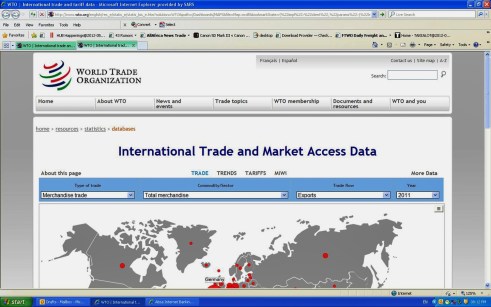
Researchers and students of international trade patterns and economics will find a useful resource in the following link. Information is made available across databases, annual publications as well as interactive statistics and maps. Please take note of the copyright.

WTO Statistics

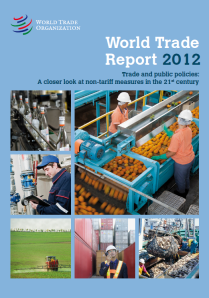
World Trade Report 2012

This year’s World Trade Report ventures beyond tariffs to examine other policy measures that can affect trade. As tariffs have fallen in the years since the birth of the General Agreement on Tariffs and Trade (GATT) in 1948, attention has progressively shifted towards non-tariff measures (NTMs). The range of NTMs is vast, complex, driven by multiple policy motives, and ever-changing. Public policy objectives underlying NTMs have evolved. The drivers of change are many, including greater inter-dependency in a globalizing world, increased social awareness, and growing concerns regarding health, safety, and environmental quality. Many of these factors call for a deepening of integration, wresting attention away from more traditional and shallower forms of cooperation. Trade in services is a part of this development and has come under greater scrutiny, along with the policies that influence services trade.

So what does the report contain? Click here to download the report!

  • Section A of the Report presents an overview of the history of non-tariff measures in the GATT/WTO. This overview discusses how motivations for using NTMs have evolved, complicating this area of trade policy but not changing the core challenge of managing the relationship between public policy and trading opportunities.
  • Section B examines the reasons why governments use NTMs and services measures and the extent to which public policy interventions may also distort international trade. The phenomenon of off-shoring and the cross-effects of services measures on goods trade are also considered. The section analyses choices among alternative policy instruments from a theoretical and empirical perspective. Finally, case studies are presented on the use of NTMs in particular contexts.These include the recent financial crisis, climate change policy and food safety concerns. The case studies consider how far measures adopted may pose a challenge for international trade.
  • Section C of the Report surveys available sources of information on NTMs and services measures and evaluates their relative strengths and weaknesses. It uses this information to establish a number of “stylized facts”, first about NTMs (TBT/SPS measures in particular) and then about services measures.
  • Section D discusses the magnitude and the trade effects of NTMs and services measures in general, before focusing on TBT/SPS measures and domestic regulation in services. It also examines how regulatory harmonization and/or mutual recognition of standards help to reduce the trade-hindering effects of the diversity of TBT and SPS measures and domestic regulation in services.
  • Section E looks at international cooperation on NTMs and services measures. The first part reviews the economic rationale for such cooperation and discusses the efficient design of rules on NTMs in a trade agreement. The second part looks at how cooperation has occurred on TBT/SPS measures and services regulation in the multilateral trading system, and within other international forums and institutions. The third part of the section deals with the legal analysis of the treatment of NTMs in the GATT/WTO dispute system and interpretations of the rules that have emerged in recent international trade disputes. The section concludes with a discussion of outstanding challenges and key policy implications of the Report. Source: World Trade Organisation.
Related articles

Trade Facilitation Implementation Guide

UNECE-Trade Facilitation Implementation GuideHaving spent the better part of the last fortnight amongst customs authorities and implementors of Single Window, I’m compelled to share with you a site (if you have not already been there) which attempts in a simple but comprehensive way to articulate the concept and principles of Trade Facilitation and its relationship and connotation with Single Window. The UNECE Trade Facilitation Implementation Guide should come as a welcomed resource, if not a companion, to trade facilitation practitioners and more specifically Customs Authorities wishing to embark on a trade facilitation approach. Of course it is a very useful reference for the many avid scholars on customs and trade matters across the global village. Of particular interest are the case studies – two of which feature African countries (Mozambique and Senegal) – providing a welcomed introduction of trade facilitation and Single Window on our continent. It is good to note that Single Window has less to do with technology and more to do with inter-governmental and trade relationships and an understanding of how these are meant to co-exist and support one another  – Enjoy!

Trade facilitation is emerging as an important factor for international trade and the economic development of countries. This is due to its impact on competitiveness and market integration and its increasing importance in attracting direct foreign investments. Over the last decade, it has gained prominence in the international political agenda as part of the ongoing WTO multilateral trade negotiations as well as of wide international technical assistance programs for developing and transition economies.

The primary goal of trade facilitation is to help make trade across borders faster and cheaper, whilst ensuring its safety and security. In terms of focus, it is about formalities, procedures, and the related exchange of information and documents between the various partners in the supply chain. For UNECE and its UN Centre for Trade Facilitation and Electronic Business (UN/CEFACT), trade facilitation is “the simplification, standardization and harmonization of procedures and associated information flows required to move goods from seller to buyer and to make payment”. Such a definition implies that not only the physical movement of goods is important in a supply chain, but also the associated information flows. It also encompasses all governmental agencies that intervene in the transit of goods, and the various commercial entities that conduct business and move the goods. This is in line with discussions on trade facilitation currently ongoing at the WTO. Source: UNECE

Is South Africa being screwed by China?

In recent days there’s been mutterings amongst several business commentators concerning the state of the South African manufacturing sector and its inability to compete in the local economy in the face of ‘so-called’ cheap imports. For once I heard some common sense instead of the usual WTO/economist waffle which normally just confuses people instead of shedding light on the inherent problems. What the Business Times article below suggests is that our prevailing job plight is self-induced and should not be blamed entirely on rogue elements alone. Under valuation and mis-declaration have and always will pose a challenge to any country. The blame has been placed on Customs not doing its job; yet, the problem appears to lie at the feet of policy makers who have made foolish decisions for which the country as whole now pays the price. 

The trouble began soon after 1994, when then Trade and Industry Minister, anxious to prove to the then rich and powerful, and sceptical, West what lovers of democracy and free markets they were, removed tariff protection on cheap imports against a considerable body of expert advice. And 12 years before we needed to, because the World Trade Organisation‘s predecessor, GATT, had given South Africa 12 years to modernise its manufacturing, improve its skills and prepare itself before lowering import tariffs.

At the time, Trade and Industry Minister and the government thought South Africa did not need a grace period. Leslie Boyd, then head of the Anglo-American industrial division, warned of the devastating consequences but to no avail. “They thought if they took the crutches away we’d become a free market economy and we’d be competitive,” says Stewart Jennings, chairman of the Manufacturing Circle which represents thousands of manufacturers in SA. “It was the most ridiculous thing you could ever imagine. Those of us in business know there is no free market in the world. Every country protects itself. We don’t. Here’s an economy without skills that just throws open the tariffs. We’re the country that’s whiter than white in terms of the WTO. Everybody else just abuses us.”

Business consultant Moeletsi Mbeki opines “[government] is too ideologically orientated, it operates from ideology rather than from practical expertise. This motivates our relationship with China. The Chinese can do no wrong.”

One of the worst mistakes they made, he believes, was to sign an agreement that gave the Chinese market economy status which it did not and does not deserve. The talk was that SA agreed to do this as compensation for imposing a three-year quota on Chinese textile imports. The effect on SA’s manufacturing sector has been devastating. “As a consequence of that agreement it is virtually impossible for us to get countervailing duties into China through ITAC [the International Trade Administration Commission which used to fall under the Department of Trade and Industry but is now under Ebrahim Patel‘s Department of Economic Development],” says Stewart Jennings. “We’ve battled to get dumping duties or safeguards against China. Most of the applications that have gone to ITAC have been kicked into touch.”

First, China starts with a currency that is 30% undervalued. It manipulates it, so any goods it exports to SA are 30% cheaper than they should be. On top of that there are all sorts of incentives for Chinese exporters. And then, as Jennings says, attempts by local manufacturers to defend themselves by applying for countervailing duties more often than not go nowhere.

Iraj Abedian of Pan African Investment and Research says the short answer to the question is yes, we are being screwed. “Not because the Chinese have been smart but because we’ve been snoozing and naïve.”

SA was so flattered to be asked to join the BRIC (Brazil, Russia, India, China) club of developing economies that it did not drive a hard enough bargain. “We were romanticising our relationship with China and celebrating the fact that China was inviting us to join BRIC. We took it as a form of political honeymoon without recognising its effect on manufacturing, without assessing our counter-strategy for safeguarding national interests in the form of jobs and tax revenue.” China needed SA to join BRIC at least as much as SA itself wanted to join, but SA failed to capitalise on this.

Executive director of the Manufacturing Circle, Coenraad Bezuidenhout, who has observed the effect at close quarters, thinks part of it is that “our guys find the prospect of dealing with China daunting. They feel we need China as a market for our raw materials more than China needs us.” He thinks this attitude reflects a worrying lack of professionalism on the part of those who are paid to battle for SA’s interests. “We should be leveraging our position with regard to our minerals and our access to African markets far more than we do when we deal with China.”  Source: Business Times

Economic sanctions and international trade

Despite global automation and harmonisation of trade, customs operations and procedures, the following article exemplifies the continued need and importance of knowledgeable trade practitioners and customs specialists. Human intellect and ‘expertise’ will forever play a critical role in the interpretation international trade law and national customs procedure.

Long used by governments to punish rogue countries, regimes, entities and individuals, trade and economic sanctions impact an ever-widening range of goods, technology and services. Recent developments in Iran, Syria and Libya, for example, resulted in far-reaching sanctions by Australia, Canada, the European Union and its 27 Member States, the United Nations, the United States and others. The complexity of sanctions and the speed with which governments implement them to address rapidly changing political situations create serious compliance challenges.

Companies are therefore well advised to implement compliance from management through all levels of sales, logistics and finance. The stakes are extremely high because compliance failures—even unintentional ones—can result in the imposition of substantial fines, debarment from government contracts, damage to public reputation and even imprisonment. Recent penalties illustrate the risks and the high governmental enforcement priority for trade sanctions. These include fines of up to US$536 million imposed by US and UK regulators against financial institutions and major businesses. Individuals may also be subject to prison sentences of up to 10 years in the United States and the United Kingdom.

Anyone involved in cross-border transactions therefore needs to determine if their conduct and that of persons acting on their behalf is regulated by trade sanctions. At a minimum, businesses must understand: which countries, regimes and individuals are targeted by trade sanctions; who is obliged to comply; which transactions are prohibited or restricted; and which authorisations may be available or required for any restricted action.

Businesses should also consider the long reach of US and EU sanctions. US sanctions generally apply to “US persons” wherever they are located in the world and to anyone located in the United States. Similarly, EU sanctions apply to “EU persons” wherever they are located in the world and to anyone located in the European Union. Adding to the breadth of coverage, US rules prohibit “facilitation”, which means neither persons nor companies subject to the rules may support a transaction undertaken by another party, including a foreign affiliate, from which a US person would be prohibited from engaging in directly. EU rules likewise prohibit covered persons from infringing sanctions rules indirectly – so much for economic freedom!

Law firm McDermott Will & Emery recommends that companies should take appropriate steps to minimise the risk of infringing trade sanctions by introducing the following safeguards:

  • Require due diligence in connection with all transactions. This should involve at least the screening of all counterparties against the ever-changing sanctions lists that identify the countries, regimes, entities and persons blacklisted. Trade sanctions can apply to goods, technology licensing and the provision of technical assistance, and to ancillary services such as financing, insurance and transport.
  • Establish internal procedures to ensure prompt legal review in the event a transaction with a sanctioned party is identified.
  • Check that the due diligence checklist for merger or acquisition transactions includes an assessment for compliance with trade sanctions.

Source: McDermott Will & Emery