Port of Shanghai – extends its lead as world’s busiest container port

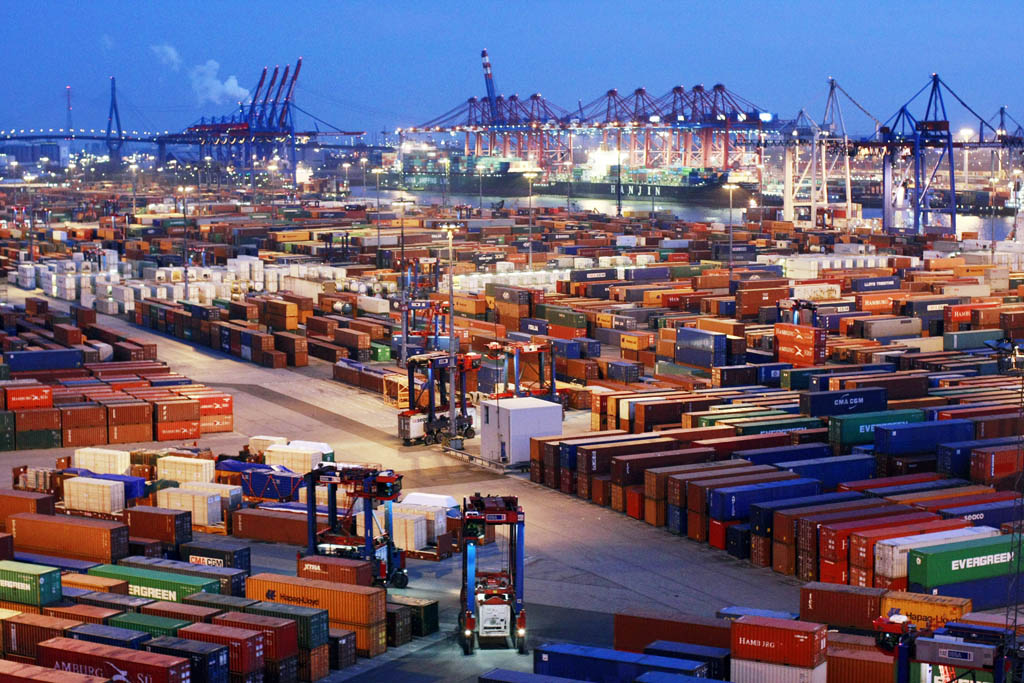
Port of Shanghai, China [Picture: DaliyMail.co.uk]

Port of Shanghai, China [Picture: DaliyMail.co.uk]

Shanghai retained its title as the world’s busiest container port for a fifth consecutive year after widening the gap with its closest rival Singapore.

Singapore handled 33.9 million 20-foot containers last year, according to a statement posted on the Maritime & Port Authority of Singapore’s website dated Jan. 16. Last month, Shanghai said it expects to process about 35.2 million boxes in 2014. A year before, the gap between the two ports was about 1 million boxes.

Shanghai, Shenzhen and other ports in China are dominating the global container-shipping market while the facility in Ningbo overtook South Korea’s Busan last year as the world’s fifth-busiest harbor. Seven of the world’s 10 top container ports were in China in 2013, with Hong Kong coming in fourth.

Shipping companies are adding larger container ships to meet demand as economic growth helped consumers to spend more money on clothes and food. Global trade last year probably grew 3.8 percent, according to the International Monetary Fund.

Global containerized trade reached 124 million boxes in the first 11 months of 2014, an increase of 4.3 percent from 118.9 million a year ago, according to Container Trade Statistics Ltd.

Geneva-based Mediterranean Shipping Co., the world’s second-largest container shipping company, currently operates the biggest vessel that can carry 19,224 boxes between Asia and Europe. Last year, China Shipping Container Lines Co. launched a ship that could carry about 19,100 containers. Source: Bloomberg/GCaptain

21st Century Silk Railway – Chinese freight train makes world record trip

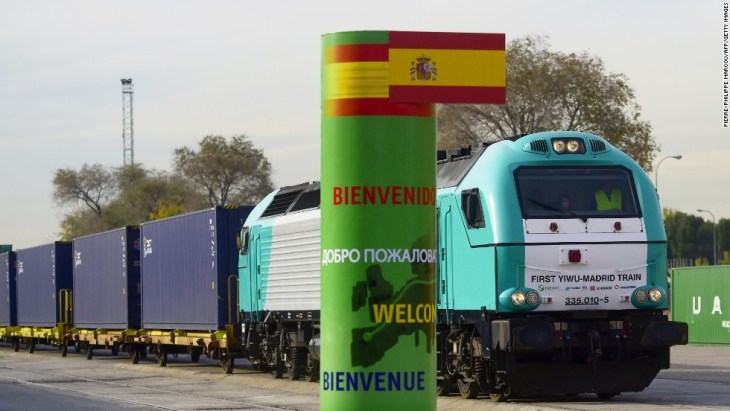
141212174829-yixinou-worlds-longest-train-journey-horizontal-large-galleryThe longest rail link in the world and the first direct link between China and Spain is up and running after a train from Yiwu in coastal China completed its maiden journey of 8,111 miles to Madrid. En route it passed through Kazakhstan, Russia, Belarus, Poland, Germany and France before arriving at the Abroñigal freight terminal in Madrid.
The railway has been dubbed the “21st-century Silk Road” by Li Qiang, the governor of Zhejiang province, where Yiwu is located. Its route is longer than the Trans-Siberian railway and the Orient Express. The first train was met by the mayor of Madrid, Ana Botella, and Spain’s minister of public works, Ana Pastor. It consisted of 30 containers carrying 1,400 tonnes of cargo – mostly toys, stationery and other items for sale over Christmas across Europe.

Yiwu is the world’s largest wholesale hub for small consumer goods and plays host to a vast 4 sq km (1.5 sq mile) market where tens of thousands of traders work daily. The journey was a test run to assess the viability of adding Spain to a route that already links China with Germany five times a week. Those trains link Chongqing, the huge industrial city in south-west China, with Duisburg, and Beijing with Hamburg.

China is Spain’s biggest trading partner after the EU, with bilateral trade worth around £16bn. It is also Spain’s third largest source of imports, after Germany and France. About half of these imports are made up of mobile phones and clothing. The Spanish prime minister, Mariano Rajoy, was in China in September, where he signed deals reported to be worth more than £6.3bn.

A major advantage of the rail route is speed. The train took just three weeks to complete a journey that takes up to six weeks by sea. It is also more environmentally friendly than road transport, which would produce 114 tonnes of CO2 to shift the same volume of goods, compared with the 44 tonnes produced by the train – a 62% reduction.

However, the cargo had to be transferred three times during the journey as a result of incompatible rail gauges. The locomotive also had to be changed every 500 miles. The service is being operated by InterRail Services and DB Schenker Rail and in Spain by DB’s Spanish offshoot, Tranfesa.

China’s Second Continent – the new colonisation of Africa

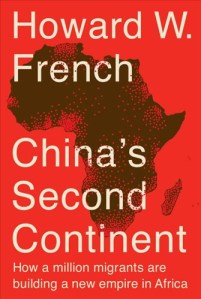
chinas-second-continent-howard-frenchFormer US Diplomat Brooks Spector takes a look at this important book (Daily Maverick) that should be on every economic policy maker’s reading list. Howard French’s China’s Second Continent, offers a very different – and provocative – perspective on China’s economic future, with special attention on Africa. Building on years of experience in both China and Africa, and following months of personal inquiry across the continent to search for answers to the questions of what China really wants in Africa, and how it is going to get there, French has effectively turned these questions on their head.
Instead of writing about China’s international economic policies in the language of the think tanks, of Wall Street and The City, or government councils in Whitehall or Washington, French has focused instead on what a million individual Chinese have done – or are now doing – throughout Africa, almost without regard to what the Chinese government may have planned or been thinking. In tackling the topic through this optic, French has given this vast Chinese movement into and across Africa crucial human dimensions. For the full review please visit this hyperlink. China’s Second Continent is available in hardcopy and electronic publication from online book stores. Source: Daily Maverick

High Court Stops Kenyan Mega-Port

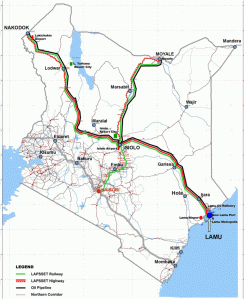
LAPSSETKenya’s high court on Friday ordered a halt to the long-delayed development of a mega-port on the country’s northern coast for at least two weeks to allow a lawsuit lodged by local landowners over compensation to move forward.

The $25.5 billion project, known as the Lamu Port-South Sudan-Ethiopia Transport (LAPSSET) project, would eventually link landlocked countries South Sudan and Ethiopia to the Indian Ocean via Kenya and include a port, new roads, a railway and a pipeline.

The LAPSSET project involves the development of a new transport corridor from the new port of Lamu through Garissa, Isiolo, Mararal, Lodwar and Lokichoggio to branch at Isiolo to Ethiopia and Southern Sudan. It will comprise of a new road network, a railway line, oil refinery at Lamu, oil pipeline, Isiolo and Lamu Airports and a free port at Lamu (Manda Bay) in addition to resort cities at the coast and in Isiolo. It will be the backbone for opening up Northern Kenya and integrating it into the national economy.

It was first conceived in the 1970s but has been gaining traction after commercial oil finds in Uganda and Kenya.

Judge Oscar Angote suspended the project and said the land compensation case would be heard on 8 December 2014. Source: Maritime Executive

US-India agreement to pave the way to implementation of the WTO “Bali Agreement” on trade facilitation?

India_USA-3The U.S. and India have reached an agreement that promises to pave the way toward global implementation of the WTO Trade Facilitation Agreement (TFA). The breakthrough agreement between India and the U.S. should now make it possible for member countries to begin implementing the requirements of the agreement, providing potentially significant financial benefits to businesses trading goods around the world as local customs procedures are streamlined. The target date for ratification of the agreement is 31 July 2015. Upon ratification by two-thirds of the membership, the agreement will enter into force for all WTO states. Member state will then begin the process of adopting conforming legislation.

The Trade Facilitation Agreement

Concluded in December 2013, the TFA is intended to streamline, and to some extent harmonize, customs clearance procedures around the world by imposing new multilateral disciplines on customs procedures in all member countries. The agreement imposes basic globally applicable principles for transparency, due process, and reasonableness in the development and implementation of customs clearance requirements across a broad spectrum of activities related to importing, exporting, and transiting of goods.

The U.S.-India agreement

While the specific details of the bilateral agreement are not publicly available at this time, a press release from the Office of the U.S. Trade Representative states that there are two key elements of the deal:

  • the U.S. and India agree that the multilateral TFA should be implemented without conditions, on the basis of a standard legal instrument for implementing new WTO agreements; and
  • the “peace clause” agreed upon by WTO members in December 2013, under which WTO members will refrain from initiating challenges to certain food security programs under the WTO dispute settlement process, will remain in place “until a permanent solution is found.”

Since announcement of the agreement last December, India has raised concerns that developing countries need greater assurances regarding their ability to maintain government agricultural buying programs and other farm subsidies until an agreement could be reached among WTO members on how to bring such programs into conformity with the body’s trade rules. The U.S. and India had previously disagreed on the form such assurances should take.

Under the new bilateral agreement, the U.S. and India will seek a General Council decision on the two key elements outlined above. A General Council decision will require the consensus of all WTO members. Source: Hogan Lovells International Trade Alert

FIATA 2014 Young Freight Forwarder of the Year Announced

Ms Nompumelelo Mboweni works as an Airfreight Import Controller at Bidvest Panalpina Logistics in Johannesburg [TT Club]

Ms Nompumelelo Mboweni works as an Airfreight Import Controller at Bidvest Panalpina Logistics in Johannesburg [TT Club]

The 2014 Young International Freight Forwarder of the Year (YIFFY) Award has been presented to South African forwarder Fortunate Nompumelelo Mboweni at the FIATA Annual Congress in Istanbul.

Each year at the FIATA Annual Congress the achievements of young freight forwarders from around the world are celebrated via an awards programme. TT Club is proud to have sponsored this award, now in its sixteenth year, since its foundation. The process of awarding the honour of Young Freight Forwarder of the Year (YIFFY) began earlier this year when entrants from all over the world submitted papers about a wide variety of transport and logistics projects.

These ranged from the transportation of tunnel drilling equipment to Bolivia to the delivery of a catamaran in Indonesia and from a project moving radioactive isotopes from South Africa to Namibia to the expedited deployment of a Disaster Assistance Response Team in the Philippines.

From this bewildering, yet highly professional array, the YIFFY Steering Committee selected a shortlist of four regional finalists. These four young professionals were then invited to attend the 2014 FIATA World Congress this week in Istanbul, Turkey to make a presentation on their dissertation topic.

The four regional finalists who proudly represented the future of the international freight forwarding industry in Istanbul were –

Africa/Middle East: Miss Fortunate Nompumelelo Mboweni, South Africa
Americas: Mr Douglas Whitlock, Canada
Asia-Pacific: Mr Saiful Ridhwan Bin Zulkifli, Singapore
Europe: Mr Christian Hensen, Germany

Following a comprehensive judging process, Ms Fortunate Nompumelelo Mboweni from South Africa was announced as the 2014 Young Freight Forwarder of the Year at the FIATA Congress’ opening ceremony on 13 October. Ms Nompumelelo Mboweni works as an Airfreight Import Controller at Bidvest Panalpina Logistics in Johannesburg. Andrew Kemp, TT Club’s Regional Director for Europe congratulated her and presented the award.

“I have been honoured as TT Club’s representative to be part of the selection process, and I personally was engrossed by the finalists’ presentations, which showed a considerable depth of understanding of their individual projects. I have to say all four finalists performed with flying colours at the recent final presentations; it was certainly a difficult decision to pick an overall winner. However, Fortunate prevailed and deservedly takes this year’s award,” said Kemp.

The award is presented in recognition of forwarding excellence and was established by FIATA with the support of TT Club to encourage the development of quality training in the industry and to reward young talent with additional valuable training opportunities. The TT Club has been a sponsor of the award since its inception and remains firmly committed to the importance of individual training and development within the global freight forwarding community. Source: TT Club

Container traffic to hit 1 billion TEU in 2020

-Dinesh Sharma, senior research manager at Drewry Maritime Advisors, says that global container throughput would rise between 5% and 5.5% a year up to the end of the decade. Speaking at a Ports & Terminals seminar in London, he cited ports in Africa and northern China as registering the strongest growth.

In his outlook, Sharma projected a 2020 global throughput volume of at least 1 billion TEU, up from 623 million TEU in 2013, with Asia accounting for 65% (650 million TEU) and transhipment traffic 32% (320 million TEU) of the total. This, he explained would compare with shares of 56% and 22.5% (140 million TEU), respectively, in 2013.

Within Asia, Sharma argued that China would become increasingly significant over the next seven years, citing that the country’s share of global container-handling activity would rise from 30% in 2013 to 40% in 2014. In 2000, China’s ports processed just 16% of a world total of 235 million TEU, a figure that reveals the spectacular growth that has occurred in the Asian country since it joined the World Trade Organisation in November 2001.
In a further assessment of the future, Sharma said the percentage of empty boxes handled would not change and would remain at about the 20% (200 million TEU) level in 2020.
Other interesting facts presented by the analyst showed that 22,000 TEU-sized ships would be in operation in 2020, the world population of super post panamax cranes would number over 2,000 units, compared with 1,160 units in service in 2013, and that the leading four global terminal operating companies would control an estimated 41% of all containers handled. Source: World Cargo News

FDI – Where is China Investing?

China-Overseas-FDIFollowing the financial crisis that hit Asia in the late 1990s, the Chinese government introduced its ‘Going Out’ or ‘Going Global’ strategy. The country had been open to inward FDI for a number of years at this stage, and the time had come to promote Chinese companies globally.

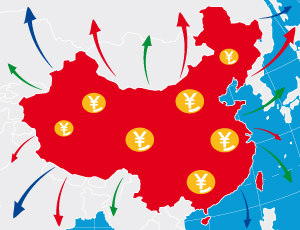
While Africa considers itself as a significant destination for China FDI, the numbers indicate that Chinese projects and investment is significantly smaller than it’s investments in other parts of the western world. To see exactly where the money is going, visit this link – Where is China Investing?

The government aimed to increase investment, promote its Chinese brand of companies and improve the country’s free market. The policy became one of the government’s ‘four modernisations’ and encompassed a range of schemes to assist outward FDI, such as using currency reserves to support foreign investment, offering tax rebates to investors and encouraging Chinese embassies globally to offer more and better financial assistance.

The result has been a boom in Chinese outward FDI. Between January 2009 and December 2013, greenfield investment monitor fDi Markets recorded a total of $161.03bn in Chinese outward FDI, creating almost 300,000 jobs across the world. During this period, in terms of investment projects, China was the ninth largest source country for FDI, peaking in 2011 with 429 projects. In terms of both capital expenditure and job creation, China was ranked seventh globally. Source: FDI Magazine

UK Forwarders object to New Air Cargo Surcharge

awb_welcomeIt is becoming more and more evident that every ‘automation’ project entails ‘more costs’. The benefits appear to lie in the ‘comfort’ of doing stuff at your keyboard. Much vaunted ‘cost-savings’ are a myth as technology encroaches every facet of global trading. The following is a fine example.

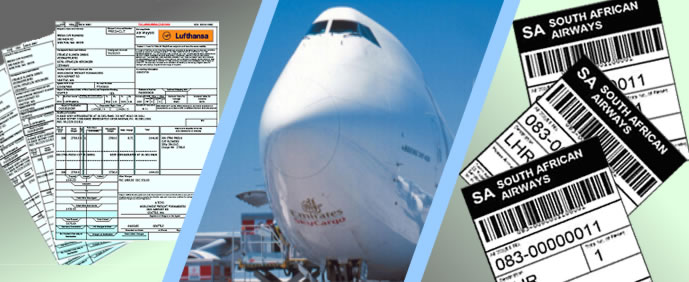
The trade association for UK freight forwarders and logistics service providers is encouraging its members to object to a Paper Air Waybill (AWB) Surcharge that airlines are planning for export AWBs that are not filed electronically. Robert Keen, director general of the British International Freight Association (Bifa), commented: “Bifa supports e-Commerce and e-Air Waybill implementation in the air cargo supply chain. However, we believe that implementation should create value for forwarders and airlines alike, and airlines need to recognise the costs that the originator of the information incurs to enter and transmit data.”

Keen continued: “Through our international body Fiata, Bifa will be voicing our objection to carriers that seek to apply yet another surcharge, and create yet another revenue stream, under the guise of supporting IATA’s – the airline industry body’s – e-Freight initiative, which aims to implement e-Freight worldwide.” Bifa is asking its members to join in the stand against the introduction of this surcharge by completing an online survey, which can be found here: http://www.surveygizmo.com/s3/1782849/Paper-AWB-Surcharge-Survey

The air freight sector missed IATA’s target last year of achieving 20% e-air waybill penetration “on feasible lanes”, achieving just 12%. The target for 2014 has been revised downwards to 22%, with a target for 45% e-AWB penetration by the end of 2015 and 80% by the end of 2016. IATA expects to see an acceleration of penetration levels this year, in part because of the introduction last year of the e-AWB Multilateral Agreement, to which around 70 airlines and more than 100 freight forwarders have now signed up.

But while there is increasing momentum among airlines and air cargo handlers, many forwarders remain unconvinced of the benefits. Chuck Zhao, process engineer project manager at US air cargo handler Consolidated Aviation Services (CAS), observes that only around 6% shipments out of the US are e-freight, largely because “those who cut the paper air waybills simply do not see the benefits of going paperless”.

Michael White, assistant director of cargo facilitation, security and standards for US air freight association Cargo Network Services (CNS) and regional manager of cargo for IATA, observed that there was a need for effective communication routes for the forwarders, especially small and medium-sized ones, to transmit their FWB & FHL messages – preferably a community system rather than via multiple airline portals. He said there was currently no community system in the US, but there were signs that companies are looking at that capability. Source: Lloydsloadinglist.com

Global platform for young freight forwarder

SAAFFAs the winner of the Region Africa Middle East phase of the Young Freight Forwarder of the Year competition, Fortunate Mboweni of Bidvest Panalpina Logistics is now off to compete on a global platform.

Fortunate’s prize is to attend and participate in the FIATA World Congress in Istanbul in October this year. At this Congress Fortunate and the three other regional winners representing the Americas, Asia Pacific and Europe will compete to become the global winner.

The global winner will receive a total of five weeks training in New York and London, as well as at one of the IATA major centres, with all expenses paid by competition sponsors, the Transit Trade Club and International Air Transport Association. The competition was developed to encourage training in the freight forwarding industry and to further develop the professionalism of young people.

Winners were chosen from dissertations on how they handle all aspects of the international movement of goods that are not the usual run of the mill cargo. Fortunate’s dissertation was called ‘Multimodal transport operations in practice: radio actives and abnormals from and to South Africa.’

Fortunate is a channel controller at BPL and she is currently studying for the Generic Management NQF level 5 qualification. Source: http://www.transportworldafrica.com

Egypt Plans New $4b Suez Canal

Capesize bulk carrier at Suez Canal Bridge [www.maritemexecutive.com]

Capesize bulk carrier at Suez Canal Bridge [www.maritimexecutive.com]

Egypt has plans to build a new Suez Canal alongside the existing 145-year-old historic waterway in a multi-billion dollar project to expand trade along the fastest shipping route between Europe and Asia.

The project, to be run by the army, is a major step by new President Abdel Fattah al-Sisi to stimulate Egypt’s struggling economy and recalled some of the grand national programs of one of Sisi’s predecessors, army strongman Gamal Abdel Nasser.

The Suez Canal earns Egypt about $5 billion a year, a vital source of hard currency for a country that has suffered a slump in tourism and foreign investment since the 2011 uprising that preceded Mursi’s presidency.

An official in the Suez Canal Authority told Reuters the new canal was set to boost annual revenues to $13.5 billion by 2023. The new channel, part of a larger project to expand port and shipping facilities around the canal, aims to raise Egypt’s international profile and establish it as a major trade hub.

“This giant project will be the creation of a new Suez Canal parallel to the current channel of a total length of 72 kilometers (44.74 miles),” Mohab Mamish, authority chairman, told a conference in Ismailia, a port city on the canal.

He said the total estimated cost of drilling the new channel would be about $4 billion and be completed in five years, though Sisi said he hoped it would be finished within a more ambitious one-year deadline.

The original canal, linking the Mediterranean and Red Seas, took 10 years of brutal, poorly paid work by Egyptians, drafted at the rate of 20,000 every 10 months from “the peasantry”.

It slashed weeks if not months off journeys between Europe and Asia that otherwise necessitated a trip round Africa. Up to 20 Egyptian firms could be involved but would work under military supervision, he said.

Egypt has planned for years to develop 76,000 sq km (29,000 sq miles) around the canal into an international industrial and logistics hub to attract more ships and generate income.

Neil Davidson, senior adviser for ports and terminals at London-based Drewry Maritime Research, said the new canal would not necessarily generate greater trade but the development of a hub around it could prove lucrative.

“The strategic location of Egypt and the canal is a key advantage… being a key point where cargo can be distributed or worked on. This hubbing concept is extremely valuable,” he said.

Mamish, the chairman, said the project would involve 35 kilometers (22 miles) of “dry digging” and 37 kilometers (23 miles) would be “expansion and deepening”, indicating the current Suez Canal, which is 163 km (101 miles) long, could be widened as part of the project.

The Panama Canal linking the Atlantic and Pacific Oceans in Central America, is also being expanded with a third set of locks being built to allow bigger ships to pass through the waterway. That project is due to open in 2016.Among the bidders for the Suez project, according to Egypt’s Al Mal newspaper, was a group including state-run Arab Contractors and consultancy firm James Cubitt and Partners. Another included McKinsey & Co management consulting firm. Source: Reuters

Forwarders – losing out on new business due to out-dated back-end systems

Losing-Business-On-Social-MediaOn March 13th, 2014, Sean Day, a Chicago-based wholesaler, called up the Italian branch of a leading global freight forwarder and requested a price quote for a door-to-door air freight shipment from a Rome-based apparel supplier, to his own warehouse in Chicago, IL. Within 37 minutes, he received pricing for two out of the three legs – from the Rome address to Rome’s airport, and from there to Chicago’s O’Hare airport. If that doesn’t impress you, consider that prompt price quotes for international freight shipments, are rather like four-leaf clovers. A spot quote in 37 minutes seemed too good to be true.

It was. Sean only received the final quote, including delivery to his Chicago address, four days later, on May 17th. Yes, four days.

Bear in mind that this was an air freight quote. Sean was willing to pay a substantial premium to fly his precious cargo by air, because he needed it urgently. What’s the point of splashing out on air freight, you might wonder, if you wait four days just for the price quote? Sean wondered the same thing.

At least he would have wondered, if he actually existed. In fact, our company, Freightos, created Sean, a fictional employee working at an imaginary company, as well as multiple whimsical competitors, in order to collect data on the sales process, and customer experience, of procuring international freight forwarding services. Over the course of two months, we requested dozens of air, ocean and ground quotes from five of the top fifteen freight forwarders in the world (after, of course, receiving permission from the companies). Each time, we identified ourselves as a new customer with potential for repeat business in the future.

Sean’s quoting experience was no exception. Due primarily to the archaic back-end systems so prevalent in the industry, and the lack of data sharing between fiefdoms, the average quote time was approximately 62 hours, with some quotes taking as long as a week. The quoting process was rife with other problems, ranging from vague quotations to blatant inaccuracies. In some freight forwarders, each office, or even individual sales staff, used their own price quote templates. Many forwarders had inactive contact numbers on their website. Worst of all, a staggering 43% of quote requests were simply ignored. Some way to capture new customers!

If these quotes were frustrating for the customers, they were also expensive for the vendors. We estimate a person-hour went into each. In developed countries that’s about $40. And forwarders often do five quotes for every secured order. That’s $200 wasted. For a smallish spot order, $200 is the entire profit! Click here to continue reading the full article… Source: LloydsLoading.com

US loses multi-billion dollar court cases against China and India

India, China, US [Picture: www.wespeaknews.com]

India, China, US [Picture: http://www.wespeaknews.com]

The World Trade Organization agreed on Monday this week to side with claims against the United States made by both China and India concerning US-imposed tariffs on products exported to America.

In both instances, the WTO ruled against the US and decided in favor of the major BRICs countries, who for two years now have each asked the organization to intervene and weigh in on America’s use of tariffs to tax certain imports dating back to 2007.

With regards to both cases, the WTO’s judges ruled that the US acted “inconsistent with its agreement on subsidies and countervailing duties,” or taxes imposed on goods sold by “public bodies.”

In China, the panel agreed, US officials improperly levied those taxes against state-owned enterprises that the WTO does not consider to be “public bodies.” Instead, the WTO said, those entities were majority-owned by the Chinese government, but did not perform “government function” or exercise “government authority,” according to the Financial Times. With respect to India, the WTO again agreed that the US was wrong to similarly treat state-owned National Mineral Development Corporation as a public body, according to the International Business Times.

At issue were billions of dollars’ worth of Chinese steel products, solar panels, aluminum, paper and other goods shipped to the US after being taxed as originating from public bodies. The panel’s decision, Reuters reported, “reflected a widespread concern in the 160-member WTO over what many see as illegal U.S. protection of its own producers.”

“China urges the United States to respect the WTO rulings and correct its wrongdoings of abusively using trade remedy measures, and to ensure an environment of fair competition for Chinese enterprises,” China’s commerce ministry said in a statement.

Mike Froman, the US trade representative, responded by saying Washington was “carefully evaluating its options, and will take all appropriate steps to ensure that US remedies against unfair subsidies remain strong and effective”.

Nevertheless, Froman added that the WTO’s ruling in the Indian case constituted at least a partial victory for the US.

“The panel’s findings rejecting most of India’s numerous challenges to our laws and determinations is a significant victory for the United States and for the (US) workers and businesses making these steep products,” he told Reuters. Source: Russia Today.

Global Value Chains in the Current Trade Slowdown

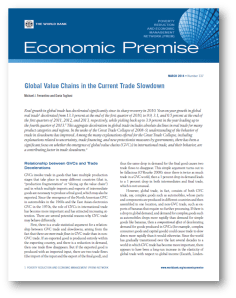
WB-GVC Slow Down TradeReal growth in global trade has decelerated significantly since its sharp recovery in 2010. Year-on-year growth in global real trade decelerated from 13.3 percent at the end of the first quarter of 2010, to 9.9, 3.1, and 0.5 percent at the end of the first quarters of 2011, 2012, and 2013, respectively, while picking back up to 3.9 percent in the year leading up to the fourth quarter of 2013. This aggregate deceleration in global trade includes absolute declines in real trade for many product categories and regions. In the wake of the Great Trade Collapse of 2008–9, understanding of the behavior of trade in slowdowns has improved. Among the many explanations offered for the Great Trade Collapse, including explanations related to uncertainty, trade financing, and new protectionist measures by governments, there has been a significant focus on whether the emergence of global value chains (GVCs) in international trade, and their behavior, are a contributing factor in trade slowdowns.

For detailed analysis of the apparel/footwear, electronics, and motor vehicles and related parts industries, download the World Bank report. Source: World Bank

Time to modernise trade rules for digital era

digital-ownershipIn the past, nations with the best ships and ports were able to establish global trade leadership and the growth that came along with it. Today, global trade has gone digital.

In the digital economy software-enabled products and services such as cloud computing and data analytics are the key drivers of growth and competitiveness. In fact, the world now invests more than $3.7 trillion (R40 trillion) on information and communications technologies a year.

In South Africa, we spend $26 billion a year and the total for the Middle East/Africa region is $228bn. However, to maximise our return on that investment, it is important for policymakers to eliminate barriers that could inhibit the continued expansion of digital trade.

It is clear that software-driven technology is transforming every sector of the global economy. For example, thanks to unprecedented processing power and vast data storage capabilities, banks can detect and prevent fraud by analyzing large numbers of transactions; doctors are now able to study historical trends in medical records to find more effective treatments; and manufacturers can pinpoint the sources of delays in global supply chains.

Against the backdrop of this kind of innovation, any country that wants to compete in today’s international marketplace must have a comprehensive digital agenda at the core of its growth and development strategy. In addition to domestic initiatives such as investment in education and skills training, or development of information technology infrastructure, policymakers can succeed in laying the groundwork for broad-based growth in the digital age if they focus on three big priorities.

First, any bilateral or multilateral trade agreement needs to facilitate the growth of innovative services such as cloud computing. As part of this, there should be clear rules that allow information to move securely across borders and prevent governments from mandating where servers must be located except in very specific situations.

Second, to promote innovation and foreign investment, continued intellectual property protection is vital and the use of voluntary, market-led technology standards – instead of country-specific criteria that force firms to jump through different technical hoops every time they enter a new local market – should be encouraged.

Third, all governments should ensure there are level playing fields for all competitors so customers have access to the best products and services the world has to offer.

At the same time, disclosures about government surveillance programmes in the US and other countries have sparked a renewed focus on data protection and personal privacy. Those concerns are worthy of debate and careful reform. But it is critically important not to conflate separate issues: We can’t let national security concerns derail digital trade.

There is precedent for navigating periods of change such as this in the global trade arena. Policymakers stood at a similar inflection point in the 1980s when they recognised the keys to growth in the coming decades would be intellectual property, services and foreign direct investment.

With foresight and hard work, they updated trade rules in the Uruguay Round of multilateral negotiations to ensure commitments were in place to provide a check against protectionist impulses. Now, as governments pursue robust growth agendas for the digital economy, it is critical we modernise trade rules again. Source: The Software Alliance (South Africa).