OECD estimates WTO TFA could to cut trade cost by 17.5% on customs rules

cut-red-tape“Simplifying trade documentation”; “automating border procedures”; “streamlining border controls” – all cliche’s of the modern customs and international trade scene, but just how attainable are they? Beyond the pleasantries, and fanfare of ribbon cutting ceremonies, very little seems to happen at the cold face. Sovereign states are inward-looking and jealously wish to preserve their ‘sovereign domains’.

A major World Trade Organization deal on streamlining global customs rules could cut international trade costs by between 12.5 percent and 17.5 percent, a study by the Organization for Economic Co-Operation and Development showed on Thursday.

A deal between India and the United States on the Trade Facilitation Agreement last year, which needs to be backed by all 160 WTO members, had resurrected hopes that the trade body could push through such reforms to cut red tape.

“There are very practical measures that we’ve identified that offer significant benefits,” Ken Ash, the OECD director for Trade and Agriculture, told media.

“Things like simplifying the required trade documentation. Automating border procedures, or streamlining border controls.”
Economists say the Trade Facilitation Agreement could save $1 trillion. Ash declined to endorse this figure, only saying the Paris-based body expected each 1 percent reduction in worldwide trade costs to bring $40 billion in savings.

Australia was to formally accept the agreement later on Thursday, Steven Ciobo, parliamentary secretary to the minister of foreign affairs, said at the news briefing in Paris, making Australia the seventh WTO member to adopt the agreement.

Africa losing $40bn in illegal cigarette trade

ContrabandA tobacco body has urged African governments to stamp out illegal tobacco trade, as their economies are losing billions of dollars in taxes annually. Tobacco Institute of Southern Africa (TISA) revealed that governments in the region are losing between US$20 billion and US$40 billion annually in taxes as a result of illegal tobacco trade, hence the need for collaboration among stakeholders to curb the vice.

This is contained in a statement issued by KPR Consulting Limited on Friday. “The size of the global illegal tobacco trade ranges between 330 and 660 billion cigarettes a year. These are cigarettes that are either smuggled, counterfeited or where tax is being evaded. “This equates to around six and 12 percent of global consumption, which deprives governments of between US$20 [billion] and US$40 billion a year in taxes,” the statement reads.

TISA, which is a regional body that represents tobacco traders, growers and processors, estimates illicit tobacco trade incidences in Zambia being between 20 and 30 percent. South Africa is rated among the top five countries globally when it comes to the trade in illegal cigarettes, with industry research estimating that around 23 percent of all cigarettes consumed in South Africa in 2014 were illegal. Commenting on the issue, British American Tobacco Zambia managing director Clara Mlambo cited weak penalties for criminals, poor border controls, low arrest rates and tobacco taxes creating intra-regional disparities as contributing factors.

Hong Kong Customs seizes 1.1m sticks of illicit cigarettes worth $3.1m

securityHong Kong Customs mounted a special operation at Lok Ma Chau Control Point to combat organised cigarette smuggling activities. About 1.1 million sticks of suspected illicit cigarettes with a market value of about $3.1 million and duty potential of about $2.2 million were seized. A 52-year-old male driver was arrested and the vehicle used for conveying the suspected illicit cigarettes was detained.

Customs officers here the other day intercepted an incoming container truck declared to be empty at Lok Ma Chau Control Point.

After X-ray examination and thorough inspection by Customs officers, about 1.1 million sticks of suspected illicit cigarettes in 83 carton boxes were found inside a false compartment of the container. The cigarettes were sorted and packed according to orders placed with a view to quick delivery to buyers.

A Customs spokesman said today (June 5), “The operation showed the effectiveness of the enforcement strategy, especially the escalated enforcement actions against smuggling activities at source. Customs will continue to carry out stringent enforcement action against all illicit cigarette activities.”

Under the Import and Export Ordinance, smuggling is a serious offense. The maximum penalty is a fine of $2 million and imprisonment for seven years. Source: CustomsToday

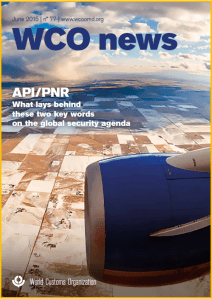
WCO News – June 2015 Edition

WCO News Edition no.77-2The WCO’s flagship magazine WCO News, aimed at the global Customs community, has published its latest edition which features a special dossier on API/PNR (Advance Passenger Information and Passenger Name Record) – two key words on the global security agenda.

Other highlights include a focus on Customs laboratories, interviews on the ‘illicit tobacco trade’ and the ‘killing of elephants,’ as well as articles covering trade-based money laundering, strengthening export controls, the illegal vehicle trade and much more.

The magazine is published and distributed free of charge three times a year, in February, June and October, and is available online or in paper format. If you do not want to miss future issues of WCO News, you are invited to fill out the online subscription form. Source: WCO

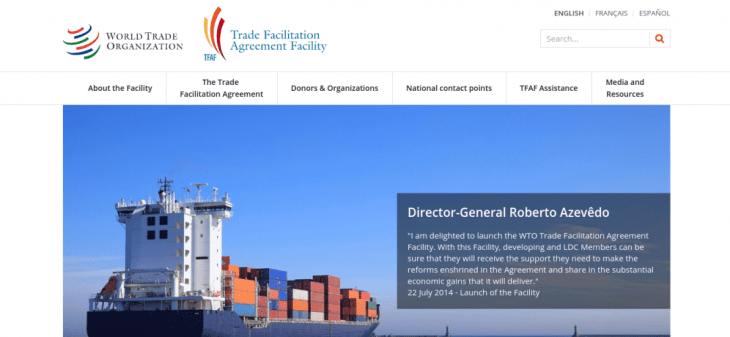
WTO launches dedicated website for new Trade Facilitation Agreement Facility

new-Trade-Facilitation-Agreement-Facility-siteThe WTO has launched a new website which will serve as a focal point for members, donors, and others seeking information on the new Trade Facilitation Agreement Facility (TFAF). The TFAF was created at the request of developing country and least-developed country (LDC) members to help ensure that they receive the assistance needed to reap the full benefits of the Trade Facilitation Agreement and to support the ultimate goal of full implementation of the new Agreement by all members. The TFAF will support these countries in assessing their specific needs and identifying possible development partners to help them meet those needs through a diverse number of activities.

The Facility was formally launched on 22 July 2014 by WTO Director-General Roberto Azevêdo and became operational on 27 November 2014. The website can be accessed here! To benefit from this, developing and LDC members must notify the WTO which provisions they will implement when the Agreement enters into force or, in the case of LDCs, within one year after entry into force (Category A commitments); which provisions they will implement after a transitional period following the entry into force of the Agreement (Category B); and which provisions they will implement on a date after a transitional period following the entry into force of the Agreement and that require the acquisition of assistance and support for capacity building (Category C).

The aim of the TFAF is to help ensure that this assistance is provided to all those needing it. The website provides background on the Agreement and the TFAF, information on programmes that support implementation of the Agreement, as well as information on national contact points for trade facilitation in developing and LDC members.

The website also provides information on TFAF support related to the preparation of Category A, B and C commitments, assistance and support for capacity-building, and applications for TFAF grants where no other funding sources are available to developing and LDC countries to meet their implementation needs. The website is a “work in progress” and will be continuously updated to provide useful information for WTO members. Source: WTO

Chinese Customs destroys half a ton of ivory worth £3m

ivory2-634x330Chinese authorities destroyed more than half a tonne of confiscated ivory in Beijing here the other day. The public event, organised by the Chinese State Forestry Administration and the Customs Department, is set to display the country’s determination to ‘further protect wild animals’, according to the People’s Daily Online.

A whopping 662kg (1,460lb) of illegal ivory and ivory products were ground into powder as part of the central government’s crackdown on the illegal trade. The destroyed ivory items include thousands of ornaments, jewellery and fine art pieces. Whole elephant tusks were carved into the images of Buddhas, goddesses or Chinese landscapes.

Members of the media and diplomats were invited to attend the public destruction, which took place at Beijing Wild Animals Rescue Centre, as Chinese authorities hope to rid the country’s reputation of a global trading hub for illegal elephant tusks.

According to the country’s Forestry Administration, raw tusks sell for at least 41,667 Yuan (£4,400) per kilogram, making the total value of this destruction around £3 million. Source: Customs Today

Peshawar Customs pays tribute to retired and deceased officials

Customs logoI was surprised to come across this article, especially since I always believed Pakistan to be a militant country – certainly not one that would consider the memories of past customs officials.

Rich tribute was paid to retired and deceased customs Officials of Khyber Pakhtunkhwa region recently during an award ceremony for retired officers and heirs of dead customs officials, held in Customs House Peshawar.

A large number of retired and relatives of dead customs officials attended the ceremony and received awards for their performance and services.

Speaking on the occasion, Custom Collector Peshawar Muhammad Aamir said that the function was organised on the instruction of Prime Minister Pakistan Nawaz Sharif, to pay tribute to retired custom officials who played crucial role to generate the revenue and serve the country. Muhammad Aamir informed that the collectorate has also hired the family members of those officials who died in the line of duty.

Retired Customs officials thanked the collector who gave a wonderful farewell to them for the first time and said that the department gave us respect and honor; however, they appealed the serving officials to do their best to generate the revenue for government exchequer.

Custom Collector Peshawar Muhammad Aamer distributed awards among retired superintendents, inspectors, hawaldars, constables and family members of dead customs officials who retired during last two years.

Collectorate of Customs Peshawar was officially established in July 1974 from the Collectorate of Land Customs and Central Excise Lahore. History of Customs in this part of Pakistan is as old as trade itself. Its jurisdiction extends over traditional trade routes with Afghanistan. Prior to establishment of Lahore Collectorate. Traditionally, Peshawar Customs have to contend with tough conditions in the field of enforcement. Proximity with Afghanistan having a long porous border on which only a couple of Customs stations are established, makes checking of smuggling more difficult. Enforcement of Customs controls is made further difficult due to fragile security situation on the border, roughness and ruggedness of the tribesmen, harshness of the terrain, occasional and insufficient power supply and absence of regular criminal law.

Source: Customs Today & Pakistan Customs

ZIMRA online Customs Clearance overcoming major systems failure

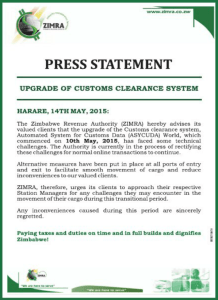
Zimra-press statementThe movement of commercial cargo has relatively improved at most of the country’s ports after the Zimbabwe Revenue Authority (Zimra) addressed some of the teething challenges affecting its customs online clearance system. Zimra is now using an advanced Automated System for Customs Data (Asycuda) for clearing commercial cargo entering or leaving the country.

However, when Zimra started upgrading its online clearance system on May 10, cargo had been stuck due to a systems failure at most of the country’s borders especially at Beitbridge Border Post, the busiest port of entry in Zimbabwe and gateway to Southern Africa.

Close to 15 000 haulage trucks per month pass through Beitbridge going either side of the border.

Zimra’s director of corporate and legal affairs, Florence Jambga, said in a recent statement that the upgrading of the customs clearing system had met with technical challenges.

“The authority is in the process of rectifying these challenges for normal online transactions to continue. Alternative measures have been put in place at all ports of entry and exit to facilitate smooth movement of cargo and reduce inconveniences to our valued clients.

“Zimra, therefore, urges its clients to approach their respective station managers for any challenges they may encounter in the movement of their cargo during this transitional period. Any inconveniences caused during this period are sincerely regretted,” she said.

In separate interviews, customs clearing agents and importers yesterday said the movement of cargo had improved as from Saturday evening.

Shipping and Forwarding Agents Association of Zimbabwe board member Mr Osbert Shumba said though the situation had relatively improved, they remained cautious.

“We will continue to monitor the situation and we are very hopeful that things will get back to normal as soon as possible,” he said.

At the Beitbridge Border Post, commercial cargo had been stuck there since Sunday last week resulting in truckers piling up on the South African side of the border.

Under a normal clearance system, cargo has to move to either side of the border after getting prior notification that the export or import papers have been processed.

By end of day yesterday trucks entering or leaving the country were being cleared expeditiously.

Asycuda is a more efficient and advanced system for customs data processing since it is Internet based.

The system allows that any clearing agent registered with Zimra can lodge a bill of entry from anywhere in the world where there is Internet connectivity. Communication between Zimra and the agent is, therefore, done electronically. Source: Customs Today

Two Zimbabweans appear in Namibian court over cigarette smuggling

Namibian police inspect over 1,000 boxes of impounded cigarettes at a roadblock in Rundu [Coastweek]

Namibian police inspect over 1,000 boxes of impounded cigarettes at a roadblock in Rundu [Coastweek]

Two suspects have appeared in a Namibian regional court Monday in connection with more than 1,000 cartons of cigarettes confiscated by the police Thursday last week.The two, both said to be Zimbabweans, appeared before a Rundu Magistrate in the northern Kavango region after their arrest over the 11.3 million Namibian dollars (940,000 U.S. dollars) cigarette contraband destined for South Africa.

The two were each charged with two counts of contravening the Custom and Excise Act 20 of 1998 and non-declaration of goods upon entering Namibia as well as the Prevention of Organized Crime Act 29 of 2004 of money laundering.

The accused persons were not asked to plead and their case was then postponed to July 8 for further police investigation. Acting on a tip-off, customs officials and the police raided two trucks en-route to South Africa and discovered 1,130 boxes that were hidden in fuel tankers. Source: http://www.spyghana.com/

African Stowaway Found Dead in Philadelphia

man+found+dead+on+shipThe body of a man, presumed to be a stowaway from Africa, has been found in the cargo hold of a ship carrying bags of cocoa beans to the U.S.

The UK-flagged Sian C was being unloaded at Pier 84 on the Delaware River, Philadelphia, when the body was found on Monday. The vessel had docked last Thursday after a 5,000 mile voyage from the Ivory Coast (Côte d’Ivoire).

Authorities were called to recover the decomposing body, and customs officials are trying to identify the man. He was found with a backpack containing some provisions and a pair of boots.

The man may have died as a result of suffocation or been crushed by the bags of cocoa beans, reports local media.

The IMO conducted a regional seminar on stowaways in the Ivory Coast in March which was hosted by the Ministry of Transport of Côte d’Ivoire. Participants agreed that port facilities need to further strengthen their capacities for surveillance and access control in order to reduce the incidence of stowaways.

The 12 most frequent ports of embarkation for stowaways are the major ports of Benin, Cameroon, Côte d’Ivoire, the Democratic Republic of Congo, Ghana, Guinea, Morocco, Nigeria, Senegal, Sierra Leone and Togo.

The International Group of P&I Clubs (Protection and Indemnity insurance) puts the annual cost of all stowaway cases worldwide at approximately $15.3 million (measured from February 2011 to February 2012). Source: www.maritime-executive.com

WCO publishes the Correlation Tables between the 2012 version and the 2017 version of the Harmonized System

OMD_7760The Correlation Tables between the 2012 version and the 2017 version of the Harmonized System (HS) are an essential device for preparation of new national Customs tariffs and a trade statistical classification based upon the HS Nomenclature 2017 Edition; modification of HS-based international Nomenclatures such as the Standard International Trade Classification (SITC) and the Central Product Classification (CPC); and preparations for possible WTO negotiations.

At its 55th Session in March 2015, the HS Committee examined and approved the Correlation Tables correlating the 2017 and 2012 versions of the HS.

Table І establishes the correlation between the 2017 version and the 2012 version of the HS. It contains remarks opposite certain correlations briefly specifying the nature of the goods transferred. In many cases, reference has also been made to the amended legal provisions.

Table ІІ establishes the correlation starting from the 2012 version to the 2017 version. It is simply a mechanical transposition of Table І and therefore includes no remarks. Source: WCO

Dubai Customs Receives Enterprise Architecture Award

main_building_of_Dubai_CustomsDubai Customs (DC) has earned the coveted Enterprise Architecture Award 2015, presented by Frost & Sullivan; a world leader in growth consulting and the integrated areas of technology research, market research, mega trends, economic research, customer research, competitive intelligence, and corporate strategy.

The award was presented to Dubai Customs to recognise its Business Capability Management, developed by the Business Process and Enterprise Architecture at the Customs Development Division to upgrade corporate capability at Dubai Customs.

Commenting on the advantages of the Business Capability Management, Juma Al Ghaith, Executive Director of Customs Development Division, said that the project provides a comprehensive connected view of DC’s business capability and determines the gaps and requirements of business units while putting forth a plan to fill these gaps. It also pinpoints strength and weakness points to help make informed decisions, offers improvement recommendations for business capabilities and devises an action plan for implementing these recommendations.

Creatively upgrading the enterprise architecture helps create a conducive environment for divisions and departments in DC to bond and better manage capabilities, allowing DC to determine its structural strategy and formulate a clear road map and initiatives for corporate changes.

The Enterprise Connected View links and documents all corporate components, allowing a more accurate and speedy decision making process and facilitating an effective change management.

Counting Frost & Sullivan’s EA Award 2015 in, Dubai Customs has scooped three global awards for its “Business Capability Management and Enterprise Architecture” in 2014 and 2015,The Business Capability Management focuses on four aspects: People, Process, Technology and Information.It identifies capabilities and measures them against world-class criteria to ensure optimal performance, revenue and sustainability.

Frost & Sullivan’s Best Practices Awards recognize companies throughout a range of regional and global markets for superior leadership, technological innovation, customer service, and strategic product development. Frost & Sullivan, founded in 1961, has more than 40 global offices with more than 1,800 industry consultants, market research analysts, technology analysts and economists. Source: CustomsToday.pk

South Africa and Zimbabwe sign milestone Customs Mutual Assistance Agreement

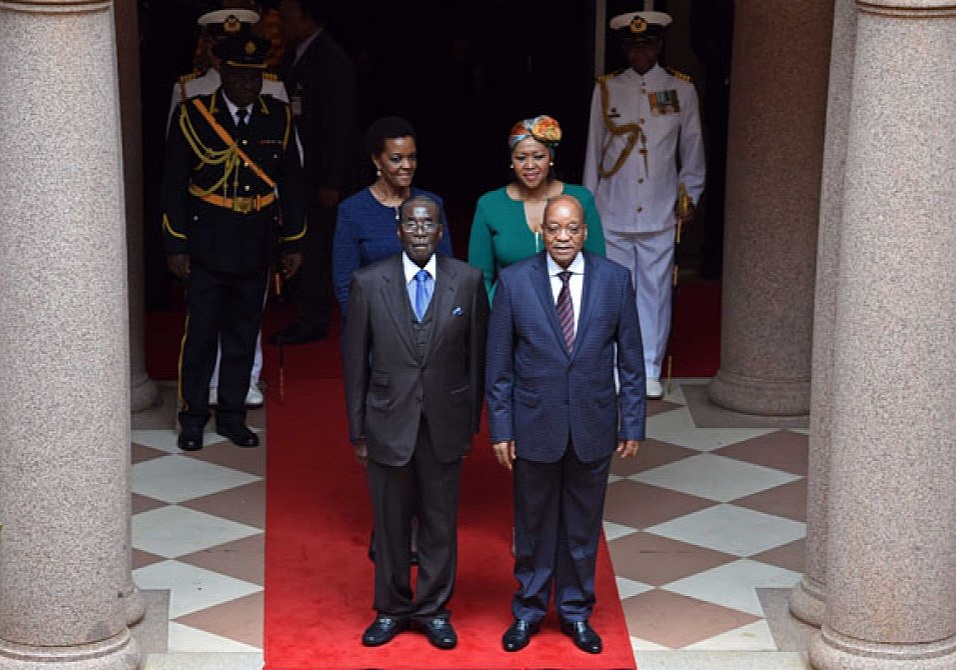
robertmugabejacobzuma2015govtza_SnapseedSouth Africa and Zimbabwe have elevated bilateral relations with the signing of five agreements set to benefit both countries. The agreements were signed on Wednesday during President Robert Mugabe’s state visit to South Africa at the invitation of President Jacob Zuma. An agreement regarding mutual assistance between customs administrations between the two countries was also signed, which will further cooperation towards the establishment of a one-stop border post. This is viewed as a crucial milestone.

Zimbabwe tightens border controls on imported goods

Zimbabwe-flagZimbabwe has introduced custom-control measures aimed at reducing the inflow of smuggled and inferior goods, and boosting its revenue from customs duty. Goods being exported to Zimbabwe will have to undergo consignment verification from May 16.

The government’s customs officials are also tightening up inspections at the Beitbridge border post to stem the flow of cheap, illegal goods, which Zimbabwean companies blame for their financial woes.

Executive chairman of the European Union Chamber of Commerce and Industry of Southern Africa Stefan Sakoschek said on Thursday that “the general idea is for Zimbabwe to protect its borders from substandard goods, as well as from undervaluation”.

Mr Sakoschek said the consignment-based conformity assessment programme fell within the framework of the World Trade Organisation’s technical barriers to trade as well as the regulations of the General Agreement on Tariffs and Trade.

Exporters and clearing agents have been informed of the new consignment verification measures, which will ensure conformity to standards and the value of goods declared. A certificate will be issued for the consignments for presentation to customs officials on arrival in Zimbabwe. Goods without a certificate will be refused entry.

Targeted products include food and agricultural goods, building and civil engineering products, timber and timber products, petroleum and fuel, packaging materials, electrical and electronic appliances, body care products, automotive and transportation goods, clothing and textiles, engineering equipment, mechanical appliances and toys.

Trade Law Chambers director Rian Geldenhuys said the pre-shipment verification process would entail additional costs but should not contribute to further delays in shipment. Consignment verification was widely practised especially in developing countries as a way to ensure the collection of customs duty revenue, Mr Geldenhuys said.

“Underinvoicing is a huge problem throughout the world, especially least developed and developing countries which Zimbabwe is one of,” he said.

Trade Law Centre researcher Willemien Viljoen also said the assessments would entail additional costs. Much of the effect would depend on how the conformity assessments were implemented and the standards that would be applied, Ms Viljoen said.

The Zimbabwean government has appointed well-recognised French company Bureau Veritas as the conformity assessment company for verification purposes, and has given the assurance that “compliant exporters will be able to benefit from fast-track procedures reducing systematic intervention on their frequent exports to Zimbabwe.”

Zimbabwean Industry and Commerce Minister Mike Bimha was quoted by the Zimbabwean press as saying that Zimbabwe was being “flooded with sub-standard imports which do not meet quality, safety, health and environmental standards”.

These goods had a negative effect on the country’s economic development and the competitiveness of its industries, Mr Bimha said.

In terms of its four-year agreement with Bureau Veritas the Zimbabwean government will receive monthly royalty fees equivalent to 5% of all monies received for its services. This arrangement will eventually lapse when the Zimbabwe Standards Regulatory Authority is established to monitor and control imports, exports and local goods to ensure compliance with quality, health, safety and environmental standards. Bureau Veritas operates in 140 countries and offers pre-shipment services to SA, Ethiopia, Kenya, Somalia, Uganda and Côte d’Ivoire. Source: BDLive (Reporter: Linda Ensor)

Read also the following articles, published in Zimbabwean Situation – Govt moves to tighten border controls (September 2014) as well as Zim mulls one-stop border post (November 2014) which might suggest that entry arrival procedures at Zimbabwean ports of entry may not be that expeditious given a prominent focus on revenue collection.

Event – Role of the Private Sector in Support of the Trade Facilitation Agreement

international-trade1The role of the private sector in the implementation of the World Trade Organization’s (WTO) Trade Facilitation Agreement (TFA) will be the focus of the 2015 edition of the Global Facilitation Partnership for Transportation and Trade (GFP) meeting. With the world’s customs administrations currently identifying their respective TFA  implementation commitments and setting up National Trade Facilitation Committees, trade and logistics operators can learn how they can participate in such initiatives by attending these sessions.

The GFP meeting will be held at Palais des Nations, Geneva, on 22 April, and will be divided into three thematic sessions.

The first session, ‘Governments’ Priorities: Strategies for Fostering Private Sector Participation in the TFA Implementation Process’ will look at how governments are planning to implement the TFA.

It will focus on how the private sector is consulted and how an effective participation of the private sector can be facilitated to implement the Agreement.

The second session, ‘Priorities, Perspectives, and Expectations from the Private Sector on TFA Implementation’ will assess how the private sector – including large corporates and small and medium-sized enterprises – view TFA implementation. It will look at the potential benefits from a private-sector perspective, and how the sector can contribute to national and international initiatives to implement the agreement.

The third session, ‘International Organizations’ Co-ordination and Partnership for Supporting TFA Implementation’, will provide an opportunity to share information and experiences on how the TFA can be implemented with public-private partnerships in mind, as how national trade facilitation committees can better support this process.

ITC invites all interested stakeholders to join the GFP meeting at the Palais des Nations on 22 April from 9:00. Click here for link to online registration.

Source: International Trade Centre (Geneva)