SACU – All’s not fair in proposed Customs Union reforms

SACU mapThe Southern African Customs Union (SACU) is an almost invisible organisation. Yet it has arguably had a profound impact on South Africa’s economic and even political relations with its much smaller neighbours – and on those four small countries themselves. But there are also deep differences among its five members – the others are Botswana, Lesotho, Namibia and Swaziland (BLNS) – about what the essential nature of SACU should be.

This weekend, SACU ministers will be meeting in South Africa for a retreat to try once again to set a new strategic direction, a roadmap into the future, for this critical body.

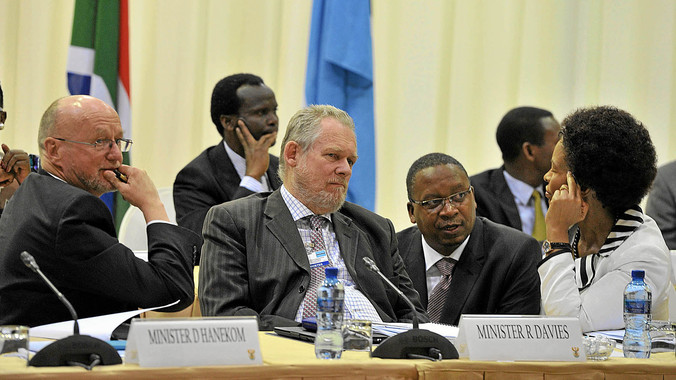
The leaders of the member countries will meet in a summit, also in South Africa, sometime before 15 July – when South Africa’s term as SACU chairs ends – to adopt or reject this roadmap. The aim of the changes in the SACU treaty would be to turn it ‘from an arrangement of convenience held together by a redistributive revenue formula to a development integration instrument,’ South African Trade and Industry Minister Rob Davies said during a press briefing in Kasane, Botswana, last Friday.

Davies said there were still ‘lots of differences’ among SACU members, which they had been unable to resolve despite years of negotiations.

SACU was founded in 1910 – the year South Africa was also created. Since then, the common external tariff it created has functioned as an instrument for the much larger South Africa to support the much smaller BLNS economically, by re-distributing to them a disproportionate share the customs tariffs collected at the external borders. Or, depending on your point of view, to relegate them to being passive markets for South African products.

The new African National Congress government, which came to power in 1994, ‘democratised’ relations with the BLNS by creating a Council of Ministers to make decisions by consensus in a new post-apartheid SACU treaty, which came into force in 2004. But the basic deal remained the same, as Davies implicitly acknowledged in last Friday’s briefing when he said: ‘we have historically just set the tariffs on behalf of SACU … and … in return for that, provided compensation … in the revenue-sharing formula.’

Also read – SACU Retreat announced by President Zuma

The re-distributive revenue-sharing formula has been hugely important for the government revenues of the BLNS. In South Africa’s 2015-2016 budget year, for example, the total revenue pool was expected to be about R84 billion, of which the BLNS would receive R46 billion – according to Xolelwa Mlumbi-Peter, Acting Deputy Director-General in South Africa’s Department of Trade and Industry, in a briefing to the parliamentary portfolio committee on trade and industry last year. She added that South Africa contributes about 98% of the total pool, while BLNS receive about 55% of the proceeds.

That meant South Africa was losing – or re-distributing – about R44.3 billion in that budget year, as de facto ‘direct budgetary support’ to the BLNS, to use the language of Western development aid.

‘This is seen as “compensation” for BLNS’s lack of policy discretion to determine tariffs, and for the price-raising effects of being subjected to tariffs that primarily protect SA industry,’ Mlumbi-Peter said.

A glaring example of that dynamic is South Africa’s maintenance of import tariffs on foreign automobiles to protect its own automobile industry. That, of course, makes automobiles more expensive in the BLNS countries.

And should South Africa choose instead to grant rebates on some tariffs – for example to encourage imports of inputs into South African industrial production – this would also impact negatively on the BLNS by reducing their tariff revenues, Mlumbi-Peter suggested.

In 2011, South African President Jacob Zuma chaired a SACU summit to review these inherent disparities. It agreed on a five-point plan to change SACU’s fundamentals, including a review of the revenue-sharing formula; prioritising work on regional cross-border industrial development, including creating value chains and regional infrastructure; promoting trade facilitation measures at borders; developing SACU institutions; and strengthening cooperation in external trade negotiations.

Nonetheless, as Davies said in Kasane, ‘we haven’t really been able to reach an understanding of what does development integration in SACU mean.’ And so Zuma had just completed a tour of visits to his counterparts in the BLNS countries to discuss these plans, and the upcoming retreat and summit. Davies said Zuma had found the BLNS leaders ‘flexible’ – though regional officials suggest otherwise.

Does South Africa, as the only really industrialised nation in SACU, not have inherent and irreconcilable differences with the rest of the body? Davies acknowledges that South Africa – with about 85% of the combined population, and about 90% of the combined GDP – also has most of the industries that demand tariff protection.

Nevertheless, he added, ‘We are all committed on paper to seeing tariffs as tools of industrial development… But there is also an obvious temptation for a number of other countries to see the revenue implications as more important.’ And, he did not add, there is also a growing feeling in South Africa that it could do with that R44 billion a year or thereabouts, which it gives to the BLNS every year.

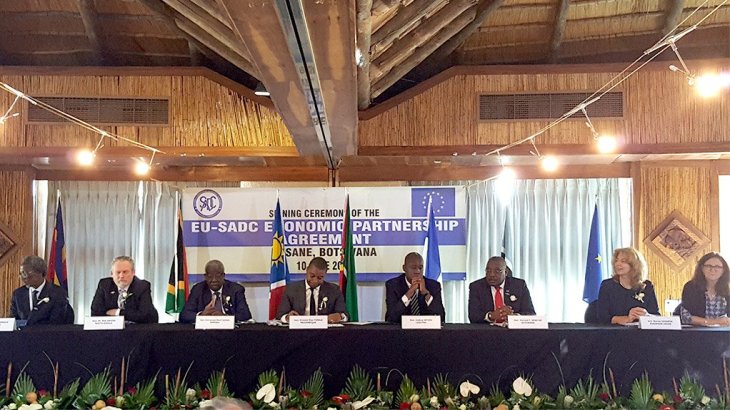
The coincidence of the signing, on 10 June, of the Economic Partnership Agreement (EPA) between the European Union (EU) and the Southern African Development Community (SADC), and the attempt to revive SACU, underscored an ironic analogy of South Africa’s and the EU’s predicaments.

Also read – Historic Economic Partnership Agreement between EU and SADC 

With the EPA, the EU hopes to shift its relations with the SADC nations away from the traditional donor-recipient type of arrangement, to one of more equal and normal trade and industrial partners. That, essentially, is what South Africa is also hoping to achieve with its proposed reforms of SACU.

But it’s hard to see how South Africa is going to convince the BLNS to give up R44 billion a year of hard cash in hand, in exchange for the rather dubious future benefits of being absorbed into South Africa’s industrial development chains.

Source: Peter Fabricius – ISS Consultant.
Historic Economic Partnership Agreement between EU and SADC

EU SADC EPAThe EU has signed an Economic Partnership Agreement (EPA) on 10 June 2016 with the SADC EPA Group comprising Botswana, Lesotho, Mozambique, Namibia, South Africa and Swaziland. Angola has an option to join the agreement in future.

The other six members of the Southern African Development Community region – the Democratic Republic of the Congo, Madagascar, Malawi, Mauritius, Zambia and Zimbabwe – are negotiating Economic Partnership Agreements with the EU as part of other regional groups, namely Central Africa or Eastern and Southern Africa.

For specific details on the key envisaged benefits of the agreement click here!

The EU-SADC EPA is the first EPA signed between the EU and an African region, with an East African agreement expected to follow in a few months, but with the West African agreement having met fresh resistance. EU Trade Commissioner Cecilia Malmström stressed at the signing ceremony the developmental bias in the agreement, which extended duty- and quota-free access to all SADC EPA members, except South Africa. Africa’s most developed economy has an existing reciprocal trade framework known as the Trade and Development Cooperation Agreement, which came into force in 2000.

South Africa, meanwhile, had secured improved access to the EU market on a range of agricultural products, as well as greater policy space to introduce export taxes. EU statistics show that bilateral trade between South Africa and the EU stood at €44.8-billion in 2015, with the balance tilted in favour of European exports to South Africa, which stood at €25.4-billion. This improved access had been facilitated in large part by South Africa’s concession on so-called geographical indications (GIs) – 252 European names used to identify agricultural products based on the region from which they originate and the specific process used in their production, such as Champagne and Feta cheese. In return, the EU has agreed to recognise over 100 South African GIs, including Rooibos and Honeybush teas, Karoo lamb and various wines.Sources: EU Commission and Engineering News


Is the Latest FTA Another Booby Prize for Africa?

COMESA-SADC-EAC-TripartiteAround 2008, most Southern African countries began to realise that the great ambition found on the SADC website at that time of moving from a SADC free trade area to a customs union by 2012 was not going to happen.

The SADC website had a very EU-like regional integration agenda.

This is not surprising given that the great sugar daddy in Brussels basically funds the entire organisation. SADC wanted to replicate the EU linear model – first a free trade area where the countries trade freely among themselves; then a customs union where the members agree to a common tariff; and then a common market where all goods, services, capital and labour flow freely. Finally, SADC was to complete the copy of the EU by creating a monetary union.

This flattering imitation of the EU was obvious – the Brussels paymaster pays and we all happily follow their model into Kwame Nkrumah’s vision of a united Africa. But the ugly problem was, as ever, African history.

The less than subtle British also wanted a customs union in Africa. So, in 1910 they just created one – the Southern African Customs Union (SACU), which, like the proverbial bicycle without any pedals, still manages to stand because it is padded with money.

When the British implemented SACU after the Anglo-Boer War, there was no need for polite and time consuming subtleties of contemporary African consensus building. The Union of South Africa and the British high commissioner signed on behalf of the protectorates of Basutoland, Bechuanaland and Swaziland – not a black person in sight unless they were serving the tea.

Almost a century later those who designed the EU-like agenda for SADC’s integration conveniently forgot their history and somehow assumed that a customs union could be readily grafted on the SADC free trade area which was already in existence.

But there cannot be two external tariffs and, therefore, either SACU or SADC as a customs union had to go. And the difficulty that SADC faced with creating a customs union is that no one is ready to sacrifice national interests for a broader common good.

Free trade areas are relatively easy, they can be easily fudged, but customs unions are hard work because all the countries that are members have to agree to the external tariff.

In the meantime, the apartheid regime in Pretoria realised that it desperately needed to buy friends and influence enemies and so in 1969 it changed SACU from a regular customs union to one where the share of revenue from customs was derived from share of regional trade.

Normally, customs unions divide the revenue poll based on what economists call the ‘destination principle’. This meant that countries get the revenue depending on what imports were destined for that country. So if 5% of imports were destined for, say, Botswana, it would get 5% of the revenue.

But the SACU formula was purposely designed by South Africa to make the BLS (Botswana, Lesotho and Swaziland as members) completely dependent upon transfers from Pretoria by basing the formula on the share of intra-SACU trade and not external trade.

The oddity was that with the end of apartheid, things actually got even worse after the 2002 SACU re-negotiations because Pretoria agreed to a formula that made Botswana, Lesotho, Swaziland and newly independent Namibia get their share of customs revenue from SACU based on the share of intra-SACU imports.

SA imports almost nothing from SACU countries and the BLNS countries import almost everything from SA and so they get a huge amount of revenue. Many officials in Pretoria deeply resent the subsidies in SACU.

When the other SADC members saw how much money the BLNS countries were getting from Sacu, whenever the issue of a SADC customs union came up their response was – ‘me too please, we want the same formula!’

So, a SADC customs union would have eaten into the massive transfers (about N$20 billion per year) that Namibia and the rest of the BLNS states get each year from Pretoria and there was no way they were going to agree, and so the SADC customs union was not a realistic possibility.

After the obvious end of the SADC negotiations for a customs union, African negotiators began to look around for something that would keep them off the unemployment lines. The infamous African ‘spaghetti junction’ of the East African Community, Comesa and SADC with its overlapping membership became the next target. If you can’t form a customs union then just get a bigger FTA (free trade area).

Now this year, finally, an FTA has been signed but it has also been fudged. Few really want to give the highly competitive Egyptian producers free trade access to their African markets.

Ostensibly, we are moving to negotiate a continental free trade area which will finally begin the process of fulfilling of Nkrumah’s dream of a united Africa. But instead, what we have is Cecil John Rhodes’s dream of a market from Cape to Cairo – almost; no deepening of the African economic relationship into a customs union; just a widening to the north and west.

Free trade areas are a nice step forward but they normally require no real sacrifice of economic interests.

Europeans are guilty of many cruelties in Africa but none so absurd or spiteful as the ridiculous lines they drew on the map of the African continent in 1884 at the Berlin Conference when they divided up the continent. The Belgian barbarism in the Congo may fade from human memory and the wounds of apartheid may heal over time but African leaders will struggle to completely eliminate those economic and political lines from the map of Africa.

It is those lines and some petty “sovereign” economic interests that are the main reason why a billion dynamic people in Africa with such incredible natural resources continue to live in poverty. The Namibian (An opinion piece by Roman Grynberg, professor of economics at the University of Namibia.)

Time to pull the plug on SACU?

SACU logoPeter Fabricus, Foreign Editor, Independent Newspapers through the Institute of Security Studies writes an insightful and balanced article on the history and current state of the Southern African Customs Union (SACU).

The formula that determines how the customs and excise revenues gathered in the Southern African Customs Union (SACU) are distributed among its members looks, to a layperson, dauntingly complex. But this formula has had an enormous impact on the economic and even political development of the five SACU member states; South Africa, Botswana, Lesotho, Namibia and Swaziland.

The impact has arguably been greatest on South Africa’s neighbours, the four smaller member states that are often referred to simply as the BLNS. But it has also had an impact on South Africa.

SACU was founded in 1910, the year the Union of South Africa came into existence, and is the oldest surviving customs union in the world. Originally it distributed customs revenue from the common external trade tariffs in proportion to each country’s trade..

So, South Africa received nearly 99%. Surprisingly, South Africa’s apartheid government radically revised the revenue-sharing formula (RSF) in 1969 after Botswana, Lesotho and Swaziland had become independent. This gave each of the BLS members first 142% and later 177% of their revenue dues, calculated on both external and intra-SACU imports, with South Africa receiving only what was left. But this apparent economic generosity from Pretoria almost certainly masked a political intention to keep its neighbours dependent and in its fold, as the rest of the world was increasingly turning against it.

However, as Roman Grynberg and Masedi Motswapong of the Botswana Institute for Development Policy Analysis pointed out in their paper, SACU Revenue Sharing Formula: The History of An Equation, the 1969 formula became increasingly unviable for South Africa as it had been de-linked from the common revenue pool. This threatened to burden Pretoria with a commitment to pay out to the BLS states more than the total amount in the pool.

The African National Congress government saw the dangers when it took office in 1994 and soon began negotiations with the BLNS states for a new formula. That was agreed in 2002 and implemented in 2004. But although the 2002 RSF eliminated the risk that the payouts to the BLNS might exceed the whole revenue pool, it actually increased the share of the pool accruing to the BLNS at the expense of South Africa – as Grynberg and Motswapong also observe.

The new RSF was based on three separate components. The first divided the customs revenue pool proportional to each member state’s share of intra-SACU imports. Because of the growing imports of the BLNS states from the ever-mightier South Africa, this meant most of the common customs pool went to the BLNS. This proportion is increasing – but never to more than the entire pool.

The second component of the RSF divided 85% of the pool of excise duties (the taxes on domestic production) in direct proportion to the share of the gross domestic product (GDP) of each of the SACU members. The remaining 15% of the excise duties became a development component, distributed in inverse proportion to the GDP per capita of each member. So the poorest members of SACU would receive a disproportionate share of this element of the excise.

Over the years the BLNS countries have grown increasingly dependent on the SACU revenue. It now funds 50% of Swaziland’s entire government revenue, 44% of Lesotho’s, 35% of Namibia’s and 30% of Botswana’s. Because of its own growing fiscal constraints, Pretoria launched a review of the formula in 2010. But this review got bogged down over major disagreements and seems to have gone nowhere.

In his budget speech this month, Finance Minister Nhlanhla Nene raised the issue again, calling for a ‘revised and improved revenue-sharing arrangement,’ and Parliament’s two finance committees examined it. National Treasury spokesperson Jabulani Sikhakhane told ISS Today that while efforts to reform the SACU formula are ongoing, ‘progress has unfortunately been arduously slow.’

Budget documents show that in 2014-15, South Africa paid out some R51.7 billion to the BNLS countries out of a total estimated revenue pool of R80 billion, and was projected to pay out R51 billion again in 2015-16. Kyle Mandy, a PricewaterhouseCoopers technical tax expert, told Parliament’s two finance committees last week that South Africa was paying about R30 billion a year more than it would otherwise under the SACU RSF. He said South Africa contributed about 97% of the customs revenue pool and received only about 17% of it.

The R51.7 billion payout to the BLNS this year represents about 5% of South Africa’s total of R979 billion in tax revenue, a substantial ‘subsidisation’ that was no longer affordable at a time of growing fiscal constraint, which had forced Nene to increase taxes, Mandy said.

He noted that the SACU revenue had allowed all but Namibia of the BLNS countries to set their taxes below South Africa’s. ‘This means South Africa is subsidising the BLS countries to compete with South Africa for investment with their more attractive taxes,’ he said in an interview.

‘This is not sustainable for anyone. It locks the BLNS countries into dependency on South Africa. They have neglected their own fiscal systems. But the moment that the revenue fluctuates, [as Nene’s budget predicted it would in 2016-17, dropping to R36.5 million], it puts them in a difficult position. When South Africa sneezes, they catch flu.’

But what to do about this? Some, like political analyst Mzukisi Qobo, have called for a total overhaul of the SACU agreement, which would make explicit that SACU is a disguised South African development project. The development aid would become transparent and could be tied to conditions such as democratic government.

That is on the face of it an attractive solution, offering the opportunity of leveraging democracy in Swaziland, in particular, by placing a conditional foot on its lifeline of SACU revenues. But Grynberg warns that a sudden withdrawal of the vital direct budgetary support which SACU customs and excise revenues provides, could implode both Swaziland and Lesotho and provoke economic crises in Namibia and even Botswana.

He also points out that the RSF is not plain charity by South Africa to its smaller neighbours. The formula has essentially just compensated them for the cost-raising and polarising effects of SACU – that the BLNS countries have generally had to pay more for imported goods over the years than they would have otherwise done because of import tariffs designed to protect South African industries; and because the duty-free trade within SACU has tended to attract investment to larger South Africa.

Meanwhile, South Africa has benefitted from a ready market for its much larger manufacturing machine. Grynberg wrote in a more recent article for the Botswana journal, Mmegi, that the South African government was thinking of pulling out of SACU because it couldn’t get its way in the negotiations to revise the RSF; and because the 2005 Southern African Development Community Free Trade Agreement now gave it duty-free access to the BLNS countries without the need to pay the re-distributive SACU customs revenues.

It was only President Jacob Zuma who was preventing this, because he didn’t want to go down in history ‘as the man who crippled the Namibian and Botswana economies and created two more “Zimbabwes” – i.e. Swaziland and Lesotho – right on the country’s border.’ Pretoria’s decision had turned SACU into a ‘dead man walking, just waiting for someone to pull the switch and end its life.’

Grynberg strongly advised the BLNS to prevent this by accepting that the political reality that underpinned the RSF of SACU no longer existed. He says that it should be transformed into a purely development community without the formula, but with mutually agreed spending on development – mainly in the BLNS. He suggested, though, that this radical change would take at least 10 to 15 years to phase in.

All very well. But isn’t that what SADC is supposed to be already? Which suggests that it might be time to take the 105-year-old dead man off life support.

Source: Institute of Secutity Studies (ISS)

Related articles

Comesa-EAC-SADC Tripartite FTA to be launched Mid-December 2014

TripartiteLogoAfrica’s longstanding vision is an integrated, prosperous and united continent. This vision will come closer to reality in December when the largest integrated market covering 26 countries in eastern and southern Africa is established.
Commonly known as the Tripartite Free Trade Area (TFTA), the integrated market will comprise the Common Market for Eastern and Southern Africa (COMESA), the East African Community (EAC) and the Southern African Development Community (SADC).

The establishment of a single and enlarged market is expected to boost intra-regional trade and deepen regional integration through improved investment flows and enhanced competition.

In fact, this integrated arrangement will create a combined population of some 625 million people covering half of the member states of the African Union (AU) and a Gross Domestic Product of about US$1.2 trillion.

According to a statement released by COMESA, which is spearheading the implementation process as chair of the Tripartite Taskforce, the proposed Grand FTA will be launched in December during a Tripartite Summit to be held in Egypt.

This follows a series of intense consultations and negotiations that have been going on since 2008 when the three regional economic communities made a commitment to jointly work together in regional integration during their historic summit held in Kampala, Uganda.

The commitment shown by the three economic communities has now proved fruitful as the Grand FTA is within sight and becoming a reality. Source: sardc.net

How SA can save R18bn – by playing hard ball

Southern_Africa_Panorama_MapSouth Africa is a member of the Southern African Customs Union (Sacu), which consists of Botswana, Lesotho, Namibia and Swaziland (BLNS), the oldest customs union in Africa but apart from this prestige, is Sacu worth the time?

In an article by Professor Roman Grynberg, he asked whether Sacu is a “dead man walking?” and I wish to follow-up on this. A recent article appearing on the World Bank’s website states that even if poor countries are neighbours, it is often more difficult for them to trade with each other than it is for them to trade with distant countries that are wealthy.

The Sacu agreement is principally about the issue of distributing customs revenue earned by the five members on their international trade with other countries. The distribution of this revenue is based on each country’s share of intra-Sacu imports and so favours the smaller members.

South Africa, for example, imports very little from within the region and so ends up paying the BLNS about R15bn to R18bn per year more than it would if Sacu did not exist.

If we are paying R15bn to R18bn per annum to be in a union with questionable benefits, why do we not exit the agreement?

For one, the SADC free trade agreement which was implemented in 2008, gives South Africa a “get out of jail free card” through providing South African exports similar but not identical market access to that available under Sacu.

We could thus “walk away from Sacu at any moment, save R15bn to R18bn and South African exports would still continue to flow across the Limpopo basin in more or less the same uninterrupted way.” (Grynberg, 2014).

Another reason, according to Grynberg, is that an “economic catastrophe” may result if South Africa exits. Swaziland and Lesotho are between 60% to 70% dependent on the Sacu for revenues, Botswana and Namibia are somewhat less dependent at 30% to 40%.

I feel though that this may be the very same reason that there will not be a major reform of the revenue-sharing formula. Would you want to cede even a third of your income?

So what should South Africa do? I think it is firstly important to note that of our SADC neighbours, South Africa earns the most from its exports to Zambia, Zimbabwe and Mozambique – none of which is in the Sacu.

This is perhaps not surprising when considering the findings of the World Bank and realising that nearly all of South Africa’s top trading partners are in the northern hemisphere.

The BLNS countries, interestingly enough, fall in the bottom 5 of our SADC trade partners and so should we worry so much about an “economic catastrophe” in the BLNS when they don’t buy our goods in any case?

What it comes down to, I feel, is that South Africa needs to play hard ball. By this I mean South Africa needs to be committed to actually exiting the Sacu agreement because it is only when the BLNS realise that we are serious and that there is the real threat of them losing 30% to 70% of their revenue that they will agree to a new revenue-sharing formula. After all, something is better than nothing. Source: Fin24

Related ‘must read’ articles

SACU revenue dependence raises concerns

Namibia-coat-of-armsA financial analyst has expressed concern about Namibia’s reliance on revenue from the Southern Africa Customs Union (SACU), saying the government needs to diversify its source of revenue.

James Cumming, Head of Research at Simonis Storm Securities told a Namibia Chamber of Commerce and Industry post budget meeting that he is concerned about over reliance of budget revenue from the SACU pool, saying 35% to 40% of tax revenue is from the SACU.

He explained that government needs to diversify its revenue sources as future adjustments to the SACU revenue formula could lead to lower revenue from this agreement.

The Minister of Finance, Saara Kuugongelwa-Amadhila, told the meeting that sources of revenue have been increasing and are expected to grow over the next three years. She said new sources of revenue have been identified with preliminary studies already underway in order to secure a consistent revenue stream in the future.

Leonard Kamwi, head of advocacy and research at the Chamber, said he was disappointed that previous budgets had failed to reconcile expenditure on education with the resulting output, which has been below par. He said it is not enough for the government to target sectors in their wholesome but rather target the prospective beneficiaries. “The budget should target specific necessary skill sets as opposed to the whole sector,” said Kamwi.

Kuugongelwa-Amadhila defended the proposed export tax on natural resources, indicating it was meant to minimise the disparities that arise from the exploitation of Namibia’s naturally endowed resources. Source: The Namibian

Membership to several blocs hurts trade in EAC

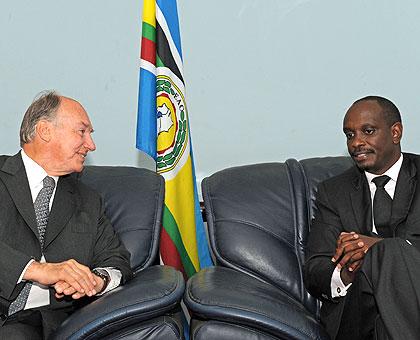
Dr Richard Sezibera meets His Highness the Agha Khan at the EAC Headquarters in Arusha. (Sunday Times Rwanda)

Dr Richard Sezibera meets His Highness the Agha Khan at the EAC Headquarters in Arusha. (Sunday Times Rwanda)

Overlapping membership in several trade areas is impeding “free circulation of goods” within the East African Community-members states, a regional integration and trade expert has said.

Alfred Ombudo K’Ombudo, the Coordinator of the EAC Common Market Scorecard team, has told The News Times that belonging to other trade blocs outside the EAC makes members reluctant to remove internal borders to allow goods to move more freely.

According to K’Ombudo, a Common External Tariff (CET) is critical to ensure free circulation of goods through the application of equal customs duties. The EAC Customs Union protocol has a three-band structure of 0 per cent duty on raw materials, 10 per cent on intermediate goods and 25 per cent on for finished goods.

However, of the five partner states, Tanzania is a member of the SADC and subscribes to a different structure while Burundi, Kenya, Rwanda, and Uganda, are members of the Common Market for Eastern and Southern Africa (Comesa). On the other hand, Burundi belongs to the Economic Community of Central African States (ECCAS).

This, according to the expert is “perforation of the bloc’s CET,” drilling a hole in the regions tariff structure as member- states trade with other countries below the agreed tariffs.

“This makes EAC countries less willing to remove internal borders because they are not sure whether goods may have come from other blocs. This is a serious structural problem that is difficult to solve because the customs union legally recognises other blocs that members belong to,” K’Ombudo noted.

Burundi, Kenya, Rwanda and Uganda’s participation in Comesa and Tanzania’s membership to SADC is recognised by the EAC, but no exception is granted to Burundi for participating in the ECCAS.

Article 37 of the bloc’s Customs Union Protocol recognises other free trade obligations of partner states but it requires them to formulate a mechanism to guide relationships between the protocol and other free trade arrangements.

EAC Secretary General, Richard Sezibera, told The New Times during the launch of the Scorecard in Arusha, that there have been efforts to address the issue of overlapping membership.

“They [EAC leaders] have done two things to [try] addressing it: One is to harmonize the CET of the EAC and that of COMESA. This makes it easier for COMESA states to reduce the level of perforation,” he explained.

He added that in 2008, the heads of state decided to negotiate a free trade area between the EAC, COMESA and SADC as another way of fixing the problem.

Dr Catherine Masinde, the Head of Investment Climate, East and southern Africa at the International Finance Corporation (IFC), said: “If we were not to perforate the EAC would end up with a bigger volume of trade figures”.

She noted that since the launch of the EAC Customs Union, in 2005, the region has witnessed strong growth in intra-regional trade, rising from $1.6 billion to $3.8 billion between 2006 and 2010. Intra-EAC trade to total EAC trade grew from 7.5 per cent in 2005 to 11.5 per cent in 2011.

“This is significant growth but, I am told that this is, in fact, a drop in the ocean. That it is far from the potential of the market. I was given a figure, that $22.7 billion [in inter-regional trade] was actually lost to other regional blocs, from this region, [between 2005 and 2012] because of non-compliance with the common market protocol.” The Scorecard, Masinde hopes, will solve various EAC compliance issues as well as energize reforms to spur the bloc’s development. Source: The Sunday Times (Rwanda)

EAC Single Customs Territory launch postponed to June

Presidents Uhuru Kenyatta (Kenya), Paul Kagame (Rwanda) and Yoweri Museveni after the trilateral talks in Entebbe, Uganda. President Jakaya Kikwete of Tanzania and Pierre Nkurunziza of Burundi stayed out of the loop of the third infrastructure summit in Kigali, Rwanda on Monday. [Photo/PPS]

Presidents Uhuru Kenyatta (Kenya), Paul Kagame (Rwanda) and Yoweri Museveni after the trilateral talks in Entebbe, Uganda. President Jakaya Kikwete of Tanzania and Pierre Nkurunziza of Burundi stayed out of the loop of the third infrastructure summit in Kigali, Rwanda on Monday. [Photo/PPS]

Kenya, Uganda and Rwanda have postponed the single customs territory (SCT) roll-out, giving Burundi and Tanzania more time to prepare for the shift.

East Africa Community (EAC) secretariat custom officer Ally Alexander told the committee on Communication, Trade and Investment in Mombasa that the implementation of the model would begin in June.

“We are looking at reducing the costs and number of days to clear the cargo from Mombasa to Kampala to take three days instead of the previous 18 days,” Mr Alexander said.

The SCT was initially planned to begin in January with the three countries moving their revenue staff to common entry and exit points to begin goods clearance. But Tanzania and Burundi protested their exclusion in the arrangement after Kenya announced in January that it was ready to start accommodating revenue officials from the two landlocked states in Mombasa, prompting the three States to go slow on their plans.

On Monday, Mr Alexander told East African Legislative Assembly that SCT would reduce the cost of doing business and bring efficiency in trade. He said for exports within the region, a single regional bond for cargo would be issued to cater for goods from the port of Mombasa to different destinations.

An electronic cargo tracking system would also be used to avoid diversion of goods into the transit market. Under the model, goods will be checked by a single agency on compliance to regional standards and instruments.

“We want to avoid agencies replicating checking on standards, when it is done once this will not be repeated,” he said.

Mr Alexander said goods would be released upon confirmation that taxes have been paid and customs procedures fulfilled.

However goods heading to the Democratic Republic of Congo which is not a member of EAC will be cleared on a transit basis.

The establishment of SCT has raised concerns among stakeholders, key among them the registration of clearing agents and job losses. Kenya Revenue Authority deputy commissioner customs Nicholas Kinoti said the concerns would be addressed through legislations. Source: http://www.businessdailyafrica.com

Crossing the SACU bridge

600px-Flag_of_Swaziland.svgMartin Gobizandla Dlamini, the new Minister of Finance, is aware of the challenges of the country’s economy in case South Africa pulls out of the Southern African Customs Union (SACU).

However, the minister warned against pressing the panic button. He said there were no pellucid pointers that South Africa might pull out of the union.

Asked what measures were in place to sustain the country economically if South Africa pulled out or reviewed the revenue sharing formula to the negative, he said: “Let us cross the bridge when we get there. I am aware that South Africa calls for changes in the revenue sharing formula. This is a matter that has been on the table for quite some time.”

“I can’t comment now on how to survive with or without SACU receipts but I can mention that we are a sovereign state.” He did not expand on the sovereignty of Swaziland. Dlamini said SACU member states would meet in February 2014 for a strategic session.

These are South Africa, Namibia, Swaziland and Lesotho. “We were to meet in February in the first place, to discuss strategies on how to modernise SACU and make it relevant to our needs. It’s not like we are going there for shocks or breaking news about South Africa’s position on SACU,” said Dlamini, the former Governor of the Central Bank of Swaziland.

The country’s Gross Domestic Product (GDP) stands at E37 billion for 2012 while that of South Africa is E3.8 trillion as at 2012. In the absence of SACU, Swaziland is left with a few companies that add value to the economy in terms of taxes. They include among others Conco Swaziland which is understood to be contributing 40 per cent to the GDP, which translates to E14.9 billion and the sugar belt companies; Royal Swaziland Sugar Corporation (RSSC) which makes a turnover in excess of E1 billion and Illovo Group’s subsidiary Ubombo Sugar Limited (USL). Illovo Sugar has a 60 per cent shareholding at Ubombo Sugar while the remaining 40 per cent is held by Tibiyo Taka Ngwane, a royal entity held in trust for the Swazi nation. To Illovo Group’s profits, Ubombo Sugar contributed E272 million.

Bongani Mtshali, the acting Chief Executive Officer (CEO) of the Federation of Swaziland Employers and Chamber of Commerce (FSE&CC), said the country could be in a very bad economic situation if South Africa were to pull out of SACU. He said the economic problem could still persist even if the revenue derived from the union was decreased. Mtshali advised Swazis to expand the revenue base and work hand in hand with the Swaziland Revenue Authority (SRA) in its collection of domestic taxes.

The taxes include company tax, pay-as-you-earn, sales tax, casino tax and value added tax. He said people and companies should be encouraged to honour tax obligations. He also called for business innovation. “We will be able to produce and sell if we innovate,” he said. He said there was a need to have an innovation institution of some sort to produce talent, nurture and release it for productivity.

As it were, he said, it was suicidal to depend entirely on SACU revenue. It can be said that over 60 per cent of the country’s budget comes from the union. The SRA collects over E3 billion and this money cannot finance the national budget of E11.5 billion.

Ministries that can save Swaziland from an economic crisis are the Ministry of Commerce, Trade and Industry; Ministry of Agriculture, Ministry of Natural Resources and Energy and the Ministry of Economic Planning and Development.

It can be said that Swaziland is an agricultural economy but the closure of the factory at SAPPI Usuthu and destruction of timber at Mondi by veld fires, spelled doom to the economic outlook of the country. It can also be said that the country’s mainstay product is now sugar.

Despite maize being the country’s staple food, government spent E123 million on maize imports from South Africa last year. This year, preliminary figures indicated that government could spend E95 million on maize imports.

The import price has decreased because the country recorded a higher maize harvest of 82 000 metric tonnes compared to 76 000 tonnes recorded the previous year.

Swaziland is still clutching at straws in terms of food security. The unemployment rate is also high as there had been no massive investments witnessed on the shores.

Jabulile Mashwama, Minister of Natural Resources and Energy, said there were plans to expand the mining sector and reopen closed ones like Dvokolwako Diamond Mine.

There are only two official mines currently operational; Maloma Colliery, which made an export revenue of E126 million in the 2011/2012 financial year and Salgaocar which extracts iron ore from dumps at Ngwenya Iron Ore Mine.

Mashwama, the minister, said she would give details on the programme to revive the mining sector at a later stage. She hinted that the nation could also bank its hopes on her ministry for job creation and revitalisation of the economy.

Gideon Dlamini, the Minister of Commerce, Trade and Industry, has been given a task to industrialise the economy as one of the five-point plan by SACU. The industry minister was reported out of the country and was not reachable through his mobile phone. Source: Times of Swaziland

SACU – the Day of Reckoning has Arrived

South Africa has been courting major player Botswana’s support for changes to SACU.

South Africa has been courting major player Botswana’s support for changes to SACU. (Mail & Guardian)

The Mail & Guardian reveals that South Africa has requested an urgent meeting with members of the Southern African Customs Union (SACU) for as early as ­February next year in what could be a make-or-break conference for the struggling union.

In July this year, a clearly frustrated Trade and Industry Minister Rob Davies told Parliament that there had been little progress on a 2011 agreement intended to advance the region’s development integration, and it was stifling its real ­economic development.

South Africa’s payments to SACU currently amount to R48.3-billion annually – a substantial amount, considering the budget deficit is presently R146.9-billion, an estimated 4.5% of gross domestic product.

In the past, South Africa has had some room to reposition itself, but as Finance Minister Pravin Gordhan has pointed out, the South African fiscus has come under a lot of pressure as a result of factors such as the global slowdown, reduction in demand from countries such as China for commodities, and reduced demand from trade partners such as the European Union.

South Africa, which according to research data, last year contributed 1.26% of its GDP, or about 98% of the pool of customs and excise duties that are shared between union countries including Swaziland, Botswana, Lesotho and Namibia, wants a percentage of this money to be set aside for regional and industrial development.

The four countries receive 55% of the proceeds, and are greatly dependent on this money, which makes up between 25% and 60% of their budget revenue. South Africa has very little direct benefit, except when it comes to exporting to these countries. It receives few imports.

Changing the revenue-sharing arrangement

Efforts to change the revenue-sharing arrangement so that money can be set aside for regional development would result in less money going into the coffers of these countries.

It would also mean that a portion of the revenue that South Africa’s SACU partners now receive with no strings attached would in future include restrictions on how it is spent.

A source close to the department said adjustments to the revenue-sharing arrangement and the promotion of regional and industrial development were issues on which the South African government was not willing to budge.

So seriously is South Africa viewing the lack of progress on the 2011 agreement, a document prepared for Cabinet discussion includes pulling out of SACU as one of its options, a source told the Mail & Guardian.

This could not be confirmed by the government, but two senior sources said South Africa was very aware of the dependence of its neighbours on income from the customs union, in particular Swaziland and Lesotho, and the impact its collapse could have on these economies.

Professor Jannie Rossouw of the University of South Africa’s department of economics believes a new revenue-sharing arrangement is essential for the long-term sustainability of SACU countries.

South Africa’s contribution

He also said that South Africa’s contribution as it presently stands should be recognised as development aid and treated as such by the international community.

Between 2002 and 2013, total transfers amounted to 0.92% of South Africa’s GDP, which exceeds the international benchmark of 0.7% set by the Organisation for Economic Co-operation and Development, he said in his research.

“It is noteworthy that South Africa transfers nearly all customs collections to SACU countries. Total collection since 2002 amounted to about R249-billion, while transfers to SACU were about R242-billion,” Rossouw said. The South African Revenue Service (SARS) recognises that inclusion of trade with Sacu would have a substantial impact on South Africa’s ­official trade balance.

South Africa’s total trade deficit for 2012 was R116.9-billion and, according to SARS, had trade with the union been included, it would have been much reduced to R34.6-billion.

South Africa has budgeted to increase its allocation to SACU from R42.3-billion in the 2012-2013 financial year to R43.3-billion this financial year and in the 2014/2015 financial year.

In 2002, the SACU agreement was modified to include higher allocations for the most vulnerable countries, Swaziland and Lesotho, and it established a council of ministers, which introduced a requirement for key issues to be decided jointly. In 2011, a summit was convened by President Jacob Zuma in which a five-point plan was established to advance regional integration.

Review of the revenue-sharing arrangement

This involved a review of the revenue-sharing arrangement; prioritising regional cross-border industrial development; making cross-border trade easier; developing SACU ­institutions such as the National Bodies (entrusted with receiving requests for tariff changes) and a SACU tariff board that would eventually take over the functions of South Africa’s International Trade Administration Commission (ITAC); and the development of a unified approach to trade negotiations with third parties.

Davies told Parliament that there had been little progress in the past three years on these five issues.

Xavier Carim, the director general of the international trade division of the department of trade and industry, said there had been positive developments regarding agreements on trade negotiations, such as those with the European Union and India on trade, and progress had been made on the development of SACU institutions, but progress was slow on the other issues.

Davies told Parliament it was difficult to develop common policy among countries that varied dramatically in economic size, ­population and levels of economic, legislative and institutional development.

He cited differences over approaches to tariff settings as an example.

“South Africa views tariffs as tools of industrial policy, while for other countries tariffs are viewed as a source of revenue,” Davies said.

A proposal that cause all the problem

“A key problem that led to differences was the proposal by one member for lower tariffs to import goods from global sources that were cheapest, which ultimately undermined the industry of another member. This was primarily an issue of countries who viewed themselves as consumers rather than producers.”

The South African government is trying diplomacy as its first option. A senior government source said issues around SACU made up a large part of talks last week between Botswana and South Africa on the establishment of co-operative agreements on trade, transport and border co-operation.

Catherine Grant of the South African Institute of International Affairs said Botswana had long been considered the leader of the four countries. It would make sense for South Africa to bring Botswana on board before the meeting.

Grant said the SACU agreement needed to be re-examined and modernised.

“There needs to be a review of the revenue-sharing formula that is less opaque and is easier to understand. The present system is complicated, making it hard to work out exactly how much countries are getting. It’s clear that Rob Davies feels hamstrung by SACU and has done for some time, because decisions cannot be made without the agreement of all five members, who have different needs and requirements.”

The trade balance is one of the elements that resulted in South Africa’s current account, which has recorded significant deficits in recent months, coming in as high as 6.5% of GDP in the second quarter of 2013.

Trade between South Africa and SACU has always been recorded, but for historical reasons it has been kept separate from official international trade statistics. Source: Mail & Guradian


Africa’s first regional Customs – Trade Forum

On the 8th of November 2013 in Maseru, Lesotho, the Southern African Customs Union (SACU) launched the first regional Customs – Trade Forum in Africa. The theme of the historical event was “Government and Business: partners for economic development through regional trade”. At the launch, the Minister of Finance and Chairperson of the SACU Council Leketekete V. Ketso and Minister of Trade and Industry, Cooperatives and Marketing, Sekhulumi P. Ntsoaole addressed the attendees as well as Director Capacity Building Erich Kieck from the WCO. Both ministers mentioned the funding from the Swedish International Development Cooperation Agency as a big contributor to undertake this event.

More than 30 representatives from the private sector in the SACU region attended the forum together with the five Heads of Customs and one delegate from each Member’s private sector presented their expectations on the continuous work within the Forum framework. The first working meeting of the Forum is tentatively scheduled to be held in April 2014. The event was acknowledged also by media and representatives from Lesotho Revenue Authority would discuss its importance in papers, radio and TV.

On the previous day, the 7th of November, the Steering Committee for the SACU – WCO Customs Development Program held its ninth meeting, providing guidance to the project. All project components, Interconnectivity, Risk Management/Enforcement, Legislation and Trade Partnerships were on the agenda. Source: World Customs Organisation

Namibia – South Africa Remains Major Trading Partner

Namibia flagSouth Africa remained Namibia’s leading trading partner, particularly on the imports front during the second quarter of 2013.

South Africa accounted for 70,1% of Namibia’s imports, followed by the Euro zone, Switzerland, Botswana and China; accounting for 3,6%, 3,5%, 2,9% and 2,8% respectively.

The remaining 17,1% was sourced from other countries such as the United Kingdom, Tanzania, United States of America, Zambia and other countries around the world, according to the September issue of the Bank of Namibia Quarterly Bulletin.

With regard to exports, Botswana, emerged the leading destination for Namibia’s exports during the second quarter. Botswana absorbed 19,6% of Namibian exports, overly dominated by rough diamonds. In the past, this position was exchanged between South Africa and the UK.

This followed a 10 year sales agreement between Botswana and De Beers that was signed in September 2011. South Africa, the Euro Area, UK, Switzerland, Angola and the US also remained prominent destinations for Namibia’s exports during the second quarter.

Namibia exported 14,4% of products to South Africa, 13, 2% to the Euro Area, 8,4% to Switzerland, 7,7% to Angola and 5,6% to the US. Countries such as China, Singapore, United Kingdom, Zambia and others also absorbed a noticeable portion of the Namibian exported commodities during the quarter under review.

Net services receipts recorded a net outflow on a quarterly and yearly basis during the second quarter of 2013, largely on account of net payments in other private services. The net services registered a deficit of N$88 million, year on year, during the quarter under review from a surplus of N$39 million.

The quarterly deficit balance was mainly reflected in the higher net outflows of other private services sub-category, which surged by four percent, quarter on quarter, to N$515 million and by 22,8% year on year. The outward movements of net services was however offset by the increased net inflows of travel services category that rose slightly by 1,1% and 11,6% quarter on quarter and year on year, respectively to N$761 million. Source: New Era (Namibia)

SACU in danger of collapse

Rob Davies Frustrated with lack of progress (Business Day)

Rob Davies Frustrated with lack of progress (Business Day)

Trade & industry minister Rob Davies did not mince his words when he briefed parliament late last month on the Southern African Customs Union (Sacu), the world’s oldest. The union was formed in 1910 and comprises SA, Botswana, Lesotho and Swaziland.

Exasperated, Davies complained to MPs that SA’s partners were hardly moving in the direction of harmonising trade and industrial policies. He said if this did not happen soon, the viability of Sacu itself might be called into question.

Sacu was initially formed as a colonial-era instrument to control the flow of goods into and out of the then British colonies, an arrangement that was retained with a new agreement in 1969. In essence, SA collects customs and excise revenue on behalf of all four countries and distributes 98% of all this money to the three other members as a form of aid, retaining only 2% that should accrue to itself. It is a formula that has both worked and been fraught with difficulties over the past century.

The agreement was modified with a more distributive formula in 2002 which came into effect into 2004. Under the new agreement the most vulnerable countries, Swaziland and Lesotho, would get a larger share of the excise portion.

The Sacu distributions are also the instrument through which Swaziland was to get R2,4bn in assistance from SA in 2011. Under that agreement SA would have advanced the landlocked kingdom the money from its future Sacu distributions, but it came with fiscal and technical conditions from SA.

In January 2013, Swazi finance minister Majozi Sithole said the loan arrangement was “not working out”. He complained about additional conditions set by SA before the first tranche of R800m could be paid to Swaziland.

The kingdom’s financial woes arose mainly from reduced customs and excise collections in 2010 which reflected reduced trade to and from the region. With up to 60% of Swaziland’s national budget dependent on Sacu funds, the reduction from a total pool of R27bn to just over R17bn left Swaziland cash strapped.

Though he didn’t explicitly say so in his briefing to parliament, Davies’ frustration with the Sacu arrangement was palpable. He took particular issue with the Sacu payments merely serving as a guaranteed source of revenue for the treasuries of Sacu member states. “There are no cross-border development initiatives out of the revenue collected when there are opportunities for the members to invest in joint projects,” he told parliament.

Sacu has other problems. While the 2002 agreement calls for harmonised trade and industrial policies, it also makes provision for the countries to have different fiscal and other regimes. As a consequence Sacu members’ corporate and personal income tax rates are different. This means some members realise lower internal tax revenues than they otherwise could, increasing dependency on the Sacu distributions.

A sense of entitlement has also crept into the arrangement. In a case that generally escaped media attention, in 2009 the other members asked for an international tribunal to seek arbitration on what they believed to be “short” payments from SA. The tribunal convened in the supreme court of Namibia in Windhoek.

The matters in dispute were resolved with the signing of the latest agreement in 2009, but the fundamental complaint demonstrated both the entitlement and the vulnerability of the most dependent members.

At the time SA was expected to make four quarterly distributions which were based on an estimate of revenues collected. As often happened, there was an overestimation which resulted in a payment surplus of just over R2bn, which SA deducted from future payments. This precipitated a dispute which, given the vulnerability of Swaziland and Lesotho, was almost inevitable as their entire fiscal planning for that year had been premised on the inaccurate Sacu estimates.

SA’s counsel in the hearing, Michael Kuper, argued that the arrangement was so inefficient that it forced SA to sometimes look for alternative sources of funding just to fulfil the Sacu revenue-sharing formula.

Officials of the department of trade & industry and national treasury have for some time been unhappy about the disruptive nature of the formula, given the volatility of customs revenue. Davies alluded to this in parliament, using the wild fluctuations in revenue before, during and after the global financial crisis.

Now Davies wants the union to shape up or make a decision on its future. He told parliament that Sacu had to live up to the outcomes of its second summit, held in 2011, where member states undertook to work on cross-border industrial development, development of Sacu institutions, unified engagement in trade negotiations and a review of the revenue-sharing arrangements.

As if to emphasise its historical and present inertia, Davies said that not much work had advanced in this regard – such as the formation of national tariff bodies, a Sacu tariff board, common antitrust regulations and co-operation in agriculture.

“Some members have proposed that the Sacu tariff board be formed even if the states’ national tariff boards have not been formalised yet,” he said, in an indication that some of the members do not have the technical wherewithal to install the necessary institutions.

Lesotho and Swaziland in particular are hampered by structural economic difficulties, including low prospects for meaningful economic growth and reliance on external aid. A recent IMF report on Lesotho complimented the new government on its fiscal discipline and recommended further aid. It also noted new measures to improve supervision over the financial and other sectors.

As Africa’s last remaining absolute monarchy, known for its profligate spending on the comforts of its king, Swaziland remains a political hot potato which has increased pressure on the SA government to attach conditions to any assistance given. Though written in diplomatic language, the 2011 IMF report on Swaziland also listed a number of areas that needed strengthening.

It recommended the cutting of public-sector wages to ease fiscal pressures, a decision that brought the kingdom to the brink of instability, precipitating the appeal to SA for help. MPs raised the Swaziland loan issue with Davies, demonstrating the internal and regional political difficulties of the arrangement.

While SA remains determined to assert its voice over its junior partners in Sacu, it still has to tread carefully lest it be seen as a bully. Providing some cover have been the conditions set by the IMF before Swaziland can receive further assistance. Some of these common conditions include the protection of the peg between the Swazi ilangeni and the rand, the implementation of a fiscal adjustment roadmap and a prioritisation of social spending over the reported excesses of King Mswati III.

Early this month Australian newspapers reported the arrival of several of King Mswati’s queens and their aides in Australia on an apparent shopping trip. It is such extravagance that has put both SA and the kingdom in a difficult position – the former in its internal political environment and the latter through the loss of credibility with international development finance institutions.

It now appears that SA is choosing the route of common economic development over the aid-like structure of the Sacu payments. It remains to be seen whether the partners will be in a position to make good on Davies’ intentions or keep talking as the member states have been doing for over a decade. Source: Financial Mail

East African Single Customs Territory Will Cut Delays

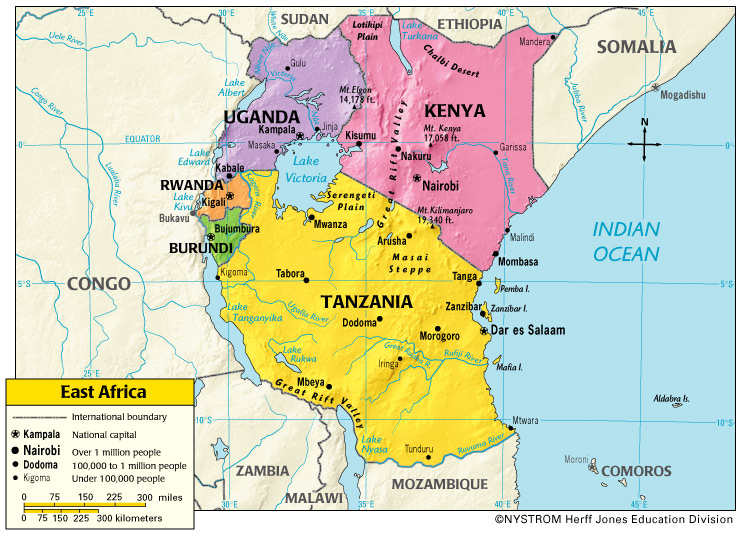
East%20Africa%20mapIn the spirit of stronger East African integration, the revenue authorities of Kenya, Uganda and Rwanda have started preparations for the implementation of a Single Customs Territory. The Commissioners’ General of the three East African countries deliberated on the mechanisms to operationalize the decisions of the heads of state who have continuously called for its fast tracking.

On June 25, 2013 at the Entebbe State House in Uganda, a Tripartite Summit involving the three heads of state issued a joint communiqué directing among other things the collection of customs duties by Uganda and Rwanda before goods are released from Mombasa. The leaders also agreed that traders with goods destined for warehousing should continue executing the general bond security.

During the meeting, the Commissioners’ General of the three countries put in place joint technical committees on ICT, Business Process, enforcement, change management, legal and human resource to discuss the implementation road map.

In a statement signed by the three Commissioners’ General, they said that the development of a Single Customs Territory will positively impact on the trading activities of the three countries as it will ensure that assessment and collection of taxes is done at the country of destination before cargo moves out of the port.

“As a result, the East African Community Customs Union will join the ranks of other Customs Union such as South African Customs Union and the European Union among others. Under this arrangement, restrictive regulations are eliminated as the corridor is now considered for customs purposes. For clarity, circulation of goods will happen with no or minimal border controls,” reads the statement in part.

Kenya said it would cut red tape holding up millions of dollars of imports into its landlocked neighbours Rwanda and Uganda, by letting the countries collect customs on goods as they arrive in its port at Mombasa. Goods can currently face long delays as agents process the paperwork to release cargoes from warehouses at east Africa’s biggest port, and later make separate arrangements to pay import duties at Kenya’s borders with Uganda and Rwanda.

Officials said the new system, due to be introduced in August, would clear inefficiencies and blockages seen as a major barrier to trade in the region. But clearing agents in Kenya said it could also cost thousands of jobs in warehouses, freight firms and almost 700 clearing and forwarding companies operating in the country.

Kenya, Uganda and Rwanda, together with Burundi and Tanzania, are members of the regional East African Community trade bloc, with a joint gross domestic product of $85 billion.

Kenyan tax officials said the new system would allow a “seamless flow of goods” and make it easier to stop goods getting through the system without customs payments. “Once cleared at the port, there will be no stoppages at borders and checkpoints along the corridor,” the Kenya Revenue Authority’s commissioner of customs, Beatrice Memo, told a news conference.

Under the system, Rwandan and Ugandan clearing agents and customs officials would be able to set up their own offices to clear cargo and collect taxes directly at the port. The Kenya International Freight and Warehousing Association said that meant up to half a million jobs could be lost to Uganda and Rwanda. “The Government has not consulted us … and we totally reject it,” said  Association chairman Boaz Makomere. Sources: East African Business Week (Kenya) & The New Vision (Uganda).