Parliament Postpones Customs Bills

Thaba Mufamadi, chairman of Parliament’s finance committee. Picture - Financial Mail

Thaba Mufamadi, chairman of Parliament’s finance committee. Picture – Financial Mail

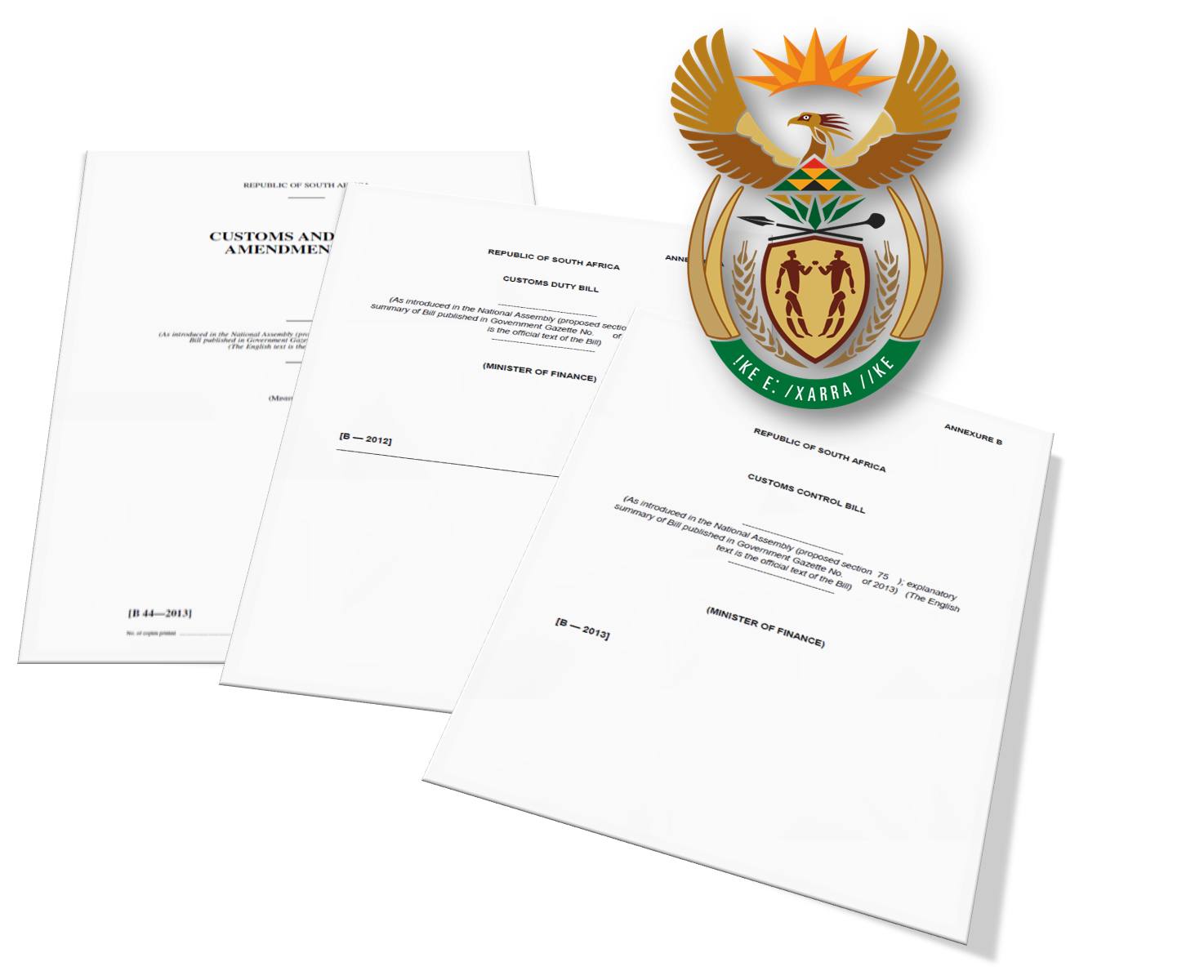
Parliment’s standing committee on finance (SCoF) has decided to postpone its deliberations on two draft customs-related bills until next year to allow importers and the freight-forwarding industry more time to comment on the proposals which threaten the status of City Deep as an inland port. This followed an appeal by the South African Association of Freight Forwarders that it had had insufficient time to consider the substantially revised draft Customs Control Bill and Customs Duty Bill, which required that imported goods would have to be cleared at the first point of entry.

The association, supported by a range of other business organisations, including the Johannesburg Chamber of Commerce and Industry, warned that the bills could be challenged on constitutional grounds if the process of consultation was deficient. All political parties supported the proposal by finance committee chairman Thaba Mufamadi on Wednesday that the deliberations on the bills be postponed until next year. He instructed stakeholders to make their submissions to the South African Revenue Service (SARS) by December 15.

Mr Mufamadi also took cognisance of concerns raised by Business Unity South Africa that parliamentary processes did not allow sufficient time to comment, for example, on the medium-term budget policy statement. Industry has warned of port delays and trade disruption if the proposals were to be adopted. The Customs Control Bill proposes that goods be cleared at the first port of entry into South Africa. This will mean that inland ports such as City Deep in Johannesburg would no longer be designated places of entry or exit for customs purposes. In the past, containerised cargo could move directly to inland ports on arrival in the country under cover of a manifest. A new declaration — of the nature, value, origin and duty payable on the goods — would replace the manifests.

SARS said these did not provide sufficient information to undertake a risk assessment. Another bone of contention for industry was the “extremely severe” penalties proposed in the draft Customs Duty Bill. Following the uproar about the proposals SARS offered a compromise earlier this week as a way out of the impasse. Instead of a clearance at the port of entry, a mandatory advance customs clearance of the goods three days before their arrival at the first port of entry would be required. Goods consigned to inland terminals such as City Deep would be released conditionally. The system would be tested for the whole of next year to iron out any problems.

An alternative option would be for the goods to undergo a lesser form of clearance at the first point of entry. This would still entail providing customs authorities with the same level of information on the tariff, value and origin of goods, which would be submitted by electronic data interchange. The importer would be held accountable for the information that was provided. SARS official Kosie Louw said that because this document would not have the formal status of a clearance certificate, it would not disrupt existing legal contractual arrangements, as claimed. The goods would still move CIF (cost insurance and freight) from the port to City Deep. SARS has also proposed softening the penalty provisions so that errors not resulting in any prejudice to customs revenue will be subject to penalties only after three warnings. These penalties will be discretionary and applied leniently in the first 12 months of the bill coming into force to allow business time to properly prepare for the change. An appeal process has been included. Source: Business Day Live. 

Draft Customs Bills in Parliment

Customs BillsParliament’s Standing Committee on Finance (SCoF) has issued an invitation (17 October 2013) to stakeholders and interested parties to submit written submissions and any indication to make oral presentation for the public hearings in regard to the Customs Control and Customs Duty Bills. The public hearings are set to take place on 30 October 2013. The draft Bills set out a new legal and regulatory framework for Customs controls over the movement of people goods and conveyance in the Republic of South Africa. The proposed new laws will in effect replace the existing Customs and Excise Act, no.91 of 1964 once in force. Copies of the bills can be located on the following website – www.parliament.gov.za – or via the following links:

SARS to address Stakeholders on Customs Control proposals

SARS chief officer of legal and policy Kosie Louw (Picture: Robert Botha/Business Day Live)

SARS chief officer of legal and policy Kosie Louw (Picture: Robert Botha/Business Day Live)

The South African Revenue Service (SARS) has committed itself to further engagements with importers of all sizes in a bid to improve its proposals to transform the customs control regime.

Consultations have already taken place with organised business on the proposed Customs Duty Bill and the Customs Control Bill, and the process would now be taken to the level of traders to find out whether the proposals presented them with any problems. Amendments have also been proposed to the Customs and Excise Act to provide for the transition to the new system.

“We want to understand the situation at a micro level. We will sit around the table until we find a solution which will guarantee to us that we get the information we require but which will also facilitate trade.

“We do not want to clog up the ports,” SARS chief officer of legal and policy Kosie Louw said in an informal briefing on the proposals to Parliament’s standing committee on finance on Wednesday.

The customs bills are mainly concerned with improving the information about imported and exported goods so that customs officials can exercise greater control.

Business has expressed concern that the requirement of the Customs Control Bill that they submit a national in-transit declaration of goods at the first port of entry before they are sent to internal terminals, or depots such as City Deep, would cause delays.

The new declaration — of the nature, value, origin and duty payable on the goods — would replace the limited manifest used to declare goods and would include information on the tariff, value and origin of goods.

Business has argued that the manifest allowed goods to move seamlessly from the exporting country to the inland port or depot, and would change the contractual relationships between exporter and importer in terms of when duty is paid.

However, Mr Louw did not believe the provision would cause delays and had obtained legal advice that the contractual relationships and method of payment of duties would not change. The problem with manifests, he said, was that they provided very limited information and did not allow SARS to prevent the inflow of unwanted goods. Nevertheless, he said that SARS would discuss the matter with traders.

Mr Louw said the proposed system would “improve SARS’s ability to perform risk assessment and intervene in respect of potentially high risk, prohibited and restricted consignments at the ports”.

The bills have been in the pipeline for about four years and have been extensively canvassed with the Southern African Customs Union and business. They were needed, Mr Louw said, so that South Africa kept pace with global trends in trade, international conventions and advances in technology.

Anti-avoidance provisions have also been introduced into the bill which sets out the offences and associated penalties for noncompliance and attempts to avoid paying customs duties.

SARS group executive for legislative research and development Franz Tomasek said the Customs Control Bill would introduce a new advance cargo loading notice for containerised cargo to prevent the loading of prohibited or restricted goods on board vessels bound for South Africa. However, to reduce the administrative burden on carriers, information submitted in advance will no longer be required on arrival or prior to departure. Source: Business Day Live


Border Management in Southern Africa: Lessons with respect to Policy and Institutional Reforms

The folk at Tralac have provided some welcomed insight to the challenges and the pains in regard to ‘regionalisation’. No doubt readers in Member States will be familiar with these issues but powerless within themselves to do anything due to conflict with national imperatives or agendas. Much of this is obvious, especially the ‘buzzwords’ – globally networked customs, one stop border post, single window, cloud computing, and the plethora of WCO standards, guidelines and principles – yet, the devil always lies in the details. While the academics have walked-the-talk, it remains to be seen if the continent’s governments have the commitment to talk-the-walk!

Regional integration is a key element of the African strategy to deal with problems of underdevelopment, small markets, a fragmented continent and the absence of economies of scale. The agreements concluded to anchor such inter-state arrangements cover mainly trade in goods; meaning that trade administration focuses primarily on the physical movement of merchandise across borders. The services aspects of cross-border trade are neglected. And there are specific local needs such as the wide-spread extent of informal trading across borders.

Defragmenting Africa WBThis state of affairs calls for specific governance and policy reforms. Effective border procedures and the identification of non-tariff barriers will bring major cost benefits and unlock huge opportunities for cross-border trade in Africa. The costs of trading remain high, which prevents potential exporters from competing in global and regional markets. The cross-border production networks which are a salient feature of development in especially East Asia have yet to materialise in Africa.

Policy makers have started paying more attention to trade-discouraging non-tariff barriers, but why does the overall picture still show little progress? The 2012 World Bank publication De-Fragmenting Africa – Deepening Regional Trade Integration in Goods and Services shows that one aspect needs to be singled out in particular:  that trade facilitation measures have become a key instrument to create a better trading environment.

The main messages of this WB study are:

  • Effective regional integration is more than simply removing tariffs – it is about addressing on-the-ground constraints that paralyze the daily operations of ordinary producers and traders.
  • This calls for regulatory reform and, equally important, for capacity building among the institutions that are charged with enforcing the regulations.
  • The integration agenda must cover services as well as goods……services are critical, job-creating inputs into the competitive edge of almost all other activities.
  • Simultaneous action is required at both the supra-national and national levels. Regional communities can provide the framework for reform, for example, by bringing together regulators to define harmonised standards or to agree on mutual      recognition of the qualification of professionals……. but responsibility for implementation lies with each member country.

African governments are still reluctant to implement the reforms needed to address these issues. They are sensitive about loss of ‘sovereign policy space’ and are not keen to establish supra-national institutions. They are also opposed to relaxing immigration controls. The result is that border control functions have been exercised along traditional lines and not with sufficient emphasis on trade facilitation benefits. This is changing but specific technical and governance issues remain unresolved, despite the fact that the improved border management entails various technical aspects which are not politically sensitive.

The required reforms involve domestic as well as regional dimensions. Regional integration is a continental priority but implementation is compounded by legal and institutional uncertainties and burdens caused by overlapping membership of Regional Economic Communities (RECs). The monitoring of compliance remains a specific challenge. Continue reading →

Port-to-Hinterland…gearing up for growth?

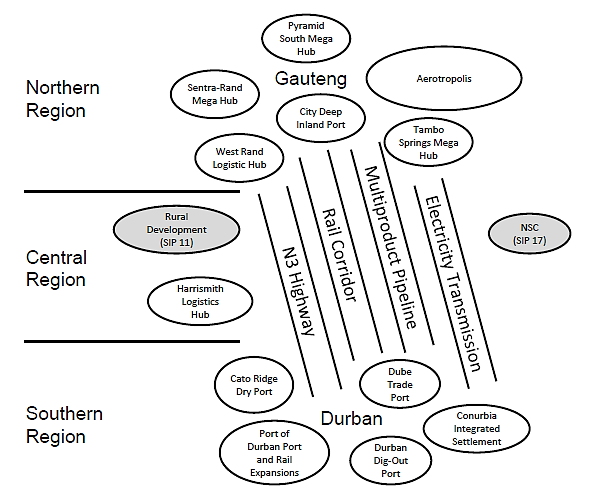
Proposed Durban-Free State-Gauteng Logistics and Industrial Corridor Plan (SIP2)

Proposed Durban-Free State-Gauteng Logistics and Industrial Corridor Plan (SIP2)

Notwithstanding on-going discontent amongst industry operators in regard to proposed legislative measures mandating customs clearance at first port of entry, the South African government (GCIS) reports that work has already commenced on a massive logistics corridor stretching between Durban and the central provinces of the Free State and Gauteng. Most of the projects that form part of the second Strategic Infrastructure Project (SIP 2), also known as the Durban-Free State-Johannesburg Logistics and Industrial Corridor, are still in the concept or pre-feasibility stage, but construction has already started on several projects.

These include:

  • the building of a R2,3 billion container terminal at City Deep
  • a R3,9 billion project to upgrade Pier 2 at the Port of Durban
  • R14,9 billion procurement of rolling stock for the rail line which will service the corridor.

Work has also started on the R250 million Harrismith logistics hub development to set up a fuel distribution depot, as well as on phase one of the new multi-product pipeline which will run between Johannesburg and Durban and transport petrol, diesel, jet fuel and gas.

The aim of these projects and others which form part of SIP 2, is to strengthen the logistics and transport corridor between South Africa’s main industrial hubs and to improve access to Durban’s export and import facilities. It is estimated that 135 000 jobs will be created in the construction of projects in the corridor. Once the projects are completed a further 85 000 jobs are expected to be created by those businesses that use the new facilities. Source: SA Government Information Service

Interested in more details regarding South Africa’s infrastructure development plan? Click here!

Latest SA Cabinet decisions affecting Customs

Coat_of_arms_of_South_Africa_svgGovernment Communication and Information (GCIS) has published a statement on Cabinet’s recent meeting (26 June 2013) revealing at least three key aspects affecting SARS as well as external stakeholders involved in or impacted by Customs business. An excerpt of the statement follows below.

Cabinet approved the submission of the Southern African Development Community (SADC) Protocol on Trade in Services to Parliament for ratification, in accordance with section 231 of the Constitution. The objectives of the Protocol are to liberalise intra-regional trade in services on the basis of equity, balance and mutual benefit. This Protocol also sets out a framework for the liberalisation of trade in services between SADC member states and serves as a basis for negotiations.

Cabinet approved the implementation steps proposed for the establishment of a Border Management Agency (BMA).  The BMA would manage migration, customs and land border line control services and efficiently coordinate the service of all departments in ports of entry. The Department of Home Affairs will be the lead Department in establishing the BMA.

Finally, and for some a contentious issue, Cabinet also approved the Customs Control Bill (CCB), the Customs Duty Bill, 2013 (CDB) and the Customs and Excise Amendment Act, 2013 (CEAA) for submission to Parliment.  The Bills provide a foundation for the facilitation of international trade and protection of the economy and society, thereby creating a balance between customs control and trade facilitation. Source: GCIS

Ready for Another 24-Hour Rule?

logoLast month (May 2013), the Nippon Automated Cargo and Port Consolidated System (NACCS) released an updated version of guidelines for filing under the Japan 24-hour rule. As the main system for the online processing and procedures related to the new 24-hour rule, NACCS has been updating the guidelines and holding informational sessions across Europe, North America and China since early 2013.

Scheduled to go into force March 2014, Japan Customs and NACCS is encouraging shippers to begin looking at requirements and working towards compliance now. Penalties include Do Not Loads (DNLs) and fines up to 500 thousand JPY.

The NACCS has provided several good resources for the trade to use in familiarizing themselves with the Japan 24-hour Rule:

Therefore, South African shippers, exporters, and carriers of goods to Japan have a few more months to get their systems and processes in order to meet Japanese advance reporting requirements. For those already meeting US, Canadian and EU advance manifest reporting requirements this should not pose too much of a problem.

Source: Integrationpoint.com

CBP initiation date for liquidated damages for 10+2 non-compliance

isfU.S. Customs and Border Protection (CBP) has announced that on July 9, 2013, it will begin full enforcement of Importer Security Filing (ISF or 10+2), and will start issuing liquidated damages against ISF importers and carriers for ISF non-compliance.

According to the CBP release, “in order to achieve the most compliance with the least disruption to the trade and to domestic port operations, it has been applying a “measured and commonsense approach” to Importer Security Filing (ISF or 10+2) enforcement.

The Importer Security Filing (ISF) system—also referred to as the “10+2” data elements—requires both importers and carriers to transmit certain information to CBP regarding inbound ocean cargo 24 hours prior to lading that cargo at foreign ports. These rules are intended to satisfy certain requirements under the Security Accountability for Every (SAFE) Port Act of 2006 and the Trade Act of 2002, as amended by the Maritime Transportation Security Act of 2002.

Under the ISF, the following 10 data elements are required from the importer:

  1. Manufacturer (or supplier) name and address
  2. Seller (or owner) name and address
  3. Buyer (or owner) name and address
  4. Ship-to name and address
  5. Container stuffing location
  6. Consolidator (stuffer) name and address
  7. Importer of record number/foreign trade zone applicant identification number
  8. Consignee number(s)
  9. Country of origin
  10. Commodity Harmonized Tariff Schedule number

From the carrier, 2 data elements are required:

  1. Vessel stow plan
  2. Container status messages

Source: CBP.gov

Johburg Chamber to meet Parliment over Customs Bill

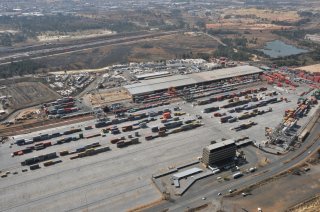
City Deep Container Terminal, Johannesburg

City Deep Container Terminal, Johannesburg

Online media company Engineering News reports that the Chamber of Commerce and Industry Johannesburg (JCCI) would take its objections of certain aspects of the recently tabled Customs Control Bill to Parliament and called on South African business and interested stakeholders to provide input as well.

The South African Revenue Services’ (Sars’) newly drafted Customs Control Bill, which, in conjunction with the Customs Duty Bill, would replace the current legislation governing customs operations, declared that all imported goods be cleared and released at first port of entry.

“The Customs Bill, cancelling the status of inland ports as a point of entry, will be before Parliament very soon, and only a short notice period for comment is expected,” JCCI former president Patrick Corbin said.

While all other comments and suggestions relating to the Bill were adequately dealt with, this remained the one disagreement that had not been satisfactorily resolved, he stated.

Corbin invited all parties to voice their concerns to ensure “all areas of impact and concern were captured”, adding further weight to the JCCI’s presentation. The implementation of the new Bill would directly impact the City Deep container terminal, which had been operating as an inland port for the past 35 years, alleviating pressure from the already-constrained coastal ports.

Despite customs officials assuring the chamber that the operations and facilities at City Deep/Kaserne would retain its licence as a container depot, Corbin stated that the Bill had failed to recognise the critical role City Deep played as an inland port and the impact it would have on the cost of doing business, the country’s road-to-rail ambitions, the coastal ports and ease of movement of goods nationally and to neighbouring countries.

“The authorities do not accept the fact that by moving the Customs release point back to the coast, a vessel manifest will terminate at the coastal port. There will not be the option of a multimodal Bill of Lading and seamless inland movements, as all boxes or the unpacked contents will remain at the coast until cleared and released by the line before being reconsigned,” he explained.

Citing potential challenges, Corbin said that only the containers cleared 72 hours prior to arrival would be allocated to rail transport and that those not cleared three days before arrival would be pushed onto road transport to prevent blocking and delaying rail operations.

This would also result in less rail capacity returning for export from Johannesburg, leading to increased volumes moving by road from City Deep to Durban.

He warned of the Durban port becoming heavily congested with uncleared containers, causing delays and potential penalties, while hampering berthing movements and upsetting shipping lines’ vessel schedules.

The release of the vessel manifest at the coastal port also placed increased risk on the shipping operators delivering cargo to Johannesburg following the clearance of goods at customs and required reconsignment at the country’s shores.

However, Transnet remained committed to investing R900-million for upgrading the City Deep terminal and the railway sidings, while Transnet CEO Brian Molefe had accepted the assurances from customs that “nothing would change and the boxes would still be able to move seamlessly once cleared”.

The Gauteng Department of Roads and Transport Department had allocated R122-million for the roadworks surrounding the inland port, while Gauteng MEC for Roads and Transport Dr Ismail Vadi said the department’s focus this year would narrow to the expansion and development opportunities at City Deep/Kaserne.

The department was also progressing well with the development of a second inland port, Tambo Springs Inland Port and Logistics Gateway, expected to be completed by 2017.

Vadi recently commented that the Gauteng Department of Roads and Transport, which was currently developing a terminal master plan for the project, would link the freight hub through road and rail transport to and from South Africa’s major freight routes and other freight hubs, including City Deep, which was about 33 km away.

The National Economic Development and Labour Council, under which the Bill had been drafted during a three-year development process, had agreed to fund an impact assessment study, led by Global Maritime Learning Solutions director Mark Goodger. The study was “close to completion” and would be presented alongside JCCI’s objections in Parliament. Source: Engineering News

Importing and Exporting in the absence of Customs Registration

Import exportAs of May 10 2013 an amendment to the South African Customs and Excise Act (91/1964) published in Government Gazette 36433, concerns an increase to the threshold for importation and exportation in the absence of customs registration.

General Registration Code 70707070 may be used by a party that is not registered as an importer or exporter with the South African Revenue Service, but wishes to import or export goods, provided that the following requirements are met:

  • The goods have a value of less than R 50,000 per consignment, subject to a limitation of three such consignments per calendar year;
  • The goods are declared for home consumption (ie, consumption or use in South Africa) or temporary import or export;
  • The importer or exporter is a natural person located in South Africa; and
  • The importer or exporter states its identity number or taxpayer reference number on the customs declaration form.

Traders should not confuse the above with the withdrawal of the General Registration Code from use by importers and exporters at land borders, which occurred during the course of 2012. In this regard refer to Rule Amendment Government Gazette No. 35178

Serbia – History of Customs Law & Customs Tariffs

The following comes from the Serbian Customs website – darn interesting! I would indeed like to learn of any other Customs administrations who have preserved “with diginity” their relics of the past.

The Customs profession, one of the oldest trades (emerging immediately after the clerical, ruling and military professions – lets not forget prostitution) withstood many turbulences and assaults, but it persevered, survived and developed. The number of customs officers and customs houses reflects the greatness of a state. And there lies also the greatness of the customs profession.”  These words end a text written on his profession by Veljko Velikić, a customs officer from Vršac, published in the magazine “Carinik” (Customs Officer) in November 1926.

The oldest preserved customs law related to our region was the Dubrovnik customs statute – Liber Statutorum Doane – from 1277 A.D. in Serbia, in addition to case law and national written legal sources, as early back as 13th century the first written legal source of Byzantine origin was applied. Sava Nemanjić, Saint Sava, on declaration of autocephaly of Serbian Orthodox Church in 1219, issued the Nomokanon, a collection of ecclesiastical and civil law regulations.

The oldest preserved customs law related to our region was the Dubrovnik customs statute – Liber Statutorum Doane – from 1277 A.D. in Serbia, in addition to case law and national written legal sources, as early back as 13th century the first written legal source of Byzantine origin was applied. Sava Nemanjić, Saint Sava, on declaration of autocephaly of Serbian Orthodox Church in 1219, issued the Nomokanon, a collection of ecclesiastical and civil law regulations.

This view of our colleague from early XX century was based on historical facts, since customs duties, in the form of tolls or taxes, were known back in the Old Ages.  They were levied by the state or individual cities.  The Old Greeks in Athens imposed a duty of 2% on imports and exports over the Pierian Mountains. The Romans also used to levy such duties as state and provincial or city taxes.  As early back as the Roman times customs duties made up a significant part of public revenues for the state treasury. At certain communication points in the provinces there were customs stations (stationes) where the duties were charged for the goods passing such points. The amount of duties was 2.5% (quadrogesimo) of the value of imported goods. The collection of customs duties was also farmed out, at the beginning granted even to farmers from the ranks of domiciled population, and later on, from mid-2nd century on, duties were collected by officials that in our territory were called publicum portarii Illyrici et ripae Thraciae. In the Middle Ages, in addition to import and export duties, the so-called transit duties were also levied. 

It was the basis for Dušan’s Code, drawn up at the times of developed feudal state in 1349, and amended in 1354, and this Code provided rules for the largest number of social relations.  Medieval Serbian rulers usually farmed out the collection of customs duties, most often to Dubrovnik citizens. After the arrival of Ottoman Turks in the Balkans the structure of revenues was changed entirely. The most important tax was the one paid in money, the so-called desetak (tithe), and also in “fruit of the land” and in labour; also levied were a district surcharge (nahijski prirez), fines, and revenues were also collected from customs duties, transportation and fishing taxes. On liberation from Ottoman Turks, the revenues from customs duties and charges on ferry transportation started to be collected for the first time in May of 1804, when Karadjordje established a customs house with a ferry at Ostružnica. Similar to the rate during the Ottoman rule, the customs duties stood at 3%. The vassal Serbia had to establish its customs tariffs in line with the then applicable provisions of agreements with the Holy See, and Prince Miloš fully complied with the Holy See’s instructions in that area.

Continue reading →

Cracking Down on Cheating by Foreign Companies

Customs LawThe following article and its ensuing piece of legislation would seem to suggest that current Customs’ automated risk management is not doing its job, or at least is not as successful as authorities would often have one believe. Will this legislation signal a return to good old-fashioned ‘manual’ customs investigative work based on human intelligence? What the Congressman appears to overlook is that it is the US importers who are liable for correct clearance of foreign supplied goods. If CTPAT (and any other AEO scheme for that matter) have any worth, then surely the USCBP would look at de-accrediting US importers who fall foul of its import compliance levels? For many, the question remains – how successful (or even relevant) are the post 9/11 Customs Security measures? Besides creating significant expense budgets for Customs administrations, lucrative business opportunities for scientists, technology vendors, standards bodies, and of course consulting opportunities for the hundreds of audit firms and donor agencies – are the benefits, cost-savings and efficiencies in our current era of “Security” that visible? For many traders, all of this has been accepted as little more than the cost of doing and remaining in business. Period!

Congressman Dan Lipinski introduced legislation that will help American manufacturers grow their businesses and add jobs by cracking down on foreign companies that illegally avoid paying millions of dollars in customs duties. The Customs Training Enhancement Act (click on hyperlink to view the Bill) will facilitate the sharing of information between the private sector and U.S. Customs and Border Protection, enabling the government to do a better job of identifying schemes that cheat American taxpayers by importing foreign goods without paying duties.

The bill, which was folded into Democratic and Republican versions of more comprehensive Customs legislation in the previous Congress, further advances the goal of levelling the playing field so American businesses have a fairer shot against their foreign competitors.

“Blatant cheating by foreign firms has become more widespread at a time when American employers and workers are already at a serious disadvantage. This is not only bad for American business, but it hurts taxpayers by robbing the federal government of taxes it is rightfully owed,” Rep. Lipinski said. “The Customs Training Enhancement Act offers a common-sense approach by allowing impacted industries to  provide our Customs agents the critical intelligence they need to spot the cheaters.”

Since 2001, importers and exporters of goods into the United States have avoided paying $600 million in duties, according to the U.S. Government Accountability Office, which estimates that 90 percent of all transhipped or mislabelled items originated in China. Foreign companies have avoided duties by misclassifying and undervaluing products or by shipping goods from one country to another on their way to the United States in order to disguise the country of origin.

Under Rep. Lipinski’s bill, Customs and Border Protection would be required to seek out companies and trade groups that have information that can identify misrepresented shipments. That information, in turn, would be shared directly from these industry experts to Customs agents working on the front lines.

The Customs Training Enhancement Act is modelled on a successful program forged between the steel industry and Customs and Border Protection in which company and industry officials have taught Customs agents how to spot products that have been deliberately mislabelled.

“The steel industry has shown us a public-private partnership that saves taxpayers millions of dollars while costing the federal government very few, if any, resources,” Lipinski said. “We need to expand this program and fight back against the lying and cheating by foreign companies that are hurting American taxpayers, businesses, and workers. The Customs Training Enhancement Act is an important first step.” Source: www.lipinski.house.gov

Warehouse Operators – Easy prey for HMRC

warehousingThere is growing evidence that HM Revenue & Customs (HMRC) has begun a campaign to target warehouse keepers and hauliers who may unknowingly be handling excise goods on which the duty has yet to be paid.

And the United Kingdom Warehousing Association (UKWA) is warning that any company found guilty of storing goods on which duty is outstanding could face ‘financial ruin’ – even if the storage company was unaware that duty had not been paid.

“While HMRC has had the authority to assess anyone for duty on goods illegally diverted from bonded movements who was ‘aware or should reasonably have been aware’ of the diversion at any point in the supply chain since 2010, action has been spasmodic,” says Alan Powell of Alan Powell Associates, UKWA’s honorary adviser on Customs & Excise Matters.

“However,” he continues, “HMRC is deploying more officers to investigate excise goods supply chains. As a result, we are now increasingly seeing third party service providers, including hauliers, warehouse keepers and lessors of property, such as barns and outbuildings, being penalised by HMRC as a result of their involvement with businesses that have evaded duty on alcohol and have absconded – so called ‘missing traders’.”

Anyone found to have held or dealt in duty-unpaid excise goods, can be fined up to 100% of the duty evaded, as Alan Powell explains: “HMRC had been slow to apply what are called ‘excise wrong-doing penalties’ but are now vigorously applying them.  As a result, many small and medium companies are facing unexpected bills and penalties from HMRC of hundreds of thousands of pounds.”

Allan Powell continues: “In simple terms, if an organisation has been involved at any stage in the supply of goods that have been illicitly diverted from a bonded supply chain, that  organisation could be liable for duty – even if that organisation is not directly responsible for the diversion.

“Essentially, anyone handling duty-unpaid product is classed as being ‘contaminated’ within the supply chain and assessed for the duty.”

In one particular instance, a storage company is facing a duty bill alone for nearly £100,000 after HMRC inspectors found duty-unpaid alcohol stored at the company’s site.

“The storage company was simply unaware about the risks involved in handling loads of duty un-paid alcohol and the director of the company to whom they leased the space has disappeared,” says UKWA’s chief executive officer, Roger Williams.

The message from Alan Powell and UKWA is that if you offer third party logistical services of any kind, you must check what is being handled or stored – do not take storage requirements on face value.

Alan Powell says: “Always be wary and query the business need, checking out with HMRC if possible.  If in any doubt, do NOT become involved – it could end very badly.” Source: www.ukwa.org.uk.

Read a followup article by – UKWA :Don’t be fazed by HMRC move (Lloyds List)

City Deep Inland Terminal [port] to be hit hard by Customs Bill

Trucks at Transnet Freight Rail's City Deep Terminal (Engineering News)

Trucks at Transnet Freight Rail’s City Deep Terminal (Engineering News)

Following up on last year’s meeting (click here!) of the minds, convened by the JCCI, a recent meeting in Johannesburg placed fresh emphasis on the dilemma which impending changes contemplated in Customs Draft Control Bill will have for the import and logistics industry in particular. The following report carried by Engineering News highlights trade’s concerns which are by no means light weight and should be addressed with some consideration before the Bills come into effect. Gauging from the content below, there is a clear disconnect between business and policy makers.

The closure of Johannesburg’s inland port seemed to be a “done deal” as Parliament deliberated the recently tabled Customs Control Bill that would leave the City Deep container depot invalid, Chamber of Commerce and Industry Johannesburg (JCCI) former president Patrick Corbin said on Friday.

The promulgation of the South African Revenue Services’ (Sars’) newly drafted Customs Control Bill, which, in conjunction with the Customs Duty Bill, would replace the current legislation governing customs operations, would have a far-reaching impact on the cost and efficiencies of doing business in South Africa and other fellow Southern African Customs Union (Sacu) countries, he added.

The Bill, which was the product of a three-year development process within the National Economic Development and Labour Council, declared that all imported goods be cleared and released at first port of entry. This was part of efforts by customs officials and government to root out any diversion and smuggling of goods, ensure greater control of goods moving across borders and eliminate risks to national security.

Speaking at the City Deep Forum, held at the JCCI’s offices in Johannesburg, Corbin noted, however, that City Deep had operated as an inland port for the past 35 years, easing the load on the country’s coastal ports, which were already strained to capacity. Despite customs officials assuring the chamber that the operations and facilities in City Deep/Kaserne would retain its licence as a container depot, he believed customs had failed to recognise the critical role City Deep had played in lowering the cost of business, easing the burden on South Africa’s ports and ensuring ease of movement of goods to neighbouring countries. As customs moved full responsibility of container clearances to the ports, port congestion, inefficiencies, shipping delays and costs would rise, and jobs would be lost and import rail volumes decreased, he noted.

Economist Mike Schussler added that the closure of the City Deep inland port operations would add costs, increase unreliability and induce “hassles”, as the Durban port did not have the capacity to handle the extra volumes and its productivity and efficiencies were “questionable” compared with other ports.

“The volume of containers going to overstay or being stopped for examination in City Deep [will] need to be handled by [the coastal] ports. If they can’t cope with the volume at the moment, how are they going to handle increased volumes,” Iprop director Dennis Trotter questioned. He noted that only the containers cleared 72 hours prior to arrival would be allocated to rail transport. Those not cleared three days before arrival would be pushed onto road transport to prevent blocking and delaying rail operations.

This, Schussler said, would also contribute – along with port tariffs and the cost of delays – to higher costs, as road transport was more expensive than rail.

He pointed out that South Africa was deemed third-highest globally in terms of transport pricing. It would also result in less rail capacity returning for export from Johannesburg, further leading to increased volumes moving by road from City Deep to Durban.

Sacu countries, such as Botswana, would also be burdened with higher costs as they relied on City Deep as an inland port. Trotter noted that the region would experience loss of revenue and resultant job losses. Over 50% of South Africa’s economy was located closer to Gauteng than the coastal ports. Johannesburg alone accounted for 34% of the economy, said Schussler, questioning the viability of removing the option of City Deep as a dry port.

However, unfazed by the impending regulations, Transnet continued to inject over R1-billion into expansion and development opportunities at City Deep/Kaserne. Corbin commented that Transnet had accepted the assurances from customs that “nothing would change and the boxes would still be able to move seamlessly once cleared.” The City of Johannesburg’s manager of transport planning Daisy Dwango said the State-owned freight group was ramping up to meet forecast demand of the City Deep/Kaserne depot.

The terminal’s capacity would be increased from the current 280 000 twenty-foot equivalent units (TEUs) a year, to 400 000 TEUs a year by 2016, increasing to 700 000 TEUs a year by 2019. Transnet aimed to eventually move to “overcapacity” of up to 1.2-million TEUs a year. Dwango said projections have indicated that by 2021, the City Deep/Kaserne terminals would handle between 900 000 and one-million TEUs a year. Source: Engineering News

Government heeds the call – Tax Holidays for SEZs

Minister Pravin Gordhan and his 'budget team' on their way to parliment [Picture credit-SARS]

Minister Pravin Gordhan and his ‘budget team’ on their way to parliament [Picture credit – SARS]

After more than a decade of fruitless marketing and billions spent on capital investment, Budget 2013 brings some hope of a turn-around and better fortunes for economic development zones in South Africa.

Minister of Finance, Pravin Gordhan announced, what is an unprecedented move. to bolster support for government’s Special Economic Zone (SEZ)programme. Investors in such zones are expected to qualify for a 15% corporate tax rate, and in addition, a further tax deduction for companies employing workers earning less than R60,000 per year.

This is a significant development in that the previous dispensation under the Industrial Development Zone (IDZ) programme only afforded prospective investors a duty rebate and VAT exemption on imported goods for use in the Customs Controlled Area (CCA) of an IDZ. The reality is that these benefits were simply not enough to woo foreign company’s to set up shop in our back yard, let alone existing big business in South Africa to relocate to these zones. Mozambique, next door, has had much success as are other African countries through the offering of company tax holidays with the introduction of export-focussed special manufacturing facilities.

The SEZ (so it would seem) differs little from the IDZ approach save the fact that the former does not require the location of the economic zone at an international airport, seaport or border crossing. As such, an existing IDZ may ‘house’ a special economic zone, thus maximizing return on investment.

Recent developments in SA Customs realise a provision permitting foreign entities to register as importers or exporters under the ‘foreign principal’ clause in the Customs and Excise Act. Approval of such is dependant on the foreign principal establishing a business relationship with a South African ‘Agent’. This ‘agent’ is required to be registered with the SA Revenue Service as the party representing a ‘foreign principal’ in customs affairs. At this point, the provision is being applied to business entities in BLNS countries who import or move bonded goods into or from South Africa.

Future global application of this provision could boost the possibilities of a broader range of investor to favourably consider SEZ opportunities in South Africa. This option will, no doubt, not go unnoticed by the big audit firms seeking to broker ‘cross-border’ customs facilities for their multi-national clients. I perceive that more introspection is still required concerning ‘non-resident’ banking facilities and transfer pricing issues to enable the global application of the foreign principal concept. But after all this seems a good case for trade liberalisation. Add to this the forthcoming launch of Customs new integrated declaration processing system that will (in time) offer simplified electronic clearance and expedited release facilities for future SEZ clients.