Non-Intrusive Inspection capability – now in the Port of Cape Town

South African Customs has introduced non- intrusive inspection (NII) capability at the Port of Cape Town. The recent completion of an impressive relocatable scanner facility within the port precinct will now afford state of the art inspection services for customs targeted consignments for inspection. This is the third X-Ray scanner installed and operated by the South African Revenue Service (SARS).

In March 2008, a mobile scanner was implemented at Durban Container Terminal. More recently, a relocatable X-Ray Scanner was implemented adjacent to the container terminal in Durban to allow for improved capacity and efficiency.

The new facility in Cape Town not only extends customs risk and enforcement capability in the use of such technology but acts as a deterrent against any possible threat posed by international cargoes entering or leaving the country’s ports of entry.

In addition to the new x-ray inspection hardware, SARS has developed bespoke support to allow scanned images to be reviewed remotely – away from the port area – affording customs increased flexibility, allowing image analysis experts elsewhere in the country to provide almost real-time analysis and support for the inspection team. The approach also meets SARS differentiated inspection case methodology which ensures that case finalization and cargo release does not rest with a single customs official.

Remote screening analysis is a practice that has already been pioneered in Europe with great effectiveness in recent years.

The benefit of non-intrusive inspection (NII) allows customs to ‘see whats inside’ the container, vehicle or tanker without having to break the seal. All of this can be done in a few minutes. It forms part of Customs overall approach to minimise the time taken to conduct a customs intervention and latent cost, damage and theft which plague conventional physical inspection of cargoes.

The new inspection site also enables SARS to increase its participation and effectiveness in the US Container Security Initiative (CSI) which was launched in Durban, December 2003. Under the CSI Agreement, SARS officials together with US Customs & Border Protection Agency (USCBP) officials – co-located at the Port of Durban – analyze and mitigate risks relating to any containerised cargo destined to ports in the United States.

Credit to Indresan Reddy (Customs Business Systems) for the photographs.

Related documents

Hong Kong Customs seizes 1.1m sticks of illicit cigarettes worth $3.1m

securityHong Kong Customs mounted a special operation at Lok Ma Chau Control Point to combat organised cigarette smuggling activities. About 1.1 million sticks of suspected illicit cigarettes with a market value of about $3.1 million and duty potential of about $2.2 million were seized. A 52-year-old male driver was arrested and the vehicle used for conveying the suspected illicit cigarettes was detained.

Customs officers here the other day intercepted an incoming container truck declared to be empty at Lok Ma Chau Control Point.

After X-ray examination and thorough inspection by Customs officers, about 1.1 million sticks of suspected illicit cigarettes in 83 carton boxes were found inside a false compartment of the container. The cigarettes were sorted and packed according to orders placed with a view to quick delivery to buyers.

A Customs spokesman said today (June 5), “The operation showed the effectiveness of the enforcement strategy, especially the escalated enforcement actions against smuggling activities at source. Customs will continue to carry out stringent enforcement action against all illicit cigarette activities.”

Under the Import and Export Ordinance, smuggling is a serious offense. The maximum penalty is a fine of $2 million and imprisonment for seven years. Source: CustomsToday

ZIM Police struggle to bust cigarette racket

CigarettesAn intricate web of smugglers, which reportedly involves manufacturers and middlemen, has been illegally carting cigarettes worth millions of dollars out of the country over the years, prejudicing the treasury of vital revenue.

Cigarette manufacturer, Savanna, has been fingered as one of the main culprits, while multinationals like BAT have also been mentioned in the illicit cross-border trade, mainly to South Africa.

Commonly smuggled brands include Remington Gold, Madison, Sevilles, Magazine Blue, Chelsea and Pacific Blue, manufactured by Savanna – which consistently denies smuggling.

A senior police sokesperson said “Even though we don’t always talk about it, we have managed to make significant arrests and the cases have been taken to court. The arrests include smuggling attempts at undesignated spots along the border and through official exit points such as Beitbridge”

A senior customs official told The Zimbabwean that cigarette smuggling, particularly through Beitbridge and Plumtree border posts, was difficult to arrest because of corruption.

“Policing at the border posts involves several agencies, namely the police, CIO (Central Intelligence Organisation), customs and special deployments from ZIMRA (Zimbabwe Revenue Authority). The problem is that these officers work in collaboration with the smugglers and haulage trucks and other containers carrying the cigarettes are cleared without proper checking. Hefty bribes are involved and the money is too tempting to resist,” said the customs official.

“You would be amazed how wealthy these officers have become. They have bought houses, luxury cars and send their children to expensive schools – yet their regular salaries are so low,” he added.

Immigration and customs officials, who also constantly liaise with their South African and Botswana counterparts and meet physically regularly, pretend to be checking the containers but clear them without completing the task, and know what the trucks and other carriers would be ferrying.

ZIMRA has four scanners for detecting contraband and an anti-smuggling team that also uses sniffer dogs, in addition to guard soldiers posted between the Zimbabwean and South African borders.

There are about 15 regular roadblocks along the Harare-Beitbridge road and 10 between Bulawayo and Plumtree that search trucks, buses and private cars. Despite this, the smuggling continues because of the collusion among the officials, said the source.

In early January, the Ferret team, a joint operation involving Zimbabwean and South African officers, intercepted a truckload of 790 Remington Gold cigarettes worth an estimated $119,000 destined for South Africa along the Masvingo-Beitbridge road. The smugglers were caught and arrested while offloading the cartons into small trucks. Source: The Zimbabwean

Unusual Container Weight Fraud Uncovered

containerThe International Maritime Bureau has been alerted to a fraud involving a shipping container’s weight and size that is atypical of what one might out of a container weight fraud case; the tare weight, or unladen weight of the container itself was unrealistically falsified and much higher than the actual, correct weight of the container.

The IMB reports that the incident concerned a container of aluminium scrap in which the information outside the box was tampered with to show false weight and size. The fraud was uncovered by an IMB member after being notified of a significant weight shortage on the container, which arrived in the Far East from the Middle East.

During the investigation, the IMB member noted that the tare weight of the container, as shown on its door – and used by the shipper – was 3,680kg, while the cube, also shown on the door, was 2,700 cubic feet. While the numbers displayed were entirely acceptable for a 40 foot container, the box in question was a 20 foot one, according to the IMB. The shipper has since confirmed that the correct tare weight for the container should have been 2,200kg, much lower than what was declared.

An examination of the photos taken when the container was loaded revealed that the part of the door on which the figures were displayed was a slightly different color, which leads to the conclusion that the door had been repainted at some point, and the new, false figures were added after that. The IMB notes is not known when this was done and it is unlikely to be an isolated case.

The IMB says it has not come across a case before where a container has been repainted with incorrect weight and size information that in hindsight clearly cannot be correct for a 20 foot container, however it does have knowledge of a case where a label was placed over the container number of a stolen container to disguise the theft. The IMB says that this would be a more logical deception since carriers tend to focus on the container numbers themselves, and rely on the shipper to provide any other information required.

The IMB asks that others who detect similar container information tampering to report it so that it can attempt to establish a pattern that might indicate who is responsible and can issue suitable warnings to the industry if it proves widespread in the future.

Apart from being a fraud, mis-declaring the weight of containers can also pose a danger to the vessel and crew, as mis-declared container weights remains a contributing factor to incidents involving containers lost at sea.

This month, the International Maritime Organization’s Maritime Safety Committee is scheduled to adopt amendments to the International Convention for the Safety of Life at Sea chapter VI to require mandatory verification of the gross mass of containers, either by weighing the packed container or by weighing all packages and cargo items and adding the tare mass, in turn boosting the safety of container ships and crew.

The IMB stresses that in this case, the container owner has denied responsibility and the IMB member doubts its supplier was involved. Source: emaritimeexchange.com

South African Air Cargo Security Systems receive International thumbs up!

Cargo Screening [www.aircargonews.net]

Cargo Screening [www.aircargonews.net]

Both the European Union (EU) as well as the United States’ Transport Security Administration (TSA) have approved South African air cargo security systems.

Poppy Khoza , The South African Civil Aviation Authority (SACAA) director, says, “The two affirmations place South Africa in a unique position, making the country the only one on the continent with such recognition and agreements in place.”

“This essentially means that, following audits by the European Union and the United States, South Africa is acknowledged as one of the countries where the level of aviation security is regarded as robust and reliable. This will benefit air carriers operating between South Africa and the two regions.”

In the case of the US, the TSA carries out yearly assessments of South Africa’s aviation security regime with the last audit conducted in June 2014.

The results of the audit indicate that South Africa did not attract any findings or observation and in some instances, the standards were found to be higher than in previous years.

“The TSA audit comes after almost a year since the SACAA and the TSA concluded a recognition agreement on air cargo security programmes, thus acknowledging that South African systems are on par with the stringent requirements of the USA.”

“This agreement also enhances air cargo security measures and initiatives between the two countries. Most significantly, the agreement enables quicker facilitation of goods between the two countries, and helps eradicate duplicative or redundant measures while still ensuring the highest levels of security that both the TSA and the SACAA require.”

The EU recognition means that South Africa has been included in the list of third countries where air carriers are exempted from the application of the ACC3 (Air cargo and mail carrier operation into the EU from a third country airport) regime of which the requirements are viewed as stringent to operators from countries outside the EU.

In terms of the ACC3 process, carriers wishing to carry cargo into the EU have to request an ACC3 status, and this process requires rigorous screening of air cargo or the existence of a properly functioning and secure air cargo system.

As from July this year, cargo operators flying to the EU destinations must therefore either hold a valid EU validation report, proving that they have adequate security measures in place, or in the absence of such assurance, cargo operators will have to use the services of EU validators to pronounce their cargo as secured.

“The services of EU validators are not free and come at a cost to air carriers, but it does acknowledge that security measures applied in South Africa and the EU are equivalent.”

“This recognition by the EU is a significant milestone for the country and South African carriers, as this means that they can now benefit from an exemption from the ACC3 regime, provided that the level of risk remains similarly low, commensurate with a robust oversight system being in place.”

Source: SAnews.gov.za

US extends Air Cargo Screening Scheme

CBP_0US Customs and Border Protection (CBP) has extended its Air Cargo Advance Screening (ACAS) pilot programme for a further year following representations from freight forwarding representatives, and has reopened the application period for new participants. The pilot was set to expire this month but will now be extended until 26 July 2015, and CBP is also accepting applications for new participants until 26 September 2014.

The programme, which analyses advance data on inbound air shipments to the US to assess risk, is currently in pilot phase, but US Customs and Border Protection (CBP) has signalled that it intends to expand it to apply to all inbound air cargo via a “rulemaking”. The extensions follow a letter sent in June to CBP and the US Transportation Security Administration (TSA) from a coalition of associations representing air freight forwarding companies, calling on the US government to solicit input from small and medium-sized forwarders before expanding the ACAS programme.

The Airforwarders Association (AfA), the National Customs Brokers and Forwarders Association of America (NCBFAA), The International Air Cargo Association (TIACA), and the Express Delivery and Logistics Association (XLA) jointly sent letters to CBP and the TSA noting their support of the concept of the ACAS programme’s risk-based analysis at the shipment level, but expressing concerns about certain issues. In addition to detailing issues regarding potential negative impacts on small and medium-sized air forwarding businesses, the letters included requests to meet with both agencies and representatives from air carriers in June to discuss the concerns and try to resolve them.

TIACA said it was strongly encouraging airlines and freight forwarders to apply for and engage in the pilot. “Only through wide participation, which can fully test the various IT connectivity issues for Advance Filing, as well as understanding the operational impact for the future, will we be able to ensure an effective programme when it becomes mandatory,” TIACA said.

It noted that this extension was for a full year, whereas CBP had only extended the pilot in six-month intervals in the past. TIACA said that following the pilot, CBP plans to issue a Notice of Proposed Rulemaking (NPRM), “and the current estimate is that this may occur in Q3/2015, with the likelihood of possibly Q4/2015 or Q1/2016.”

It said the issuance of an NPRM is followed by a mandatory comment period from industry, after which CBP reviews all of the comments. CBP must then respond to those comments when the final rule is issued.

“Thus, ACAS may not become a mandatory CBP data transmission programme until sometime in late 2016,” TIACA noted. “In comparison, the EU PRECISE programme is currently targeted for the first half of 2016.”  Source: Lloyds Loading List

Accelerated Screening – Port of Rotterdam’s ability to scan cargo on trains moving at 35 mph

Picture1The days of halting trains and unloading contents for inspection appear to be over at the Dutch Port of Rotterdam, where trained operators can now use high-power X-ray scanners to produce clear, unambiguous imagery of densely packed cargo in trains moving at speeds up to 60 kilometers per hour (35 MPH).

Simultaneously, another group of operators located several miles away in a secure inspection office collect, analyze and evaluate the X-ray images for a wide range of potential threats, dangerous materials and contraband.

Because it all happens so swiftly — particularly as the containers are never unloaded or diverted individually to cargo inspection facilities — the speed of throughput increases exponentially. To be precise, Dutch Customs at the Port of Rotterdam can now inspect nearly two hundred thousand rail containers per year, or a single 40-foot container in eight-tenths of a second.

This is the future, or as in the case of Rotterdam, the present model of an enhanced global supply chain — ultra-high-speed rail throughput combined with ultra-accurate threat detection. This combination of speed and efficiency is an innovation that allows not only railways to be more secure, but the global supply chain as a whole.

Rail has long been an overlooked component of the modern supply chain, even though it is arguably one of the most important. Because of the nature of rail — with thousands of miles of unguarded track, often connecting countries — it has previously been challenging to screen and secure without causing a disruption to the supply chain. And while ports and airports typically get the lion’s share of technology innovation, all components need to be equally considered and secured to prevent interference and have a smoothly run supply chain.

For a long time, cost-minded operators have tended to view the security of rail cargo scanning and the efficiency of throughput as essentially two competing interests.

When minor security gains trigger major productivity losses — and when even small throughput disruptions can grind supply chains to a halt — it’s easy to see why rail lines have been relatively (and intentionally) under-served by global security improvement efforts.

As a result, one of the more popular rail security/efficiency compromises has been to implement a procedure for “small sample” screenings, by which only a small portion of each rail car or trainload is scanned for threats, dangerous materials, and contraband — providing a modicum of security without disrupting the core efficiency of the supply chain.

However, as malicious activities have become more prevalent and more sophisticated, “small sample” rail screenings have become increasingly insufficient. The United States Department of Homeland Security even instituted a 100% cargo-screening mandate at ports (though that mandate has since been retracted).

Accordingly, the industry has been eagerly seeking newer technology-based answers — ways to scan a larger portion of rail cargo without degrading throughput efficiency. The Dutch Customs’ solution meets higher inspection goals without detrimentally affecting the international supply chain.

Countless other customs and border agencies, companies, and national organizations are pursuing their own answers to similar and related security/efficiency challenges. For instance, rail operators worldwide are now experimenting with higher-energy X-rays for penetrating more densely packed freight cars. (When throughput lags, companies will attempt to condense their shipments into fewer cars, which can pose an obstacle for traditional X-ray scanners.)

In addition to the security factor, revenue is another motivator for government agencies to embrace this new cargo scanning technology. Customs enforcement of a freight rail (for international cargo lines) is extremely important to a country as contraband goods can cost governments hundreds of thousands of dollars in tax dollars. And smuggled contraband can also help fund organized crime and domestic terrorists, making it all the more important that rail lines not be overlooked when it comes to integrating cutting edge security.

In fact, a single malicious attack, occurring anywhere in the world, can devastate the global supply chain in its entirety, driving up prices and imposing major delays on manufacturers worldwide. By not being required to choose between 1) preventing extraordinary threats, and 2) maximizing the efficient of ordinary processes, the evolving technology can truly accelerate rail cargo screening and secure it too. Source: Rapiscan (Contributed by Andy Brown)

AS&E introduces ground-breaking imaging system

Mini Z, the handheld technology from American Science and Engineering (AS&E), has been designed to offer port security officials an innovative new tool to combat contraband and illicit substances on ships.

Hailed as the world’s first handheld Z backscatter imaging system, the Mini Z aims to provide security officials with the ability to screen ‘the hulls and bulkheads of suspected drug-running boats for contraband or narcotics’, according to a company press release.

The Mini Z boasts the ability to scan in places that other systems cannot reach, while being easy-to-use and offering advanced X-ray imaging to present a real-time picture of ship and vehicle contents.

The Mini Z system is a game-changer for law enforcement and border security officials who are constantly challenged to quickly and accurately detect potential threats in hard-to-reach environments.

For an interactive introduction to the MINI Z, click here

Source: AS&E

Lesotho Revenue Authority to acquire two AS&E ZBV Mobile Screening Systems

AS&E's Cargo and vehicle screening system deployed in 55 countries

AS&E’s Cargo and vehicle screening system deployed in 55 countries

American Science and Engineering, Inc. (“AS&E”), has announced the receipt of an order for two ZBV® mobile screening systems from a new international customer, the Kingdom of Lesotho. The ZBV systems will screen vehicles and cargo for threats and trade fraud on its border with South Africa to facilitate trade and counter smuggling.

The Lesotho Revenue Authority (LRA) has launched a Customs Modernization Program aimed at simplifying border procedures while speeding up the inspection process. The ZBV systems, with its safe and effective technology, ease-of-use, and high-throughput capability will greatly support this initiative.

“We are delighted to have the opportunity to support the LRA in its Customs Modernization Program and to help secure the Kingdom of Lesotho,” said Chuck Dougherty, AS&E’s president and CEO. “The ZBV system has been proven effective for anti-smuggling programs, with one customer recently reporting a 54% increase in tobacco seizuresi in a four month period. With the ZBV system’s outstanding field reports, we continue to add new countries to our installed base in key geographic markets and expand our market penetration of Z Backscatter® technology in Africa.”

LRA spokesperson Mr. Pheello Mphana says, “The LRA is pleased to acquire this advanced technology to support our modernization process. Following our detailed examination of non-intrusive inspection systems, the ZBV provides the optimum solution to deploy on our borders to facilitate trade by reducing inspection delays and the cost of compliance, improve border control and detect illicit cross-border movement.”

The highly mobile ZBV® system screening system allows for immediate deployment and rapid inspection to reveal explosives, drugs, currency, alcohol, cigarettes and other organic threats or contraband. With over 730 systems sold to date, AS&E’s ZBV system is used by leading government agencies, border authorities, law enforcement, military organizations, and security agencies in more than 64 countries. Source: AS&E

State-of-Art Port Control Centre opens in Cape Town

Inter-Departmental CooperationSouth Africa’s first maritime port of entry control centre represents a milestone in the country’s journey to secure, modernise and control its borders, Finance Minister Pravin Gordhan said at the opening of the centre at Cowrie Port in Cape Town harbour last week on Friday.

The centre puts all the government departments and agencies involved in immigration and border control under one roof. These include the departments of home affairs, health, agriculture and fisheries, the SA Police Service (border police and crime intelligence), and the SA Revenue Service (Customs). The state-of-the-art centre would not only improve security and immigration issues, but would also serve to enhance trade and South Africa’s status as a logistical gateway to Africa, Gordhan said.

Trade

The rationale behind the centre was in line with the National Development Plan, the minister said. Among other things, the NDP aims to stimulate growth by lowering the cost of doing business in South Africa, improving the country’s competitiveness and exports, and linking local products with other emerging markets. Gordhan said the fast-growing markets of Africa represented important new markets, and the NDP was committed to increasing South Africa’s trade with its regional neighbours from 15% to 30%.

‘Complex borders’

Home Affairs Minister Naledi Pandor, also speaking at Friday’s opening, said the centre had been designed “to accommodate in one spot not only customs, excise and immigration, but also health, safety and intelligence.

“Ports are complex borders to manage. Cowrie Place will provide the space and facilities to manage passengers and cargoes more efficiently than before.” Pandor said the government hoped to establish a border management agency by the end of 2016, taking advantage of the lessons learnt from Cowrie Place. A flagship feature of Cowrie Place is the co-ordination monitoring centre, where the data and information will be fed, assimilated and made available to all government department and agencies involved in the maritime border management.

“For the bona fide tourist or member of the trade community, this will mean better service,” Gordhan said. “For those who intend to challenge the laws of our country, be warned, as we intend to raise the bar of compliance by an order of magnitude.”

Important port

Cape Town’s port is oldest in South Africa, but despite changes to its maritime culture brought by air travel and containerisation, it is still an important point of entry. The port processes more than 870 000 containers as well as nearly 730 000 tons of dry bulk per annum, Pandor said.

A total of 6 173 commercial vessels and 55 passenger vessels entered and/or left the port in 2013, while more than 62 000 people entered and/or departed from Cape Town harbour. Pandor said E-berth at the harbour would be developed into a fully fledged passenger liner terminal to complement Cowrie Place.

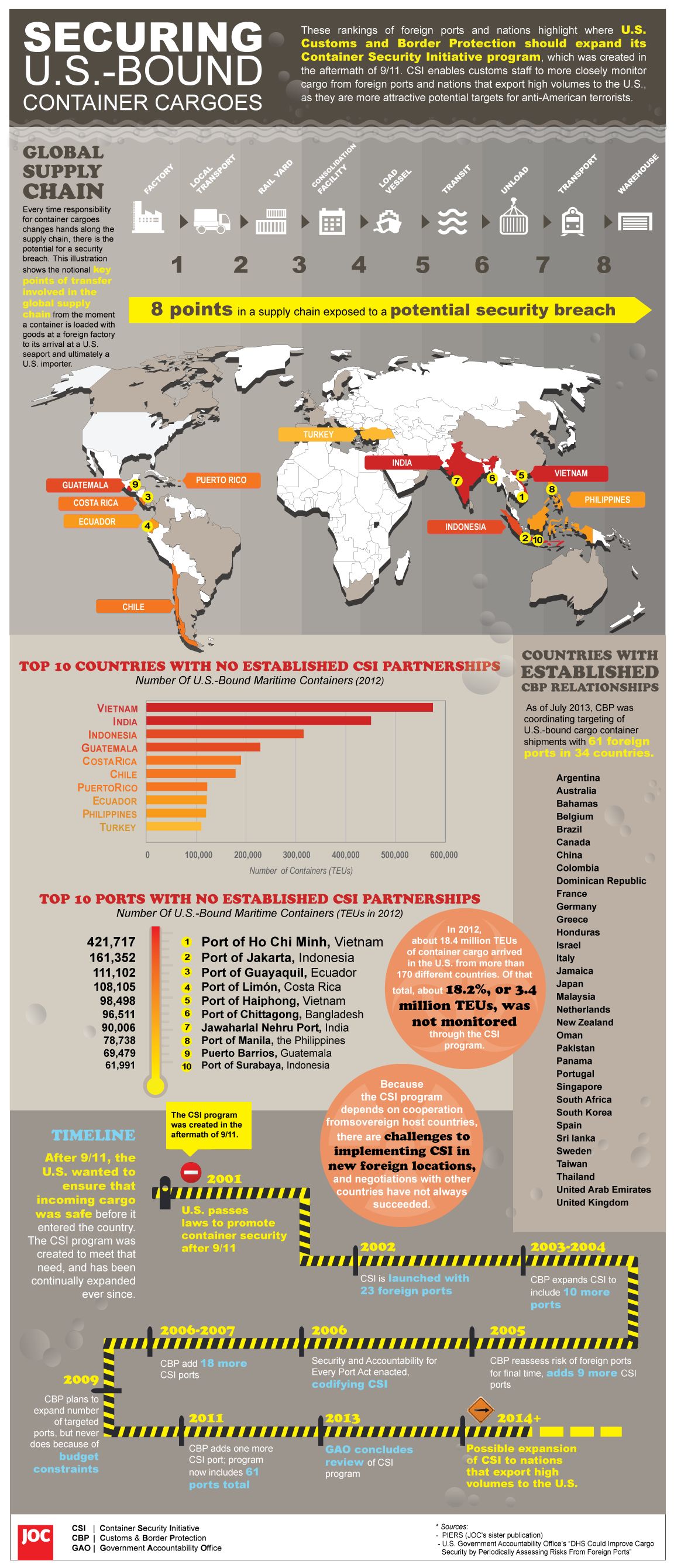
Protecting U.S.-Bound Container Cargoes

Securing US Cargo - Infographic by Journal of Commerce (Click to enlarge)

Securing US Cargo – Infographic by Journal of Commerce (Click to enlarge)

The Journal of Commerce provides a very useful infographic on the U.S. Customs and Border Protection’s efforts and initiatives in securing US – cargoes from foreign ports. While the Container Security Initiative (CSI) was one of the very first post 9/11 security initiatives it has since been supported by a number of other partnership programs involving other customs agencies and the US trade community. These have spawned many of the policies and guidelines being adopted by Customs agencies around the world where the WCO has ‘formulated’ and ‘standardised’ such requirements for broader international use, in conjunction with capacity building programs.

The U.S. Government Accountability Office has published a report, “DHS Could Improve Cargo Security by Periodically Assessing Risks From Foreign Ports,” recommending that U.S. Customs and Border Protection should continually update and expand its Container Security Initiative.

Since Sept. 11, 2001, CBP has taken steps to reduce vulnerabilities associated with U.S.-bound cargo container shipments by placing customs officials at foreign seaports to determine whether U.S.-bound shipments from those ports pose a risk of containing weapons of mass destruction or other terrorist contraband. While cargo from foreign ports and ships is critical to the U.S. economy, it can also be exploited by terrorists.

When CSI was launched in 2002, CBP initially selected 23 CSI ports largely on the basis of the volume of U.S.-bound container cargo, but it increased the number of risk factors in selected additional ports as it expanded the CSI program beginning in 2003. Through 2007, CBP added 35 ports to the CSI program based on additional criteria, such as strategic threat factors and diplomatic or political considerations. As of July 2013, CBP was coordinating targeting of U.S.-bound cargo container shipments with 61 foreign ports in 34 countries.

Cargo shipment data from PIERS, JOC’s sister publication, supports the GAO’s view that the U.S. needs to update and expand CSI in order to continue effectively monitoring incoming cargo. In particular, it appears the U.S. should form new CSI partnerships with Vietnam and India, which are the Top 2 exporters to the U.S. with no established CSI partnerships.

Although Vietnam is “relatively stable” in terms of its government, it is geographically close to Laos and Cambodia, and is therefore risky because of transshipment issues, according to Susan Kohn Ross, an attorney with Mitchell Silberberg & Knupp in Los Angeles. She also noted there has been a trend of manufacturers moving from China to Vietnam recently, as labor has become more expensive in China, resulting in more Vietnamese exports to the U.S.

Meanwhile, local uprisings in India recently have increased the country’s vulnerabilities to terrorist plans, despite the nation’s stable government, Ross said. India’s proximity to Pakistan also exposes it to terrorist groups, such as al-Qaida and the Taliban, and because Pakistan already has an established CSI partnership, terrorists might find it easier to smuggle cargo via India, she explained.

Conversely, if budgetary constraints ever force the CSI program to condense its monitoring, then CSI partnerships could perhaps be downgraded or eliminated entirely with the governments of Jamaica, Oman and Greece, which are the smallest exporters to the U.S. with established CSI connections, according to PIERS.

However, expanding and even contracting the CSI program present challenges. For example, CBP officials said in the GAO report that it is difficult to close CSI ports because removing the program from a country might negatively affect U.S. relations with the host government.

Furthermore, implementing a CSI partnership in a country exposes jurisdictional issues and regulatory differences, Ross said. For instance, the U.S. considers drugs to be a national security issue, but that’s not always the case in other countries, so prioritization of monitoring has to be worked out. Issues like which nation should pay for customs officers to be trained, or who should fix scanning equipment when it breaks, also must be resolved.

Ross further explained that it is “highly unlikely” that the federal government will ever expand CSI to cover 100 percent of all U.S. imports, an idea that CBP considered in 2009, but never implemented because of budget constraints. She said that scanning equipment is not advanced enough to expeditiously monitor all U.S.-bound cargo, and not all countries would even be willing to put CSI in place anyway.

Ultimately, nothing is foolproof, and if terrorists really wanted to wreak havoc on the U.S., they could probably more easily attack the U.S. through its borders, via Canada and Mexico, Ross said. However, CSI acts as an important deterrent, limiting the number of chances a terrorist has to harm to the U.S. Source: www.joc.com

100% Scanning – Have all the Options been considered?

Port of Oakland - VertiTainer's  crane mounted scanner solution employs advanced passive scanning technology and sophisticated identification algorithms to detect and identify gamma and neutron sources in shipping containers as they are loaded or discharged from a container ship.

Port of Oakland – VertiTainer’s crane mounted scanner solution employs advanced passive scanning technology and sophisticated identification algorithms to detect and identify gamma and neutron sources in shipping containers as they are loaded or discharged from a container ship.

While the question of mandatory weighing of containers features high on the International Maritime Organisations’ (IMO) list of priorities, a recent post “Container Weighing – industry solution on the horizon“, reminded me of a solution which has been around for some time now, but for various reasons would appear to have been overlooked by authorities – or so it would appear. Readers and followers of this blog may well already have viewed the feature on VeriTainer’s gantry crane mounted radiation detection and identification system, called the VeriSpreader® – refer to the New generation NII technology page of this Blog.

The spreader is a device used for lifting containers and unitized cargo. The spreader used for containers has a locking mechanism at each corner that attaches the four corners of the container. A spreader can be used on a container crane, a straddle carrier and with any other machinery to lift containers. (Wikipedia)

The recent maritime disaster involving the breaking-in-half, and eventual sinking of the MOL Comfort gave rise to the question of overloaded container boxes. While government and international security-minded organisations have pursued methods to address breaches in the supply chain, it would seem that little ‘innovation’ has been applied to the problem – specifically in regard to minimizing the time and cost of routing containers via purpose-built inspection facilities.

At least three known radiation incidents have hit the headlines in recent times – namely Port of Genoa (2010), Port Elizabeth, New Jersey (Feb, 2013), and the most recent in the Port of Voltri (July, 2013). Each of these incidents warranted an emergency response from authorities with a consequential impact on Port Operations.  Unfortunately, advanced risk management systems and other security safeguards did not alert suspicion, allowing these ‘threats’ into the heart of the port, not to mention the radiation threat to port workers?

It could be argued that since the inception of government-led supply chain security, 2002 onwards, many of the world’s supply chains have built in ‘possible inspection’ into their export lead times. A trip to a purpose-built inspection facility will normally require diverting transport from its predestined journey to a land border crossing or seaport. Moreover, lack of predictability often causes delays with possible loss of business where ‘security’ measures delay the movement of cargo.

Several Customs and Border authorities have instituted ‘export-led’ compliance programmes which seek to create better regulatory awareness and expectation for shippers. While not without merit, these still impose an inherent cost to trade where in some instances, shipper’s are compelled to institute ISO-type security standards which for some require dedicated and skilled experts to entrench and maintain these throughout the organisation. So, while the development of increasing levels of compliance amongst supply chain operators will occur over time, what of government ‘Non-Intrusive’ inspection capability?

Port Technology International‘s Feb 2013 article – Future X-Ray Inspection Equipment to be based on Industry Standards – opined that “future developments in cargo screening are likely to follow a common innovation trajectory that is fostered by market needs and new technology, while being strengthened by existing intellectual property and evolving industry standards. Innovation is often perceived as a circular path beginning with customer needs that are identified by a technology developer. The developer then creates application technology in the form of products to meet those needs”.

Land and rail-based cargo screening technology has improved immensely over the last 10 years with improved safety (shielding), throughput (speed) and portability. Engineers have likewise realized the need to ‘fuse’ imaging and radiation threat detection technologies, all offering a more cost-effective package to the end-user. These are by and large the Customs and Border authorities worldwide who protect our territorial waters and ports. Yet, the approach remains ‘modality driven’ which has ensured a period of predictability for designers and manufacturers, not to mention their revenue streams. Given the container weighing – port radiation threats discussed earlier, perhaps it is time now for transport and enforcement authorities to consider technologies as developed by VeriTainer and Lasstec and define a specification for “100%” needs – could this be uniform? Not unlike Lasstec’s container-weighing solution that allows the weighing of containers during the loading cycle so not to disrupt the work flow, Veritainer’s VeriRAD solution uses a gantry crane ‘spreader’ to house its unique solution with specific emphasis to mitigate the threat of a ‘dirty bomb’.


Weighing Cargo at the source

IMG_39671-210x140Worldcargo news.com reports that a recent truck weighing deal in the UK provides food for thought in the run-up to IMO DSC/18 in September 2013.

Central Weighing, part of Avery Weigh-Tronix, has supplied a cost-effective weighing solution to help Balfour Beatty avoid overloading on its fleet of 3000 light commercial vehicles and 1000 heavy commercial vehicles, which are located at numerous and very often temporary sites across the UK.

Balfour Beatty operates a large and diverse fleet of commercial vehicles in the UK ranging from small vans to 44t artics. The plant, tools, equipment and materials carried vary widely depending on the project or contract being serviced.

“With such a wide variety of loads being transported, it is essential that the vehicles can be weighed accurately and efficiently, to ensure safety and comply with road transport legislation,” stated Central Weighing. “Installing a weighbridge at each location was not financially feasible, so Central Weighing’s solution was implemented to supply 10 portable dynamic weighbridges.”

As discussed on numerous occasions in WorldCargo News, where the shipping line requires container weights to be verified by physical weighing of the container, the ideal location from an overall supply chain perspective is the shipper’s or export packer’s container stuffing point. This provides:

  • the earliest possible notice of discrepancy with the declared weight, and hence the most time for the ship planner to adjust the loading plan.
  • confirmation of legality for road shipment in terms of gross truck mass and axle loads. Inland transportation is outwith IMO’s remit, but this point is clearly very important in terms of road safety. It is not acceptable for shipping lines employing hauliers in a carrier haulage move to ignore it and focus exclusively on the integrity of their loading plans.

Of course, most shippers do not have container lifting equipment, but container chassis could easily be fitted with load cells measuring the weight and distribution as the container is stuffed at the loading dock, or the whole rig could be driven onto portable weighbridges/mats shortly after the container is loaded. If Balfour Beatty can do it, why can’t shipping lines or their contracted road hauliers?

If the truck is shown to be overloaded in terms of gross mass and/or individual axle loads, the container will have to be stripped and restuffed, leading to dispatch delays. Since gate “slot” times and reception “cut off” times are so tight, something has got to give. Don’t expect a truck with a three-hour window between departure from, say, Daventry and arrival in Felixstowe to make it in one hour!

Both container weighing and packing are being discussed in special workshops at next week’s TOC CSC Europe conference in Rotterdam, and these points need to be aired.

Sounds like the kind of discussion and development to be followed by Transport (including Port) and Customs authorities alike. Perhaps the MOL COMFORT tragedy will lend some importance (interest) to this debate.

Source: World Cargo News

The trouble with Safety Sheets

The TT Club says that the abuse of safety data sheets (SDS) for cargo bookings is “uncomfortably frequent” leading to the view that shipping executives feel “surrounded by criminals”.

The following expose is no less pertinent to Customs risk-profilers.

A recent TT Club claim relating to a fire onboard a ship highlighted a number of issues. The insurance expert argues that differing global format standards and the ease of creating “viable” SDS are only serving to make cargo screening more difficult.

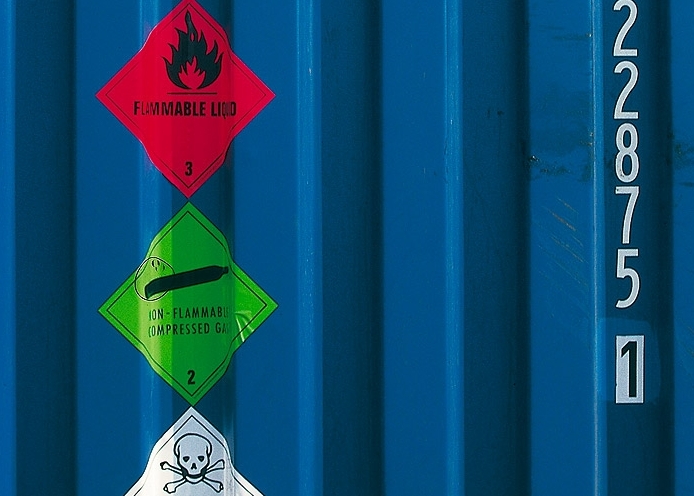
What’s really in the box asks the TT Club.  Photo: Port of Hamburg (Credit - Port Strategy)

What’s really in the box asks the TT Club. Photo: Port of Hamburg (Credit – Port Strategy)

In the claim, a cargo was booked, packed, declared and documented by a shipper as ‘Hookah burner (C.Tablets)’. When the ship caught fire at sea, significant costs were incurred by the ship because of mis-declared cargo, which was in fact activated carbon/charcoal.

Worryingly, when this was investigated further, the shipper had produced two safety data sheets – one was correct, but the other suggested that activated carbon was not considered to be a dangerous good.

TT Club argues that the situation is made far more difficult by the lack of consistency between the various governments about when SDS should be reviewed – Australia stipulates every five years, Canada every three and the EU Regulation recommends checking at “regular intervals”.

Peregrine Storrs-Fox, risk management director, TT Club, told Port Strategy: “We’ve identified two [problem]areas – firstly at the point of booking/contracting with a carrier and secondly post event. Conversations with a number of liner shipping companies confirm that the information given at the time of booking/contracting is frequently suspect. In one instance a single SDS had been presented for about 50 different cargoes over a period.”

Although this is an issue between shipper and carrier, which includes forwarders/logistics operators, there is wider issue here for port operators. During an incident, the port may be supplied with SDS in order to respond appropriately – so there is a risk associated with that too.

The advice to freight forwarders, operators and carriers from the Club is to “Be constantly vigilant and question anything that seems strange or suspicious”. The penalties for non-compliance can be severe. Source: PortStrategy.com

100% Container Scanning in Ports – a solution on the horizon?

Decision Sciences maintains that 100% container scanning is possible without bringingcommerce to a crawl (Credit: Maritime Professional)

Decision Sciences maintains that 100% container scanning is possible without bringing
commerce to a crawl (Credit: Maritime Professional)

The following article published by Maritime Professional describes a new technology, already in use by a major terminal operator, which appears to put the requirement for 100% scanning of all inbound containers back on track. The article has been doing the rounds on a social media platform with some sceptism still being shared on its viability as a ‘100%’ scanning solution. All the same its always interesting to learn of new innovations. I guess the US Treasury has spent billions sponsoring these types of tech-development so as to vindicate its original threat to the rest of the world! (For the PDF version please click here!)

In July 2007, U.S. legislators passed a law requiring 100% scanning of U.S. bound containers at their last foreign ports by the year 2012. That federal requirement nearly died a quick death recently but has received a reprieve of sorts. Originally scheduled to take effect July 1, Homeland Security Secretary Janet Napolitano in May of 2012 notified Congress that she would use her authority under the 2007 law to delay implementation by two years. Napolitano said systems available to scan containers would result in a negative impact on trade capacity and the flow of cargo, and that some foreign ports do not have the physical characteristics needed to install such systems. If the last part was true then, however, it may not necessarily be the case now.

As reported in our 1Q 2012 edition of MarPro, pilot efforts were established at several foreign ports under the Secure Freight Initiative (SFI) targeting in-bound containers for weapons of mass destruction (WMD) prior to loading. Objections by trading partners surfaced and were confirmed by the Government Accounting Office (GAO).

In her testimony before the Senate Commerce, Science and Transportation Committee, DHS Secretary Janet Napolitano said in part, “DHS has learned a great deal from these pilots, but it has also encountered a number of steep challenges. Some of these issues relate to the limits on current technology. Technology doesn’t exist right now to effectively and automatically detect suspicious anomalies and cargo. This makes scanning difficult and time-consuming. …Therefore, DHS is compelled to seek the time extensions authorized by law with respect to the scanning provision.” At the time DHS’s Science & Technology Directorate (S&T) had already spent nearly $10 million on efforts to develop a container security device; to no avail.

New Technology: New Hope for Compliance
As the U.S. government continues to try to find a solution to its own scanning requirements, it also continues to fund testing when a promising solution comes to light. In September of last year, Decision Sciences International Corporation (DSIC), a provider of security and detection systems, announced that it was awarded a $2.7 million contract by the DHS Domestic Nuclear Detection Office (DNDO) for an Advanced Technology Demonstration (ATD) of its Multi-Mode Passive Detection System (MMPDS). Under the contract, DSIC supports government testing of MMPDS intended to evaluate the system’s effectiveness and readiness for transition to production. Before that, Decision Sciences was awarded another contract – this one worth $400,000 – by the U.S. Department of Defense to test muon tomography based scanning systems capable of detecting explosives. 

The Multi-Mode Passive Detection System – how it works
Based in Chantilly, VA, with a development/production facility in Poway, CA, DSIC and its 27 employees and contractors hope to bring together hardware and software development, systems integration and cutting edge science to improve the safety and security of global commerce. Based on patented technology invented by scientists at the Alamos National Laboratory, the Multi-Mode Passive Detection System (MMPDS) was developed with private sector investment and expertise. MMPDS is billed as a safe, effective and reliable automated scanning device for detecting unshielded to heavily shielded nuclear and radiological threats. In reality, and as MarPro found out during a focused site visit in Freeport, Bahamas, the system does so much more.

DSIC’s passive scanning technology uses naturally occurring cosmic ray muons to detect potential threats in cargo, vehicles and other conveyances. DSIC President and CEO Dr. Stanton D. Sloane explains, “Equipment can generally be classified into two main categories; active and passive. Active systems include x-ray and/or radiation technologies. In other words, they add some sort of radiation or energy to the environment. Our system is 100 percent passive; we don’t generate any additional energy. We simply use the existing cosmic ray ‘muons’ to do the scanning. When cosmic rays hit the upper atmosphere, they create showers of atomic particles. One of the particles is a muon. High in mass, muons travel at near the velocity of light. Because of this, muons penetrate materials … even very dense materials … readily.

Normal cosmic radiation is 5000 muons per minute and penetrates through lead, steel, concrete and just about anything else. Sloane adds, “That’s really the breakthrough technology. We have upper and lower detectors. As the muons go through the upper detector we calculate their trajectory. As they go through the bottom detector, we calculate their trajectory and we look for a change in that track. The angular change of the track is a function of the density of the material that the muons go through. The denser the material that the muons penetrate, the larger the angular change.”

Beyond the efficacy of the system is its vivid imagery of the inside of the container it is scanning. With x-ray machines, if something is found, the container must be taken to the side, analysis performed and delays to the container magnified. Not so with Decision Sciences technology: false positives are eliminated because the density of typical items – and the dangerous ones too – can be catalogued.

Continue reading →