Xenophobia Backlash – Mozambique/South African Border closed

Lebombo border post has been closed until further notice Friday17 April 2015 after an unruly mob barricaded the N4 near Ressano Garcia, targeting trucks with South African registration numbers [Picture: Sowetan]

Lebombo border post has been closed until further notice Friday17 April 2015 after an unruly mob barricaded the N4 near Ressano Garcia, targeting trucks with South African registration numbers. [Picture: Sowetan]

The border post between South Africa and Mozambique has been closed until further notice Friday after an unruly mob barricaded the N4 near Ressano Garcia, targeting trucks with South African registration numbers.

This also came just as immigration officials from Mozambique early in the morning began the blocking of all vehicles coming from South Africa under unexplained circumstances. Witnesses told ZimEye.com the situation at the border is both shocking and desperate with drivers voicing their frustration at the hands of Mozambican border officials.

Lebombo border post has been closed until further notice Friday17 April 2015 after an unruly mob barricaded the N4 near Ressano Garcia, targeting trucks with South African registration numbers..

“Trucks with South African registration plates have been stoned in Mozambique. A volatile crowd of about 200 Mozambicans has barricaded the N4 about four kilometres east of the Resano Garcia border post, where there is a truck stop,” reported Corridor Gazette on Friday.

“It is suspected that this action in related to the Xenophobic attacks which have erupted in various areas of KwaZulu-Natal and Gauteng this week.”

Trac, a company which is responsible for the 570km of the road between Solomon Mahlangu off-ramp in Tshwane and the Port of Maputo in Mozambique, placed a warning on the protest action on its website.

A traveller who en route to Nelspruit from Maputo at around 9:30 on Friday morning told the website that: “The crowd let us pass because we had a Mozambican-registered car.

South Africa and Zimbabwe sign milestone Customs Mutual Assistance Agreement

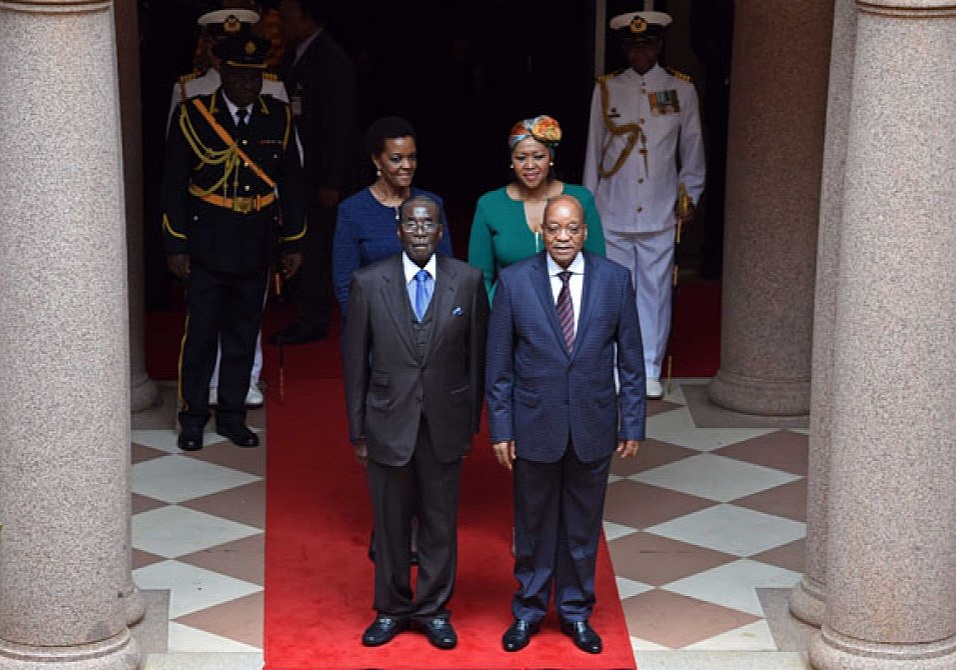
robertmugabejacobzuma2015govtza_SnapseedSouth Africa and Zimbabwe have elevated bilateral relations with the signing of five agreements set to benefit both countries. The agreements were signed on Wednesday during President Robert Mugabe’s state visit to South Africa at the invitation of President Jacob Zuma. An agreement regarding mutual assistance between customs administrations between the two countries was also signed, which will further cooperation towards the establishment of a one-stop border post. This is viewed as a crucial milestone.

Zimbabwean Customs seizes 48kg illicit South African gold worth R20m

goldZimbabwean Customs (ZIMRA) seized 48 kg illicit gold worth R 20 million and arrested 46 people for initial investigations. Forged gold serial-number stamps, specially designed armoured vehicles, clandestine refineries, fake customs clearance papers and documents with links to the black market.
These and other pieces of evidence are the keys that the Hawks believe link a Zimbabwean and South African gold-smuggling syndicate to scores of buyers in Europe masquerading as dealers in precious metals. For two years police have been zeroing in on the syndicate, whose roots are in illegal gold mining in Zimbabwe. Inside were 48kg of gold bars valued at R20-million.On Friday, they acted. In the early hours teams from the Hawks, the Special Task Force and Crime Intelligence raided luxury homes and farms across Gauteng and the North West.

In one of the raids police discovered a walk-in vault at a warehouse outside OR Tambo International Airport. Inside were 48kg of gold bars valued at R20-million. They were being prepared for stamping with official South African gold serial numbers designating that the metal had been officially mined and refined in the country. Police sources say the gold was to have been flown to at least three European countries at the weekend before being smelted, re-refined and distributed.

A source with knowledge of the investigation has revealed the inner workings of the syndicate, from how and where the gold is mined to how corrupt customs and mining officials facilitate the metal’s passage across borders.(Now should’nt this prompt some serious cause for concern, if true?)

“The amount this syndicate has handled is immeasurable. We have known about them for two years and in that short time we have recovered R40-million,” he said.

“They have operated both in South Africa and Zimbabwe as well as other SADC [Southern African Development Community] countries for years, well before we even discovered them”

Illegal miners in Zimbabwe supplied the syndicate. “With the instability and corruption there [South Africa?] it’s dangerous but easy. Once they have the gold, runners take it to the border where, through corrupt officials, it is smuggled across disguised as things such as household products.”

The gold was taken to farms in and around Modimolle in Limpopo where illicit refineries smelted and refined it, the source said. With the help of South African mining officials, gold clearance documentation and special serial and insignia stamps were sourced.

“Once stamped you would never know the difference. We have placed it next to legitimate bars and it looks and feels the same.” He said the gold was distributed through legitimate channels in Europe.

“Those running the syndicate know what they are doing. They are well-connected and influential businessmen with ties to Africa, Europe, the US and Asia”.

“They are linked to the gold powerhouses of the world. These are not ‘mickey-mouse’ people. They are immensely powerful and extremely well connected to some of the world’s top legal firms. Within hours of Friday’s raids lawyers were arriving at their clients’ homes and businesses.”

He said police seized hundreds of official gold clearance documents, serial stamps and other paperwork with links to mines and importers and exporters. Source and picture: CustomsToday.com

Contraband Cigarettes – 3 Zimbabweans and a South African arrested

cigarettes1Three Zimbabweans and a South African were arrested in Limpopo province for allegedly teaming up and smuggling cigarettes worth $200,000 into the neighbouring country. The Zimbabwean trio, Takuzo Mutswiro, 22, Tatenda Nyamhunga, 31, Joseph Mhembwe, 27 and Gilbert Mamburu, 54, a South African from Tshiozwi village in Limpopo province, were arrested last week at Tshilwavhusiku near Thohoyandou after police intercepted a truck they were using to transport the cigarettes.

Limpopo provincial spokesperson Colonel Ronel Otto, in a statement, said police followed up on information they received about suspicious activities at Mamburu’s house. Upon arrival at the scene, the three Zimbabweans attempted to run away, but were apprehended. Cigarettes with an estimated value of more than R2 million were found hidden in a small truck as well as a light delivery truck. It is suspected the cigarettes were smuggled from Zimbabwe, however their origin and destination is still being investigated.

Lately there has been an increase in the number of cigarette smugglers being arrested in the neighbouring country. Some of the cigarettes are smuggled out of the country through undesignated entry points along the crocodile-infested Limpopo River while others find their way into South Africa through Beitbridge Border Post despite the presence of Zimbabwe Revenue Authority (ZIMRA) scanners.The machines are able to detect concealed goods hidden in sealed containers.

The South Africa reportedly charges high rates on cigarette imports, which has resulted in a marked increase in cases of smuggling between Zimbabwe and South Africa. Most of these cigarettes are repackaged when they get to South Africa before being shipped to either Europe or Asia.

According to the South African Revenue Services (SARS), Beitbridge Border Post accounts for 70 percent of the cigarettes which are smuggled into that country. A recent statement from the South African Police Service said cigarette smuggling from Zimbabwe was being prioritised after it emerged the country supplied 55 to 70 percent of the 10 billion cigarettes reaching the neighbouring country’s black market. Source: The Chronical (Zimbabwe) & Customstoday.com

Time to pull the plug on SACU?

SACU logoPeter Fabricus, Foreign Editor, Independent Newspapers through the Institute of Security Studies writes an insightful and balanced article on the history and current state of the Southern African Customs Union (SACU).

The formula that determines how the customs and excise revenues gathered in the Southern African Customs Union (SACU) are distributed among its members looks, to a layperson, dauntingly complex. But this formula has had an enormous impact on the economic and even political development of the five SACU member states; South Africa, Botswana, Lesotho, Namibia and Swaziland.

The impact has arguably been greatest on South Africa’s neighbours, the four smaller member states that are often referred to simply as the BLNS. But it has also had an impact on South Africa.

SACU was founded in 1910, the year the Union of South Africa came into existence, and is the oldest surviving customs union in the world. Originally it distributed customs revenue from the common external trade tariffs in proportion to each country’s trade..

So, South Africa received nearly 99%. Surprisingly, South Africa’s apartheid government radically revised the revenue-sharing formula (RSF) in 1969 after Botswana, Lesotho and Swaziland had become independent. This gave each of the BLS members first 142% and later 177% of their revenue dues, calculated on both external and intra-SACU imports, with South Africa receiving only what was left. But this apparent economic generosity from Pretoria almost certainly masked a political intention to keep its neighbours dependent and in its fold, as the rest of the world was increasingly turning against it.

However, as Roman Grynberg and Masedi Motswapong of the Botswana Institute for Development Policy Analysis pointed out in their paper, SACU Revenue Sharing Formula: The History of An Equation, the 1969 formula became increasingly unviable for South Africa as it had been de-linked from the common revenue pool. This threatened to burden Pretoria with a commitment to pay out to the BLS states more than the total amount in the pool.

The African National Congress government saw the dangers when it took office in 1994 and soon began negotiations with the BLNS states for a new formula. That was agreed in 2002 and implemented in 2004. But although the 2002 RSF eliminated the risk that the payouts to the BLNS might exceed the whole revenue pool, it actually increased the share of the pool accruing to the BLNS at the expense of South Africa – as Grynberg and Motswapong also observe.

The new RSF was based on three separate components. The first divided the customs revenue pool proportional to each member state’s share of intra-SACU imports. Because of the growing imports of the BLNS states from the ever-mightier South Africa, this meant most of the common customs pool went to the BLNS. This proportion is increasing – but never to more than the entire pool.

The second component of the RSF divided 85% of the pool of excise duties (the taxes on domestic production) in direct proportion to the share of the gross domestic product (GDP) of each of the SACU members. The remaining 15% of the excise duties became a development component, distributed in inverse proportion to the GDP per capita of each member. So the poorest members of SACU would receive a disproportionate share of this element of the excise.

Over the years the BLNS countries have grown increasingly dependent on the SACU revenue. It now funds 50% of Swaziland’s entire government revenue, 44% of Lesotho’s, 35% of Namibia’s and 30% of Botswana’s. Because of its own growing fiscal constraints, Pretoria launched a review of the formula in 2010. But this review got bogged down over major disagreements and seems to have gone nowhere.

In his budget speech this month, Finance Minister Nhlanhla Nene raised the issue again, calling for a ‘revised and improved revenue-sharing arrangement,’ and Parliament’s two finance committees examined it. National Treasury spokesperson Jabulani Sikhakhane told ISS Today that while efforts to reform the SACU formula are ongoing, ‘progress has unfortunately been arduously slow.’

Budget documents show that in 2014-15, South Africa paid out some R51.7 billion to the BNLS countries out of a total estimated revenue pool of R80 billion, and was projected to pay out R51 billion again in 2015-16. Kyle Mandy, a PricewaterhouseCoopers technical tax expert, told Parliament’s two finance committees last week that South Africa was paying about R30 billion a year more than it would otherwise under the SACU RSF. He said South Africa contributed about 97% of the customs revenue pool and received only about 17% of it.

The R51.7 billion payout to the BLNS this year represents about 5% of South Africa’s total of R979 billion in tax revenue, a substantial ‘subsidisation’ that was no longer affordable at a time of growing fiscal constraint, which had forced Nene to increase taxes, Mandy said.

He noted that the SACU revenue had allowed all but Namibia of the BLNS countries to set their taxes below South Africa’s. ‘This means South Africa is subsidising the BLS countries to compete with South Africa for investment with their more attractive taxes,’ he said in an interview.

‘This is not sustainable for anyone. It locks the BLNS countries into dependency on South Africa. They have neglected their own fiscal systems. But the moment that the revenue fluctuates, [as Nene’s budget predicted it would in 2016-17, dropping to R36.5 million], it puts them in a difficult position. When South Africa sneezes, they catch flu.’

But what to do about this? Some, like political analyst Mzukisi Qobo, have called for a total overhaul of the SACU agreement, which would make explicit that SACU is a disguised South African development project. The development aid would become transparent and could be tied to conditions such as democratic government.

That is on the face of it an attractive solution, offering the opportunity of leveraging democracy in Swaziland, in particular, by placing a conditional foot on its lifeline of SACU revenues. But Grynberg warns that a sudden withdrawal of the vital direct budgetary support which SACU customs and excise revenues provides, could implode both Swaziland and Lesotho and provoke economic crises in Namibia and even Botswana.

He also points out that the RSF is not plain charity by South Africa to its smaller neighbours. The formula has essentially just compensated them for the cost-raising and polarising effects of SACU – that the BLNS countries have generally had to pay more for imported goods over the years than they would have otherwise done because of import tariffs designed to protect South African industries; and because the duty-free trade within SACU has tended to attract investment to larger South Africa.

Meanwhile, South Africa has benefitted from a ready market for its much larger manufacturing machine. Grynberg wrote in a more recent article for the Botswana journal, Mmegi, that the South African government was thinking of pulling out of SACU because it couldn’t get its way in the negotiations to revise the RSF; and because the 2005 Southern African Development Community Free Trade Agreement now gave it duty-free access to the BLNS countries without the need to pay the re-distributive SACU customs revenues.

It was only President Jacob Zuma who was preventing this, because he didn’t want to go down in history ‘as the man who crippled the Namibian and Botswana economies and created two more “Zimbabwes” – i.e. Swaziland and Lesotho – right on the country’s border.’ Pretoria’s decision had turned SACU into a ‘dead man walking, just waiting for someone to pull the switch and end its life.’

Grynberg strongly advised the BLNS to prevent this by accepting that the political reality that underpinned the RSF of SACU no longer existed. He says that it should be transformed into a purely development community without the formula, but with mutually agreed spending on development – mainly in the BLNS. He suggested, though, that this radical change would take at least 10 to 15 years to phase in.

All very well. But isn’t that what SADC is supposed to be already? Which suggests that it might be time to take the 105-year-old dead man off life support.

Source: Institute of Secutity Studies (ISS)

Related articles

Its Annual Budget time – Tobacco, Tax and the Black Market

Cigarettes+XXX+smokingThe nation awaits the 2015 Budget Speech with trepidation to know if income taxes will rise. But there is unanimous certainty there will, as per usual, be an increase in ‘Specific Excise Duties’. The only question is by how much? Taxation of cigarettes and tobacco products appears to be the path of least resistance for tax-collectors. It receives little backlash from the wider public (unlike e-tolls) and even support in some quarters.

The imposition of the so-called “sin taxes” on cigarettes and liquor products, in addition to generating significant fiscal revenues, does serve an economic purpose. Unlike normal goods and “necessity” products, cigarettes are not an essential good which people need to survive. As far back as the 1700s, Adam Smith averred “Sugar, rum, and tobacco, are commodities which are nowhere necessaries of life … are therefore extremely proper subjects of taxation.” Again, the notion of the importance of tobacco to the fiscal basket is exemplified in utmost simplicity and honesty – if a politician, or an emperor in this case can be believed –

This vice brings in one hundred million francs in taxes every year. I will certainly forbid it at once – as soon as you can name a virtue that brings in as much revenue [Napoleon III (1800s) – reply when asked to ban smoking]

Despite all the furore over public health and governments efforts to decrease the demand for cigarettes, South Africa is no different to other nations – annual tobacco revenues to the state coffers amounts to around R10 Billion! Another round of sin tax increases in the upcoming budget appears inevitable, and these increases are spawning a range of unintended (but not unexpected) consequences – the illicit trade. Source: Polity.org / DNA Economics.

ZIM Police struggle to bust cigarette racket

CigarettesAn intricate web of smugglers, which reportedly involves manufacturers and middlemen, has been illegally carting cigarettes worth millions of dollars out of the country over the years, prejudicing the treasury of vital revenue.

Cigarette manufacturer, Savanna, has been fingered as one of the main culprits, while multinationals like BAT have also been mentioned in the illicit cross-border trade, mainly to South Africa.

Commonly smuggled brands include Remington Gold, Madison, Sevilles, Magazine Blue, Chelsea and Pacific Blue, manufactured by Savanna – which consistently denies smuggling.

A senior police sokesperson said “Even though we don’t always talk about it, we have managed to make significant arrests and the cases have been taken to court. The arrests include smuggling attempts at undesignated spots along the border and through official exit points such as Beitbridge”

A senior customs official told The Zimbabwean that cigarette smuggling, particularly through Beitbridge and Plumtree border posts, was difficult to arrest because of corruption.

“Policing at the border posts involves several agencies, namely the police, CIO (Central Intelligence Organisation), customs and special deployments from ZIMRA (Zimbabwe Revenue Authority). The problem is that these officers work in collaboration with the smugglers and haulage trucks and other containers carrying the cigarettes are cleared without proper checking. Hefty bribes are involved and the money is too tempting to resist,” said the customs official.

“You would be amazed how wealthy these officers have become. They have bought houses, luxury cars and send their children to expensive schools – yet their regular salaries are so low,” he added.

Immigration and customs officials, who also constantly liaise with their South African and Botswana counterparts and meet physically regularly, pretend to be checking the containers but clear them without completing the task, and know what the trucks and other carriers would be ferrying.

ZIMRA has four scanners for detecting contraband and an anti-smuggling team that also uses sniffer dogs, in addition to guard soldiers posted between the Zimbabwean and South African borders.

There are about 15 regular roadblocks along the Harare-Beitbridge road and 10 between Bulawayo and Plumtree that search trucks, buses and private cars. Despite this, the smuggling continues because of the collusion among the officials, said the source.

In early January, the Ferret team, a joint operation involving Zimbabwean and South African officers, intercepted a truckload of 790 Remington Gold cigarettes worth an estimated $119,000 destined for South Africa along the Masvingo-Beitbridge road. The smugglers were caught and arrested while offloading the cartons into small trucks. Source: The Zimbabwean

South Africa leads the Continent in Illicit Cigarette Trade

illicit cigarettesSouth Africa leads Africa in the illicit trade in tobacco and is listed among the top five illicit markets globally, according to the Tobacco Institute of Southern Africa, which represents tobacco growers, leaf merchants, processors, manufacturers, importers and exporters of tobacco products in SA.
More than R20bn in tax revenue has been lost in SA since 2010 due to the illicit trade in tobacco, the institute’s CEO, Francois van der Merwe, said on Wednesday. The problem is severe in SA, but Zambia, Namibia and Swaziland have estimated incidences of well above the global average of between 10% and 12%.

Mr van der Merwe said efforts to combat the illicit trade in tobacco were complicated by the links that the business had with transnational organised crime syndicates, some of which funded terrorism.

“The problem runs far deeper than enormous losses of fiscal income that could have been put to good use to bolster government efforts in education, infrastructure development and poverty alleviation,” said Mr van der Merwe.

He was speaking ahead of a meeting later in November of global, regional and local law enforcement, along with revenue and customs agencies in Cape Town, who will seek better ways to collaborate in addressing the illicit tobacco trade in sub-Saharan Africa.

“We have seen first hand what effective focus on combating illicit trade by government can achieve,” said Mr van der Merwe, ascribing a decrease in the illicit tobacco trade, from 31% to 23% this year, to better collaboration.

“This is in the most part due to the excellent efforts by the various law enforcement, customs and revenue, Treasury and defence departments in the South African government.”

Mr Van der Merwe said that although the declining numbers in SA were encouraging, this did not bode well for the rest of the region as organised crime was a moving target prone to shifting its focus to “easier” markets when it was under attack.

He claimed that those who traded in illicit products, whether cigarettes, alcohol, textiles or DVDs, or committed environmental crimes such as rhino poaching or abalone smuggling were most often also involved in other serious crimes and even the funding of terrorism and money laundering. Source: BDLive.co.za

Relate articles

Biggest bust of Rhino Horn at a South African airport

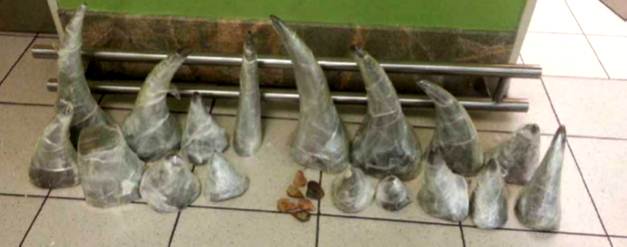
Biggest bust of Rhino Horn at a South African airportSARS Customs officers at OR Tambo International Airport (ORTIA) last week intercepted over 41kg of rhino horns – with a total value of over R4.5 million – transiting through the airport. This is the biggest ever seizure of rhino horn by the SARS Customs team at OR Tambo International, Johannesburg.

As a result of profiling two foreign nationals travelling from Maputo to Vietnam via Johannesburg,  their baggage was intercepted during a stop-over at ORTIA. A Customs detector dog “Mimmo” reacted positively to two bags. The tags found on the bags also did not correspond to the tags presented to Customs officials during the initial questioning of the passengers. This is a practice commonly found with narcotics smuggling syndicates.

The bags had a strong garlic and glue smell, (a tactic to distract detector dogs). Further to the plastic wrapped horns, the zips of the bags were also glued in an effort to keep the odour intact and to make the inspection difficult. Subsequent physical inspection of the bags by Customs officials revealed the rhino horn allegedly being smuggled by the two travellers. Source: SARS

Surge in Car Imports at ZIM/RSA Border as Dealers Panic

The Herald - Surge in new car imports between ZIM-RSAThere is a drastic increase in motor vehicle imports through Beitbridge border post as dealers are rushing to buy cars before the proposed 20 percent customs duty increase on imported motor vehicles comes into effect on November 1.

Finance and Economic Development Minister Patrick Chinamasa announced recently the Government intendeds to increase duty of motor vehicles which he said contributed 10 percent of the import bill in the first half of this year.

He proposed an increase in customs duty on single cab of a payload more than 800kgs from 20% to 40%, buses of carrying capacity of 26 passengers and above from 0% to 40%, double cab trucks from 40% to 60%, and passenger motor vehicles of engine capacity below 1500cc from 25% to 40%.

Customs duty for vehicles with engines above 1500cc has not been changed from 86 percent inclusive of VAT and Surtax. The development has raised anxiety among most Zimbabweans who are now rushing to buy second hand cars from Japan some of which come through South Africa.

Zimbabwe Revenue Authority (Zimra) is processing an average of 170 car imports at the border post per day since the beginning of October. Prior to the announcement Zimra used to process between 60 and 70 car imports per day. ZIMRA officers at the border said in separate interview yesterday that they were battling to clear the vehicles at Manica Transit Shed where 300 new cars arrive per day.

“We used to get 100 to 150 cars per day , but now the number has doubled and is ever increasing,” said one of the officers.

A sales manager at Wright Cars on the South African border, Mr Clemence Mabidi said the demand of cars with small engines such as Nissan March, Honda Fit, Toyota Vitz, Toyota Corolla, Toyota Raum and Fun Cargo had increased.

“We used to sell around 20 cars per day but now the number has increased to 40 and we have a backlog in deliveries to Zimbabwe.

“We are now hiring other car carriers to take the vehicles across the border,” he said.

Mr Mabidi said even the small car dealers who used to sell between 5 and 10 cars per day were now selling up to 20 vehicles. Some dealers have also reduced prices while others are increasing the prices because of the demand. A modest vehicle costs between $2500 and $3000 at these dealerships. Source: The Herald

FIATA 2014 Young Freight Forwarder of the Year Announced

Ms Nompumelelo Mboweni works as an Airfreight Import Controller at Bidvest Panalpina Logistics in Johannesburg [TT Club]

Ms Nompumelelo Mboweni works as an Airfreight Import Controller at Bidvest Panalpina Logistics in Johannesburg [TT Club]

The 2014 Young International Freight Forwarder of the Year (YIFFY) Award has been presented to South African forwarder Fortunate Nompumelelo Mboweni at the FIATA Annual Congress in Istanbul.

Each year at the FIATA Annual Congress the achievements of young freight forwarders from around the world are celebrated via an awards programme. TT Club is proud to have sponsored this award, now in its sixteenth year, since its foundation. The process of awarding the honour of Young Freight Forwarder of the Year (YIFFY) began earlier this year when entrants from all over the world submitted papers about a wide variety of transport and logistics projects.

These ranged from the transportation of tunnel drilling equipment to Bolivia to the delivery of a catamaran in Indonesia and from a project moving radioactive isotopes from South Africa to Namibia to the expedited deployment of a Disaster Assistance Response Team in the Philippines.

From this bewildering, yet highly professional array, the YIFFY Steering Committee selected a shortlist of four regional finalists. These four young professionals were then invited to attend the 2014 FIATA World Congress this week in Istanbul, Turkey to make a presentation on their dissertation topic.

The four regional finalists who proudly represented the future of the international freight forwarding industry in Istanbul were –

Africa/Middle East: Miss Fortunate Nompumelelo Mboweni, South Africa
Americas: Mr Douglas Whitlock, Canada
Asia-Pacific: Mr Saiful Ridhwan Bin Zulkifli, Singapore
Europe: Mr Christian Hensen, Germany

Following a comprehensive judging process, Ms Fortunate Nompumelelo Mboweni from South Africa was announced as the 2014 Young Freight Forwarder of the Year at the FIATA Congress’ opening ceremony on 13 October. Ms Nompumelelo Mboweni works as an Airfreight Import Controller at Bidvest Panalpina Logistics in Johannesburg. Andrew Kemp, TT Club’s Regional Director for Europe congratulated her and presented the award.

“I have been honoured as TT Club’s representative to be part of the selection process, and I personally was engrossed by the finalists’ presentations, which showed a considerable depth of understanding of their individual projects. I have to say all four finalists performed with flying colours at the recent final presentations; it was certainly a difficult decision to pick an overall winner. However, Fortunate prevailed and deservedly takes this year’s award,” said Kemp.

The award is presented in recognition of forwarding excellence and was established by FIATA with the support of TT Club to encourage the development of quality training in the industry and to reward young talent with additional valuable training opportunities. The TT Club has been a sponsor of the award since its inception and remains firmly committed to the importance of individual training and development within the global freight forwarding community. Source: TT Club

New Report Tracks Illegal Ivory, Rhino Horn Trade

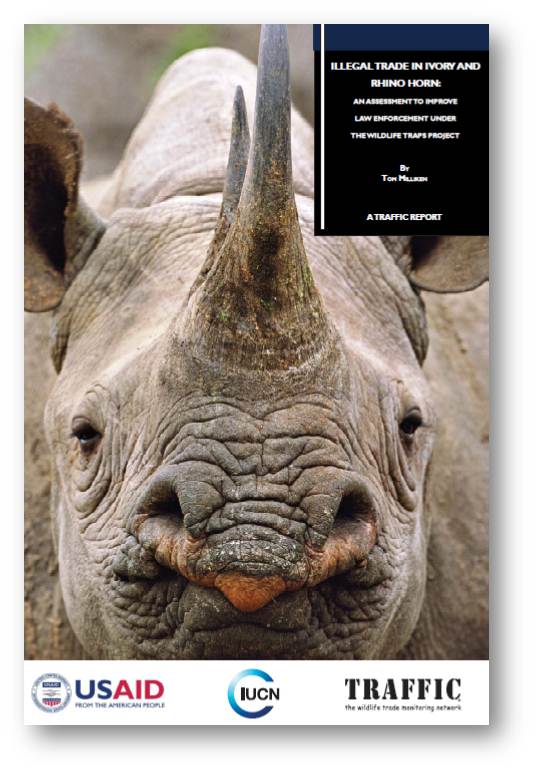
RhinoA new report released by the U.S. Agency for International Development (USAID) partner TRAFFIC reveals that illegal rhino horn trade has reached the highest levels since the early 1990s, and illegal trade in ivory increased by nearly 300 percent from 1998 to 2011.

The report, Illegal trade in ivory and rhino horn: an assessment to improve law enforcement, is a key step to achieving USAID’s vision to adapt and deploy a range of development tools and interventions to significantly reduce illegal wildlife trafficking, USAID said in a September 22 press release. The report was prepared by the wildlife monitoring network TRAFFIC in partnership with USAID. The assessment uses robust analysis to identify capacity gaps and key intervention points in countries combating wildlife trafficking.

Seizure data indicate that “the fundamental trade dynamic now lies between Africa and Asia,” according to the report. In China and Thailand, elephant ivory is fashioned into jewellery and carved into other decorative items, while wealthy consumers in Vietnam use rhino horn as a drug that they mistakenly believe cures hangovers and detoxifies the body.

Rhinos and elephants are under serious poaching pressure throughout Africa, with even previously safe populations collapsing. Central Africa’s forest elephants have been reduced by an estimated 76 percent over the past 12 years, while in Tanzania’s Selous Game Reserve elephant numbers have fallen from 70,000 in 2007 to only 13,000 by late 2013. A record 1,004 rhinos were poached in 2013 in South Africa alone, a stark contrast to the 13 animals poached there in 2007 before the latest crisis began.

Record quantities of ivory were seized worldwide between 2011 and 2013, with an alarming increase in the frequency of large-scale ivory seizures (500 kg or more) since 2000. Preliminary data already show more large-scale ivory seizures in 2013 than in the previous 25 years. Although incomplete, 2013 raw data already represent the greatest quantity of ivory in these seizures in more than 25 years.

Both rhino horn and ivory trafficking are believed to function as Asian-run, African-based operations, with the syndicates increasingly relying on sophisticated technology to run their operations. In order to disrupt and apprehend the individuals behind them, the global response needs to be equally sophisticated, USAID said.

“There’s no single solution to addressing the poaching crisis in Africa, and while the criminals master-minding and profiting from the trafficking have gotten smarter, so too must enforcement agencies, who need to improve collaborative efforts in order to disrupt the criminal syndicates involved in this illicit trade,” says Nick Ahlers, the leader of the Wildlife Trafficking, Response, Assessment and Priority Setting (Wildlife-TRAPS) Project.

The USAID-funded Wildlife-TRAPS Project seeks to transform the level of cooperation among those affected by illegal wildlife trade between Africa and Asia.

Rhino horn is often smuggled by air, using international airports as transit points between source countries in Africa and demand countries in Asia. Since 2009, the majority of ivory shipments have involved African seaports, increasingly coming out of East Africa. As fewer than 5 percent of export containers are examined in seaports, wildlife law enforcement relies greatly on gathering and acting on intelligence to detect illegal ivory shipments.

The report recommends further developing coordinated, specialized intelligence units to disrupt organized criminal networks by identifying key individuals and financial flows and making more high-level arrests. Also critically important are improved training, law enforcement technology, and monitoring judiciary processes at key locations in Africa and Asia.

The full text of the report (PDF, 1.6MB) is available on the USAID website. Source: USAID

Dube Tradeport to be officially launched as an IDZ

Dube Tradeport will be officially launched as an Industrial Development Zone (IDZ) by President Zuma on Tuesday 7 October.

At the launch event, the Dube Tradeport will officially be handed over an operator permit which provides them the status of an IDZ.

Situated at the Dube Centre, King Shaka International Airport, Durban, it was designated as an IDZ on 1 July 2014 by the Minister of Trade and Industry, Dr Rob Davies.

Davies says, “The Dube Tradeport IDZ will be launched during a period of transition wherein Industrial Development Zones as governed by the Manufacturing Development Act will become Special Economic Zones (SEZ) under the new Special Economic Zones Act 16 of 2014.”
According to Davies, the Act has been assented to by the President, and will come into effect before the end of 2014.

Davies adds, “The main areas that have designated as Dube Tradeport Industrial Development Zone (DTPIDZ) are Dube Agrizone and Dube Tradeport. Dube Agrizone is about 63.5 hectares and focuses on high-value, niche agricultural and horticultural products while Dube Tradezone which is 240.27 hectares focuses on manufacturing and value-addition primarily for automotive, electronic, fashion garments and similar high value, time-sensitive products and inputs.”

“The launch of the IDZ will highlight the continuous efforts by government to promote industrialisation and create awareness about the SEZ programme, and its potential to grow the economy and create jobs through creating a conducive environment for foreign direct investment.” Source: Transportworldafrica.co.za with images from dubetradeport.co.za.

South African Customs launches new X-Ray Inspection Facility in Durban

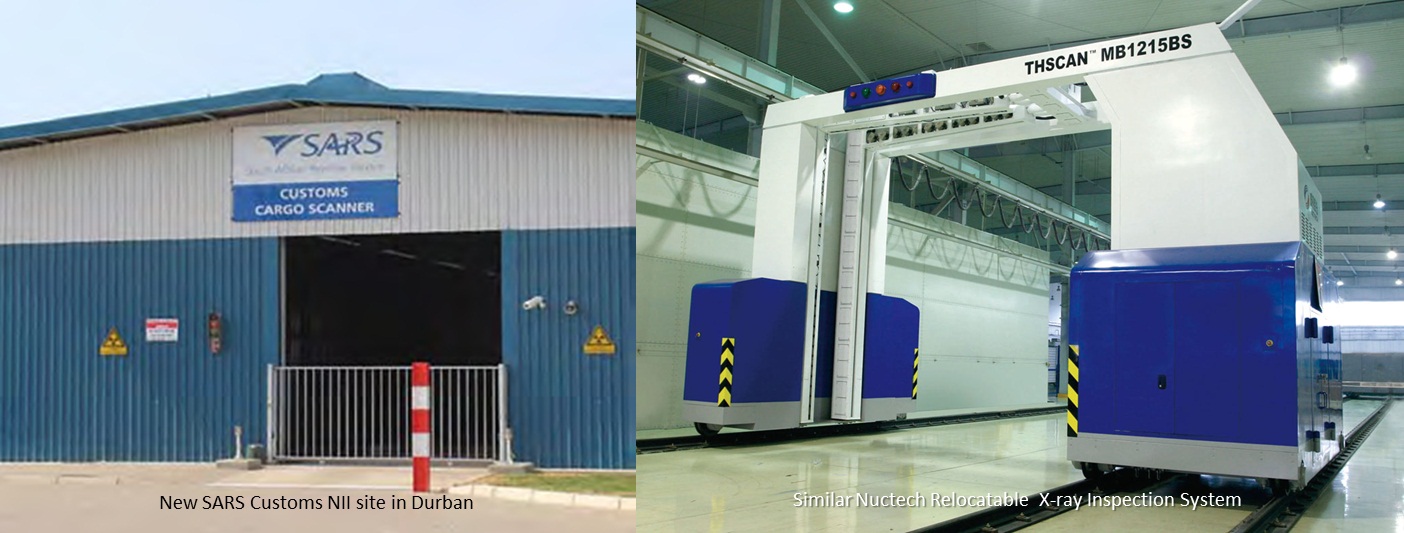
SARS Customs New NII Ste - DurbanSARS Customs recently launched its new X-Ray cargo inspection facility adjacent to the Durban Container Terminal in the Port of Durban. Following the trend as in other countries, SARS has identified non-intrusive inspection capability as part of its ‘tiered’ approach to risk management.

In 2008, SARS introduced its very first mobile x-ray scanner which was located inside the Durban container terminal precinct as part of South Africa’s participation in the US Container Security Initiative (CSI). While it has proven itself in the development of Customs NII capability, its location and lack of integration with other Customs automated tools has limited its success.

The new Customs inspection facility is a step-up in technology and automation – a Nuctech MB 1215HL Relocatable Container/Vehicle Inspection System. It has some significant advantages over the original mobile version namely –

  • An efficient and cost-effective security solution with a relatively small footprint (site size).
  • 6 Mev dual energy X-Ray technology with high penetration (through 330 mm of steel).
  • High throughput of 20-25 units of 40ft container vehicles per hour.
  • A unique modular gantry design which improves system relocatability.
  • Self-shielding architecture which requires no additional radiation protection wall.
  • Advanced screening and security features such as organic/inorganic material discrimination.
  • High quality scanning image manipulation tools allowing the customs image reviewer the ability to verify and distinguish the contents of a vehicle or cargo container.

Since its launch more than 350 scans have been performed. Suspect containers were sent for full unpack resulting in various positive findings.

The new relocatable scanner is easier to operate and significantly faster than the mobile scanner. In addition, scanned images are now automatically integrated into SARS Customs case management and inspection software making case management both seamless and efficient.

It is anticipated that until October 2014, both the new scanner and the existing mobile scanner operations will co-exist. During this time, the new scanner will operate risk generated cases directly from SARS automated risk engine. Unscheduled or random interventions will continue to occur at the old scanner site, which operates 24/7.

Plans are in place to decommission the mobile scanner after October 2014. The new scanner will then operate on a 24/7 basis.

Reefer Owners Beware

reeferThe Department of Agriculture, Forestry and Fisheries appears to have adopted a concerning stance on the requirements of the Marine Living Resources Act regarding the licensing of vessels entering South African waters. The policy affects reefer vessels in particular and owners are advised to pay attention to this development.

Among other things, the act requires that every foreign-flagged fishing vessel entering the South African exclusive economic zone apply for and obtain a fishing permit. A ‘fishing vessel’ is defined in the act as any vessel, boat, ship or other craft which is used for, equipped to be used for or of a type that is normally used for fishing or related activities, and includes all gear, equipment, stores, cargo and fuel onboard. Further, the term ‘related activities’ is defined as including:

  • storing, buying, selling, transshipping, processing or transporting fish or any fish product taken from South African waters up to the time it is first landed or in the course of high seas fishing;
  • storing, buying, selling or processing fish or any fish product onshore from the time it is first landed;
  • refuelling or supplying fishing vessels, selling or supplying fishing equipment or performing any other act in support of fishing;
  • exporting and importing fish or any fish product; and
  • providing agency, consultancy or other similar services for and in relation to fishing or a related activity.

It is a criminal offence to undertake fishing or related activities without the requisite licence. The penalties for contravention include a number of measures which may be taken by a fishery control officer, such as seizure of the vessel concerned or the arrest of anyone whom the fishery control officer has reasonable grounds to suspect has committed an offence in terms of the act.

The act seems to be sufficiently clear; what is concerning is the manner in which fishery control officers are implementing it. For example, in a recent case the fishery control officers in Cape Town conducted a raid in the port and seized a reefer vessel which had called for medical assistance to a crew member and undertook subsequent repairs, on the grounds that the vessel had no fishing licence onboard. There was no suggestion by the officers that the vessel was actually engaged in fishing or related activities. Instead, the officers’ view was that an offence had been committed by the mere fact that the vessel was capable of carrying fish and had entered the South Africa exclusive economic zone without a fishing permit. On a plain reading of the act, no criminal offence had been committed on the facts of the case. The reasonable inference is that the fishery control officers had acted outside the scope of the act.

Perhaps the most worrying aspect was that, in the face of a legal challenge to the seizure notice, the fishery control officers took it upon themselves to arrest the master of the vessel with the assistance of the South African Police Services at 7:00pm before the vessel was due to depart, so that the master might be prosecuted in the magistrates’ court under the act unless he paid an admission of guilt fine.

The extent to which actions of this nature by the department will continue is unknown, but until the fishing industry or lobby groups can get a clear understanding of the department’s policy, it is advisable for reefer owners (in particular) to canvass the issue with their local port agents well in advance of calling at South Africa. Source: Bowman Gilfillan