SA – New Bills discouraging trade and investment

containeryardSouth Africa is moving away from a policy promoting trade and investment to one that contradicts this, a roundtable on SA-European Union (EU) trade relations heard on Tuesday.

This comes as global foreign direct investment (FDI) flows jumped 36% last year to their highest level since the global economic and financial crisis began in late 2008, but plummeted in emerging markets, especially SA.

The most recent United Nations (UN) Conference on Trade and Development global investment trends monitor shows FDI into SA fell 74% to $1.5bn last year, while FDI inflows to Africa fell 31% to about $38bn.

Central Africa and Southern Africa saw the largest declines in FDI. The end of the commodity “supercycle” and the plunge in oil prices affected new project developments drastically, the UN body said. This had also affected Brazil, Russia and China, but not India, whose economy had surged ahead of late.

Peter Draper, MD of Tutwa Consulting, which researches policy and regulatory matters in emerging markets, said the promulgation of legislation such as the private security bill and the expropriation bill, created an impression that SA was not an attractive investment destination.

“What lies behind all of that, I think, is an ideological agenda, which is not favourable to business,” he said. “Geopolitically there is no love between SA and the US and SA and the EU. (But) There is lots of love for the Brics (Brazil, Russia, India, China, SA).”

South African and international business have raised the alarm over the quiet signing into law of SA’s Promotion and Protection of Investment Bill late last year, after the government had acknowledged that it would do little to promote trade.

Meanwhile, the Department of Trade and Industry said last week that the African National Congress had directed its economic transformation subcommittee to review the trade agreements signed by SA since 1999.

It said SA’s goal in “negotiating” trade agreements was to support national development objectives, promote intra-African trade and the integration of SA into global markets. This is likely to be highly controversial after the government from 2013 unilaterally cancelled about 13 bilateral investment treaties with major EU countries, drawing warnings from the bloc that this could damage trade relations.

Investors fear the Protection of Investment Bill has diluted recourse to international arbitration over trade disputes, and enhances the possibility of expropriation. Critics also say it contradicts SA’s obligations under the Southern African Development Community’s finance and investment protocol, by undermining equitable treatment between foreign and domestic investors.

John Purchase, CE of agribusiness association Agbiz, which with Tutwa Consulting organised yesterday’s roundtable, said the bill had not answered “all those questions around the bilateral investment treaties”. Source: Business Day

R12-million drug bust at OR Tambo Airport

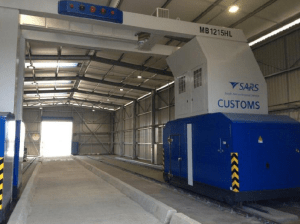
SARS Customs intercepted a male traveller from Tanzania carrying narcotics worth over R12-million at OR Tambo International Airport yesterday (24 January 2016).

The bust took place when the 36-year old man, who was carrying two large suitcases, was asked to put his luggage through the Customs scanner. The scanner image revealed 10 clear plastic bags that contained a white crystal substance.

Upon investigation this turned out to be 10 bags of Ephedrine. The total weight of the consignment was 40.20 kg with an estimated street value of R12 060 000. The man has been handed over to the South African Police Service and he is expected to appear in court. Source and photos: SARS

SA Customs lends Detector Dog support to Mozambique

The SARS Customs Detector Dog Unit (DDU) recently deployed two trained detector dog handlers and dogs on foreign soil in Maputo, Mozambique. This forms part of a Customs co-operation agreement between the governments of South Africa and Mozambique.

The capacity-building programme provides for the training of at least eight detector dog handlers and dogs for Mozambique in over a period of 14 weeks followed by a ‘Train-the-Trainer’ programme for purposes of sustainability.

The deployment of SARS Detector Dog Handlers and dogs trained to interdict endangered species and narcotics in Maputo will promote and strengthen a  cross-border intergovernmental approach in the prevention and detection of smuggling of illicit, illegal goods or substances via ports of entry between Mozambique and South Africa.

The programme is designed to capacitate Mozambique Customs in the establishment of its own canine unit that will further enhance its current non-intrusive scanning enforcement capability at ports of entry and exit. Source and pictures: SARS

WCO facilitates Data Model training for SARS

WCO Data Model Workshop, Pretoria, South Africa, Dec. 2015

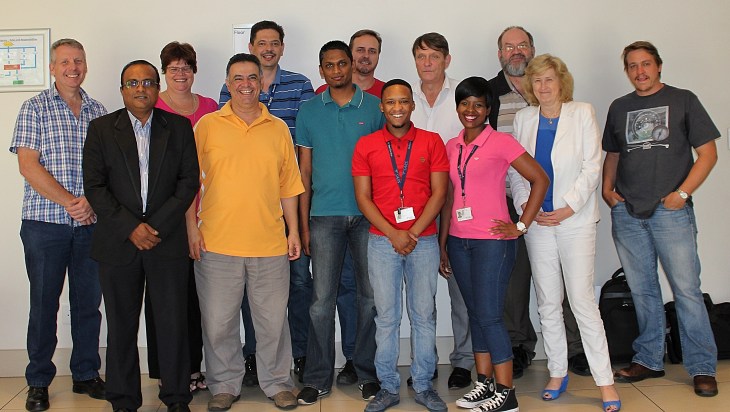
SARS’ EDI and Customs Business Systems representatives with WCO Data Model facilitators Mr. Giandeo Mungroo (2nd from the left) and Ms. Sue Probert (2nd from the right) [Photo – SARS]

Officials of the South African Revenue Service (SARS) last week attended a WCO workshop on the Data Model facilitated by Ms. Sue Probert and Mr. Giandeo Mungroo. The event, held in Pretoria, South Africa was sponsored by the CCF of China as part of the WCO’s Capacity Building endeavours to promote the adoption and use of customs standards and best practice amongst it’s  member states.

The workshop was requested by SARS ahead of new technical and systems developments and requirements informed by SARS’ new Customs Control and Duty Acts. Moreover, there are also political ambition to institute a Border Management Agency for the Republic of South Africa. All of this requires that SARS Customs has a robust electronic tool to assist the organisation in mapping national data requirements according to specific needs.

Besides the use of a value added Data Model tool – GEFEG, it is imperative for the organisation to develop capacity in the knowledge and understanding of the WCO Data Model. SARS has successfully EDI (Electronic Data Interchange) for the last 15 years with various local supply chain trading partners and government agencies. Over the last few years SARS has been actively pursuing and promoting IT connectivity with regional trading partners with the express purpose to extend the benefits of eCommerce across borders.

GEFEG.FX software is used to model data formats and develop implementation guidelines for data interchange standards such as UN/EDIFACT. It is a software tool that brings together modelling, XML schema development, and editing of classic EDI standards under a unified user interface, and supports the development of multilingual implementation guidelines.

Version 3 of the WCO Data Model brought about a distinct shift towards an ‘all-of-government’ approach at international borders with the introduction of the GOVCBR (Government Cross Border Regulatory) message. The message and underlying data requirements facilitate the exchange of customs and other government regulatory information to support a Single Window environment.

WCO Data Model not only includes data sets for different customs procedures but also information needed by other Cross-border Regulatory Agencies for the cross-border release and clearance at the border. The WCO Data Model supports the implementation of a Single Window as it allows the reporting of information to all government agency through the unique way it organizes regulatory information. This instrument is already 10 years old and is seeing increased use by WCO members.

Amongst the benefits derived from the workshop, SARS staff acquired the following competencies that will not only aid their work but business user support as well –

  • Competence in operating the tool to build a source control collaborative environment to support national and regional harmonization;
  • Competence to build a base to conduct national/ regional data harmonization based on the WCO Data Model to support national Single Window implementation as well as Regional Integration;
  • Competence to build systems/ electronic interfaces between Customs and its partner government agencies including a Border Management Agency; and
  • Provide needed competence to develop, maintain and publish national and regional information packages based on the WCO Data Model.

SA – Hub for computerised Regional Integration?

AfricaFrom time to time it is nice to reflect on a good news story within the local customs and logistics industry. Freight & Trade Weekly’s (2015.11.06, page 4) article – “SA will be base for development of single customs platform” provides such a basis for reflection. The article reports on the recent merger of freight industry IT service providers Compu-Clearing and Core Freight and their plans to establish a robust and agile IT solution for trade on the African sub-continent.

In recent years local software development companies have facilitated most of the IT changes emerging from the Customs Modernisation Programme. Service Providers also known as computer bureaus have been in existence as far back as the early 1980’s when Customs introduced its first automated system ‘CAPE’. They have followed and influenced Customs developments that have resulted in the modern computerised and electronic communication platforms we have today. For those who do not know there are today at least 20 such service providers bringing a variety of software solutions to the market. Several of these provide a whole lot more than just customs software, offering solutions for warehousing, logistics and more. As the FTW article suggests, ongoing demands by trade customers and the ever-evolving technology space means that these software solutions will offer even greater customization, functionality, integration and ease of use for customers.

What is also clear is that these companies are no longer pure software development houses. While compliance with Customs law applies to specific parties required to registered and/or licensed for Customs purposes, the terrain on which the software company plays has become vital to enable these licensees or registrants the ‘ability to comply’ within the modern digital environment. This means that Service Providers need to have more than just IT skills, most importantly a better understanding of the laws affecting their customers – the importers, exporters, Customs brokers, freight forwarders, warehouse operators, etc.

Under the new Customs Control Act, for instance, the sheer level of compliance – subject to punitive measures in the fullness of time – will compel Service Providers to have a keen understanding of both the ‘letter of the law’ as well as the ability to translate this into user-friendly solutions that will provide comfort to their customers. Comfort to the extent that Customs registrants and licensees will have confidence that their preferred software solutions not only provide the tools for trading, but also the means for compliance of the law. Then, there is also the matter of scalability of these solutions to keep pace with ongoing local, regional and global supply chain demands.

The recent Customs Modernisation Programme realised significant technological advances with associated benefits for both SARS and trade alike. For the customs and shipping industry quantification of these benefits probably lies more in ‘improved convenience’ and ‘speed’ of the customer’s interaction with SARS than cost-savings itself. My next installment on this subject will consider the question of cross-border trade and how modern customs systems can influence and lead to increased regional trade.

South Africa Registers First Vessel in 30 Years

[Picture:  tropic maritime photos, Australia]

[Picture: tropic maritime photos, Australia]

For more than 30 years, the South African Maritime Safety Authority (SAMSA) has not had a registered vessel. The M/V Cape Orchid, a bulk carrier, is its first vessel registered since 1985.

While South African imports $102 billion and exports $97 billion each year, the Cape Orchid is the country’s first registered vessel and is currently transporting iron ore from Saldanha Bay to China.

The 172,600-dwt bulker is owned by Vuka Marine, which is a joint venture between South Africa’s Via Maritime Holdings and Japan-based K-Line. South Africa will also soon register the Cape Enterprise, a 185,900 dwt vessel, which is also owned by K-Line during next few weeks.

The SAMSA and the South African Department of Transport hope that Vuka Marine’s registration will l encourage other vessel operators join the nation’s flag registry. More than 12,000 foreign flagged ships call South Africa each year, which is the gateway for African trade.

South Africans own about 19 vessels including three petroleum tankers, which are all registered in foreign countries. The country’s key ports are Cape Town, Durban, Port Elizabeth, Richards Bay, and Saldanha Bay. Its prime container port is Durban, which handled about 2,712,975 boxes last year.

Border Management Agency (BMA) Bill introduced into Parliment

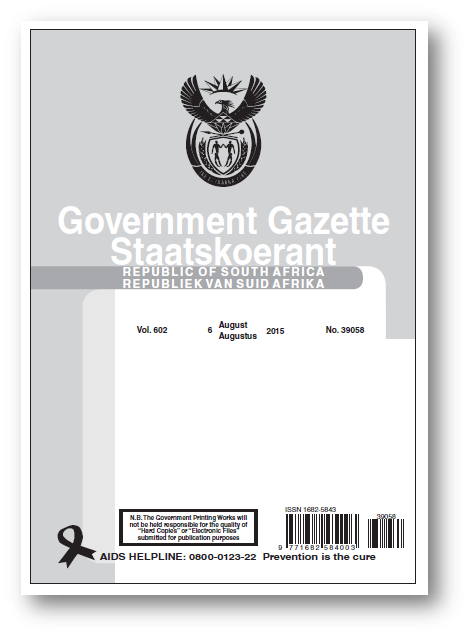
The BMA Bill No.39058Cabinet [has] approved the introduction of the Border Management Agency (BMA) Bill, 2015 into Parliament. The Bill aims to establish the BMA, which will balance secure cross-border travel, trade facilitation and national security imperatives within the context of South Africa’s regional, African and international obligations. This single authority for border law enforcement provides the potential for more cost-effective services, enhanced security and better management of the border environment. Source: Statement on the Cabinet meeting of 23 September 2015 (SA Government)

South Africa – WCO ESA Regional Workshop on TFA implementation

ESA_Regional-WS_South-AfricaThe WCO Regional Workshop on Strategic Initiatives for Trade Facilitation and the Implementation of the WTO Trade Facilitation Agreement (TFA) – Mercator Programme – for the WCO East and Southern Africa (ESA) region was held from 15 to 17 September 2015 in Johannesburg, South Africa. It was hosted by the South African Revenue Service (SARS) representing the WCO Vice Chair of the ESA region, and financially supported by the United Kingdom Department for International Development (UK DFID) and the Ministry for Foreign Affairs of Finland. More than 100 participants from 21 ESA Members (Customs, Trade Ministries/equivalent Ministries), the WTO and other international organizations, development partners and the private sector participated in the event.

The Workshop was opened by the Commissioner of SARS, Mr. Thomas Moyane. He expressed his view that the WCO Mercator Programme created significant conditions for contributing to intra-African as well as international trade facilitation benefits. As Vice Chair of the ESA region, he hoped that the Workshop could recommend immediate actions for the region.

The Workshop raised a lot of interest and active discussions from a variety of well-prepared and informative presentations, including the role of the WCO in TFA implementation;  TFA regulations such as Article 23.2 on National Committees on Trade Facilitation (NCTF) and specific national and (sub-)regional examples of implementation approaches; experiences of Trade Ministries and several partner institutions active in the region; and discussions on further approaches to Capacity Building and TFA implementation, including in cooperation with Development Partners.

The region agreed on next steps forward, including on a regional focus on the establishment and maintenance of NCTFs (for instance further provision of replies to the respective WCO survey; identification of the situation within ESA Members); reporting the outcomes of the Workshop to the ESA Regional Steering Committee; encouragement of ESA Members who are not yet Contracting Parties to the Revised Kyoto Convention to accede to it as soon as possible (and/or to identify related Capacity Building needs) – as one concrete way to also support TFA implementation; and responsibility of the ROCB and the Vice Chair to continue collecting and publishing information on ongoing Capacity Building projects and work of partner organizations such as SADC, COMESA, SACU and UNCTAD especially in the TF(A) area in the region – while encouraging Members and partner organizations to share such information.

The Workshop was successfully concluded with positive feedback from Members, partner organizations and development partners. A summary document on the discussions held during the Workshop is currently under finalization by the Vice Chair’s office and the ROCB and will be circulated to all participants of the Workshop in due course. Source: WCO

The BMA Bill – a little more for stakeholders to ponder over

The BMA Bill No.39058In recent months ‘Joe Public’ has witnessed developments relating to new visa requirements regarding international travel to and from South Africa. Tourism and the hospitality industry have been impacted in no small way while government has now established a committee to investigate the claims to the effect that the country’s tourism industry has been severely impacted.

It is now commercial trade’s time to consider the next set of legal requirements emanating from the Department of Home Affairs which, in the main, affect legislation under other departments and organ’s of state – in particular SARS Customs. Interested parties can find/download the document by clicking the link http://www.gpwonline.co.za/ and searching for eGazette No.39058.

In essence function of the Border Management Agency (BMA) Bill is – To provide for the establishment, organisation, regulation and control of the Border Management Agency; to provide for the transfer, assignment, and designation of law enforcement border related functions to the Border Management Agency; and to provide for matters connected thereto.

Be sure to digest the content of the Schedules to the Bill which contain the extent of the ‘meat’ and authority which the proposed Border Management Agency will exert if, or once approved. The Department of Home Affairs (DHA) invites comments to the draft Bill which must reach DHA no later than 14 September 2015.

The SACU Utility Block – My Export is Your Entry

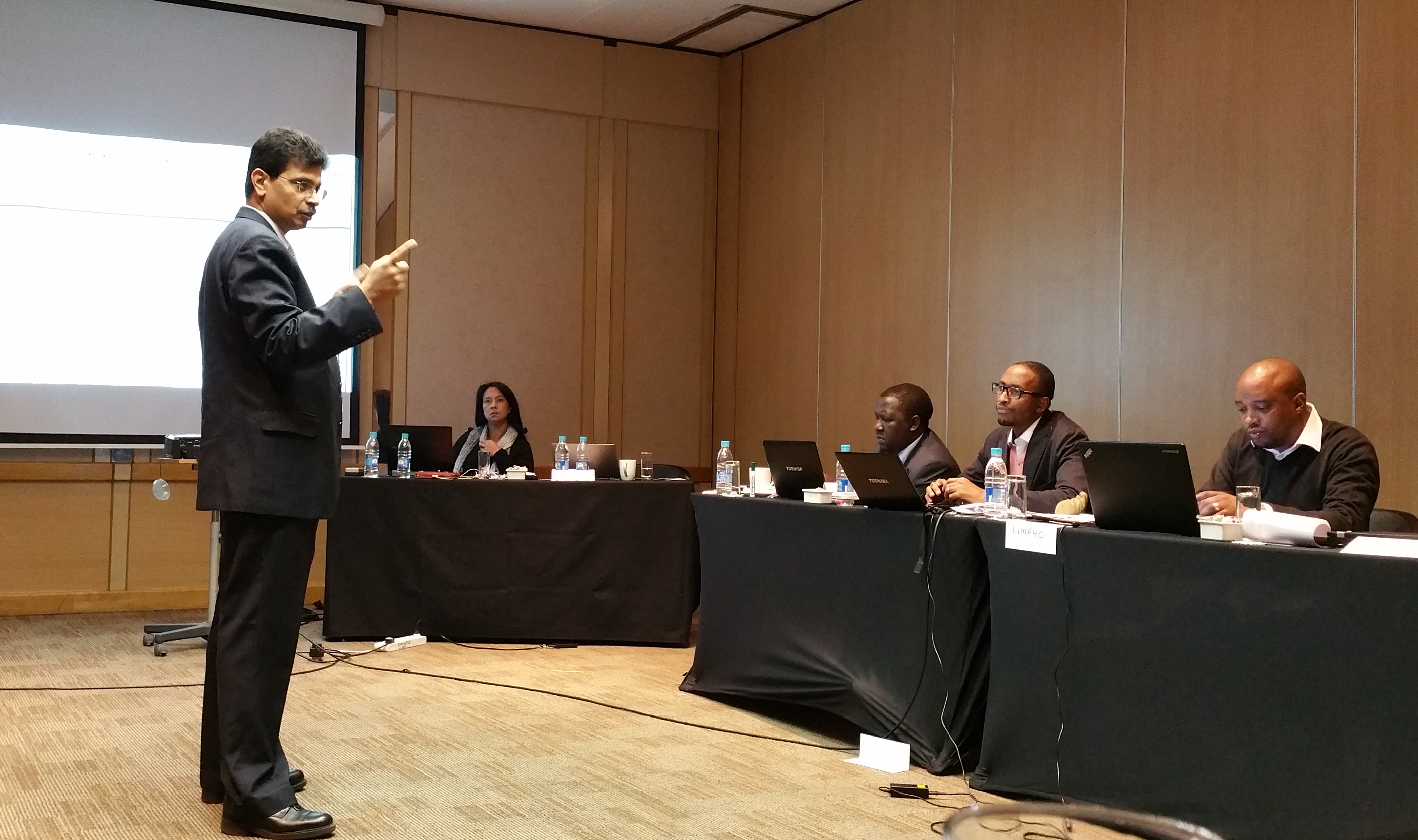
SACU IT Connectivity ConferenceRepresentatives from the Southern African Customs Union (SACU) gathered in Johannesburg, South Africa recently to refine requirements towards the development IT connectivity and electronic data exchange to facilitate cross-border customs clearance in the region. The workshop was convened by the SACU Secretariat under the sponsorship of the Swedish government and technical support from the World Customs Organisation.

Work already commenced way back in 2012 on this initiative. Progress in the main has been hampered by the legal agreement which to date not all members of the Customs Union have ratified. One of the features of this initiative, however, has been the continuity of support rendered by the WCO.

This event was indeed fortunate to secure – once again – the services of S.P. Sahu, former head of Information Technology at the WCO. After his secondment to the WCO he is now back in his home country where he is the Commissioner for Single Window based in Delhi, India.

S.P’s years of experience in both the technical and operational spheres of customs and the international supply chain enable him to articulate concepts and solutions in a manner which are practical and simple to understand. The workshop recognised the need to accelerate border processes and to this end the border process should be limited to physical examination, inspection, release; declaration processes should be done away from borders.

While simple enough in theory, the notion of clearance away from borders could pose challenges. Many of Africa’s borders – including those of a ‘One Stop’ kind – have not fully embraced the need to integrate processing and synchronize Customs activities. The challenge posed by ‘regional integration’ is one of surrendering national imperatives for a common regional good. It imposes a co-ordination of and development towards ‘regional objectives’ with the same level of purpose as national states do for their domestic agenda’s. In the case of SACU, it challenges member state’s stance on what real benefits the customs union should aspire to, beyond the mere sharing of the common revenue pool.

The outcome of the workshop resulted in a more refined, do-able scope and objective. With Mr. Sahu’s experience and guidance, the revised Utility Block (UB) speaks to all facets (legal, operational and technical) of the ‘regional agreement’ to the extent it specifies in the required detail the programme of action required on the part of the member stats as well as the SACU Secretariat. Refinement of the UB includes the removal from scope of the Release Message, Manifest Information and bond/guarantee message for the purpose of simplification of customs processes.

What remains are –

  • An Export & Transit Message – which includes the Unique Consignment Reference (UCR) validated and approved by the Export/Exit country.
  • An Arrival Confirmation/Notification Message – where the arrival date time would be when the import country recognises goods as received and places the goods under its customs procedure.
  • A Control Results Message – which includes the results of data matching, inspection and risk assessment based on agreed business rules.

In support of the above, SACU recently agreed on a framework of a UCR which must be further discussed and agreed upon by the respective member states. The UCR is a structured reference number which will be used by customs administrations of the respective member states to ‘link up’ import declaration data with the corresponding ‘export declaration’ data electronically exchanged by the export country.

Regional traders who have electronic clearance and forwarding capability will also play a role in the exchange of data through the exchange of the UCR on export and transit information with their counterparts or clients in the destination country. Once the exchange of data is operational between member states, it will be imperative for the importer to receive/obtain the UCR from the exporting country and apply it to his/her import declaration when making clearance with Customs.

The SACU Utility block will be tabled at a future Permanent Technical Committee meeting of the WCO for consideration and approval. A Utility Block is a concept structure which is proposed under the WCO’s Globally Networked Customs (GNC) initiative which seeks to aid and assist its members in the operationalisation of Mutual Administrative Assistance agreements.

IT System to Transform SA Ports into ‘smartPORTS’

At the launch of Transnet National Ports Authority's new Integrated Port Management System (IPMS) [Transnet]

At the launch of Transnet National Ports Authority’s new Integrated Port Management System (IPMS) [Transnet]

Transnet National Ports Authority’s new web-based Integrated Port Management System (IPMS) went live on 26 July at the pilot site, the Port of Durban, with the crude oil tanker, Colorado, the first to be brought into the port using the new system.

Developed by Navayuga Infotech, a company based in India, in collaboration with their South African partner Nambiti Technologies, the IPMS is a strategic project that aims to support the broader objectives of the Transnet Market Demand Strategy (MDS) in terms of efficiency and productivity.

The project will cost TNPA around R79 million for the entire system, for all eight South African ports, covering concept development, architecture, implementation and rollout.

TNPA Chief Executive, Richard Vallihu, said: “Since 2008, various feasibility studies were undertaken where we identified the need for an automated and web-based system to improve port operations, strengthen efficiencies and enhance competitiveness. This online system will help transform our ocean gateways into smartPORTs by using advanced information technology that will make them more intelligent and sustainable, while conserving resources, time, space and energy.”
The system replaces manual processes, with key port operations now set to be automated, online and in real time.

Vallihu said the IPMS was benchmarked against Malaysian and Singaporean ports which were among the world’s most efficient. The IPMS system will be a groundbreaking initiative in that for the first time in the world a system such as this is integrated across multiple ports on a single platform.

“For us as a customer-focused organisation this state-of-the-art information technology will ensure that port information and processes are transparent and easily accessible to users throughout the South African port logistics chain,” he said.

Yugen Reddy of Sharaf Shipping Agency was excited about being able to work more efficiently. “My role as an agent is to make sure that ships are in and out of the port as quick as possible because time is money. With IPMS we will be able to use our smart phones or tablets while we’re out and about to update the system and get acknowledgment from TNPA on the spot with regards to sailing or berthing of vessels,” he said.

Vessel agent, Londa Small of Thembani Shipping agreed. “I am optimistic about the IPMS system because everything’s going to be in real-time enabling quicker turnaround,” he said.

IPMS will link to Transnet Freight Rail’s Integrated Train Plan (ITP) and Train Execution Management System (TEMS). It is also integrated with global systems such as Lloyds Register, AIS (for vessel traffic management), IPOSS (for weather), EDI (Electronic Data Interchange) and SAP (for business operations, customer relations and finance).

From Durban the project team will move on to Cape Town and Saldanha, then Port Elizabeth, Ngqura and East London and finally to Richards Bay and Mossel Bay.

TNPA conducted daily intensive training for internal and external users at the Maritime School of Excellence in Durban during June. Source: Transnet

Customs Non-Intrusive Inspection affects trade costs

DBN Relocatable ScannerThe following article suggests the need for greater consultation and collaboration between all supply chain parties. While the associated costs relating to supply chain movements is not the purview of SARS, these should be considered as part of the overall impact assessment in the lead up to such an implementation. For all intents and purposes this is an unintended consequence. Stakeholders should also note that the SA government has not imposed any fee for the scanning of cargoes to re-coup costs. Non-intrusive inspection (NII) capability is a tenet of international customs control intended to mitigate security threats and incidents of cargo misdeclaration, even legitimate cargo that can be used to mask harmful products stowed in vehicles/containers. The issue of increased cost of compliance has unfortunately been a trait of many international customs developments ever since the advent of ‘heightened security’ – post 9/11 and seems destined to remain a ‘challenge’ as we supposedly move into an era of increased trade facilitation.Joint collaboration between all parties not only assists in better understanding of the broader supply chain landscape but can also contribute to positive measures on the ‘ease of doing business’.

Freight & Trade Weekly (issue no. 2158, 10 July 2015) reports that Industry has called on customs to look into processes around its cargo scanners which they say are currently driving up costs.

Two state-of-the art scanners are currently operational at the Port of Durban and Cape Town and are part of South African Revenue Service’s (Sars) countrywide approach to risk management that aims for less intrusive inspections at ports and border entries.

The scanners were introduced in order to improve efficiency, with stopped containers being released more speedily than has been the case to date.

“It has however in some cases increased costs because it has resulted in double handling of containers,” said Dave Watts, a maritime consultant for the SA Association of Freight Forwarders (Saaff).

Before the introduction of the scanners all stopped containers were moved by shipping lines to licensed depots for examination by Sars. Once the inspection was concluded and the container released the importer or his agent could collect it using their own transport.

The new process however sees the stopped container transported by the shipping line to the scanner where it is either released or has to be moved for a physical inspection to a depot.

If released at the scanner the container is however still on the shipping line’s appointed truck and not that of the importer or its agent’s nominated haulier.

There are no facilities to move it from one truck to the other at the scanners which means carrier haulage moves it to a depot anyway.

“The extra cost comes in simply because of the double handling,” explained Watts.

In Durban, where the new technology scanner was introduced just over a year ago, several importers maintain it is cheaper to just have their stopped containers taken to the depot for unpacks rather than going through the scanner and not unpacking.

According to Mike Walwyn, chairman of the Port Liaison Forum, the issue of carrier choice also comes into play as the importer now has to use carrier haulage for delivery as opposed to his or her own transport.

Whilst the Cape Town scanner has only been operational for a week, some very real challenges are foreseen and increased cost is one of them.

“The issue is not necessarily around the scanner,” says Watts, “but the rules and regulations around the customs act that stipulates all containers remain the liability of the shipping line until released by customs. In other words it has to be taken to the scanner by the carrier.”

It has been suggested that instead of doubling the handling of containers the carrier should just make the final delivery of the container, but it is generally accepted that carrier cartage rates are much higher than contracted cartage rates. In some cases the cost is said to be four times higher.” Source: FTW

New IDZ designated for Free State

Harrismith, Free State, South AfricaThe South African Cabinet has ratified a decision by the Department of Trade and Industry (DTI) to designate the Maluti-A-Phofung (MAP) logistics hub, in Harrismith, in the Free State, an industrial development zone (IDZ), further approving the granting of operator permit for this zone to the Free State Development Corporation.

The designation would result in the establishment of a logistics-orientated platform 10 km outside of Harrismith, primarily to service the automotive, light manufacturing, agro-processing, distribution and logistics sectors.

The Harrismith hub had become part of a key nodal point of the Durban–Free State–Gauteng Corridor, which was identified in the 2005 National Freight Logistics Strategy approved by Cabinet. According to the DTI, the MAP IDZ would become a multi-sector processing, manufacturing, engineering, logistics services, transport and logistics complex, serving the needs of the upstream value-adding, beneficiation, processing and production service companies operating across sectors and geographical areas in Southern Africa.

The zone would further look to provide efficient IDZ and customs-controlled area operations and processes that would facilitate timeous and cost-effective operations for international and domestic investors.

BMA – This one is not implementable!

[Picture Credit: John Moore - Getty Images]

Border between South Africa and Zimbabwe [Picture Credit: John Moore – Getty Images]

The SA government is forging ahead with plans for a border management agency to handle all aspects of border control, from security to customs and plant and animal inspection – but MPs have said it can’t be done.

Home Affairs Minister Malusi Gigaba and his defence counterpart Nosiviwe Mapisa-Nqakula launched Operation Pyramid – a transitional arrangement to improve interdepartmental co-ordination – on Friday, while a draft bill to create the legal framework for the agency was tabled at a workshop in Pretoria earlier in the week.

But there are serious concerns about the ability of one entity to manage the diverse requirements of border control, which would require a huge single body that may prove unwieldy, while it would also need to assume some of the functions of the police and defence force. This would put it in conflict with the constitution, which provides for a single police service and defence force.

Section 199.2 of the constitution states the defence force is the “only lawful military force in the Republic”. Establishing a border management agency performing security functions in parallel with the police and SANDF would thus require a constitutional amendment, but this is just one among many challenges.

The need for such an agency arose in the first place because numerous national intelligence estimates had said the lack of co-ordination in the border environment resulted in “significant weaknesses, threats and challenges”.

Briefing Parliament’s police oversight committee this week, Brigadier David Chilembe, head of border policing, outlined steps that had been taken to get the agency off the ground, six years after President Jacob Zuma ordered it to be done.

The Department of Home Affairs, the lead agent in the project, had established a project office to oversee implementation, heads of affected departments had signed a multiparty agreement and sat on a committee together to co-ordinate their efforts, while an interministerial committee ironed out the policy questions.

The Government Technical Advisory Centre in the Treasury was working on the business case for the agency, Chilembe said.
The plan was to set up the agency in stages and identify the legal and operational implications at each stage so they could be addressed.

But a follow-up briefing on concerns raised by MPs after an oversight visit to the Lebombo border post near Komatipoort in Mpumalanga opened a window into the difficulties the agency will face.

The committee wrote a damning report on the Lebombo border post after a visit earlier this year, when MPs found the ceiling was collapsing because air-conditioning ducts dripped on to it, the door was shattered and the gate jammed, meaning it was possible to drive or walk through it without stopping.

Police complained they had to stand unprotected in the sun or rain and had to make their own travel arrangements from town.
Lieutenant-General Kehla Sithole said the problems originated in a 1998 agreement between Mozambique and South Africa for the post to be established as a “one-stop” facility, with officials sitting back-to-back under one roof.

Mozambique later said it had expected South Africa to pay for its construction, but the Treasury balked at this.The resulting limbo meant new facilities could not be built and neither could the existing ones be refurbished because the Public Works Department refused to upgrade buildings earmarked for demolition.

There were perceptions that the SA Revenue Service, which was the lead agency in the Border Control Operational Co-ordinating Committee – the body charged with harmonising the environment since 2001 – looked after its own interests first, leaving the SAPS short-changed in accommodation and office space.

MPs were shocked to hear an 80-room residential complex for SAPS personnel stood empty because police were expected to pay for it themselves but, unlike SARS officials, did not receive an accommodation allowance. As a result, they preferred to rent a shack in town and travel to the border post daily.

There was also no scanner at the border post, meaning truck cargos, for instance, could only be inspected manually. Opposition DA spokeswoman on police Dianne Kohler Barnard said this almost certainly meant the majority of vehicles went through the post unchecked, meaning it could easily be used for child trafficking, for example.

Sithole said the lack of a scanner was the result of a Treasury instruction for departments represented at the post to make a joint proposal for one to be procured, instead of each asking for their own – at a cost of millions a unit.

A “scanner committee” had been established in the late 1990s but, because one was provided for in the plans for the one-stop concept, it had yet to be bought.

Committee chairman Francois Beukman said MPs weren’t interested in the history of the problem, but rather in what would be done to get a scanner in place.

ANC MP Jerome Maake, supported by Leonard Ramatlakane, said after the presentation it was clear the border management agency couldn’t work. If it was established as a government department – one of three options on the table – this would create a “super department” that would reach into the functions of the others. This would confuse lines of accountability.

If it was established as a government component under an executive authority, or as a public entity, the other two options, it would run into the constitutional challenges related to the police and defence functions.

“All I see here is problems and I don’t see how they can be solved,” Maake said.

“Maybe you’re just afraid of telling the president, this animal can’t be implemented and you’re moving around it, on the periphery, afraid to just say, no – can we come up with something new?

“This one is not implementable.”

Source: Independant On Line (IOL)

Africa losing $40bn in illegal cigarette trade

ContrabandA tobacco body has urged African governments to stamp out illegal tobacco trade, as their economies are losing billions of dollars in taxes annually. Tobacco Institute of Southern Africa (TISA) revealed that governments in the region are losing between US$20 billion and US$40 billion annually in taxes as a result of illegal tobacco trade, hence the need for collaboration among stakeholders to curb the vice.

This is contained in a statement issued by KPR Consulting Limited on Friday. “The size of the global illegal tobacco trade ranges between 330 and 660 billion cigarettes a year. These are cigarettes that are either smuggled, counterfeited or where tax is being evaded. “This equates to around six and 12 percent of global consumption, which deprives governments of between US$20 [billion] and US$40 billion a year in taxes,” the statement reads.

TISA, which is a regional body that represents tobacco traders, growers and processors, estimates illicit tobacco trade incidences in Zambia being between 20 and 30 percent. South Africa is rated among the top five countries globally when it comes to the trade in illegal cigarettes, with industry research estimating that around 23 percent of all cigarettes consumed in South Africa in 2014 were illegal. Commenting on the issue, British American Tobacco Zambia managing director Clara Mlambo cited weak penalties for criminals, poor border controls, low arrest rates and tobacco taxes creating intra-regional disparities as contributing factors.