Parliament Postpones Customs Bills

Thaba Mufamadi, chairman of Parliament’s finance committee. Picture - Financial Mail

Thaba Mufamadi, chairman of Parliament’s finance committee. Picture – Financial Mail

Parliment’s standing committee on finance (SCoF) has decided to postpone its deliberations on two draft customs-related bills until next year to allow importers and the freight-forwarding industry more time to comment on the proposals which threaten the status of City Deep as an inland port. This followed an appeal by the South African Association of Freight Forwarders that it had had insufficient time to consider the substantially revised draft Customs Control Bill and Customs Duty Bill, which required that imported goods would have to be cleared at the first point of entry.

The association, supported by a range of other business organisations, including the Johannesburg Chamber of Commerce and Industry, warned that the bills could be challenged on constitutional grounds if the process of consultation was deficient. All political parties supported the proposal by finance committee chairman Thaba Mufamadi on Wednesday that the deliberations on the bills be postponed until next year. He instructed stakeholders to make their submissions to the South African Revenue Service (SARS) by December 15.

Mr Mufamadi also took cognisance of concerns raised by Business Unity South Africa that parliamentary processes did not allow sufficient time to comment, for example, on the medium-term budget policy statement. Industry has warned of port delays and trade disruption if the proposals were to be adopted. The Customs Control Bill proposes that goods be cleared at the first port of entry into South Africa. This will mean that inland ports such as City Deep in Johannesburg would no longer be designated places of entry or exit for customs purposes. In the past, containerised cargo could move directly to inland ports on arrival in the country under cover of a manifest. A new declaration — of the nature, value, origin and duty payable on the goods — would replace the manifests.

SARS said these did not provide sufficient information to undertake a risk assessment. Another bone of contention for industry was the “extremely severe” penalties proposed in the draft Customs Duty Bill. Following the uproar about the proposals SARS offered a compromise earlier this week as a way out of the impasse. Instead of a clearance at the port of entry, a mandatory advance customs clearance of the goods three days before their arrival at the first port of entry would be required. Goods consigned to inland terminals such as City Deep would be released conditionally. The system would be tested for the whole of next year to iron out any problems.

An alternative option would be for the goods to undergo a lesser form of clearance at the first point of entry. This would still entail providing customs authorities with the same level of information on the tariff, value and origin of goods, which would be submitted by electronic data interchange. The importer would be held accountable for the information that was provided. SARS official Kosie Louw said that because this document would not have the formal status of a clearance certificate, it would not disrupt existing legal contractual arrangements, as claimed. The goods would still move CIF (cost insurance and freight) from the port to City Deep. SARS has also proposed softening the penalty provisions so that errors not resulting in any prejudice to customs revenue will be subject to penalties only after three warnings. These penalties will be discretionary and applied leniently in the first 12 months of the bill coming into force to allow business time to properly prepare for the change. An appeal process has been included. Source: Business Day Live. 

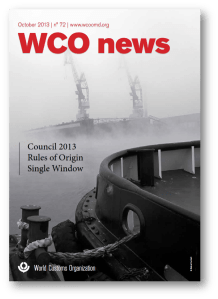
WCO News – October 2013 Edition

wco news 2013The latest edition of WCO News reflects on the Secretary General’s thoughts on what the WCO has done, what it will be doing, and what will impact on its work in the coming months. The WCO will actively focus its energies on it’s four strategic packages concentrating on revenue, compliance and enforcement, economic competitiveness and organizational development. Together, these packages support the adoption and application of modern Customs practices and raise awareness on the vital role of Customs in international trade.

Featured articles include –

  • From borders to boundless: the digital dilemma in Customs – it discusses two questions – How does an industry traditionally focused on physical borders remake itself for digital commerce, which inherently circumvents such borders? and, Why must Customs agencies transform to address the rise in digital goods and services?
  • Intercepting next generation threats

    For those responsible for the security of our borders, transit networks, VIPs and high-profile sites, the threat posed by more creative adversaries is compounded by the increasing frustrations of passengers and visitors, when subjected to existing security checks. The article discusses a range of ingenuity which technology nowadays provides to these adversaries, and the elements of new Terahertz imaging equipment to assist border agencies in the combat thereof.

  • Beyond the Single 

    Window (SW) – In the 20-plus years since they first opened in Singapore and Sweden, SWs have remained a central focus of border clearance strategies, even though the majority of Customs administrations have not implemented them. Although design plans vary considerably, most SW systems support an electronic data exchange model which allows for (i) Single submission of data and information; (ii) Single and synchronous processing; and (iii) Single decision-making for release and clearance. This article considers 4 best practices which governments should consider when implementing Single Window programs.

The publication also includes country case study’s on Single Window featuring Nigeria and New Zealand, Sri Lanka Customs 20 years of dedication towards conservation, a feature on Argentine Customs and many other interesting articles. To access the publication – click here! Source: WCO

Draft Customs Bills in Parliment

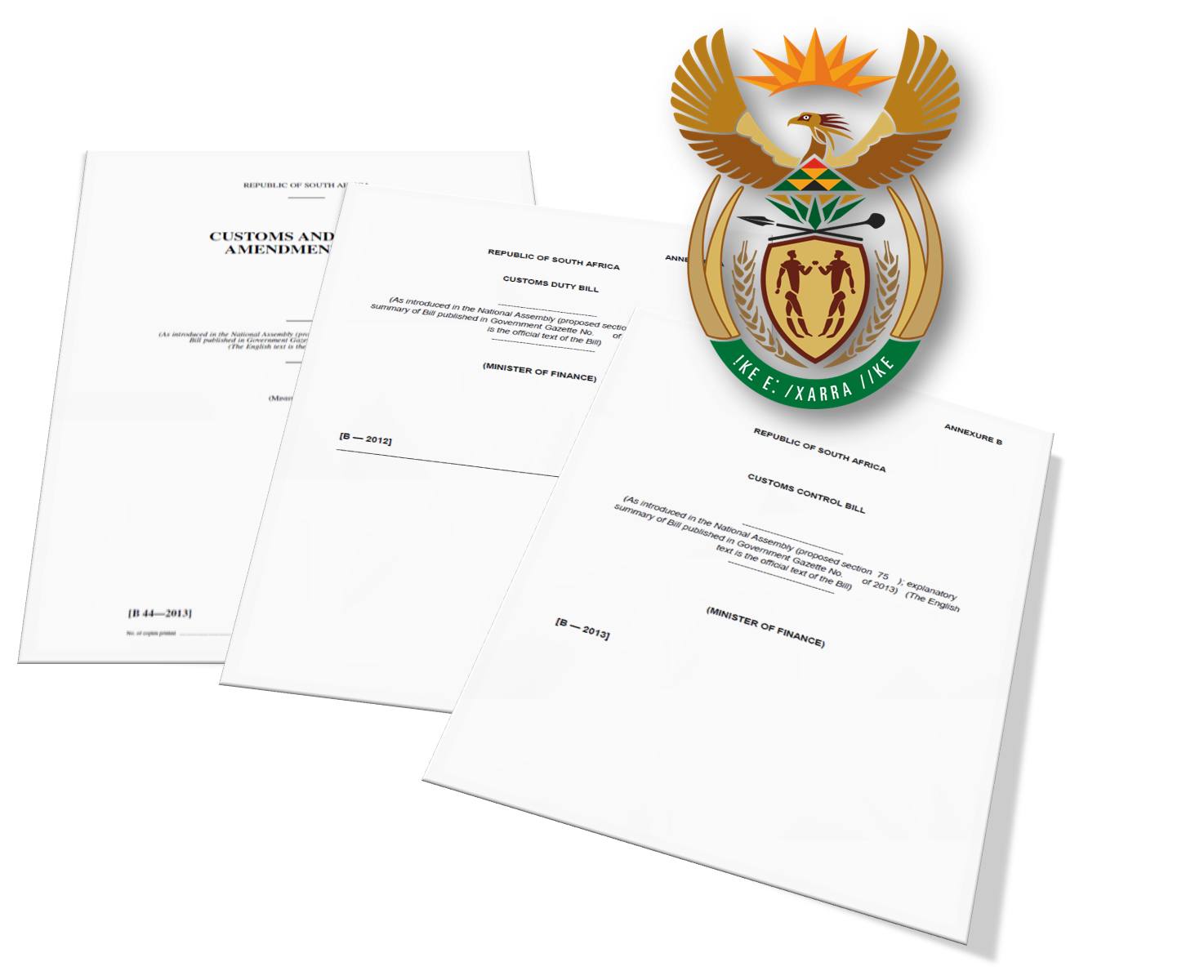
Customs BillsParliament’s Standing Committee on Finance (SCoF) has issued an invitation (17 October 2013) to stakeholders and interested parties to submit written submissions and any indication to make oral presentation for the public hearings in regard to the Customs Control and Customs Duty Bills. The public hearings are set to take place on 30 October 2013. The draft Bills set out a new legal and regulatory framework for Customs controls over the movement of people goods and conveyance in the Republic of South Africa. The proposed new laws will in effect replace the existing Customs and Excise Act, no.91 of 1964 once in force. Copies of the bills can be located on the following website – www.parliament.gov.za – or via the following links:

Visiting the WCO’s Strategic Plan

Reality Check

The ongoing global financial and economic crisis affects governments,  organisations and citizens in different ways. It would seem that no individual or any organisation has the proverbial ‘silver bullet’ to normalise the situation either. Today, probably most Customs and Border agencies are undergoing ‘modernisation’ or some form of restructuring. Modernisation in itself implies automation or digitization of information changing the lives of the average customs (border) official as well as the expectations and predictability of service to traders and trade intermediaries around the world. 9/11 forever changed the role of Customs and for most of governments, border regulatory authorities as well. Changes in Customs have since been focussed on alignment to policy, standards and guidelines as advocated by the WCO.

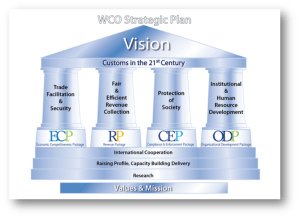
WCO Startegic PlanNational adoption of these remains the foremost critical step in establishing a country’s ability to ‘connect’ with the world. A national administration should seek inclusivity of its trading community lest its modernisation be regarded as self-serving. Simultaneously, regional economic communities also seek radical change, albeit on a regionalisation level. Pressures on national (sovereign) nations develop given high-level political commitment to regionalisation, often without taking into account their respective countries’ state of readiness. This creates a false sense of commitment which results in regional failures. Behind such regional initiatives are normally a host of sponsors, purportedly with the right experts and solutions to rectify the ‘barriers’ which prevent a national state from integrating with its neighbours and global partners. Sound familiar? If so, it wouldn’t do national representatives any harm to refresh themselves with the under mentioned WCO tools and validate this in relation to the direction which their organisation is headed. These form part of the WCO’s Customs’ in the 21st Century Agenda. It is also recommended reading for the various regional economic communities (RECs) – here I refer to the African continent – who are not always au fait or fully appraised on the ‘readiness’ landscape of the member states they represent.

The Economic Competitiveness Package (ECP) (Click the hyperlink for more information) is currently a matter of high priority at the World Customs Organization (WCO). Economic competitiveness starts with trade facilitation and Customs administrations undeniably play an important role in this respect. Indeed, facilitating trade is one of the WCO’s key objectives and the Organization has contributed, through its tools and instruments as well as through technical assistance, to increasing the economic competitiveness and growth of Members.

The Revenue Package (RP) (Click the hyperlink for more information) was developed by the World Customs Organization (WCO) in response to WCO Members’ concerns in regard to falling revenue returns in the light of the global financial crisis and declining duty rates.

Significant progress has been made since the adoption of the WCO Capacity Building Strategy in 2003. However, new and emerging key strategic drivers impact on international trade and the roles and responsibilities of Customs administrations. This requires that all our capacity building efforts remain responsive and needs-driven to ensure beneficiary Customs administrations can obtain the support they need to pursue their reform and modernization. This Organisational Development Package (ODP) (Click the hyperlink for more information) outlines the basic approach of the WCO towards organizational development. It provides a simple and accessible overview of the texts, tools and instruments that relate to this topic. It refers and offers access to these resources but does not purport to capture all knowledge and practices within this extensive area.

The Compliance and Enforcement Package (CEP) (Click the hyperlink for more information) has been developed in order to assist Members to address the high-risk areas for Customs enforcement. The Customs in the 21st Century Strategy calls on Customs administrations to implement modern working methods and techniques. In this context, Customs should be equipped with the necessary tools that allow it to effectively manage supply chain risks and enforce laws and regulations in cases of non-compliance. In discharging this mandate, the WCO, in close co-operation with Members, has created an extensive library of instruments, tools, guidance materials and operational co-ordination activities to support Customs compliance and enforcement actions. These tools new form part of the CEP.


Mastermind and KRA Feud Over Tobacco Imports

Cigarettes+XXX+smokingWhile many nations are mulling over health legislation to curb tobacco use, it would seem the Kenyan authorities have opted for a conventional ‘delay-and-stall’ approach. From a trade facilitation perspective it is a disaster, but no doubt the ‘health propeller heads’ will be happy.

The Star (Kenya) reports that Mastermind Tobacco Kenya has accused the Kenya Revenue Authority of detaining its vehicles bringing in unprocessed tobacco from the Democratic Republic of Congo at the Malaba border for the last one month.

MTK Malaba liaison officer Robert Kiru said three trucks for its processing plant in Nairobi had been detained at the border since August 30 (2013) with no explanation coming from KRA.

“KRA Malaba station manager Philip Chirchir has not given concrete reasons why the trucks are held and neither have we been invoiced for any payment. Our three other trucks are still parked at Malaba Uganda with storage charges now totalling Sh300,000,” Kiru said. Addressing journalists at Malaba border Kiru dismissed as false claims by KRA that no bond had been paid on the impounded trucks. He however failed to show copies of the bond to prove payment.

MTK Corporate Affairs manager Josh Kirimania said he had talked to KRA top officers in Nairobi and wondered why none of them has ordered their officers in Malaba to release the trucks. “KRA have no tangible reasons to hold our trucks in Malaba. This is killing our business since we rely on imports from DRC and Uganda to sustain our business,” he said. Kirimania said KRA was ‘blocking’ their trade by continuously detaining their trucks at the Malaba border and called for an end to the practice. Chirchir could not be reached for comment as he was said to be in a security meeting. Source: The Star (Kenya)

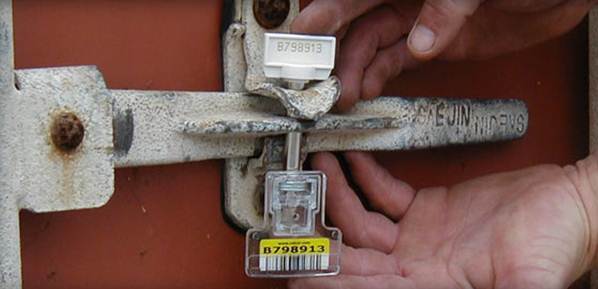
Commercial seal equivalent to official seal in unperformed cargo safety checks

Cargo seal inspection - (Picture: www.recolor.com)

Cargo seal inspection – (Picture: http://www.recolor.com)

Finland – Recent criminal proceedings in which a driver was accused of neglecting to control the cargo security of a trailer which he had picked up from the port of Vuosaari, have been set aside by the Helsinki Appeal Court. When Customs conducted a safety inspection of the cargo, it was found that the cargo had not been secured properly. It was undisputed that the insufficient securing of the cargo could not be seen from outside, and that the driver had checked the trailer, but the trailer had been sealed with the transport company’s seal.

The court first considered whether the transport company’s commercial seal overruled the duty to carry out a cargo safety check. The expert witness testified before the Helsinki District Court that according to the Road Traffic Act, a ‘seal’ is only an official Customs seal (subject to the TIR Convention), and that the term does not include the commercial seals used by transport companies. However, the district court found that a ‘seal’ is not defined in the Road Traffic Act or its preparatory work, and the term thus includes commercial seals. It went on to determine whether checking the cargo could have caused unreasonable harm or delay. The driver stated that pursuant to the employer’s instructions, a cargo unit must never be opened alone; two people must always be present. The district court found that it was not proved that opening the trailer would not have caused unreasonable harm or delay to the transport assignment, and hence the driver had done his best. The criminal charges against the driver were rejected.

The proceedings before the Helsinki Appeal Court were limited to the first question – the definition of the seal. The appeal court found no reason to change the district court’s judgment. The appeal court judgment is final. It is quite common that a driver is assigned to pick up a transport unit which is already loaded, secured and, on many occasions, also sealed. Under these circumstances the driver has no means to carry out cargo safety checks from anywhere other than outside of the transport unit. Source: International Law Office & Hammarström Puhakka Partners, Attorneys (Finland)


SARS to address Stakeholders on Customs Control proposals

SARS chief officer of legal and policy Kosie Louw (Picture: Robert Botha/Business Day Live)

SARS chief officer of legal and policy Kosie Louw (Picture: Robert Botha/Business Day Live)

The South African Revenue Service (SARS) has committed itself to further engagements with importers of all sizes in a bid to improve its proposals to transform the customs control regime.

Consultations have already taken place with organised business on the proposed Customs Duty Bill and the Customs Control Bill, and the process would now be taken to the level of traders to find out whether the proposals presented them with any problems. Amendments have also been proposed to the Customs and Excise Act to provide for the transition to the new system.

“We want to understand the situation at a micro level. We will sit around the table until we find a solution which will guarantee to us that we get the information we require but which will also facilitate trade.

“We do not want to clog up the ports,” SARS chief officer of legal and policy Kosie Louw said in an informal briefing on the proposals to Parliament’s standing committee on finance on Wednesday.

The customs bills are mainly concerned with improving the information about imported and exported goods so that customs officials can exercise greater control.

Business has expressed concern that the requirement of the Customs Control Bill that they submit a national in-transit declaration of goods at the first port of entry before they are sent to internal terminals, or depots such as City Deep, would cause delays.

The new declaration — of the nature, value, origin and duty payable on the goods — would replace the limited manifest used to declare goods and would include information on the tariff, value and origin of goods.

Business has argued that the manifest allowed goods to move seamlessly from the exporting country to the inland port or depot, and would change the contractual relationships between exporter and importer in terms of when duty is paid.

However, Mr Louw did not believe the provision would cause delays and had obtained legal advice that the contractual relationships and method of payment of duties would not change. The problem with manifests, he said, was that they provided very limited information and did not allow SARS to prevent the inflow of unwanted goods. Nevertheless, he said that SARS would discuss the matter with traders.

Mr Louw said the proposed system would “improve SARS’s ability to perform risk assessment and intervene in respect of potentially high risk, prohibited and restricted consignments at the ports”.

The bills have been in the pipeline for about four years and have been extensively canvassed with the Southern African Customs Union and business. They were needed, Mr Louw said, so that South Africa kept pace with global trends in trade, international conventions and advances in technology.

Anti-avoidance provisions have also been introduced into the bill which sets out the offences and associated penalties for noncompliance and attempts to avoid paying customs duties.

SARS group executive for legislative research and development Franz Tomasek said the Customs Control Bill would introduce a new advance cargo loading notice for containerised cargo to prevent the loading of prohibited or restricted goods on board vessels bound for South Africa. However, to reduce the administrative burden on carriers, information submitted in advance will no longer be required on arrival or prior to departure. Source: Business Day Live


Drop in fake goods seized by EU Customs

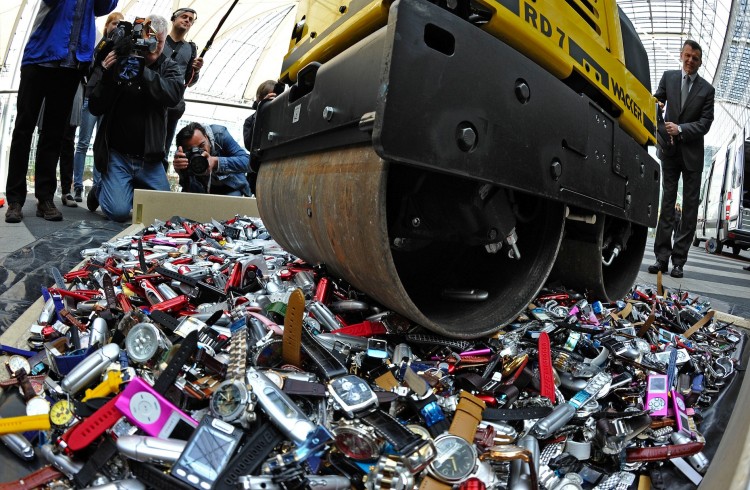
Fake goods being destroyed

Fake goods being destroyed

Customs in the European Union (EU) detained almost 40 million products in 2012, suspected of violating intellectual property rights (IPR), with an original goods retail value of just under €1 billion, according to an annual report published by the European Commission.

The previous year, close to 115 million ’fake’ items had been seized, worth more than €1.27 billion. However, the number of recorded cases for detained goods last year was down only slightly on 2011.
This is thought to be due to the strong growth in small shipments of counterfeit merchandise ordered via the Internet.

Globally, 30% of the goods seized were cigarettes followed by a miscellany of goods (11%), packaging materials (9%), clothing (8%), toys (4%) and perfumes and cosmetics (3%). The vast majority were destroyed.

In terms of the number of cases, most of the detained goods had been shipped by air, post and express, whereas maritime container transport was the main mode for the number of articles seized.

In over 92% of all cases, Customs action was triggered whilst the goods concerned were under an import procedure.

“Customs is the EU’s first line of defence against fake products which undermine legal businesses,” said Algirdas Šemeta, Commissioner for Taxation, Customs, Anti-fraud and Audit.

He stressed that the annual report illustrated “the intensity and importance of the work being done by Customs in this field. I will continue to push for even greater protection of intellectual property rights in Europe, through our work with international partners, the industry and Member States.”

China was by far the principal origin of the fake goods. However, other countries were the primary source for specific product categories. For example, Morocco for foodstuffs, Hong Kong for CD/DVDs and tobacco product accessories (electronic cigarettes and the liquid fillings for them), and Bulgaria for packaging materials. Source: EU Commission

A new instrument of the Technical Committee on Customs Valuation

wco - valuationA new instrument of the Technical Committee on Customs Valuation has recently been published. Advisory Opinion 4.15 provides guidance on a case where royalties have been paid to a third party licensor (in other words, the licensor is not the seller of the goods) and determines whether or not it is appropriate to include the royalty fee in the Customs value of the imported goods. Available from WCO Online Bookshop.

When a Beer is definitely not a Beer!

beerThe Tanzania Revenue Authority (TRA) has been blamed for disobeying the decree issued by Kinondoni District Court, which prohibits import and distribution of Windhoek Premium Lager Beer in the country, which does not bear code number MB66.

It is alleged further that the TRA, in total disobedience of the decree in question issued on October 15, 2010, has been allowing and collecting tax from dishonest businessmen and companies who import the beer brand that does not bear the said code number.

A consultant with Mabibo Beer Wine and Spirit Limited told the ‘Sunday News’ that his company was shocked after learning that a certain TRA officer said the Authority does not recognize the decree that was issued by the Kinondoni District Court.

A TRA officer recently informed the police authorities who are investigating Mabibo’s complaints against Land Mark Hotel for disobeying a lawful court order that TRA does not recognise the decree that prohibits any person from importing or selling Windhoek Premium Lager.

According to the court order – failure or refusal by the defendant, its owners, agents, directors, servants and other unknown persons who are directly or indirectly related to the defendant or any other persons, to comply with the prohibition orders shall amount to contempt of the orders of the court.

TRA has been accused of allowing Land Mark Hotel to import Windhoek Premium Lager Beer in violation of the court decree and was only concerned with the collection of taxes and that the Authority was not bound to respect the order of the court. Following the court order, Windhoek Premium Lager Beer which does not bear code Number MB66 became restricted and prohibited goods, save where specific written consent of Mabibo has been sought and obtained. Source: Tanzania Daily News.


Johburg Chamber to meet Parliment over Customs Bill

City Deep Container Terminal, Johannesburg

City Deep Container Terminal, Johannesburg

Online media company Engineering News reports that the Chamber of Commerce and Industry Johannesburg (JCCI) would take its objections of certain aspects of the recently tabled Customs Control Bill to Parliament and called on South African business and interested stakeholders to provide input as well.

The South African Revenue Services’ (Sars’) newly drafted Customs Control Bill, which, in conjunction with the Customs Duty Bill, would replace the current legislation governing customs operations, declared that all imported goods be cleared and released at first port of entry.

“The Customs Bill, cancelling the status of inland ports as a point of entry, will be before Parliament very soon, and only a short notice period for comment is expected,” JCCI former president Patrick Corbin said.

While all other comments and suggestions relating to the Bill were adequately dealt with, this remained the one disagreement that had not been satisfactorily resolved, he stated.

Corbin invited all parties to voice their concerns to ensure “all areas of impact and concern were captured”, adding further weight to the JCCI’s presentation. The implementation of the new Bill would directly impact the City Deep container terminal, which had been operating as an inland port for the past 35 years, alleviating pressure from the already-constrained coastal ports.

Despite customs officials assuring the chamber that the operations and facilities at City Deep/Kaserne would retain its licence as a container depot, Corbin stated that the Bill had failed to recognise the critical role City Deep played as an inland port and the impact it would have on the cost of doing business, the country’s road-to-rail ambitions, the coastal ports and ease of movement of goods nationally and to neighbouring countries.

“The authorities do not accept the fact that by moving the Customs release point back to the coast, a vessel manifest will terminate at the coastal port. There will not be the option of a multimodal Bill of Lading and seamless inland movements, as all boxes or the unpacked contents will remain at the coast until cleared and released by the line before being reconsigned,” he explained.

Citing potential challenges, Corbin said that only the containers cleared 72 hours prior to arrival would be allocated to rail transport and that those not cleared three days before arrival would be pushed onto road transport to prevent blocking and delaying rail operations.

This would also result in less rail capacity returning for export from Johannesburg, leading to increased volumes moving by road from City Deep to Durban.

He warned of the Durban port becoming heavily congested with uncleared containers, causing delays and potential penalties, while hampering berthing movements and upsetting shipping lines’ vessel schedules.

The release of the vessel manifest at the coastal port also placed increased risk on the shipping operators delivering cargo to Johannesburg following the clearance of goods at customs and required reconsignment at the country’s shores.

However, Transnet remained committed to investing R900-million for upgrading the City Deep terminal and the railway sidings, while Transnet CEO Brian Molefe had accepted the assurances from customs that “nothing would change and the boxes would still be able to move seamlessly once cleared”.

The Gauteng Department of Roads and Transport Department had allocated R122-million for the roadworks surrounding the inland port, while Gauteng MEC for Roads and Transport Dr Ismail Vadi said the department’s focus this year would narrow to the expansion and development opportunities at City Deep/Kaserne.

The department was also progressing well with the development of a second inland port, Tambo Springs Inland Port and Logistics Gateway, expected to be completed by 2017.

Vadi recently commented that the Gauteng Department of Roads and Transport, which was currently developing a terminal master plan for the project, would link the freight hub through road and rail transport to and from South Africa’s major freight routes and other freight hubs, including City Deep, which was about 33 km away.

The National Economic Development and Labour Council, under which the Bill had been drafted during a three-year development process, had agreed to fund an impact assessment study, led by Global Maritime Learning Solutions director Mark Goodger. The study was “close to completion” and would be presented alongside JCCI’s objections in Parliament. Source: Engineering News

Mozambique Customs gets a new DG

Guilherma Mambo presenting the Mozambique Single Electronic Window at the SADC ICT Conference, in Mauritius, 2012.

Guilherma Mambo presenting the Mozambique Single Electronic Window at the SADC ICT Conference, in Mauritius, 2012.

Guilherme Mambo has just been appointed Director General Mozambique Customs on the 10th May 2013. Until then he was Board Director of MCNet – Mozambique Community Network the PPP responsibly for implementation of Electronic Single Window for customs clearance in Mozambique where he were responsible for implementation and operations. In recent months he has lead Mozambique’s bi-lateral engagement on IT-Connectivity and Data Exchange with his counterparts at the South African Revenue Service (SARS).

For the past 10 years Mambo served as director IT Mozambique Customs and then for Mozambique Revenue Authority. On this role he participated in various modernization projects aimed at improving the business environment in Mozambique through improvement of public services particularly the complete organizational transformation of customs and internal tax areas.

Prior to working with customs and MRA, he worked in aviation industry and a UN lead project in Chechnya, Liberia, Angola were he was exposed multifaceted international experience.

As Director General – Mozambique Customs his responsibility is to manage the General Directorate of Customs (DGA) a paramilitary organization with around 2000 staff, one of the two major collectors of government revenue derived from external trade largely from customs duty, excise duty and the Value Added Tax (IVA).  DGA is also a law enforcement agency that undertakes the control of imports and exports for the protection of revenue to prevent evasion of duties and taxes and assists in the promotion of the community’s well-being to prevent the smuggling of controlled, prohibited and restricted goods (such as illicit narcotic drugs and firearms). The Director General heads the DGA and his assisted by three Deputy Director General each of one have a specific area of responsibility.

Rwanda Customs Process Made Easier for Tax Compliant Traders

Headquarters of the Rwanda Revenue Authority

Headquarters of the Rwanda Revenue Authority

Thirteen companies, three of them Rwandan, last week signed a Memorandum of understanding with Rwanda Revenue Authority to be accorded preferential treatment when clearing their goods at customs. The Authorized Economic Operator (AEO) is a regional trade facilitation program recommended by the world customs organization to ease trade and customs clearance for tax compliant and prominent importers and exporters.

Delay in clearing goods at customs is one of the major impediments to smooth trading within the East African Community (EAC). It also contributes to making the EAC region one of the most expensive places to do business despite being the second most growing economy in the world. The AEO creates some kind of obstacle-free zone where traders in the import or export business, known to be complaint with customs requirements, are accorded special treatment to ease the process of clearing their goods while in transit.

The pilot project will see how the system works in reality and the beneficiaries have all been informed of their rights and which ports or borders to claim them from. Rwanda customs officials issue special identifiers to the beneficiaries to help them identify the benefiting traders once their goods appear at any of the designated custom points. These identifiers will be recognizable everywhere in the five partner states of the EAC where the beneficiaries will pass and claim their privileges as AEO.

The growth of global trade and increasing security threats to the international movement of goods have forced customs administrations to shift their focus more and more to securing the international trade flow and away from the traditional task of collecting customs duties.

Recognizing these developments, the World Customs Organization (WCO) drafted the WCO Framework of Standards to Secure and Facilitate global trade (SAFE). In the framework, several standards are included that can assist customs administrations in meeting these new challenges and developing an Authorized Economic Operator programme is a core part of SAFE. Source: AllAfrica.com

Serbia – History of Customs Law & Customs Tariffs

The following comes from the Serbian Customs website – darn interesting! I would indeed like to learn of any other Customs administrations who have preserved “with diginity” their relics of the past.

The Customs profession, one of the oldest trades (emerging immediately after the clerical, ruling and military professions – lets not forget prostitution) withstood many turbulences and assaults, but it persevered, survived and developed. The number of customs officers and customs houses reflects the greatness of a state. And there lies also the greatness of the customs profession.”  These words end a text written on his profession by Veljko Velikić, a customs officer from Vršac, published in the magazine “Carinik” (Customs Officer) in November 1926.

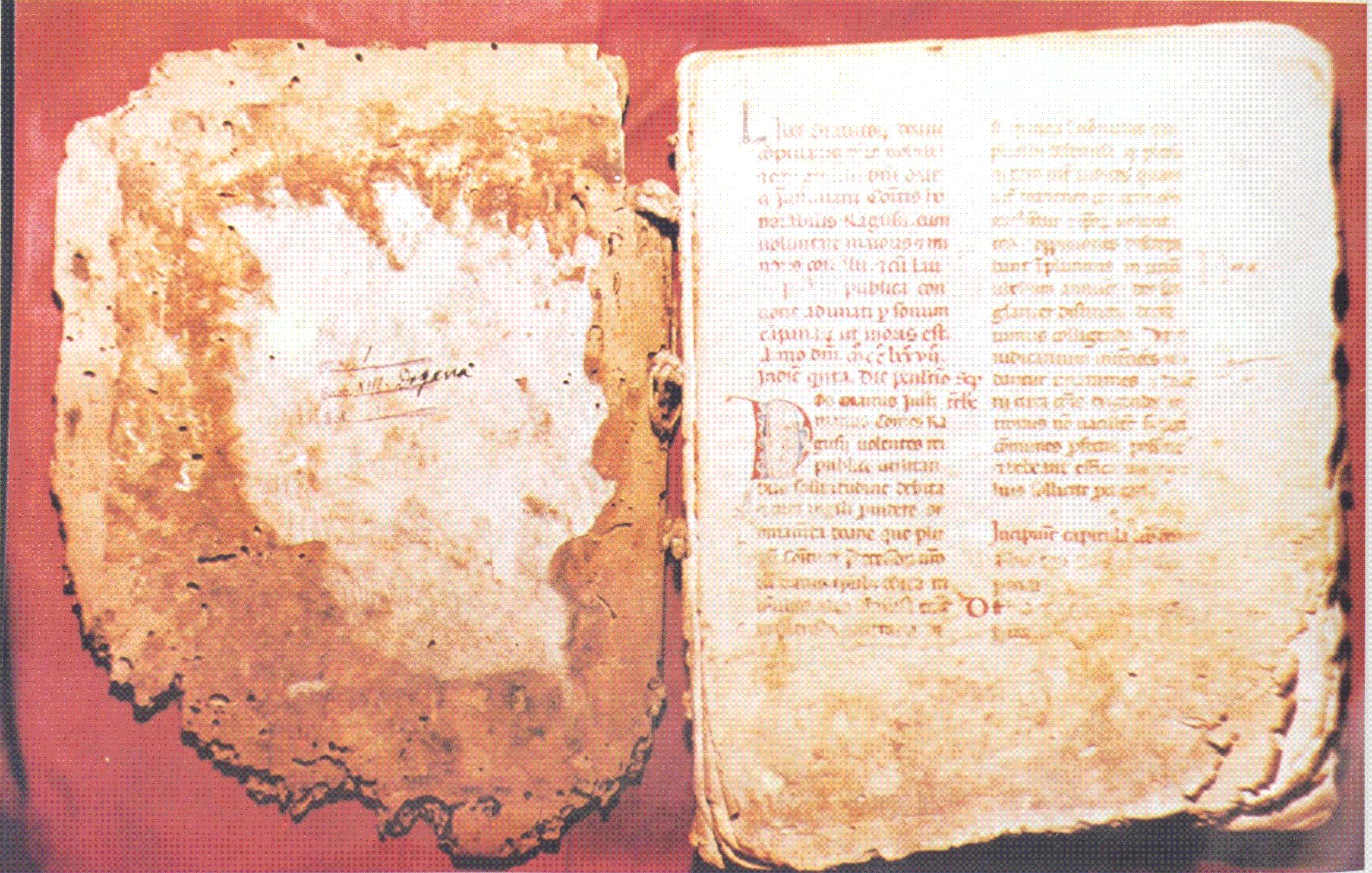
The oldest preserved customs law related to our region was the Dubrovnik customs statute – Liber Statutorum Doane – from 1277 A.D. in Serbia, in addition to case law and national written legal sources, as early back as 13th century the first written legal source of Byzantine origin was applied. Sava Nemanjić, Saint Sava, on declaration of autocephaly of Serbian Orthodox Church in 1219, issued the Nomokanon, a collection of ecclesiastical and civil law regulations.

The oldest preserved customs law related to our region was the Dubrovnik customs statute – Liber Statutorum Doane – from 1277 A.D. in Serbia, in addition to case law and national written legal sources, as early back as 13th century the first written legal source of Byzantine origin was applied. Sava Nemanjić, Saint Sava, on declaration of autocephaly of Serbian Orthodox Church in 1219, issued the Nomokanon, a collection of ecclesiastical and civil law regulations.

This view of our colleague from early XX century was based on historical facts, since customs duties, in the form of tolls or taxes, were known back in the Old Ages.  They were levied by the state or individual cities.  The Old Greeks in Athens imposed a duty of 2% on imports and exports over the Pierian Mountains. The Romans also used to levy such duties as state and provincial or city taxes.  As early back as the Roman times customs duties made up a significant part of public revenues for the state treasury. At certain communication points in the provinces there were customs stations (stationes) where the duties were charged for the goods passing such points. The amount of duties was 2.5% (quadrogesimo) of the value of imported goods. The collection of customs duties was also farmed out, at the beginning granted even to farmers from the ranks of domiciled population, and later on, from mid-2nd century on, duties were collected by officials that in our territory were called publicum portarii Illyrici et ripae Thraciae. In the Middle Ages, in addition to import and export duties, the so-called transit duties were also levied. 

It was the basis for Dušan’s Code, drawn up at the times of developed feudal state in 1349, and amended in 1354, and this Code provided rules for the largest number of social relations.  Medieval Serbian rulers usually farmed out the collection of customs duties, most often to Dubrovnik citizens. After the arrival of Ottoman Turks in the Balkans the structure of revenues was changed entirely. The most important tax was the one paid in money, the so-called desetak (tithe), and also in “fruit of the land” and in labour; also levied were a district surcharge (nahijski prirez), fines, and revenues were also collected from customs duties, transportation and fishing taxes. On liberation from Ottoman Turks, the revenues from customs duties and charges on ferry transportation started to be collected for the first time in May of 1804, when Karadjordje established a customs house with a ferry at Ostružnica. Similar to the rate during the Ottoman rule, the customs duties stood at 3%. The vassal Serbia had to establish its customs tariffs in line with the then applicable provisions of agreements with the Holy See, and Prince Miloš fully complied with the Holy See’s instructions in that area.

Continue reading →

Nigerian Customs Develops Trade Facilitation Portal

NigerianCustoms-BadgeAs part of plans to consolidate on its modernisation efforts for eventual take-over from the service providers at the expiration of the extended contract by June 2013, the Nigeria Customs Service (NCS) says it has developed a web-based application to provide information and guidance for international trade business processors in the areas of import, export and transit trade.

The portal is a non-restrictive online medium and an intuitive and interactive platform for classifying goods, a statement from the Customs spokesman, Wale Adeniyi said yesterday. The portal was developed by the service’s technical partners, nominated officers as well as other stakeholders, it said.

Through the platform, trade processors are enabled to find exact Harmonized System Codes (HS Codes) required for related tariffs and duties. It is expected that the platform will enhance compliance by traders and avail them the required information on tariff, prohibited items as well as taxes/levies due for payment upon importation.

Adeniyi explained also that the application has been designed to boost trade facilitation by granting trade processors access to information from all related government agencies. “Guidelines and procedures for obtaining permits, licences and certificates of specified commodity and country of origin that a trade will require for business processing is available on the portal,”he said. He added that the portal further allows traders to convert currencies to exchange rates set by the Central Bank of Nigeria on a monthly basis, make payments and simulate tax. Source: The Daily Trust