Zimbabwe Industry slams ASYCUDA

With much talk of intra-African trade, perhaps its a good time to consider increased collaboration between customs administrations regarding modernisation initiatives. It helps little for trade if the system only works on one side of the border. The case in point demonstrates a painful realization of too little mediation with stakeholders.

THE Zimbabwe Revenue Authority‘s introduction of the latest version of an automated customs clearance management system has brought industry to its knees as goods in transit are stuck at the country’s ports. The system challenges at Zimbabwe’s ports is particularly worrisome for importers as the majority are set to close shop today for the festive season. ASYCUDA is an acronym for Automated System for Customs Data, an automated customs clearance management system.

The Shipping and Forwarding Agents’ Association of Zimbabwe (Sfaaz) held a crisis meeting in Harare, where they intended to engage the Ministry of Finance and Zimra officials who had been invited. Ministry of Finance and Zimra officials were, however, conspicuous by their absence. Sfaaz chairman Mr Phanuel Gukwe said the system, whose implementation commenced in October, had significantly slowed down clearance procedures. “There is perennial breakdown of operations at most ports, which means no imports are coming out of Zimra, funds are locked in prepayment accounts and turnaround of bill of entries is taking up to two weeks instead of the normal three hours.

“Contrary to expectations when Zimra proposed the system, the situation at ports has worsened drastically,” he said. The situation at the country’s ports, which is now in its third month, might have implications on the revenue collection targets for the fourth quarter, especially in terms of excise duty, import duty and customs tax.

Questions sent to Zimra were unanswered by the time of publication yesterday. ASYCUDA 2.3 was the earliest version to be introduced in Zimbabwe in 1992 and was upgraded to versions 2.5 and 2.7. ASYCUDA++ later came on board in the form of version 1.15 and 1.18. Currently, Zimra is rolling out ASYCUDA World version 4.0.21 to over 14 stations.

Mr Gukwe said Zimra had ignored the association’s earlier proposal to stagger the implementation of the new system. “We had proposed to Zimra to follow the example of South Africa, which undertook to implement the system at limited ports at a time, but they rather chose to go wholesale. Zimra also ignored us when we pressed them for a fallback system to be put in place,” he said.

The Wednesday crisis meeting, that was emotionally charged, saw importers level a range of accusations against Zimra. Some said Zimra had only two examining officers at some border posts, which means the slow clearance was an issue not just of failure in connectivity but also manpower shortages. It was also observed that when clients of local importers called Zimra to find out about the system challenges, Zimra officials were telling them that problems with the system had since been rectified, a situation that was portraying the local importers in bad light.

“I do not think it is legal for Zimra officials to be discussing these matters with our clients, they should only communicate with those who put in the bill of entry,” said one Sfaaz member. Others accused Zimra for being nonchalant. “Zimra should be taking responsibility on this matter. They could have at least eased our plight by arranging for the reduction or waiving of storage fees. We are paying some serious money for storage for weeks on end, which is driving up our landing costs,” said an importer.

Observers warn that if the problem continues, it could have wider repercussions on the economy, which is still a net importer of most goods. Meanwhile, Sfaaz officials were yesterday engaged in a closed door meeting with top Zimra officials over the matter. Source: The Herald (Zimbabwe)

Pre-shipment Inspection (PSI) – an antiquated approach

Recently, an organisation called Global Inspection Group (GIG) has advocated PSI – an import verification system – as a solution to counteract South Africa’s trade deficit. The article Import verification would outlaw customs fraud’ alludes to the apparent success of these mechanisms in other African states to support quality and import standards in those countries, respectively. Because South Africa has no verification of imports system ‘it is easy to systematically under-declare goods’, the article states. Furthermore, it mentions that a Finance ministry would benefit from such a system ensuring the collection of the correct duties. [Really? how naive].

South Africa is a free country, and it follows that organisations will go to extremes to secure a business foothold in the country. The question is – to what length and to what end? If any ministry of finance were to rely on a PSI company, it would first disband its customs department, because there is evidently no trust in its frontline and post clearance capability.  Most governments (if not all) are pretty much aware of the broader international customs developments championed by the WCO. In recent years, the WCO has developed several diagnostic studies and programmes – with the option of donor funding if required. There would therefore be no sense or credibility in a government that would persist in pursuance of PSI services for fiscal assurance.

Any trade practitioner and supply chain operator in South Africa will readily confirm the hectic ‘change’ programme which is being pursued under Customs Modernisation. These changes and their associated systematic innovations and efficiencies are by no means the result of government capitulating in the face of illegitimate trade. No, it’s a conscious decision to take responsibility for the problem, and together with the allied trade to improve the situation.

It is therefore high time that such organisations which front themselves with the ‘be-all and end-all’ systems in Customs’ tariff and valuation appraisal rather seek a more practical and benefit-delivering model than one which not only scams governments for service and inspection fees, but also offers no benefit to trade. Included are those BOT vehicles offering governments ‘free’ cargo scanning equipment in exchange for a lucrative inspection fee. None of this is based on risk management and is purely profit focussed. The concept forgoes most if not all, the modern customs principles and standards promoted by the WCO. The buzz word is ‘Capacity Building!’

The reality in all of this should be clear. No private sector entity can replace Customs. Outsourcing in any event would require government to set up a vehicle of its own to ‘ensure’ that the outsourcer is doing his job. If there is a dearth in knowledge and skills, then it is up to government to rectify the situation.  Source: FTW Print version.

Ports back campaign to weigh all export containers

The International Association of Ports and Harbours (IAPH) has joined the World Shipping Council (WSC) and International Chamber of Shipping (ICS) in urging the International Maritime Organization (IMO) to establish an international legal requirement that all loaded containers be weighed at the marine port facility before they are stowed aboard a vessel for export. In what has been a much publicized issue since 2008 in the maritime industry, much the same view is taken by customs administrations. Like many other changes in the supply chain, it is a lot easier said than done. Modern ports are designed and developed taking into account requirements for weight bridges, radiation portal monitors, networks to monitor vehicle and container movements in and around port precincts, and inland transportation routes. While the expense and budget for these are usually borne by the relevant port authority, would it not indeed be good if those responsible for the packing/stuffing of containers took it upon themselves to ensure the correct weight, quantity and content are properly declared?

Refer to the joint WSC/ICS paper on “Solving the Problem of Overweight Containers” as well as the ICS’s “Safe Transport of Containers by Sea”. Both are self explanatory and short enough so as not to be considered laborious. In the South African context the question of who packed the box is often unanswered given that a variety of entities could be involved in this activity. In some instances it could be a container depot operator or a freight forwarding and consolidation agent; depending on how ‘safety and compliant conscious’ the shipper wants to be. While it will still take some time before the entire supply chain becomes properly regulated and monitored, now’s the time for ‘operators’ to take stock of what might in future be a new standard. New standards mean more capital outlay with pass-on costs for which the shipper ultimately carries the can.

New Mozambique Customs System will reduce processing time

Customs processing times for goods imported into Mozambique will be lowered from the current minimum of three days to just a few hours with the introduction of a modern customs processing system, Mozambican daily newspaper Notícias reported.

Known as the Single Electronic Window, the new tool is made up of two computer systems – the integrated customs management system and the operators’ mechanism.

Via the Single Electronic Window importers are able to submit the customs declaration and pay all fees via a retail bank before the actual unloading of the goods, which will reduce their processing time.

Rosário Fernandes, chair of the Mozambican Tributary Authority said that the transmission network for the Single Window (Janela Única), managed by MCNet (Mozambique Community Network), would show the cargo manifest and customs declaration from carriers or owners of the goods, processing, payments inspection and management of the output of imported goods.

MCNet is 60 percent-owned by the Escopil Internacional and SGS Moçambique consortium and by the State and Confederation of Economic Associations (CTA), each with a 20 percent stake. Source: macauhub

Freight forwarders’ liability is being boosted by expanding supply chains

TT Club, the international transport liability insurer, is warning that freight forwarders and other transport intermediaries face increasingly significant liability risk, particularly in emerging markets, as they take on additional supply chain services for their customers. TT Club specialises in the insurance of liabilities and equipment for multi-modal operators.

Traditional freight forwarders, who have seen the opportunity to offer extended warehousing, packaging, delivery fulfilment and even purchasing functions for shippers are not always fully aware of the liabilities for cargo loss and third-party damages that these additional tasks are opening them up to, according to Andrew Kemp, European regional director of the TT Club.

He told the Cargo and Freight Insurance Annual Conference in Moscow that as supply chains continue to develop to supply emerging markets, where the cargo owners are not always willing to invest in distribution infrastructure, the out-sourcing of such tasks will proliferate.

This could bring significant new business opportunities to companies, which had previously limited their service offerings to freight forwarding and the organisation of international transport, but these additional procedures could be complex.

“A typical new type of activity would be the packaging, for the local retail market of an item with a sales promotion attached (price discount or two for one offer). This task is straightforward in itself but brings with it risks of errors and possible damage to the items. This would be something not experienced by transport operators in the past,” he said. Source: Logisticsmanager.com

Mobile Customs Control – Great minds think alike

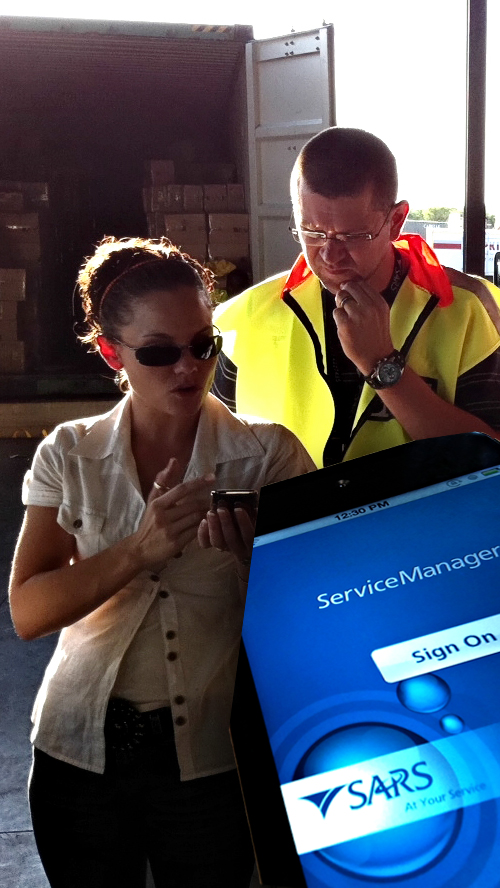
Beitbridge inspection area6 December 2010 saw the rollout of a new electronic tool for customs inspectors at Beitbridge border post. The need for a hand-held device was identified following the rollout of a new workflow system, called Service Manager, to various Customs offices over the past few months. Although the changes introduced recently were aimed at moving Customs to a totally paperless environment, customs inspectors still had to print out their instructions on paper, manually write down the inspection results and then recapture these onto the system back in the office.

The use of an iPod by a Customs officer to conduct a physical inspection at Beitbridge this week introduces significant enhancements over the previous manual process. SARS has been liaising with iPod experts in various countries around the world over the past few months to develop this function and procure the devices.

The solution comprises an Apple iPod Touch which has been configured to operate SARS’ automated inspection workflow application – Service Manager. The introduction of a hand-held device therefore means that all the functions of Service Manager are now at the inspector’s finger-tips. Inspectors receive their instructions on the iPod, capture the results and make recommendations which then go to the finalisation/adjustment inspector. They can even take photographs with the iPod if they need further clarification on the goods they are inspecting. Inspectors no longer have to go back and forth to the office and their next job can be assigned to them on the spot. This is expected to substantially reduce the time spent on physical inspections and minimise human error.

Initially 34 iPods were procured for Beitbridge, WiFi technology was made available at the port and training of affected staff undertaken. All physical inspections at Beitbridge were being conducted with iPods and will be rolled out to the other Customs border posts throughout 2012.

While SARS’ solution is the first known Apple solution of its kind, similar solutions have been introduced recently within the US Bureau for Customs and Border Control and the Australian Border Control Agency offering varying types of functionality, including the integration of RFID technology by the Australians to monitor and track cargo movements. Life for Customs officers is a whole different and will continue to evolve if it expects to remain in touch with modern era fraud and scams.

WCO – 2012 is the year of Connectivity

WCO 60 Years AnniversarySecretary General of the WCO, Kunio Mikuriya, is pleased to announce that 2012 will be dedicated to promoting connectivity, including enhanced cooperation and communication, under the slogan “Borders divide, Customs connects”.

“Connectivity encompasses people-to-people, institutional, and information linkages that underpin and facilitate the achievement of Customs’ main goals,” said the Secretary General. “This theme is particularly relevant as the WCO prepares to commemorate its 60th anniversary in 2012,” he added.

The Year of Connectivity will be launched on International Customs Day, celebrated annually by the global Customs community on 26 January in honour of the inaugural session of the Customs Co-operation Council (CCC) which took place on 26 January 1953.

In 1994, the CCC adopted the informal working name “World Customs Organization” to better reflect its worldwide growth in membership which now totals 177 Customs administrations.

Customs and its stakeholders are urged to be innovative and creative in taking forward the connectivity theme in all its facets throughout 2012. The WCO invites the Customs community to diarise 26 January. Source WCO.

Customs Connect 2 – SA Customs Modernisation

Customs Connect 2The year 2011 has proven both challenging and beneficial for many in the South African Customs community. New business opportunities offered via the Customs Modernisation Programme materialised and provided the service providers ample scope to improve their service offerings to clients in the freight forwarding and clearance space. Leveraging off tried and tested technology tools already employed by SARS in the Tax business, the implementation of E@syScan provided significant efficiencies in the customs clearance processing response times, although the jury is still out on whether such efficiencies have in fact translated into cost-savings for the customs trade. In this regard it is up to trade itself to assess if the traditional cost of printing reams of paper and employing a runner to deliver manual documents to Customs is significantly reduced by the new electronic supporting document process. Could be an interesting exercise.

On the SARS front, the implementation of a new automated case management, and inspection workflow is nothing short of a revelation in so far as traceability and improved efficiency. Similarly, such efficiency needs to translate into cost savings. Certainly there are less manual interventions in the process, the emphasis now moves to working more smartly as regards the booking and conducting of physical inspections. True this has been a huge learning curve for all. Refinements and fine-tuning of the process moving forward will undoubtedly release the expected results to the point where most will wonder how they ever managed in ‘manual mode’ in the past.

To close off the year, SARS has just published its second edition of its electronic Customs bulletin – Customs Connect. Please take the time to read and digest.

Free Trade talks to kick continent into the future

The first round of negotiations to establish a free trade area covering 27 countries in southern and east Africa will kick off on December 8, in Nairobi. It is envisaged that the negotiations will be completed in 36 months. (Really?)

The three trade blocs involved – the Southern African Development Community (SADC), the East African Community (EAC) and the Common Market for Eastern and Southern Africa (COMESA) – decided in October 2008 in Kampala to move towards a free trade agreement.

The intention is to boost intra-regional trade because the market will be much bigger, there will be more investment flows, enhanced competitiveness and the development of cross-regional infrastructure.

Industrialisation, making goods to sell instead of selling primary products, is a possible and also necessary spin-off. Competition with older established and also bigger emerging economies might be a stumbling block initially, but the huge new market may make it possible for locally manufactured goods to compete with those imported from outside the FTA.

Close to 600 million people live in the FTA with a gross domestic product of $1 trillion – suddenly we are boxing in the same weight division as China, India, Russia, Brazil, the US and the EU. Source: All Africa.com.

BriberyComment: Heard all of this before?  It could be hoped that some positive developments will materialise from more talkshops with promises to alleviate poverty and increase Africa’s slice of the international market. While the retail and telecommunications industries have made significant inroads into Africa, manufacturing remains a moot point. Does Africa have the political will to take risks? Removing internal border controls for instance are not high priority for sovereign governments. Neither for that matter is the question of the integrity of officials who man these borders. And, neither is the matter of removing one of the key contributors to cross border fraud – the “paper customs declaration”. Nonetheless, attempts are still being made to redress these ills. Recent developments within SACU indicate a genuine move towards customs-2-customs information exchange based on the ‘Customs Inter-connectivity’ concept. More on this shortly.

US and EU one step closer to Mutual Recognition agreement

The U.S. Customs and Border Protection (CBP) and the European Union Taxation and Customs Union Directorate (TAXUD) have agreed to language for the U.S.-EU Mutual Recognition Decision today which will lead to its signing in the Spring of 2012. Once signed, the Mutual Recognition Decision will recognize the respective trade partnership programs of the U.S. and the EU—CBP’s Customs-Trade Partnership Against Terrorism (C-TPAT) and the EU’s Authorized Economic Operator (AEO)—with reciprocal benefits.

In 2007, CBP and TAXUD initiated efforts to implement Mutual Recognition between C-TPAT and AEO. Mutual Recognition is an industry partnership program that creates a unified and sustainable security posture that can assist in securing and facilitating global cargo trade. Upon achieving mutual recognition with a foreign partner, one program may recognize the validation findings of the other program.

C-TPAT is a voluntary government-business initiative to build cooperative relationships that strengthen and improve overall international supply chain and U.S. border security. C-TPAT recognizes that U.S. Customs and Border Protection can provide the highest level of cargo security only through close cooperation with the ultimate owners of the international supply chain such as importers, carriers, consolidators, licensed customs brokers, and manufacturers. CBP currently has mutual recognition with: New Zealand, Canada, Japan, Korea and Jordan. Source: USCBP

Related articles

Insight behind the WCO Data Model

WCODMV3 Technical BrochureGovernments around the world have realized that rapid economic growth cannot be achieved in an environment where international trade processes are inefficient and cumbersome. Over the past two decades, serious attention has been devoted to the modernization of international trade and cross-border regulatory procedures. Countries have committed substantial resources to national projects in the areas of customs automation and Electronic Data Interchange (EDI) infrastructure.

Electronic ‘Single Window’ services delivery is now being demanded in several countries. Based on the principle of joined-up government services, the ‘Single Window’ environment has the potential to deliver transformational advantages to business by simplifying and unifying touch-points between members of the trade and the different government departments involved in cross-border regulatory procedures. In addition, new demands on supply chain security and facilitation have emerged, leading to the establishment of the WCO SAFE Framework of Standards.

This booklet provides a brief introduction to WCO Data Model Version 3.0. It explains the scope of the Model, its relationship with other international instruments such as the Revised Kyoto Convention, and its alignment with widely used international standards. The booklet is aimed at project leaders and Information Technology architects from Customs administrations and other cross-border regulatory agencies. The World Customs Organization hopes that this booklet will create a proper understanding of the value of the WCO Data Model as an indispensable instrument in projects that address modernization of regulatory agencies including Customs. Source: WCO.

Please visit: http://wcoomdpublications.org/data-model-3.html for pricing and conditions of online WCO Data Model usage and support. Available for Customs administrations and Trade Practitioners.

Related article

Latest Edition – World Customs Journal

Just in time for the Christmas holiday break! A new edition of the World Customs Journal is now available and, per usual, offers a number of excellent papers on current issues and demands facing Customs and Border Control agencies. Professor David Widdowson, editor-in-chief, and head of the Centre for Customs & Excise Studies (CCES) at the University of Canberra, Australia makes some poignant remarks about customs education, research and the application thereof in the modern world –

World Customs Journal - Sept 2011“one very clear message for me is the need to ensure that our research remains demand-driven rather than supply-driven, otherwise it won’t be valued or, worse still, it won’t even be read by those who could potentially benefit from it. In this regard, there is a need to monitor the effectiveness of what we do – to what extent is the theory being translated into practice? To what extent are academic efforts and activities found to be useful by the WCO and its member administrations? To what extent are research findings being applied in a practical sense? This is, in itself, a fertile area for future research.”

These are very pertinent views given the volume of students undertaking these courses, who in many cases work in customs environments (at home) which are seemingly both oblivious and ignorant to the importance of academic knowledge and human intellect. With so much importance and bias on the ICT nowadays, the technical skills and attributes of what makes a good customs and border control official are relegated to secondary importance. Please read the articles

Related article

Three tax risks to consider when managing your supply chain

Supply Chain Management (SCM) aims at fulfilling customer demands through the most efficient use of resources, which includes distribution capacity, inventory and labour. Merely locating the assets and risks of one’s supply chain in a favourable tax jurisdiction is not sufficient. The functions, together with the people, must be located in the chosen jurisdiction to manage these particular assets and risks. It is essential that the systems and processes, implemented and applied, support these functions in order to create a sustainable tax benefit.

Local tax authorities will attempt to defend their tax base at all costs. This may result in the local tax authorities seeking substantial taxable capital gains and/or transfer pricing adjustments when restructuring actions (which reduce the ultimate tax they would have received) are implemented.

Therefore, careful planning and documentation substantiating the reasons why certain steps were taken, are essential to ensure most tax risks are mitigated. Transfer pricing documentation also forms an important part of the documentation required. In the absence thereof, a substantial amount of time and resources may need to be set aside in the event that adverse assessments have to be defended. Read the rest of the advice of local tax consultants at the following link: Deloitte Tax identifies three tax risks to consider when managing your supply chain.

GSP – Good news for developing countries

The European Commission adopted a regulation revising rules of origin for products imported under the generalised system of preferences (GSP). This regulation relaxes and simplifies rules and procedures for developing countries wishing to access the EU’s preferential trade arrangements, while ensuring the necessary controls are in place to prevent fraud.

The Regulation adopted by the Commission today will considerably simplify the rules of origin so that they are easier for developing countries to understand and to comply with. The new rules take into account the specificities of different sectors of production and particular processing requirements, amongst other things. In addition, special provisions are included for Least Developed Countries (LDCs) which would allow them to claim origin for many more goods which are processed in their territories, even if the primary materials do not originate there. For instance, an operator in Zambia that produces and exports plastics to the EU will benefit from the new rules of origin, because even with up to 70% of foreign input the exported plastics can still be considered as originating from Zambia. These new rules should greatly benefit the industries and economies of the world’s poorest countries.

The proposal also puts forward a new procedure for demonstrating proof of origin, which places more responsibility on the operators. From 2017, the current system of certification of origin carried out by the third country authorities will be replaced by statements of origin made out directly by exporters registered via an electronic system. This will allow the authorities of the exporting country to re-focus their resources on better controls against fraud and abuse, while reducing red-tape for businesses. The new rules of origin will apply from 1 January 2011.

For more information on the new proposal please check: http://ec.europa.eu/taxation_customs/index_en.htm

Another WCO resource for the Customs and Trade Professional

The WCO developed the Revenue Package in response to Members’ concerns in regard to falling revenue returns in the light of the global financial crisis and declining duty rates.

Revenue PackageCollection of revenue has historically been the cornerstone of a Customs administration’s responsibilities. For a number of years, Customs has been actively involved in protection of society and trade facilitation initiatives. More recently, the role of Customs has expanded; issues such as the fight against counterfeiting, counter-terrorism activities and the protection of the environment have featured high on the agenda of international Customs work programmes. Alongside these important topics, revenue collection continues to be an area of concern for Customs administrations. The global financial crisis has led to a downturn in international trade which has inevitably hit government revenues. Additionally, the global trend in the reduction of Customs duty rates, through unilateral, regional, and multilateral trade liberalizations, can potentially have the same effect.

The Revenue Package currently consists of all available tools and instruments relevant to revenue collection. This includes, inter alia, formal instruments and Conventions, guidance notes and training material. Members are encouraged to consult the Package to ensure that necessary requirements have been met and that all relevant material has been obtained by the administration and is being utilized as appropriate.

The Revenue Package is divided into six topics :

  • Topic 1. Facilitation and Procedures
  • Topic 2. Customs Valuation
  • Topic 3. Harmonized System/Nomenclature
  • Topic 4. Origin
  • Topic 5. Compliance and Enforcement
  • Topic 6. Capacity Building and Training

Under each topic, the prime text is referenced, where appropriate. For example, for Topic 1 (Facilitation and Procedures), the Revised Kyoto Convention is the prime text. This is followed by a list of supporting instruments and tools for that topic, providing information on content and availability. Web links are included to provide convenient access to the relevant material, which is either freely available to download or available for purchase from the WCO’s Online Bookshop. Source: WCO.