A South African RFID/GPS cross-border logistics and customs solution

Inefficiency of road freight transport is one of the primary factors that hamper the economy of sub-Saharan Africa. Long delays experienced at border posts are the single biggest contributor towards the slow average movement of freight. Cross-border operations are complicated by the conflicting security objectives of customs and border authorities versus efficiency objectives of transport operators. It furthermore suffers from illegal practices involving truck drivers and border officials. In theory the efficiency of cross-border operations can be improved based on the availability of more accurate and complete information – the latter will be possible if different stakeholders can exchange data between currently isolated systems.

Cross-border trade basically comprises 3 distinct but interlinked layers –

An information layer – in which various trade documentation (purchase order, invoice), cargo and conveyance information (packing list, manifest), customs and government regulatory data (declaration, permits) are exchanged between various supply chain entities and the customs authority. These primarily attest to the legal ownership, contract of carriage, reporting and compliance with customs and other regulatory authority formalities (export and import), and delivery at destination.

A logistics layer – for the collection, consolidation, sealing and conveyance of physical cargo from point of despatch via at least two customs control points (export and import), to deconsolidation and delivery at point of destination.

A financial layer – which refers to the monetary exchange flow from buyer (importer) to seller (exporter) according to the terms and conditions of the sale (INCOTERMS). Hmm… no, this does not include ‘bribe’ money.

All three layers are inter-linked and prone to risk at any point of a given transaction. There is also no silver bullet solution to secure supply chains. Moreover, it is a fallacy that Customs and Border Agencies will ever conquer cross-border crime – simply because there are too many angles to monitor. Furthermore, in order to set up cross—border information exchange and joint enforcement operations it is both legally and politically time-consuming. Criminal elements are not hampered by these ‘institutions’, they simply spot the gaps and forge ahead.

One of the areas requiring customs attention is that of chain of custody. In short this implies the formal adoption of the World Customs Organisation’s SAFE Framework principles. Each party with data that needs to be filed with the government for Customs and security screening purposes has responsibilities. Those responsibilities include –

  • Protecting the physical goods from tampering, theft, and damage.
  • Providing appropriate information to government authorities in a timely and accurate manner for security screening purposes.
  • Protecting the information related to the goods from tampering and unauthorized access. This responsibility applies equally to times before, during and after having custody of the goods.

Tenacent RFID Tag

Tenacent RFID Tag

Security seals are an integral part of the chain of custody. The proper grade and application of the security seal is addressed below. Security seals should be inspected by the receiving party at each change of custody for a cargo-laden container. Inspecting a seal requires visual check for signs of tampering, comparison of the seal’s identification number with the cargo documentation, and noting the inspection in the appropriate documentation. More recently the emergence of certain e-seals and container security devices (CSDs) contribute even further to minimizing the amount of ‘physical’ verification required, as they are able to electronically notify the owner of the goods or government authority in the event of an incidence of tampering.
White Paper - GPS-RFID systems for cross-border management of freight consignments

White Paper – GPS-RFID systems for cross-border management of freight consignments

A group of South African specialist engineers have been working closely with transport authorities, logistics specialists, defense experts and customs authorities across the globe. Their e-seal is patented in no less than 16 high volume countries. It is produced in Singapore, China and Indonesia depending on politics, free-trade agreements and demand. May move some to Brazil and US in time. Proof of concept (POC) initiatives are currently underway in Brazil for rail cargo, US Marine Corps for their p-RFID program and other Department of Defense divisions in the USA, and will shortly be included in one of the GSA agreements making it available to any government department in the US. Further adrift, the e-seal is also currently enjoying interest in Guatemala, Mexico, Canada, Panama, Jordan, Italy, Spain, and Malaysia. Here, in South Africa, a POC was conducted at the 1st autogate at Durban Container Terminal, funded by the North West University, and overseen with successfully achieved objectives by Transnet Port Terminals. For technical details of the RFID seal, click here!

With much anticipated success abroad, how much support will this product attain in the local and sub-Saharan African scene? Government authorities, as well as logistics and supply chain operators are therefore encouraged to study the enclosed ‘white paper’ – Click Here!. It firstly quantifies the size of the problem and estimates the potential economic benefits that will be created by improved cross-border operations. It then proposes a combined GPS/RFID system that can provide the required level of visibility to support improved operational management, resulting in a simultaneous increase in the security and efficiency of cross-border freight operations. A brief cost-benefits analysis is performed to show that the expected benefits from such a system will by far exceed the costs of implementation. Source: Tenacent & iPico

Freight-forwarder liability at a glance

services_import_SnapseedActually, this is a view from the Ukraine. In modern practice, the organisation of the transport process often necessitates direct international multimodal transportation, in which case the freight forwarder carries out the contract of carriage as a multimodal transport operator, even if it does not directly own any vehicles. However, a trend has arisen in which the functions of the carrier and forwarder are combined. Under this model, traditional carriers diversify their activities by creating a forwarding unit within their companies, or forwarding agents acquire vehicles or create dependent carriers. Furthermore, forwarders often hire subcontractors to undertake the shipment; as a result, cases of loss or shortage of goods and claims against forwarding agents can become quite complicated. 

General provisions

Ukrainian legislation does not provide detailed rules governing freight-forwarding activities. The Law on Freight-Forwarding Activities, the Civil Code and the Economic Code stipulate only the general regulations of freight forwarding.

In accordance with Clause 1 of the Law on Freight Forwarding Activities, the contract of freight forwarding is a contract in which the freight forwarder agrees, at the client’s behest, to perform or arrange for the performance of certain contract work related to the transportation of goods. The forwarding agent is entitled to engage other parties for the execution of certain work under the contract (eg, transportation, storage, loading and unloading).

The law includes only general provisions under which the freight forwarder may be held liable to the customer (unless provided otherwise in the contract) for:

  • the number of packages;
  • the weight of the packages (if the weighing was conducted in the presence of the carrier and confirmed with its signature); and
  • packaging requirements under the related shipping documents (signed by a representative of the carrier).

Issues regarding the forwarder’s liability are also governed by the general provisions of the Civil Code, which provides for liability for breach of obligations under the contract. Thus, Article 623 of the code provides that a debtor in breach of its obligations must compensate the creditor for losses caused.

Where the freight forwarder engages third parties to fulfil its obligations under the contract of freight forwarding, the forwarding agent will be held fully responsible for the actions and omissions of the third parties.

Ukrainian law lacks specific rules that directly limit the freight forwarder’s liability to the client. Detailed rules governing the forwarding agent’s liability to the customer, as well as grounds and limitations of such liability, are fixed by the parties in the contract of freight forwarding.

At the same time, Ukrainian legislation contains general rules that allow for the release of the freight forwarder from liability. In accordance with Clause 614 of the Civil Code, a party that has violated its obligations will be held responsible only if found guilty (intently or negligently), unless otherwise agreed in the contract. Disputes in connection with claims against freight forwarders for loss of cargo in transit are common in Ukraine, so there is ample case law in the area. However, since Ukrainian legislation provides only general provisions on the freight forwarder’s liability, court practice for such disputes is often ambiguous and contradictory. In particular, there have been separate cases with similar circumstances in which the court variously found the freight forwarder both liable and not liable for cargo loss in transit. Continue reading →

SA Ratifies the Sanitary and Phytosanitary Annex to the SADC Protocol On Trade

WTO-SPS-Measures-Presentation-Transcript-23698Cabinet approved South Africa’s ratification of the Sanitary and Phytosanitary (SPS) Annex to the Southern African Development Community‘s (SADC) Protocol on Trade and for this to be submitted to Parliament.

Agriculture is one of the key sectors in the SADC region due to the sector having the highest potential for growth in terms of export. SADC realises, however, that the sector can only grow significantly if producers are able to access markets for agricultural products. To facilitate market access and promote intra Africa trade it is critical that border trade policies, including SPS measures be harmonised in line with international standards and guidelines in the interest of improving the movement of goods and services in the region. (Read in more red tape)

The SADC Protocol on Trade to which SA has acceded, serves to promote regional cooperation and integration amongst member states for trade in goods and services within the region, including agricultural products.

Article 16 of the Protocol encourages member states to base their Sanitary and Phytosanitary (SPS) measures on international standards, guidelines and recommendations so as to harmonise SPS measures for plant health, animal health and food safety.

To give effect to the provisions of Article 16 of the Protocol, an SPS annex to the SADC Protocol on Trade was drafted and consequently adopted by the SADC Committee of Ministers of Trade (CMT), in July 2008.  Annex VIII to the SADC Protocol on Trade concerning SPS measures represents an enabling regional strategy to promote cooperation in SADC with regards to issues of food safety, plant health and animal health.

In addition, most SADC member states are also signatory members to the World Trade Organisation‘s Agreement on Sanitary and Phytosanitary measures (WTO-SPS) which places obligations on member states to ensure that the SPS measures they implement are least restrictive to trade, while being scientifically justifiable for the protection of human, animal or plant life and health.

The ratification and implementation of the SPS Annex will therefore facilitate improved mechanisms and institutional arrangements in conformity with obligations under the WTO-SPS agreement so as to minimise SPS related issues that impact the trade of agricultural and services trade within the region. Source: SA Government

Want to understand more on the WTO Agreement on Sanitary and Phytosanitary MeasuresClick here!


Rwanda Customs Process Made Easier for Tax Compliant Traders

Headquarters of the Rwanda Revenue Authority

Headquarters of the Rwanda Revenue Authority

Thirteen companies, three of them Rwandan, last week signed a Memorandum of understanding with Rwanda Revenue Authority to be accorded preferential treatment when clearing their goods at customs. The Authorized Economic Operator (AEO) is a regional trade facilitation program recommended by the world customs organization to ease trade and customs clearance for tax compliant and prominent importers and exporters.

Delay in clearing goods at customs is one of the major impediments to smooth trading within the East African Community (EAC). It also contributes to making the EAC region one of the most expensive places to do business despite being the second most growing economy in the world. The AEO creates some kind of obstacle-free zone where traders in the import or export business, known to be complaint with customs requirements, are accorded special treatment to ease the process of clearing their goods while in transit.

The pilot project will see how the system works in reality and the beneficiaries have all been informed of their rights and which ports or borders to claim them from. Rwanda customs officials issue special identifiers to the beneficiaries to help them identify the benefiting traders once their goods appear at any of the designated custom points. These identifiers will be recognizable everywhere in the five partner states of the EAC where the beneficiaries will pass and claim their privileges as AEO.

The growth of global trade and increasing security threats to the international movement of goods have forced customs administrations to shift their focus more and more to securing the international trade flow and away from the traditional task of collecting customs duties.

Recognizing these developments, the World Customs Organization (WCO) drafted the WCO Framework of Standards to Secure and Facilitate global trade (SAFE). In the framework, several standards are included that can assist customs administrations in meeting these new challenges and developing an Authorized Economic Operator programme is a core part of SAFE. Source: AllAfrica.com

Nigeria to Change from FOB to CIF

Trade policy - a balancing actThe Federal Government of Nigeria is set to change its trade policy from the present Free on Board (FOB) to Cost, Insurance and Freight (CIF) which most countries across the world use because of its economic benefits, before the end of the year. FOB makes it mandatory for the buyer to determine who ships and insures the goods to his port of destination while the CIF ensures that the seller determines who ships and who insures the goods brought from him. Presently, goods bought from Nigeria are on FOB basis while Nigerian trade with other nations is on a CIF basis.

Disclosing the position of the federal government to Vanguard in Houston, Texas at the ongoing Offshore Technology Conference (OTC), Leke Oyewole, Special Adviser to President Goodluck Jonathan, said work has been completed on the document for a change in policy so as to help indigenous operators. (?)

The Economic Management Team (EMT) is to take a final look at the policy before returning it to the President for it to be signed into law.

Asked whether the policy would be reversed before the end of the year, the Special Adviser to the President said, ” I am hopeful, am very hopeful, but you also know that if today the President signs the policy into law, Nigerians would not begin by tomorrow. We need to give time sufficient enough for Nigerians to acquire vessels to begin to carry.”

He noted that the country presently “operates on FOB, in which case, as soon as we put cargo onboard the ship, foreign funds are released to Nigeria. When we go on CIF, it will mean waiting until delivery of cargo, before the money will come into Nigeria. There will be a gap, that gap most not be too wide otherwise it will hamper the national funding because we get most of our revenue from these products (petroleum products). Source: Vanguard, Lagos.

EAC Traders Encouraged to Grab AEO Business Opportunities

EACThe EAC business community has been asked to take advantage of the Authorized Economic Operator (AEO) scheme that seeks to cut down costs of doing business in the East African member states.

The AEO programme, launched in Dar es Salaam on Wednesday, is an entity involving importers, clearing agents, transport companies authorized to import and move cargo within the EAC region with minimal inspections and other customs interventions at checkpoints.

The Permanent Secretary in the Ministry of East African Cooperation Dr Stergomena Tax, launching the World Customs Organisation (WCO)-AEO pilot programme said, “The AEO status can provide companies with significant competitive advantages in terms of supply chain certainty and reduced import costs and finally to the final consumer.”

Apart from reduced transport costs, Dr Tax said the programme would also pull down storage charges because of minimal customs border inspections as well as few checkpoints or road blocks for transit goods.

The Swedish Ambassador to Tanzania Mr Lennarth Hjelmåker said the AEO scheme is a broader compliance strategy to reward compliant traders with simplification benefits which are concrete and predictable.

“Regional integration and cooperation are factors which are important for development, including creation of favourable conditions under which private sector can operate and provide for economic growth with focus on sustainability,” he said.

Sweden, through the Swedish International Development Cooperation (SIDA), has been supporting the work carried out by the WCO-EAC-AEO programme since 2008. Speaking on behalf of the Tanzania Revenue Authority (TRA) Commissioner General Mr Saleh Mshoro, the revenues body’s Finance Director said efficiency and effectiveness of customs procedures can significantly boost the nation’s economic competitiveness.

The launching of AEO programme marks the beginning of a journey between the region’s revenues authorities and the business communities in facilitating smooth and win win trading activities. Source: Tanzania Daily News

Storm in a Teacup – South Africa to apply “the system” to protect Rooibos

South African rooibos (Afrikaans for red bush) is caffeine-free, high in anti-oxidants and minerals, and traditionally grown in the Cederberg region, 250 kilometres to the north of Cape Town. Credit: John Fraser/IPS

South African rooibos (Afrikaans for red bush) is caffeine-free, high in anti-oxidants and minerals, and traditionally grown in the Cederberg region, 250 kilometres to the north of Cape Town. Credit: John Fraser/IPS

A trademark system which is used to protect Europe’s finest wines, cheeses and hams could soon brew up benefits for a humble tea from a remote region of South Africa.

The trade protection system called Geographic Indications (GIs), which is highly favoured by the eurocrats of Brussels, could be used to protect a South African red tea, locally known as rooibos (Afrikaans for red bush) as French firm Compagnie de Trucy is trying to secure the exclusive rights to market it in France.

GIs are increasingly important in the global trade arena, although it is wrong to think they offer enormous bulk trade opportunities. This form of food copyright already applies widely to specialty products, which can be linked to a specific region – such as French champagne, Parma ham and many types of cheese.

They (GIs) open-up niche markets for increased value add products, which taken together can total something significant. In addition, they involve cutting-edge frontiers in trade that largely rely on intellectual property rights for value, and are also linked to trade issues regarding brands and logos.

South African rooibos is caffeine-free, high in anti-oxidants and minerals, and traditionally grown in the Cederberg region, 250 kilometres to the north of Cape Town. It is growing in popularity worldwide due to its healthy properties, which helps to explain Compagnie de Trucy’s move to obtain marketing rights.

The issue has been elevated to diplomatic level between the European Union and South Africa at a time when both parties hope to finally conclude negotiations on updating their wide-ranging trade framework, after more than a decade of discussion. The GI system has enabled EU countries to clinch niche markets for brands such as champagne, which have enormous growth potential on a global basis.

While China as a country is South Africa’s biggest trading partner, the EU as a bloc is more important in value terms, and there are powerful arguments that both sides should expand GIs in their future relations. Soekie Snyman, the spokeswoman for the South African Rooibos Council, which represents rooibos producers, told IPS that the red tea needed to receive official trademark status in South Africa itself before it could qualify as a GI.

Rooibos, Aspalathus linearis (N.L.Burm.) R.Dah...

Rooibos, Aspalathus linearis (N.L.Burm.) R.Dahlgr., Clanwilliam, Western Cape, South Africa (Photo credit: Wikipedia)

The EU supports the protection of indigenous crops, with one of the main requirements being that the product must be protected in its country of origin, and we are nearly ready to file for trademark protection in South Africa. Rooibos is a unique plant, coming from the Cederberg mountain area. It is a caffeine-free beverage.

The EU ambassador in Pretoria, Roeland van de Geer, confirmed in a news release in March that he received a request from South Africa’s Minister of Trade and Industry Rob Davies “for the protection of South African food product names as Geographic Indications in the EU.

As well as rooibos, there have been requests for Honeybush, which is another type of tea, and for lamb from the Karoo desert region. The development of a GI system for South African farmers will reinforce the uniqueness and quality of South African products. South African wine makers have used the GI system for many years and have found it an effective way to protect famous names like Paarl and Stellenbosch.

There is a range of other South African products that might also be eligible for GI protection, such as ostrich and springbok meat, and the marula fruit from which the Amarula liquor is made. Meanwhile, the same criteria could apply to produce from other countries of the Southern African region – such as Mozambican prawns, Botswana beef and Namibian oysters. Source: AllAfrica.com

Why 2013 Is the Time to Adopt e-Invoicing

e-Invoicing INTTRA

Rod Agona, Managing Director, Electronic Invoicing, INTTRA explains three reasons why it is time for ocean carriers and shippers to say goodbye to paper. This follows the recent announcement by IATA on the introduction of its eAWB initiative.

In a digital age where a delay of seconds or one human error can be the cause of lost revenue, wasted resources or unhappy customers, good technology becomes critical to run a business.

Twelve years after the ocean shipping industry adopted e-commerce tools that resulted in an average savings of $100,000 per year and hundreds of thousands of labor hours per week, the final step in the shipping process – invoicing and payment – are still catching up. Surprisingly, invoices are still largely processed by hand in the ocean shipping sector. Considered the most tedious and costly step in the shipping process, manual invoicing can take days to complete and is often riddled with disputes and errors. And the amount of time it takes to manage disputes is more than anyone is comfortable admitting – knowing each delayed payment impacts carrier cash flow and creates dissatisfied shipping customers.

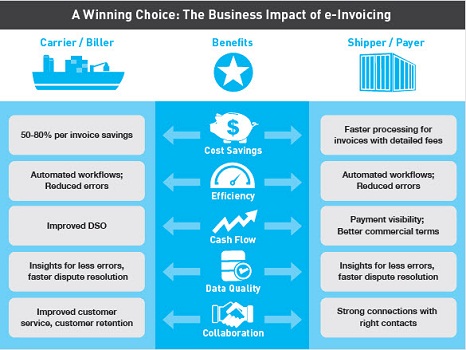
With electronic invoicing (e-Invoicing), there is a potential 50-80 percent cost savings according to the E-Invoicing/E-Billing 2012 Report from the international e-billing firm, Billentis, and the payment process is significantly shortened with DSO (days sales outstanding) typically decreasing by up to 10 days. Error rates are also greatly reduced, and customer satisfaction increased.

Although e-Invoicing as a trend has picked up rapidly in government and commercial sectors in the past three years (growing at a rate of 20 percent last year, according to the Billentis report), many in the ocean shipping sector are just catching wind of the benefits. Popularity among players is expected to grow this year – both on the biller and payer sides. Three reasons for the industry’s recent e-Invoicing surge are:

1. Demand Is at a Record High

At least 81 percent of the world’s largest shippers are requesting electronic invoices from their carriers in 2013, says a 2012 global shipping study conducted by INTTRA, the world’s largest ocean shipping network. The demand to move away from paper invoicing has never been greater, with shippers claiming to be “ready now and actively seeking e-Invoicing from their business partners.”

2. Proven to Lower Costs and Speed Internal Operations

Shippers’ biggest complaints with paper invoicing are 1) managing disputes, 2) the time and costs required to process invoices, and 3) correcting invoice inaccuracies. e-Invoicing is proven to alleviate these concerns by streamlining the entire settlement process, improving accuracy, and reducing the costs and labor required to process manual invoices. Payers end up happier as a result, receiving faster and improved communications and lowering the true total cost of doing business. For carriers, e-Invoicing is proven to cut costs and improve cash flow and working capital – and investments are often gained back within six months.

Both shippers and carriers want a solution to better manage high-volume transactions. Imagine spending millions of dollars on a global SAP (or equivalent) rollout and still manually keying in a half-million invoices per year. There is a better way.

3. It May Soon Be Mandatory (if it isn’t already)

Shipping companies are trying to keep up with rapidly changing local and international trade regulations, and e-commerce shipping is the smart way to stay compliant. Countries like Mexico, Brazil, Norway, Sweden, Finland and Denmark have already made electronic invoicing mandatory for all business-to-government transactions. Most others in Europe, North America and Australia are increasingly adopting electronic invoicing due to its cost-saving benefits.

Companies that act today put themselves at a competitive advantage as they are able to put their savings back to work and redirect employees engaged in manual processing to higher value tasks.

Looking Forward – 2013 and Beyond

The tipping point for when a technology ‘best practice’ becomes a ‘must have’ is never clear-cut – until an industry struggles as much as ours has. Change is hard, but for an industry with few proven solutions to remove costs, e-Invoicing is a viable, must-have solution.

2013 is a critical year for the ocean shipping industry. It is expected to be a year of major change in the way carriers and shippers do business. Competition is growing fiercer, and the industry continues to consolidate. e-Invoicing is one way to cut costs and reallocate dollars to where they are needed most in today’s challenging environment. Source: Maritime-Executive.com

For information, visit http://www.inttra.com/e-invoicing.

Hi-tech shippers switch from air to ocean

sea_freight_trackingCargo traditionally sent by air is increasingly switching to sea as shippers capitalise on the mode’s lower transport costs – a trend expected to continue over the coming years.

Lloyds List reports that several leading freight forwarders reported in their full-year results that certain cargo types — particularly hi-tech and telecoms — switched from air freight to sea freight last year.

DHL Global Forwarding CEO Roger Crook said the switch was the result of a price difference of 10 times between the two modes of transport. He said: “Obviously many companies are under cost pressure and looking to reduce total supply chain costs. Therefore, they are buying and moving by ocean freight, and particularly it is happening in the technology sector.”

Panalpina chief operating officer Karl Weyeneth said he expected the trend to continue. “There is a maximum shift you can achieve, depending on what industry you are talking about,” he said.

“But I believe that now supply chains are used to working with more ocean freight, this impact will stay for at least a couple of years, until the economy has really recovered, then it will start to shift back again.”

“We really see this as an important factor in our market for the next two to three years.”

Kuehne+Nagel (KN) chief executive Reinhard Lange said the decision on whether cargo was suitable to be switched from air to sea partly came down to the weight of the shipment. He said that if two products had the same market value, but one weighed less than the other, the overall cost impact of flying was less for the lighter cargo because air cargo costs were based on weight. He said this explained why hi-tech products had transferred to ocean freight while lighter products, such as pharmaceuticals, had, in the main, continued to utilise air freight.

The forwarders said the impact of the switch from air to ocean freight was partly to blame for a decline in air freight volumes last year, while container volumes continued to grow. In its full-year results, Panalpina saw air freight volumes decline 6% last year while ocean freight volumes grew by the same amount. Meanwhile, DHL Global Forwarding’s air freight volumes slipped 5.3% in 2012 with ocean freight increasing 4.3%, while KN saw its air freight volumes grow by 2% while ocean freight increased 6% year on year. Source: LloydsList

Aerotropolis for Gauteng…stuff’s about to happen

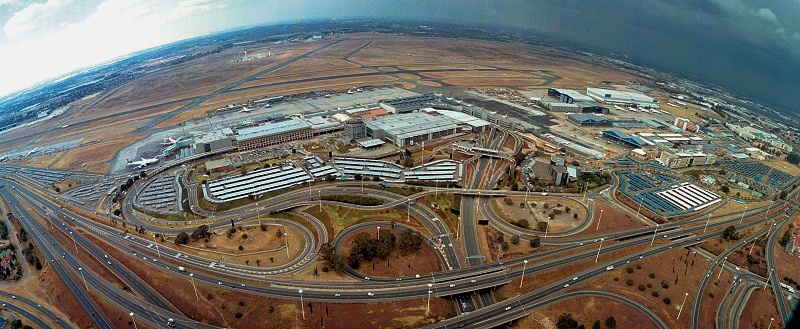
Oliver Reginald Tambo International Airport (east of Johannesburg) to become Africa's first aerotropolis

Oliver Reginald Tambo International Airport (east of Johannesburg) to become Africa’s first aerotropolis

The Gauteng Provinicial government has announced that Africa’s busiest airport, OR Tambo International Airport is set to become the location for the continent’s first aerotropolis. Work on the development of the aerotropolis, centred at OR Tambo International Airport, seeks to leverage public and private sector investment at the airport and surrounding areas. In supporting industrial development in this precinct, approval has been granted for the creation of an Industrial Development Zone (IDZ) in the area surrounding the airport. Heard this all before, but what’s different this time around?

An aerotropolis is an urban plan in which the layout, infrastructure, and economy is centered around an airport, existing as an airport city. It is similar in form and function to a traditional metropolis, which contains a central city core and its commuter-linked suburbs.The term was first proposed by New York commercial artist Nicholas DeSantis, whose drawing of a skyscraper rooftop airport in the city was presented in the November 1939 issue of Popular Science.The term was revived and substantially extended by academic and air commerce expert Dr. John D. Kasarda in 2000, based on his prior research on airport-driven economic development. Wikipedia

Jack van der Merwe, who successfully oversaw the development of the Gautrain project, has been appointed to lead the initiative of developing the aerotropolis. The proposal for the airport to become a terminal city with air, rail and road networks fuelling economic development. It is envisaged to include a commercial component, hotel, conferences, exhibitions and a residential component.

One of the key initiatives of the national government is the e-Thekwini-Free State-Gauteng freight and logistics corridor, known as the Strategic Infrastructure Project 2 (SIP2), which seeks to improve the movement of goods from the Durban port to Gauteng, and to business enterprises nationally as well as in southern Africa.

City Deep/Kazerne cargo terminals and the planned Tambo-Springs Freight and Logistics Hub are to be the focal points for the movement of goods for the export market. Phase 1 of the City Deep/Kazerne Terminal expansion and roads upgrade was underway at the continent’s largest and busiest in-land container terminal. This includes a redesign and upgrading of the roads network in and around the City Deep Terminal to provide for better flow of freight traffic and linkages with the national highways – the cost of the road works would amount to R122 million. At some point the issue of non-tariff barriers to import/export trade will need to be discussed…..and overcome.

Transnet has completed the first phase in the actual improvements of the terminal. It will be investing R900 million in upgrading the terminal. A detailed road design work, including feasibility studies and the development of a master plan, are underway for the Tambo-Springs Inland Port. Now, we’re talking…….

Gauteng  Province is to get 2 484 new modern trains as part of the Passenger Rail Agency of South Africa (PRASA) rolling stock for fleet recapitalisation and refurbishment programme.

The province will be making major investments in road infrastructure in the coming financial year and these include reconstruction and upgrading of the R55 (Voortreker Road) to a dual carriageway road between Olievenhoutbosch and Pretoria West; rehabilitation of the remaining section between Main Road and Maunde Street in Atteridgeville; reconstruction and upgrading of William Nicol Drive (K46) between Fourways and Diepsloot as well as reconstruction and improvement of the remaining section of the Old Pretoria to Cullinan Road between the Chris Hani Flats and Cullinan, among others. Wow, and the toll fees?

The department has been allocated a budget of R4.77 billion for the 2013/14 financial year. Of this amount R1.4 billion has been earmarked for roads maintenance and upgrading, R1.7 billion for public transport operations and R802 million for the running cost of the Gautrain Management Agency. Source: EngineeringNews

So, all-in-all, the above together with other recent noises of incentives and benefits for foreign and local investors in SEZs, the future holds some promise and interest…..

Port Tariffs to Drop on Export Containers

cargo-container-shippingThe Ports Regulator of South Africa will soon announce anew port tariffs structure that will include a cut of about 40% in the tariff on exported containers. This step is part of the Transnet National Ports Authority‘s strategy to reduce South African port charges, which are seen as among the highest in the world, because it erodes the competitiveness of South Africa’s exports.

This announcement was made during a colloquium on the impact of administered prices on the manufacturing sector. The purpose of the colloquium was to get all the stakeholders together to try and find a solution to the challenges. It had become clear that the stakeholders did not have a regular opportunity to engage on the issue of administered prices.

In addition to the new tariffs, the authority is proposing a reworking of its tariff structure, which if accepted by the regulator, will see higher charges for bulk commodities, up to 68%. South African port tariffs were at least 8.7 times more than the global average for containers and 7.4 times the global average for automotive cargo.

Transnet’s CEO said the shift in the tariff burden was aligned with the government’s manufacturing growth strategy. The mining sector had been hugely subsidised by a tariff structure weighted in favour of raw exports, at the expense of the manufacturing and agricultural sectors. Department of Trade and Industry has also welcomed the expected tariff reduction, saying it would be a major boost for exporters. 

One would therfore like to believe that these tariff reductions will be extended to agriculture and agro-processing. Hopefully ocean carriers will not see this as an opportunity to increase their tariffs!

Government heeds the call – Tax Holidays for SEZs

Minister Pravin Gordhan and his 'budget team' on their way to parliment [Picture credit-SARS]

Minister Pravin Gordhan and his ‘budget team’ on their way to parliament [Picture credit – SARS]

After more than a decade of fruitless marketing and billions spent on capital investment, Budget 2013 brings some hope of a turn-around and better fortunes for economic development zones in South Africa.

Minister of Finance, Pravin Gordhan announced, what is an unprecedented move. to bolster support for government’s Special Economic Zone (SEZ)programme. Investors in such zones are expected to qualify for a 15% corporate tax rate, and in addition, a further tax deduction for companies employing workers earning less than R60,000 per year.

This is a significant development in that the previous dispensation under the Industrial Development Zone (IDZ) programme only afforded prospective investors a duty rebate and VAT exemption on imported goods for use in the Customs Controlled Area (CCA) of an IDZ. The reality is that these benefits were simply not enough to woo foreign company’s to set up shop in our back yard, let alone existing big business in South Africa to relocate to these zones. Mozambique, next door, has had much success as are other African countries through the offering of company tax holidays with the introduction of export-focussed special manufacturing facilities.

The SEZ (so it would seem) differs little from the IDZ approach save the fact that the former does not require the location of the economic zone at an international airport, seaport or border crossing. As such, an existing IDZ may ‘house’ a special economic zone, thus maximizing return on investment.

Recent developments in SA Customs realise a provision permitting foreign entities to register as importers or exporters under the ‘foreign principal’ clause in the Customs and Excise Act. Approval of such is dependant on the foreign principal establishing a business relationship with a South African ‘Agent’. This ‘agent’ is required to be registered with the SA Revenue Service as the party representing a ‘foreign principal’ in customs affairs. At this point, the provision is being applied to business entities in BLNS countries who import or move bonded goods into or from South Africa.

Future global application of this provision could boost the possibilities of a broader range of investor to favourably consider SEZ opportunities in South Africa. This option will, no doubt, not go unnoticed by the big audit firms seeking to broker ‘cross-border’ customs facilities for their multi-national clients. I perceive that more introspection is still required concerning ‘non-resident’ banking facilities and transfer pricing issues to enable the global application of the foreign principal concept. But after all this seems a good case for trade liberalisation. Add to this the forthcoming launch of Customs new integrated declaration processing system that will (in time) offer simplified electronic clearance and expedited release facilities for future SEZ clients.

Traders can’t interpret Terms

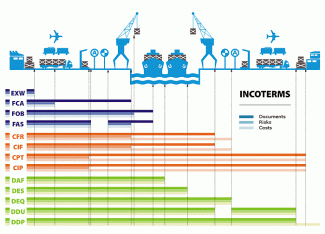
incoterms2The lack of knowledge to interpret international terms of trade (INCOTERMS) is to blame for the high cost of doing businesses among importers and exporters, the secretary general of the Uganda Shippers Council. Many importers do not understand international terms of trade such as Cost and Freight, Free on Board and Cost Insurance and Freight (CIF), yet in Uganda, taxation is done based on CIF.

“This means that a Ugandan trader who is importing or exporting goods has to pay freight costs in the East African region, whose headquarters are based at Mombasa, in addition to cost of goods, insurance and freight charges for the goods,” explained Kankunda, Secretary General of the local shipper’s council..

“If a Ugandan trader is able to understand these terms, then they will be in position to secure a local shipping line and pay a slightly lower cost compared to paying from the country where the goods are coming from.”

Kankunda was speaking at a three-day workshop on INCOTERMS for importers and exporters from the East Africa region. The training was aimed educating international traders best practices in handling INCOTERMs and other international freight transactions. It is expected to contribute to reducing the cost of cargo handling and shipment along East African corridors by enabling importers and exporters to efficiently apply proper commercial terms and practices.

Kankunda said the application of inappropriate commercial terms, insurance policies and inefficient processing of various trade transactions when importing or exporting goods are some of the causes of the high cost of doing business in the region. It is estimated that transport costs make up 30% to 40% of CIF value of imported goods in East Africa, compared to about 5% to 10% in other regions. Source: AllAfrica.com

Best SA Exporters

best_sa_logoBest SA Exporters is an online based business, created in order to promote export-ready Southern African goods and services to the international marketplace. In essence, Best SA Exporters role is to assist in growing your international trade, resulting in foreign direct investment and national job creation. Clients are advertised and promoted through a highly visible Best SA Exporters website, as well as through popular social networking presence on Facebook, Twitter and LinkedIn. Adding on to these services, Best SA Exporters now offers an international trade related company the opportunity to promote its goods / services to the Best SA Exporters database of approximately 8000 online subscribers. Trade leads received for each campaign will then be collated and supplied exclusively to you as an advertiser. Something worthwhile for exporters to look into?

Nigeria – Maximizing Opportunities in Free Trade Zones

Lagos Free Trade Zone

Lagos Free Trade Zone

So how come FTZs, IDZs, EPZs, etc are working in other African countries and not here in South Africa? This Day Live (Nigeria) offers some of the critical success factors which delineate such zones from the normal economic operations in a country. Are we missing the boat? The extent of economic and incentive offering can vary substantially between the different economic and trade zone models – some extremely liberal while others tend to the conservative. Obviously the more liberal and free the regulations are the more stringent the ‘guarantees’ and controls need to be. However, in today’s e-commercial world, risk to revenue can more than adequately be mitigated and managed with through risk management systems. Manufacturing and logistical supply chain operations are likewise managed in automated fashion. I guess the real issue lies in governments appetite for risk and more particularly its willingness to relax tax and labour laws within such zones. Furthermore, a sound economic roadmap demonstrating backward linkages to the local economy and outward linkages to international markets must be defined. Herein lies some of the difficulties which have plagued South African attempts at such economic offerings – no specific economic (export specific) goals. Limited financial/tax incentives for investors, and poor cooperation between the various organs of state to bring about a favourable investment climate.

Free Trade Zones (FTZs) are at the crux of the growth attributed to emerging markets. All the BRIC nations have used the FTZs as a buffer to economic meltdown particularly in the wake of the most recent financial and economic crises. The “great recession” of 2007 – 2009 saw the BRIC nations growing at the rates of 7% to 13%. Consequently, the importance of FTZs as well as maximizing opportunities therein cannot be over-emphasized. The literature defining FTZs vary, but they all have the following characteristics in common:

  • A clearly delimited and enclosed area of a national customs territory, often at an advantageous geographical location, with an infrastructure suited to the conduct of trade and industrial operations and subject to the principle of customs and fiscal segregation.
  • A clearly delineated industrial estate, which constitutes a free trade enclave in the customs and trade regime of a country, and where foreign manufacturing firms, mainly producing for export, benefit from a certain number of fiscal and financial incentives.
  • Industrial zones with special incentives set up to attract foreign investors, in which imported materials undergo some degree of processing before being re-exported.
  • Fulfilling their roles in having a positive effect on the host economy, regulators look at FTZs from a nationalist perspective. Inevitably, they seek the following benefits:
    • Creating jobs and income: one of the foremost reasons for the establishment of FTZs is the creation of employment.
    • Generating foreign exchange earnings and attracting foreign direct investment (FDI): measures designed to influence the size, location, or industry of a FDI investment project by affecting its relative cost or by altering the risks attached to it through inducements that are not available to comparable domestic investors are incentives to promoting FDI. Implicit in this statement lies the definition of FTZ. Other traits that are recognizable when discussing FDI’s include specially negotiated fiscal derogations, grants and soft loans, free land, job training, employment and infrastructure subsidies, product enhancement, R&D support and ad hoc exceptions and derogations from regulations. In addition to FDI, by promoting non-traditional exports, increased export earnings tend to have a positive impact on the exchange rate.
    • Transfer of technology: trans-national corporations (TNCs) are a dominant source of innovation and direct investment by them is a major mode of international technology transfer, possibly contributing to local innovative activities in host countries. It is a government’s primary obligation to its citizenry to provide attractive technology, innovative capacities and mastering, upgrading, and diffusing them throughout the domestic economy. Nevertheless, through national policies, international treaty making, market-friendly approaches, a host country gravitates from providing an enabling environment to stronger pro-innovation regimes that perpetually encourage technology transfer.

FTZs can be both publicly (i.e. government) and or privately owned and managed. Governments own the more traditional older zones, which tend to focus more on policy goals that are primarily socio-economic. They emphasize industry diversification, attracting FDI, job creation and the like. Privately-owned FTZs have the advantage of eliminating government bureaucracy, are more flexible, and are better prepared to deal with technological changes. The global trend towards privatization has made privately-run zones more popular and a number are highly successful. The role of government in the case of privately-run zones is to provide a competitive legal framework with attractive incentive packages that meet the World Trade Organization (WTO) requirements.

FTZ Operations in Nigeria

FTZs were established in 1991 in order to diversify Nigeria’s export activity that had been dominated by the hydrocarbon sector. By 2011, there were nine operational zones; ten under construction; and three in the planning stages. The governing legislation includes the Nigeria Export Processing Zones Act (NEPZA) and the Oil and Gas Export Free Zone Act (OGEFZA). Zones may be managed by public or private entities or a combination of both under supervision of the Authority. For the full article go to – This Day Live