TRALAC – What has happened since customs duties on 124 clothing tariff lines were increased in 2009?

I really enjoy TRALAC’s Newsletter – their analysis is always concise and down-to-earth. This Hot Seat Comment is no exception. One often wonders about the impact and nett result of tariff changes and trade remedies. Here we get some insight.

The clothing and textile industry has a long history in South Africa and is still a very important source of employment, especially for women and in poorer communities. The industry is geographically bound to specific provinces, including the Western Cape, KwaZulu-Natal, the Free State and Gauteng. In many rural areas the clothing and textile sector is often the only source of formal employment. Since about 2002 the Rand appreciated substantially and South African exports became less competitive in the global market. Coupled with the trade liberalisation, in terms of South Africa’s WTO offer, the clothing and textile industry has experienced sustained import competition due mostly from Asian imports. In order to try and remedy large-scale factory closures and employment losses in the industry the Southern Africa Clothing and Textile Workers Union (SACTWU) applied for an increase in the import tariffs of 124 clothing tariff lines to the WTO bound rates of 45 percent in 2009. These clothing tariff lines are classified under Chapter 61 and 62 of the South African Tariff Book and include various clothing items, including men’s woven and knitted shirts, jackets and trousers; babies’ garments; and women’s woven and knitted jackets, skirts, dresses and trousers. Although the retailers objected to an increase in import duties the International Trade Administration Commission (ITAC) granted the application and general customs duties on 121 clothing tariff lines were increased from 40 percent to 45 percent, while the general customs duties on three tariff lines (hosiery) was increased from 20 percent to 45 percent.

imagesIn its application SACTWU stated three reasons for the application: there has been a significant increase in imports under these 124 tariff lines flowing into South Africa; market disruptions in the SACU industry which have resulted in factory closures and retrenchments warranted increased protection for the domestic industry; and increased tariffs will provide both relief and show increased confidence in the industry. The retail industry objected to the application on the following grounds: the loss of business in the manufacturing industry can not only be attributed to price competition, but also inefficiency in the local industry; increased duties will have an inflationary effect impacting the ability of consumers to buy clothing at competitive prices; and increased duties will have a punitive effect on the rail sector and the end consumers. In its decision the Commission found the declining rate of investment and employment in the clothing sector coupled with increased imports a disturbing trend. The Commission decided that an increase in customs duties will enable manufacturers to protect existing jobs, increase market penetration and price competition and growth the domestic manufacturing sector in the export market. However, the question of whether the increase in these customs duties have been successful in reaching its goal of decreased imports and increased domestic production, sales and exports still remain.

Import and export data sourced from the World Trade Atlas (2013) and production and sales data sourced from Statistics South Africa (2013) show the following patterns in the clothing industry between 2009 and 2012:

  • Over the time period imports of the 124 clothing tariff lines increased by 15 percent, from approximately US$ 834 million in 2009 to approximately US$ 1.2 billion in 2012.
  • The top five importing countries were China, Mauritius, India, Madagascar and Bangladesh, accounting for 89 percent of the total imports of these clothing articles into South Africa over the time period.
  • China mainly exported men’s, boy’s, women’s and girl’s cotton trousers; knitted sweaters and pullovers; cotton and knitted t-shirts; and knitted babies’ garments to South Africa between 2009 and 2012.
  • South Africa’s exports of these clothing tariff lines increased by 6 percent, from approximately US$ 71 million in 2009 to approximately US$ 84 million in 2012.
  • These clothing articles were mainly exported to African countries, including Zambia, Mozambique and Zimbabwe.
  • The production index of the physical volume of production (base year is 2005) show there has been a significant decrease in the volume of production of knitted and crocheted articles and wearing apparel in South Africa. The index decreased from an average of 108.11 in 2009 to an average of 79.82 in 2012.
  • The sales of knitted and crocheted articles and wearing apparel also declined over the time period. Actual value of sales declined by 3 percent, from approximately US$ 18 billion in 2009 to approximately US$ 16 billion in 2012.

Although there has not been a significant lapse of time since the increase of import tariffs the data gives the short term response of imports, exports, and production to the change in import duties in November 2009. Immediately after the increase in tariffs there was an initial decrease in exports, production and sales.  However, exports recovered by the end of 2012, while production and sales are still significant lower than pre-2009 levels. SACTWU has also recently indicated that employment in the clothing, textiles and leather sector seems to be more stable over the last two years. However, one of the main objectives of the increase in import duties, to deter lower priced imports mainly from Asia, has not been accomplished. Source and content credit – Willemien Viljoen, TRALAC Researcher.

Tobacco industry uses trade pacts – to snuff out anti-smoking laws

Anti-tobaccoAs countries around the world ramp up their campaigns against smoking with tough restrictions on tobacco advertising, the industry is fighting back by invoking international trade agreements to thwart the most stringent rules.

A key battlefront is Australia, which is trying to repel a legal assault on its groundbreaking law requiring cigarettes to be sold in plain packs without distinctive brand logos or colors. Contesting the law, which came into effect Dec.1, are the top multinational cigarette makers and three countries — Ukraine, Honduras and Dominican Republic — whose legal fees are being paid by the industry.

The dispute underlines broader concerns about trade provisions that enable foreign companies to challenge national health, labor and environmental standards. Once a country ratifies a trade agreement, its terms supersede domestic laws. If a country’s regulations are found to impose unreasonable restrictions on trade, it must amend the rules or compensate the nation or foreign corporation that brought the complaint. In the case of Australia’s plain packaging law, the tobacco industry and its allies are challenging the measure as a violation of intellectual property rights under trade agreements the nation signed years ago.

Public health advocates fear the legal attack will deter other countries from passing strong measures to combat the public health burdens of smoking. The “cost of defending this case, and the risk of being held liable, would intimidate all but the most wealthy, sophisticated countries into inaction,” said Matthew L. Myers, president of the Campaign for TobaccoFree Kids in Washington D.C.

The advocates also say countries should be free to decide how best to protect public health, without being second-guessed by unelected trade panels. Moreover, they argue, tobacco products, which kill when used as intended, should not be afforded the same trade protections as other goods and services. Worldwide, nearly 6 million people a year die of smoking-related causes, according to the World Health Organization, which says the toll could top 8 million by 2030. With fewer people lighting up in wealthy nations, nearly 80 percent of the world’s 1 billion smokers live in low and middle-income countries.

Marlboro, the world’s top-selling brand, packaged under labeling laws of (clockwise) the U.S., Egypt, Djibouti, Hungary/Photos of non-U.S. packs, Canadian Cancer Society

Marlboro, the world’s top-selling brand, packaged under labeling laws of (clockwise) the U.S., Egypt, Djibouti, Hungary/Photos of non-U.S. packs, Canadian Cancer Society

Countries have been emboldened to pass more stringent measures by the Framework Convention on Tobacco Control. In effect since 2005, the treaty has committed about 175 nations to pursue such measures as higher cigarette taxes, public smoking bans, prohibitions on tobacco advertising, and graphic warning labels with grisly images such as diseased lungs and rotting teeth (The U.S. has signed the treaty, but the Senate has not ratified it. The U.S. Food and Drug Administration has ordered graphic warnings for cigarette packs, but an industry court challenge on 1st Amendment grounds has stalled the rule.)

Cigarette makers say they acknowledge the hazards and the need for regulations. “We actually support the vast majority of them,” said Peter Nixon, vice president of communications for Philip Morris International, which has its headquarters in New York, its operations center in Switzerland, and is the biggest multinational cigarette maker with 16 percent of global sales.

But the industry has watched with growing concern as more than 35 countries have adopted total or near-total bans on cigarette advertising. Its big profits depend on consumer recognition of its brands. Yet in many countries, the once-ubiquitous logos and imagery are receding, leaving the cigarette pack as a last refuge against invisibility.

Now the pack, too, is under attack. Along with plain packaging laws such as Australia’s, countries are weighing retail display bans that keep cigarette packs out of view of consumers, and laws requiring graphic health warnings so large that there is barely any room for trademarks. Tobacco companies contend that countries enforcing such rules are effectively confiscating their intellectual property and must pay damages.

The industry also claims that measures like plain packaging are counterproductive. “We see no evidence — none at all — that this will be effective in reducing smoking,” Nixon of Philip Morris International said in an interview. In fact, he said, generic packaging likely will increase sales of cheap, untaxed counterfeit smokes, thus increasing consumption (my emphasis added).

Comment: And for me this is the bottom line. Governments are happy to collect the ‘sin tax’ every year, most increasing it annually under the pretext of curbing the use of alcohol or tobacco products. Forcing draconian law will only increase the contraband ‘underground’ which these same governments have little control over. The worldwide push under the WHO banner appears to have more of a ‘social conditioning’ connotation than a health one.

Nigeria – Who’s afraid of new Customs Law?

English: Ngozi Okonjo-Iweala, Managing Directo...

English: Ngozi Okonjo-Iweala, Managing Director, World Bank, Washington DC; Global Agenda Council on Corruption, is captured during the session ‘Zero Option for Corruption’ in the Congress Centre of the Annual Meeting 2010 of the World Economic Forum in Davos, Switzerland. (Photo credit: Wikipedia)

Not a few people raised eyebrows at one session of a senate committee when the Minister of Finance, Dr Ngozi Okonjo-Iweala, intervened during proceedings. Unlike most public hearings in the National Assembly, the particular one conducted by the Finance Committee of the Senate on the new Customs Bill was historic. Everyone agreed that the bill, which seeks to repeal the pre-independence Act, was timely. The dominant argument was that the roles and responsibilities of the Department of Customs and Excise have changed and required legislation to accommodate those changes.

From a modest outfit collecting taxes and royalties on coastal trading activities, the Department has evolved to become a large organisation employing over 20,000 Nigerians, with responsibilities cutting across revenue collection, border protection, public health and trade facilitation. The new law is to take account of the realities of the 21st century. Provisions were therefore made for electronic processes of Customs clearance, use of non-intrusive intervention methods to enforce controls and adherence with global best practice in customs operations.

However, Dr Okonjo-Iweala , who by virtue of her position is the Chairman of the Nigeria Customs Service Board raised dust when she expressed concerns over the powers of Mr President and the Minister of Finance as contained in the new Bill. Committee members were astonished when she appeared to labour to sound modest in kicking against the provisions which she complained ‘whittled down the powers of Mr President and the Minister over Customs’.

Another dissenting voice came from the Director of Budget in the Ministry, Dr Bright Okogwu, who argued that Customs should not be funded up to the tune of 2.5 % of Value on Board (FOB)’ as provided under Section 18 of the new Bill, although his earlier view appeared to support to the canvassed by Central Bank of Nigeria on the matter.

It is a fact that many Nigerians were not opportune to read the bill before the hearing. My interest in it followed claim of the possibility of creating a Customs outfit that would be too powerful to be under the thumb of the president or the minister of finance.

On the contrary, the bill does seek a stronger Board capable of enunciating policies devoid of bureaucratic bottlenecks. The bill still allows the minister enormous powers as chairman of the Board with the power to appoint some of its members.

But the notion that the bill strips the president of certain powers gave added impetus to the public hearing; Mrs Okonjo-Iweala was clearly agitated. But try as they could, no one could pinpoint the sections which allegedly render the President powerless over Customs matters.

The major omission in the existing legislations put up for repeal is the Customs, Excise Tariff, etc. (Consolidation) Act Cap C.49 of 1995. Perhaps the hullabaloo about the powers of Mr President stems from the erroneous impression that all the previous Acts relating to Customs matters were being repealed. Section 13of this Act is emphatic about the powers on the much-hyped waivers and concessions. The section vested on the president the power to impose, vary or remove any import or excise duty on goods that are liable to payment of such charges. This provision is still extant.

Opposition to Sections 42 and 43 which sought to prohibit by law the future use of Pre-shipment and Destination Inspection service providers was a source of disappointment to most Nigerians. Leading the pack of opposition was the Central Bank of Nigeria with the argument that the provision ‘ties government hands ‘, if such service is found necessary in the future.

Customs position throughout the hearing was to express readiness to take over its statutory roles. If there was any doubt about Customs ability, the CBN and the Finance Ministry, both supervisory organs of the destination Inspection should be held responsible for the orchestrated effort to perpetrate or institutionalise self-gratifying contracts.

All said and done, Nigerians are patiently waiting for the senators to do what is right and ignore sentiments associated with the various positions canvassed during the hearing. It should not be about muscle flexing of who wields what powers as was witnessed during the hearing. Nor should it be about the office holders, since the Service will outlive the current actors involved. It is about building a strong institution that can stand the test of time. Source: The Daily Trust (Nigeria)

Related articles

Uganda prepares to introduce AEO

Authorised Economic Operators (AEO), a scheme focusing on compliant companies to facilitate trade starts before the year ends. The Uganda Revenue Authority (URA) Public and Corporate Affairs Assistant Commissioner Sarah Banage recently disclosed that AEO is meant to enhance compliance “by removing barriers for the most complaint taxpayer”.

“Under the scheme, the benefit of being complaint will be red-carpet treatment offered by URA,” she stated, adding, “we want to demonstrate that there are rewards for being compliant.” Banage cited electronic submission of declaration without supporting documents, pre-arrival clearance of cargo, and self-management of bonded warehouses as some of the benefits. Others are: priority treatment when cargo is selected for control, choosing the place for examination, automatic renewal of licences and withholding tax exemption status.

Because the relationship between URA and its clients is “symbiotic”, it is expected that there will be an increase in taxes, Banage argued. Potential beneficiaries of AEO are: agents, importers, exporters, shippers, internal container depot operators, and others involved in international shipment of goods, among others.

To be eligible, Banage said, one should be involved in international trade, have a good compliance history, be financially sound, install and use customs automated systems like e-tax and should implement the AEO compliance programme. To be authorized, companies/organizations will apply to the commissioner, after which a preliminary consultation is done.

“We will then determine who should formally apply. Officials will adjudicate submitted documents before a site is inspected to ensure compliance with guidelines,” she said. Subsequently, a one-year certificate will be issued.

“An AEO is an individual, a business entity or a government department that is involved in international trade and is duly authorized by the Commissioner of Customs of Uganda Revenue Authority.”

Banage said that implementing AEO does not only have short-term results but also resultant long-term benefits to the business community. These include reduction of the cost of doing business and increased turnover over time, among others. In the middle of April, customs officials held a breakfast meeting at Serena hotel, Kampala where Chief Executive Officers of major organizations were sensitized about the plan.

Later, customs officials interacted with personnel of the Auditor General, Export Promotion Board, the Trade, Industry and Cooperatives ministry, the Agriculture, Animal Industry and Fisheries ministry and Uganda National Bureau of Standards. Also at Serena, it was meant to “share with them the programme in order to capture their ideas,” according to Banage.

Weeks ago, URA asked companies to express interest in joining the scheme. Over 20 organizations applied and are currently involved in talks expected to culminate in attaining AEO status. “Admission to the scheme will depend on how the companies implement the compliance programme. By December, some companies should be authorized,” Banage added. Among others, those expected to benefit from the first phase are importers, clearing agents and transporters.

Regarding the East African Community (EAC), customs administrators have adopted an AEO policy framework. It was adopted in 2010 as a basis for implementing trade facilitation initiatives that drive economic development for the EAC. Under AEO’s mutual recognition arrangement, a government formally recognizes the AEO programme of another country, thereby granting benefits to the AEOs of that country. Under a regional project, companies in the five countries receive benefits related to the scheme. Among the benefits is priority treatment at customs points. Source: The Observer (Kampala) 

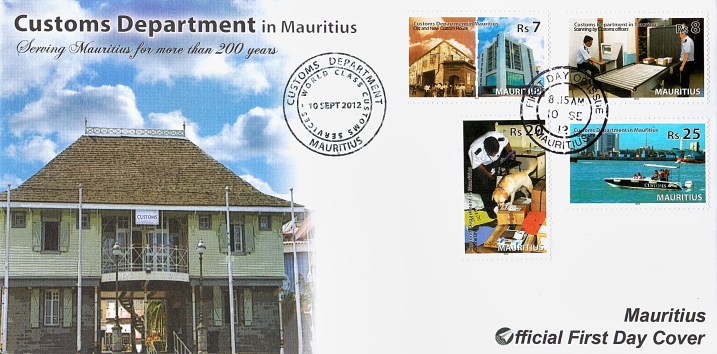
Mauritius Customs turns 200

Mauritius Customs 1st Day CoverOn the ocassion of my 300th post, join me in raising the Portcullis for Mauritius Customs! During September, the Mauritius Revenue Authority (MRA) marked the bicentenary celebrations of Customs services in Mauritius by launching a special First Day Cover with four stamps on the Customs Department to mark the bicentenary celebrations of Customs Services in Mauritius. The issue of these new stamps is an acknowledgement of the significant contribution of the Customs services to the economic and social life of the country for more than 200 years. The four stamps depict the Customs Services in different fields with denotation of Rs 7, Rs 8, Rs 20 and Rs 25 illustrating some of the areas where the customs services are involved in their fight against crime and fraud prevention through the use of people, animals and state-of-the-art technology.

On 18 August 1797, a ‘bureau de Douane’ was established for the purpose of raising revenue in a context of war and blockade. It became a major financial institution contributing towards 50% of total revenue. The British took over in 1811 and installed the first Collector of Customs.British Customs practices were gradually introduced in the colony in line with British commercial law.

In modern times, the MRA Customs Department has set as one of its main objective to combat the illicit trade of drug and other illicit substances. The MRA has a team of 6 drug detector dogs handled by certified dog handlers trained by the French Customs and the South African Revenue Services (SARS). Our dogs have been selected carefully from examined litters and were declared competent drug detector dogs as per SAQA Unit Standard in the handling of a service to detect illicit substances.

Since 2008, our sniffer dogs have detected drugs in 25 instances involving the import of Cannabis, Heroin, Hashish, Subutex and other illegal substances worth around Rs 42,530,543. The Drug Detector Dog squad operates at the courier services, Parcel Post Office, Vehicle Search at Airport, Port and Freight Stations, Port area, Airport (Plaisance Air Transport Services & Luggage on carrousels at SSR Int. Airport and Aircraft search) as well as at the seaport for search of vessels. Source: Mauritius Revenue Authority

Tobacco duty-free concessions changed

For ‘smoking’ travellers to Australia, please read up on the new duty-free concessions before you decide to stock up.

The reduced tobacco duty-free limit came into effect on 1 September 2012. It was announced in the 2012-13 Federal Budget that the duty-free concession on tobacco products would change.

Travellers aged 18 years or over can bring 50 cigarettes or 50 grams of cigars or tobacco products duty-free into Australia with you. All tobacco products in accompanied baggage are included in this category, regardless of where or how they were purchased.

Be aware that if you exceed Australia’s duty-free limits, duty and tax will apply on ALL items of that type (general goods, alcohol or tobacco), not just the goods over the limit. The general goods and alcohol duty-free concessions remain the same. Source: Australian Customs Service

Australia’s high court recently upheld the government’s decision to implement a law which requires cigarettes to be sold in olive green packets, with graphic images warning of the consequences of smoking. The law is to come into effect on 1 December 2012. The South African authorities appear to be following the same route and are currently ‘testing’ the concept of the olive green packets (what’s there to test?). Despite the obvious reaction of the Tobacco Inc. to the new law, it is not difficult to see that it will make anti-counterfeit enforcement even more difficult for authorities. Perhaps the UK liquor boys are ahead in their thinking – import liquor in bulk and bottle it in the UK, this way you’re in charge of the packaging and labelling. Health officials are definitely more concerned with health than profit.

Is South Africa being screwed by China?

In recent days there’s been mutterings amongst several business commentators concerning the state of the South African manufacturing sector and its inability to compete in the local economy in the face of ‘so-called’ cheap imports. For once I heard some common sense instead of the usual WTO/economist waffle which normally just confuses people instead of shedding light on the inherent problems. What the Business Times article below suggests is that our prevailing job plight is self-induced and should not be blamed entirely on rogue elements alone. Under valuation and mis-declaration have and always will pose a challenge to any country. The blame has been placed on Customs not doing its job; yet, the problem appears to lie at the feet of policy makers who have made foolish decisions for which the country as whole now pays the price. 

The trouble began soon after 1994, when then Trade and Industry Minister, anxious to prove to the then rich and powerful, and sceptical, West what lovers of democracy and free markets they were, removed tariff protection on cheap imports against a considerable body of expert advice. And 12 years before we needed to, because the World Trade Organisation‘s predecessor, GATT, had given South Africa 12 years to modernise its manufacturing, improve its skills and prepare itself before lowering import tariffs.

At the time, Trade and Industry Minister and the government thought South Africa did not need a grace period. Leslie Boyd, then head of the Anglo-American industrial division, warned of the devastating consequences but to no avail. “They thought if they took the crutches away we’d become a free market economy and we’d be competitive,” says Stewart Jennings, chairman of the Manufacturing Circle which represents thousands of manufacturers in SA. “It was the most ridiculous thing you could ever imagine. Those of us in business know there is no free market in the world. Every country protects itself. We don’t. Here’s an economy without skills that just throws open the tariffs. We’re the country that’s whiter than white in terms of the WTO. Everybody else just abuses us.”

Business consultant Moeletsi Mbeki opines “[government] is too ideologically orientated, it operates from ideology rather than from practical expertise. This motivates our relationship with China. The Chinese can do no wrong.”

One of the worst mistakes they made, he believes, was to sign an agreement that gave the Chinese market economy status which it did not and does not deserve. The talk was that SA agreed to do this as compensation for imposing a three-year quota on Chinese textile imports. The effect on SA’s manufacturing sector has been devastating. “As a consequence of that agreement it is virtually impossible for us to get countervailing duties into China through ITAC [the International Trade Administration Commission which used to fall under the Department of Trade and Industry but is now under Ebrahim Patel‘s Department of Economic Development],” says Stewart Jennings. “We’ve battled to get dumping duties or safeguards against China. Most of the applications that have gone to ITAC have been kicked into touch.”

First, China starts with a currency that is 30% undervalued. It manipulates it, so any goods it exports to SA are 30% cheaper than they should be. On top of that there are all sorts of incentives for Chinese exporters. And then, as Jennings says, attempts by local manufacturers to defend themselves by applying for countervailing duties more often than not go nowhere.

Iraj Abedian of Pan African Investment and Research says the short answer to the question is yes, we are being screwed. “Not because the Chinese have been smart but because we’ve been snoozing and naïve.”

SA was so flattered to be asked to join the BRIC (Brazil, Russia, India, China) club of developing economies that it did not drive a hard enough bargain. “We were romanticising our relationship with China and celebrating the fact that China was inviting us to join BRIC. We took it as a form of political honeymoon without recognising its effect on manufacturing, without assessing our counter-strategy for safeguarding national interests in the form of jobs and tax revenue.” China needed SA to join BRIC at least as much as SA itself wanted to join, but SA failed to capitalise on this.

Executive director of the Manufacturing Circle, Coenraad Bezuidenhout, who has observed the effect at close quarters, thinks part of it is that “our guys find the prospect of dealing with China daunting. They feel we need China as a market for our raw materials more than China needs us.” He thinks this attitude reflects a worrying lack of professionalism on the part of those who are paid to battle for SA’s interests. “We should be leveraging our position with regard to our minerals and our access to African markets far more than we do when we deal with China.”  Source: Business Times

Car importers slam KRA transit vehicles rule

Is the time for a regional transit bond nigh? Given prevailing draconian measures to ensure security and surety, the message is clear that customs brokers, freight forwarders or clearing agents need to demonstrate financial security over and beyond what they are accustomed to. Question – is the transit business lucrative for agents? Why not refuse the business – its just not worth the risk.

A requirement by the Kenya Revenue Authority demanding that all imported transit vehicles above 2000cc be cleared against cash bonds or bank guarantees has been opposed by clearing agents in Mombasa. The agents, under their umbrella Kenya International Freight and Warehousing Association, have threatened not to pay taxes if the regulations are not withdrawn by the tax collector. The agents said that the stringent measures by KRA may stifle trade in the region and may also see the port of Mombasa losing some foreign importers to the port of Dar es Salaam in Tanzania. “We as clearing agents cannot pay the bonds for the importers”.

On August 31, KRA directed all clearing agents that with effect from September 1, all transit vehicles exceeding 2000cc would be cleared against a cash bond or bank guarantees paid by the agents. The forwarders also said that Uganda, Rwanda and DR Congo business class was considering ditching Kenya as an import avenue for Dar es Salaam port. Source: The Star (Nairobi)

Two-thirds of UK logistics firms fail to meet needs of Bribery Act

UK companies are not doing enough to comply with the Bribery Act 2010 (Act) and may also be failing to meet reporting obligations required under the European Union Emissions Trading System (EU ETS) according to a survey of UK logistics professionals released today. The research, carried out by industry law specialists at Thomas Eggar LLP, shows that three-quarters of respondents are either aware of the EU ETS but find it difficult to understand or not aware of it at all. What this means is that very few logistics companies are properly engaging in the EU ETS or have the proper compliance measures in place. Also, despite two years passing since the introduction of the Bribery Act in 2010, nearly two-thirds of those surveyed admit their organisation could either do more to comply or does not have a bribery policy at all.

Described by some as ‘the toughest anti-corruption legislation in the world’, the Act covers the crimes of bribery; being bribed; the bribery of foreign public officials; and the failure of a commercial organisation to prevent bribery on its behalf.  The Act is relevant because many companies operate supply chains or form part of a supply chain in countries where there is a high risk of bribery. Also, their activities may include those with a high risk of corruption, such as interacting with public officials or using local agents or partners. Because the Act has wide extra-territorial jurisdiction, this means any act of bribery by a UK organisation, UK national or UK resident, anywhere in the world, breaks the law in the UK. Read the fill article here! Source: Thomas Eggar

Namibian Ministry of Finance angers clearing agents

Below is a situation which might have been avoided if trader registration/licensing was properly addressed by the Namibian Authorities. With the likes of SADC and COMESA encouraging the implementation of regional transit guarantees, trade operators need to clearly address their obligations and liabilities. Moreover, any suggestion of authorised economic operator (AEO) programme in the Southern African region needs to fully align its requirements with the standards being applied by other countries across the globe. It is therefore clear that no preferred trader scheme can be implemented across the Trans-Kalahari Corridor or across SACU if such disparities of knowledge and practice exist. While one might have compassion for possible job redundancies and the pleas expressed by certain clearing agents, they evidently do not understand the game they are playing in and will drastically need to redress their understanding of the role they play in the supply chain. International clearing and forwarding is not a game for sissies, or people who want to try their hand at a quick buck. A bold stance by the Ministry of Finance.

The Namibian Ministry of Finance’s decision to ban clearing agents from using guarantees and bonds from third parties as security to move goods has caused an uproar among clearing agents. The Deputy Minister of Finance, Calle Schlettwein, explained that the decision that became effective on July 26 was taken to protect the taxpayer. Clearing agents aren’t closed down, and neither are they stopped from using their own security to move these goods, he said. As from July 26, the agents are simply not allowed to use a bond or guarantee issued to another clearing agent as security for their goods in transit, the ministry said.

Before the clampdown, clearing agent A used to ‘borrow’ guarantees or bonds, backed by financial or other institutions from clearing agent B to clear any goods coming through Namport and destined for landlocked countries such as Botswana, Zambia and Zimbabwe. However, should a problem develop with agent A’s consignment, the guarantee or bond would be worthless to Government, as the financial institution agreed to back only agent B’s guarantee or bond. “We don’t know how or when the practice started, but it is illegal,” a ministry spokesperson said.,

Schlettwein said Government stood to lose out on duties and customs through the practice, and the taxpayers would have ended up having to pick up the tab. The ministry’s announcement was met with considerable protest from the smaller clearing agencies, claiming that they didn’t have the money or financial backing to secure the necessary bonds or guarantees. Nampa reported that 76 small and medium enterprises (SMEs) operating as clearing agencies at the coast have been affected. At the Oshikango border post and at Helao Nafidi in the North, 30 agencies with more than 100 employees are affected.

Regina Amupolo of Pride Clearing and Forwarding Agent has called on the ministry to urgently look into this matter, because many trucks with goods and containers are stuck at the Oshikango border post, Walvis Bay harbour or at other border posts. Their customers have already complained that they are losing business because of this, Amupolo said. Amupolo said most SMEs don’t have the money to obtain bonds or guarantees. She said ministry officials said anyone who wants a bond must have collateral of N$1,6 million. “We are small business people, trying to employ ourselves and some of our fellow men and women in our societies, but now the Government, the Ministry of Finance, is making things difficult for us. How are we going to make a living if the ministry is cutting off our jobs in this way?” she asked.

In a letter written to all clearing agents at Oshikango, the controller customs and excise officer, Festus Shidute, said the practice of using third-party bonds or guarantees posed a serious challenge to customs administration and control of guarantees in the event of liabilities by third parties. Amupolo and Rejoice Nangolo from Flora Clearing Agent said they have already paid N$20 000 to obtain a clearing licence, while they have to pay Namport another N$20 000. She said they are losing thousands of dollars as a result of this unexpected prohibition by the ministry and are demanding an extension to allow them to take the matter up with the ministry.

Nangolo said her business has branches at other border posts like Omahenene, Katwitwi, Ngoma, Wenela, Trans-Kalahari, Ariamsvlei, Noordoewer, Walvis Bay, Hosea Kutako International Airport and Oshikango. Her Angolan customers have threatened to stop moving their goods through Namibia and only to use their own ports, she said. At Oshikango there are only two big companies, Piramund and CRN, that can guarantee bonds and assist them as SMEs clearing their work effectively. According to Amupolo and Nangolo, they started with their clearing business in Oshikango in 2000 and were doing well until the ministry imposed the ban.

Speaking to Nampa, Lunomukumo Taanyanda of Oluvanda Clearing and Forwarding Close Corporation (OCFCC) said his company has been operational for two years and deals mostly with car consignments from countries such as the United Kingdom (UK) and Dubai.Before clearing the consignments, OCFCC has to declare the consignment at the Namport customs desk. However, before they can fill in a customs declaration form to clear the transit goods, the goods need to be secured and this is where the company (OCFCC) requires the assistance of third parties such as Wesbank Transport, Transworld Cargo and Woker Freight Services.

These smaller companies acquire assistance from bigger companies (the third parties) as they experience problems when trying to obtain their own bonds and guarantees. According to Taanyanda, it is a very costly and time-consuming process. “We agents do not have enough collateral for bonds, which start at N$350 000, and now the ministry has stopped us from borrowing bonds from third parties,” he said. Source: The Namibian

Related Articles

http://www.namibian.com.na/news/marketplace/full-story/archive/2012/august/article/clearing-agents-want-answers-today/

US Customs – $100 million customs fraud uncovered


The article below has been doing the rounds over various social media the last few days. The ‘standout’ issue for me is the fact that such an alleged crime occurred in the USA. With the focus of the customs world nowadays so much on the anti-terror campaign, could it be that one of the single biggest enforcement agencies in the world is not as sharp on traditional customs fraud activities? With the boundless focus on ‘safety and security’ it often seems as though the traditional customs crimes have given way to ‘globally networked syndicates’ using every means of technology to by-pass sovereign authorities. Yet, when you read the brief below, it all boils down to the human factor. To what extent the outcome of this case will attest to the Customs and Border Protection Agency’s risk management capability and moreover the extent to which such campaigns as CT-PAT really give the agency the edge in better ‘knowing’ its customers remains to be seen. A successful border agency must still do the basic things right, as dated as they may seem in the modern world. This case therefore proves how important it is for any national customs and border management agencies to invest in customs-skills training with lesser emphasis on the technology side of things. It is so unfortunate that most countries see Customs Capacity Building as an investment in technology. At this rate with no investment in customs technique, who is going to be able to properly interpret risk indicators if all the agency employs are statisticians and university post-graduates?

SAN DIEGO, CA – A complaint charging eight individuals and three corporations with operating a ring that illegally imported hundreds of millions of dollars in foreign goods into the United States though the Long Beach Port-of-Entry and evaded millions of dollars in import taxes was unsealed today, announced United States Attorney for the Southern District of California Laura E. Duffy.

According to the complaint, the defendants’ scheme focused on purchasing large, commercial quantities of foreign-made goods and importing them without paying import taxes or A Customs duties. As alleged in the charging documents, wholesalers in the United States would procure commercial shipments of, among other things, Chinese-made apparel and Indian-made cigarettes, and arrange for them to be shipped by ocean container to the Port of Long Beach, California. Before the goods entered   States, the defendants generated paperwork and database entries indicating that the goods were not intended to enter the commerce of the United States, but instead would be transshipped “in-bond” to another country, such as Mexico.

As noted in the complaint, this in-bond process is a routine feature of international trade. Goods that travel in-bond through the territory of the United States do not formally enter the commerce of the United States, and so are not subject to Customs duties.By claiming that the goods would be transshipped in-bond to another country, the defendants falsely represented that no Customs duties applied.

According to the complaint, instead of completing the in-bond transshipment, the defendants would hire truck drivers to haul the shipments to warehouses throughout Southern California. After generating the false paperwork and database entries, the goods would then be diverted back to Los Angeles and other destinations for shipment throughout the United States. As the conspirators had now effectively imported the goods tax-free, they could in turn sell more merchandise at cheaper prices and reap greater profits than their law-abiding competitors, including domestic American manufacturers of the same goods.

The complaint alleges that in addition to harming lawful domestic businesses, the defendants deprived the United States of the Customs duties that it was owed on these diverted shipments. To date, the government has already identified more than 90 commercial shipments of Chinese-made apparel, foreign-made cigarettes and other goods that were illegally imported in this manner. Altogether, these shipments were worth at least $100 million and resulted in more than $10 million in lost Customs duties, taxes and other revenue.

According to United States Attorney Duffy, “The charges announced today underscores our commitment to ensure that no one exploits the import process for personal gain. Not only does such illegal conduct present a significant danger to the American people, but it deprives law-abiding companies of a level playing field resulting in the potential loss ofbillions of dollars in revenue.”

“This investigation pulled back the curtain on a potentially costly fraud scheme operating in one of the world’sbusiest commercial centers,” said ICE Director John Morton. “Instead, HSI, aided by our law enforcement partners, exposed and dismantled this criminal ring and now those responsible will be held accountable.”
“Every day, U.S. Customs and Border Protection officials work to protect the U.S. and interdict fraudulent goods from entering the country. I commend the work of our officers for their instinct and diligence, and recognize the seamless coordination across government agencies,” said David V. Aguilar, Acting Commissioner, U.S. Customs and Border Protection. “Joint efforts such as this are crucial to maintaining our nation’seconomic security and competitiveness.”

“The FDA-Office of Criminal Investigations is fully committed to investigating and supporting the prosecution of those who may endanger the public’s health and safety by importing unsafe and potentially life-threatening products. We commend the U.S.Attorney’s Office in the Southern District of California for their diligence,”said Lisa Malinowski, Acting Special Agent in Charge, U.S. Food and Drug Administration’s Office of Criminal Investigations, Los Angeles Field Office. As alleged in the complaint,defendant Gerardo Chavez is President of the San Diego Customs Brokers Association and a licensed Customs broker. Using his Customs license, Chavez, his employees and his companies—including defendants Tecate Logistics, LLC and International Trade Consultants, LLC—generated the fraudulent Customs paperwork that was integral to the scheme. Similarly, Chavez and his companies would make false entries into Customs databases, in order to create the false appearance that in-bond shipments of foreign-made goods had been lawfully transshipped to Mexico. As part of this effort, Chavez, Joel Varela and others would also forge official Customs markings to make it appear as if a United States Customs official had certified various shipments as having been transshipped to Mexico.

Charging documents also allege that Chavez had several dedicated customers who were part of the conspiracy. For example, defendant Sunil Mirwani, a citizen of the United Kingdom, received dozens of shipments of illegally imported Chinese-made apparel at warehouses throughout the Los Angeles area. Mirwani marketed and sold the apparel using hiscompany, defendant M Trade Inc. Similarly, defendant Rene Trahin and other co-conspirators distributed various shipments of illegally imported “gray market” cigarettes ranging from Indian-made to German-made brands to warehouses, self-storage areas and a residence in San Diego, Los Angeles and parts between.

The complaint alleges that the defendants also imported produce infected by Salmonella Agona. Often called simply “Salmonella,” this pathogen is a potentially life-threatening infectious bacteria. On one occasion, after a shipment of nopal cactus (also known as prickly pear) tested positive for Salmonella,co-conspirator changed the description of the nopal cactus’ grower for subsequent shipments, for the purpose of evading future Food and Drug Administration (“FDA”) inspections. Similarly, defendant Elizabeth Sandoval and Varela conspired to import Mexican snack foods that were mislabeled and adulterated with a prohibited dye. The remaining defendants named in the complaint are employees and agents of Customs brokers, wholesalers and transport companies who are alleged to have knowingly aided the conspiracy.

This case is being prosecuted in federal court in San Diego by Assistant United States Attorney Timothy C. Perry and is being investigated by the Department of Homeland Security, Immigration and Customs Enforcement Homeland Security Investigations, and United States Customs and Border Protection, the Internal Revenue Service, the Food and Drug Administration, and the Alcohol and Tobacco Tax and Trade Bureau. A complaint is a formal charging document and defendants are presumed innocent until the Government meets its burden in court of proving guilt beyond a reasonable doubt. Source: US Department of Justice


Politicians – they’re all the same

A strong and informed opposition is always healthy, so the exponents of the modern democracy continually advocate. Well if the speech of the Democratic Alliance‘s shadow minister on trade and industry, Dr. Wilmot James,  to the House of Commons in London is anything to go by, is just a case of “same old, same old“, filled with cliches and boring statistics scrounged from publications such as Doingbuisness.org. Furthermore, it illustrates why poor legislation comes about, in many cases uncontested unless it touches a political nerve.

The speech concludes with a set policy proposals that will form part of the official opposition’s manifesto for the 2014 elections. Read the full speech here! To what extent the opposition has canvassed the real import/export community is questionable, and reveals a level of understanding that is ‘uninformed’ at best. I’m not impressed and totally uninspired.

Revisiting the national transit procedure – Part 1

FTW Online last week ran an interesting article in response to a proposed change in Customs’ policy concerning the national transit movement of containers from coastal ports to inland container terminals and depots. In February 2011, I ran an article Customs Bill – Poser for Cargo Carriers, Handlers and Reporters alluding to some of the challenges posed by this approach. The following article goes a step further, providing a trade reaction which prompts a valid question concerning the practicality and viability of the proposed change given logistical concerns. I believe that there is sufficient merit in the issues being raised which must prompt closer collaboration between the South African Revenue Service and trade entities. For now it is sufficient to present the context of the argument – for which purpose the full text of the FTW article is presented below. In Part 2, I will follow-up with SARS’ response (published in this week’s edition of the FTW) and elaborate on both view points; as well as consider the matter  on ‘raw’ analysis of the ‘cargo’ and ‘goods declaration’ elements which influence this matter. Furthermore, one needs to consider in more detail what the Revised Kyoto Convention has to say on the matter, as well as how other global agencies are dealing and treating the matter of ‘security versus facilitation’.

Customs’ determination to have all goods cleared at the coast does not bode well for the South African trade environment, Pat Corbin, past president of the Johannesburg Chamber of Commerce and Industry (JCCI), said. Speaking at the Transport forum in Johannesburg Corbin said the Customs Bills have been on the cards for several years now and while consensus had been reached on most issues in the Nedlac process, the determination of Customs to not allow for any clearing to take place at inland ports will only add more pressure to the already overburdened ports in the country. “Customs maintains that despite the changes they propose it will be business as usual. We disagree. We have severe reservations about their intention to terminate vessel manifests at the coastal ports in all cases and have called for further research to be undertaken in this regard,” said Corbin. “By terminating the manifest at the coast it has severe ramifications for moving goods from road to rail. International experience has shown when you have an inland port and you have an adequate rail service where the vessel manifest only terminates at the inland port, up to 80% of the boxes for inland regions are put on rail while only 12% land on rail if the manifest terminates at the coastal port.” Corbin said the congestion at both the port and on the road would continue and have an adverse impact on quick trade flows. “It also raises issues around the levels of custom security and control at inland ports and then the general implications on the modernisation project.” According to Corbin, government’s continued response has been that no provision exists for inland ports and that goods must be cleared at the first port of entry. “They maintain that it is about controlling goods moving across our borders and thus the requirement that all goods must be cleared at the first port of entry. The security of the supply chain plays an important role to avoid diversion or smuggling of goods,” said Corbin. “Government says that the policy change will not clog up the ports or prohibit the seamless movement of trade. Labour organizations and unions seem to agree with them.” But, Corbin said, the Johannesburg Chamber of Commerce differs and is worried about the ramifications of this dramatic change to the 35-year-old option of clearing goods at an inland port or terminal. “With this policy change all containers will have to be reconsigned after not only Customs clearance on copy documents but also critically, completion of shipping lines’ requirements ie, payment of freight, original bill of lading presentation and receiving delivery instructions prior to their issuing a delivery order.” Corbin said the issue had been addressed directly with Transnet CEO Brian Molefe on two occasions, but that he had said he accepted Customs’ assurance that nothing would change and the boxes would still be able to move seamlessly once cleared. “It is not understood that the manifest will terminate at the coast where all boxes will dwell until they can be reconsigned,” said Corbin. Source: FTW Online – “New Customs Bill ruling will put pressure on port efficiency.”

USCBP and EU sign C-TPAT Mutual Recognition

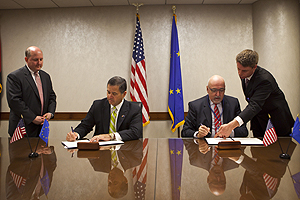
U.S. Customs and Border Protection (CBP) and the European Union (EU) signed today a Mutual Recognition Decision between CBP’s Customs-Trade Partnership Against Terrorism (C-TPAT) program and the EU’s Authorized Economic Operator (AEO) program.

U.S. Customs and Border Protection Acting Commissioner David V. Aguilar and European Union Taxation and Customs Union Directorate Director-General Heinz Zourek sign the Mutual Recognition Decision between CBP’s Customs-Trade Partnership Against Terrorism program and the EU’s Authorized Economic Operator Program.

CBP Acting Commissioner David V. Aguilar and Director-General Heinz Zourek, European Union Taxation and Customs Union Directorate (TAXUD) signed the decision, which recognizes compatibility between the EU and the U.S. cargo security programs.

“Today’s decision on the mutual recognition of the EU and U.S. trade partnership programmes is a win-win achievement: It will save time and money for trusted operators on both sides of the Atlantic while it will allow customs authorities to concentrate their resources on risky consignments and better facilitate legitimate trade,” said Director-General Zourek.

C-TPAT is a voluntary government-business initiative to build cooperative relationships that strengthen and improve overall international supply chain and U.S. border security. C-TPAT recognized that U.S. Customs and Border Protection can provide the highest level of cargo security only through close cooperation with the ultimate owners of the international supply chain such as importers, carriers, consolidators, licensed customs brokers, and manufacturers. Source: US CBP

Related article

Decay in ‘morals’ – irrational and corrupt behaviour

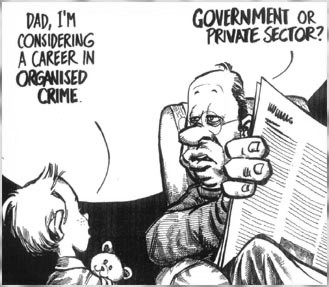
My recent post – Harbour mafia busted! – prompts a serious look at human judgement and the cause and effects of corrupt behaviour. The tragedy of the hit on Johan Nortje brings to reality the result of playing with danger. Those that will subsequently be convicted, most likely never conceived this ‘danger’ at the moment of their initial courtship with the criminal underworld. Neither did they perceive that a fellow law enforcement colleague would bear the brunt of their wrong-doing. That’s the reality of consequence of choice.

The origin of customs collection and control dates back more than 2000 years, as do attempts to undermine a country’s fiscal and economic security. Therefore the scourge of corruption is as old as the laws which gave rise to ‘controls’ at borders and ports of entry. The levying of taxes has always resulted in attempts to circumvent the payment thereof. Corruption of senior officials and politicians is the Achilles heel of poor and developing countries. It is a crime that is largely invisible but its consequences can be far reaching. It destroys confidence and morale in law enforcement structures, and robs local laborers and companies trying to etch out a decent living.

Over the centuries, and particularly the latter decades, governments and their law enforcement arms have fought against fraud in various ways. Populous countries (in the past) always had an abundance of people to staff the Customs or Border agency. Above all it was important for the government of the day to be seen as providing employment, hence a measure of comfort at election time. The close-knit command and control of port and border officials under strict observation of their respective port commanders – who in the past had ultimate control over their regions – proved effective in the main in preventing cross border crimes. However, the emergence of bootlegging and the mafia in the 1930’s (USA) proved a real challenge given that these ‘movements’ had an enormous amount of money to neutralise uncooperative customs officials and law enforcement officers. Buying the cooperation of officials left ‘blackmail’ hanging over the heads of the unfortunate officers. In many cases, breaking silence or turning state witness meant possible assassination for the individual and possibly his family as well. Yet, let it be said that such cross-border crime was very much tangible by way of the persons and the modus operandi involved. No, I’m not suggesting it was easy to contain, but it was certainly a whole lot more visible and localised for the authorities to contend with and address. Still, the manpower and the cost to deploy large task forces on the ground were inhibitive for law enforcement agencies.

Today, the world of ‘illicit goods’ is global; the operators can direct activities from the remotest parts of the world thanks to the information super-highway and all means of information and communication technology available today. Similarly, technology ensures near real-time payments to willing participants in crime. Despite this, the matter of ‘illicit goods’ remains a physical movement requiring ‘people’ to arrange and oversee transportation, and distribution to the buyer. It is a well-known fact that the movement of ‘illicit goods’ has a corresponding financial pipeline through which the profits of crime are channeled. Law enforcement has a challenge in trying to piece these activities together. This will involve cooperation of multiple agencies to bring about a result. More often than not, the selfish ambition of one or other agency overrides the collective approach to smash a syndicate. Once again its the age of key performance areas and indicators, and outcomes based initiatives which get ahead of the real issue – to neutralise an enemy. Today furthermore, unfortunately, its better to secure a huge penalty or forfeiture than to apprehend criminals and face months if not years in court – the revenue target is the primary goal. Money drives both the state and the criminal underworld.

Maybe I will be censured yet. Nonetheless, I will conclude with exercising some freedom of expression concerning views on what I believe fundamentally contributes to criminal and irrational behaviour. The democratic way of modern life has indeed perpetuated a lot of freedoms. With this, however, comes a corresponding responsibility and ability to discern between what is right or wrong. Freedom comes in both guises, sometimes simultaneously so as to confuse the mind – not unlike the ‘forbidden fruit’ in the Garden of Eden – making a choice between the right or wrong path. A flaw in democracy is that it tends to present everything in a “yes we can!” mentality. What this does is ‘challenge’ the individual or group to ‘achieve’. There might be little wrong with this, however, there are no documented guidelines on how to ‘achieve’, hence it is concluded that one must ‘achieve at all costs’. So what has this to do with corruption? The multiplicity of (false) ‘comforts’ offered by the modern world tend to excite the senses and numb the conscience. After all democracy tends to advocate equality in everything, so what can be wrong with a bit of excess, since one has freedom of choice? Wrong! unfortunately, this is the very mentality which drives ‘corrupt’ behaviour. There will always be consequences. Add to this indiscretion some measure of peer pressure, jealousy, or avarice and you have a recipe for a corrupt organisation.

The causes are multi-facetted –

  • The blatant disrespect of corporate structures in not recognising the need for staff to spend quality time with their families. (Less work = less profit and poor returns)
  • Parents too focused on personal gain or pleasing the shareholder, rather than tending to the real needs of their children to build honest citizens.
  • Ill-disciplined ‘educators’ who care little about their ‘learners’ and more about their rights!
  • Law enforcement agencies focused on revenue collection rather than law enforcement.
  • Lack of knowledge amongst politicians and heads of government agencies as to what their real mission ought to be.
  • Lack of a real support base within law enforcement agencies to deal with the threats being faced by their organisation.
  • Lack of role models in our society.

Is it little wonder then that the majority of tendencies today follow corruption? I’ve yet to note a single statesman (sorry states-person) who is morally upright. I would however like to concede that at least that maverick Prof. Jonathan Jansen (University of the Orange Freestate) is not afraid to stand up and talk straight.

Those interested in the topic of organised crime in Africa should can an interesting analysis (below) which the Internet has freely allowed me to obtain. ICT is without doubt a necessary evil!

Related articles