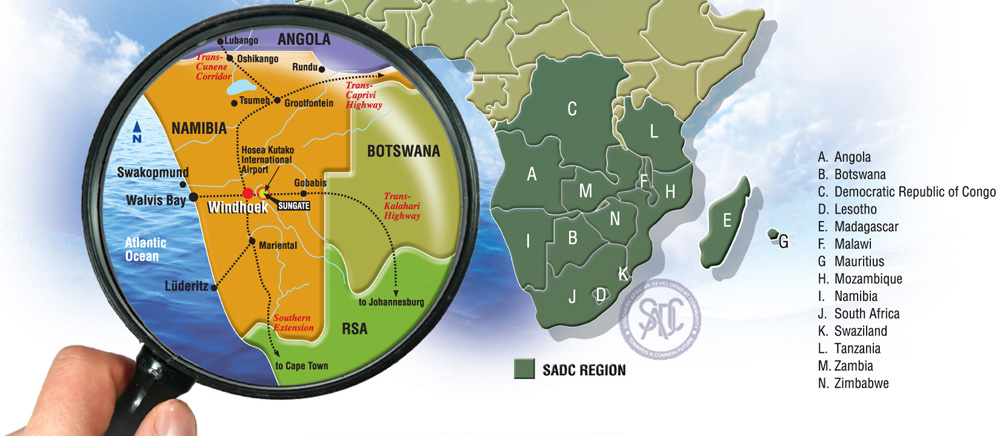
NRA/BURS – Customs Connectivity Passes Test

TKCThe first live demonstration of an end-to-end customs connectivity solution was successfully completed in Windhoek, Namibia on December 12, 2012. Customs Connectivity enables customs administrations from different countries to share information seamlessly and instantly across borders: reducing processing time and improving access to reliable, real-time trade statistics.

The demonstration was witnessed by the Commissioners of Botswana (BURS) and Namibia Customs (NRA), senior managers and operational teams. The demonstration involved moving information from an ASYCUDA++ entry in Botswana via the Cloud-based User Portal to an ASYCUDA++ entry in Namibia, and vice-versa from Namibia to Botswana. It demonstrated how clearing agents/traders would manage the flow of their information via the secure online User Portal.

The demonstration marked a “watershed moment” in turning Customs Connectivity into reality. The next steps for the pilot project include full system testing and documentation before end-user training commences. Full implementation is scheduled to take place during the first half of 2013.

Customs Connectivity offers countries in the region a historic opportunity to engage cutting-edge technology and modern tools to facilitate trade throughout Southern Africa, enhancing economic growth and promoting food security. The pilot project is being implemented by Botswana and Namibia, supported by the USAID Southern Africa Trade Hub. Source: SATH

Request – Perhaps some of the TKC clearing agents, NRA and BURS customs staff would like to comment on their experience thus far? 

Major trade route now reaches Katanga

Port of Walvis Bay – Namibian transport corridor

A new regional trade route reaching from the Katanga Province in the Congo all the way to Walvis Bay as point of entry, is on the radar of the Walvis Bay Corridor Group following an agreement between Namibia and the DRC. Development of this major link started its first tentative steps recently when the Corridor Group opened an office in Lubumbashi, on the border of the DRC and Zambia.The Corridor Group said earlier this week it had launched an office in Lubumbashi, DRC, to create a strong business presence in the mineral-rich Katanga Province.

The Walvis Bay Corridor Group Lubumbashi office was officially opened by the Governor of the Katanga Province, Hon. Moïse Katumbi Chapwe, supported by the Namibian Ambassador, Mr Ringo Abed, Corridor Chairman Mr Bisey Uirab, and Corridor Group CEO, Mr Johny Smith.

The need for landlocked countries to gain access through an alternative trade route to and from sea was recognised, where neigbouring countries and beyond could benefit from access to the Port of Walvis Bay that offers importers and exporters reduced time and cost savings, high reliability, and cargo security. The Katanga Province offers a market of more than 2 million consumers and with the fast expanding mineral rich DRC there is also a need from the DRC Government for the Walvis Bay-Ndola-Lubumbashi Corridor to extend further towards other Provinces in the DRC. Walvis Bay is surely growing as an alternative trade route for Southern DRC in that various commodities are being moved via the Port of Walvis Bay such as copper, frozen products, machinery & equipment and consumables.

The office in Lubumbashi, DRC is now the third branch office of the WBCG beyond Namibia, with the other branch offices in Lusaka, Zambia since 2005 and Johannesburg, South Africa in operation since 2008. The Walvis Bay Corridor Group is currently hosting the Walvis Bay-Ndola-Lubumbashi Development Corridor Technical Committee, which is a Public Private Partnership between the government departments responsible for transport of the DRC, Namibia and Zambia to address the bottlenecks that impede the flow of traffic along this trade route using the Port of Walvis Bay. Source: Economist (Namibia)

Tobacco Wars Heating Up

Australian courts this week threw out the bid by tobacco conglomerates to block government from introducing plain packaging for cigarettes. Tobacco product distributors operating in Namibia have been banking on a victory in the Australian courts to strengthen their arguments against similar plans by the Namibian government. Namibia Gazetted the Tobacco Products Control Act of 2010 that introduced plain packaging and ban the use of words such ‘mild’ or ‘light’ on cigarette boxes or any other tobacco products sold in Namibia.

The world’s biggest and the Namibian market leader in tobacco products, British American Tobacco (BAT) has been fighting the Act with serious threats to take the government to court if it dared to implement the Act. BAT has been citing the Australian court case as an example of how far it is prepared to go to fight the Namibian government over what it says is tantamount to expropriation of its trademarks properties. BAT also says plain packaging takes away its trade rights to freely communicate to consumers the nature of their lawful products on offer.

The Australian government’s victory now exposes BAT, along with Japan’s Tobacco International (JTI) and Imperial Tobacco to similar laws across the world. Britain, Canada, New Zealand, China, France, India, South Africa, Norway and Uruguay are already considering implementing the plain packaging measures. Southern Africa Customs Union (SACU) member states intend to adopt the generic Tobacco Products Control Act of South Africa that is in line with the World Health Organisation (WHO)’s pressure on the use of tobacco products, through the Framework Convention on Tobacco Control. BAT has been saying the proposed branding would exacerbate the illegal tobacco trade in Namibia where about 225 000 cigarettes are illegally sold every day.

BAT has a market share of about 85 percent of the Namibian tobacco market, selling just over 330 million cigarettes every year in the country. Namibians are said to smoke 75 000 packs of 20 cigarettes each per day or an equivalent of 1.5 million cigarettes each day. The court ruling in Australia makes Australia the first country in the world where cigarettes are sold in drab, olive coloured packets with graphic health warnings and no logos.

The Tobacco Products Control Act of 2010 also mandates the establishment of a fund from levies on sales of tobacco and other sources.The fund would partly use the money to pay for treatment of tobacco-related illnesses. The new proposed packaging features graphic pictures depicting the ill health associated with smoking. These range from stained teeth, throat cancer to damaged lungs and breast cancer with appropriate warnings underneath the picture. If the new legislation is implemented fully there would be a total blackout on advertising, promotion and any public relations activities around tobacco products or companies whose names are directly associated with tobacco products. Source: New Era, Namibia.

Namibian Ministry of Finance angers clearing agents

Below is a situation which might have been avoided if trader registration/licensing was properly addressed by the Namibian Authorities. With the likes of SADC and COMESA encouraging the implementation of regional transit guarantees, trade operators need to clearly address their obligations and liabilities. Moreover, any suggestion of authorised economic operator (AEO) programme in the Southern African region needs to fully align its requirements with the standards being applied by other countries across the globe. It is therefore clear that no preferred trader scheme can be implemented across the Trans-Kalahari Corridor or across SACU if such disparities of knowledge and practice exist. While one might have compassion for possible job redundancies and the pleas expressed by certain clearing agents, they evidently do not understand the game they are playing in and will drastically need to redress their understanding of the role they play in the supply chain. International clearing and forwarding is not a game for sissies, or people who want to try their hand at a quick buck. A bold stance by the Ministry of Finance.

The Namibian Ministry of Finance’s decision to ban clearing agents from using guarantees and bonds from third parties as security to move goods has caused an uproar among clearing agents. The Deputy Minister of Finance, Calle Schlettwein, explained that the decision that became effective on July 26 was taken to protect the taxpayer. Clearing agents aren’t closed down, and neither are they stopped from using their own security to move these goods, he said. As from July 26, the agents are simply not allowed to use a bond or guarantee issued to another clearing agent as security for their goods in transit, the ministry said.

Before the clampdown, clearing agent A used to ‘borrow’ guarantees or bonds, backed by financial or other institutions from clearing agent B to clear any goods coming through Namport and destined for landlocked countries such as Botswana, Zambia and Zimbabwe. However, should a problem develop with agent A’s consignment, the guarantee or bond would be worthless to Government, as the financial institution agreed to back only agent B’s guarantee or bond. “We don’t know how or when the practice started, but it is illegal,” a ministry spokesperson said.,

Schlettwein said Government stood to lose out on duties and customs through the practice, and the taxpayers would have ended up having to pick up the tab. The ministry’s announcement was met with considerable protest from the smaller clearing agencies, claiming that they didn’t have the money or financial backing to secure the necessary bonds or guarantees. Nampa reported that 76 small and medium enterprises (SMEs) operating as clearing agencies at the coast have been affected. At the Oshikango border post and at Helao Nafidi in the North, 30 agencies with more than 100 employees are affected.

Regina Amupolo of Pride Clearing and Forwarding Agent has called on the ministry to urgently look into this matter, because many trucks with goods and containers are stuck at the Oshikango border post, Walvis Bay harbour or at other border posts. Their customers have already complained that they are losing business because of this, Amupolo said. Amupolo said most SMEs don’t have the money to obtain bonds or guarantees. She said ministry officials said anyone who wants a bond must have collateral of N$1,6 million. “We are small business people, trying to employ ourselves and some of our fellow men and women in our societies, but now the Government, the Ministry of Finance, is making things difficult for us. How are we going to make a living if the ministry is cutting off our jobs in this way?” she asked.

In a letter written to all clearing agents at Oshikango, the controller customs and excise officer, Festus Shidute, said the practice of using third-party bonds or guarantees posed a serious challenge to customs administration and control of guarantees in the event of liabilities by third parties. Amupolo and Rejoice Nangolo from Flora Clearing Agent said they have already paid N$20 000 to obtain a clearing licence, while they have to pay Namport another N$20 000. She said they are losing thousands of dollars as a result of this unexpected prohibition by the ministry and are demanding an extension to allow them to take the matter up with the ministry.

Nangolo said her business has branches at other border posts like Omahenene, Katwitwi, Ngoma, Wenela, Trans-Kalahari, Ariamsvlei, Noordoewer, Walvis Bay, Hosea Kutako International Airport and Oshikango. Her Angolan customers have threatened to stop moving their goods through Namibia and only to use their own ports, she said. At Oshikango there are only two big companies, Piramund and CRN, that can guarantee bonds and assist them as SMEs clearing their work effectively. According to Amupolo and Nangolo, they started with their clearing business in Oshikango in 2000 and were doing well until the ministry imposed the ban.

Speaking to Nampa, Lunomukumo Taanyanda of Oluvanda Clearing and Forwarding Close Corporation (OCFCC) said his company has been operational for two years and deals mostly with car consignments from countries such as the United Kingdom (UK) and Dubai.Before clearing the consignments, OCFCC has to declare the consignment at the Namport customs desk. However, before they can fill in a customs declaration form to clear the transit goods, the goods need to be secured and this is where the company (OCFCC) requires the assistance of third parties such as Wesbank Transport, Transworld Cargo and Woker Freight Services.

These smaller companies acquire assistance from bigger companies (the third parties) as they experience problems when trying to obtain their own bonds and guarantees. According to Taanyanda, it is a very costly and time-consuming process. “We agents do not have enough collateral for bonds, which start at N$350 000, and now the ministry has stopped us from borrowing bonds from third parties,” he said. Source: The Namibian

Related Articles

http://www.namibian.com.na/news/marketplace/full-story/archive/2012/august/article/clearing-agents-want-answers-today/
Namibia buys into ‘Single Window’ concept

From April 12-13, Southern African Trade Hub (aka USAID) presented Single Window as a cutting-edge tool for trade facilitation to the Ministry of Industry and Trade, Ministry of Finance, Customs and other private sector organizations, explaining how a NSW for Namibia could improve the Trading Across Borders index ranking, which currently stands at 142 out of 183 countries. Single Window is a crucial instrument that will eliminate inefficiency and ineffectiveness in business and government procedures and document requirements along the international supply chain, reduce trade transaction costs, as well as improve border control, compliance, and security.

Benefits for Government: A Single Window will lead to a better combination of existing governmental systems and processes, while at the same time promoting a more open and facilitative approach to the way in which governments operate and communicate with business. Traders will submit all the required information and documents through a single entity, more effective systems will be established for a quicker and more accurate validation and distribution of this information to all relevant government agencies. This will also result in better coordination and cooperation between the Government and regulatory authorities involved in trade-related activities.

Benefits for trade: The main benefit for the trading community is that a Single Window will provide the trader with a single point for the one-time submission of all required information and documentation to all governmental agencies involved in export, import or transit procedures. As the Single Window enables governments to process submitted information, documents and fees both faster and more accurately, traders would benefit from faster clearance and release times, enabling them to speed up the supply chain. In addition, the improved transparency and increased predictability would further reduce the potential for corrupt behaviour from both the public and private sector.

If the Single Window functions as a focal point for the access to updated information on current trade rules, regulations and compliance requirements, it will lower the administrative costs of trade transactions and encourage greater trader compliance. The Permanent Secretary for the Ministry of Industry and Trade underscored the need for Namibia to proceed with the Single Window concept, and advised participants that his Ministry, together with the Ministry of Finance, would jointly package the Single Window concept and submit it to Cabinet for Government approval.

In Southern Africa, Mauritius already has an effective Single Window, which is reflected in its “Trading Across Borders” ranking of 21. Mozambique recently launched its pilot Single Window. SATH will support and facilitate the processes for the establishment of a Botswana National Single Window system to streamline cross border trade. The current SATH Trans Kalahari Corridor (TKC) Cloud Computing Connectivity program, which is being piloted between Botswana and Namibia, provides an ideal technology platform for linking Botswana and Namibia Single Windows, leveraging the investment by BURS, Namibia Customs and SATH to date in the development of this system. SATH is currently in the process of gauging support for National Single Window in South Africa.

Excuse my cynicism, but the SA Trade HUB  has yet to demonstrate the viability of its Cloud Computing solution between Namibia and Botswana Customs. What is reported above is the usual sweet and fluffy adjectives which accompany most international customs and trade ICT offerings, ignoring prerequisite building blocks upon which concepts such as Cloud and Single Window may prove beneficial and effective. Past project failures in Africa are usually blamed on the target country in not bedding down or embracing the new process/solution – never the vendor. Given the frequency of technology offerings being presented by donor agencies on unwitting national states, there seems little foreign interest in ‘bedding down’ or ‘knowledge transfer’ than the ‘delivery of expensive technology’.

Related articles and references

TKC Pilot – linking regional Customs systems through the “Cloud”

FTW Online recently published an update on recent developments occurring along the Trans-Kalahari Corridor (TKC). It suggests that customs systems throughout the SADC region could soon be talking to each other through the Internet, if the pilot project between Namibia and Botswana is successful. During July 2011, the Southern African Trade Hub unveiled a plan to initiate a pilot programme to link the ASYCUDA systems of Namibia and Botswana via Microsoft’s Cloud Computing technology. Both Microsoft and USAID are partners in this initiative seeking to enable the two customs systems to communicate with each other through a secure portal. View the keynote presentation at the 2011 World Customs Organization IT Conference and Exhibition – Seattle, Ranga Munyaradzi (SATH) and Namibian Customs Commissioner, Bevan Simataa, were invited on-stage to elaborate on this initiative – click here!

According to Oscar Muyatwa, executive director of the Trans-Kalahari Corridor Secretariat, the initiative holds the prospect of opening up African opportunities in the United States for exports, as it is being supported by USAID as part of the African Growth and Opportunities Act (AGOA). Both Namibian and Botswana Customs officials are to be trained in Cape Town over the next few months. The TKC Secretariat believe this initiative will bring about its vision of a ‘automated corridor’. Further ahead the TKCs envisages the establishment of One Stop Border Posts (OSBPs) to reduce border dwell and transit times. Muyatwa says ‘The ‘cloud’ will maintain vast volumes of transit data that will assist future planning along the corridor as well as revenue and budgeting forecasts’. Source: FTW Online.

Comment: lest there be any confusion amongst Customs users, traders and carriers, the concept of cloud computing in the Customs sphere is very ‘clouded’ at this point. What needs to be considered is the ‘ownership’, rights to ‘access’ and ‘integrity of use’ of such information. Furthermore, as this is a first-of-its-kind initiative (in Africa at least); it would be highly recommended that the participants and developers ‘share’ details of the approach with other SACU members in order to better understand the programme. Up to this point it is very unclear how the developer has gone about the integration of customs information, for instance, since ‘users’ have not been fully involved in the scope, proof-of-concept or design of the system. 

Related articles

Record Freight Traffic for Walvis Bay Corridors

Walvis Bay CorridorsVolumes along all the Walvis Bay Corridors have hit a record high of more than 63,000 tonnes for the month of January 2012, reports Namib Times. The report describes this as a significant growth of cargo volumes along the TransKalahari, TransCaprivi and TransCunene Corridors respectively. From a mere ten trucks a day that left the Port of Walvis Bay seven years ago to other SADC countries, more than 1,000 vehicles are now entering or leaving the Port of Walvis Bay on a monthly basis.

Although some markets such as Zimbabwe, Zambia and DRC have experienced stronger growth than the other markets, a growth factor has been seen with all the Corridor markets for the past six months. The Botswana and Gauteng (South Africa) markets are growing slowly, with the variety of commodities being expanded along these corridors. Imports and exports for Malawi via Walvis Bay are also on the increase, as this market also offers an immense possibility of attracting commodities such as tobacco to be transported via the Namibian port. The Angolan market also showed an increase during the past 6 months as more types of commodities are being transported via Walvis Bay destined for Southern Angola. Source: Namib Times