First BRICS Heads of Customs Meeting

Delegates who attended the first BRICS Customs Heads of Customs Meeting [SARS]

Delegates who attended the first BRICS Customs Heads of Customs Meeting [SARS]

At a meeting hosted by the Commissioner near Bela Bela, South Africa from 7 to 8 March 2013, delegations from the Customs Administrations of Brazil, Russia, India, China and South Africa (BRICS) met for the first time. The BRICS Customs administrations exchanged experience and ideas in a spirit of openness so as to identify areas for cooperation so that they can most effectively and efficiently facilitate legitimate trade and combat illicit trade and Customs fraud. From 27 to 28 March, South Africa will also host the BRICS Summit in Durban, to be attended by various Ministers and the BRICS Heads of State.

Key points of discussion, focus and future cooperation –

Customs cooperation
The Heads of Customs committed themselves to consolidating and building on the cooperation that has already been established so that they can collectively curb Customs offences, safeguard the international supply chain and achieve effective enforcement of Customs legislation, while facilitating legitimate trade,both among BRICS countries and also globally.

Capacity building
As part of their cooperation to build Customs capacity in relation to human resources, technologies and procedures,the administrations would look into various practical and innovative solutions and endeavour to share their resources, knowledge and best practices with each other.

Cooperation at multilateral forums
A BRICS Customs mechanism will be established, including attachés networks based in Brussels and other strategic places, to identify issues of common interest, develop common responses and ensure regular engagement and interaction, including before important multilateral meetings.

Customs Mutual Administrative Assistance and the Exchange of Customs Information
The administrations also agreed to ensure that there is an enabling legal basis between them to support intra-BRICS Customs mutual administrative assistance and the exchange of Customs information. Such assistance and exchange will assist in combating illicit trade and protecting revenues and societies.

Facilitation of legitimate trade between BRICS countries
To further facilitate trade and reduce the Customs administrative burden on both trade and the administrations themselves, the administrations will exchange information in various areas of common interest and concern, including on the simplification of Customs procedures and the use of modern technologies and techniques.

The administrations will also work towards possible solutions for achieving mutual recognition of Customs controls and of trader management programs aligned to the Authorised Economic Operator (AEO) concept of the World Customs Organization (WCO), establishing Customs interconnectivity and supporting the WCO’s work on developing the Globally Networked Customs (GNC) model.

Opportunities for enforcement cooperation will also be explored, including possible joint actions, information sharing and other enforcement assistance. The use of international instruments developed by the WCO, including Conventions, Recommendations, Decisions and Declarations that support Customs trade facilitation, compliance and enforcement will be actively promoted.

Governance issues
A Governance Framework aligned to the overall BRICS commitments will be established. An annual BRICS Customs Heads meeting has been proposed whose deliberations would be informed to other BRICS forums, including in particular the Summit. Such a BRICS Customs Heads Meeting would be supported by a Customs working group under the guidance of the BRICS Heads of Customs. Source: SARS

Uganda prepares to introduce AEO

Authorised Economic Operators (AEO), a scheme focusing on compliant companies to facilitate trade starts before the year ends. The Uganda Revenue Authority (URA) Public and Corporate Affairs Assistant Commissioner Sarah Banage recently disclosed that AEO is meant to enhance compliance “by removing barriers for the most complaint taxpayer”.

“Under the scheme, the benefit of being complaint will be red-carpet treatment offered by URA,” she stated, adding, “we want to demonstrate that there are rewards for being compliant.” Banage cited electronic submission of declaration without supporting documents, pre-arrival clearance of cargo, and self-management of bonded warehouses as some of the benefits. Others are: priority treatment when cargo is selected for control, choosing the place for examination, automatic renewal of licences and withholding tax exemption status.

Because the relationship between URA and its clients is “symbiotic”, it is expected that there will be an increase in taxes, Banage argued. Potential beneficiaries of AEO are: agents, importers, exporters, shippers, internal container depot operators, and others involved in international shipment of goods, among others.

To be eligible, Banage said, one should be involved in international trade, have a good compliance history, be financially sound, install and use customs automated systems like e-tax and should implement the AEO compliance programme. To be authorized, companies/organizations will apply to the commissioner, after which a preliminary consultation is done.

“We will then determine who should formally apply. Officials will adjudicate submitted documents before a site is inspected to ensure compliance with guidelines,” she said. Subsequently, a one-year certificate will be issued.

“An AEO is an individual, a business entity or a government department that is involved in international trade and is duly authorized by the Commissioner of Customs of Uganda Revenue Authority.”

Banage said that implementing AEO does not only have short-term results but also resultant long-term benefits to the business community. These include reduction of the cost of doing business and increased turnover over time, among others. In the middle of April, customs officials held a breakfast meeting at Serena hotel, Kampala where Chief Executive Officers of major organizations were sensitized about the plan.

Later, customs officials interacted with personnel of the Auditor General, Export Promotion Board, the Trade, Industry and Cooperatives ministry, the Agriculture, Animal Industry and Fisheries ministry and Uganda National Bureau of Standards. Also at Serena, it was meant to “share with them the programme in order to capture their ideas,” according to Banage.

Weeks ago, URA asked companies to express interest in joining the scheme. Over 20 organizations applied and are currently involved in talks expected to culminate in attaining AEO status. “Admission to the scheme will depend on how the companies implement the compliance programme. By December, some companies should be authorized,” Banage added. Among others, those expected to benefit from the first phase are importers, clearing agents and transporters.

Regarding the East African Community (EAC), customs administrators have adopted an AEO policy framework. It was adopted in 2010 as a basis for implementing trade facilitation initiatives that drive economic development for the EAC. Under AEO’s mutual recognition arrangement, a government formally recognizes the AEO programme of another country, thereby granting benefits to the AEOs of that country. Under a regional project, companies in the five countries receive benefits related to the scheme. Among the benefits is priority treatment at customs points. Source: The Observer (Kampala) 

USCBP and EU sign C-TPAT Mutual Recognition

U.S. Customs and Border Protection (CBP) and the European Union (EU) signed today a Mutual Recognition Decision between CBP’s Customs-Trade Partnership Against Terrorism (C-TPAT) program and the EU’s Authorized Economic Operator (AEO) program.

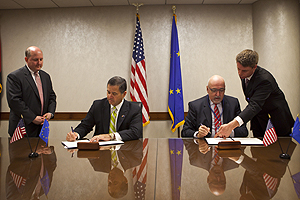
U.S. Customs and Border Protection Acting Commissioner David V. Aguilar and European Union Taxation and Customs Union Directorate Director-General Heinz Zourek sign the Mutual Recognition Decision between CBP’s Customs-Trade Partnership Against Terrorism program and the EU’s Authorized Economic Operator Program.

CBP Acting Commissioner David V. Aguilar and Director-General Heinz Zourek, European Union Taxation and Customs Union Directorate (TAXUD) signed the decision, which recognizes compatibility between the EU and the U.S. cargo security programs.

“Today’s decision on the mutual recognition of the EU and U.S. trade partnership programmes is a win-win achievement: It will save time and money for trusted operators on both sides of the Atlantic while it will allow customs authorities to concentrate their resources on risky consignments and better facilitate legitimate trade,” said Director-General Zourek.

C-TPAT is a voluntary government-business initiative to build cooperative relationships that strengthen and improve overall international supply chain and U.S. border security. C-TPAT recognized that U.S. Customs and Border Protection can provide the highest level of cargo security only through close cooperation with the ultimate owners of the international supply chain such as importers, carriers, consolidators, licensed customs brokers, and manufacturers. Source: US CBP

Related article

SARS issues Compliance Programme 2012/13 – 2016/17

SARS has issued its inaugural SARS Compliance Programme, a high-level overview of its plans for the next five years to further grow compliance with tax and customs legislation. More so than perhaps any other time in history, the current global economic conditions have thrust domestic resource mobilisation into the spotlight, highlighting sustainability built on a foundation of tax compliance. Countries lacking this solid base have found their room for manoeuvre in these uncertain times severely curtailed and, in some cases, completely absent. The impact of self-reliance on self-determination is self-evident.

Many tax administrations publish similar compliance programmes (including Australia, Brazil, Canada, Denmark, Netherlands, New Zealand, Poland, Spain, Sweden, Turkey, USA, UK) and SARS has based it’s Compliance Programme on their ground-breaking work. To download and read the SARS Compliance Programme, click here! For Customs specialists and trade practitioners no less than 3 priority areas involve Customs –

Illicit cigarettes: the trade in and consumption of illicit cigarettes is detrimental to the fiscus and to the health of South Africans. SARS interventions will continue to focus on clamping down on cigarettes smuggled via warehouses as well the diversion of cigarettes destined for export back into the local market. SARS also plans to modernise it’s warehousing management and acquittal system.

Undervaluation of imports in the clothing and textile industry: Undervalued imports pose a significant risk not only to the fiscus but to local industry and job creation. SARS will continue to work together with other government agencies and industry stakeholders to clamp down on this practice including through the establishment and frequent revision of a reference pricing database to detect undervaluation, increasing inspections as well as supporting an integrated border management model.

Tax Practitioners and Trader Intermediaries: Regulation of this industry will be pursued to ensure that tax practitioners and trade intermediaries are all persons of good standing, are fully tax compliant in their personal capacity and provide a high quality service and advice to their clients. SARS will also develop a rigorous risk profiling system to identify high risk practitioners and trade intermediaries.

US and EU one step closer to Mutual Recognition agreement

The U.S. Customs and Border Protection (CBP) and the European Union Taxation and Customs Union Directorate (TAXUD) have agreed to language for the U.S.-EU Mutual Recognition Decision today which will lead to its signing in the Spring of 2012. Once signed, the Mutual Recognition Decision will recognize the respective trade partnership programs of the U.S. and the EU—CBP’s Customs-Trade Partnership Against Terrorism (C-TPAT) and the EU’s Authorized Economic Operator (AEO)—with reciprocal benefits.

In 2007, CBP and TAXUD initiated efforts to implement Mutual Recognition between C-TPAT and AEO. Mutual Recognition is an industry partnership program that creates a unified and sustainable security posture that can assist in securing and facilitating global cargo trade. Upon achieving mutual recognition with a foreign partner, one program may recognize the validation findings of the other program.

C-TPAT is a voluntary government-business initiative to build cooperative relationships that strengthen and improve overall international supply chain and U.S. border security. C-TPAT recognizes that U.S. Customs and Border Protection can provide the highest level of cargo security only through close cooperation with the ultimate owners of the international supply chain such as importers, carriers, consolidators, licensed customs brokers, and manufacturers. CBP currently has mutual recognition with: New Zealand, Canada, Japan, Korea and Jordan. Source: USCBP

Related articles