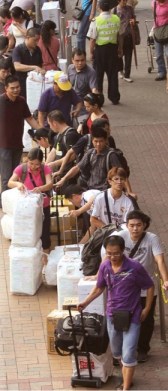
Border Madness!

Mainland Chinese visitors line up and wait for check in outside Hong Kong’s Sheung Shui train station with packages of diapers to be parallel imported into Shenzhen for resale.

While communist China bears the brunt of criticism for its exportation of low cost and in many cases inferior products to the rest of the world, the following article suggests one should spare a thought for the Chinese citizens themselves given what they have to put up with from the authorities between Hong Kong and Shenzhen.

The recent hard crackdown on smugglers and couriers across the boundary between Hong Kong and Shenzhen has cut deeply into the business of parallel trading on both sides of the border, and thus far, appears to have reduced the nuisance problem caused to residents of the northern New Territory. However, with the crackdown on-going and the Mass Transit Railway Corporation (MTR) adding further pressure by restricting the dimensions and weight of passenger luggage going across the border, complaints have started buzzing, that the move may have frightened away the passenger couriers, but not the syndicates coordinating them behind the scenes.

Effective 9 October 2012, the Mass Transit Railway Corporation (MTR) imposed a maximum weight limitation of 32 kilograms or 130 centimetres in length for passenger luggage on the East Rail Line, under a three-month trial scheme. Could you just imagine this at an African border crossing? Passengers are allowed only one piece of baggage. All their small parcels and suitcases are required to be bundled up into a single “package,” all part of the bid to curb the passenger-couriers whose clamouring and crowding had become a serious issue for neighbours of MTR in New Territories.

The restrictions were seen as MTR’s contribution to the collaborative effort that involved governments on both sides of the border, to cut down on so-called parallel traders and smugglers. MTR’s new rule has, in general, earned praise from residents of northern New Territory because the nuisance problem caused by the traders/smugglers has been alleviated. However, for residents of Shenzhen, who travel back and forth every day, or residents of `other parts of the mainland who come to Hong Kong for shopping, the size and weight limitations seem be “unnecessary” and “troublesome”.

“I was often asked to buy things in Hong Kong on my way home: cooking oil, rice, baby formula, tissues, etc. I really don’t have time to care about how heavy they are or how long they are,” said Go, a resident of Shenzhen. He Hua, also a Shenzhen resident living in Luohu district who comes to Hong Kong to go shopping two to three times a month, also doesn’t like the new limitation. “I came to Hong Kong regularly to buy things for myself and my family. I paid my money and followed regulations of the Customs, why should I worry about my weight and length? If the goods are all legal, why can’t I take them on the train at one time?” said Hua, who had carried six cans of baby formula with her, which she claimed were for her elder sister’s baby.

Recently, there has been a strengthened effort to combat parallel trade, with a collaborative effort between the Customs and Excise Department of the SAR and the Shenzhen Anti-Smuggling Bureau. The action uncovered 120 cases of parallel trading and made 123 arrests, with the unpaid taxation of the confiscated goods amounting to one million yuan. On the other side of the border, business associated with cross boundary goods was also affected. In North Huaqiang district in Shenzhen, which had been long recognized as the “centre of parallel trading” of “grey goods” from Hong Kong, business has shrunken since the crackdown.

A shop owner in North Huangqian area told China Daily that he had expected to make a huge profit by selling iPhone 5, the latest release by Apple Corporation. It never happened, because his Hong Kong supplier informed him that it was too difficult and that it was risky to get the iPhone 5 across the border. And the seller couldn’t get the supply he had counted on.

“The whole business chain of parallel trading depends on the ‘suppliers’ to smuggle goods from Hong Kong to Shenzhen, especially electronic goods. Now the suppliers have trouble getting through the border, (so) we have trouble getting the goods,” said the anonymous shop owner. Because of serious supply shortage, the price of “grey goods” has soared significantly on the mainland side of the border. The best example was iPhone, which sold originally at HK$5,688 (US$733.8) at the Apple Store in Hong Kong, but was priced at 8,000 yuan (US$1276.5) at the anonymous shop owner’s store. Insiders of the courier industry also told China Daily that the price for smuggling goods across the border with “ant house-moving” tactics had increased from 22 yuan per kilogram to a record high of 50 yuan per kilogram.

The business of stores that sell Hong Kong goods in Shenzhen has picked up since the crackdown, as people who live along the border in Shenzhen choose to buy daily-use goods in local stores – like cooking oil, rice and baby formula, instead of going to Hong Kong by themselves. “We have adequate Hong Kong goods, don’t worry; they are all fresh and delivered to us fresh every day,” said the owner of a store selling Hong Kong goods in Shatoujiao, or Sha Tau Kok in Cantonese, in eastern Shenzhen. The store owner refused to answer how he managed to get “adequate supply” from Hong Kong every day.

The crackdown on smugglers, especially the MTR weight limitation, had stopped individual couriers; however, it didn’t shut down the syndicates coordinating behind the scenes. What’s more, there are some 157 online stores that sold Hong Kong goods on Taobao, the biggest online shopping market in the mainland. The record on the website showed that one of the big shops had sold out 1,357 pieces of Hong Kong goods in the past week, 90 percent of which are daily use goods and food. Source: The China Daily
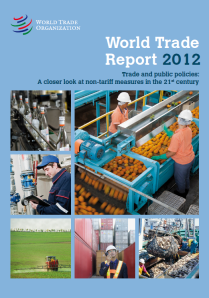
World Trade Report 2012

This year’s World Trade Report ventures beyond tariffs to examine other policy measures that can affect trade. As tariffs have fallen in the years since the birth of the General Agreement on Tariffs and Trade (GATT) in 1948, attention has progressively shifted towards non-tariff measures (NTMs). The range of NTMs is vast, complex, driven by multiple policy motives, and ever-changing. Public policy objectives underlying NTMs have evolved. The drivers of change are many, including greater inter-dependency in a globalizing world, increased social awareness, and growing concerns regarding health, safety, and environmental quality. Many of these factors call for a deepening of integration, wresting attention away from more traditional and shallower forms of cooperation. Trade in services is a part of this development and has come under greater scrutiny, along with the policies that influence services trade.

So what does the report contain? Click here to download the report!

  • Section A of the Report presents an overview of the history of non-tariff measures in the GATT/WTO. This overview discusses how motivations for using NTMs have evolved, complicating this area of trade policy but not changing the core challenge of managing the relationship between public policy and trading opportunities.
  • Section B examines the reasons why governments use NTMs and services measures and the extent to which public policy interventions may also distort international trade. The phenomenon of off-shoring and the cross-effects of services measures on goods trade are also considered. The section analyses choices among alternative policy instruments from a theoretical and empirical perspective. Finally, case studies are presented on the use of NTMs in particular contexts.These include the recent financial crisis, climate change policy and food safety concerns. The case studies consider how far measures adopted may pose a challenge for international trade.
  • Section C of the Report surveys available sources of information on NTMs and services measures and evaluates their relative strengths and weaknesses. It uses this information to establish a number of “stylized facts”, first about NTMs (TBT/SPS measures in particular) and then about services measures.
  • Section D discusses the magnitude and the trade effects of NTMs and services measures in general, before focusing on TBT/SPS measures and domestic regulation in services. It also examines how regulatory harmonization and/or mutual recognition of standards help to reduce the trade-hindering effects of the diversity of TBT and SPS measures and domestic regulation in services.
  • Section E looks at international cooperation on NTMs and services measures. The first part reviews the economic rationale for such cooperation and discusses the efficient design of rules on NTMs in a trade agreement. The second part looks at how cooperation has occurred on TBT/SPS measures and services regulation in the multilateral trading system, and within other international forums and institutions. The third part of the section deals with the legal analysis of the treatment of NTMs in the GATT/WTO dispute system and interpretations of the rules that have emerged in recent international trade disputes. The section concludes with a discussion of outstanding challenges and key policy implications of the Report. Source: World Trade Organisation.
Related articles

Customs Modernisation – positive impact on Doing Business in South Africa!

South Africa ranks 39th out of 185 countries surveyed in the latest International Finance Corporation (IFC)-World Bank ‘Doing Business’ report, which was published on Tuesday.Last year, South Africa ranked 35 out of 183 countries assessed.

The country is placed above Qatar and below Israel in the Doing Business 2013 report, which covers issues such as starting a business, dealing with construction permits, getting electricity, registering property, accessing credit, protecting investors, paying taxes, trading across borders, enforcing contracts and resolving insolvency.

Singapore remains at the top of the ease-of-doing-business ranking for the seventh consecutive year, followed by Hong Kong and New Zealand. Poland improved the most in making it easier to do business, by implementing four regulatory reforms in the past year.

South Africa led the pack in terms of improving in the ease of trading across borders through its customs modernisation programme, which reduced the time, cost and documents required for international trade. “We hope that through the streamlining of procedures, we will see the growth of commerce in the country,” said coauthor of the report Santiago Croci Downes.

The Doing Business 2013 report stated that improvements in South Africa have effects throughout Southern Africa. “Since overseas goods to and from Botswana, Lesotho, Swaziland and Zimbabwe transit through South Africa, traders in these economies are also enjoying the benefits,” it stated.

Another 21 economies also implemented reforms aimed at making it easier to trade across borders in the past year. Trading across borders remains the easiest in Singapore, while it is the most difficult in Uzbekistan.

Out of the 185 economies assessed in the 2013 report, South Africa ranked 53rd for starting a business, 39th for dealing with construction permits, 79th for registering property, 10th for protecting investors, 32nd for paying taxes, 82nd for enforcing contracts and 84th for resolving insolvency.

The country ranked low, at 150, for ease of access to electricity, while it tied at the top with the UK and Malaysia for ease of access to credit. Croci Downes added that it was still too early to tell whether the recent labour unrest in the mining and transport industries would have an impact on South Africa’s ranking or on foreign direct investment .

Meanwhile, the IFC and World Bank reported that of the 50 economies making the most improvement in business regulation for domestic firms since 2005, 17 were in sub-Saharan Africa.

From June 2011 to June 2012, 28 of 46 governments in sub-Saharan Africa implemented at least one regulatory reform making it easier to do business – a total of 44 reforms.

Mauritius and South Africa were the only African economies among the top 40 in the global ranking. World Bank global indicators and analysis director Augusto Lopez-Claros said Doing Business was about smart business regulations, not necessarily fewer regulations. “We are very encouraged that so many economies in Africa are among the 50 that have made the most improvement since 2005 as captured by the Doing Business indicators.”

IFC human resources director Oumar Seydi added that lower costs of business registrations encouraged entrepreneurship, while simpler business registrations translated to greater employment opportunities in the formal sector.

“Business reforms in Africa will continue to have a strong impact on geopolitical stability. We encourage governments to go beyond their rankings. Ranking does matter, and competition is important, but that is not all that counts. What truly matters is how reforms are positively impacting growing economies,” he said.

African economies that have improved the most since 2005 include Rwanda, Burkina Faso, Mali, Sierra Leone, Ghana, Burundi, Guinea-Bissau, Senegal, Angola, Mauritius, Madagascar, Mozambique, Côte d’Ivoire, Togo, Niger, Nigeria, and São Tomé and Príncipe. Source: http://www.polity.org.za

Dynamic X-Ray imaging – detecting objects or living creatures

The conventional image (left) and the dynamic image (right) of a pack of rice containing mealworm larvae

The conventional image (left) and the dynamic image (right) of a pack of rice containing mealworm larvae

X-ray inspection systems are a standard feature in many ports. These X-ray systems have the unique ability to non-destructively image the contents of entire cargo containers in just a few seconds. It is a difficult task, however, to identify what is in the container based on the obtained X-ray images. The superposition of two images with different contrasts – like in dual-energy X-ray imaging – can enhance the effectiveness of the detection. A novel X-ray imaging technology now introduces an entirely new type of contrast based on movement. This technology can be combined with existing single-energy and dual-energy X-ray imaging methods, opening new possibilities in port security applications.

One important application of the dynamic imaging technology could be finding stowaway pests in the cargo. Stowaway pests travel hidden within transported goods and may damage the cargo while being shipped. In addition to this, potentially invasive species often travel as stowaway pests and arrive to new territories unnoticed. Although better part of these exotics are harmless, approximately 20 to 30 percent of the introduced species are pests and cause major environmental and economic problems. Read the full article here! Source: Porttechnology.com

“Blood Ivory” – Huge seizure of Illegal Ivory in Hong Kong

An emperor, faced with the task of selecting a successor, devises a test: he lays out an array of valuable artifacts — items of gold, jade and ivory — and asks each of his sons to choose one treasure. One prince ponders his options for a while, before selecting an ivory scepter. The emperor is pleased. Ivory is valuable, he says, and also imbued with wisdom. The son with the scepter will rule. This, of course, is merely a fable. But the tale of the emperor and his son hints at ivory’s enduring lure in China. For millennia, it has been seen as a symbol of wealth, a source of wisdom and a sign of nobility. This helps explain why more than 20 years after an international ban on the trade of elephant ivory, the business is booming. “With more disposable income in mainland China, many people are flaunting their wealth, and ivory is seen as a luxury product that confers status,” says Tom Milliken of the Wildlife Trade Monitoring Network. “We are seeing the worst poaching of elephants and the worst illegal trade in ivory over the last 23 years.”

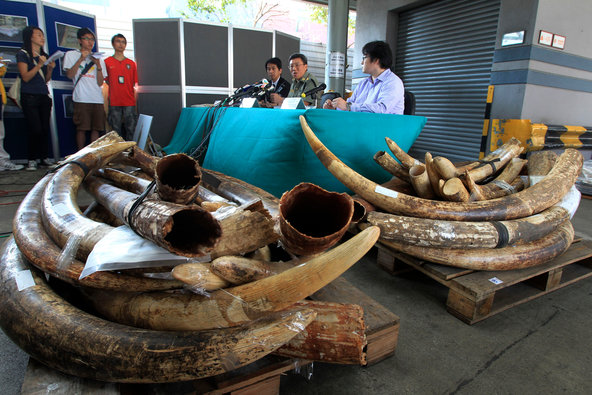
Authorities in Hong Kong have intercepted one of the largest shipments of illegal ivory in history – 1,209 elephant tusks and ivory ornaments weighing more than 8,400 pounds. The Hong Kong Customs and Excise Department announced the seizure on Saturday of 3,813 kilograms of ivory hidden inside two containers shipped from Tanzania and Kenya. One container was labeled as carrying plastic scrap, the other was marked as dried beans.

It was the largest-ever seizure of contraband ivory in Hong Kong. Even within the context of soaring wildlife poaching, the numbers are staggering: the equivalent of more than 600 dead elephants. So lucrative is the ivory trade now that well-armed mafias have gotten in on the act. Hong Kong officials estimated the value of the seizure at 26.7 million Hong Kong dollars, or just under $3.5 million.

The customs agency, which said in a statement that it had “smashed” the ivory smuggling case, reported no arrests. But the South China Morning Post reported that seven people in China were arrested in connection with the seizure. Demand from an increasingly affluent Asia, improved international transport and trade links, and weak enforcement and feeble penalties (in many countries) have caused wildlife poaching to jump over the past decade or two.

More than 300 elephants were killed in Cameroon alone early this year. A video from the World Wildlife Fund shows some of that grim slaughter. In this article, published in September, Jeffrey Gettleman reported that ivory — like blood diamonds from Sierra Leone or plundered minerals from Congo — is now a “conflict resource,” used to help finance conflicts across the African continent.

“Some of Africa’s most notorious armed groups, including the Lord’s Resistance Army, the Shabab and Darfur’s janjaweed,” he wrote, “are hunting down elephants and using the tusks to buy weapons and sustain their mayhem.” Members of some of the African armies backed by the U.S. government, Jeffrey reported, also have been implicated in poaching elephants and dealing in ivory. Source: New York Times

Related Articles

Port of Antwerp – Customs seize record cocaine haul

Customs Officers at the Belgian Port of Antwerp seized more than eight tons of cocaine hidden in a shipment of bananas originating from Ecuador last week. The cocaine, with a street value of more than US$500 million, were found in a container on Monday in what is the largest drugs haul ever in both Belgium and the Netherlands, and the second largest ever in Europe.

Dutch authorities have made five arrests in connection with the find, with a 46-year old Belgian truck driver and four Dutch citizens currently being questioned by police. Reports also indicate that a 31-year old Customs Officer from Antwerp is suspected to have helped the gang move the drugs out of the Belgian port, where the truck was put under surveillance before being intercepted on the outskirts of Rotterdam.

“The police investigation is now focusing on the final destination for the drugs and the financing,” Dutch News said citing prosecutors. The 20,000 kilos of bananas, which were seized along with the 7,000 packs of cocaine weighing over a kilo each, have been donated to Rotterdam’s Blijdorp Zoo. Source: Porttechnology.com

SADC Member States driving the Customs regional integration agenda

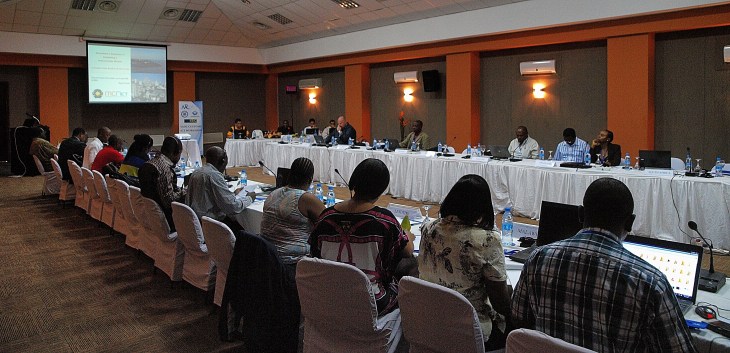
Delegates from the SADC member states gathered in Port Louis, Mauritius between 9 and 13 October to establish a SADC Customs ICT strategy for the region. The conference, sponsored by the United Nations Economic Commission for Africa, coincided with the 200th anniversary of Customs in Mauritius.

Following recent developments on IT connectivity and data exchange in the region, the conference addressed other areas of ICT in Customs which have a significant influence not only for internal Customs processing but its impact and effect on the broader stakeholder community. The conference was well attended with representatives from Angola, Mozambique, Lesotho, Swaziland, Namibia, Botswana, Tanzania, Zimbabwe, Seychelles, Mauritius, Democratic Republic of Congo, Malawi, and South Africa.

The event also drew international interest with representatives from the World Customs Organisation, Trans-Kalahari Corridor, SA Trade Hub, the East African Community, Southern African Customs Union, and the UN Economic Commission for Africa.

“Customs Connects, Borders Divide” conveyed the central theme for the event with the WCO IT and Capacity Building expert, Mats Wicktor, providing an enabling platform upon which the conference deliberations occurred. A detailed presentation clearly outlined the WCO’s the basis for standards, recommendations and guidelines, with specific reference to the Data Model, the Unique Consignment Reference and the most recent developments on Globally Networked Customs (GNC).

Other keynote addresses were made by Mozambique (DGA) on their experience in implementing the Single Window concept (for more details on this project visit URL: http://tfig.unece.org/case-stories.html).  Host nation Mauritius presented their Cargo Community System, and a number of other IT developments namely, e-Certificate of Origin, valuation database for 2nd hand motor vehicles, and the recently implemented Customs Enforcement Network (CEN) solution. SARS presented its Customs Modernisation journey highlighting some of the key ICT products and features and the respective efficiencies and trade facilitation benefits introduced for trade. Furthermore, it elaborated on its current bilateral data exchange initiatives with Swaziland, Zimbabwe, Mozambique as well as the IBSA countries.

The business end of the conference saw the finalisation, tabling and vetting of a draft SADC Customs ICT strategy. The strategy provides a broad framework, focussed around the concept of Customs-to-Customs data exchange. It seeks to create synergy between member states in regard to aspects such as transit management, common risk and enforcement principles, the entrenching of the One Stop Border Post concept, as well as automation of certificates of origin. From a SADC point of view, the strategy will support the realisation of its Strategic Plan – envisaged to include a Customs Union.

Cargo Crime – Security and Theft Prevention

A must read for Supply Chain practitioners. Cargo crime—including theft, fraud, and the passage of contraband through commercial shipping lanes—poses an enormous threat to security and the economy.

By understanding the current methods and operations of those who attack the supply chain, industry professionals can design effective security plans and law enforcement can properly investigate these crimes.

Cargo Crime: Security and Theft Prevention is drawn from the author’s (John J. Coughlin) personal experiences as a law enforcement detective and supervisor and as a regional security manager for a large multi-modal transportation and logistics company.

The book reviews emerging trends, identifies criminal tactics, discusses law enforcement response to cargo theft, and presents best practices to help businesses avoid victimization by cargo thieves. Topics include:

  • The various modes of freight transportation and the differences in cargo crime activity in each mode.
  • Methods of operation used by organized crime syndicates and narcotic smugglers.
  • The effective use of public and private information-sharing partnerships to thwart criminal activities.
  • Known profiles consistent in over 90 percent of contraband shipments.

The book features the following key aspects:

  • Identifies current methods of operation being used by organized and opportunistic criminals who target the supply chain.
  • Discusses current law enforcement efforts and response to cargo theft.
  • Examines the various modes of freight transportation and the differences in cargo crime activity in each mode.
  • Outlines best practices for industry practitioners to prevent being victimized by cargo thieves.
  • Addresses industry and law enforcement public/private partnerships for sharing information, educating law enforcement, and circumventing the cargo theft issue.

Cargo crime is a critical concern of freight transportation operators, manufacturers, shippers, insurers, law enforcement, and consumers. This book arms professionals charged with protecting the supply chain with essential information that can help them investigate and uncover criminal activity and develop a first class cargo security program. Available for purchase from http://www.crcpress.com.

Uganda prepares to introduce AEO

Authorised Economic Operators (AEO), a scheme focusing on compliant companies to facilitate trade starts before the year ends. The Uganda Revenue Authority (URA) Public and Corporate Affairs Assistant Commissioner Sarah Banage recently disclosed that AEO is meant to enhance compliance “by removing barriers for the most complaint taxpayer”.

“Under the scheme, the benefit of being complaint will be red-carpet treatment offered by URA,” she stated, adding, “we want to demonstrate that there are rewards for being compliant.” Banage cited electronic submission of declaration without supporting documents, pre-arrival clearance of cargo, and self-management of bonded warehouses as some of the benefits. Others are: priority treatment when cargo is selected for control, choosing the place for examination, automatic renewal of licences and withholding tax exemption status.

Because the relationship between URA and its clients is “symbiotic”, it is expected that there will be an increase in taxes, Banage argued. Potential beneficiaries of AEO are: agents, importers, exporters, shippers, internal container depot operators, and others involved in international shipment of goods, among others.

To be eligible, Banage said, one should be involved in international trade, have a good compliance history, be financially sound, install and use customs automated systems like e-tax and should implement the AEO compliance programme. To be authorized, companies/organizations will apply to the commissioner, after which a preliminary consultation is done.

“We will then determine who should formally apply. Officials will adjudicate submitted documents before a site is inspected to ensure compliance with guidelines,” she said. Subsequently, a one-year certificate will be issued.

“An AEO is an individual, a business entity or a government department that is involved in international trade and is duly authorized by the Commissioner of Customs of Uganda Revenue Authority.”

Banage said that implementing AEO does not only have short-term results but also resultant long-term benefits to the business community. These include reduction of the cost of doing business and increased turnover over time, among others. In the middle of April, customs officials held a breakfast meeting at Serena hotel, Kampala where Chief Executive Officers of major organizations were sensitized about the plan.

Later, customs officials interacted with personnel of the Auditor General, Export Promotion Board, the Trade, Industry and Cooperatives ministry, the Agriculture, Animal Industry and Fisheries ministry and Uganda National Bureau of Standards. Also at Serena, it was meant to “share with them the programme in order to capture their ideas,” according to Banage.

Weeks ago, URA asked companies to express interest in joining the scheme. Over 20 organizations applied and are currently involved in talks expected to culminate in attaining AEO status. “Admission to the scheme will depend on how the companies implement the compliance programme. By December, some companies should be authorized,” Banage added. Among others, those expected to benefit from the first phase are importers, clearing agents and transporters.

Regarding the East African Community (EAC), customs administrators have adopted an AEO policy framework. It was adopted in 2010 as a basis for implementing trade facilitation initiatives that drive economic development for the EAC. Under AEO’s mutual recognition arrangement, a government formally recognizes the AEO programme of another country, thereby granting benefits to the AEOs of that country. Under a regional project, companies in the five countries receive benefits related to the scheme. Among the benefits is priority treatment at customs points. Source: The Observer (Kampala) 

Private sector finally welcome in Africa?

The acceptance of private sector participation in ports in Africa is gaining traction, and not before time. At least that’s what a meeting of port minds in Nigeria would have us believe. The Port Management Association of West and Central Africa at its 35th Council Meeting and 11th Round Table Conference held recently in Lagos, Nigeria, came out firmly in favour of increased private sector participation in ports as a means of achieving cost efficiency improvements.

The Council meeting, held under the theme ‘Impact of Port Concession on the Socio-Economic Development of Our Countries’ ended with the resolution that, “member countries should put in place robust legal frameworks that will sustain the growth of Public Private Partnerships in port management systems”. Words that are encouraging to hear and that generally reflect a much changed position from a decade ago when there was still a strong belief in the public versus private system of port operation.

Successful privatisation programmes such as the major one that has been implemented in Nigeria have, however, brought some insight into what the private sector can do better than the public sector and hence a changed perception, although the learning curve is by no means over in this respect. What would also help facilitate this however is improved process to the goal – what can perhaps be termed Step 2. In particular, concession processes that are not weighed exclusively by cash received considerations but place greater emphasis on technical considerations in the broadest sense of the word.

A better balance between the two elements can lead to the selection of a more appropriate long term strategic partner and potentially to all-round greater economic benefit. The trouble is of course that such systems are not high on the agenda of African nations where cash considerations are usually to the fore especially in today’s troubled economic times. A system of this ilk is more likely to be found deployed in a mature economy than an emerging one. It remains a laudable goal, however, as a longer term objective and as part of efforts by the IMF, World Bank and aid agencies to develop Africa’s infrastructure, particularly in Sub-Saharan Africa. Source: Port Strategy

African Rhino poaching reaches new record

A record number of African rhinos were illegally killed in South Africa this year, driven by the use of their horns in Chinese medicine and a spreading belief in Southeast Asia, unfounded in science, that they may cure cancer. The street value of rhinoceros horns has soared to about $65 000 a kilogramme, making it more expensive than gold.

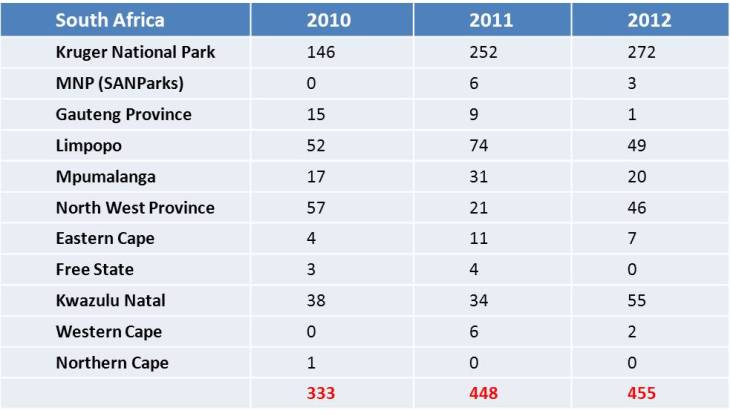
South Africa, home to more than 20 000 rhinos, or about 90% of all the rhinos in Africa, lost 455 rhinos to poachers, as of Tuesday, to eclipse the 448 killed in all of 2011, the environment ministry said in a statement. Around 15 animals a year were lost a decade ago, showing the impact of rising demand from Asia.

The number of rhinoceroses dying unnatural deaths in South Africa, either through illegal poaching or legal hunts, has now reached a level likely to lead to population decline, according to a study by Richard Emslie, an expert in the field. Poaching increased dramatically from about 2007 as a growing affluent class in China, Vietnam and Thailand began spending more on rhino horn for traditional medicine, where it was once used for ailments such as devil possession.

About half of poaching takes place in Kruger National Park, the country’s flagship park covering an area about the size of Israel, where soldiers and surveillance aircraft have been deployed in recent months to slow the carnage. The park has been the focal point of an arms race as gangs of poachers sponsored by international crime syndicates have used high-powered weaponry, night vision goggles and helicopters to hunt the animals, investigators said. Source: Polity.org.za

Mauritius Customs turns 200

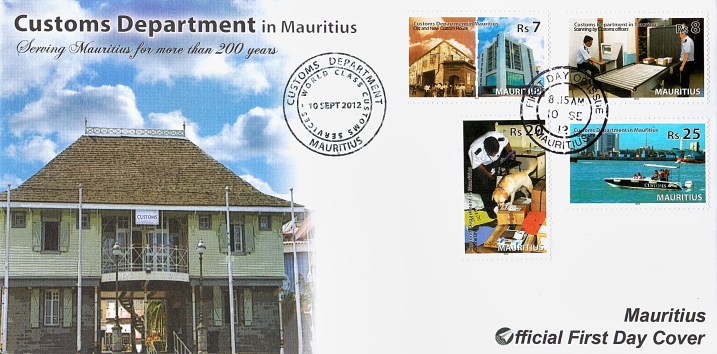
Mauritius Customs 1st Day CoverOn the ocassion of my 300th post, join me in raising the Portcullis for Mauritius Customs! During September, the Mauritius Revenue Authority (MRA) marked the bicentenary celebrations of Customs services in Mauritius by launching a special First Day Cover with four stamps on the Customs Department to mark the bicentenary celebrations of Customs Services in Mauritius. The issue of these new stamps is an acknowledgement of the significant contribution of the Customs services to the economic and social life of the country for more than 200 years. The four stamps depict the Customs Services in different fields with denotation of Rs 7, Rs 8, Rs 20 and Rs 25 illustrating some of the areas where the customs services are involved in their fight against crime and fraud prevention through the use of people, animals and state-of-the-art technology.

On 18 August 1797, a ‘bureau de Douane’ was established for the purpose of raising revenue in a context of war and blockade. It became a major financial institution contributing towards 50% of total revenue. The British took over in 1811 and installed the first Collector of Customs.British Customs practices were gradually introduced in the colony in line with British commercial law.

In modern times, the MRA Customs Department has set as one of its main objective to combat the illicit trade of drug and other illicit substances. The MRA has a team of 6 drug detector dogs handled by certified dog handlers trained by the French Customs and the South African Revenue Services (SARS). Our dogs have been selected carefully from examined litters and were declared competent drug detector dogs as per SAQA Unit Standard in the handling of a service to detect illicit substances.

Since 2008, our sniffer dogs have detected drugs in 25 instances involving the import of Cannabis, Heroin, Hashish, Subutex and other illegal substances worth around Rs 42,530,543. The Drug Detector Dog squad operates at the courier services, Parcel Post Office, Vehicle Search at Airport, Port and Freight Stations, Port area, Airport (Plaisance Air Transport Services & Luggage on carrousels at SSR Int. Airport and Aircraft search) as well as at the seaport for search of vessels. Source: Mauritius Revenue Authority

Most African countries to be middle income by 2025?

As many as 38 of sub-Saharan Africa’s 48 countries could be regarded as ‘middle income’ by 2025, but World Bank chief economist for Africa Shantayanan Devarajan warned that such an advancement would not necessarily translate into a reduction in poverty. Currently, 21 countries, collectively with 400-million citizens, have middle-income status, which the World Bank defines as countries with yearly per-capita income levels of higher than $1 000.

Speaking following the release of the October edition of the bank’s ‘Africa Pulse’ publication, Devarajan noted that at least ten countries, representing 200-million people, were poised to transition to middle-income status over the coming 13 years on the back of prevailing growth rates. Included in the list are countries such as Zimbabwe and Comoros, which would require both growth and stablisation.

Over the past 15 years, the continent had expanded at a rate of two percentage points better than the average global growth rate, and the bank was still expecting sub-Saharan Africa to expand by 4.8% in 2012 – excluding slow-growing South Africa, the region’s largest economy, average growth for the region was forecast at closer to 6% for the year.

But there was potential for a further seven countries, with 70-million citizens, to be included in the middle-income mix over the period if rates of growth accelerated beyond levels achieved over the past 15 years. Only ten African countries, representing 230-million people, almost certainly will not achieve middle-income status by 2025.

But while Africa’s recent growth spurt had resulted in the first overall reversal in the continent’s poverty rate since the 1970s – from 58% in 1999 to 47.5% in 2008 – the bank cautioned that continued progress would depend on continued macroeconomic prudence and improved governance, particularly in the area of natural resources.

Africa Pulse showed that resource-rich countries had seen a strengthening of economic growth, while poverty rates and inequality levels had not performed as impressively. “Some countries, such as Angola, Republic of Congo and Gabon have actually witnessed an increase in the percent of the population living in extreme poverty.”

“Resource-rich African countries have to make the conscious choice to invest in better health, education, and jobs, and less poverty for their people because it will not happen automatically when countries strike it rich,” Devarajan said. “Gabon, for example, with a per-capita income of $10 000 has one of the lowest child immunisation rates in Africa.”

To ensure that the benefits of rising growth were “pro poor”, more jobs would need to be created. And, in the context of high levels of informal sector employment, efforts would also need to be made to improve access to finance and skills, in the informal sector. Source: Engineeringnews.co.za


Trade Facilitation Implementation Guide

UNECE-Trade Facilitation Implementation GuideHaving spent the better part of the last fortnight amongst customs authorities and implementors of Single Window, I’m compelled to share with you a site (if you have not already been there) which attempts in a simple but comprehensive way to articulate the concept and principles of Trade Facilitation and its relationship and connotation with Single Window. The UNECE Trade Facilitation Implementation Guide should come as a welcomed resource, if not a companion, to trade facilitation practitioners and more specifically Customs Authorities wishing to embark on a trade facilitation approach. Of course it is a very useful reference for the many avid scholars on customs and trade matters across the global village. Of particular interest are the case studies – two of which feature African countries (Mozambique and Senegal) – providing a welcomed introduction of trade facilitation and Single Window on our continent. It is good to note that Single Window has less to do with technology and more to do with inter-governmental and trade relationships and an understanding of how these are meant to co-exist and support one another  – Enjoy!

Trade facilitation is emerging as an important factor for international trade and the economic development of countries. This is due to its impact on competitiveness and market integration and its increasing importance in attracting direct foreign investments. Over the last decade, it has gained prominence in the international political agenda as part of the ongoing WTO multilateral trade negotiations as well as of wide international technical assistance programs for developing and transition economies.

The primary goal of trade facilitation is to help make trade across borders faster and cheaper, whilst ensuring its safety and security. In terms of focus, it is about formalities, procedures, and the related exchange of information and documents between the various partners in the supply chain. For UNECE and its UN Centre for Trade Facilitation and Electronic Business (UN/CEFACT), trade facilitation is “the simplification, standardization and harmonization of procedures and associated information flows required to move goods from seller to buyer and to make payment”. Such a definition implies that not only the physical movement of goods is important in a supply chain, but also the associated information flows. It also encompasses all governmental agencies that intervene in the transit of goods, and the various commercial entities that conduct business and move the goods. This is in line with discussions on trade facilitation currently ongoing at the WTO. Source: UNECE

Grindrod – coastwise feeder expansion to extend services between Durban and Angola

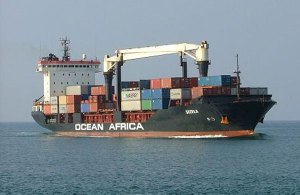
South African logistics and shipping firm Grindrod has continued its expansion programme, with the purchase of Safmarine’s 51% stake in Ocean Africa Container Lines. Grinrdod gave no details of the price paid for Safmarine’s stake in Ocean Africa Container Lines (OACL), but Grindrod now fully owns the company, which operates a feeder service with four vessels between Durban and Angola, calling at several ports in between, including in Namibia and Angola.

OACL’s former COO, Mahmood Simjee, has now been appointed CEO. Grindrod hopes that OACL can continue to benefit from close ties with Safmarine and the latter’s parent company, Maersk. OACL could take advantage of Ngqura’s growing role as a transhipment port, particularly with Angolan ports. The shipping line previously operated between Durban and Mozambican ports and could again resume this role.

Röhlig-Grindrod, a joint venture between Grindrod Limited and Röhlig International, has also acquired Sturrock Group’s clearing and freight forwarding division in exchange for a 15% stake in Röhlig-Grindrod, leaving the founding partners with 42.5% equity each in the venture. The inclusion of black empowerment partners in Sturrock Group helps Röhlig-Grindrod to fulfil its empowerment requirements.

Hylton Gray, the CEO of Grindrod Logistics, said: “We are very pleased with the merger of the businesses and the introduction of the empowerment partners. Calulo, a partner in the Sturrock Group, already has a stake in Grindrod’s South African operations and has contributed significantly by way of existing relationships and experience in niche markets.” Source: worldcargonews.com