Dog-inspired scent detector sniffs out explosives and narcotics

A team of UCSB researchers have mimicked the anatomy of a dog’s nose to build a highly effective scent detector that could be used to sniff out explosives and narcotics (University of California)

Combining nanotechnology and microfluidics, researchers at UC Santa Barbara have created a high-performance detector that draws inspiration from the anatomy of a dog’s nose to accurately identify substances – including explosives and narcotics – from very small concentrations of airborne molecules.

Able to detect smells ten thousand times as faint as humans can, a dog’s nose is an invaluable asset to police forces around the globe. So, when UCSB researchers set out to build an effective electronic nose that could assist homeland security, they already knew where they could find the perfect design.

By modeling the way in which a dog’s nose efficiently absorbs and then concentrates airborne molecules, the researchers were able to produce a device with remarkable performance, capable of capturing and identifying molecules in concentrations as low as one part per billion – as well, or better, than their furry counterparts.

Within the paperclip-sized chip, a network of microscale channels twenty times thinner than a human hair picks up the molecules and increases their concentration by a factor of up to a million. The molecules then interact with nanoparticles that amplify their spectral signature, and a miniature spectrometer detects their composition. The results from this analysis are then compared to a comprehensive database to find the closest match, identifying the molecule with a high degree of accuracy.

Even though it was first intended for use in explosives detection (the design will soon be commercialized for homeland security applications) this technology has much more far-reaching applications. Because it can be used to identify a very wide variety of molecules, the researchers say it could be easily adapted to detect narcotic substances, food that has spoiled, or even as a diagnostic tool that can identify disease, including certain forms of cancer. Source: http://www.gizmag.com.


Bribery along the corridor

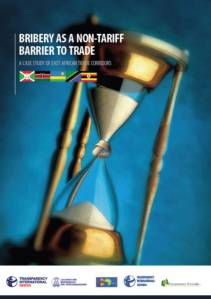
Notwithstanding efforts to minimize collusion, bribery and corruption through increased use of technology, the underlying fact remains that human intervention cannot be completely removed from nodes within the supply chain.Identifying the causes and parties involved in such activity is only the start (yet minuscule) aspect of a problem entrenched in the distrust of government officials and border authorities in particular. Integrity is based on trust. If trust is the placement of hordes of incompetence in public jobs to secure votes, then you will not need to look very far to understand that “the bribe” epitomizes the ultimate enterprise of individuals either bent on extortion, or to avail their services (like prostitutes  to the crooked trader. The following article “Bribery as a non-tariff barrier to trade” (click hyperlink to download) takes account of a wide-spread of role players as to their views and attitudes on the matter. In my view it is a template for what actually occurs at every border across the continent. 

Transparency International (Kenya) and Trade Mark (East Africa) have collaborated in the publication of a review on the subject of bribery in the EAC region. The executive summary elucidates the context – 

The East African Common Market Protocol that came into force in 2010 provides for the free flow of goods, labour, services and capital across the EAC bloc. To achieve this, members undertook to remove all tariff and non-tariff barriers to trade. While progress has been made on the removal of the former, doing away with the Non-tariff barriers along the main transport corridors of the region has remained a challenge.

Taking cognizance of this, Transparency International-Kenya, Uganda, Rwanda and Burundi in conjunction with the Transparency Forum in Tanzania conducted a survey along EAC‘s main corridors — the Northern and Central corridors- that form a vital trade link in the region between August and November 2011. The survey objectives were to measure the impact of bribery practices and create public awareness on the vice.

In determining the size of bribe payable, negotiations came top. The value of consignment and the urgency were some of the other factors sighted by the respondents. According to the survey, truck drivers have devised various means of accounting for bribery expenses to their employers. The most common is road trip expense’. These are anticipated regular amounts given prior to the start of a journey and ad hoc miscellaneous expenses. In the transporters’ books of accounts, the bribes are normally disguised either as anticipated regular amounts or as ad hoc miscellaneous expenses. Source: Transparency International and Trade Mark

Durban “Dig-out” port – a flagship PPP initiative?

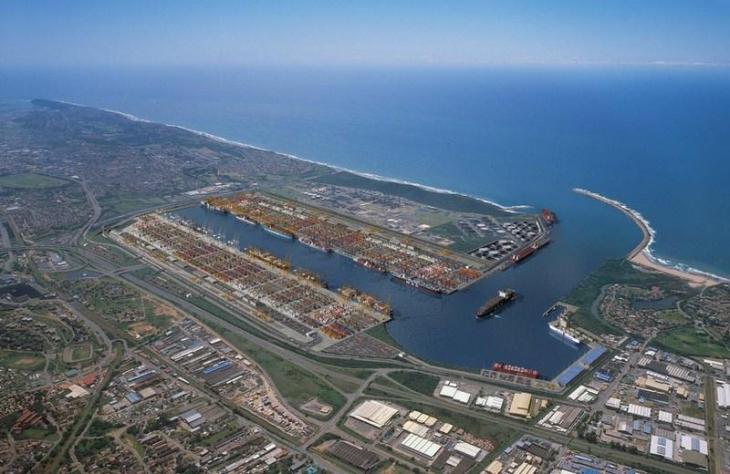
Artistic impression – Durban Dig-out Port

Freight and Trade Weekly (FTW) reports that a team has been assembled to sort out the funding for the new dig-out port on the old Durban International Airport site (FTW November 9, 2012) – a project that represents a potential major shot in the arm for the economy of the region and the country. The consortium is composed of the well-known Dutch port consultants, MTBS; the highly respected international engineering firm, Arup; and Durban-based lawyers,Van Velden Pike Incorporated, in association with Nichols Attorneys.

This consortium is to act as transaction advisers to Transnet, on what is, according to government, likely to be SA’s flagship public/private sector partnership initiative.That will be part of the team’s studies, according to Andrew Pike, partner in Van Velden Pike. However, the study, although started, is still very much in pre-feasibility stage, and there is obviously still no firm comment to be made on what direction the public/private element will take, he told FTW.

Further abroad, AECOM has announced (Oct 2012) that Transnet has awarded the company a US$3.4-million contract to initiate the design of the Durban Dig Out Port in South Africa. AECOM’s has experience delivering creative design services for major ports around the world, such as the New Port Project in Doha, Qatar. As part of the contract, AECOM will provide concept and pre-feasibility design services for the new port and container terminals, including all associated infrastructure relating to its operation. A critical aspect of the design will be ensuring the sustainability of the port throughout the construction phase as well as all of the operational phases of its development.

The Mercury reports that work on the multi-billion rand project is expected to commence in July 2016, with the first phase of the project completed by 2019. Development of the project is to be over a 30-year period. The construction phase will provide an estimated 64,000 jobs, while 25,000 permanent jobs are envisaged in the functioning port.

The scale and details of the project are staggering. The port will involve liquid fuel, automotive and container cargoes. The siting of the entrance to the port will require the relocation of the Shell and BO Refinery’s (Sapref) single buoy mooring. The construction of the southern breakwater alone will absorb 16% of the total cost and will require special sources of quarry stone. Environmental concerns are being taken very seriously. For example R85-million has been budgeted to relocate some 2,000 chameleons which inhabit a part of the northern section of the airport site.

Of particular significance is that without the dig-out port, Durban will stagnate as a port of call and experience decline. Already Cape Town does not have the capacity or berths deep enough to handle the new generation of 18,000 TEU ships that are due soon. Durban’s proximity to the Witwatersrand makes it the logical and preferred destination for container shipping. Studies have shown that the old airport site is ideal for the construction of a new harbour designed specifically to manage the size and volume of container shipping. Durban’s geographical location in the southern hemisphere is particularly advantageous as regards intercontinental shipments from the east to South America and beyond to the north Atlantic. Sources: FTW, AECOM, and The Mercury.


Saldanha Bay IDZ?

Its difficult not to be cynical…..after several failed and half-baked attempts at IDZs whats different about this one? Have the labour and tax issues changed?

A 60 day public consultation period for the designation of an Industrial Development Zone (IDZ) in Saldanha Bay has begun. Members of the public can make use of this opportunity to voice their opinions on the proposed vision for Saldanha Bay as presented in the Application for IDZ Designation and Operator Permit for the Saldanha Bay IDZ document gazetted earlier last week. View the document here!

Collaboration between government, citizens and business is necessary to build a Western Cape that is a better place to invest, to do business, get a job and earn a living, for everyone. Saldanha Bay has long been acknowledged as an important resource for the sustainable growth and development of the West Coast region, and indeed, the whole of the Western Cape.

All indicators show that an Industrial Development Zone in Saldanha Bay would be to the benefit of the Western Cape, South Africa and the African continent as a whole in creating a functional, self-sustaining industry that contributes to economic development and sustainable employment. The Saldanha Bay Feasibility Study published in October 2011, found that there was sufficient non-environmentally sensitive land upon which an IDZ development could take place.

After a process of consolidation into an attainable business plan focussing on the Oil & Gas and Marine Repair Cluster, the socio-economic impacts were found to be that after 20 years, an IDZ in Saldanha Bay developed around these industries, would generate a minimum annual return of R11 billion for the economy and create over 25 000 sustainable jobs nationally.

The total contribution to GDP for the IDZ is expected to amount to R3.4 billion in the first year, increasing to nearly R6 billion in the second year. In the third year the contribution is expected to be slightly lower at R5.5 billion due to a decrease in capital spend, but then increasing by the twentieth year with a total annual contribution to GDP amounting to R11 billion.

Total direct and indirect jobs in the Western Cape are expected to amount to 4 492 in the first year, 8 094 in the second year, 7 274 in the third year, 10 132 in the fourth year and 14 922 in the fifth year. From the seventh year around 14 700 direct and indirect jobs would be sustained in the province as a result of the IDZ.

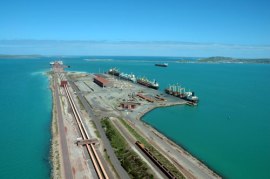
Saldanha Bay is an ideal location for the development of an Oil & Gas and Marine Repair Cluster. The Port of Saldanha Bay is also competitively located between the oil and gas developments on the West Coast of Africa, as well as the recent gas finds on the East Coast of Africa. South Africa is a significant industrial economy in the sub Saharan region and is logistically well connected to the region. It is therefore a natural location for providing repair and maintenance services, warehousing and logistics and professional/technical services where proximity to end location is an advantage. Source: Western Cape Minister of Finance, Economic Development & Tourism

Zim Police make yet another cigarette bust

Beit Bridge Borderpost, Zimbabwe

Police in Beitbridge have recovered yet another consignment of cigarettes worth US$20 000 in Tshapfuche as they intensify their anti smuggling operation. The stash destined for export was recovered last Friday morning following the discovery of other contraband shipment worth almost US$500 000 in the same area the previous day.

Countries of the South African Customs Union (South Africa, Namibia, Botswana, Lesotho and Swaziland) charge high duties on cigarettes, meaning that even those bought retail in Zimbabwe can be sold for good profit in South Africa.

The police officer commanding Beitbridge district Chief Superintendent Lawrence Chinhengo said the second stash was recovered at the homestead of a security guard they had earlier on arrested.

The security guard was part of the three suspects who were arrested while looking after the “merchandise” at Edzisani Muleya’s homestead. Chief Supt Chinhengo said the suspect had hid 33 boxes at his sister’s homestead while he kept another 72 boxes at his house.

Three hundred and eleven boxes of Remmington Gold, 442 Cevils, 221 Dullas and 107 Newbury cigarettes worth US$500 000 were last week recovered from Muleya’s homestead. Police say the house had become an illegal transit warehouse.

Muleya has since gone into hiding and police have launched a manhunt. Chief Supt Chinhengo said the Ferret squad, made up of the ZRP, Zimbabwe Revenue Authority and other security agents raided the homestead on Thursday afternoon during an operation code-named Sukani Emanzini (Get out of the Limpopo River). Source: The Herald (Zimbabwe)

Hijackers bleed cigarette exporters

While the world’s health authorities rally for legislation outlawing or at least curbing tobacco abuse, it seems there is a world of intrigue deep in the heart of the tobacco trade. 

Zimbabwe is investigating possible industrial espionage amid reports that South African tobacco firms are hiring hijackers to pounce on export cigarette consignments in transit to that country. In the past year or so, indigenous producers exporting to South Africa lost an estimated R100 million worth of cigarettes to armed robbery syndicates. Among the affected companies are Kingdom, Savanna Tobacco, Breco (Fodya), Cutrag, Trednet and Chelsea.

Savanna Tobacco has confirmed losing cigarettes worth over R18 million through hijackings and robberies while their warehouse in SA has been broken into several times. Only British American Tobacco Company has been spared. At least eight Zimbabweans were arrested at Savanna Tobacco in Harare on suspected espionage. Cosygene Dekeya, a former army military intelligence operative and Edmore Muronzerei appeared in court last week.

Investigations by The Herald showed that the Tobacco Institute of South Africa contracted a security firm, Forensic Security Service, to monitor Zimbabwean cigarette manufacturers, whose brands are giving their South African counterparts stiff competition. Stephen Botha, a former apartheid military supremo owns Forensic Security Services, the company that allegedly recruited spies within the workforce of Zimbabwean cigarette manufacturers. The spies allegedly supply consignment export details, enabling the cartel to track, intercept and hijack. FSS is said to have engaged a local business mogul (name supplied) who owns one of the largest courier service companies to co-ordinate the spies and their payments. The mogul’s trucks have also been hijacked in what might turn out to be inside jobs. Local (Zimbabwean) companies now suspect BAT of being behind the formation of TISA, which has since been regionalised.

Savanna Tobacco executive chairman Mr Adam Molai said it was shocking that South Africans were infiltrating local security organisations to commit economic crimes and bleed the economy. “It is deplorable, you cannot have foreign agencies working for our competitors to distabilise our operations in Zimbabwe. We hope our authorities will ensure that issues of this nature are dealt with accordingly,” said Mr Molai.

Trednet administrative manager Mr Graham Acutt said his company had reduced production by 70 percent. “We are aware of the under cover operations for quite some time now. This is tantamount to industrial espionage and it is highly illegal and frowned upon the world over. Imagine people spying on you and following your consignment. It becomes sensitive and clients will stop buying your product,” he said.

Mr Acutt said he was aware that police were investigating and he was willing to assist as much as he could. “We need more help from the authorities in Zimbabwe to investigate those who are actually behind this. We will assist where we can. This espionage has compromised our ability to export and obviously to earn foreign currency for the country,” he said.

Breco, which is now trading as Fodya said their market intelligence has over time indicated that there were clandestine activities being undertaken by some organisations to disrupt their business. “We understand most companies in this industry experienced this form of activity in one form or another,” said Breco in an e-mail to The Herald. “What is most alarming is that some of the organisations involved in these activities are externally-based and being assisted by local Zimbabweans. If the activities of these institutions or organisations are the real basis for our reduced capacity, then it is illegal,” it said. Source: The Herald (Zimbabwe)

Beitbridge to be Zim’s first economic zone?

The Chronicle (Zimbabwe) reports that the Ministry of Economic Planning and Investment Promotion and South Africa’s Department of Trade and Industry are creating economic zones in their respective countries to boost investment. Economic zones are areas where local and foreign investors or companies who invest there are given preferential benefits like low tax and low rentals.

Speaking during the 4th Investment and Trade Initiative between visiting South African business delegates and Bulawayo business people, the Deputy Minister of Economic Planning and Investment Promotion Dr Samuel Undenge said the Bilateral Investment Promotion and Protection Agreement signed in 2010 by the Zimbabwean and South African Governments would help in the creation of the economic zones.

South Africa’s Deputy Director General responsible for Enterprise and Development Mr Sipho Zikode said they were busy crafting a special document to guide the 12 identified economic zones in South Africa. “Messina is one of the chosen economic zones in South Africa and we also want to create linkages with Beitbridge as they are close to each other,” said Mr Zikode. Dr Undenge said there was need for countries to work together to boost economies on the continent. The business seminar was held to achieve mutual economic growth and development through outward investment facilitation, infrastructure development and trade liberalisation between Zimbabwe and South Africa.

New Zealand – Contraband now available On-line

New Zealand Customs popular Contraband magazine is now available as an online publication. You can still however locate and link to previous publications that are downloadable in .pdf format. The latest edition includes articles on  –

  • What’s My Duty?, an import duty estimator to help people buying goods online know how much duty and GST they may be liable for.
  • China and NZ Customs to work more closely together on to combat the smuggling of pharmaceutical products used to manufacture methamphetamine.
  • Kunio Mikuriya, Secretary General of the World Customs Organization’s (WCO) visit to New Zealand – commending the Service for its strong reputation for border management of Customs.

Source: New Zealand Customs Service


New Edition – World Customs Journal

A much-awaited edition of the World Customs Journal has been published and is available on their website follow this link. In his editorial, Professor David Widdowson reflects on the recent WCO conference on Excise Administration and Enforcement.  “An important subject for discussion at the Excise Summit was the increasing incidence of illicit international trade, particularly in relation to alcohol and tobacco products, and we are pleased to provide a useful overview of the topic in Section 3 of this edition of the World Customs Journal”, states Professor Widdowson (World Customs Journal, vol. 6, no. 2, p. v).  It is not often that the subject of Excise attracts much or any real conference publicity, so it is all the more a treat to have such a bumper edition on the subject with papers and articles from academics and practitioners.

In South Africa, the subject is somewhat subdued given the emphasis and prominence accorded to the Customs Modernisation Programme. Of late there have been determined efforts within the SARS administration to initiate some focus on Excise. This is only right since many of the so-called excise manufacturers and supporting industries play a significant role not only towards their contribution to the South African fiscus, but likewise have linkages with the import and export logistics supply chain. For this reason alone, the WCJ September 2012 Edition comes at a fortuitous time. I would also encourage you to read the article by Elizabeth Allen (a collaborator on my blog) titled – The Illicit Trade in Tobacco Products and How to Tackle It. 

Nigeria – Who’s afraid of new Customs Law?

English: Ngozi Okonjo-Iweala, Managing Directo...

English: Ngozi Okonjo-Iweala, Managing Director, World Bank, Washington DC; Global Agenda Council on Corruption, is captured during the session ‘Zero Option for Corruption’ in the Congress Centre of the Annual Meeting 2010 of the World Economic Forum in Davos, Switzerland. (Photo credit: Wikipedia)

Not a few people raised eyebrows at one session of a senate committee when the Minister of Finance, Dr Ngozi Okonjo-Iweala, intervened during proceedings. Unlike most public hearings in the National Assembly, the particular one conducted by the Finance Committee of the Senate on the new Customs Bill was historic. Everyone agreed that the bill, which seeks to repeal the pre-independence Act, was timely. The dominant argument was that the roles and responsibilities of the Department of Customs and Excise have changed and required legislation to accommodate those changes.

From a modest outfit collecting taxes and royalties on coastal trading activities, the Department has evolved to become a large organisation employing over 20,000 Nigerians, with responsibilities cutting across revenue collection, border protection, public health and trade facilitation. The new law is to take account of the realities of the 21st century. Provisions were therefore made for electronic processes of Customs clearance, use of non-intrusive intervention methods to enforce controls and adherence with global best practice in customs operations.

However, Dr Okonjo-Iweala , who by virtue of her position is the Chairman of the Nigeria Customs Service Board raised dust when she expressed concerns over the powers of Mr President and the Minister of Finance as contained in the new Bill. Committee members were astonished when she appeared to labour to sound modest in kicking against the provisions which she complained ‘whittled down the powers of Mr President and the Minister over Customs’.

Another dissenting voice came from the Director of Budget in the Ministry, Dr Bright Okogwu, who argued that Customs should not be funded up to the tune of 2.5 % of Value on Board (FOB)’ as provided under Section 18 of the new Bill, although his earlier view appeared to support to the canvassed by Central Bank of Nigeria on the matter.

It is a fact that many Nigerians were not opportune to read the bill before the hearing. My interest in it followed claim of the possibility of creating a Customs outfit that would be too powerful to be under the thumb of the president or the minister of finance.

On the contrary, the bill does seek a stronger Board capable of enunciating policies devoid of bureaucratic bottlenecks. The bill still allows the minister enormous powers as chairman of the Board with the power to appoint some of its members.

But the notion that the bill strips the president of certain powers gave added impetus to the public hearing; Mrs Okonjo-Iweala was clearly agitated. But try as they could, no one could pinpoint the sections which allegedly render the President powerless over Customs matters.

The major omission in the existing legislations put up for repeal is the Customs, Excise Tariff, etc. (Consolidation) Act Cap C.49 of 1995. Perhaps the hullabaloo about the powers of Mr President stems from the erroneous impression that all the previous Acts relating to Customs matters were being repealed. Section 13of this Act is emphatic about the powers on the much-hyped waivers and concessions. The section vested on the president the power to impose, vary or remove any import or excise duty on goods that are liable to payment of such charges. This provision is still extant.

Opposition to Sections 42 and 43 which sought to prohibit by law the future use of Pre-shipment and Destination Inspection service providers was a source of disappointment to most Nigerians. Leading the pack of opposition was the Central Bank of Nigeria with the argument that the provision ‘ties government hands ‘, if such service is found necessary in the future.

Customs position throughout the hearing was to express readiness to take over its statutory roles. If there was any doubt about Customs ability, the CBN and the Finance Ministry, both supervisory organs of the destination Inspection should be held responsible for the orchestrated effort to perpetrate or institutionalise self-gratifying contracts.

All said and done, Nigerians are patiently waiting for the senators to do what is right and ignore sentiments associated with the various positions canvassed during the hearing. It should not be about muscle flexing of who wields what powers as was witnessed during the hearing. Nor should it be about the office holders, since the Service will outlive the current actors involved. It is about building a strong institution that can stand the test of time. Source: The Daily Trust (Nigeria)

Related articles

Blood Diamonds – a case of western jealousy perhaps?

Reap What You Sow is the third investigation by Partnership Africa Canada into illicit activity in Zimbabwe‘s diamond sector. The report is divided into three main sections. The first looks at ongoing trade irregularities and the lack of transparency of diamond revenues, and examines ways ZANU and the global diamond industry have interacted, before, during and after the Kimberley Process imposed an embargo on Marange stones in 2009. The second examines the various revenue streams of Obert Mpofu and concludes the Minister of Mines is utilizing monies and assets divorced from his ministerial salary and known business entities. The third offers policy suggestions and recommendations that would improve the management and public beneficiation of Zimbabwe’s diamond revenues.

The biggest conclusion of this report is that despite government pronouncements to the contrary, the illicit trade of Marange diamonds is alive and well. A parallel trade in Marange diamonds continues to thrive, with the full knowledge and complicity of top officials in the Ministry of Mines, ZMDC, MMCZ and military.

The theft of Marange diamonds is perhaps the biggest single plunder of diamonds the world has seen since Cecil Rhodes. Conservative estimates place the losses due to illicit activity at over $2 billion since 2008. PAC has found that while the mismanagement of Marange remains primarily a Zimbabwean problem, the global dimensions of the illegality has metastasized to compromise most of the major diamond markets of the world. Previously most of the illegal trade primarily involved South Africa, Mozambique, UAE and India. This remains the case, but greater vigilance by enforcement authorities should now extend to other centres, particularly Israel. Source:http://www.kubatana.net

One commentator suggests that whilst it makes for interesting reading, it falls short of absolute indictments of individuals, particularly, Obert Mpofu. It unfortunately reads like a laundry list of barely substantiated rumours that have been doing the rounds for years. It seems the writers’ intention is to agitate the individuals, get them to sue the writers and thereby force the accused to disprove the claims on public record. This strategy is currently being used by Core mining in their case against the Minister where in a trial within a trial they claim they paid the Minister a bribe of $10million to ensure their mining rights and partnership with the ZMDC. This partnership was dissolved by the Minister under unclear circumstances. The cases are both before the courts with no resolution on the horizon.

Big Brother – Robot Mosquito Spy Drones

Reports indicate that the US military has poured huge sums of money into surveillance drone miniaturization and is developing micro aircraft which now come in a swarm of bug-sized flying spies.

According to various internet sources, a team of researchers at the Johns Hopkins University in conjunction with the US Air Force Office of Scientific Research at Wright-Patterson Air Force Base in Arlington, Virginia, is helping develop what they are calling a micro aerial vehicle (MAV) that will undertake various espionage tasks.

The robotic insect can effortlessly infiltrate urban areas, where dense concentrations of buildings and people, along with unpredictable winds and other obstacles make it impractical.

It can be controlled from a great distance and is equipped with a camera and a built-in microphone.The new device has the capability to land precisely on human skin, use its super-micron sized needle to take DNA samples and fly off again at speed. All people feel is the pain of a mosquito bite without the burning sensation and the swelling of course. The hard-to-detect surveillance drone can also inject a micro radio frequency identification (RFID) tracking device right under skin, and can be used to inject toxins into enemies during wars.

As early as in 2007, the US government was accused of secretly developing robotic insect spies when anti-war protesters in the United States saw some flying objects similar to dragonflies or little helicopters hovering above them. The US is not alone in miniaturizing drones that imitate nature: France, the Netherlands and Israel are also developing similar devices.France has developed flapping wing bio-inspired micro drones. The Netherlands BioMAV (Biologically Inspired AI for Micro Aerial Vehicles) has also built Parrot AR drones.

Meanwhile, Israel Aerospace Industries (IAI) has produced a butterfly-shaped drone, weighing just 20 grams, which can gather intelligence inside buildings.
The insect drone, with its 0.15-gram camera and memory card, is managed remotely with a special helmet. Putting on the helmet, the operator finds themselves in the “butterfly’s cockpit” and virtually sees what the butterfly sees in real time.Source: http://www.theintelhub.com


CBP Maritime Operations resume after hurricane ‘Sandy’

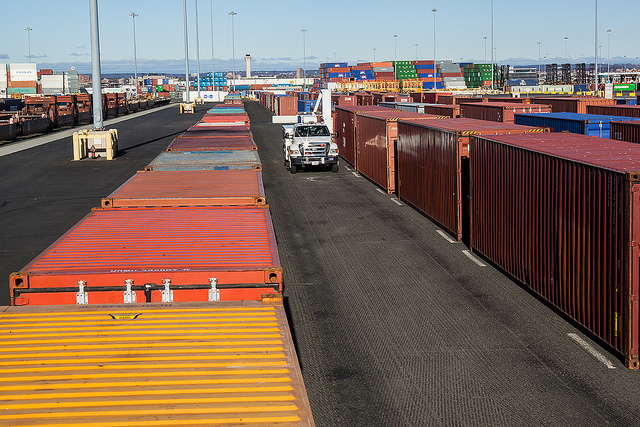
A U.S. Customs & Border Protection Mobile Radiation Portal Monitor (MRPM) drives down a row of containers checking them for radiation.The truck will drive down an entire row of containers, scan one side of them and then it will drive down and scan the other side of them.

U.S. Customs and Border Protection’s maritime mission is now back on-line with today’s processing of cargo vessels and containers. “In the aftermath of Hurricane Sandy the people of New York and New Jersey have faced great adversity, the men and women of CBP have been with them each step of the way,” said Robert E. Perez, CBP’s Lead Field Coordinator for CBP in FEMA Region II. “Today’s processing of cargo ships into the Port of New York/Newark marks the next step in CBP restoring its maritime operations here in the greater New York City area and returning to business as usual.”

CBP personnel are on site today processing 161 expected international flights with approximately 31,500 passengers at JFK and 92 expected international flights with approximately 14,500 passengers at Newark International Airport.

To facilitate the flow of goods into the New York area, CBP officers conducted cargo container inspections this morning at the Port of New York/Newark for the first time since Hurricane Sandy battered the New York/New Jersey area. CBP import and entry specialists were back to work as soon as their facility opened last week, processing merchandise to help facilitate the flow of much needed supplies and supporting the United States economy.

CBP worked very closely with the U. S. Coast Guard and the NY/NJ Port Authority to lift waterway restrictions and open marine terminals to cargo vessels. Officers were on site and ready to process shipments as soon as cargo was off loaded. CBP deployed officers to JFK and Newark Liberty International Airport from other parts of the country to assist with the processing of international passengers. Source: FEMA

Major trade route now reaches Katanga

Port of Walvis Bay – Namibian transport corridor

A new regional trade route reaching from the Katanga Province in the Congo all the way to Walvis Bay as point of entry, is on the radar of the Walvis Bay Corridor Group following an agreement between Namibia and the DRC. Development of this major link started its first tentative steps recently when the Corridor Group opened an office in Lubumbashi, on the border of the DRC and Zambia.The Corridor Group said earlier this week it had launched an office in Lubumbashi, DRC, to create a strong business presence in the mineral-rich Katanga Province.

The Walvis Bay Corridor Group Lubumbashi office was officially opened by the Governor of the Katanga Province, Hon. Moïse Katumbi Chapwe, supported by the Namibian Ambassador, Mr Ringo Abed, Corridor Chairman Mr Bisey Uirab, and Corridor Group CEO, Mr Johny Smith.

The need for landlocked countries to gain access through an alternative trade route to and from sea was recognised, where neigbouring countries and beyond could benefit from access to the Port of Walvis Bay that offers importers and exporters reduced time and cost savings, high reliability, and cargo security. The Katanga Province offers a market of more than 2 million consumers and with the fast expanding mineral rich DRC there is also a need from the DRC Government for the Walvis Bay-Ndola-Lubumbashi Corridor to extend further towards other Provinces in the DRC. Walvis Bay is surely growing as an alternative trade route for Southern DRC in that various commodities are being moved via the Port of Walvis Bay such as copper, frozen products, machinery & equipment and consumables.

The office in Lubumbashi, DRC is now the third branch office of the WBCG beyond Namibia, with the other branch offices in Lusaka, Zambia since 2005 and Johannesburg, South Africa in operation since 2008. The Walvis Bay Corridor Group is currently hosting the Walvis Bay-Ndola-Lubumbashi Development Corridor Technical Committee, which is a Public Private Partnership between the government departments responsible for transport of the DRC, Namibia and Zambia to address the bottlenecks that impede the flow of traffic along this trade route using the Port of Walvis Bay. Source: Economist (Namibia)

US$500 000 cigarette bootleg seized in raid

Police and Zimra officials remove cigarettes from an illegal “warehouse” in Tshapfuche, Beitbridge

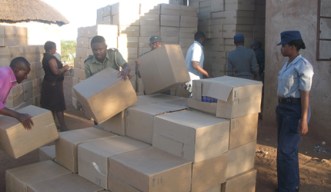
Zimbabwean Customs and Police have smashed a cigarette smuggling syndicate and recovered a bootleg of export quality cigarettes worth almost US$500 000 in Tshapfuche. The 1 081 boxes of assorted local cigarettes brands were kept at Edzisani Muleya’s homestead. Police said the house had become an illegal transit warehouse.

Muleya disappeared and police have since launched a manhunt. The Ferret squad, made up of the ZRP, Zimbabwe Revenue Authority and other security agents raided the homestead on Thursday afternoon during an operation code-named Sukani Emanzini (Get out of the Limpopo River). Two men and a woman were arrested after police found them taking a nap on top of the cigarette boxes. The suspects kept their “merchandise” in five rooms. By end of day on Thursday, armed police had cordoned off the homestead. Several homesteads in the area were deserted when police arrived.

Police believe the homestead was a transit point for criminals who would then smuggle the cigarettes into South Africa through the Limpopo River. They said South Africa is a choice destination for regional cigarette smugglers who repackage them for export to Asia and other European markets. Another 107 boxes of Newbury cigarettes were recovered in Lutumba on the same day. Police intercepted a suspect attempting move the contraband to “safety”.

Police officer commanding Beitbridge district Chief Superintendent Lawrence Chinhengo yesterday said the raids were made after a tip-off. He said they recovered 311 boxes of Remmington Gold, 442 Cevils, 221 Dullas and 107 Newbury cigarettes. “We received a tip-off to the effect that Edzisani Muleya’s homestead in Tshapfuche area had been turned into an illegal warehouse for cigarettes”.

“We then raided the area on Thursday afternoon, where we found two men who had been hired as security guards sleeping on top of the boxes.” Chief Supt Chinhengo said police recovered documents with the movement, list of suppliers and other people who are part of the syndicate. He said investigations were under way. Last week, a 43-year-old Malawian trucker was fined US$1 000 for attempting to smuggle 262 boxes of export quality cigarettes worth US$35 000 through Beitbridge Border Post. Source: The Herald (Zimbabwe)