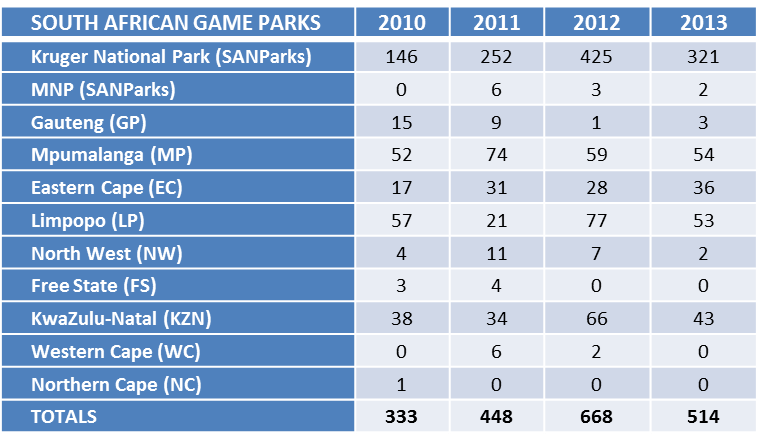
514 rhinos poached in South Africa so far in 2013

Rhino poaching statistics (Department of Environmental Affairs)

Rhino poaching statistics (Department of Environmental Affairs)

The Department of Environmental Affairs today, 24 July 2013 released the Rhino Issue Management (RIM) Report which emanated from the national consultation process to facilitate a common understanding of the key issues related to the protection and conservation of South Africa’s rhino population. The release of the RIM report comes as the number of rhino poached in South Africa increased to 514. To access the report, Click Here!

The Kruger National Park continues to bear the brunt of poaching with 321 rhino poached since 1 January 2013, while 54 have been killed for their horns in Limpopo, 53 in North West and 43 in KwaZulu-Natal. A total of 143 alleged poachers have been arrested this year.

The final report submitted to the Minister and Department of Environmental Affairs in January 2013 has greatly assisted the department in reviewing and updating its rhino response strategy outlined in the National Strategy for the Safety and Security of the Rhinoceros Population of South Africa (NSSSRPSA).

The RIM report incorporates current thinking on sustainable rhino conservation by acknowledged rhino specialists, ecologists and a range of other experts. It encapsulates viewpoints from Non-Government Organisations (NGO’s) both specialised and community based, civil society, and from traders, professional hunters, resource economists and ordinary citizens with a deep concern for the ethical and humane treatment of animals.

The consultation process resulted in clear agreement that the country’s rhinos should be conserved for the good of all humanity, and that every effort should be made to protect the threatened species from the sustained poaching onslaught by international syndicates earning huge profits from the sale of rhino horn.

The RIM report does, however, state that there is support to include commercial international trade in rhino horn as an integral part of South Africa’s comprehensive response strategy to address the continued illegal killing of rhinos. Source: Department of Environmental Affairs (South Africa) 

Czech Customs Seize Rhino Horns

Rhino horns seized from smugglers by the Czech Customs Authority

Rhino horns seized from smugglers by the Czech Customs Authority

Czech customs agents seized 24 rhinoceros horns Tuesday and charged 16 people with bringing the prized material illegally from South Africa to sell it in Asia.

“Our investigation showed that the transport is organized by an international ring of smugglers who have used fake export permissions seemingly complying with (the Convention on International Trade in Endangered Species of Wild Fauna and Flora) to import the rhinoceros horns from the Republic of South Africa to the European Union,” said Jiri Bartak, spokesman for the Czech customs department.

The arrests follow an investigation by Czech and EU customs authorities begun in 2011. The gang was alleged to have planned re-exporting the horns as trophies, according to their fake documentation. Rhino horns are popular in parts of Asia where many believe they can cure various illnesses or work as an aphrodisiac.

South Africa is home to the world’s largest rhino population, estimated at about 20 000, though the large upsurge in poaching is threatening their existence. Rhino poaching is expected to reach record levels this year, according to South African officials.

Czech authorities estimate the value of the seized rhino horns at up to 100 million koruna ($5 million), Mr. Bartak said. The authorities said the ring employed people impersonating hunters to gain permission to ship horns acquired from African poachers to Europe and elsewhere. Czech customs didn’t release details of where the charged individuals came from or give their names. If convicted they face up to eight years in prison. Source: leos.rousek@wsj.com

Is it a TEU or a FEU?

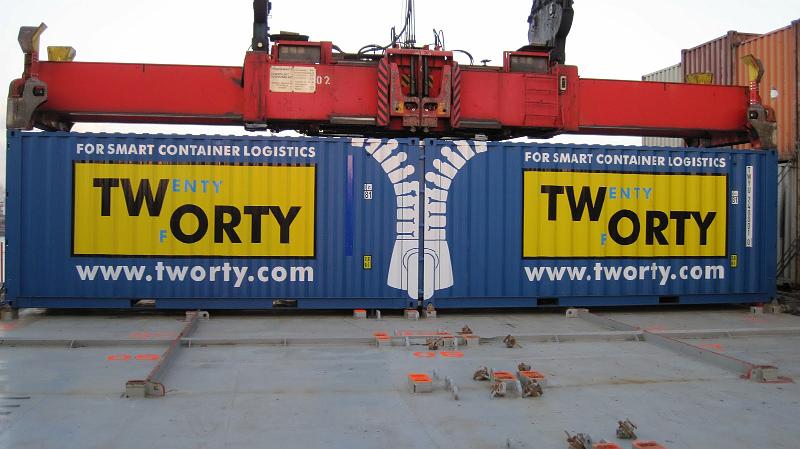
Thinking outside the box - Tworty’s unit has doors at each end, the second opening to and locked from the inside.

Thinking outside the box – Tworty’s unit has doors at each end, the second opening to and locked from the inside.

An innovative new ISO container design that allows a unit to be used either as a 40 ft or 20 ft box has completed its maiden voyage.

The Tworty Box, two 20 ft containers that can be linked together to form a single 40 ft unit – “twenty + forty = tworty” – competed its maiden voyage from Hamburg to Montreal on the containership OOCL Montreal.

Two containers joined together as a single unit were stuffed with 20 tonnes of breakbulk cargo, mainly car parts and granulate, for Canadian consignees.

Developer Tworty Box said the container was designed to reduce the cost of repositioning empties, caused by imbalances between supply and demand for 20 ft and 40 ft containers. As the company humourously explains on its website, 1 x tworty = 20ft, 2 x tworty = 40ft.

It has doors at each end; the second door opens to the inside and can only be locked from the inside. This door can be fixed to the container ceiling and, with the use of its special bonding elements, another Tworty Box can be joined up, thereby creating a 40 ft unit of full value and standard doors at both ends.

Tworty Box prototypes have received full International Convention for Safe Containers certification for single and for coupled operation. Source: Tworty.com and Lloyds.


When a Beer is definitely not a Beer!

beerThe Tanzania Revenue Authority (TRA) has been blamed for disobeying the decree issued by Kinondoni District Court, which prohibits import and distribution of Windhoek Premium Lager Beer in the country, which does not bear code number MB66.

It is alleged further that the TRA, in total disobedience of the decree in question issued on October 15, 2010, has been allowing and collecting tax from dishonest businessmen and companies who import the beer brand that does not bear the said code number.

A consultant with Mabibo Beer Wine and Spirit Limited told the ‘Sunday News’ that his company was shocked after learning that a certain TRA officer said the Authority does not recognize the decree that was issued by the Kinondoni District Court.

A TRA officer recently informed the police authorities who are investigating Mabibo’s complaints against Land Mark Hotel for disobeying a lawful court order that TRA does not recognise the decree that prohibits any person from importing or selling Windhoek Premium Lager.

According to the court order – failure or refusal by the defendant, its owners, agents, directors, servants and other unknown persons who are directly or indirectly related to the defendant or any other persons, to comply with the prohibition orders shall amount to contempt of the orders of the court.

TRA has been accused of allowing Land Mark Hotel to import Windhoek Premium Lager Beer in violation of the court decree and was only concerned with the collection of taxes and that the Authority was not bound to respect the order of the court. Following the court order, Windhoek Premium Lager Beer which does not bear code Number MB66 became restricted and prohibited goods, save where specific written consent of Mabibo has been sought and obtained. Source: Tanzania Daily News.


New Smart ID card next year

smart-id-naledi-pandor

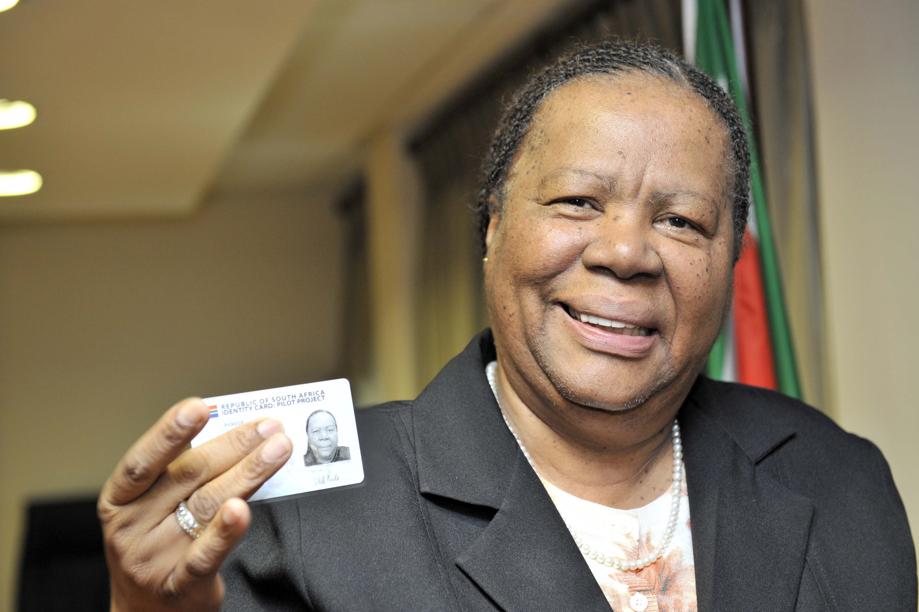
Home Affairs Minister, Naledi Pandor with the new Smartcard ID (SAPA)

The new South African smart ID cards will start being issued in the new year. The cost of the card had not yet been determined. The minister for Home Affairs said the cost would not exceed that of the current green bar-coded identity document, which the card would replace.

A microchip, the specifications for which cannot be disclosed for security reasons, will house the necessary biometric data and the information on the chip will be laser-engraved to prevent tampering.

A range of physical and data-security features was being considered, and that there was also ongoing discussion about whether to include provision for a pin code as a secondary means of verification, to complement the biometric features of the card. The minister said the department was discussing how to implement the process. One option would be to issue smart ID cards to first applicants. The project was likely to be implemented over the next four years. For more info on the ID cards read the Government Gazette (click hyperlink).

Rwanda-Burundi Establish Second One-Stop Border Post

Rwanad-Burundi OSBPA one stop border post has been established at Ruhwa in Rusizi District order to reduce the amount of time spent by traders clearing goods at the Rwanda-Burundi border. The one-stop border post is also expected to bolster trade between the two countries and see an infrastructure overhaul at the border area, according to the Minister of State for Transport, Dr Alexis Nzahabwanimana.

Under the one border post, travellers will access services at one spot unlike in the past when documents were processed at two locations – one in Rwanda and the other across the Burundi border. The process will now take about five minutes as opposed to 30.

With the new system, immigration, emigration and customs officials from the two countries share offices to ease the clearance procedures for travellers entering or departing either country.

Dr Nzahabwanimana observed that the post is an indication of existing good relations between the two countries and that it will “strengthen brotherhood between our peoples and boost trade between our two countries.”

“The post will ease the movement of people and goods,” Nzahabwanimana on Wednesday. “It will also reduce delays that people incurred while clearing at the border in the past.”

He urged employees to seize the opportunity and improve on the quality of services they provide. He also advised them to exploit modern technologies if they want to make a difference in what they do.

Burundi’s Minister of Transport and Public Works, Deogratias Rurimunzu described the move as “another step forward in the cooperation and friendship” between Rwanda and Burundi. He observed that the border will promote bilateral trade and cooperation abetween both countries.

“Work diligently, use your skills, pto provide better services and put these infrastructures to good use for them to benefit our population,” Rurimunzu told employees at the border post.

About the project

The idea to establish the one-stop border post was first floated in 2009. It is part of a larger project which comprises border infrastructures including administrative blocks, staff quarters, a warehouse, a weighbridge, social facilities, street lighting and water sources, among others.

The project also comprised the renovation of a 50.6 kilometre road between Nyamitanga and Ruhwa on the Burundian side as well as the construction of Ntendezi-Mwityazo Road on the Rwandan side.

The project was sponsored by the African Development Bank (AfDB), at a cost of about Rwf32billion on either side of the border. Ruhwa one stop border post is the second shared between Rwanda and Burundi following the establishment of the Gasenyi-Nemba border post in Bugesera district in 2011. Source: The New Times, Rwanda

Port-to-Hinterland…gearing up for growth?

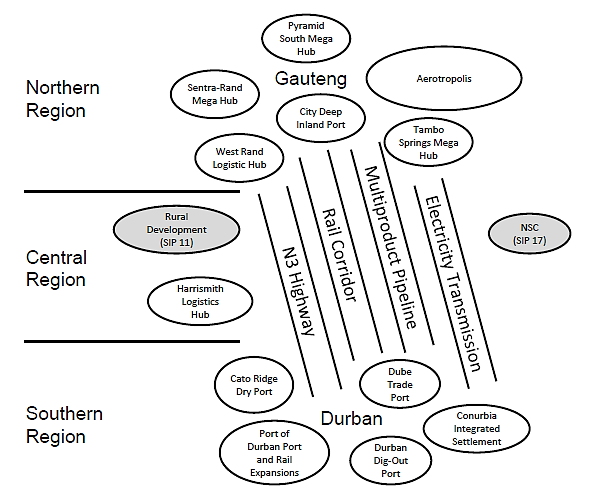
Proposed Durban-Free State-Gauteng Logistics and Industrial Corridor Plan (SIP2)

Proposed Durban-Free State-Gauteng Logistics and Industrial Corridor Plan (SIP2)

Notwithstanding on-going discontent amongst industry operators in regard to proposed legislative measures mandating customs clearance at first port of entry, the South African government (GCIS) reports that work has already commenced on a massive logistics corridor stretching between Durban and the central provinces of the Free State and Gauteng. Most of the projects that form part of the second Strategic Infrastructure Project (SIP 2), also known as the Durban-Free State-Johannesburg Logistics and Industrial Corridor, are still in the concept or pre-feasibility stage, but construction has already started on several projects.

These include:

  • the building of a R2,3 billion container terminal at City Deep
  • a R3,9 billion project to upgrade Pier 2 at the Port of Durban
  • R14,9 billion procurement of rolling stock for the rail line which will service the corridor.

Work has also started on the R250 million Harrismith logistics hub development to set up a fuel distribution depot, as well as on phase one of the new multi-product pipeline which will run between Johannesburg and Durban and transport petrol, diesel, jet fuel and gas.

The aim of these projects and others which form part of SIP 2, is to strengthen the logistics and transport corridor between South Africa’s main industrial hubs and to improve access to Durban’s export and import facilities. It is estimated that 135 000 jobs will be created in the construction of projects in the corridor. Once the projects are completed a further 85 000 jobs are expected to be created by those businesses that use the new facilities. Source: SA Government Information Service

Interested in more details regarding South Africa’s infrastructure development plan? Click here!

Easing customs formalities – using ‘e-Manifest’

European union concept, digital illustration.The European Commission has set out plans to ease customs formalities for ship but it’s as yet unclear as to how the changes are likely to affect EU ports.

Known as the Blue Belt, the proposals aim to create an area where ships can operate freely within the EU internal market with minimum administrative burden when it comes to safety, security, the environment and taxes.

Although free movement of goods is a basic freedom under EU law the Commission says that it’s not yet a reality for the maritime sector which needs to play more of a part in getting more trucks off congested roads.

Siim Kallas,Vice-President, European Commission, said: “We are proposing innovative tools to cut red tape and help make the shipping sector a more attractive alternative for customers looking to move goods around the EU.”

The new proposals will require amending the existing Customs Code Implementing Provisions (CCIP).

Under the new proposals Regular Shipping Services procedures will be made shorter and more flexible. The consultation period for Member States will be shortened from 45 days to 15 and companies will be able to apply in advance for an authorisation from countries they intend to do business with to save time.

The Commission also proposes putting in place a system which can distinguish EU goods on board a ship (which could be fast tracked through customs) from non-EU items, which would need to go through the appropriate customs procedures.

This new “e-Manifest” system would allow the shipping company to relay all goods information in advance to customs officials.

The Commission expects to make the Blue Belt proposal a reality by 2015. Source: PortStrategy.com

Why Do We Import Cure-Dent From China?

The following article is a lesson for all aspiring enterpeneurs on the African continent.

I got curious about the small, mostly unnoticed item in Kigali, what we like to call ‘cure-dent’, the tooth pick. This is how I stumbled onto the fact that we import toothpicks. Yes we import toothpicks from China. Toothpicks here are a symbol for all the things we could make ourselves but import.

toothpicksIt got me wondering – just how complicated is it to make a toothpick? Firstly, toothpicks are made from bamboo and we have plenty of that in Musanze. In any case bamboo can be cultivated. It grows fast and there are new genetically modified reach heights of over 15 metres. A little time on Google showed me that it does not take very much to make them. Indeed the whole process can be done in a woodwork workshop. The process from splitting the bamboo to sharpening the toothpicks takes less than half an hour. That is about 100 packets of toothpicks.

The reason we give for imported stuff is supposedly because we do not have the technology required to make it. This is clearly not true in this case, and, I bet, in the case of a lot of other imports.

Toothpicks are very cheap. They go for between Rwf100 and Rwf500 for each small packet. This is after all the manufacture, freight, taxes and, of course, the shopkeeper’s profits have been considered. Maybe this is why we consider it not to be a profitable venture. Would making toothpicks be profitable? The answer is yes. Let us consider two reasons.

One – the Chinese are not known for time wasting. If they would engage in this enterprise to this extent, they must be something in it. Two – consider being able to make 100 packs of toothpicks in half an hour.

That makes 200 per hour and 1600 per eight hour day (you are by no means tied to this. If you sell them at Rwf50 per pack, you will be grossing Rwf80,000 per day. Now that is profit!

Where is the market? Are we not in the East African Community? We have to start exporting beyond the agricultural produce. Why is urwagwa and akabanga not on the shelves of Kenyan, Ugandan, Tanzanian and Burundian shops?

Why are we always importing? If we are importing toothpicks what do we not import? Unfair Balance of Trade and its accompanying Balance of Payments in addition to aid dependency are the main propagators of poverty in our country. They give us aid… .we use it to buy their products, down to toothpicks!

If we are to make it to self-sufficiency we have to manufacture and export. The journey to self-sufficiency must precede self-reliance. As Bob Marley would say, “We gotta be conscious”.

Article by Sam Kebongo writing for the Rwanda New Times.

A South African RFID/GPS cross-border logistics and customs solution

Inefficiency of road freight transport is one of the primary factors that hamper the economy of sub-Saharan Africa. Long delays experienced at border posts are the single biggest contributor towards the slow average movement of freight. Cross-border operations are complicated by the conflicting security objectives of customs and border authorities versus efficiency objectives of transport operators. It furthermore suffers from illegal practices involving truck drivers and border officials. In theory the efficiency of cross-border operations can be improved based on the availability of more accurate and complete information – the latter will be possible if different stakeholders can exchange data between currently isolated systems.

Cross-border trade basically comprises 3 distinct but interlinked layers –

An information layer – in which various trade documentation (purchase order, invoice), cargo and conveyance information (packing list, manifest), customs and government regulatory data (declaration, permits) are exchanged between various supply chain entities and the customs authority. These primarily attest to the legal ownership, contract of carriage, reporting and compliance with customs and other regulatory authority formalities (export and import), and delivery at destination.

A logistics layer – for the collection, consolidation, sealing and conveyance of physical cargo from point of despatch via at least two customs control points (export and import), to deconsolidation and delivery at point of destination.

A financial layer – which refers to the monetary exchange flow from buyer (importer) to seller (exporter) according to the terms and conditions of the sale (INCOTERMS). Hmm… no, this does not include ‘bribe’ money.

All three layers are inter-linked and prone to risk at any point of a given transaction. There is also no silver bullet solution to secure supply chains. Moreover, it is a fallacy that Customs and Border Agencies will ever conquer cross-border crime – simply because there are too many angles to monitor. Furthermore, in order to set up cross—border information exchange and joint enforcement operations it is both legally and politically time-consuming. Criminal elements are not hampered by these ‘institutions’, they simply spot the gaps and forge ahead.

One of the areas requiring customs attention is that of chain of custody. In short this implies the formal adoption of the World Customs Organisation’s SAFE Framework principles. Each party with data that needs to be filed with the government for Customs and security screening purposes has responsibilities. Those responsibilities include –

  • Protecting the physical goods from tampering, theft, and damage.
  • Providing appropriate information to government authorities in a timely and accurate manner for security screening purposes.
  • Protecting the information related to the goods from tampering and unauthorized access. This responsibility applies equally to times before, during and after having custody of the goods.

Tenacent RFID Tag

Tenacent RFID Tag

Security seals are an integral part of the chain of custody. The proper grade and application of the security seal is addressed below. Security seals should be inspected by the receiving party at each change of custody for a cargo-laden container. Inspecting a seal requires visual check for signs of tampering, comparison of the seal’s identification number with the cargo documentation, and noting the inspection in the appropriate documentation. More recently the emergence of certain e-seals and container security devices (CSDs) contribute even further to minimizing the amount of ‘physical’ verification required, as they are able to electronically notify the owner of the goods or government authority in the event of an incidence of tampering.
White Paper - GPS-RFID systems for cross-border management of freight consignments

White Paper – GPS-RFID systems for cross-border management of freight consignments

A group of South African specialist engineers have been working closely with transport authorities, logistics specialists, defense experts and customs authorities across the globe. Their e-seal is patented in no less than 16 high volume countries. It is produced in Singapore, China and Indonesia depending on politics, free-trade agreements and demand. May move some to Brazil and US in time. Proof of concept (POC) initiatives are currently underway in Brazil for rail cargo, US Marine Corps for their p-RFID program and other Department of Defense divisions in the USA, and will shortly be included in one of the GSA agreements making it available to any government department in the US. Further adrift, the e-seal is also currently enjoying interest in Guatemala, Mexico, Canada, Panama, Jordan, Italy, Spain, and Malaysia. Here, in South Africa, a POC was conducted at the 1st autogate at Durban Container Terminal, funded by the North West University, and overseen with successfully achieved objectives by Transnet Port Terminals. For technical details of the RFID seal, click here!

With much anticipated success abroad, how much support will this product attain in the local and sub-Saharan African scene? Government authorities, as well as logistics and supply chain operators are therefore encouraged to study the enclosed ‘white paper’ – Click Here!. It firstly quantifies the size of the problem and estimates the potential economic benefits that will be created by improved cross-border operations. It then proposes a combined GPS/RFID system that can provide the required level of visibility to support improved operational management, resulting in a simultaneous increase in the security and efficiency of cross-border freight operations. A brief cost-benefits analysis is performed to show that the expected benefits from such a system will by far exceed the costs of implementation. Source: Tenacent & iPico

UNCTAD – Africa ‘ignores its trade deals’

Cars and trucks at the South African border at Musina, Limpopo, queue to cross into Zimbabwe. The Unctad report says there are traditional transport routes in Africa - Photo: Motshwari Mofokeng.

Cars and trucks at the South African border at Musina, Limpopo, queue to cross into Zimbabwe. The Unctad report says there are traditional transport routes in Africa – Photo: Motshwari Mofokeng.

An official in the UN Conference on Trade and Development (Unctad), complains that Africa’s leaders repeatedly sign trade agreements and fail to implement them. Launching the organisation’s 2013 Africa development report in Johannesburg, Patrick Osakwe said leaders should set more realistic targets and “do more serious research” on the viability of the agreements.

Intra-African trade represents only about 11 percent of Africa’s total trade with the world, despite official commitments to improve the flows. Osakwe cited the case of the regional industrial policy adopted by the Economic Community of West African States in June 2010, which “has yet to be fully implemented”.

In June 2011 President Jacob Zuma announced talks on a 26-nation free trade agreement between three existing trading blocs, including the Southern African Development Community, of which South Africa is a member. Experts greeted the proposal with scepticism, noting a long history of leaders signing commitments to free trade or regional integration, but failing to follow through.

The Unctad report, which was launched simultaneously in Geneva and in centres in Africa, said development should be seen in a regional context: co-operation among countries in a broader range of areas than just trade and trade facilitation. It should include investment, research and development, and regional infrastructure development.

The report cited the Maputo Development Corridor linking Gauteng to the port of Maputo as “a successful, true transport corridor that has unlocked landlocked provinces in one of the most highly industrialised and productive regions of southern Africa”.

It said: “There are currently more than 20 corridors in operation in Africa but most tend to be traditional transport corridors. There is a need to move beyond that and to create industrial development corridors as well.

The report focused on intra-African trade and urged governments to unlock the private sector’s potential so that they could successfully diversify their economies. Most African countries are heavily dependent on commodities to grow their economies.

Africa accounts for only 1 percent of global manufacturing, and manufacturing represents only about 10 percent of African gross domestic product, compared with 35 percent for east Asia and the Pacific, and 16 percent for Latin America and the Caribbean.

The share of manufacturing in intra-African trade fell from about 54 percent between 1996 and 2000 to 43 percent between 2007 and 2011, as the value of commodity exports soared.

The report identified a major challenge to expanding the manufacturing sector. The average manufacturing company in sub-Saharan Africa has 47 employees, compared with 171 in Malaysia, 195 in Vietnam and 393 in Thailand. The small size of the operations prevents businesses from achieving economies of scale.

Other barriers were weak linkages between small and large firms, a high share of informal firms, low levels of export competitiveness and a lack of innovation capability. Transport costs were also prohibitive. “In central Africa, transporting 1 ton of goods from Douala in Cameroon to N’Djamena in Chad costs $0.11 (R1.10) per kilometre, more than twice the cost in western Europe and more than five times the cost in Pakistan.” Source: www.iol.co.za

MOL Comfort – off to Davey Jone’s Locker!

Ironically, nature always has the last say. Mitsui OSK Lines has confirmed that the fore section of MOL Comfort has sunk in the Indian Ocean despite salvage and coastguard teams battling for seven days to contain a blaze that broke out on board after the vessel split in heavy seas.

MOL Comfort sank in high seas near 19º56’N and 065º25’E in waters around 3,000 metres deep at about 0400 hrs Japan standard time on 11 July, MOL said in a statement .

Mitsui has reported this fact to the flag state of Bahamas, Indian authorities and parties concerned, and will keep the salvage team at the scene to monitor if there is any oil leakage and floating containers. The salvage team comprises Smit Salvage, which was overseeing the operation from Singapore, and Nippon Salvage.

The Indian Coast Guard sent a patrol vessel with firefighting capability two days go to help put out the fire.

The 2008-built, 8,110 TEU ship ruptured on 17 June off the coast of Yemen while en route from Singapore to Jeddah with some 4,372 boxes on board. It split in two the following morning and the stern section sank after drifting for 10 days.

Tugs reached the forward section, which still had much cargo intact, on 24 June, which slipped free from its tow wire on 1 July, but was reattached on 3 July. Adverse weather has hampered the salvage operation since it began. Source: Mitsui. Pictures courtesy gCaptain.com

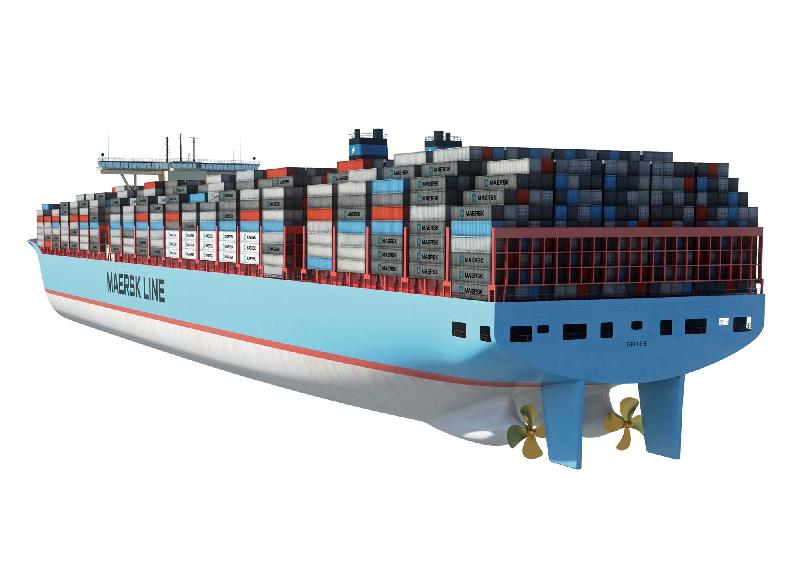
As Maersk Line’s Triple E, The World’s Largest Cargo Ship, Preps For Maiden Voyage, Many Ports Can’t Handle It

5_triple-eThe world’s largest cargo ship is leaving its shipyard this week to prepare for its July 15 maiden voyage, but much of its cargo space will be under-utilized as many ports don’t have the ability unload the 20-story-high container stacks the vessel can lug between Asia and Europe.

The ship, a $185-million, 1,300-foot long behemoth with a capacity of 18,000 containers, is a gamble for the vessel’s owner, Danish group A.P. Møller-Maersk A/S. Freight, which has been so battered by the recent global economic downturn that at one point it had hundreds of cargo ships sitting idle in Singapore. The ship is so big, it’s essentially leap-frogged over many ports’ ability to off-load it when it’s at full capacity.

“We will operate it as a smaller ship for the first few months while ports upgrade their cranes,” Lars Jensen, head of Maersk Line’s Asia-Europe operations, told Dow Jones Newswires.

The problem is that ports lack gantries — those giant square-shaped cranes that slide over loaded cargo ships and pick up or drop off loaded containers — that can accommodate a fully loaded Triple E. So before Maersk can utilize the ship’s full capacity at major ports, many of those ports have to invest in upgrading, a process that could take years.

Dow Jones says 16 ports on the ship’s route are certified to handle it, but “several” lack the adequate crane ability to handle it when it’s fully loaded. So for now, the ship will have to haul less, which eats into the company’s potential profit. It will embark on its first journey on July 15 from Busan, South Korea, to Europe, after a stop at Singapore. Source: Seanews.com and International Business Times


TT Club – Container packing standards must be improved

TT ClubThe TT Club, has called for higher levels of training to maintain and improve the expertise of those employed by shippers, consolidators, warehouses and depots to pack containers properly.

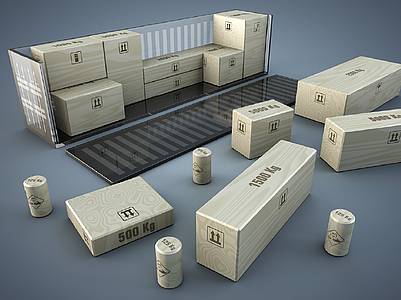
The insurance organisation said it is no surprise that the correct packing of containers is high on the agenda for industry bodies, regulators and insurers, as the consequences of unsafe and badly secured cargo are serious. According to freight transport insurer TT Club’s claims, some 65 per cent feature cargo loss or damage, of which over one-third result from poor packing.

It is timely that TT Club and Exis Technologies have come together to develop CTUpack e-learning, an online training tool for those involved in the loading and unloading of containers or Cargo Transport Units.

Designed and produced by Exis Technologies on the initiative of the TT Club, and with its financial investment, the CTUpack e-learning(tm) course is aligned with IMO/ILO/UN ECE guidelines for packing containers. Beginning with the foundation course, which will be launched later this year, it will comprise modules that include topics such as cargo or transport and elements equivalent to lessons, covering areas like forces and stresses.

In future the course will evolve to reflect developments and updates to the ILO guidelines and there is a capacity for additional modules to incorporate cargo specific and more advanced training elements. Source: Seanews.com

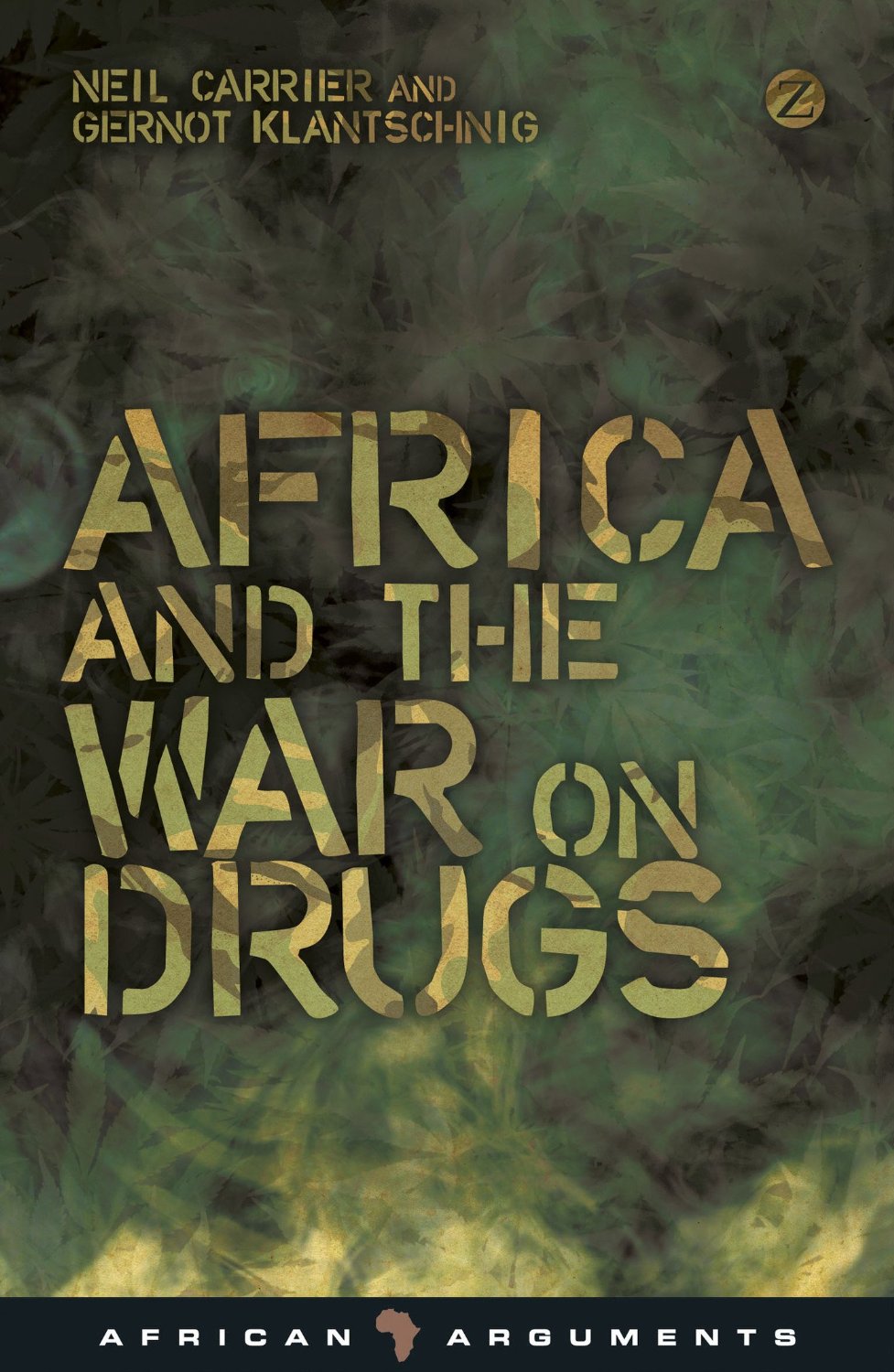
Africa and the War on Drugs

Co-authored by Neil Carrier - a researcher based at the African Studies Centre, Oxford and Gernot Klantschnig - a lecturer in International Studies at the University of Nottingham, Ningbo, China.

Co-authored by Neil Carrier – a researcher based at the African Studies Centre, Oxford and Gernot Klantschnig – a lecturer in International Studies at the University of Nottingham, Ningbo, China.

Given the much over-stated phrase ‘the war on drugs’, enforcement and security agents alike will find the following book of immense value, especially in that it provides a continental view of the problem in Africa. Nigerian drug lords in UK prisons, khat-chewing Somali pirates hijacking Western ships, crystal meth-smoking gangs controlling South Africa’s streets and the Bissau-Guinean state captured by narco-traffickers. These are some of the vivid images surrounding drugs in Africa which have alarmed policymakers, academics and the general public in recent years. In this revealing and original book, the authors weave these aspects into a provocative argument about Africa’s role in the global trade and control of drugs. In doing so, they show how foreign-inspired policies have failed to help African drug users who require medical support, while strengthening the role of corrupt and brutal law enforcement officers who are tasked with halting the export of heroin and cocaine to European and American consumer markets.

‘A fresh, ambitious, and critical survey of drug use and trafficking in Africa, where globalization has added cocaine, heroin, and methamphetamine to local staples like beer, khat, and cannabis. Carrier and Klantschnig explore the continent’s changing drug ecologies, the mixed implications for development, and policy responses that have ranged from more drug wars to state complicity in the traffic.’ David T. Courtwright, Presidential Professor,Department of History, University of North Florida

‘Reliable data on the use of drugs in Africa is notoriously hard to find, and this is a topic which tends to attract sensationalism and political opportunism rather than rational commentary and debate. In this readable and thorough book, Carrier and Klantschnig offer a calm and reasoned review of the existing evidence and develop an effective critique of the “war on drugs” approach. Picking apart many common assumptions about psycho-active substances in Africa, they effectively challenge the value of supply-side regulatory approaches and attempts at prohibition, and argue for policies based on harm-reduction. This book will be essential reading for anyone interested in drugs policy in Africa.’ Justin Willis, Durham University

Reviews: courtesy Amazon.com