Ghana – Two Single Windows?

Ghana
Deputy Minister of Trade and Industry, Mr. Carlos Ahenkorah, says Ghana a signatory to the WTO Trade Facilitation Agreement is too small a country to have two Single Window operators.

He challenged the pioneer and only single window operator, Ghana Community Network Services Limited (GCNet) to speedily re-double its efforts in actualising the full breadth of Single Window operations in the country.

He recalled GCNet’s drive to automate trade facilitation and port clearance processes in the country and the difference that brought to trade and port operators.

He praised the Ghana Integrated Cargo Clearance Systems (GICCS) deployed by GCNet as efficient and robust enough to deliver on any valuation needs and address any bottlenecks in the overall clearance systems at the ports to deepen trade facilitation and enhance revenue mobilisation.

He noted that GCNet had taken too long in securing the manifest, the seed document in clearance processes at the ports from source, a situation that may have encouraged other operators to exploit the loophole to try to secure that right from the International Air Transport Association.

The Deputy Trade Minister, however, noted that if GCNet had connected Maersk Lines to transmit its manifest into the Ghana Customs Management System (GCMS) over the past three years then there was no way that it could not oblige other carriers to emulate that example and ensure that both air and sea manifest are transmitted expeditiously.

He also urged GRA (Customs Division) as the statutory body to assist GCNet to get all other carriers to do so with dispatch going forward.

Mr. Ahenkorah also charged GCNet to remain committed to their tenets of innovation and service delivery and work harder to expand the scope of its TradeNet Single Window platforms in order to ward off any superfluous and duplicitous competition.

On his part, the Chief Executive Officer of the Ghana Shippers Authority, Dr. Kofi Mbiah, challenged Government to be bold to speedily resolve critical issues militating against the full actualisation of Single Window implementation in the country.

He said Ghana having been acknowledged as a pioneer in Single Window operations by international bodies like the World Bank and a number of countries having undertaking familiarization visits to Ghana to learn about the GCNet experience.

Dr. Mbiah noted that in as much as there was the need for collaboration between GCNet and other operators, it was also extremely important to define the parameters of engagement to create a level playing field for all players in the trade facilitation and revenue mobilisation eco-system.

Welcoming guests earlier to the event, the Executive Chairman of GCNet, Dr. Nortey Omaboe, noted that as a Public Private Partnership (PPP) conceived since its inception, the model over time had proved to be the most effective way of executing such a national mandate to support revenue mobilisation by Government, foster trade facilitation and enhance business competitiveness.

Dr. Omaboe observed that Government’s quest for increased revenue in an environment of reduced taxes to stimulate private sector growth meant greater focus on GCNet to come up with new initiatives to support revenue mobilisation efforts.

He, therefore, outlined a number of initiatives that GCNet had proposed to Government to enhance revenue mobilization.

These include the need to improve upon the valuation of consignments, the need to invoke bonds for transit goods that do not exit the country after 14 days and the review of the paltry charges currently imposed, ensuring that warehoused goods are ex-warehoused within the stipulated time periods.

Also, tighter control of free zone operations and the duty and tax exemptions granted thereon, the assignment of all newly registered taxpayers to relevant GRA Tax Offices and ensuring they file tax returns, etc.

Dr. Omaboe however expressed concerned about non-clarity in the role of some entrants in the trade facilitation and revenue mobilisation space following the cessation of the destination inspection companies and called for urgent steps to address the worrying development; and its inherent duplications and hence unnecessary cost to Government.

He was confident that what he termed ‘unnecessary complication’ would eventually be resolved mindful of the consideration that the interest of the country should remain paramount and be protected.

Dr. Omaboe assured guests that GCNet was poised for further growth and development in the years ahead as it leverages upon its continuous innovations in deploying systems that bring greater value to the Government and people of Ghana. Source: Ghana News Agency, Two Single Window Operators too much for Ghana, April 19, 2017

India – Customs introduces ‘self-sealing’ export container procedure

Customs_&_Central_Excise_DKBThe Indian Customs department (CBEC) has allowed self-sealing procedure as of 1 October for containers to be exported, as it aims to move towards a ‘trust based compliance environment’ and trade facilitation for exporters.

In a circular to all Principal Chief Commissioners, the Central Board of Excise and Customs (CBEC) said exporters who were availing facility of sealing at the factory premises under the supervision of customs authorities will be automatically entitled for self-sealing facility.

It said that permission once granted for self-sealing at an approved premise will remain valid unless withdrawn. However, in case of change in the premise, a fresh approval from Customs department will be required.

“The new self-sealing procedure shall come into effect from October 1, 2017. Till then the existing procedure shall continue,” the CBEC said.

It asked field officers to notify a Superintendent-rank officer to act as the nodal officer for the self-sealing procedure.

The officer will be responsible for coordination of the arrangements for installation of reader-scanners.

Earlier in July, the CBEC had said it will introduce the system of self-sealing by 1 September , as against the practise of sealing of containers under the supervision of revenue officials.

However, the CBEC now said that exporters can self-seal containers using the tamper proof electronic seals from 1 October 2017.

Under the new procedure, the exporter will have to declare the physical serial number of the e-seal at the time of filing the online integrated shipping bill or in the case of manual shipping bill before the container is dispatched for the port.

The exporters will directly procure RFID seals from vendors.

“In case, the RFID seals of the containers are found to be tampered with, then mandatory examination would be carried out by the Customs authorities,” the CBEC said.

From October 1, the exporters will need to furnish e-seal number, date of sealing, time of sealing, destination customs station for export, container number and trailer track number to the customs authorities.

In a circular in July, the CBEC had said it endeavours to create a trust based environment where compliance with laws is ensured by strengthening risk management system and Intelligence setup of the department.

Accordingly, CBEC has decided to lay down a simplified procedure for stuffing and sealing of export goods in containers. Source: The India Times > Economic Times, 5 September 2017.

Books to make you better understand the Shipping Industry

Luc Castera founder of Octopi, a tech company in the logistics industry, has recommended a series books to broaden culture and learning about the shipping industry. Ninety percent of everything around you was carried over on a shipping container before it reached you. It’s the industry that puts food in your plate, clothes on your back and enables the success of e-commerce globally. Yet, very few companies are trying to solve the hard problems facing this industry, says Octopi co-founder Luc Castera. If you are new to this industry, or if you have been working it in for 20 years and believe that learning should be constant, Luc highly recommends the following books.

1. The Docks by Bill Sharpsteen

Focusing on the Port of Los Angeles, The Docks delves into the unseen world of this highly successful enterprise. Author Bill Sharpsteen paints a picture of the port’s origins, zeroing in on the people that helped contribute to its economic prosperity. While Sharpsteen emphasizes the Port’s success, he also talks about its vulnerability with security and labor, while including personal stories from industry insiders. One perspective he includes is that of one of the first women longshoremen. The Docks demonstrates the energy behind this incredible port through dramatic photographs and personal perspectives.

2. The Box: How the Shipping Container Made the World Smaller and the World Economy Bigger by Marc Levinson

The Box tells the story of the container and its beginnings. What started as a simple box, changed the future of the shipping and transportation industries collectively. The container idea was slow on the uptake and economist Mark Levinson tells the story of how, after a decade of struggle, it came to fruition and changed the transport industry for good. Levinson includes key notes about how the inclusion of the “box” brought some ports back to life, whereas others suffered with its implementation. Thanks to this extraordinary box, costs were cut in the transport sector and the global economy is able to thrive, today.

3. Port Management and Operations by Maria G. Burns

Port Management and Operations has created a manual filled with insights and strategies into the world of shipping. Through examination of port management practices on a global level and deconstructing them on commercial and technological levels, this manual provides readers with a new set of skills and perspective. Port Management and Operations touches on 4 themes: “Port Strategy and Structure, Legal and Regulatory Framework, Input: Factors of Production, and Output and Economic Framework.” This book also identifies strategies and provides insight into the future of shipping.

4. Port Business by Jurgen Sorgenfrei

For veterans or those just starting out in the shipping industry, this book breaks down the meaning of ports and explains the role they play in the global supply chain. With globalization, exporting has increased exponentially, and the shipping market is changing. Port Business breaks down and analyzes the struggles for small to mega-sized ports, providing insight into the industry’s future.

5. The Travels of a T-Shirt in the Global Economy by Pietra Rivoli

Through the perspective of a T-shirt, this narrative has a lot to say about globalization and international business. Following a T-shirt from Texas to Africa, author Pietra Rivoli reveals political, cultural, economic, and moral issues associated with international business. The reader is challenged to view trade through an unconventional perspective while evaluating the complex layers of business crossing borders.

6.The Shipping Man by Matthew McCleery

Matthew McCleery tells the story of a hedge fund manager turned shipping man. After deciding to buy a ship on a whim, Robert Fairchild enters the complex world of shipping. A stark contrast to his New York life, Fairchild embarks on a journey where he learns about everything from Somali pirates to the wealthy folk of Wall Street. Though he ends up losing his hedge fund, he gains the title of shipping man along with the knowledge associated with it.

7. Ninety Percent of Everything: Inside Shipping, the Invisible Industry That Puts Clothes on Your Back, Gas in Your Car, and Food on Your Plate by Rose George

Ninety Percent of Everything unveils the invisible world of shipping to the commoner’s eye. Author Rose George divulges the secrets of the “invisible industry” through her incredible adventure sailing from southern England to Singapore. Five weeks aboard The Maersk Kendal and countless miles later, George lets readers into the shipping industry from the perspective of someone with little experience. Her objective in writing this tell-all piece is to shed light on the otherwise closed-door industry and to inform consumers about the shipping life and all that entails.

Published by Maritime Executive, Luc Castera, August 23, 2017

Republic of Ireland – warns UK against using border as Brexit bargaining chip

Irish flag

Following Britain’s recent utterances that it will not rule out the possibility that the EU may retain oversight of customs controls at UK borders after it leaves the bloc, the Irish government has warned UK authorities it will not be used as a “pawn” in Brexit negotiations, reports News Letter, UK.

Foreign Affairs Minister Simon Coveney said he does not want the issue of the Irish border to be used by the UK government as a tool to pressurise the EU for broader trade agreements.

Mr Coveney also said that sufficient progress on the future of the Irish border has not been made during Brexit talks.

Speaking ahead of a meeting with Northern Ireland Secretary of State James Brokenshire in Dublin on Tuesday Mr Coveney said: “We do not want the Irish issue, the border issue, to be used as a pawn to try to pressurise for broader trade agreements.”

He added: “Sufficient progress (on the issues facing the island of Ireland post-Brexit) hasn’t been made to date.”

He warned that in order for Brexit negotiations to move onto the next phase “measurable and real progress” is needed.

Before the meeting Mr Brokenshire insisted there was no possibility of the UK staying within a customs union post Brexit.

He said that to do so would prevent the UK from negotiating international trade deals.However, following a meeting with the Irish and British Chamber of Commerce he said there would be a period of implementation where the UK would adhere closely to the existing customs union.

“We think it is important there is an implementation period where the UK would adhere closely to the existing customs union,” said Mr Brokenshire. “But ultimately it is about the UK being able to negotiate international trade deals.

We want to harness those freedoms. If we were to remain in the customs union that would prevent us from doing so. “We are leaving EU, customs union and single market. We have set out options as to how we can achieve that frictionless trade,” he added.

However, Mr Coveney said the Irish Government believes the best way to progress “the complexity of Britain leaving the European Union is for Britain to remain very close to the single market and effectively to remain part of the customs union.”

He added: “That would certainly make the issues on the island of Ireland an awful lot easier to manage. “But of course the British Government’s stated position is not in agreement with that but that doesn’t mean we won’t continue to advocate for that.

“In the absence of that it is up to the British government to come up with flexible and imaginative solutions to actually try to deal with the specific island of Ireland issues.” Source: Newsletter.co.uk, author Mc Aleese. D, August 22, 2017.

Chamber of Mines goes after UNCTAD over faulty trade misinvoicing report

Chamber of Mines

The report claimed there was widespread misinvoicing in primary commodities in developing countries, including South Africa.

The Chamber of Mines on Tuesday called on the United Nations Conference on Trade and Development (UNCTAD) to withdraw its report on trade misinvoicing and acknowledge its shortcomings, saying that the prestigious agency had failed to collect its data accurately.

This comes after the Chamber released the third and final report in a series commissioned to examine the July 2016 UNCTAD report that claimed there was widespread misinvoicing in primary commodities in developing countries, including South Africa.

Also read Maya Forestater’s blog post Misinvoicing or misunderstanding? for an incisive explanation regarding the UN’s claims in its recent report Trade Misinvoicing in Primary Commodities in Developing Countries.

The UNCTAD report titled “Trade Misinvoicing in Primary Commodities in Developing Countries: The cases of Chile, Cote d’Ivoire, Nigeria, South Africa and Zambia”, claimed to have found widespread under-invoicing which, it alleged, was designed by commodities producers to evade tax and other entitlements due to the fiscal authorities.

UNCTAD said some commodity dependent developing countries were losing as much as 67 percent of their exports worth billions of dollars to trade misinvoicing.

For South Africa, the report calculated cumulative under-invoicing over the period 2000-2014 to have amounted to U.S.$102.8 billion; which was U.S.$620 million for iron ore, U.S.$24 billion for silver and platinum, and U.S.$78.2 billion for gold.

UNCTAD revised the report in December, though its fundamentals remained unchanged.

The Chamber of Mines also commissioned Eunomix to compile its own reports which were published in December and February respectively, focusing on UNCTAD’s gold scenarios.

The third report, which was published on Tuesday, deals with the other commodities.

The Chamber said in terms of gold, the UNCTAD study methodology compared reported exports by product and country of destination with the reported imports of the products by those same countries, and did not use other widely available data, including that of Statistics SA and the Reserve Bank.

The Chamber also dismissed all other UNCTAD findings in terms of silver and platinum, and iron ore.

The Chamber said all the factors that UNCTAD did not consider reinforced the point made in the earlier Eunomix reports regarding the lack of rigour and unreliable methodologies used in UNCTAD’s report.

“This is extremely unfortunate given the levels of credence that tend to be given to reports of this UN agency. Accusations of extensive misinvoicing and other illicit financial flows are feeding a growing lack of trust between key stakeholders in the mining industry,” the Chamber said.

“The Chamber of Mines again calls on UNCTAD to withdraw this report and acknowledge its shortcomings.” Source: The Citizen, Business News, 22 Aug, 2017. [Picture: Chamber of Mines]

UK’s “New Customs Partnership” – may grant Europe oversight of the Customs border

UK Brexit

Reuters reports that Britain will not rule out the possibility that the EU may retain oversight of customs controls at UK borders after it leaves the bloc, as the country seeks ways to keep unhindered access to EU markets following Brexit.

Last week, the UK published a policy document proposing two possible models for customs arrangements between Britain and the EU after withdrawal from the EU in 2019.

The first model was a “highly streamlined customs arrangement”, which involved the reintroduction of a customs border but which envisaged electronic tracking of shipments, rather than physical checks of goods and documents at the border.

An alternative proposal was the “new customs partnership”, which would remove the need for a customs border between the UK and EU altogether.

Under this model, the UK would operate as if it was still part of the bloc for customs purposes. British goods would be exported tariff-free and Britain would levy EU tariffs on goods coming into the UK for onward passage to the EU directly or as components in UK exports.

Lawyers said there would be a need for a mechanism to oversee the “new customs partnership” to ensure that the UK was correctly monitoring goods coming into the UK and destined for Europe.

The EU’s system of movement of goods across EU borders without checks works on the basis all members closely monitor shipments coming into the bloc from outside, to ensure the correct tariffs are paid and that goods meet EU standards.

The antifraud agency of the EU polices customs agencies across Europe to ensure that they are correctly monitoring imports. Source: Reuters, Bergin T, August 21, 2017

C-TPAT falters – how ‘SAFE’ are the world’s AEO programmes?

AEO group

The following article appeared on Maritime Executive’s webpage titled ‘Can C-TPAT be fixed?‘ authored by Stephen L. Caldwell (2017-07-18). The assessment reveals that Customs-Trade partnerships require continuous review and enhancement to retain their appeal and relevance – a significant challenge for customs and border authorities primarily focussed on compliance with the law. I have appended hyperlinks to the critic’s articles at the bottom of this post.

As the Customs-Trade Partnership Against Terrorism celebrates its fifteenth anniversary, it faces stagnant membership, software train wrecks, questionable assertions of benefits and a much- needed retooling to stay current.

The Customs-Trade Partnership Against Terrorism (C-TPAT) is a voluntary security program started in the aftermath of 9/11. Member companies sign up and agree to maintain strong supply chain security. U.S. Customs and Border Protection (CBP) staff then validate members’ security practices to ensure they meet minimum criteria. Members are then eligible for benefits such as reduced likelihood that CBP will examine their shipments.

C-TPAT currently has about 11,500 members including importers, consolidators, sea carriers, port terminals and foreign manufacturers. Membership is segregated into three “Tiers” with Tier I representing companies that sign up, Tier II representing validated members, and Tier III representing companies with the highest demonstrated level of security.

The program grew rapidly in the beginning, reaching 1,500 members by 2002, 3,000 by 2003, 7,000 by 2004 and 10,000 by 2012. Given this growth, Congress wanted to make sure it was more than just a “sign- up sheet” and asked its watchdog, the Government Accountability Office (GAO), to monitor the program.

GAO’s July 2003 report found that, after companies signed up but before any validation process was completed, CBP went ahead and provided benefits by reducing their scores in its risk algorithm. By May 2003, for example, there were 3,355 members receiving benefits but only 15 had been validated. It took a couple of years to work down the backlog.

Even then, GAO’s March 2005 report found the validation process was not rigorous enough to ensure that a company’s security practices were reliable, accurate and effective. Its 2008 report found that CBP still faced challenges in verifying that C-TPAT members met minimum security criteria. It also found that CPB’s records management system did not allow managers to determine whether C-TPAT members complied with program requirements.

Midlife Crisis

Michael Laden, head of customs compliance firm Trade Innovations in Eden Prairie, Minnesota, has been helping industry clients with C-TPAT since 2005. Laden has been a licensed customs broker since 1981 and served as Director of Global Trade Services at Target Corporation prior to founding his own firm. He believes that C-TPAT is having a midlife crisis: “The stagnation of membership levels in the 10,000-12,000 range is an indication that industry has lost its appetite for C-TPAT.” He cites a problematic history of revolving short-term leadership as part of the problem.

Laden says the program reached its nadir with the August 2015 release of the much-anticipated Portal 2.0 software, designed to further automate the validation process. “The release was rushed into service with limited capabilities and minimal pre-testing,” he explains. “It was a complete train wreck. The data from the previous version just disappeared. In some cases, not only did the data disappear but the company disappeared too.”

The problems with Portal 2.0 were documented in GAO’s most recent report of February 2017, which found that Portal 2.0 incorrectly altered C-TPAT members’ certifications or security profiles, impairing the ability of C-TPAT specialists to identify and complete required security validations. Portal 2.0 problems also prevented C-TPAT members from accessing their own data and responding to validation reports.

Since C-TPAT was presented as a partnership with CBP benefiting from its knowledge of member companies’ security practices and companies benefiting from reduced scrutiny of their shipments, CBP in 2012 developed a software “Dashboard” to track such benefits. It used the Dashboard in its Program Benefits Reference Guide to assert that entries filed by C-TPAT members were less likely to undergo a security examination than those filed by non-members. Tier III members, for example, were nine times less likely to be examined, and Tier II members 3.5 times less likely.

However, the February 2017 GAO analysis found that C-TPAT members’ shipments did not consistently experience lower examinations, hold rates or processing times compared to non-member shipments. When GAO shared its preliminary analysis with C-TPAT officials, they acknowledged that they had never completed system verification, acceptance-testing, or checks on the data in the Dashboard. GAO’s conclusion was that the data was unreliable going back to the Dashboard’s introduction in 2012, and CBP to this day remains unable to determine the benefits of C-TPAT membership.

Industry Finds Its Own Solutions  

While industry was anxious for definitive information on membership benefits, it decided to find its own solutions to some of the costs. One key cost involves security audits of the supply chain, particularly in foreign countries. Shippers and importers got together and created the Supplier Compliance Audit Network (SCAN) to address costs, “audit fatigue,” inconsistent reporting and varying compliance requirements.

Companies pay a sliding fee to become part of SCAN, where they can commission audits and get access to completed audits, which could obviate the need for a new audit of a particular supplier. In 2016, SCAN completed more than 3,379 audits in 51 countries. Its board of directors represents some of the largest importers in the U.S., and its audits are conducted by proven service providers such as Bureau Veritas and business standards company BSI.

Dan Purtell, Senior Vice President of 30 BSI’s Supply Chain Solutions Group, says, “SCAN members clearly see the benefit of the C-TPAT program. These companies are the ‘who’s who’ of the Tier III C-TPAT community and truly are the supply chain security thought-leaders within the private sector. Member companies compete on the shelf but unite to secure trade, mitigate supply chain risk, and identify and correct security deficiencies.”

Purtell notes that “More than 15,000 such deficiencies have been remedied by SCAN since its inception just two years ago. No other association has done more to address global supply chain exposures.”

Next Steps

Despite problems, there are signs of improvement according to Trade Innovations’ Laden, starting with the decision by the last CBP Commissioner to make the Director of C-TPAT a more permanent position. “This should add continuity to the leadership of the program,” he explains, “allowing it to reach its true potential.” Laden also praises the new Director, Elizabeth Schmelzinger, for her openness to listen to industry.

“We’re retooling the program so that it stays current,” says Schmelzinger. “There are a lot of factors that have changed over the years. We want to make sure the minimum standards are still relevant.” CBP had enlisted its industry-based Commercial Operations Advisory Committee (COAC) to help it validate those minimum standards and develop C-TPAT best practices with the results to be announced at COAC’s March 1 meeting in Washington, DC. However, it was announced at the meeting that the results had been delayed to “make sure they get it right.”

When asked whether the intent of revisiting the minimum standards was to increase membership, Schmelzinger responded: “C-TPAT’s standards remain high. It’s not all about joining the program. We also suspend companies and remove them from the program. So, there is a constant churn in membership.”

She also described the evolving roles of C-TPAT and CBP’s newer Trusted Trader program, noting that “C-TPAT was foundational to any Trusted Trader status.” In other words, the first element of a Trusted Trader program was to ensure security. Then the elements of compliance with rules and regulations would be taken into consideration.

Ultimately, C-TPAT and Trusted Trader would transition into a global safety net whereby low-risk importers and exporters would have their goods expedited through customs processes in both the U.S. and its trading partners.

AEOs and Mutual Recognition

In international parlance, security partnership arrangements like C-TPAT are called Authorized Economic Operator (AEO) programs. The U.N. reported that, as of 2016, some 79 countries had established AEO programs and an additional 16 planned to launch such programs in the near future. The E.U., consisting of 28 countries, has the largest program, and its Union Customs Code of 2013 aims to, among other things, reinforce swifter customs procedures for compliant AEOs.

Many countries with AEO programs, including the U.S. with its C-TPAT, have signed “mutual recognition agreements” whereby two countries’ customs administrations agree to recognize the AEO authorization issued under the other’s program and provide reciprocal benefits to companies. As of May 2016, some 40 bilateral agreements had been concluded with 30 more being negotiated. According to the U.N., these bilateral agreements will form the basis for multilateral agreements. To date, the U.S. has signed 11 agreements with, among others, the E.U., Canada, Mexico, Japan and Korea.

C-TPAT Director Schmelzinger adds that “We are also restructuring the program to include exports so that it is more in line with the structure of other countries’ AEO programs. As part of our agreements with countries that have AEO programs, those countries will honor a commitment to our exporters who are low- risk. This will help U.S. exporters establish a foothold in those markets.”

One Step at a Time

Michael Laden is more skeptical of mutual recognition, calling it a “noble gesture” but adding there will be little enthusiasm from industry. Most of his clients are importers and will not get any benefit from the new export component.

Regarding exporters, he says that “Since CBP so rarely examines exports, the usual benefit offered by C-TPAT membership does not exist for that part of industry.” In Laden’s view, “Let’s fix C-TPAT before we move on to harmonize customs security and compliance throughout the world.”    Source: Maritime-Executive

Recommended reading –

 

New Digital Currency “TEU” to Transform Container Shipping Business

TEU Token

The creators of a new industry-specific digital currency that shippers can use to book ocean shipments say so-called “cryptocurrency” could help reduce carrier overbooking and shipper no-shows, which cost the industry some $23 billion annually.

The Hong Kong-based 300 Cubits recently introduced the TEU, not the container unit but rather a digital dollar that replaces traditional currencies as the deposit for shipment bookings, providing greater visibility to the booking process and allowing users to penalize bad behaviour. Whereas other tech startups have introduced digital management platforms to achieve the same goals, 300Cubits’ founders say they’re offering something different: not a place for transaction, but a means of transaction.

The company introduced the new TEU crypto currency to the market, putting some up for sale and giving others away to container lines and shippers “who actively promote the tokens for early adoption.” The TEU tokens are blockchain-based, which means they are tethered to a decentralized, distributed digital ledger used to record transactions across many computers so that the record cannot be altered retroactively.

Blockchain is a largely back-end technology, which means there’s very little change for the user, both shipper and carrier, according to Johnson Leung, a longtime shipping finance analyst formerly with Jefferies who founded 300Cubits with his partner Jonathan Lee.

“The biggest change is the acceptance of TEU tokens as a booking deposit, which is a more commercial decision than a technical call,” Leung told, “We do not plan on a substantial change in terms of user interface experience other than having one more option for the user to choose whether to use TEU tokens and the amount to put it before the shipper clicks on the book button.”

The tokens were named TEU to honor, in a way, the classical unit of measurement for container shipping, said Leung.

“TEU is a kind of a classical unit for container shipping that is getting less and less used,” Leung said. “We just think that the people in the industry would appreciate the name as TEU when naming something that could be the money for the industry.”

In an era marked by the buzzword “disruption,” Leung was clear that TEU tokens are not disrupting any existing system or process in the container shipping industry. TEU tokens are like an industry-specific bitcoin, another blockchain-based cryptocurrency. Put simply, Leung said, “We play part of what the dollar does today in container shipping.”

According to a white paper prepared by the company, once TEU tokens are used to book shipment their value could be lost if a customer does not turn up with cargo or a carrier does not load cargo according to a confirmed booking.

Trust, or lack thereof, is the biggest pain point in the container shipping industry, according to 300 Cubits.

“Unlike ticket booking in airlines, customers in container shipping do not bear any consequence for not showing up for bookings. Industry people complain the lack of trust between liners and customers,” the company said in a statement. The TEU token can change that.

While it is aimed at tackling overbookings and no-shows and providing greater visibility into the container shipping industry, 300Cubits should not be confused with other tech firms attempting to accomplish the same feat through different avenues. Leung’s company only provides the means of transaction. It does not provide the actual space for where carriers and shippers can transact, like the New York Shipping Exchange, an online portal through which carrier cargo space can be booked and which also monitors whether the booking is fulfilled by shipper and carrier.

According to Leung, the container shipping industry is a $150 billion industry that has been in “constant distress” since the economic crisis of 2008. Subtle technological innovations, like digital currencies and digital marketplaces to use them, are going to be the means to ease that volatility.

Frequently Asked Questions regarding TEU – 300cubits.tech

300Cubits White Paper – 300cubits.tech

Source: www.dailyshippingtimes.com, 3 August 2017.

SA Donkeys ‘ferry’ illicit vehicles into Zimbabwe

Police are on high alert looking for a syndicate that uses donkeys to smuggle luxury cars across the Limpopo River into the Zimbabwe.

Thieves tied ropes to the cars which were hitched on to the donkeys to pull the cars across the river.

Some cars are driven through the drier parts of the river. On Tuesday, a Mercedes Benz C220 was intercepted before it disappeared into Zimbabwe.

“Our members were just in time to pounce on them after the donkeys were apparently no longer able to pull it through the sand,” Brigadier Motlafela Mojapelo  for the SA Police Service said.

The suspects fled into the bushes towards Zimbabwe side. Most of the cars are being smuggled across the river through the border between South Africa and Zimbabwe, south of Beitbridge border post.

In December, police recovered a Hilux bakkie when thieves attempted to smuggle it through the river. The bakkie was stolen in Durban.

It was semi-submerged in the water when Limpopo police commissioner Lieutenant-General Nneke Ledwaba spotted it from a helicopter while he was leading a high-density operation in Musina and Beitbridge.

The vehicle and donkeys were abandoned in the middle of the river and the suspect fled into Zimbabwe. It is not clear why the thieves do not simply driver the car into Zimbabwe – one reason might be that most modern cars are fitted with a tracking device which uses satellite tracking to locate a vehicle, if stolen. The tracker is only active when the car is running.

Mojapelo said 13 vehicles have been recovered since January this year. Thieves target luxury bakkies, SUV’s, specifically Toyota and Isuzu. Gauteng and KwaZulu-Natal are the two provinces that are mostly affected.

Last week, four vehicles were recovered. A Range Rover worth R900 000 was recovered after police intercepted it at the Beitbridge border post. The vehicle was en route to Malawi. The man was arrested and was found in possession of cash with an estimated amount of R30 000.

Mojapelo said the car had Limpopo registration numbers, but it was still unclear where it was stolen. Source: Pictures – SAPS and article – Iavan Pijoos, News24, 2 August 2017.

WCO to unveil future norms for e-commerce trade

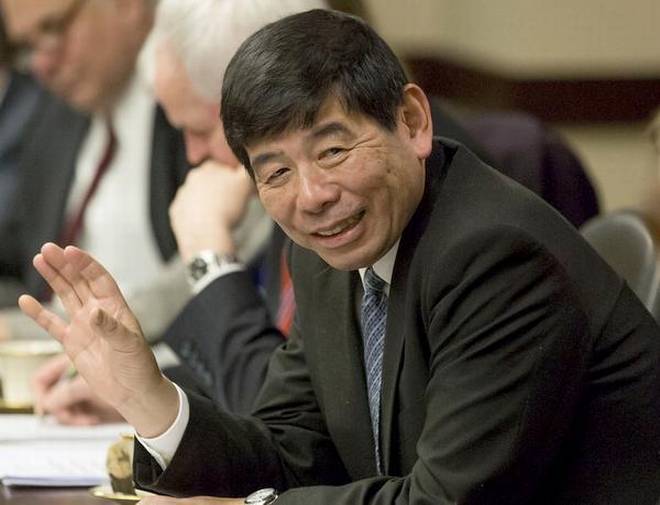
Kunio Mikuriya - Hindu Times

The Hindu Times reports that the World Customs Organization (WCO) will soon bring out guidelines on ‘cross-border e-commerce’, which will focus on preventing illegal trade as well as addressing the challenges stemming from the ‘digital divide’, according to the WCO Secretary General Kunio Mikuriya.

In an interview to The Hindu on his recent India trip, Mr. Mikuriya said, “We are developing guidelines on e-commerce to see how best Customs can facilitate legitimate trade through that route.” He added, “We [the WCO] will address issues related to digital divide by looking into what is blocking e-commerce trade, and what kind of enabling environment is needed to support developing countries so that they benefit more from e-commerce.”

Terming e-commerce as a “game changer” in global trade that is benefiting small firms and consumers, he said the new guidelines would, however, include provisions to prevent illegal trade and illicit financial flows. This would be ensured through measures that would help strengthen information exchange between Customs administrations of countries as well as collaboration with other government agencies.

The WCO has a Working Group on e-Commerce and four sub-groups. To develop guidelines on cross-border e-commerce, the work packages identified are: ‘trade facilitation and simplification of procedures’, ‘safety and security’, ‘revenue collection’, and ‘measurement and analysis’. According to the UN body ‘UNCTAD’, the value of online trade jumped from $16 trillion to $22 trillion between 2013 and 2015.

“The continuous increase in online trading has raised questions regarding regulation, consumer protection, revenue collection and national security,” according to the WCO’s ‘Study Report on Cross-Border E-Commerce’ (March 2017). “These questions cannot be dealt with individually, but require a common, broad approach by the international Customs community, together with all relevant stakeholders as a whole.”

The WCO said more sophisticated equipment was needed to combat illicit trading through low-value shipments in the postal, express and cargo streams.

“Pre-arrival information on the consignment and the consignee could be of great importance in detecting and intercepting illicit trade. In addition, the improvement of non-intrusive inspection equipment and an increase in the number of trained staff could help to enhance the detection rate of illicit goods,” it said.

In an article on e-commerce, the WCO’s Director of Compliance and Facilitation Ana Hinojosa pointed out that in many countries, there were de minimisthresholds that allow low-value packages to enter a country with little or no duties or taxes, and with much more simplified procedures.

“This has led to clever manipulations by either the shipper or the consumer to avoid the extra charges by splitting invoices, undervaluing the invoices or mis-declaring the items altogether,” wrote Ms. Hinojosa. Another type of manipulation used was to classify the item as something else or claiming a different country of origin for the product, to take advantage of better duty or tax rates, the WCO official said, adding that these distortions had had an impact on many countries’ revenue collection volumes. Therefore, “some countries… are re-evaluating their established thresholds due to the significant implications that the changes brought about by these growing volumes of low-value small packages are having on their fiscal revenues,” observed Ms. Hinojosa. Source: The Hindu, 2 August 2017.

Namibia Revenue Agency Bill – Finance officials to reapply for jobs

Namibia flagOver 1 380 finance ministry officials will be required to reapply for their jobs when the proposed state-owned Namibia Revenue Agency is formed.

Finance minister Calle Schlettwein tabled the Namibia Revenue Agency Bill 2017 to pave the way for the creation of the independent agency which will assess and collect taxes.

The agency will not only extract the largest part of the finance ministry’s workforce, but a proposed law tabled last week suggests that the new parastatal should be allowed to attract experts by paying more than what other civil servants currently earn.

When he tabled the proposed bill in the National Assembly last week, Schlettwein said 730 officials from the Inland Revenue department and 650 from the directorate of customs will have to reapply for their jobs when the new agency opens next year.

According to Schlettwein, the two departments make up 79% of the total staff at the finance ministry.

Schlettwein told The Namibian yesterday that the finance ministry has a total workforce of 1 740, but the two departments have up to 1 380 workers.

“To further avoid compromising on the skills needed for the agency, there will be no automatic transfer of existing staff of the departments of Inland Revenue and Customs and Excise to the new institution,” the minister stated.

However, finance officials will be offered the first opportunity to apply and compete for jobs offered at the new agency before the platform is opened up to the public, he said.

“As such, arrangements will be made to ensure that the selection process is transparent and adheres to best practices,” Schlettwein added.

According to the minister, officials at the finance ministry who fail to get jobs at the new tax agency will be offered positions elsewhere in government, as stipulated in the Public Service Act.

He said some officials at the agency will also be highly paid in order to attract the best talent.

“The agency will be exempted from the public service rules and public enterprises remuneration guidelines,” he noted.

The 2017/18 budget documents indicate that the finance ministry will spend N$28 million on salaries and other benefits. Schlettwein said the new parastatal will start working next year at a date yet to be announced, adding that there is a need to manage the transition process well to avoid making costly mistakes.

He said for now, a finance ministry and revenue agency task team will finalise the transitional aspects for the establishment of the agency.

“This entails further consultations on the operational modalities, the determination of the recruitment process, and proposals for the draft internal policies of the new institution in preparation for the recruitment of the board and senior management of the agency,” Schlettwein stated.

The minister said one of the functions of setting up a highly-paying tax body is to catch companies and individuals who are taking advantage of loopholes to avoid paying taxes.

“We are a resource-based economy, which comes with the potential for illicit financial flows, transfer pricing, profit shifting and other base-eroding tax planning activities,” he said.

Illicit financial flows involve money illegally earned, transferred or used which crosses national borders. Culprits are usually multinational companies and criminals.

The minister said tackling illicit financial flows will require specialised skills, which could not be optimised in the public service due to a lack of skills.

Tackling illicit financial flows will give President Hage Geingob’s administration plaudits for tackling corporate and financial cheating.

The real impact of illicit financial flows on Namibia is currently not known, as the government continues to rely on international statistics when commenting on the subject.

For instance, the United States-based think tank, Global Financial Integrity, said in its 2012 report that Namibia lost around N$5,6 billion per year to illegal activities between 2001 to 2010.

The Namibia Revenue Agency will be run by a seven-member board on a three-year term. The board members will be appointed by the minister from experts selected from state entities, such as the permanent secretary from the finance ministry, the commissioner, and five members who will be appointed based on areas of expertise such as taxation, law, auditing and human resources.

A commissioner will be appointed as the chief executive for five years. The chief executive can only serve for a maximum two terms (10 years), but his/her second-term appointment should be based on “excellence” in performance, and at the discretion of the finance minister. Source: The Namibia, 2017-06-27. Author: Shinovene Immanuel

AGOA – a Poisoned Chalice?

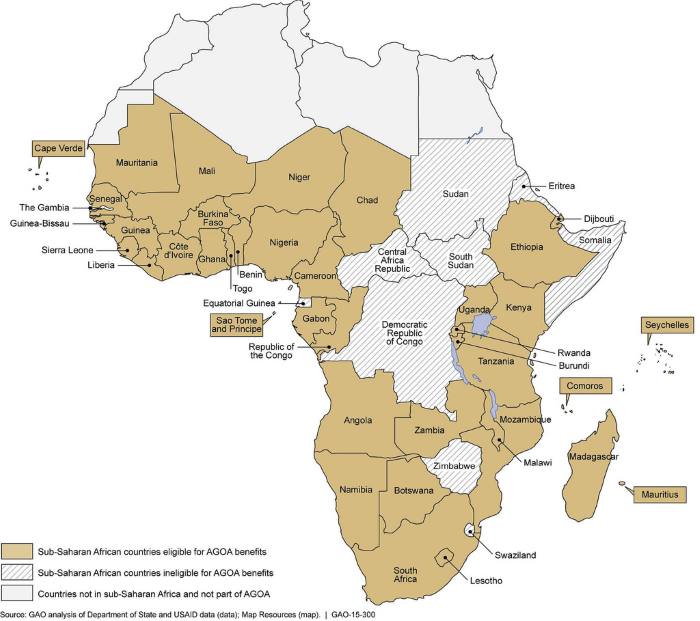
AGOA States-GAO

“Is the Africa Growth and Opportunity Act (AGOA) always a poisoned chalice from the United States of America?”, asks an editorial in The East African. The Kenya newspaper suggests it appeared to be so after the US allowed a petition that could see Tanzania, Uganda and Rwanda lose their unlimited opening to its market.

This follows the US Trade Representative assenting last week to an appeal by Secondary Materials and Recycled Textiles Association, a used clothes lobby, for a review of the three countries’ duty-free, quota-free access to the country for their resolve to ban importation of used clothes, the The East African continues.

The US just happens to be the biggest source of used clothes sold in the world. Some of the clothes are recycled in countries like Canada and Thailand before being shipped to markets mostly in the developing world.

In East Africa, up to $125 million is spent on used clothes annually, a fifth of them imported directly from the US and the bulk from trans-shippers including Canada, India, the UAE, Pakistan, Honduras and Mexico.

The East Africa imports account for 22 percent of used clothes sold in Africa. Suspending the three countries from the 2000 trade affirmation would leave them short of $230 million in foreign exchange that they earn from exports to the US.

That would worsen the trade balance, which is already $80 million in favour of the US. In trade disputes, numbers do not tell the whole story. Agoa now appears to have been caught up in the nationalism sweeping across the developed world and Trumponomics.

US lobbies have been pushing for tough conditions to be imposed since it was enacted, including the third country rule of origin which would require that apparel exports be made from local fabric.

The rule, targeted at curbing China’s indirect benefits from Agoa through fabric sales, comes up for a legislative review in 2025, making it prudent for African countries to prepare for the worst. Whether that comes through a ban or phasing out of secondhand clothing (the wording that saved Kenya from being listed for a review) is immaterial.

What is imperative is that African countries have to be resolute in promoting domestic industries. In textiles and leather, for instance, that effort should include on-farm incentives for increasing cotton, hides and skins output, concessions for investments in value-adding plants like ginneries and tanneries and market outlets for local textile and shoe companies.

The world over, domestic markets provide the initial motivation for production before investors venture farther afield. Import bans come in handy when faced with such low costs of production in other countries that heavy taxation still leaves those products cheaper than those of competitors in the receiving countries.

The US has also been opposed to heavy taxation of used clothes, which buyers say are of better quality and more durable. For Kenya to be kept out of the review, it had to agree to reduce taxes on used apparel.

These factors have left Agoa beneficiaries in a no-win situation: Damned if you ban, damned if you do not. With their backs to the wall, beneficiaries like Tanzania, Uganda and Rwanda have to think long term in choosing their industrial policies and calling the US bluff.

Beneficiaries must speak with one voice to effectively guard against trade conditions that over time hamper domestic industrial growth. Source: The East African, Picture: US GAO

USCBP donates border protection equipment to SARS

CBPSARS3

The U.S. Embassy in South Africa’s office of U.S. Customs and Border Protection (CBP) donated border enforcement equipment and tools to the South African Revenue Service (SARS) at their K-9 facility in Kempton Park today. The equipment will be utilized in support SARS’ efforts to safeguard the borders in South Africa. The donation, valuing more than $105,000, includes vehicle GPS units, field binoculars, night vision goggles, handheld thermal imagers, radiation detector/pagers, and contraband detection kits.

The donation is a part of the U.S. Customs and Border Protection’s longstanding partnership with the government of South Africa to support border security, trade facilitation and combat wildlife trafficking. U.S. Chargé d’Affaires Jessye Lapenn said, “Following South Africa’s success in hosting the 17th Meeting of the Conference of the Parties (COP17) to the Convention on International Trade in Endangered Species of Wild Fauna and Flora (CITES) in 2016, we are delighted to support your continued efforts. This equipment will be used to help conserve your incredibly diverse wildlife species, promote economic development, and combat the multi-billion dollar illicit wildlife trade within your borders, across our borders, and globally. I am proud of the great work our South African and American teams have done together on these issues. Together, we are making a difference.”

An executive for Customs at SARS said, “from the South African perspective, we acknowledge and receive these ‘tools of the trade’ from the United States with gratitude. This donation will strengthen our long-lasting relationship with the United States, which has been assisting us since the 1990s. Our work together has helped us improve our fight against the illicit economy.”

With more than 60,000 employees, CBP is one of the world’s largest law enforcement organizations and is charged with keeping terrorists and their weapons out of the U.S. while facilitating lawful international travel and trade. As the United States’ first unified border entity, CBP takes a comprehensive approach to border management and control, combining customs, immigration, border security, and agricultural protection into one coordinated and supportive activity. The men and women of CBP are responsible for enforcing hundreds of U.S. laws and regulations. On a typical day, CBP welcomes nearly one million visitors, screens more than 67,000 cargo containers, arrests more than 1,100 individuals, and seizes nearly six tons of illicit drugs. Annually, CBP facilitates an average of more than $3 trillion in legitimate trade while enforcing U.S. trade laws.

Source:  APO on behalf of U.S. Embassy Pretoria, South Africa.

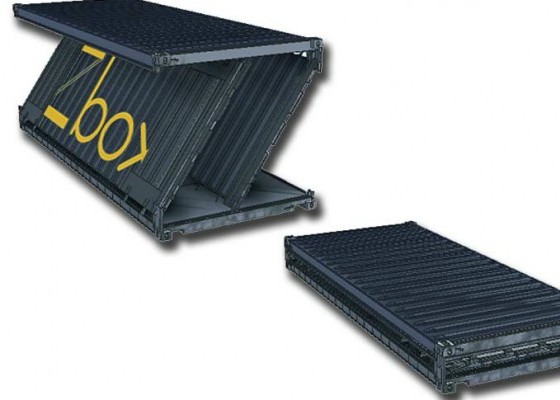
Zbox – New Collapsible Container

image001

A new collapsible 20ft container, which is currently in development, promises to save operators both money and space both at the terminal and in the supply chain, according to Port Strategy.

Navlandis’s ZBox claims to be able to take the place of empty containers, which take up around 25% of sea traffic, slashing both logistics and transportation costs.

This is because five folded units can fit into the space occupied by a current standard container potentially reducing operating costs by up to 50% and CO emissions by up to 20%.

This container has the same strength as conventional containers. In addition, it can be handled with the same machinery at all freight ports and with minimum human resources, which will make operating costs much more competitive.

The technology is still at prototype stage but reportedly has the backing of the Port of Valencia. Navlandis said that a good number of shipping companies have shown interest too.

Navlandis said that the 20-foot container complies with all ISO and CSC certifications, ensuring all loading, resistance and watertightness requirements of the logistics industry, with the same dimensions as a standard container. In addition, it is manufactured with the same parts as the standards require. Source: Port Strategy

Payback Time for the man who decimated South African Rock Lobster

rock-lobster3

Cape Town businessman Arnold Bengis drained South Africa’s seas – and now it is payback time.

A US court has ordered the 81-year-old to pay South Africa $37-million (about R483-million) for catching thousands of tons of rock lobster over 14 years.

The restitution amount replaces a $21-million payment Bengis agreed to make to South Africa in 2004. Because he paid only $1.25-million and placed the rest “out of reach of the US”, Manhattan District Court Judge Lewis Kaplan sentenced him on Wednesday to more than four years’ imprisonment.

Kaplan ordered an immediate arrest warrant for Bengis, now living in Israel. State attorney Kiersten Fletcher said US authorities would try to extradite him.

Said the judge: “There is value to Mr Bengis understanding that.there may be a knock at the door and a pair of handcuffs in his future.”

The Department of Agriculture, Forestry and Fisheries wanted $100-million in restitution but it welcomed Kaplan’s judgment.

“We are fairly satisfied with the $37-million, but we hope [Bengis] won’t appeal it, so the payment will be effected as soon as possible,” said the department’s Thembalethu Vico.

Although Bengis’s activities stopped 17 years ago, damage to the coastal ecosystem was still depriving fishing communities of access to resources, he said.

Former department head of fisheries Horst Kleinschmidt, who testified in the District Court in 2004 about Bengis’s fishing activities, quoted research that suggested free-falling rock lobster stocks “immediately stabilised” after his operation was stopped.

He said yesterday that when officials discovered the extent of Bengis’s plunder “it made nonsense of any scientific inquiry” into environmental factors behind declining fish stocks.

“He hired lots of little fishermen with boats to supply him with contraband fish stocks. The decline is evident in the total allowable catch figures, which the scientists set lower and lower. Once he was caught, we realised he was a major source of that,” he said.

His fleet of trawlers overfished more than 2200t of West Coast rock lobster between 1987 and 2000. The $37-million was the proceeds of just one year, plus interest, said an Ocean and Land Resources Assessment Consultants report.South Africa will be the first foreign government to be compensated under a 117-year-old US law, the Lacey Act, which regulates imports of protected species.

Department lawyer Barnabas Xulu said it took his team six months to prepare for the case and hailed the ruling as “ground-breaking”, but conceded there could still be challenges ahead.

During arguments in court, Kaplan told Bengis’s attorney, Eric Creizman, his client “rearranged” his assets, amounting to $25-million, into a Channel Islands fund so the US government could not reach it. Source: Times Live (2017, July 21)