Another WCO resource for the Customs and Trade Professional

The WCO developed the Revenue Package in response to Members’ concerns in regard to falling revenue returns in the light of the global financial crisis and declining duty rates.

Revenue PackageCollection of revenue has historically been the cornerstone of a Customs administration’s responsibilities. For a number of years, Customs has been actively involved in protection of society and trade facilitation initiatives. More recently, the role of Customs has expanded; issues such as the fight against counterfeiting, counter-terrorism activities and the protection of the environment have featured high on the agenda of international Customs work programmes. Alongside these important topics, revenue collection continues to be an area of concern for Customs administrations. The global financial crisis has led to a downturn in international trade which has inevitably hit government revenues. Additionally, the global trend in the reduction of Customs duty rates, through unilateral, regional, and multilateral trade liberalizations, can potentially have the same effect.

The Revenue Package currently consists of all available tools and instruments relevant to revenue collection. This includes, inter alia, formal instruments and Conventions, guidance notes and training material. Members are encouraged to consult the Package to ensure that necessary requirements have been met and that all relevant material has been obtained by the administration and is being utilized as appropriate.

The Revenue Package is divided into six topics :

  • Topic 1. Facilitation and Procedures
  • Topic 2. Customs Valuation
  • Topic 3. Harmonized System/Nomenclature
  • Topic 4. Origin
  • Topic 5. Compliance and Enforcement
  • Topic 6. Capacity Building and Training

Under each topic, the prime text is referenced, where appropriate. For example, for Topic 1 (Facilitation and Procedures), the Revised Kyoto Convention is the prime text. This is followed by a list of supporting instruments and tools for that topic, providing information on content and availability. Web links are included to provide convenient access to the relevant material, which is either freely available to download or available for purchase from the WCO’s Online Bookshop. Source: WCO.
U.S. Customs may get more involved with export security

A top U.S. Customs and Border Protection (CBP) official said the agency is considering expanding its role to include verifying U.S. exporters’ security compliance, with any future program likely to be modeled after the agency’s Customs-Trade Partnership Against Terrorism (C-TPAT) program. C-TPAT sets security standards for imports and verifies compliance with those standards.

“The idea is being noodled around now” at CBP’s headquarters in Washington, said Dan Baldwin, executive director for cargo and conveyance security in CBP’s Office of Field Operations, during a Nov. 3 presentation at the Coalition of New England Companies for Trade (CONECT) 10th Annual Northeast Cargo Symposium in Foxborough, Mass.

The impetus for adding export security to CBP’s portfolio comes partly from the Obama Administration’s push to increase exports as a means of strengthening the U.S. economy. But much of the motivation traces back to exporters themselves.

Large exporters have been asking for a program that would verify their compliance with foreign governments’ cargo security programs, some of which are based on C-TPAT, Baldwin said. CBP plans to sign an agreement with the European Union regarding coordination between C-TPAT and the EU’s Authorised Economic Operator (AEO) security program by the end of this year, he said.

CBP already has some involvement with export security, notably on the U.S. borders with Mexico and Canada. The agency could play a bigger role than it currently does in enforcing limits on technology and licensed goods, Baldwin said.

“I think … the same process we use on the import side should be emulated on the export side,” he concluded. “I don’t think that’s going to be a heavy lift.”  Source: DCVelocity.com Comment: not likely if it means the CBP has to condescend to adapt its system to those of a foreign sovereignty!

Related articles

WCO News – October 2011 Edition

WCOnews October 2011An eagerly awaited edition of the WCO news magazine once again promises loads of insight into the Customs world. This edition includes – per usual – a variety of topics, amongst which –

  • The Secretary General of the WCO shares his thoughts on global threats and the need to remain vigilant and responsive.
  • Latest developments in WCO areas of work: compliance and enforcement, procedures and facilitation, capacity building and tariff and trade affairs.
  • How the WCO and UNCTAD work together to foster international trade.
  • Using controlled deliveries to combat wildlife crime.
  • Knowledge and dialogue – the focus of the Open Day for Trade and the Knowledge Academy.
  • PICARD Conference promotes research-based knowledge.

There also interesting articles from around the world –

  • East and Southern Africa benefits from new MBA with Customs specialization.
  • New Zealand Customs Service’s role in natural disaster relief.
  • Engaging the trading community in Customs modernization: the Brazilian experience.

The WCO’s website now also features some new stuff, and in particular ‘scholars’ are encouraged to try out some of the ‘free’ e-learning courses. These are not just for the privilege of customs officers. The WCO has been working hard with trade organisations to provide ‘industry wide’ courses and programmes for the trade professional. Source: WCO

WCO Remembers September 11

Picture of Kunio Mikuriya at the World Customs...

WCO's Kunio Mikuriya

To commemorate the 10th anniversary of 9/11, WCO Secretary General, Kunio Mikuriya stated that “security, in particular global trade security, became a priority policy objective and is now part of Customs’ existing border protection portfolio to prevent such attacks from re-occurring”.

“Customs administrations across the globe have made considerable efforts to counter security threats,” stressed the Secretary General. “It is therefore fitting that as we commemorate the anniversary of 9/11, we renew our firm commitment to continue to take speedy action against terrorism and other forms of organized crime,” he concluded.

In response to 9/11, over the last 10 years the WCO has developed many international standards including the renowned SAFE Framework of Standards to Secure and Facilitate Global Trade, and further supported national Customs administrations to implement the Framework through a vigorous and highly successful capacity building programme.

This Framework promotes supply chain security through the submission of advance cargo information, the application of risk management, the use of non-intrusive cargo scanning equipment, the development of Authorized Economic Operator (AEO) programmes, and partnerships between Customs administrations and between Customs and their trade stakeholders.

To further assist its Members and others who play a role in global trade security, the WCO has published a Research Paper – The Customs Supply Chain Security Paradigm and 9/11: Ten Years On and Beyond. Source WCO.

Zero Tolerance – the saga of 100% scanning continues

Various opinions on this subject have been voiced over the last 3 years – the threat of sea and airborne cargo being used as ‘a delivery mechanism’ for a nuclear or terrorist attack. Besides the US calling for 100% scanning of containerised cargoes at point of origin, the reality remains that less than 4% of seaborne containers are being scanned at port of departure.

Post 9/11, the US was quick to initiate a multi-layered approach to securing America against another terrorist attack. This entailed a number of domestic and extra-territorial programmes. At the bottom of each of these lies an authoritarian distrust or question mark against the integrity of entities involved in the international supply chain. In as much as these modern-day Customs’ initiatives aim to deal with tangible and intangible threats, one can begin to question the motives used by many governments and organisations in introducing such programs.

Last year, the US postponed it’s requirement for 100% scanning of inbound boxes by at least two years because of technical and funding issues. (Lets not forget the massive outcry from foreign countries of origin who envisaged their own ports coming to a standstill). The 2014 deadline, as it stands, would require any container heading to the US to be scanned for conventional as well as radioactive threats before being loaded at a foreign port.

However, in June 2011, US Homeland Security chief Janet Napolitano went on record saying that 100% scanning was “probably not the best way to go”. She said Congress was considering a “more layered approach” to container security, a combined system of scanning, data and risk analysis, physical checks and closer co-operation with ports and countries around the world.

Could it be that the promise of mega-deals for the ‘security industry’ is under serious threat given limited success and results from these ‘supply chain’ initiatives? One hears less and less about the awarding of multi-million dollar contracts for non-intrusive equipment. Funding is a big issue, and no less an issue is the question mark which countries of origin have regarding the direct intrusion these US-domestic policies have on their local economies and supply chains.

The WCO went a long way in accommodating and addressing the question of international terrorism which in the view of many helped curbed the ‘paranoia’ which prevailed post 9/11. Still the question of motive and opportunity spurred several organisations and governments to support the many bilateral developments that ensued. The EU Commission for one was infuriated by the bilateral overtures of the CBP and EU Custom’s administrations before diplomatic agreement prevailed.

The bottom line is that a nation’s domestic policy overrides that of the wants and whims of the more affluent states. Several donor programs nowadays offer ‘security equipment’ free of charge to countries packaged with ‘capacity building programmes’ to instil the desired mentality of the donor country or agency. Traditional forms of customs control and human initiative/intuition are being cast out on the trash heap as primitive everywhere, yet there is little to show for the billions of dollars spent on anti-terrorism measures year after year. However, reading the article – Zero Tolerance – you get the impression of a little desperation on the part of the engineers and manufacturers of nuclear based security equipment – almost wishing a further nuclear calamity to prove their point! Source of article: www.portstrategy.com

What is an Authorised Economic Operator (AEO)?

WCO LogoAlthough in its infancy here in South Africa, I thought I should share an interesting research paper on AEO developments across the globe. First, let’s define what it means to have AEO status? AEO status is given to a company who is considered to be reliable in their Customs-related operations. This includes customs compliance, appropriate record-keeping, proven financial solvency and security and safety standards. In principle, there are 3 types of AEO certificates — security and safety, customs simplifications, and full which includes customs simplifications/security and safety.

If you’re curious about which countries currently have AEO programs, the WCO has put together a compendium of 30 programmes currently operating in 56 countries.

The list has been divided into three areas — operational AEO programmes, AEO programmes to be launched in the near future, and Customs compliance programmes. While technically not AEOs, Customs compliance programmes can be regarded as an initial step towards the establishment of an AEO programme. Besides providing basic information on AEO and Customs compliance programmes, the Compendium also includes a short overview of AEO authorization procedures and benefits offered by programmes. The latter should be useful to South African traders participating in SARS’ “Trusted Trader” programme. Click here to access the WCO AEO Compendium

WCO Knowledge Academy 2011

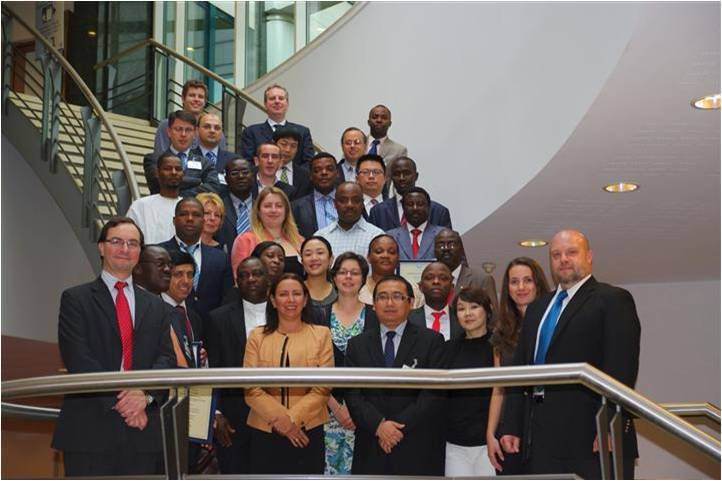
WCO Knowledge Academy 2011After an absence of almost a decade, the WCO convened a Knowledge Academy at its headquarters in Brussels. It took place right after the WCO Open Day for Trade, and ran for eight days, between 28 June and 8 July 2011. Over 50 delegates from both the private sector and WCO Member administrations travelled to Brussels from all parts of the world to attend the Academy. One of these was local systems architect, Anton Eccles (E-Tradex) based in Cape Town.

A total of 11 modules were offered focussing on key areas of WCO work, namely tariff and trade affairs (HS 2012, Rules of Origin, Valuation, Transfer Pricing), and facilitation and enforcement (WCO Data Model, AEO/SAFE, Risk Management). Following classroom activities participants travelled to the Port of Rotterdam for a presentation by Dutch Customs followed by a boat tour. This visit provided participants with the opportunity to see Customs procedures that were discussed and analyzed during the Academy in actual operation.

Thirty-four speakers, trainers and facilitators were involved: 17 were WCO staff members and they were joined by 17 external experts who were invited to address participants in either plenary sessions or during one of the training courses. Speakers included experts from three international organizations: the World Trade Organization (WTO); the International Monetary Fund (IMF); and the Organization for Economic Co-operation and Development (OECD).

In review, Anton maintains “the course was excellent and we had access to some really knowledgeable people. I think it was a good place to get an overall view of where the world of customs and global trade is moving too. Besides the course itself, the opportunity to share some experiences with people from other countries really gives you a good perspective what we do in South Africa”. The next Knowledge Academy is planned for July 2012.

South African visitors also attended the Trade Open Day.  Louise Wiggett (E-Tradex) and Mark Goodger (GMLS) stressed the importance of good partnerships between customs and trade. Both parties cannot operate effectively in their own capacity and it is only by joining forces that international trade can flow in a compliant, operationally effective and cost effective manner. 

To view a selection of photos from the WCO Council Session 2011, click here!

SARS honoured by WCO for World Cup work

SARS receives WCO Award

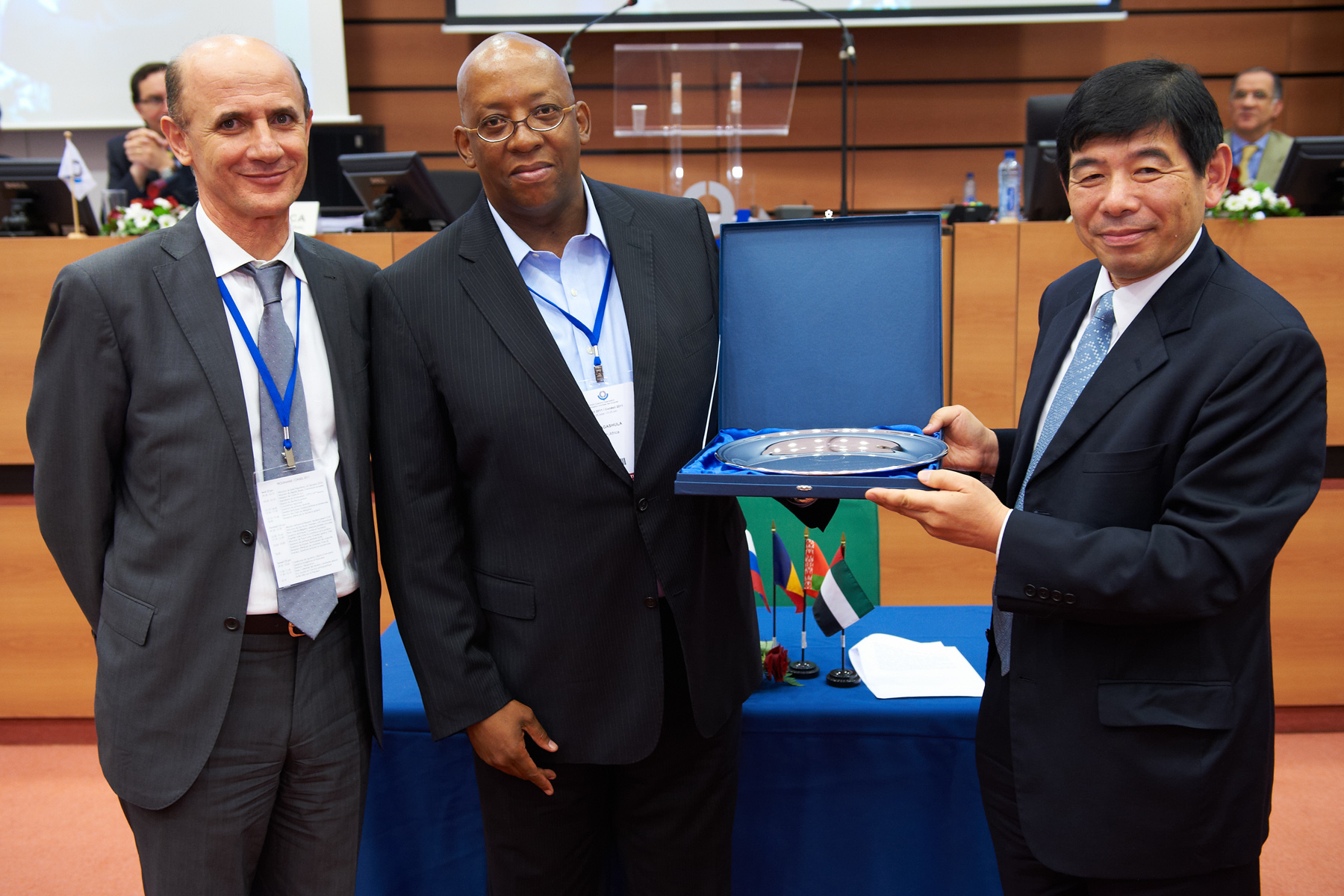
Acting Chairperson of the WCO Council, Zouhair Chorfi (left) with SARS Commissioner Oupa Magashula and WCO Secretary-General Kunio Mikuriya at the award hand-over

A special award was recently presented to SARS by the World Customs Organization (WCO) in recognition of SARS Customs’ commitment in the fight against counterfeiting and piracy, in particular before and during the 2010 FIFA Soccer World Cup. South Africa was flooded with counterfeit products, particularly clothing and footwear, in the run-up to the World Cup, and SARS Customs pulled out all stops to prevent these goods from entering the country. Approximately R350 to R400 million worth of counterfeit goods, including over 1.1 million Bafana Bafana shirts, were confiscated by Customs during this time. The award was handed over to the Commissioner of SARS at a WCO Council meeting in Brussels at the end of June. Source: SARS eNews

For more pictures of the WCO Council Session 2011, click here!

WCO 2011 – Photo Contest Winner

2011 WCO Photo Competition: “In the desert, the next shift arrives” is the title of the winning photo submitted by Algerian Customs ( Photo by Francis Roche, a retired French Customs photographer – Copyright © Algeria Customs). To see a selection of this year’s entries click  HERE!

Algerian Customs

WCO News – Latest edition

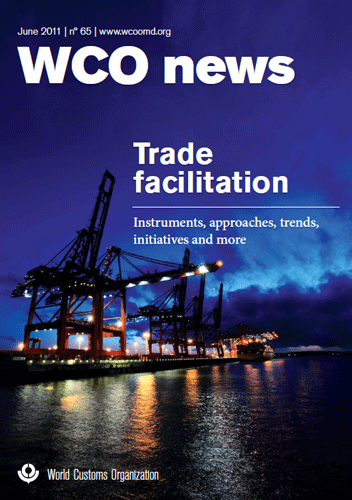
WCO-News-June-2011The June 2011 edition of the WCO News is a bumper 56 pages. You will find several interesting articles relating to the latest developments and initiatives on trade facilitation. A particular article features East Africa’s efforts at facilitation at its land borders. Read also about –

  • Korea’s Client-oriented Logistics Information System which automatically measures the time taken for processing imported cargo at each stage of clearance from arrival at port to release (arrival at port > bonded warehouse > import declaration > permission > release), to diagnose and eliminate bottlenecks in logistics.
  • TradeFIRST, Singapore Customs’ latest initiative to improve trade facilitation through better partnerships with business. TradeFIRST is a single trade facilitation window that integrates the concepts of facilitation, compliance and risk management, and promises to make trade easier, fairer and more secure.
  • Latin America leads the way with AEO implementation, and
  • The concept of multi-layered security.

The Magazine is available in traditional PDF format or as an ebook. www.wcoomd.org

A new Customs Journal

Customs Scientific Journal 1st Edition 2011The Customs Scientific Journal CUSTOMS is a peer-reviewed academic journal that is published electronically, twice a year by the Academy of Customs Service of Ukraine on behalf of the Regional Office for Capacity Building & Regional Training Centers for the European Region of the World Customs Organization. It was launched by the initiative of Regional Office for Capacity Building/Regional Training Centers for the European Region of the World Customs Organization on October 1, 2010.

Founders of this Journal regard it as a mirror of the implementation of Capacity Building Strategy for the Region Europe, as the communication and the coordination mechanism within region to support the establishment of customs-to-customs partnerships as well as to enhance the identification and exchange of modern technologies and best practices within the region.

The journal covers all aspects of the roles and responsibilities of customs with the focus on: Customs & Business Partnership, Professional education in Customs domain, Implementation of the WCO Standards, Best practices, Development of scientific activity. The most prospective are also the following broad sections: Young researchers’ page, Guests (papers by representatives of Customs Administrations/Customs Universities from non-EuR Region of WCO), as well as Reference Material.

Related articles:

Customs and the Academia

Recommended reads for the Customs professional. Visit the WCO for the latest edition of WCO News. The main  articles  include why knowledge is the catalyst for customs excellence; an update on air cargo security and developments coWorld Customs Journalncerning HS2012. 

For readers and customs users requiring more academic related information, you will not be disappointed with the latest bi-annual publication of the World Customs Journal. Some very interesting papers covering AEO certification and revocation; Risk management systems and the use of data mining; Case study of Customs and other Agency role in trade facilitation initiatives in Bangladesh,  and Customs valuation compliance through corporate income tax to name but a few. You will also find the Special Report from the recent PICARD 2010 Conference held in Abu Dhabi, UAE.

Border Management ModernisationThe World Bank Border Management Modernization book  is designed to shed new light on problems related to border clearance processes by Customs and other agencies, processes which are among the most important, and problematic links in the global supply chain. In spite of widespread recognition of the need to improve the efficiency of border management regimes, Customs and other border management agencies in many countries frequently pay lip service to the trade facilitation agenda according to the authors.

The book aims to identify a range of strategies that will help officials meet their traditional control responsibilities while facilitating legitimate trade at the same time. It also provides advice to development professionals and key policy makers about what works, what does not and why. Gerard McLinden, Enrique Fanta, David Widdowson and Tom Doyle edited the new book and the WCO Secretariat contributed chapter 11 on Reform instruments, tools, and best practice approaches. For more information visit the World Bank website  http://publications.worldbank.org.

You may also acquire this publication through local site http://www.take2.co.za

iTunes Resources for Customs and Trade Users

For those of you using Apple iPhones or iPads, you can now purchase 2 useful applications to help ease your decision- making and hopefully your workload too!  A company by the name of Slig Logic has developed these applications which are available on iTunes store at a nominal charge.

HS Code The HS Code Handbook provides the HS nomenclature which is expandable up to 6-digits with full HS descriptions. Although a search function exists, the app still requires the user to have a general understanding of the HS system structure in order to navigate properly.

International Trade DictionaryAnother application called International Trade Dictionary is particularly useful for supply chain operators who need to understand trade terminology better. It includes over 1000 terms and has been updated to reflect compatibility with Incoterms 2010. These are not just gimmicks, but very handy.

WCO Photo Competition 2011

PhotgrapherThis year the World Customs Organization is running the third edition of the Photo Competition in which a Member Customs administration will win an award for a photograph showing its services in line with this year’s theme of Customs in the 21st Century. The 20 best photos will be exhibited in the WCO Headquarters building at the Organization’s 117th/118th Council Sessions in June 2011, and an award will be presented to the representative of the winning Customs administration during the sessions.This is a fantastic chance to really understand the progress made over the years in Customs and also to encourage staff participation and awareness in our field.

The competition is open to all active WCO Member Customs administrations. The objective is to reward a Customs administration which has been able, through a photograph, to portray Customs in the 21st Century. Customs has indeed changed over the years so the idea behind this year’s theme is to reflect upon this evolution.

SARS officers will be notified shortly of the details. The competition closes mid- May 2011.

Harmonised System 2012

HS Tariff booksBelow you will find the link to the WCO-published HS amendments to enable an early start for all IT service providers, importers and compliance practitioners out there. 5 years seems a very short time since the last major revision in 2007. The volume of amendments within, for instance, Chapter 3, for the separate identification of certain species of fish and crustaceans, molluscs and other aquatic invertebrates, is noticeable. The modifications aim at improving the quality and precision of trade data in these commodities.

New subheadings have been created for the separate identification of certain edible vegetables, roots and tubers, fruit and nuts, as well as cereals. HS 2012 also features new subheadings for specific chemicals controlled under the Rotterdam Convention and ozone-depleting substances controlled under the Montreal Protocol.

Other amendments resulted from changes in international trade patterns. These include deleting more than 40 subheadings due to the low volume of trade in specific products, separately identifying certain commodities in either existing or new headings, and reflecting advances in technology where possible. Finally, a number of amendments aim to clarify texts to ensure uniform application of the HS Nomenclature.

Refer to the following link: http://www.wcoomd.org/files/1.%20Public%20files/PDFandDocuments/HarmonizedSystem/HS%20Overview/NG0163B1.pdf

Want to find out more on what HS 2012 means, then join Jeff Bensing with Mercor Consulting and Angela Chamberlain with Integration Point, for a one-hour webcast to discuss:

* What HS chapters are impacted by the WCO changes
* How could this affect an organization’s importing and exporting processes
* What an organization can do now to prepare for the 2012 HS changes
* Best practices to consider for an overall improved classification strategy

This webcast will be held on Thursday, March 29, 2011 at 1:00 p.m. EST. Don’t miss the chance to know the latest changes to he HS to make them work for you! For more information and to register, go to:

https://integrationpoint.webex.com/integrationpoint/onstage/g.php?t=a&d=661096485&SourceID=li