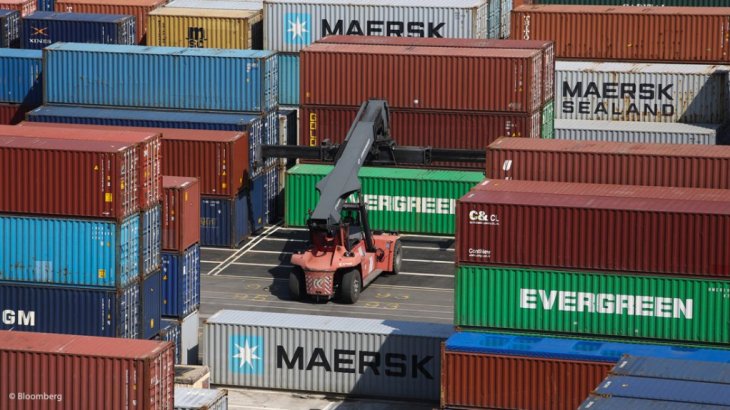
WCO Workshop on Inland Depots in Lao PDR

inland-port-7The World Customs Organization (WCO) organized a National Workshop on Inland Depots under the sponsorship of the Customs Cooperation Fund (CCF)/Japan and the Japan International Cooperation Agency (JICA). It was held from 20 to 22 September 2016 in Savannakhet Province, Lao People’s Democratic Republic.

Twenty six Customs officers from the Lao Customs Administration participated in the workshop, along with guest Customs experts from The Former Yugoslav Republic of Macedonia, Japan and JICA. Mr. Somphit Sengmanivong, Deputy Director General of the Lao Customs Administration, opened the workshop. He highlighted the importance of Inland Depots as a national strategy to secure his country’s economic growth and sought participants’ active participation in the discussions on this topic.

Presently, there is no clear definition of “Inland Depot” and many similar terms, such as Dry Port, Inland Terminal, Free Trade Zone and Special Economic Zones, are used in the international logistics. During the three-day workshop, participants discussed the functions and a possible definition of Inland Depot from a Customs perspective.

AmatiComment – Inland container terminals serve as important hubs or nodes for the distribution and consolidation of imported and export destined cargoes. There are 16 Landlocked countries in Africa, which signifies the importance of hinterland logistics development and its consequential impact on regional trade groupings. Consequentially, it behooves governments to understand and support the logistics supply chain industry in maximizing inland transportation (multi-modal) infrastructures to achieve a common and mutually beneficial economic environment. Furthermore, the more facilitative these arrangements, the better opportunity there is for success and longer-term economic sustainability.

The WCO Secretariat made presentations on international standards for relevant procedures, including Customs warehouses, free zones, Customs transit, inward processing, clearance for home use and temporary admission. Experts from The Former Yugoslav Republic of Macedonia and Japan described their national and regional experience of Customs warehousing, and Customs transit procedures. The JICA expert presented the bonded procedures applied by neighbouring countries to Lao People’s Democratic Republic. Lao Customs administration explained their national system for Inland Depots and a logistics company of Lao PDR shared its expectations on inland depots.

On the last day, participants discussed the challenges and possible solutions to enhance the functional and efficiency of Lao’s Inland Depots. Possible solutions, such as the use of modern information technology, further cooperation with the private sector, clear regulations on relevant procedures, coordinated border management and international cooperation were considered. Source: WCO

Recommended reading

Streamlined export clearance ‘worth billions’

trusted-trader-transparent

A new customs program aimed at bringing Australia into line with other major trading nations could substantially cut costs when exporting to Asia.

The Department of Immigration and Border Protection (DIPB) believes that the benefits to the Australian economy of this streamlined export process could be worth up to $1.5 billion for every one per cent increase in efficiency of transport and logistics supply chains.

The pilot for the Australian Trusted Trader (ATT) program launched this month will eventually allow accredited export businesses to gain streamlined customs and security clearance in countries that have a mutual recognition agreement with Australia.

Similar programs have already been adopted by more than 58 international jurisdictions – including China, India, Japan, Singapore, Taiwan and South Korea – since being introduced by the World Customs Organisation (WCO) in 2005.

Known generally as Authorised Economic Operator (AEO) schemes, they provide a framework of standards for trading partners in recognising each other’s customs and security regimes.

According to the Centre for Customs and Excise Studies (CCES) at Charles Stuart University, the goods of exporters who are accredited to the New Zealand AEO scheme are 3.5 times less likely to be inspected or held up on arrival in the US.

Professor David Widdowson, head of school at CCES, and a leading advocate and advisor on the introduction of the ATT, says that accreditation to an AEO is often an imperative for many international supply chains.

“When exporters send goods overseas and they get held up, there’s basically two ways that countries are dealing with them,” he said. “There those that come from a known secure supply chain – such those where a mutual AEO agreement is in place – and they’re treated as low-risk; and then there’s the rest, which are treated as high-risk.

“Without being part of an AEO or trusted trader agreement, Australian exporters are more often likely to fall into the latter category.

“In some jurisdictions it can be very difficult to be accepted onto an AEO scheme as an importer, so big multinationals often actively look for partners and suppliers who are already accredited to a scheme in their own country – and won’t deal with anyone who isn’t. They don’t want to run the risk of their non-accredited parts of their supply chain compromising their status on the scheme.

“So we can see how AEOs are actually now being used by commerce as a key indicator of the standard that business is looking for in terms of protecting their international supply chain.”

The aims of the ATT include expedited border clearance, reduced or priority inspections and priority access to trade services. The DIPB will also explore the possibilities for duty deferral and streamlined reporting arrangements.

Accredited trusted traders are to be assigned an account manager within the DIPB, as a single point of contact to assist with customs and export issues across all federal departments.

To apply to enter the program, Australian exporters and supply-chain businesses – including freight-forwarders, brokers and logistics firms – first need to obtain a self-assessment questionnaire from DIPB.

The information submitted by the business is then audited by the DIPB to ensure that the necessary security systems and procedures are in place, before accreditation can be given. There is no licence or application fee for the program, and Prof Widdowson expects the process to take “a few weeks if it’s a major company or it could be a few days if it’s a medium-sized company”.

The pilot phase will be completed in this current financial year, and only four companies will be taking part initially: Boeing Aerostructures Australia, Devondale Murray Goulburn, Mondelez Australia and Techwool Trading.

Teresa Conolan, assistant secretary of the Trusted Trader and Industry Branch at the DIPB, said more companies would be included in the pilot as it progresses.

“We’re hoping to have around 40 companies over the 12 months in the pilot, across a range of business sectors, so we can actually test the processes and make sure they are not too burdensome,” she said.

“Over four years we’re expecting around 1500 companies to join the scheme – so it’s certainly not going to cover all business.”

Conolan added that preliminary discussions with some countries were already underway, though negotiations on agreements were unlikely to begin until the ATT was fully launched next July.

She said Australia’s key trading partners would be the priority, but expected the negotiations and implementation of agreements with some of them to take a further year.

The rollout of the pilot program follows years of pressure from the Australian business community to embrace AEO, after initial reluctance by the Australian Customs and Border Protection Service (ACBPS).

Following an article by The Australian Financial Review on March 20, 2013, which flagged Australia’s non-participation, business leaders sponsored a research study, undertaken by the CCES, which found that the scheme could be highly beneficial. Business groups began to lobby the federal government, by which time the ACBPS had reversed its attitude and agreed to consider implementing an Australian scheme.

For more information on the Australian Trusted Trader scheme, visit – trustedtraders@borders.gov.au

Also read:

High Aspirations for planned Tambo Springs Intermodal Hub

containersThe following was penned by a long-time customs acquaintance Aires Nunes da Costa, who has kindly permitted me to post his article titled “Why unpack containers in Durban if you can have containers at your door step in Gauteng within 24 hours?” which first appeared on LinkedIN.
The Tambo Springs initiative involves creating a significantly improved intermodal capability for the movement of freight to and from Gauteng. This is to be achieved by the operational twinning of the inland port with other seaport, inland and cross border locations. The connectivity i.r.o. these twinned locations is achieved via sea, rail, road and air linkages, ideally involving seamless movement of freight between modes.

The Tambo Springs development incorporates a next generation inland port with a state of the art rail terminal facility designed to be developed in phases, with an ultimate capacity of 1 m TEU’S p.a., as well as, a sprinter freight land bridge.

The key elements are as follows:-

Direct Traditional Rail Link to Durban Harbour

The Tambo Springs Terminal will be linked to the Durban Container Terminal which currently handles the bulk of all container freight moving in and out of Gauteng, via an efficient rail service. The fixed rail infrastructure for this link already exists to the Tambo Springs site. This state of the art Terminal facility is designed to significantly increase the rail capacity for container freight to/from Gauteng, while simultaneously reducing real costs and significantly improving levels of service via:

  • a new technology “greenfields” terminal being more efficient;
  • a reduction of congestion issues in and out of the new inland port due to its location;
    improved efficiency of port operations;
  • having the facility serviced by improved rolling stock commissioned by Transnet;
    Sprinter Freight Rail Link to Ngqura Harbour In the Coega IDZ (Port Elizabeth)

In addition to the direct rail link with Durban harbour, the initial phase of this programme involves the twinning of the Coega IDZ and its adjoining Deep Water Container Terminal at the Port of Ngqura with Tambo Springs. This is to be undertaken by means of a Public Private Partnership type structure which utilizes the Transnet capability between the two locations as well as the participation of SARS.

The service level to be achieved for the movement of the freight via this land bridge has a goal of “24 hours” as opposed to the current 3 to 5 days service level achieved at City Deep. This is to be achieved by capitalizing on the creation of high efficiency intermodal activities integrated with the port functions and feeder network.

Truck Freight Movement

The Tambo Springs Inland Port will function as a multimodal logistics gateway serving the Gauteng Catchment area. It therefore provides ease of movement between individual transportation modes in addition to facilitating manufacturing, warehousing and distribution activities.

The operational plan is therefore designed to accommodate long distance (FTL) truck traffic in addition to regional (LTL) freight movement.

The principle truck markets the inland port will attract include:

  • FTL long distance movement of time sensitive freight from other ports or metropolitan areas. This includes both cross docking and stuffing/de-stuffing facilities within the inland port;
  • Rail/truck (intermodal) movement where product utilizing the rail links is transferred to truck in order to each its final destination;
  • LTL truck and Van short distance movement of freight, including a regional metropolitan distribution function.

The next generation inland port therefore capitalizes both on rail and road transportation modes with a focus on increased movement of long distance freight by sprinter rail.

Intermodal Movement

In order to achieve seamless intermodal movement of freight between sea, rail, road and air transport, it is essential to link Tambo Springs with other inland port and hub locations. The creation of such a twinned Inland Port Network provides a means to effectively participate in the Global Supply Chain in a manner which optimizes both existing and new facilities to enhance capacity. Hence, for example, Tambo Springs would be linked to City Deep via rail and road linkages and to other hub locations in Gauteng and elsewhere.

A principle element of this approach is to create an efficient transportation service between all the individual entry/exit ports providing an improved level of service over and above that provided by a traditional network. The key to this is to rethink existing processes with a focus on efficiency savings in terms of the inbound and outbound process flow at Tambo Springs. This has been incorporated into the operational concept and addresses both operational and customs and regulatory efficiency issues as part of the supply chain. Source: Aires Nunes da Costa (Customs & Excise Specialist)

Historic Economic Partnership Agreement between EU and SADC

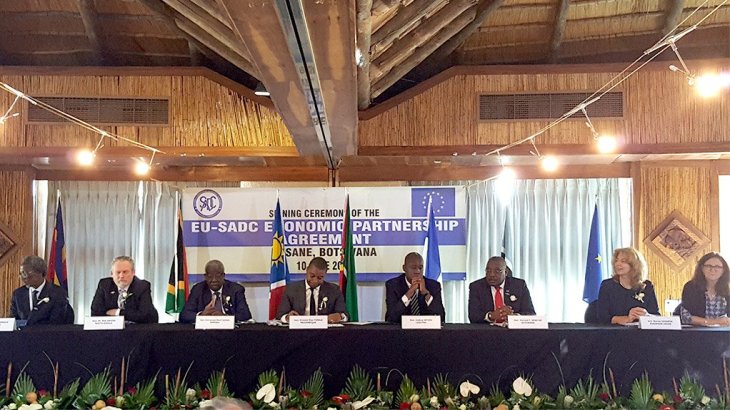
EU SADC EPAThe EU has signed an Economic Partnership Agreement (EPA) on 10 June 2016 with the SADC EPA Group comprising Botswana, Lesotho, Mozambique, Namibia, South Africa and Swaziland. Angola has an option to join the agreement in future.
The other six members of the Southern African Development Community region – the Democratic Republic of the Congo, Madagascar, Malawi, Mauritius, Zambia and Zimbabwe – are negotiating Economic Partnership Agreements with the EU as part of other regional groups, namely Central Africa or Eastern and Southern Africa.

For specific details on the key envisaged benefits of the agreement click here!

The EU-SADC EPA is the first EPA signed between the EU and an African region, with an East African agreement expected to follow in a few months, but with the West African agreement having met fresh resistance. EU Trade Commissioner Cecilia Malmström stressed at the signing ceremony the developmental bias in the agreement, which extended duty- and quota-free access to all SADC EPA members, except South Africa. Africa’s most developed economy has an existing reciprocal trade framework known as the Trade and Development Cooperation Agreement, which came into force in 2000.

South Africa, meanwhile, had secured improved access to the EU market on a range of agricultural products, as well as greater policy space to introduce export taxes. EU statistics show that bilateral trade between South Africa and the EU stood at €44.8-billion in 2015, with the balance tilted in favour of European exports to South Africa, which stood at €25.4-billion. This improved access had been facilitated in large part by South Africa’s concession on so-called geographical indications (GIs) – 252 European names used to identify agricultural products based on the region from which they originate and the specific process used in their production, such as Champagne and Feta cheese. In return, the EU has agreed to recognise over 100 South African GIs, including Rooibos and Honeybush teas, Karoo lamb and various wines.Sources: EU Commission and Engineering News


EU – UCC strengthens the case for AEO

AEO-LogoHere follows an appreciation of AEO within the context of the EU. According to KGH customs consultancy services, being an Authorised Economic Operator (AEO) already entails advantages for companies that have invested in doing the work to gain the AEO certification. With the new Union Customs Code (UCC), companies with an AEO permit will be able to gain additional advantages leading to more predictable and efficient logistics flows as well as an increased competitive edge.
Centralised clearance (being able to clear all customs declarations from one central location in the EU) and self-assessment (self-declaration of custom fees, similar to VAT reporting) are two new possibilities under UCC that will be implemented towards the end of the initial UCC implementation period from 1 May 2016 to 31 December 2020. To take advantage of these, AEO will be a prerequisite. AEO-ready businesses will therefore be well positioned to take advantage of these new possibilities when they become available.

Direct AEO benefits, including fewer physical and document-based controls, pre-notification in case of controls, easier access to customs simplifications and other customs authorisations, as well as access to mutual recognition with third countries, will continue to apply under UCC. The same is true of the soft benefits, such as better cross-functional communication and cooperation, improved customs knowledge and better risk management, which often outweigh the direct benefits as detailed by customs authorities.

With the UCC, AEO becomes a permit (authorisation) and all AEO certifications will have to be reviewed in line with the new UCC guidelines. Much is recognisable from before, but there is an additional competency requirement that is realised through either experience and/or professional qualifications. There is also likely to be more focus on ensuring that AEO applicants have robust routines that reflect their business, and that those routines are known in the business and used on a day-to-day basis.

Ever since the Authorised Economic Operator (AEO) certification was launched in 2008, many companies have been trying to evaluate whether to go for AEO or not. What are the benefits? How long does it take to become certified? Can we do it ourselves or do we need some help? What do we really gain by being AEO? This has sometimes stopped companies taking active steps to get ready for AEO.

Furthermore, some AEO-certified companies have felt that they have been exposed to more controls after AEO certification than before. In other instances the initial certification was fairly easy to achieve, but it then proved much harder to retain at a subsequent audit because routines were not being kept up to date or there had been insufficient internal controls and reviews performed in the business.

Our experience shows that companies that did a thorough job at the time of certification and that also afterwards had a genuine focus on maintaining knowledge, following routines and updating documentation as and when appropriate, have been able to benefit from improved customs management to a greater extent than they first envisaged.

KGH opines there are six situations where being AEO could be beneficial for a company:

  • Freight forwarder serving customers with logistics flows to and from the EU.
  • Strong business links with countries where the EU either has mutual recognition or is likely to have it in the not too distant future.
  • Businesses with many permits that will be reconsidered as part of the transition to UCC, where being AEO may facilitate the reconsideration process for other customs permits.
  • Large customs guarantee, which may be able to be reduced as a result of being an AEO.
  • Interested in centralised clearance and self-assessment that will be introduced towards the end of the UCC implementation period.
  • Interested in raising customs knowledge in a business, in order to better manage risks and be able to take advantage of business opportunities connected with international trade.

Here AEO can also be seen as a seal of quality. Source: kghcustoms.com

WCO Regional Workshop on Coordinated Border Management, Single Window and the Data Model

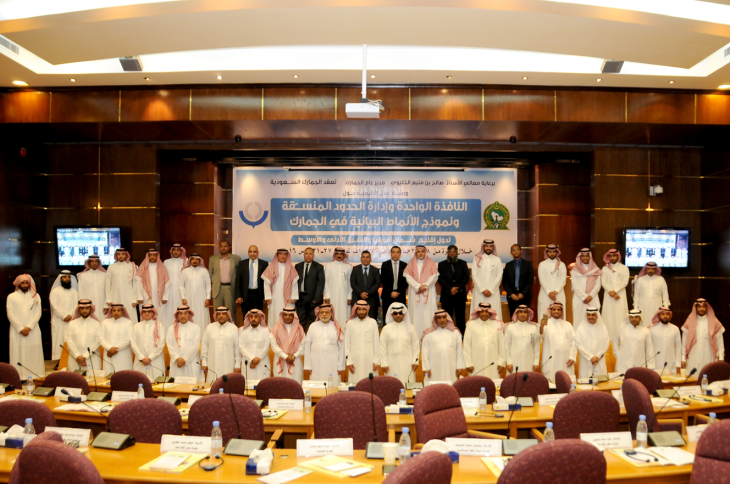
Wco CBM & Single Window WorkshopThe World Customs Organization (WCO), with the financial support of the Customs Administration of Saudi Arabia, successfully held a Regional Workshop on Coordinated Border Management (CBM), Single Window and the WCO Data Model in Riyadh, Saudi Arabia from 27 to 31 March 2016. Thirty seven middle management officials of the Customs Administrations from the MENA Region, namely Saudi Arabia, Egypt, Lebanon, Jordan, Morocco, Tunisia, Sudan, Bahrain and the United Arab Emirates participated in the Workshop. In addition, twelve officials of Customs’ Partner Agencies and two representatives from the private sector attended the event.
Mr. Abdulah AlMogehem, the Deputy Director General of the Customs Administration of Saudi Arabia in his opening remarks highlighted the importance of Single Window development by governments to simplify cross-border trade regulatory procedures which will reduce inefficiency and redundancy of border management processes.

The event highlighted the importance of CBM principles as the basis for the development of a Single Window Environment to enable coordination and cooperation between all relevant government agencies involved in border management. The Workshop also focused on the importance of strategic planning and formal governance structures in establishing a Single Window Environment. SA Revenue Service’s Intikhab Shaik incidentally facilitated the session and discussion on Single Window.

Other important topics included Business Process Re-engineering as well as Data Harmonization, using the WCO Data Model as the inter-operability framework to lay the foundation for CBM and Single Window. Source: WCO

Africa to Get First Automated Container Terminal

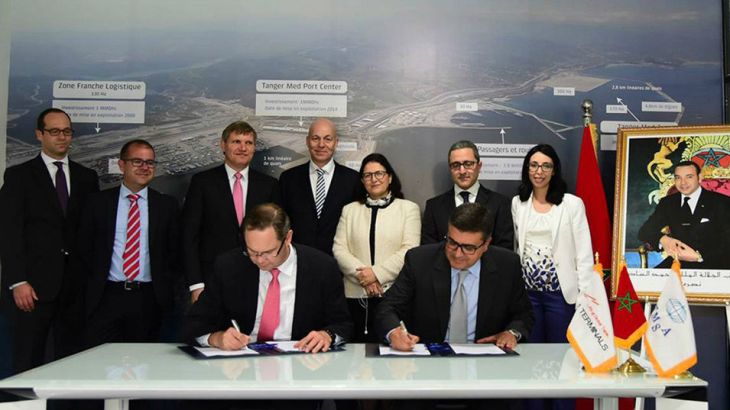
MarEx APM Tangier 2016Maritime Executive reports that the world’s third largest port operator APM Terminals said it will invest 758 million euros ($858.3 million) in a new transhipment terminal in Tangier, Morocco, that will be the first automated terminal in Africa.

APM Terminals, a unit of Denmark’s shipping and oil group A.P. Moller-Maersk, has been named as the operator of the new container transshipment terminal at the Tanger Med 2 port complex. The group already operates the APM Terminals Tangier facility at Tanger Med 1 port, which started operations in July of 2007 and handled 1.7 million TEUs in 2015. The new terminal will have annual capacity of five million TEUs.

Maersk Line, also a part A.P. Moller-Maersk, will be an important customer of the new terminal. The new terminal is scheduled to open in 2019, under the terms of a 30-year concession agreement with the Tanger Med Special Agency (TMSA), which has responsibility for the development and management of the Tanger Med port complex.

The Tanger-Med port complex is strategically located on Africa’s northwest coast near the mouth of the Mediterranean Sea on the Strait of Gibraltar, where the Atlantic Ocean and Mediterranean Sea meet. Tanger-Med is the second-busiest container port on the African continent after Port Said, Egypt. The new APM Terminals MedPort Tangier terminal will increase the port’s total annual throughput capacity to over nine million TEUs.

APM Terminals MedPort Tangier will have up to 2,000 meters of quay length and will feature the technology pioneered at the APM Terminals Maasvlakte II Rotterdam terminal which opened in 2015.

For APM Terminals the Western Mediterranean is an important market. APM Terminals Algeciras, on the Spanish side of the Strait of Gibraltar, operates in tandem with APM Terminals Tangier as an integrated Western Mediterranean transshipment hub. APM Terminals Algeciras handled more than 3.5 million TEUs in 2015, and has completed a major upgrading of its cranes and quay infrastructure to accommodate ultra-large container Ships of 18,000 TEU capacity and above.

The location of the Tangier and Algeciras facilities provide a natural transshipment location for cargoes moving on vessels to and from Africa from Europe and the Far East on the primary East/West shipping route through the Mediterranean Sea; over 200 cargo vessels pass through the Strait of Gibraltar daily on major liner services linking Asia, Europe, the Americas and Africa.

While African ports at present account for only 4.5 percent of global port throughput (including transshipment cargoes), the United Nations 2015 World Population Prospects Report projects that more than half of the world’s population growth between 2015 and 2050 will occur in Africa, with the African population more than doubling from 1.1 billion to 2.4 billion over the next three and a half decades.

Significant investment in port and transportation infrastructure will be required to meet the anticipated needs of the expanding African population and corresponding economic growth.

APM Terminals is the largest port and terminal operating company in Africa by equity-weighted container volume, with 12 facilities operating in 10 countries and three more terminals under construction. Source: Maritime Executive

WCO accredited Customs Modernization Advisors and Mercator Programme Advisors

The WCO, in its effort to assist Members with Strategic Planning activities and WTO TFA implementation held two back to back accreditation workshops in Pretoria, South Africa. These events were held during the week of 1-5 February 2016 and 8-12 February 2016, were funded by the United Kingdom within the framework of the WCO-DFID ESA project and HMRC-WCO-UNCTAD project and organizationally supported by the South African Revenue Service.

24Customs officers from the WCO ESA and WCA regions participated in the workshops and were assessed against the Customs Modernization Advisors (CMAs) and Mercator Programme Advisors (MPAs) required profile through a series of testing exercises, presentations, role-plays, group activities and plenary discussions.

Participants were also required to demonstrate their knowledge and strategic application of core WCO tools and instruments and the WTO Trade Facilitation Agreement along with their potential to facilitate discussions with senior Customs and other officials in a strategic context.

At these two events 15 participants successfully completed step 1 of the accreditation process as they demonstrated their potential to become CMA’s/MPA’s during the range of workshop activities.

From the five WCO CMA/MPA accreditation events held to date a total of 41 participants have been assessed as being suitable to become CMAs and MPAs under step 1 of the accreditation process and will be invited to participate in TFA implementation support missions under the Mercator Programme in order to complete the accreditation process. It is expected that the successful candidates are made available by their Customs administrations for further support missions in the future. Source: WCO

WCO facilitates Data Model training for SARS

WCO Data Model Workshop, Pretoria, South Africa, Dec. 2015

SARS’ EDI and Customs Business Systems representatives with WCO Data Model facilitators Mr. Giandeo Mungroo (2nd from the left) and Ms. Sue Probert (2nd from the right) [Photo – SARS]

Officials of the South African Revenue Service (SARS) last week attended a WCO workshop on the Data Model facilitated by Ms. Sue Probert and Mr. Giandeo Mungroo. The event, held in Pretoria, South Africa was sponsored by the CCF of China as part of the WCO’s Capacity Building endeavours to promote the adoption and use of customs standards and best practice amongst it’s  member states.

The workshop was requested by SARS ahead of new technical and systems developments and requirements informed by SARS’ new Customs Control and Duty Acts. Moreover, there are also political ambition to institute a Border Management Agency for the Republic of South Africa. All of this requires that SARS Customs has a robust electronic tool to assist the organisation in mapping national data requirements according to specific needs.

Besides the use of a value added Data Model tool – GEFEG, it is imperative for the organisation to develop capacity in the knowledge and understanding of the WCO Data Model. SARS has successfully EDI (Electronic Data Interchange) for the last 15 years with various local supply chain trading partners and government agencies. Over the last few years SARS has been actively pursuing and promoting IT connectivity with regional trading partners with the express purpose to extend the benefits of eCommerce across borders.

GEFEG.FX software is used to model data formats and develop implementation guidelines for data interchange standards such as UN/EDIFACT. It is a software tool that brings together modelling, XML schema development, and editing of classic EDI standards under a unified user interface, and supports the development of multilingual implementation guidelines.

Version 3 of the WCO Data Model brought about a distinct shift towards an ‘all-of-government’ approach at international borders with the introduction of the GOVCBR (Government Cross Border Regulatory) message. The message and underlying data requirements facilitate the exchange of customs and other government regulatory information to support a Single Window environment.

WCO Data Model not only includes data sets for different customs procedures but also information needed by other Cross-border Regulatory Agencies for the cross-border release and clearance at the border. The WCO Data Model supports the implementation of a Single Window as it allows the reporting of information to all government agency through the unique way it organizes regulatory information. This instrument is already 10 years old and is seeing increased use by WCO members.

Amongst the benefits derived from the workshop, SARS staff acquired the following competencies that will not only aid their work but business user support as well –

  • Competence in operating the tool to build a source control collaborative environment to support national and regional harmonization;
  • Competence to build a base to conduct national/ regional data harmonization based on the WCO Data Model to support national Single Window implementation as well as Regional Integration;
  • Competence to build systems/ electronic interfaces between Customs and its partner government agencies including a Border Management Agency; and
  • Provide needed competence to develop, maintain and publish national and regional information packages based on the WCO Data Model.

SA – Hub for computerised Regional Integration?

AfricaFrom time to time it is nice to reflect on a good news story within the local customs and logistics industry. Freight & Trade Weekly’s (2015.11.06, page 4) article – “SA will be base for development of single customs platform” provides such a basis for reflection. The article reports on the recent merger of freight industry IT service providers Compu-Clearing and Core Freight and their plans to establish a robust and agile IT solution for trade on the African sub-continent.
In recent years local software development companies have facilitated most of the IT changes emerging from the Customs Modernisation Programme. Service Providers also known as computer bureaus have been in existence as far back as the early 1980’s when Customs introduced its first automated system ‘CAPE’. They have followed and influenced Customs developments that have resulted in the modern computerised and electronic communication platforms we have today. For those who do not know there are today at least 20 such service providers bringing a variety of software solutions to the market. Several of these provide a whole lot more than just customs software, offering solutions for warehousing, logistics and more. As the FTW article suggests, ongoing demands by trade customers and the ever-evolving technology space means that these software solutions will offer even greater customization, functionality, integration and ease of use for customers.

What is also clear is that these companies are no longer pure software development houses. While compliance with Customs law applies to specific parties required to registered and/or licensed for Customs purposes, the terrain on which the software company plays has become vital to enable these licensees or registrants the ‘ability to comply’ within the modern digital environment. This means that Service Providers need to have more than just IT skills, most importantly a better understanding of the laws affecting their customers – the importers, exporters, Customs brokers, freight forwarders, warehouse operators, etc.

Under the new Customs Control Act, for instance, the sheer level of compliance – subject to punitive measures in the fullness of time – will compel Service Providers to have a keen understanding of both the ‘letter of the law’ as well as the ability to translate this into user-friendly solutions that will provide comfort to their customers. Comfort to the extent that Customs registrants and licensees will have confidence that their preferred software solutions not only provide the tools for trading, but also the means for compliance of the law. Then, there is also the matter of scalability of these solutions to keep pace with ongoing local, regional and global supply chain demands.

The recent Customs Modernisation Programme realised significant technological advances with associated benefits for both SARS and trade alike. For the customs and shipping industry quantification of these benefits probably lies more in ‘improved convenience’ and ‘speed’ of the customer’s interaction with SARS than cost-savings itself. My next installment on this subject will consider the question of cross-border trade and how modern customs systems can influence and lead to increased regional trade.

South Africa – WCO ESA Regional Workshop on TFA implementation

ESA_Regional-WS_South-AfricaThe WCO Regional Workshop on Strategic Initiatives for Trade Facilitation and the Implementation of the WTO Trade Facilitation Agreement (TFA) – Mercator Programme – for the WCO East and Southern Africa (ESA) region was held from 15 to 17 September 2015 in Johannesburg, South Africa. It was hosted by the South African Revenue Service (SARS) representing the WCO Vice Chair of the ESA region, and financially supported by the United Kingdom Department for International Development (UK DFID) and the Ministry for Foreign Affairs of Finland. More than 100 participants from 21 ESA Members (Customs, Trade Ministries/equivalent Ministries), the WTO and other international organizations, development partners and the private sector participated in the event.

The Workshop was opened by the Commissioner of SARS, Mr. Thomas Moyane. He expressed his view that the WCO Mercator Programme created significant conditions for contributing to intra-African as well as international trade facilitation benefits. As Vice Chair of the ESA region, he hoped that the Workshop could recommend immediate actions for the region.

The Workshop raised a lot of interest and active discussions from a variety of well-prepared and informative presentations, including the role of the WCO in TFA implementation;  TFA regulations such as Article 23.2 on National Committees on Trade Facilitation (NCTF) and specific national and (sub-)regional examples of implementation approaches; experiences of Trade Ministries and several partner institutions active in the region; and discussions on further approaches to Capacity Building and TFA implementation, including in cooperation with Development Partners.

The region agreed on next steps forward, including on a regional focus on the establishment and maintenance of NCTFs (for instance further provision of replies to the respective WCO survey; identification of the situation within ESA Members); reporting the outcomes of the Workshop to the ESA Regional Steering Committee; encouragement of ESA Members who are not yet Contracting Parties to the Revised Kyoto Convention to accede to it as soon as possible (and/or to identify related Capacity Building needs) – as one concrete way to also support TFA implementation; and responsibility of the ROCB and the Vice Chair to continue collecting and publishing information on ongoing Capacity Building projects and work of partner organizations such as SADC, COMESA, SACU and UNCTAD especially in the TF(A) area in the region – while encouraging Members and partner organizations to share such information.

The Workshop was successfully concluded with positive feedback from Members, partner organizations and development partners. A summary document on the discussions held during the Workshop is currently under finalization by the Vice Chair’s office and the ROCB and will be circulated to all participants of the Workshop in due course. Source: WCO

TFA – Africa is on the move! Why not go faster?

WTO LogoThe following article is published with the kind permission of the author, Tapia Naula who is Principal Transport Economist at African Development Bank, based in the Ivory Coast. He is an international project manager and transport economist with experience in logistics business, research and trade facilitation. This article is a must for anyone associated with or working on the TFA on the African sub-continent, and a bit of a wake up call to those countries who have as yet done little or nothing to progress their participation.
In the World TFA Cup Asia is leading Africa 72 – 35. The first scores of the WTO Trade Facilitation Agreement are out as member countries submit their Category A notifications. Initial results of the African first series are somewhat unfulfilling. Some teams are playing defensive even if attacking tactic is the only way to win.

In December 2013, WTO members concluded negotiations on a Trade Facilitation Agreement (TFA) at the Bali Ministerial Conference, as part of a wider “Bali Package”. Among trade facilitation practitioners the Agreement was received with great enthusiasm: finally there was a legal instrument, which is concrete enough to make a difference! TFA will enter into force once two-thirds of members have completed their domestic ratification process. Section I contains substantive provisions in 12 main Articles. The members are required to categorize and notify each provision of the Agreement as either A, B or C Category. The A Category commits a country to implement the provision upon entry into force of the TFA, or one year after for LDC’s. For B-Category there will be a transitional period. C-Category provisions are allowed a transitional period, technical assistance and capacity building.

First, let it be said loud and clear: the WTO TFA is an excellent collection of modern trade and transport facilitation instruments in one folder. In developing countries its implementation would mean reforms that would save time, money and efforts for regular business people and consumers. These reforms may be painful but the countries that can do it, will be the future winners of their regional competition and they will be the ones that will most benefit from joining the global value chains. TFA is the best vehicle for poverty reduction invented so far and that is why it is so important.

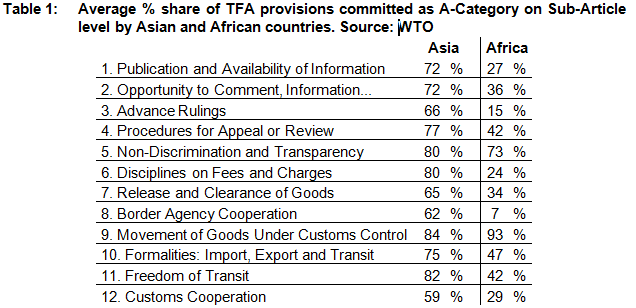
In August, 2015, 14 African countries and 25 Asian countries had submitted notifications for category A provisions. Asian countries had “accepted” 72 % of all the provisions as A-Category commitments on average where the respective share of the African countries is only 35 %. On Article-level African countries lag behind on every Article except one (Table 1).

In addition to the low overall share of category A-notifications, the African notifications generally look like “random picks” of sub-paragraphs, compared to many Asian members that have commonly chosen the strategy of basically accepting the whole Agreement and making exceptions for certain few paragraphs according to their particular needs.

Were African governments well-informed of the impact and substance of each paragraph – or are they just being cautious, perhaps trying to delay the final commitment? The patterns between African and Asian countries are in any case different.

Table 1

TFA includes also “low hanging fruit” – sections that require little technical expertise to be implemented. At least some of these should have been easy for member countries to accept. “Publication and Availability of Information” is one of those sections. Access to information through internet is routine and affordable. It should not require transition periods or particular technical assistance. Donors are even competing to assist governments with such low cost and high-return activities. Still, less than one third of the African Governments notified this Article.

Here are some other peculiar findings:

  • Out of 14 African countries only Morocco accepted “Border Agency Cooperation” as A –Category provision. Three of the others countries that did not notify it are landlocked countries;
  • Only four out of 14 African countries had fully notified “Freedom of Transit.” Transit challenges in Africa are probably the single most significant source of inefficiency in trade logistics;
  • One of the foundations of modern customs management is the introduction of Risk Management. Only 3 out of 14 African countries had notified this provision;
  • Only Morocco notified Trade Facilitation Measures for Authorized Economic Operators (AEO), which gives certain privileges to traders and transport operators, who show high level of compliance to regulations. One wonders why Kenya, Uganda, Rwanda, Burundi and Tanzania did not notify it as we know that an AEO program is being piloted in the East African Community;
  • Only Senegal notified the sub-Article on Single Window, which is probably the most important one of the whole Agreement. Senegal perhaps deserves this honor – being the first truly African-based single window country – and also representing the good practice of SW management. Yet, according to the African Alliance for e-Commerce, currently there are at least 16 other single windows either already operational or under development in Africa. Why weren’t these developments recognized?

Despite the above “peculiarities” the African situation is fortunately nowhere near as somber as the A-Category notifications indicate. There are plenty of trade and transport facilitation initiatives under implementation – and Africa is indeed “on the Move.” We should on one hand side make sure that the valuable TFA Agreement is not becoming a separate formal process alongside the practical actions on the ground, but rather a framework for coaching governments in climbing up the stairs toward greater competitiveness. On the other hand, the countries should not ignore the existing achievements. A lot has been achieved in Africa in recent years and this process should go on and gain speed. Some sub-regions, which have been less successful in this field need  benchmarks, encouraging and coaching. This is where African and international organizations can play a role.

Although the direct cost of TFA implementation is relatively low, the indirect cost may be extremely high. The indirect cost concerns existing structures, which generate income for organizations and individuals, who often greatly benefit from the status quo. Some governments have entered into concessions outsourcing critical government functions such as pre-customs clearance operations and processing and submissions of declarations to customs. Western firms have efficiently seized the opportunity and negotiated deals, which guarantee profits for in many cases for decades to come. Single Windows in certain countries are good examples for these. In an unnamed Southern African country for example, humanitarian aid is exempt from taxes and duties in import. If however a UN agency for example imports a container of pharmaceuticals worth five million USD, it will have to pay for a Single Window fee of 42,500 USD! Such Ad Valorem fee arrangements are against the TFA. Such concessions are often built inside structures, which profit from the concessions and in exchange – protects its operations and continuity. This is why they are difficult to tackle. This is an example of the problematics that African policy makers must deal with when taking a position in committing in TFA provisions. It may be a whole lot more complicated than what it looks like.

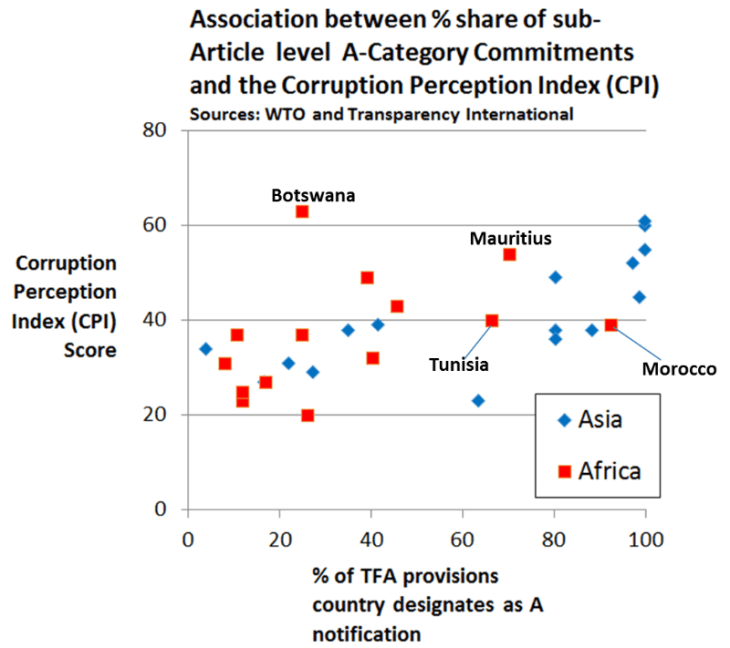
Association between % Share of Sub-Article Level A-Category Commitments and the Corruption Perception Index Score (CPI). Sources: WTO and transparency International.

The diagram above shows the association of share of the provisions that have been covered by A-Category notifications and the Corruption Perception Index (CPI) score of the countries. For African countries the correlation is moderate (correlation co-efficient: 0.42) but for Asian countries the association is strong (correlation co-efficient: 0.73). The association of the two variables is understandable: the less corruption a country has (the higher the CPI rank is), the more reforms the government is in liberty to conduct (the higher coverage of TFA as A-category Notifications).

We need to better understand the underlying reasons why policymakers cannot let reforms take off. Traditions, corruption and outdated structures are usually the biggest obstacles. These cannot be overcome by merely providing short-term technical assistance and bench-marking the world best practices but only strong political leadership can make the change. Developing partners should raise this topic on the highest political level and “live together” through the reforms with the counterparts.

The Northern Corridor (Kenya, Uganda, Rwanda) provides an encouraging example how multiple reforms can be carried out in very short time. Only two years ago it took staggering 27 days to transport a container from Mombasa Port and deliver it in Kigali, Rwanda. Today it takes only seven days. The improvement was enabled by series of reforms, which were championed by the Heads of States of the Corridor member countries. The example proves that major improvements can indeed be achieved in very short time. On the other hand, even with the most sophisticated instruments, reforms will not succeed if there the high-level ownership is not there. Author: Tapio Naula

Namibia Launches Trade Portal

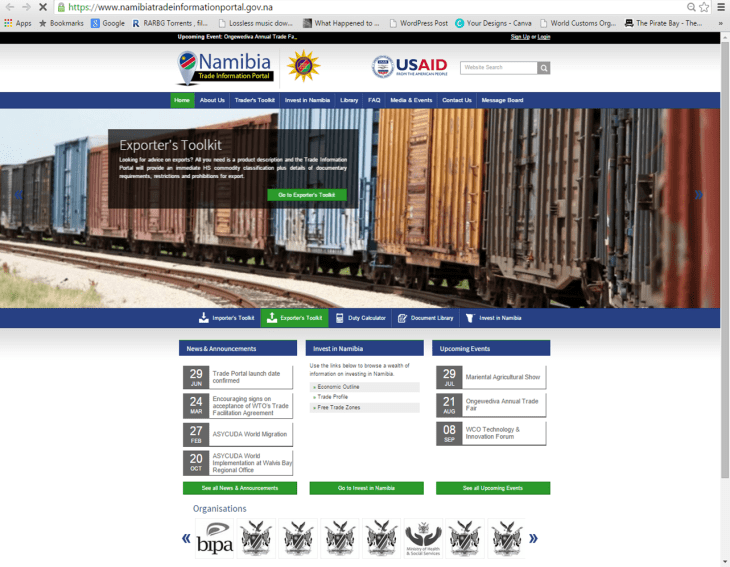
Namibian Trade PortalThe Namibia’s Ministry of Finance and Namibia’s Customs & Excise, in partnership with the U.S. government has recently launched a powerful new tool to increase and facilitate cross-border trade. The “Namibia Trade Information Portal” is a web-based platform that provides an authoritative “one-stop shop” of readily accessible trade, customs and compliance information. It is designed to significantly reduce the time and effort required for local and international traders to access current information and documentation required for doing business. The portal is the culmination of many years of collaboration between government of Namibia agencies and ministries and the U.S. government, working through the U.S. Agency for International Development (USAID) Southern Africa Trade Hub Project.

In his keynote address, Minister of Finance Calle Schlettwein said that the Trade Portal reflects the commitment of the Namibian government to build a “robust, knowledge-based society” through various modernization projects. However, he cautioned that the portal must be kept up-to-date if it is to be sustainable and relevant.

“For this reason, I strongly appeal to my fellow and counterpart ministers to designate focal points in their ministries who shall administer and avail timely updates, preferably online transmission of such information to our designated team in the Ministry of Finance who will, in turn, keep the portal updated,” Schlettwein said.

According to Namibia Trade Information Portal’s project manager, Melannie Tjijenda, the portal will save people time when they enquire about trade-related matters, so they will no longer be sent ‘from office to office.’

“International traders will now know how they can invest in Namibia,” she said, adding that this will save money on expenses like phone calls.

Tjijenda said the fact that most government websites are not regularly updated will not be the case with this portal. “When something changes, we will update it” she said, further pointing out that they have a team of content managers who will be checking and updating the content on regular basis. Source: The Namibian/USAID

OECD estimates WTO TFA could to cut trade cost by 17.5% on customs rules

cut-red-tape“Simplifying trade documentation”; “automating border procedures”; “streamlining border controls” – all cliche’s of the modern customs and international trade scene, but just how attainable are they? Beyond the pleasantries, and fanfare of ribbon cutting ceremonies, very little seems to happen at the cold face. Sovereign states are inward-looking and jealously wish to preserve their ‘sovereign domains’.

A major World Trade Organization deal on streamlining global customs rules could cut international trade costs by between 12.5 percent and 17.5 percent, a study by the Organization for Economic Co-Operation and Development showed on Thursday.

A deal between India and the United States on the Trade Facilitation Agreement last year, which needs to be backed by all 160 WTO members, had resurrected hopes that the trade body could push through such reforms to cut red tape.

“There are very practical measures that we’ve identified that offer significant benefits,” Ken Ash, the OECD director for Trade and Agriculture, told media.

“Things like simplifying the required trade documentation. Automating border procedures, or streamlining border controls.”
Economists say the Trade Facilitation Agreement could save $1 trillion. Ash declined to endorse this figure, only saying the Paris-based body expected each 1 percent reduction in worldwide trade costs to bring $40 billion in savings.

Australia was to formally accept the agreement later on Thursday, Steven Ciobo, parliamentary secretary to the minister of foreign affairs, said at the news briefing in Paris, making Australia the seventh WTO member to adopt the agreement.

WTO launches dedicated website for new Trade Facilitation Agreement Facility

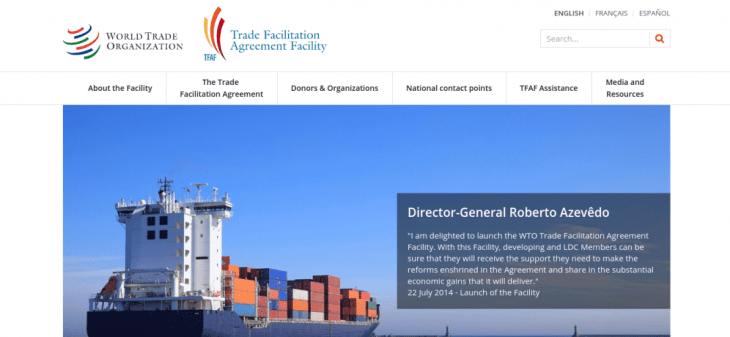
new-Trade-Facilitation-Agreement-Facility-siteThe WTO has launched a new website which will serve as a focal point for members, donors, and others seeking information on the new Trade Facilitation Agreement Facility (TFAF). The TFAF was created at the request of developing country and least-developed country (LDC) members to help ensure that they receive the assistance needed to reap the full benefits of the Trade Facilitation Agreement and to support the ultimate goal of full implementation of the new Agreement by all members. The TFAF will support these countries in assessing their specific needs and identifying possible development partners to help them meet those needs through a diverse number of activities.

The Facility was formally launched on 22 July 2014 by WTO Director-General Roberto Azevêdo and became operational on 27 November 2014. The website can be accessed here! To benefit from this, developing and LDC members must notify the WTO which provisions they will implement when the Agreement enters into force or, in the case of LDCs, within one year after entry into force (Category A commitments); which provisions they will implement after a transitional period following the entry into force of the Agreement (Category B); and which provisions they will implement on a date after a transitional period following the entry into force of the Agreement and that require the acquisition of assistance and support for capacity building (Category C).

The aim of the TFAF is to help ensure that this assistance is provided to all those needing it. The website provides background on the Agreement and the TFAF, information on programmes that support implementation of the Agreement, as well as information on national contact points for trade facilitation in developing and LDC members.

The website also provides information on TFAF support related to the preparation of Category A, B and C commitments, assistance and support for capacity-building, and applications for TFAF grants where no other funding sources are available to developing and LDC countries to meet their implementation needs. The website is a “work in progress” and will be continuously updated to provide useful information for WTO members. Source: WTO