Container Weighing – industry solution on the horizon

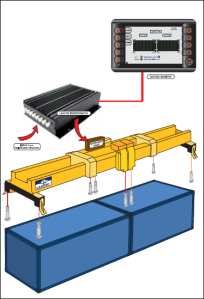
Click Picture for full report at porttechnology.org [Port Technology International – Container weighing device]

The International Maritime Organization (IMO) is expected to make the weighing of sea containers mandatory. The purpose is to make the entire container supply chain safer. This regulation is expected to be issued through the International Convention for the Safety of Life at Sea (SOLAS Convention) as a result of a number of accidents involving container losses and container stack collapses. The existing SOLAS regulation already obliges shippers to declare the correct container weights, but this is not always done. The new regulation is likely to require specifically that the container is actually weighed or calculated by reference to the contents, packing and securing materials and the tare weight of the container itself. Importantly, however, the regulation is anticipated to forbid the loading of containers unless the verified gross mass is available to the terminal and the ship’s master.

Practically speaking this means that the shipping lines may require terminals to verify container weights prior to being loaded onto their ships. There will, however, be a cost to it which the shipping lines are likely to pass on to their shippers. But besides added safety, there is another important aspect: optimising ship stowage which should reduce fuel consumption for the shipping lines. A ship is more stable at sea and consumes less fuel when the center of gravity is low and if the cargo is optimally distributed. Therefore, it is in the interest of the shipping lines to know the exact weights. Arguably, there are multiple aspects which determine fuel consumption of a ship, and some may be more important than stowage, but this is nevertheless a factor.

Determining container weights and related costs

First of all, to weigh a container and to use the load information to update the stowage plan, containers need to be weighed preferably at the completion of packing. Clearly, weighing export containers needs to be done sufficiently in advance for the stowage plan to be optimised. If the actual weight is not determined at the completion of packing, the port is in a prime position to provide this service or, indeed, to verify the documented weight. For containers that arrive at the port by road, rail or river an obvious ‘check point’ is during the inward process. Weighing with the quay side crane is too late, since the container position on the ship is determined well before loading.

Weights of transshipped containers should be verified at the original port of loading, but there will always be situations where this has not been physically possible. In that event, it can be said with certainty that every container, whether exported or transshipped, will pass through the stacking yard. It is therefore argued that equipping the stacking cranes with weighing systems best caters for all circumstances. Operators in those countries that require imported containers to be weighed may consider weighing with quay side cranes as well.

What does it cost to weigh a container? Let’s base the calculation on the capacity of a quay side crane which can typically load 100,000 twenty-foot equivalent unit (TEU) per year. Let’s also assume there are three rubber-tyred gantry cranes (RTG) or rail-mounted gantry cranes (RMGs) required per quay side crane. Let’s further assume a weighing system costs US$20,000 per stacking crane and it is amortised over three years. The cost per year to weigh 100,000 TEU is therefore US$0,20 per TEU. In addition to the capital expenditure for the weighing equipment, the terminal will incur some integration costs plus ongoing maintenance and administration costs, so let’s double this amount to US$0,40 per TEU. Weighing by the stacking cranes during the handling of the containers is also more economical than weighing with weigh bridges which very often involve manual intervention, when trucks are carrying two 20 foot containers which need to be individually weighed. Weighing in the stacking yard is therefore the fastest, most economical and non-disruptive way to the operation. Some terminals have calculated that they could offer their weighing services for US$1 per TEU and earn a profit with it. Continue reading →
Nigerian Inland Port, Kano to Begin Operations This Year

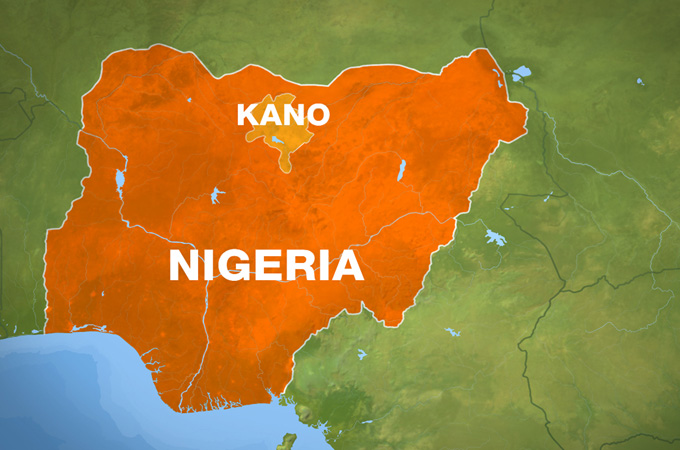
201215124949311580_20Kano Inland Container Port is scheduled to commence operations by the end of this year, Chairman Governing Board Nigerian Shippers Council, Lieutenant General Salihu Ibrahim (Rtd) has said.

According to him, all gray areas that cause the delay in the processing and documentation of Kano port which affects the commencement of operations has been resolved.

Speaking during an interactive dinner session organized by Nigerian Shippers Council, North West zone, the chairman stressed that the council is all out to ease some of the transaction difficulties faced by shippers in Nigeria. He added that commencing operation at the inland ports will absolutely ensure reduction of about 90% in the expenses incurred during shipments of goods. According to him, all things being equal, Kano inland port is hoped to be fully operational at the end of 2013. Source: Daily Trust (Nigeria)

Mega ships: positive asset or terminals’ worst nightmare?

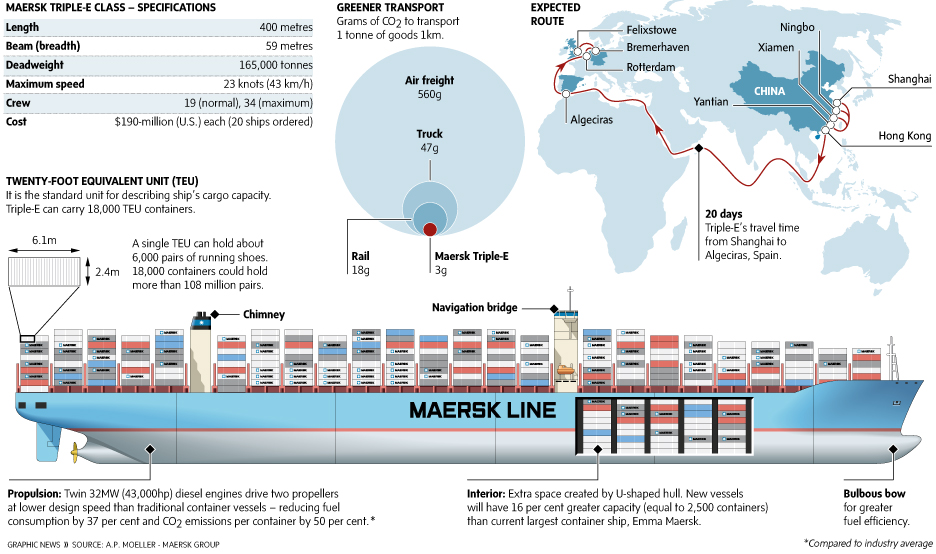
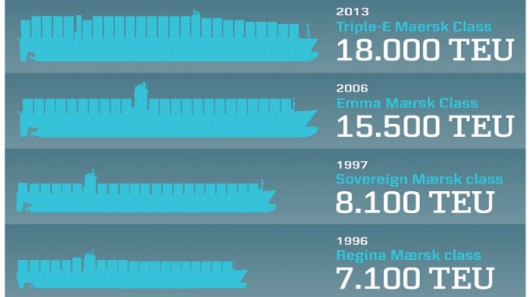
triple-e-maersk-worlds-largest-shipA Financial Times article reported Maersk’s Triple E Class (18,000 TEU) to be 26 percent more cost efficient than the current E class (15,000 TEU). – Wright, R (2011), Financial Times. ‘Big Ships: Container lines reach for scale’. Recent research into supply chain costs indicates that this is not obvious for the entire supply chain – Streng, M. (2012). Slow steaming: an economic assessment of lowering sailing speeds on a supply chain level’, Master Thesis Urban, Port and Transport Economics, Erasmus University Rotterdam.

The capital cost per TEU moved has increased even considering the increase in slot size of newer larger vessels. Due to the increase in transportation duration, the capital costs and insurance of goods transported have gone up. Further cost increase could be accounted for in the increase in time to market. Fast moving goods (such as consumer electronics) that need longer to get from the world’s production centres to the markets is also a cost. Shipping lines are demanding ever shorter port stays in order to make the economies of scale work. The bigger the ship, the greater the cost of hours lost in port, and an increased port stay is a diseconomy of scale.  Port Technology have published the following article which should be useful for shippers, freight forwarders, port planners in better understanding the economics of international shipping and logistics – Mega ships: positive asset or terminals’ worst nightmare?.

Triple E Class Specifications - (AP Moeller/MAERSK Group)

Triple E Class Specifications – (AP Moeller/MAERSK Group) [Click to Enlarge]

Is it a TEU or a FEU?

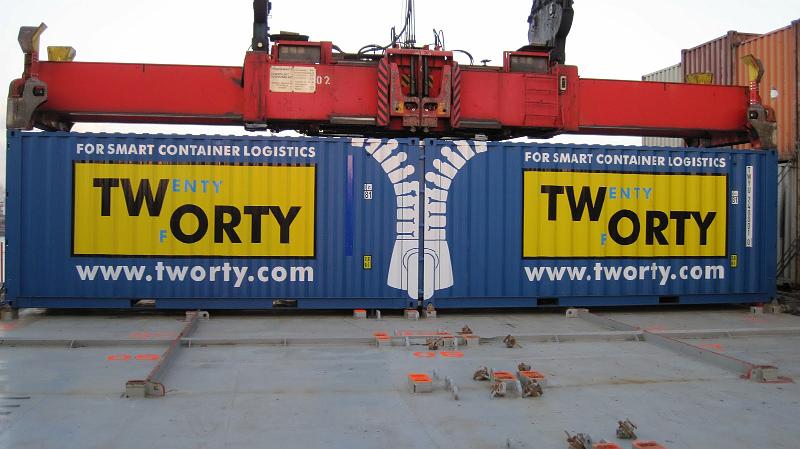
Thinking outside the box - Tworty’s unit has doors at each end, the second opening to and locked from the inside.

Thinking outside the box – Tworty’s unit has doors at each end, the second opening to and locked from the inside.

An innovative new ISO container design that allows a unit to be used either as a 40 ft or 20 ft box has completed its maiden voyage.

The Tworty Box, two 20 ft containers that can be linked together to form a single 40 ft unit – “twenty + forty = tworty” – competed its maiden voyage from Hamburg to Montreal on the containership OOCL Montreal.

Two containers joined together as a single unit were stuffed with 20 tonnes of breakbulk cargo, mainly car parts and granulate, for Canadian consignees.

Developer Tworty Box said the container was designed to reduce the cost of repositioning empties, caused by imbalances between supply and demand for 20 ft and 40 ft containers. As the company humourously explains on its website, 1 x tworty = 20ft, 2 x tworty = 40ft.

It has doors at each end; the second door opens to the inside and can only be locked from the inside. This door can be fixed to the container ceiling and, with the use of its special bonding elements, another Tworty Box can be joined up, thereby creating a 40 ft unit of full value and standard doors at both ends.

Tworty Box prototypes have received full International Convention for Safe Containers certification for single and for coupled operation. Source: Tworty.com and Lloyds.


MOL Comfort – off to Davey Jone’s Locker!

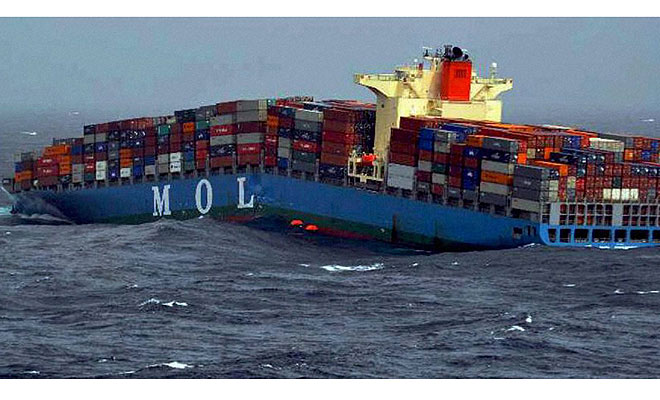
Ironically, nature always has the last say. Mitsui OSK Lines has confirmed that the fore section of MOL Comfort has sunk in the Indian Ocean despite salvage and coastguard teams battling for seven days to contain a blaze that broke out on board after the vessel split in heavy seas.

MOL Comfort sank in high seas near 19º56’N and 065º25’E in waters around 3,000 metres deep at about 0400 hrs Japan standard time on 11 July, MOL said in a statement .

Mitsui has reported this fact to the flag state of Bahamas, Indian authorities and parties concerned, and will keep the salvage team at the scene to monitor if there is any oil leakage and floating containers. The salvage team comprises Smit Salvage, which was overseeing the operation from Singapore, and Nippon Salvage.

The Indian Coast Guard sent a patrol vessel with firefighting capability two days go to help put out the fire.

The 2008-built, 8,110 TEU ship ruptured on 17 June off the coast of Yemen while en route from Singapore to Jeddah with some 4,372 boxes on board. It split in two the following morning and the stern section sank after drifting for 10 days.

Tugs reached the forward section, which still had much cargo intact, on 24 June, which slipped free from its tow wire on 1 July, but was reattached on 3 July. Adverse weather has hampered the salvage operation since it began. Source: Mitsui. Pictures courtesy gCaptain.com

As Maersk Line’s Triple E, The World’s Largest Cargo Ship, Preps For Maiden Voyage, Many Ports Can’t Handle It

5_triple-eThe world’s largest cargo ship is leaving its shipyard this week to prepare for its July 15 maiden voyage, but much of its cargo space will be under-utilized as many ports don’t have the ability unload the 20-story-high container stacks the vessel can lug between Asia and Europe.

The ship, a $185-million, 1,300-foot long behemoth with a capacity of 18,000 containers, is a gamble for the vessel’s owner, Danish group A.P. Møller-Maersk A/S. Freight, which has been so battered by the recent global economic downturn that at one point it had hundreds of cargo ships sitting idle in Singapore. The ship is so big, it’s essentially leap-frogged over many ports’ ability to off-load it when it’s at full capacity.

“We will operate it as a smaller ship for the first few months while ports upgrade their cranes,” Lars Jensen, head of Maersk Line’s Asia-Europe operations, told Dow Jones Newswires.

The problem is that ports lack gantries — those giant square-shaped cranes that slide over loaded cargo ships and pick up or drop off loaded containers — that can accommodate a fully loaded Triple E. So before Maersk can utilize the ship’s full capacity at major ports, many of those ports have to invest in upgrading, a process that could take years.

Dow Jones says 16 ports on the ship’s route are certified to handle it, but “several” lack the adequate crane ability to handle it when it’s fully loaded. So for now, the ship will have to haul less, which eats into the company’s potential profit. It will embark on its first journey on July 15 from Busan, South Korea, to Europe, after a stop at Singapore. Source: Seanews.com and International Business Times


TT Club – Container packing standards must be improved

TT ClubThe TT Club, has called for higher levels of training to maintain and improve the expertise of those employed by shippers, consolidators, warehouses and depots to pack containers properly.

The insurance organisation said it is no surprise that the correct packing of containers is high on the agenda for industry bodies, regulators and insurers, as the consequences of unsafe and badly secured cargo are serious. According to freight transport insurer TT Club’s claims, some 65 per cent feature cargo loss or damage, of which over one-third result from poor packing.

It is timely that TT Club and Exis Technologies have come together to develop CTUpack e-learning, an online training tool for those involved in the loading and unloading of containers or Cargo Transport Units.

Designed and produced by Exis Technologies on the initiative of the TT Club, and with its financial investment, the CTUpack e-learning(tm) course is aligned with IMO/ILO/UN ECE guidelines for packing containers. Beginning with the foundation course, which will be launched later this year, it will comprise modules that include topics such as cargo or transport and elements equivalent to lessons, covering areas like forces and stresses.

In future the course will evolve to reflect developments and updates to the ILO guidelines and there is a capacity for additional modules to incorporate cargo specific and more advanced training elements. Source: Seanews.com

Uganda says it’s time to talk in Africa

Africa-mombasa-mct-aerial

Port of Mombasa (Credit – Port Strategy)

Not for the first time a landlocked country in Africa is attempting to have a say in a remote port operation which functions as a major gateway for its import and export trade. This time it is Uganda proposing that it has a say in the management of Kenya’s major port, the port of Mombasa. In the recent past it was Ethiopia attempting to secure a dedicated terminal in Djibouti.

The Ugandan initiative surfaced at a recent ‘Validation Workshop on Uganda’s Position on the Single Customs Territory for the East African Community. The Permanent Secretary Ministry of EAC Affairs, Edith Mwanje said that Uganda should have a say in the management of gateway ports because of “the many delays that negatively impacted trade”. Ugandan cargo accounts for the largest body of traffic handled by the port of Mombasa for the landlocked countries surrounding Kenya.

It is unlikely, of course, that any country will give up even partial control of a national asset to another country. It is akin to relinquishing sovereignty in the minds of countries owning port assets and being asked to participate in some form of power sharing. Djibouti fought hard to prevent Ethiopian Shipping Lines gaining control of dedicated terminal assets in the old port of Djibouti and won this battle. It is very unlikely that Kenya will even consider the idea of a foreign power participating in the management of its number one port.

It may, however, be a wise course of action for countries such as Djibouti and Kenya to consider establishing some sort of regular stakeholder dialogue. This is the path to a long and sustainable relationship as opposed to a short opportunistic one.

It is known, for example, that in the past Ethiopia has been frustrated by the high price of gateway container and general cargo operations in Djibouti and this has led to tensions. Since these days, however, Djibouti has put considerable effort into having a sensible dialogue with Ethiopia and this has matured into new projects such as the signing of an agreement with Ethiopia and Djibouti to build an oil pipeline that will reduce South Sudan’s dependence on crude shipments via neighbouring Sudan, and plans for a $2.6bn liquefied natural gas terminal in Djibouti, including a liquefaction plant and a pipeline, that will enable the export of 10m cubic meters of gas from Ethiopia to China annually from 2016.

Source and Picture credit: Portstrategy.com

Ready for Another 24-Hour Rule?

logoLast month (May 2013), the Nippon Automated Cargo and Port Consolidated System (NACCS) released an updated version of guidelines for filing under the Japan 24-hour rule. As the main system for the online processing and procedures related to the new 24-hour rule, NACCS has been updating the guidelines and holding informational sessions across Europe, North America and China since early 2013.

Scheduled to go into force March 2014, Japan Customs and NACCS is encouraging shippers to begin looking at requirements and working towards compliance now. Penalties include Do Not Loads (DNLs) and fines up to 500 thousand JPY.

The NACCS has provided several good resources for the trade to use in familiarizing themselves with the Japan 24-hour Rule:

Therefore, South African shippers, exporters, and carriers of goods to Japan have a few more months to get their systems and processes in order to meet Japanese advance reporting requirements. For those already meeting US, Canadian and EU advance manifest reporting requirements this should not pose too much of a problem.

Source: Integrationpoint.com

MOL Comfort’s Stern Sinks

Mitsui O.S.K. Lines (MOL) has just reported that the aft section of the MOL Comfort has sunk near 14’26”N 66’26”E at 16:48 JST (11:48 Dubai time) on June 27. With a water depth of 4,000 meters, no further salvage of the ship will be possible due to the extreme ocean depth. About 1,700 containers and 1,500 metric tons of fuel oil sank with this section of the vessel. Some containers are confirmed floating near the site. gCaptain has been told that the stern began sinking at 1000 hrs (local time) when hatch 7 was breached. The vessel made a quick list and trim forward and to her starboard. Bright pink/ yellow and black clouds were observed coming from hold number 7 and, as a precaution, both vessels – including MV Karar- moved upwind away from the vessel. For more striking photos visit http://gcaptain.com/comfort-images/. Source and Photo Credits: gCaptain.com

CBP initiation date for liquidated damages for 10+2 non-compliance

isfU.S. Customs and Border Protection (CBP) has announced that on July 9, 2013, it will begin full enforcement of Importer Security Filing (ISF or 10+2), and will start issuing liquidated damages against ISF importers and carriers for ISF non-compliance.

According to the CBP release, “in order to achieve the most compliance with the least disruption to the trade and to domestic port operations, it has been applying a “measured and commonsense approach” to Importer Security Filing (ISF or 10+2) enforcement.

The Importer Security Filing (ISF) system—also referred to as the “10+2” data elements—requires both importers and carriers to transmit certain information to CBP regarding inbound ocean cargo 24 hours prior to lading that cargo at foreign ports. These rules are intended to satisfy certain requirements under the Security Accountability for Every (SAFE) Port Act of 2006 and the Trade Act of 2002, as amended by the Maritime Transportation Security Act of 2002.

Under the ISF, the following 10 data elements are required from the importer:

  1. Manufacturer (or supplier) name and address
  2. Seller (or owner) name and address
  3. Buyer (or owner) name and address
  4. Ship-to name and address
  5. Container stuffing location
  6. Consolidator (stuffer) name and address
  7. Importer of record number/foreign trade zone applicant identification number
  8. Consignee number(s)
  9. Country of origin
  10. Commodity Harmonized Tariff Schedule number

From the carrier, 2 data elements are required:

  1. Vessel stow plan
  2. Container status messages

Source: CBP.gov

Weighing Cargo at the source

IMG_39671-210x140Worldcargo news.com reports that a recent truck weighing deal in the UK provides food for thought in the run-up to IMO DSC/18 in September 2013.

Central Weighing, part of Avery Weigh-Tronix, has supplied a cost-effective weighing solution to help Balfour Beatty avoid overloading on its fleet of 3000 light commercial vehicles and 1000 heavy commercial vehicles, which are located at numerous and very often temporary sites across the UK.

Balfour Beatty operates a large and diverse fleet of commercial vehicles in the UK ranging from small vans to 44t artics. The plant, tools, equipment and materials carried vary widely depending on the project or contract being serviced.

“With such a wide variety of loads being transported, it is essential that the vehicles can be weighed accurately and efficiently, to ensure safety and comply with road transport legislation,” stated Central Weighing. “Installing a weighbridge at each location was not financially feasible, so Central Weighing’s solution was implemented to supply 10 portable dynamic weighbridges.”

As discussed on numerous occasions in WorldCargo News, where the shipping line requires container weights to be verified by physical weighing of the container, the ideal location from an overall supply chain perspective is the shipper’s or export packer’s container stuffing point. This provides:

  • the earliest possible notice of discrepancy with the declared weight, and hence the most time for the ship planner to adjust the loading plan.
  • confirmation of legality for road shipment in terms of gross truck mass and axle loads. Inland transportation is outwith IMO’s remit, but this point is clearly very important in terms of road safety. It is not acceptable for shipping lines employing hauliers in a carrier haulage move to ignore it and focus exclusively on the integrity of their loading plans.

Of course, most shippers do not have container lifting equipment, but container chassis could easily be fitted with load cells measuring the weight and distribution as the container is stuffed at the loading dock, or the whole rig could be driven onto portable weighbridges/mats shortly after the container is loaded. If Balfour Beatty can do it, why can’t shipping lines or their contracted road hauliers?

If the truck is shown to be overloaded in terms of gross mass and/or individual axle loads, the container will have to be stripped and restuffed, leading to dispatch delays. Since gate “slot” times and reception “cut off” times are so tight, something has got to give. Don’t expect a truck with a three-hour window between departure from, say, Daventry and arrival in Felixstowe to make it in one hour!

Both container weighing and packing are being discussed in special workshops at next week’s TOC CSC Europe conference in Rotterdam, and these points need to be aired.

Sounds like the kind of discussion and development to be followed by Transport (including Port) and Customs authorities alike. Perhaps the MOL COMFORT tragedy will lend some importance (interest) to this debate.

Source: World Cargo News

Cold COMFORT – Industry expert suggests ‘Container Weight’ is an issue

w20130617_581636_51bf7444348dFollowing up on the unvelievable events which saw the MOL COMFORT split in two, see previous post “Container Ship Breaks in Half and Sinks“,  Michael Grey (former Editor of Lloyd’s List and Fairplay, currently the London Correspondent of BIMCO and holder of a British FG Master’s Certificate) writes “How on earth does a 5 year old 90,000 ton containership, built by one of Japan’s finest shipyards and operated by a tip-top liner company, come to be floating in two bits 19 miles apart? Was it the Weather, Welding,  or perhaps one of those 100 year waves the Met. Offices are warning us about are rather more frequent?”

He goes on to maintain that the smart money must surely be on the stresses induced by under-declared container weights, which shippers routinely refuse to take with any seriousness whatsoever.

Always supposing that there is a good run through the IMO, it has been suggested that it could be another three or four years before SOLAS Regulation VI/2, which provides for the “verification” of container weights, comes into effect. As the distinguished delegates undertake their deliberations on this matter, a huge picture of the after part of the MOL Comfort sitting forlornly in the Arabian Gulf might usefully be displayed on the Council Chamber screens to help focus their minds.

It is now more than six years since the emergency in the English Channel when the MSC Napoli nearly sank through an ingress of water.

It is worth underlining the views of the UK Marine Accident Investigation Branch, which painstakingly required all the boxes retrieved from the wreck to be weighed, and note its suggestion that overweight boxes contributed to the loss of that ship.

Wheels often grind slowly in marine safety mills, but there have surely been enough warnings about excessive container weights to wake everyone up. Feeders have been regularly rolling over, fortunately in shallow water or against the quay. This clearly expensive incident which has put 25 lives and more than 4000 containers at risk ought to clarify the issues.

But we shouldn’t bet on it.

Shippers’ organisations, which have been defending their flawed position on container weights for forty years or more will still be arguing about the responsibilities for verification until the bitter end. If the salvors manage to save this ship, let us hope that every one of those boxes retrieved is weighed, and compared with the manifested declaration.

Sources: article posted in gCaptain.com with original credit to the Clay Maitland blog

Container Ship Breaks in Half and Sinks

26 crewmen had to be rescued by the Indian Coast Guard after the containership they were on snapped in half and sank off Yemen. The hull of the MV MOL COMFORT broke in two, forcing its crew to abandon ship. The men were plucked from the rough waters. Three nearby vessels aided in the rescue of the mariners, after they managed to get off the ship into two life rafts and a lifeboat. They are being transported to Colombo, Sri Lanka.

The damaged vessel sank shortly afterwards in the same position, with most of its 4,500 containers scattered in the Arabian Sea, with an unspecified amount of oil spilled. The cause of the disaster and type of cargo onboard were not immediately known.

Mitsui O.S.K. Lines, Ltd. (MOL; President: Koichi Muto) reports that the MOL-operated containership MOL Comfort, while under way from Singapore to Jeddah on the Indian Ocean (12’30”N 60’E) at about noon JST (07:00 local time) on June 17, 2013 during inclement weather, suffered a crack amidships and ingressing water in the hold. This made it impossible for the vessel to continue on under its own power.

Some of the containers on the vessel were lost overboard or suffered damage during the incident. Details are being confirmed. The damage to the MOL Comfort is extensive, while the 26 crew members took to lifeboats. All were safely rescued by other vessel in the area.

MOL immediately set up the Emergency Control Headquarters (headed by President Koichi Muto) for the incident, and is taking company-wide measures necessary to settle the matter properly.

Source: MaritimeExecutive.com

Maersk Triple-E conducts sea trials

The following ship photos come courtesy via Shipspotting, where one of their faithful users caught Maersk’s first Triple-E and the world’s largest ship, the M/V Mærsk Mc-Kinney Møller, during her 7th day of sea trials. The photos offer a first glimpse of the Triple-E underway. Despite the iconic blue color scheme and company logo Maersk does not own her just yet. Until the sea trials are completed and the vessel has been accepted by Maersk, she is the property of the yard and is under the command of the yard’s Captain.

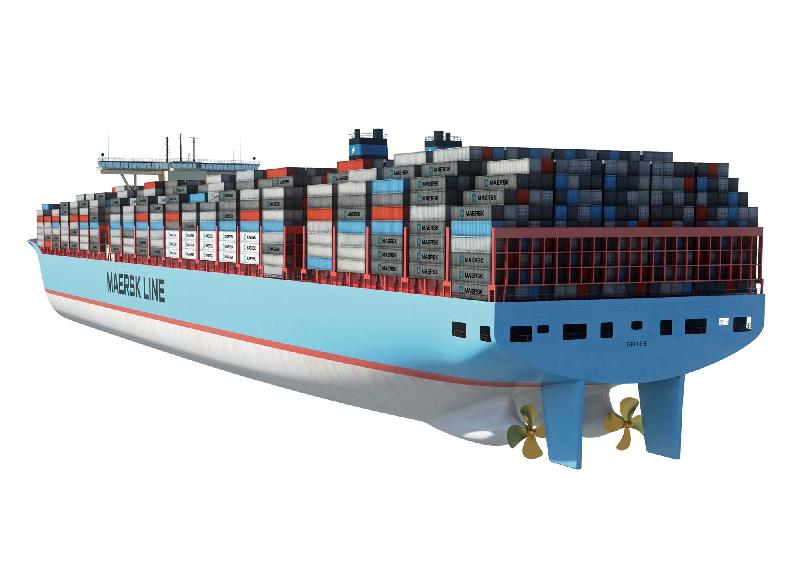
The enormous ship, due for launch on June 28, is the world’s biggest. A behemoth even in a world of behemoths, and the first sibling in a new fleet of 19 sisterships. The vessel will have the ability to carry 18,000 TEU containers and will weigh-in at 165,000 metric tons, the equivalent mass of all the gold ever mined.

Sheer size is her most distinguishing feature. At 400 meters, the M/V Maersk Mc-Kinney Møller, as she’ll be called, is significantly longer than any aircraft carrier or even the Titanic, and only slightly shorter than the Empire State Building is high. Standing on her bridge is like peering over the rim of the Grand Canyon. From her highest deck, shipyard workers resemble overgrown ants and officers needing to walk the bridge’s width, wing-to-wing, will wish they had packed roller skates. Sources: gCaptain.com and Shipspotting.com