 The WCO – Sub – Saharan African Customs Modernization Programme funded by the government of Sweden comprises four projects, namely the WCO- EAC CREATe , the WCO– SACU Connect, the WCO– WACAM and the WCO– INAMA Projects. In their totality, the projects support regional Customs Unions in Africa in their mission to facilitate trade without compromising the security of their country and the safety of their citizens. The newsletter will appear quarterly and will inform on ongoing tasks as well as give an overview of future activities. Source: WCO
Category / Information Exchange
Pakistan and China Customs to accelerate establishment EDI
 Pakistan Customs’ experts are in China to make further progress on the establishment of direct Electronic Data Interchange (EDI) with the trusted and neighbouring country to reduce the incidences of revenue losses.
The sources told Customs Today that Chief Customs Automation Abdul Qadir, Director Majid Yousfani, Riaz Chaudhary and Azeem from PRAL flew to China on August 9 to hold series of meetings with the Chinese counterparts to make further progress on the EDI.
The sources said, that the EDI will help access trade documents on real time basis from computers of cross-border customs stations. The directorate had exchanged the technical documents with China for EDI, the sources said, adding that the Chinese Customs had given feedback and counter proposal on the technical documents.
In order to expedite finalisation of the EDI arrangement, earlier a meeting with the Chinese Customs for exchange of data relating to the certificate of origin between the two countries was held on February 2 to 4, 2015 in Beijing. And, this is the second meeting of Pakistan Customs officers with the Chinese Customs, sources added.
It is recalled here, that Federal Board of Revenue had issued an alert regarding mis-declaration in imports from China under 50 HS Codes. The Board also showed concerns on the un-warranted concessions granted under various SROs covering preferential or free trade agreements.
The Board had advised verification of suspected Certificates of Origin directly through the commercial missions of Pakistan abroad, discouraging mis-classification of goods to obtain concessions and extending benefits only to goods which strictly matched the description provided in respective SROs.
It may be mentioned, that the export data of China customs for CY 2013 was cross matched with the import data of Pakistan Customs for same period and it transpired that in respect of 376 tariff lines the import value declared before Pakistan Customs was short by $2.437 billion recorded by China Customs as export value to Pakistan.
Moreover, in respect of 13 tariff lines the import value declared before Pakistan Customs was in excess of $829 million that that recorded by China Customs as export value to Pakistan. This is indicative of possible mis-classification of those goods which attract higher rates of duty but are cleared as goods attracting lower rates. Source: CustomsToday
India Customs and Airlines in Tug of War over Information Exchange
 The Indian Customs department and international airlines have locked horns over providing confidential data of passengers to the former.
According to a senior Customs official, airlines were not providing information regarding commuters due to which officials were facing problems in curbing smuggling. Due to lack of details, Customs’ anti-smuggling operations were suffering. Another issue was that airlines staff was not present round-the-clock.
“We have asked airlines to provide details over phone as per law. They have to deploy someone in the office all the time as it is in the national interest to curb smuggling. Airlines have been asked to provide details and also depute a staff to answer phone calls and provide relevant details. There is not at all violation of rules in any manner. If airlines refuse to provide details or don’t reply to phone calls, a notice will be issued,” a senior Customs official told media.
Meanwhile, airlines are challenging the authority of the Customs department in this regard. According to sources, Customs department has to provide a written request that was done earlier for getting information regarding travellers. On the other hand, an airline official said, “According to guidelines laid down by the International Civil Aviation Organisation (ICAO), passenger data should be transmitted electronically. Agencies shall not require a written declaration of baggage from passenger and crew when no dutiable or restricted goods are being carried.”
Inclusiveness Through Information Technologies – Launch of the 14th IT Conference & Exhibition

Secretary General of the WCO, Mr. Kunio Mikuriya, welcomes delegates to what is now one of WCO’s premium external events bringing together representatives of the software industry and Customs policy makers.
The 14th annual WCO IT Conference & Exhibition was officially opened on 6 May 2015 in Freeport (Bahamas). Senior Government representatives of The Bahamas Government opened the 3-day Conference in the presence of over 400 participants from 75 countries.
The Right Honorouble Perry Gladstone Christie, Prime Minister and Minister of Finance of the Commonwealth of The Bahamas thanked the WCO for choosing The Bahamas for this very important global Conference. The hosting of this WCO event is an example of the government’s commitment to bring business opportunities to Grand Bahama!
The Prime Minister further continued by reminding the delegates that the WTO concluded negotiations on a Trade Facilitation Agreement at the Bali Ministerial Conference in December 2013 and about its potential of reducing international trade costs of approximately 12%. He underlined that the WTO Trade Facilitation Agreement owes much to the technical work that had already been carried out at the World Customs Organization.
In his speech, the Prime Minister stressed: “Our efforts are very much consistent with the theme of this Conference “Inclusiveness Through Information Technology”. It is in our interest here in The Bahamas to pursue an inclusive approach to the introduction of the new IT systems. These new systems must bring benefits, not only to government, but also to commercial operators and to the general public who will use these services. We recognize that with the introduction of these IT systems we must adopt a more client focused and customer orientated approach to make it easier to conduct business.”
The Secretary General of the WCO, Mr. Kunio Mikuriya, welcomed the delegates to what is now one of WCO’s premium external events bringing together representatives of the software industry and Customs policy makers. The Secretary General emphasized the theme of this year’s Conference “Inclusiveness Through Information Technologies”, adding that it addresses three key priorities of the WCO Members – Implementation of the WTO Trade Facilitation Agreement, Regional Economic Integration and Coordinated Border Management.
Mr. Charles Turner, Comptroller of Customs and Excise Department of the Commonwealth of The Bahamas, stressed that the IT Conference & Exhibition comes at an important juncture for The Bahamas as the Customs Department implements the Trade Sector Support Program. Having such a broad range of exhibitors and international delegates provides a rare opportunity to share ideas and learn from the experiences of others. Source: WCO
WSC raises concern over New EU shipper rules – ‘could reveal confidential data’
 Current plans to identify ‘buyer’ and ‘seller’ before vessel loading could lead to disclosure of sensitive business information, claim carrier, forwarder and cargo-owner representatives, according to the World Shipping Council (WSC).
Latest European Commission amendments to the EU advance cargo data reporting requirements scheduled for adoption later this year need further clarification. The WSC along with shipper and forwarder representatives is opposing the Commission’s proposals in their current form.
The Commission is now in the final stages of completing its proposals for advance cargo data reporting requirements as part of the implementation of the new Union Customs Code which is scheduled to be adopted in May and could then take effect as early as May 1, 2016. But the WSC claims that the Commission’s efforts to find a short-cut way of obtaining the identity of the ‘buyer’ and ‘seller’ of the imported goods before vessel loading could lead to the disclosure of sensitive business information.
Instead of getting it from the importer, like the US does, the Commission has proposed regulation that would require this information be provided to the carrier or NVOCC, or in the alternative, to the ‘consignee’, to be filed in an ENS (entry summary declaration) as a condition of vessel loading.
Based on their understanding and experience with shippers, the WSC has advised the Commission that ‘buyer’ and ‘seller’ data may be business-confidential information, and that it is not appropriate to require its disclosure to ocean carriers/NVOCCs or to these parties’ consignees, who may not be parties to the goods’ sales contract.
The WSC also noted that carriers’ current documentation systems had no data fields to capture this information. The Council has been joined by the European Shippers’ Council, the European freight forwarders’ association (CLECAT) and the European Community Shipowners Association (ECSA) in opposing the Commission’s proposals.
If the regulation is implemented as proposed, exporters to the EU should recognize that they will be required to provide the identity of the buyers of their goods to their carrier or NVOCC or to their consignees prior to vessel loading, so that this information could be provided by the carrier or NVOCC in its required advance ENS filing. Source: LloydsLoading
For more detailed information in this regard refer to the World Shipping Council’s website – Advance Cargo Shipment Data
nCEN goes live in Botswana
 The WCO launched its national Customs Enforcement Network (nCEN) application in Botswana in October 2014. Following the pilot projects in Mauritius and Kenya, the nCEN is already operational in Namibia, Swaziland, and the Seychelles, providing these countries crucial opportunities for regional cooperation in the enforcement field.
After an official meeting in Gaborone with the Executive Management Committee as well as with the General Managers of Botswana Unified Revenue Service, the WCO delegation conducted an eight-day nCEN Workshop intended to provide local officers with the necessary knowhow about the nCEN application, with an ultimate goal of improving the operational efficiency and analytical possibilities of their Administration. The workshop also touched upon the other WCO applications, giving valuable insight on the additional data mining and information exchange potential of the CEN suite.
The launch of the nCEN application in the region is financially supported by the Finish government as a component of the WCO project “Building Trade Capacity through Customs Modernization in the East and Southern Africa Region”, aiming at providing Customs Administrations with the necessary hardware and software as well as related knowledge and skills to implement simplified and improved customs procedures with modern customs operational techniques.
The nCEN application consists of three independent databases (a seizure database, a suspect database, and a company database), as well as a communication component. The core database of national seizures and offences comprises data required for analysis, including means of conveyance, routes, and the possibility to view photos depicting exceptional concealment methods. Two supplementary databases contain information on suspected persons and offending business entities, facilitating a structured investigation process.
The nCEN software is a free application for all WCO Members. The costs of the hardware needed to run the nCEN application, the costs associated with the training, and possible costs for modifications to the local IT infrastructure (if applicable), are however the responsibility of the implementing Customs Administration. Source: WCO
US extends Air Cargo Screening Scheme
 US Customs and Border Protection (CBP) has extended its Air Cargo Advance Screening (ACAS) pilot programme for a further year following representations from freight forwarding representatives, and has reopened the application period for new participants. The pilot was set to expire this month but will now be extended until 26 July 2015, and CBP is also accepting applications for new participants until 26 September 2014.
The programme, which analyses advance data on inbound air shipments to the US to assess risk, is currently in pilot phase, but US Customs and Border Protection (CBP) has signalled that it intends to expand it to apply to all inbound air cargo via a “rulemaking”. The extensions follow a letter sent in June to CBP and the US Transportation Security Administration (TSA) from a coalition of associations representing air freight forwarding companies, calling on the US government to solicit input from small and medium-sized forwarders before expanding the ACAS programme.
The Airforwarders Association (AfA), the National Customs Brokers and Forwarders Association of America (NCBFAA), The International Air Cargo Association (TIACA), and the Express Delivery and Logistics Association (XLA) jointly sent letters to CBP and the TSA noting their support of the concept of the ACAS programme’s risk-based analysis at the shipment level, but expressing concerns about certain issues. In addition to detailing issues regarding potential negative impacts on small and medium-sized air forwarding businesses, the letters included requests to meet with both agencies and representatives from air carriers in June to discuss the concerns and try to resolve them.
TIACA said it was strongly encouraging airlines and freight forwarders to apply for and engage in the pilot. “Only through wide participation, which can fully test the various IT connectivity issues for Advance Filing, as well as understanding the operational impact for the future, will we be able to ensure an effective programme when it becomes mandatory,” TIACA said.
It noted that this extension was for a full year, whereas CBP had only extended the pilot in six-month intervals in the past. TIACA said that following the pilot, CBP plans to issue a Notice of Proposed Rulemaking (NPRM), “and the current estimate is that this may occur in Q3/2015, with the likelihood of possibly Q4/2015 or Q1/2016.”
It said the issuance of an NPRM is followed by a mandatory comment period from industry, after which CBP reviews all of the comments. CBP must then respond to those comments when the final rule is issued.
“Thus, ACAS may not become a mandatory CBP data transmission programme until sometime in late 2016,” TIACA noted. “In comparison, the EU PRECISE programme is currently targeted for the first half of 2016.” Source: Lloyds Loading List
Message from the WCO – International Customs Day 26 January 2014
 This year’s International Customs Day heralds the launch of the WCO Year of Communication, a year in which we, as a Customs community, move to further enhance our communication strategies and worldwide outreach programmes.
Under the slogan “Communication: sharing information for better cooperation,” we are signaling our aspiration to do more at the national, regional and international level to raise awareness of the vital role Customs plays in international trade, economic prosperity and social development.
Communication is a sharing process which fosters cooperation, and as Customs is at the centre of a network of relations, developing a sound internal and external communication strategy promotes transparency, facilitates dialogue, builds trust and ensures mutual understanding.
With our unique expertise, Customs has made great strides over recent years in achieving better visibility with national governments, international organizations, the business sector, the donor community, development banks and other international trade stakeholders.
Good communication practices by WCO Members are abundant: national Customs websites, specialized magazines, media outreach and social networks are trailblazing the way towards greater awareness of the contribution of Customs to a more resilient trade environment.
Complementing these efforts, the WCO Secretariat also has a number of communications tools to help get the word out, including the Organization’s new dynamic website, its popular and insightful WCO News magazine and our growing online social media presence.
Just as important, is the WCO’s efforts to engage as many Presidents, Ministers, leaders and international policy makers as possible in order to defend Customs’ interests, further raise its profile and create better awareness of the opportunities and challenges it faces.
It is equally imperative that we also focus on how we communicate with our stakeholders and partners, how we listen to their feedback and how we decide to respond, as this will encourage stronger support for the work we do and ensure greater buy-in to WCO strategies.
In fact, communication is a two-way process by which information and knowledge are exchanged and shared between individuals – it is not only about sending a message or passing on information, it is also about exploring, discovering, researching and generating knowledge.
As in previous years, I am fully convinced that Customs administrations and the greater Customs community will rise to the occasion, committed to actively taking the communication theme forward and thereby ensuring the success of the WCO Year of Communication.
Wishing you all a joyful International Customs Day!
Kunio Mikuriya Secretary General
Communication: Sharing Information for Better Communication
 Following a theme of logical progression over the past few years, the WCO has introduced “Communication” as this year’s theme for the 170+ Customs Administrations around the world. Last year’s theme “Innovation” set the platform for the introduction of innovative ideas and business practices, new partnerships, as well as new solutions and technologies.
While still very much in its infancy, the WCO’s Globally Networked Customs (GNC) philosophy will undoubtedly gain more and more traction as administrations iron out their national and regional aspirations and objectives.
The recent agreement on Trade Facilitation at the WTO’s conference in Bali adds further credence to the importance of the principles of the Revised Kyoto Convention (RKC). For the first time we see an attempt to fuse customs principles into a package of binding requirements.
Now, more than ever, Customs needs to work ‘collaboratively’ with all stakeholders.
With Customs and Border Agencies etching out new legal requirements, as well as organisational structures and plans, trade practitioners will likewise have to keep a watchful eye on these developments. Sometimes, not necessarily just for their own needs and obligations in their domestic markets, traders need to ensure that they keep apace with ‘destination’ Customs requirements which in these modern times are all too frequent. By opening its door to the business community, the WCO plays an ever-increasing overarching role in providing the private sector a ‘window’ to its thinking and ideology.
UNCTAD – LDCs face challenges in reaping benefits from Cloud Computing
 There is nothing nebulous about the “cloud”, especially as it applies to developing countries, a new UNCTAD report says. For businesses and governments in poorer nations to benefit from cloud computing’s increasingly rapid and more flexible supply of digitized information – the sort of thing that enables online marketers to rapidly scale up their information systems in tune with fluctuations in demand – massive, down-to-earth data processing hardware is required. Also needed is extensive broadband infrastructure, as well as laws and regulations that encourage the investment needed to pay for advanced information and communication technology (ICT) facilities and to protect users of cloud services.
UNCTAD’s Information Economy Report 2013, subtitled The Cloud Economy and Developing Countries, was released on 3 December 2013.
Referring to cloud computing, United Nations Secretary-General Ban Ki-moon states in the preface to the report: “This has considerable potential for economic and social development, in particular for our efforts to achieve the Millennium Development Goals and to define a bold agenda for a prosperous, sustainable and equitable future.”
The report shows that cloud computing offers the potential for enhanced efficiency. For example, cloud provisioning may enable small enterprises to outsource some of the information technology (IT) skills that they would otherwise have to provide internally. Companies can benefit from greater storage and computing capacity, as well as the expertise of cloud service providers in areas such as IT management and security.
But the study notes that options for cloud adoption in low- and middle-income countries look very different from those in more advanced countries. While free cloud services such as webmail and online social networks are already widely used in developing nations, the scope for cloud adoption in low- and middle-income economies is much smaller than it is in more advanced economies. In fact, the gap in availability of cloud-related infrastructure between developed and developing countries keeps widening. Access to affordable broadband Internet is still far from satisfactory in developing nations, especially in the least developed countries (LDCs). In addition, most low-income countries rely on mobile broadband networks that are characterized by low speed and high latency and therefore not ideal for cloud service provision.
The report recommends that governments “welcome the cloud but tread carefully”. Within the limits of their resources, infrastructure such as costly data centres must be constructed; at present, developed economies account for as much as 85 per cent of all data centres offering co-location services.
The cloud’s pros and cons
In simple terms, cloud computing enables users to access a scalable and elastic pool of data storage and computing resources, as and when required. Rather than being an amorphous phenomenon in the sky, cloud computing is anchored on the ground by the combination of the physical hardware, networks, storage, services and interfaces that are needed to deliver computing as a service.
The shift towards the cloud has been enabled by massively enhanced processing power and data storage, and higher transmission speeds. For example, some central processing units today are 4,000 times faster than their equivalents from four decades ago, and consumer broadband packages are almost 36,000 times faster than the dial-up connections used when Internet browsers were introduced in 1993.
The potential advantages of cloud computing include reduced costs for in-house equipment and IT management, enhanced elasticity of storage/processing capacity as required by demand, greater flexibility and mobility of access to data and services, immediate and cost-free upgrading of software, and enhanced reliability and security of data management and services.
But there are also potential costs or risks associated with cloud solutions. The UNCTAD report mentions costs of communications (to telecom operators/Internet service providers) and for migration and integration of new cloud services into companies’ existing business processes, reduced control over data and applications, data security and privacy concerns, risks of services being inaccessible to targeted users, and risks of “lock-in” with providers in uncompetitive cloud markets.
Policymakers should waste no time in exploring how the cloud computing trend may affect their economies and societies, UNCTAD recommends. Countries need to assess carefully how best to reap gains from this latest stage in the evolving information economy. In principle, UNCTAD sees no general case for government policy and regulation to discourage migration towards the cloud. Rather, governments should seek to create an enabling framework for firms and organizations that wish to migrate data and services to the cloud, so that they can do so easily and safely. But government policies should be based on a careful assessment of the pros and cons of cloud solutions, and should recognize the diversity of business models and services available. The report underlines that there are multiple ways of making use of cloud technology, including public, private or hybrid clouds, at national, regional and global levels. Source: UNCTAD
Related articles
- Cloud pricing codex to help decipher mystery of cloud computing costs (information-age.com)
SA-Mozambique One Stop Border, one step closer
 Parliment’s standing committee on finance (SCoF) on Wednesday finally adopted a bilateral agreement between South Africa and Mozambique that brings the creation of a one-stop border post between the two countries a step closer.
The move has been six years in the making. The facility is expected to expedite the movement of goods and people, reduce congestion and delays, and lower the cost of cross-border trade.
Members of Parliment heard on Wednesday that the World Bank estimated that a one-day reduction in inland travel time in sub-Saharan Africa could result in a 7% increase in exports. Further, reducing export costs 10% through greater efficiency could increase exports 4.7%.
Parliament is in the process of ratifying the bilateral legal framework for the one-stop border post between South Africa and Mozambique at Lebombo-Ressano Garcia. It is the first bilateral framework of its kind for South Africa and is likely to be replicated in other parts of the Southern African Development Community (SADC).
The facility is expected to expedite the movement of goods and people, reduce congestion and delays, and lower the cost of cross-border trade
SADC has made a commitment to implementing such bilateral agreements throughout the region.
South Africa is in discussion with Zimbabwe about having a one-stop border post at Beitbridge, which is notorious for its congestion and long delays. The committee heard from Department of Home Affairs officials that a single visa for the region was also planned once systems have been integrated and secured.
The one-stop border post facility and access roads to Lebombo-Ressano Garcia have already been built and were just awaiting the go-ahead from the South African and Mozambican governments to begin operating. Each country would have a designated area in the combined facility for customs control but housing them in one unit would mean that goods would only have to be offloaded and loaded back onto trucks once for inspection.
South African Revenue Service senior executive Kosie Louw said the benefits of one-stop border posts were reduced border crossing times and reduced logistics costs. Further, they simplified and harmonised border control and administration, and integrated risk and information management.
A reduction in corruption and illegal imports was another benefit, Mr Louw said. Frequent travellers will be processed speedily through the use of fingerprints. A key element of the agreement is to provide for extraterritorial jurisdiction at the commonly held border posts and to deal with arrest, detention and seizure of goods. Both parties will be entitled to apply their own domestic customs laws within the common control zone.
The formal agreement for the project was signed between the two countries in September 2007 and the Cabinet gave its approval in August 2011 for the bilateral legal framework to be finalised and presented to Parliament. Source: BDlive.co.za
Related articles
India Seeks Binding Trade Facilitation Agreement and Mandatory Exchange of Customs Information
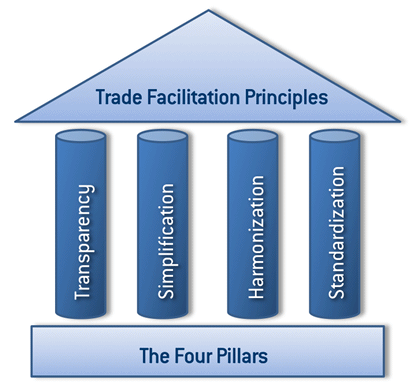
India has proposed changes in the trade facilitation agreement to address the concerns of developing countries in the proposal that tops the agenda of the WTO‘s Bali ministerial scheduled for early December.
The trade facilitation agreement aims to smoothen cross-border trade by removing red tape, improving infrastructure and harmonising Customs procedures. Seen as the developed countries’ agenda, the emerging economies have sought relaxations in the legally binding clauses like clearing shipments within three hours.
“We have informed WTO that there needs to be some restriction on the scope of expediting shipment, and should be only limited to air cargo and that too very urgent ones,” a commerce department official told ET.
The country should also be allowed to restrict it to courier services, as the ones very urgent. WTO has subsequently agreed to relax the clause to make expediting shipments within six hours or as rapidly as possible instead of three hours.
Negotiators from 159 countries have held several rounds of talks since September in Geneva to forge a consensus on the multilateral agreement.
Although talks started in 2001 in Doha, lack of consensus between the developed and developing countries has lead to an impasse.
The ninth ministerial round in Bali is being seen as the last attempt to renew the global trade agreement agenda by focusing on the low hanging fruit such as trade facilitation.
India’s commerce & industry minister Anand Sharma told WTO director-general Roberto Axevedo during his Delhi visit in October that India was in support of the trade facilitation agreement, “but needs a balance in the pact”.
India along with other developing countries had raised objection to the clause, which calls for a sufficient time gap between the announcement of change in tariff to its coming into effect. This would be against India’s constitution, since most of the budget announcements related to tariffs come into effect within 24 hours. “We cannot change our constitution for WTO,” said the official, adding that India has submitted an alternative proposal to this effect, wherein, budget-related announcement should be kept out of this clause since they need to become applicable immediately. “Deliberations are still on, we need to be given flexibility,” he added.
Besides, India has sought a binding agreement on Customs cooperation under trade facilitation, which will ensure mandatory exchange of information between Customs administrations (on request) so as to prevent under-invoicing, overvaluation, tax evasion and illicit capital flows.
However, the developed countries want to agree to it only on ‘best endeavour basis’. “It is important for us, and has been on the table for over 20 year. It is only for cross checking, as information is available at both ends. However, developed countries are putting in so many conditions, confidentiality laws, secrecy. So, we are not sure in what form it will finally look like,” said the official.
India has also been pushing for a binding technical and financial assistance by the developed countries to the developing countries to accept TF agreement. Source: Economic Times (India)
Related articles
- Joint Statement on Trade Facilitation Assistance (mpoverello.com)
CBP initiation date for liquidated damages for 10+2 non-compliance
 U.S. Customs and Border Protection (CBP) has announced that on July 9, 2013, it will begin full enforcement of Importer Security Filing (ISF or 10+2), and will start issuing liquidated damages against ISF importers and carriers for ISF non-compliance.
According to the CBP release, “in order to achieve the most compliance with the least disruption to the trade and to domestic port operations, it has been applying a “measured and commonsense approach” to Importer Security Filing (ISF or 10+2) enforcement.
The Importer Security Filing (ISF) system—also referred to as the “10+2” data elements—requires both importers and carriers to transmit certain information to CBP regarding inbound ocean cargo 24 hours prior to lading that cargo at foreign ports. These rules are intended to satisfy certain requirements under the Security Accountability for Every (SAFE) Port Act of 2006 and the Trade Act of 2002, as amended by the Maritime Transportation Security Act of 2002.
Under the ISF, the following 10 data elements are required from the importer:
- Manufacturer (or supplier) name and address
- Seller (or owner) name and address
- Buyer (or owner) name and address
- Ship-to name and address
- Container stuffing location
- Consolidator (stuffer) name and address
- Importer of record number/foreign trade zone applicant identification number
- Consignee number(s)
- Country of origin
- Commodity Harmonized Tariff Schedule number
From the carrier, 2 data elements are required:
- Vessel stow plan
- Container status messages
Source: CBP.gov
Related articles
- What’s In Store for ACE? (mpoverello.com)
Big Brother is here and his name is PRISM

Picture credit – Gizmag.com
First came news from The Guardian that the NSA was collecting phone records from millions of Verizon customers under a top-secret government order: “The National Security Agency is currently collecting the telephone records of millions of US customers of Verizon, one of America’s largest telecoms providers, under a top-secret court order issued in April.
The order, a copy of which has been obtained by the Guardian, requires Verizon on an “ongoing, daily basis” to give the NSA information on all telephone calls in its systems, both within the US and between the US and other countries.”
Then, in the last few hours, more layers were peeled back by The Washington Post: “The National Security Agency and the FBI are tapping directly into the central servers of nine leading U.S. Internet companies, extracting audio and video chats, photographs, e-mails, documents, and connection logs that enable analysts to track one target or trace a whole network of associates, according to a top-secret document obtained by The Washington Post.”
The story continues to list the companies who allegedly gave the US government unfettered access to customer data (emphasis is ours): “Equally unusual is the way the NSA extracts what it wants, according to the document: ‘Collection directly from the servers of these U.S. Service Providers: Microsoft, Yahoo, Google, Facebook, PalTalk, AOL, Skype, YouTube, Apple.”
According to a series of alleged PowerPoint slides obtained by The Washington Post, Microsoft was the first to join the program, in September of 2007. The most recent addition was Apple, in October of 2012. Dropbox is reportedly “coming soon.”
Interestingly, most of the companies named are responding to requests for comment by flat-out denying awareness or involvement. According to The Next Web, Facebook, Apple, Google, Microsoft, Dropbox and Yahoo have all denied participation. PRISM reportedly began collecting data in 2007, which means it was introduced under President Bush. However, The Washington Post says the program has experienced “exponential growth” under the Obama administration.

Video: The U.S. goverment is accessing top Internet companies’ servers to track foreign targets. Reporter Barton Gellman talks about the source who revealed this top-secret information and how he believes his whistleblowing was worth whatever consequences are ahead.
The slides reveal an annual budget of US$20 million for the program with data monitored by the program including e-mails, instant messages, videos, photos, stored data (presumably in the cloud), voice chats, file transfers, video conferences, log-in times, and social network profile details. Although the program is supposedly aimed at surveillance of foreign targets, such as spies and terrorists, and is intended to take advantage of the fact that most of the world’s data flows through the US, it is inevitable that data of US citizens is caught up in the mix. The NSA Powerpoint slides describe this as “incidental.”
It shouldn’t be too shocking that the US government spies on its citizens. What may be more surprising is just how far-reaching, and possibly unconstitutional, this program is. Perhaps the most significant part will be the fallout now that the secrets are out in the open.
Recent developments concerning customs data exchange via “cloud-type” mediums will therefore come under more scrutiny given current revelations in the US. It serves little purpose for countries to agree on data confidentiality and unwittingly (?) make such data available for ‘harvesting’ via third-party technology providers. Let this come as a fore-warning to governments.
Sources: The Guardian, The Washington Post, The Next Web, and Gizmag.
Related articles
- What Is PRISM? (gizmodo.co.uk)
- US records monitoring ignites debate (news24.com)
- Documents: U.S. mining data from 9 leading Internet firms; companies deny knowledge (washingtonpost.com)
Mozambique Customs gets a new DG

Guilherma Mambo presenting the Mozambique Single Electronic Window at the SADC ICT Conference, in Mauritius, 2012.
Guilherme Mambo has just been appointed Director General Mozambique Customs on the 10th May 2013. Until then he was Board Director of MCNet – Mozambique Community Network the PPP responsibly for implementation of Electronic Single Window for customs clearance in Mozambique where he were responsible for implementation and operations. In recent months he has lead Mozambique’s bi-lateral engagement on IT-Connectivity and Data Exchange with his counterparts at the South African Revenue Service (SARS).
For the past 10 years Mambo served as director IT Mozambique Customs and then for Mozambique Revenue Authority. On this role he participated in various modernization projects aimed at improving the business environment in Mozambique through improvement of public services particularly the complete organizational transformation of customs and internal tax areas.
Prior to working with customs and MRA, he worked in aviation industry and a UN lead project in Chechnya, Liberia, Angola were he was exposed multifaceted international experience.
As Director General – Mozambique Customs his responsibility is to manage the General Directorate of Customs (DGA) a paramilitary organization with around 2000 staff, one of the two major collectors of government revenue derived from external trade largely from customs duty, excise duty and the Value Added Tax (IVA). DGA is also a law enforcement agency that undertakes the control of imports and exports for the protection of revenue to prevent evasion of duties and taxes and assists in the promotion of the community’s well-being to prevent the smuggling of controlled, prohibited and restricted goods (such as illicit narcotic drugs and firearms). The Director General heads the DGA and his assisted by three Deputy Director General each of one have a specific area of responsibility.
 What Happened to the Portcullis?
You must be logged in to post a comment.