Customs 2013 – the Year of Innovation

web_innovationWhile contemplating next year’s challenges and opportunities, I suppose it’s not a bad time to reflect on the WCO‘s theme for Customs Inc. in 2013. The Secretary General of the WCO, Kunio Mikuriya, is pleased to announce that 2013 will be dedicated to promoting innovation under the slogan “Innovation for Customs progress”. He believes that WCO Members and their partners will have the opportunity to promote innovative ideas and practices that they have implemented, new partnerships that they have developed, as well as creative solutions and technologies that they have adopted. Customs and its stakeholders are urged to be innovative and creative in taking forward the innovation theme in all its facets throughout 2013.

The Year of innovation will be launched on International Customs Day, celebrated annually by the global Customs community on 26 January in honour of the inaugural session of the Customs Co-operation Council (CCC) which took place on 26 January 1953.

Considering the age of the WCO (CCC), I thought the pictures below might conjure up some yesteryear profiles of male and female customs officers. These come from a book A Ladybird ‘Easy-Reading’ Book – ‘People at Work’ – The CUSTOMS OFFICER, which was around when I was a youngster in primary school. Needless to say, the content is perhaps meaningless where the period ‘gate-keeper’ approach to customs control has since been superseded by ‘automated risk management’, i.e. where a computer tells a customs officer what to search for, or what is suspicious or worthwhile expending energy on. Passenger processing has likewise seen a revolution in technology aids and controlled procedures. In many places it is the biometric reader which ‘facilitates’ expedited passenger/traveller processing. While verbal interrogation is still used it is merely a ‘level’ in the ‘layered’ approach in the modern customs risk management process. X-ray body scanners and drug-loo’s complete the customs officer’s enforcement toolkit. Yet, it still takes the ingenuity of a customs officer (and many instances his detector dog) to raise the ‘portcullis’ on crime.

This slideshow requires JavaScript.

2012 in review

The WordPress.com stats helper monkeys prepared a 2012 annual report for “What Happened to the Portcullis?“. A special thanks to everyone who has browsed regularly, commented or contributed to this blog. I am deeply grateful and appreciative! Mike

Here’s an excerpt:

4,329 films were submitted to the 2012 Cannes Film Festival. This blog had 52,000 views in 2012. If each view were a film, this blog would power 12 Film Festivals

Click here to see the complete report.

Africa – China’s Export Route to the U.S.?

AGOA_W1The Africa Growth and Opportunity Act intends to support African exports to US markets. It is helping savvy Chinese companies too. US-Africa trade received a boost with the signing of the African Growth and Opportunity Act (AGOA) back in May 2000, which enabled African countries to export over 4,000 products, including apparel, quota-free and duty-free to the US.

Geared to support the integration of African countries into global markets, AGOA has enjoyed broad cross-party support in a usually fraught US legislature – especially on issues of foreign trade – and has been renewed several times. Helping Africa, it seems, is something everyone can agree on.

But they might, unwittingly, have been helping China too. Research by Lorenzo Rotunno and colleagues at the Centre for the Study of African Economies, Oxford University, suggests that savvy Chinese companies have set up shop in Africa as a route to get their products into the US with all the AGOA benefits.

The entrepreneurs’ logic is impeccable. Not only could an Africa platform get them duty free access to US markets, they could also avoid heavy quotas on China’s exports to the US, imposed through previous protectionist measures by the rich world, such as the Multi-Fiber Agreement.

Because AGOA did not contain ‘rules of origin’ provisions, the door is wide open for such creative thinking. “Restrictive quotas on Chinese apparel exports in the US and preferential treatment for African exports resulted in quota-hopping transhipment from China to the US via AGOA countries” the researchers say.

Chinese and Taiwanese producers are now said to comprise the bulk of a textile “diaspora” in Lesotho, Madagascar and Kenya. In one Kenyan processing zone, 80% of the 34 garment plants had Asian owners. While some outfits doubtless have in-country assembly – and therefore generate jobs and incomes for Africans – a number are little more than transporting docks for foreign-sourced, fully assembled goods ready to go to their final destination, tax free.

Chinese entrepreneurs made no bones about it. In one survey, they gave ‘taking advantage of international trade agreements’ in their top five list of motives for investing and operating in Africa. Source: AllAfrica.com 

Beitbridge congestion – Travellers tear-gassed by SA police

border-lines

Zimbabwean Police are set to meet their South African counterparts following an incident in which the South African officers used tear gas to control travellers at their side of the border last Friday morning. The majority of the travellers were Zimbabweans, with others coming from countries north of the Zambezi.

The South African Police Services (SAPS) used tear smoke to control travellers at around 9am as the number of human traffic started increasing at Beitbridge Border Post.

No one was injured in the incident which lasted for about 15 minutes when people started showing their discontent with the slow way they were being cleared by immigration officials from that country.

Some travellers started jumping queues after they had spent between three and four hours waiting to gain passage into South Africa. Police officer commanding Beitbridge district Chief Superintendent Lawrence Chinhengo said yesterday that the incident was a great cause for concern.

“This was a very unfortunate incident. We are not happy with the method our counterparts used to control queues and have since communicated to them that we need to have an urgent bilateral meeting to iron out the issue. There are better ways to manage people rather than the tear smoke. It is of paramount importance that we meet and find better ways to control crowds during this festive season,” he said. Source: Bulawayo24.com

For more insight also read “Zim travellers stranded at border post” on zoutnet.co.za.

New WCO Website

New look WCO WebsiteVisit the new WCO website. My impression is a very cool, uncluttered and refreshing design tailored for easy of use and the burgeoning social media space. Navigation is now a synch with the entire website content accessible via menu bar. Visit http://www.wcoomd.org/en.aspx now!

Nigerian Customs to host Single Window Feasibility Conference

Single-Window-SystemThe Nigeria Customs Service (NCS) has concluded plans to hold a conference on Single Window feasibility study findings where the national single window roadmap, implementation plan and key recommendations will be analysed.

The conference will occur in Lagos from 11 to 12 December, 2012, during which organisational, financial and cost benefit analysis for the proposed single window solution will also be analysed. The conference will address issues in areas such as business process, data harmonisation, ICT readiness of stakeholders, legislation, stakeholder relations and change management.

Feedback from all stakeholders is also expected to be collected and validated at the forum for the conclusion of the feasibility study. Furthermore, the conference is designed for policy makers, government officials, business managers, analysts, service providers, representatives of international agencies working in the field of trade facilitation, members of the academia as well as experts in trade and e-business. Source: Leadership (Abuja)

Tobacco industry uses trade pacts – to snuff out anti-smoking laws

Anti-tobaccoAs countries around the world ramp up their campaigns against smoking with tough restrictions on tobacco advertising, the industry is fighting back by invoking international trade agreements to thwart the most stringent rules.

A key battlefront is Australia, which is trying to repel a legal assault on its groundbreaking law requiring cigarettes to be sold in plain packs without distinctive brand logos or colors. Contesting the law, which came into effect Dec.1, are the top multinational cigarette makers and three countries — Ukraine, Honduras and Dominican Republic — whose legal fees are being paid by the industry.

The dispute underlines broader concerns about trade provisions that enable foreign companies to challenge national health, labor and environmental standards. Once a country ratifies a trade agreement, its terms supersede domestic laws. If a country’s regulations are found to impose unreasonable restrictions on trade, it must amend the rules or compensate the nation or foreign corporation that brought the complaint. In the case of Australia’s plain packaging law, the tobacco industry and its allies are challenging the measure as a violation of intellectual property rights under trade agreements the nation signed years ago.

Public health advocates fear the legal attack will deter other countries from passing strong measures to combat the public health burdens of smoking. The “cost of defending this case, and the risk of being held liable, would intimidate all but the most wealthy, sophisticated countries into inaction,” said Matthew L. Myers, president of the Campaign for TobaccoFree Kids in Washington D.C.

The advocates also say countries should be free to decide how best to protect public health, without being second-guessed by unelected trade panels. Moreover, they argue, tobacco products, which kill when used as intended, should not be afforded the same trade protections as other goods and services. Worldwide, nearly 6 million people a year die of smoking-related causes, according to the World Health Organization, which says the toll could top 8 million by 2030. With fewer people lighting up in wealthy nations, nearly 80 percent of the world’s 1 billion smokers live in low and middle-income countries.
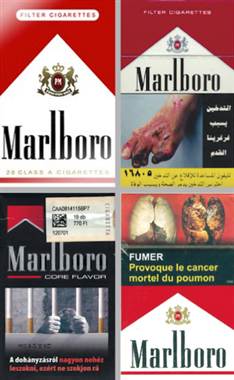
Marlboro, the world’s top-selling brand, packaged under labeling laws of (clockwise) the U.S., Egypt, Djibouti, Hungary/Photos of non-U.S. packs, Canadian Cancer Society

Marlboro, the world’s top-selling brand, packaged under labeling laws of (clockwise) the U.S., Egypt, Djibouti, Hungary/Photos of non-U.S. packs, Canadian Cancer Society

Countries have been emboldened to pass more stringent measures by the Framework Convention on Tobacco Control. In effect since 2005, the treaty has committed about 175 nations to pursue such measures as higher cigarette taxes, public smoking bans, prohibitions on tobacco advertising, and graphic warning labels with grisly images such as diseased lungs and rotting teeth (The U.S. has signed the treaty, but the Senate has not ratified it. The U.S. Food and Drug Administration has ordered graphic warnings for cigarette packs, but an industry court challenge on 1st Amendment grounds has stalled the rule.)

Cigarette makers say they acknowledge the hazards and the need for regulations. “We actually support the vast majority of them,” said Peter Nixon, vice president of communications for Philip Morris International, which has its headquarters in New York, its operations center in Switzerland, and is the biggest multinational cigarette maker with 16 percent of global sales.

But the industry has watched with growing concern as more than 35 countries have adopted total or near-total bans on cigarette advertising. Its big profits depend on consumer recognition of its brands. Yet in many countries, the once-ubiquitous logos and imagery are receding, leaving the cigarette pack as a last refuge against invisibility.

Now the pack, too, is under attack. Along with plain packaging laws such as Australia’s, countries are weighing retail display bans that keep cigarette packs out of view of consumers, and laws requiring graphic health warnings so large that there is barely any room for trademarks. Tobacco companies contend that countries enforcing such rules are effectively confiscating their intellectual property and must pay damages.

The industry also claims that measures like plain packaging are counterproductive. “We see no evidence — none at all — that this will be effective in reducing smoking,” Nixon of Philip Morris International said in an interview. In fact, he said, generic packaging likely will increase sales of cheap, untaxed counterfeit smokes, thus increasing consumption (my emphasis added).

Comment: And for me this is the bottom line. Governments are happy to collect the ‘sin tax’ every year, most increasing it annually under the pretext of curbing the use of alcohol or tobacco products. Forcing draconian law will only increase the contraband ‘underground’ which these same governments have little control over. The worldwide push under the WHO banner appears to have more of a ‘social conditioning’ connotation than a health one.
Export tax mooted on iron ore and steel

Iron ore (Engineering News)

Iron ore (Engineering News)

The South African cabinet has endorsed the final report on the work of the Intra-Departmental Task Team (IDTT) on iron ore and steel, says Minister in the Presidency responsible for Performance Monitoring, Evaluation and Administration, Collins Chabane.

Briefing reporters following Cabinet’s last meeting of year on Thursday, Chabane said in keeping with prior decisions to enhance the competitiveness of the steel value chain, Cabinet endorsed the final report on the work of the IDTT and the recommendations contained in the report for urgent implementation.

He said there had been a lot of debate and interaction between the Departments of Trade and Industry, Economic Development and steel producers and mining houses with regards to the pricing of steel.

In August 2010, the dti announced the formation of a task team to make recommendations into the viability of local steel production. This as it had expressed concern about the high price of steel in the South African economy.

“Within the context of the beneficiation programme where the government is emphasising and wanting to expand the beneficiation of South African mineral products as it is one of the critical aspects,” said Chabane.

Among the recommendations of the task team are the amendments to the Competition Act and the introduction of export taxes on iron ore and steel where appropriate. The recommendations also include the promotion of new steel investments and prioritisation of electricity available and connections to such investments.

“Government would want, among other things, to expand the number of participants in terms of those who are producing steel as part of the reason to introduce new competition. Secondly [we] also want to take measures which are going to contain the expansion of prices of steel countrywide in order to stimulate the domestic production of various products which need to be processed in the country.

“The government is going to take several steps with regards to that in order to lower the price for domestic consumption and to redirect the steel products to provide for the South African economy,” explained Chabane.

He further added that the Industrial Development Corporation (IDC) will have to play a greater role in the industrialisation of the country through being involved in manufacturing as well as beneficiation. Source: SAnews.gov.za

Corruption Perceptions Index 2012

Corruption Perceptions Index 2012Twelve African countries are ranked among the 75 least corrupt nations in the world, according to the 2012 index published Wednesday by Transparency International. Published annually, the Corruption Perceptions Index draws upon a range of data sources to determine how corrupt countries’ public sectors are perceived to be. On a scale from 100 (highly clean) to 0 (highly corrupt), two-thirds of all countries scored below 50.

The top eight in sub-Saharan Africa (SSA) in 2012 also led the list in 2011, with approximately the same global rankings, ranging from 65 to 43. Liberia – at number 11 in sub-Sahara with a score of 41 – saw its global ranking rise 16 points – from number 91 last year to 75 in 2012.

Botswana, Cape Verde, Mauritius, Rwanda, Namibia, Ghana and Lesotho led the SSA rankings, along with South Africa, which dropped two places this year – to nine from seven. Gambia, which was ninth last year, dropped this year to 21 in SSA and 105 globally. Tunisia, which is grouped with Middle East and North Africa (MENA) countries, is tied with Liberia at 75 on the global rankings. Crowding the bottom among the most corrupt in the world are Chad, Sudan and Somalia. For more information visit – www.cpi.transparency.org

Portable multi-purpose airport scanner

Flatscan portable scanner

Flatscan 27 portable scanner

Mondial Defence Systems provide the full range of CBRNe (Chemical, Biological, Radiological, Nuclear and Explosive) solutions to government, military and civil agencies.

The FlatScan 27 is a highly innovative flat portable battery-powered X-ray photodiodes system that has been specifically designed for high-speed and high-resolution inspection tasks. It incorporates a state-of-the-art 2D (two-dimensional) self-contained robust scanning detector, a laptop computer and a CP120B or CP160B portable constant potential X-ray generator to deliver real-time image processing. FlatScan 27 was developed in cooperation with specialised EOD (Explosive Ordnance Disposal) teams and comprises various unique features, specifically to meet any emergency situation. The technology will predominantly be of interest for applications used by the military, police, prisons and customs.

The FlatScan 27 comprises a large number of unique technological features and delivers a versatile and highly thin detector (thickness of just 55mm). This detector means that large objects with dimensions up to as much as 535 x 412mm can be scanned in just one attempt, even in situations where they might be located in very inaccessible places (e.g. close to a wall).

Flatscan 27 providing material discrimination and conventional scanning capability

Flatscan 27 providing material discrimination and conventional scanning capability

Furthermore, the FlatScan 27 delivers an excellent image quality with a high penetration capability (up to 34mm of steel at 160kV, 0.5mA). This is possible as a result of its sensitivity, the 800 microns resolution and the ability it offers for slowing down the speed of the scanning detector.

The FlatScan technology can be extended through a variety of options including materials separation. This involves the colour coding of a package to indicate whether the components inside are organic or inorganic in nature. This option delivers extra insight to the operator when making an informed judgment relating to the contents of suspect objects or packages.

The detector is equipped with a battery that lasts for two hours, while the two X-ray source cells each enable the development of up to 200 images. It should be noted that in cases of long-lasting laboratory applications, both items can be powered by optional mains power supplies.

For quick on site intervention, the FlatScan 27 detector can be easily transported in a backpack, while all accessories are stored in a carrying case. For more information visit – http://www.mondial-defence.com


Zambia – government to crack whip on crossborder smuggling

New Kasumbalesa border post facility - time to jack up cross-border security

New Kasumbalesa border post facility – time to jack up cross-border security

Copperbelt Permanent Secretary Stanfold Msichili says Government will enhance security measures to curb rampant illegal activities at Kasumbalesa Border Post which threaten public security. Mr Msichili has also directed Chililabombwe acting District Commissioner, Frank Siatwinda, to establish how Congolese managed to set up a booming trading place on the Zambian soil where assorted wares were being sold.

He said the Government would find a lasting solution to combat rampant illegal activities which threatens public security and that there were plans to engage concerned parties from the Democratic Republic of Congo (DRC). The Open Market has been built on our land because of its proximity to the trading area. It will not be easy to control the situation but Government is committed to finding a long-term solution.

Mr Msichili was saddened that scrap metal from DRC, which was banned for export in that country, was being smuggled into Zambia and reloaded for onward transportation to South Africa. He’s adamant that these issues should be addressed by the police, customs and immigration because we are allowing scrap metal to pass through the country. Earlier, Zambia Revenue Authority (ZRA) Kasumbalesa Border station manager Levy Simatimbe told Mr Msichili’s delegation that illegal activities were rampant at the border with some Congolese traders at the controversial Open Market on the Zambian side selling the banned alcohol, ‘Tujilijili’.

During the tour, Kasumbalesa police assistant superintendant Anthony Mphanza said the existence of the Bilanga Township, a few metres from the Zambian side where the population of foreigners was swelling posed a security threat. The Bilanga Township may encroach the Zambian side because its population of foreigners was concentrating along the areas where there was potential for trading in essential basic commodities, like maize meal, cooking oil, sugar, timber, household items, among other items. Illegal trade in cement was becoming a huge public concern at the border. It is estimated that about five tonnes of cement was illegally sold to DRC everyday. Congolese freely come to Comesa Market at Kasumbalesa Border to sell and buy different items. They carry about 10 bags of 25 kilogrammes on a bicycle. Source: The Times (Zambia)

Dog-inspired scent detector sniffs out explosives and narcotics

A team of UCSB researchers have mimicked the anatomy of a dog’s nose to build a highly effective scent detector that could be used to sniff out explosives and narcotics (University of California)

Combining nanotechnology and microfluidics, researchers at UC Santa Barbara have created a high-performance detector that draws inspiration from the anatomy of a dog’s nose to accurately identify substances – including explosives and narcotics – from very small concentrations of airborne molecules.

Able to detect smells ten thousand times as faint as humans can, a dog’s nose is an invaluable asset to police forces around the globe. So, when UCSB researchers set out to build an effective electronic nose that could assist homeland security, they already knew where they could find the perfect design.

By modeling the way in which a dog’s nose efficiently absorbs and then concentrates airborne molecules, the researchers were able to produce a device with remarkable performance, capable of capturing and identifying molecules in concentrations as low as one part per billion – as well, or better, than their furry counterparts.

Within the paperclip-sized chip, a network of microscale channels twenty times thinner than a human hair picks up the molecules and increases their concentration by a factor of up to a million. The molecules then interact with nanoparticles that amplify their spectral signature, and a miniature spectrometer detects their composition. The results from this analysis are then compared to a comprehensive database to find the closest match, identifying the molecule with a high degree of accuracy.

Even though it was first intended for use in explosives detection (the design will soon be commercialized for homeland security applications) this technology has much more far-reaching applications. Because it can be used to identify a very wide variety of molecules, the researchers say it could be easily adapted to detect narcotic substances, food that has spoiled, or even as a diagnostic tool that can identify disease, including certain forms of cancer. Source: http://www.gizmag.com.


New Zealand – Contraband now available On-line

New Zealand Customs popular Contraband magazine is now available as an online publication. You can still however locate and link to previous publications that are downloadable in .pdf format. The latest edition includes articles on  –

  • What’s My Duty?, an import duty estimator to help people buying goods online know how much duty and GST they may be liable for.
  • China and NZ Customs to work more closely together on to combat the smuggling of pharmaceutical products used to manufacture methamphetamine.
  • Kunio Mikuriya, Secretary General of the World Customs Organization’s (WCO) visit to New Zealand – commending the Service for its strong reputation for border management of Customs.

Source: New Zealand Customs Service


Big Brother – Robot Mosquito Spy Drones

Reports indicate that the US military has poured huge sums of money into surveillance drone miniaturization and is developing micro aircraft which now come in a swarm of bug-sized flying spies.

According to various internet sources, a team of researchers at the Johns Hopkins University in conjunction with the US Air Force Office of Scientific Research at Wright-Patterson Air Force Base in Arlington, Virginia, is helping develop what they are calling a micro aerial vehicle (MAV) that will undertake various espionage tasks.

The robotic insect can effortlessly infiltrate urban areas, where dense concentrations of buildings and people, along with unpredictable winds and other obstacles make it impractical.

It can be controlled from a great distance and is equipped with a camera and a built-in microphone.The new device has the capability to land precisely on human skin, use its super-micron sized needle to take DNA samples and fly off again at speed. All people feel is the pain of a mosquito bite without the burning sensation and the swelling of course. The hard-to-detect surveillance drone can also inject a micro radio frequency identification (RFID) tracking device right under skin, and can be used to inject toxins into enemies during wars.

As early as in 2007, the US government was accused of secretly developing robotic insect spies when anti-war protesters in the United States saw some flying objects similar to dragonflies or little helicopters hovering above them. The US is not alone in miniaturizing drones that imitate nature: France, the Netherlands and Israel are also developing similar devices.France has developed flapping wing bio-inspired micro drones. The Netherlands BioMAV (Biologically Inspired AI for Micro Aerial Vehicles) has also built Parrot AR drones.

Meanwhile, Israel Aerospace Industries (IAI) has produced a butterfly-shaped drone, weighing just 20 grams, which can gather intelligence inside buildings.
The insect drone, with its 0.15-gram camera and memory card, is managed remotely with a special helmet. Putting on the helmet, the operator finds themselves in the “butterfly’s cockpit” and virtually sees what the butterfly sees in real time.Source: http://www.theintelhub.com


US$500 000 cigarette bootleg seized in raid

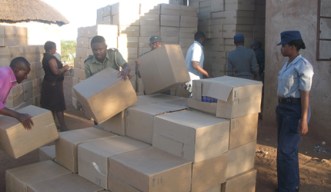
Police and Zimra officials remove cigarettes from an illegal “warehouse” in Tshapfuche, Beitbridge

Zimbabwean Customs and Police have smashed a cigarette smuggling syndicate and recovered a bootleg of export quality cigarettes worth almost US$500 000 in Tshapfuche. The 1 081 boxes of assorted local cigarettes brands were kept at Edzisani Muleya’s homestead. Police said the house had become an illegal transit warehouse.

Muleya disappeared and police have since launched a manhunt. The Ferret squad, made up of the ZRP, Zimbabwe Revenue Authority and other security agents raided the homestead on Thursday afternoon during an operation code-named Sukani Emanzini (Get out of the Limpopo River). Two men and a woman were arrested after police found them taking a nap on top of the cigarette boxes. The suspects kept their “merchandise” in five rooms. By end of day on Thursday, armed police had cordoned off the homestead. Several homesteads in the area were deserted when police arrived.

Police believe the homestead was a transit point for criminals who would then smuggle the cigarettes into South Africa through the Limpopo River. They said South Africa is a choice destination for regional cigarette smugglers who repackage them for export to Asia and other European markets. Another 107 boxes of Newbury cigarettes were recovered in Lutumba on the same day. Police intercepted a suspect attempting move the contraband to “safety”.

Police officer commanding Beitbridge district Chief Superintendent Lawrence Chinhengo yesterday said the raids were made after a tip-off. He said they recovered 311 boxes of Remmington Gold, 442 Cevils, 221 Dullas and 107 Newbury cigarettes. “We received a tip-off to the effect that Edzisani Muleya’s homestead in Tshapfuche area had been turned into an illegal warehouse for cigarettes”.

“We then raided the area on Thursday afternoon, where we found two men who had been hired as security guards sleeping on top of the boxes.” Chief Supt Chinhengo said police recovered documents with the movement, list of suppliers and other people who are part of the syndicate. He said investigations were under way. Last week, a 43-year-old Malawian trucker was fined US$1 000 for attempting to smuggle 262 boxes of export quality cigarettes worth US$35 000 through Beitbridge Border Post. Source: The Herald (Zimbabwe)