The BMA Bill – a little more for stakeholders to ponder over

The BMA Bill No.39058In recent months ‘Joe Public’ has witnessed developments relating to new visa requirements regarding international travel to and from South Africa. Tourism and the hospitality industry have been impacted in no small way while government has now established a committee to investigate the claims to the effect that the country’s tourism industry has been severely impacted.

It is now commercial trade’s time to consider the next set of legal requirements emanating from the Department of Home Affairs which, in the main, affect legislation under other departments and organ’s of state – in particular SARS Customs. Interested parties can find/download the document by clicking the link http://www.gpwonline.co.za/ and searching for eGazette No.39058.

In essence function of the Border Management Agency (BMA) Bill is – To provide for the establishment, organisation, regulation and control of the Border Management Agency; to provide for the transfer, assignment, and designation of law enforcement border related functions to the Border Management Agency; and to provide for matters connected thereto.

Be sure to digest the content of the Schedules to the Bill which contain the extent of the ‘meat’ and authority which the proposed Border Management Agency will exert if, or once approved. The Department of Home Affairs (DHA) invites comments to the draft Bill which must reach DHA no later than 14 September 2015.

Namibia Launches Trade Portal

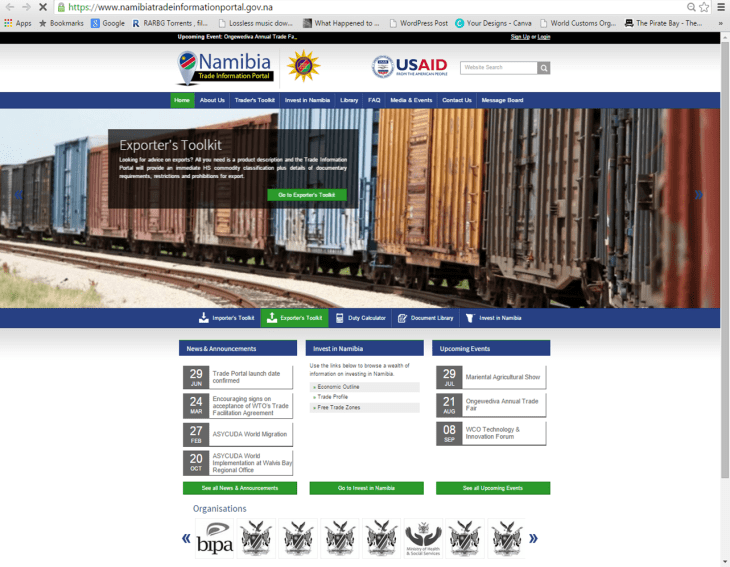
Namibian Trade PortalThe Namibia’s Ministry of Finance and Namibia’s Customs & Excise, in partnership with the U.S. government has recently launched a powerful new tool to increase and facilitate cross-border trade. The “Namibia Trade Information Portal” is a web-based platform that provides an authoritative “one-stop shop” of readily accessible trade, customs and compliance information. It is designed to significantly reduce the time and effort required for local and international traders to access current information and documentation required for doing business. The portal is the culmination of many years of collaboration between government of Namibia agencies and ministries and the U.S. government, working through the U.S. Agency for International Development (USAID) Southern Africa Trade Hub Project.

In his keynote address, Minister of Finance Calle Schlettwein said that the Trade Portal reflects the commitment of the Namibian government to build a “robust, knowledge-based society” through various modernization projects. However, he cautioned that the portal must be kept up-to-date if it is to be sustainable and relevant.

“For this reason, I strongly appeal to my fellow and counterpart ministers to designate focal points in their ministries who shall administer and avail timely updates, preferably online transmission of such information to our designated team in the Ministry of Finance who will, in turn, keep the portal updated,” Schlettwein said.

According to Namibia Trade Information Portal’s project manager, Melannie Tjijenda, the portal will save people time when they enquire about trade-related matters, so they will no longer be sent ‘from office to office.’

“International traders will now know how they can invest in Namibia,” she said, adding that this will save money on expenses like phone calls.

Tjijenda said the fact that most government websites are not regularly updated will not be the case with this portal. “When something changes, we will update it” she said, further pointing out that they have a team of content managers who will be checking and updating the content on regular basis. Source: The Namibian/USAID

US Customs to assist exporters in resolving disputes with foreign customs

CBP logoU.S. Customs and Border Protection (CBP) published a Federal Register Notice inviting U.S. exporters to request CBP’s assistance in resolving disputes with foreign customs agencies over the tariff classification or customs valuation of U.S. exports. CBP explains that it is willing to assist U.S. exporters with these disputes under the auspices of the World Customs Organization (WCO). CBP is very active at the WCO and regularly participates in meetings concerning the application of the Harmonized Commodity Description and Coding System (HS System) and the World Trade Organization’s (WTO) Customs Valuation Agreement (CVA). According to CBP, this process was helpful in providing a successful outcome for clients who disputed a foreign customs agency’s classification of imported goods.

Tariff Classification
CBP represents the United States at meetings under the auspices of the International Convention on the Harmonized Commodity Description and Coding System (“HS Convention”). The HS Convention is the international agreement that provides that WCO Members will implement the HS System and comply with decisions of the various committees organized under the convention. CBP attends semiannual meetings of the WCO’s Harmonized System Committee (HSC), where contracting parties to the HS Convention examine policy matters, make decisions on classification questions, settle disputes, and prepare amendments to the HS System and its Explanatory Notes.

Article 10 of the HS Convention governs disputes between contracting parties concerning the interpretation or application of the HS Convention. The article provides that parties with potential disputes should first try to settle the dispute through bilateral negotiations. If such negotiation cannot resolve the dispute, the parties may refer the dispute to the HSC for its consideration and recommendations. The HSC, in turn, refers irreconcilable disputes to the WCO Council for its recommendations.

Customs Valuation
CBP represents the United States at the WCO with respect to issues arising under the CVA. Pursuant to Annex II to the CVA, the WCO’s Technical Committee on Customs Valuation (TCCV) is authorized to examine specific problems arising from the customs valuation systems of WTO Members. The TCCV is responsible for examining the administration of the CVA, providing WTO Members with advisory opinions regarding particular customs valuation issues, and issuing commentaries or explanatory notes regarding the CVA. Like the HSC, the TCCV may get involved in disputes amongst foreign customs agencies. CBP stands willing to help U.S. exporters with these disputes. This process may provide U.S. exporters with a faster procedure to resolve disputes than a typical WTO dispute.

CBP’s Role at the WCO May Resolve Export Issues for U.S. Exporters
CBP states in the notice that its communication with other customs administrations through the meetings of the HSC and TCCV at the WCO can “often serve to eliminate or resolve export issues for U.S. traders.” As an example, in 2014, a U.S. exporter notified CBP of a foreign customs administration’s misclassification of its textile exports. The U.S. exporter requested that pursuant to Article 10 of the HS Convention, CBP (1) contact the foreign customs administration to resolve the tariff classification dispute; and (2) refer the matter to the HSC at the WCO, if it could not be resolved bilaterally. After confirming it agreed with the U.S. exporter’s position, CBP engaged the foreign customs administration directly. Within seven months of the exporter’s request, CBP secured a favorable decision by the foreign customs administration to classify the merchandise in a manner consistent with the U.S. position. Consequently, the U.S. exporter obtained correct tariff treatment of its imported merchandise in the foreign country as a result of CBP’s engagement.

Source: http://www.internationaltradecomplianceupdate.com/

Event – Role of the Private Sector in Support of the Trade Facilitation Agreement

international-trade1The role of the private sector in the implementation of the World Trade Organization’s (WTO) Trade Facilitation Agreement (TFA) will be the focus of the 2015 edition of the Global Facilitation Partnership for Transportation and Trade (GFP) meeting. With the world’s customs administrations currently identifying their respective TFA  implementation commitments and setting up National Trade Facilitation Committees, trade and logistics operators can learn how they can participate in such initiatives by attending these sessions.

The GFP meeting will be held at Palais des Nations, Geneva, on 22 April, and will be divided into three thematic sessions.

The first session, ‘Governments’ Priorities: Strategies for Fostering Private Sector Participation in the TFA Implementation Process’ will look at how governments are planning to implement the TFA.

It will focus on how the private sector is consulted and how an effective participation of the private sector can be facilitated to implement the Agreement.

The second session, ‘Priorities, Perspectives, and Expectations from the Private Sector on TFA Implementation’ will assess how the private sector – including large corporates and small and medium-sized enterprises – view TFA implementation. It will look at the potential benefits from a private-sector perspective, and how the sector can contribute to national and international initiatives to implement the agreement.

The third session, ‘International Organizations’ Co-ordination and Partnership for Supporting TFA Implementation’, will provide an opportunity to share information and experiences on how the TFA can be implemented with public-private partnerships in mind, as how national trade facilitation committees can better support this process.

ITC invites all interested stakeholders to join the GFP meeting at the Palais des Nations on 22 April from 9:00. Click here for link to online registration.

Source: International Trade Centre (Geneva)

SEZs – SARS proposes changes to current Rules

Trade policy - a balancing actA draft Notice for the rules under section 21A relating to Special Economic Zones has been made available for public comment. The draft rule amendments proposed under section 21A refer to the substitution of Industrial Development Zone (IDZ) for Special Economic Zone (SEZ). The draft rules can be accessed on the SARS website. Stakeholders have until 28 November 2014 to lodge any comments. Source: SARS

New Customs Control Act published

Customs Duty ActThe Customs Control Act, 2014 (Act No. 31 of 2014) and the Customs & Excise Amendment Act, 2014 (Act No. 32 of 2014) were published in the Government Gazette on 23 July 2014. For copies of these documents lease click here!

The first batch of draft rules has also been circulated in terms of the Customs Control Act, 2014 for comment with the deadline for comments looming – 29 July 2014. The ‘draft rules’ can be located by clicking here.The rest of the rules will follow in due course. Source: SARS

All stakeholders – doing business with SARS Customs – are collectively urged to take the time and opportunity to review the draft rules as they provide further detail to the future requirements and obligations for transacting Customs business when the Customs Duty and Control Acts come into operation.

New feature on SARS website – Customs Bills History

For those interested or concerned with the status of the Customs Bills from their first circulation until now, a ‘new’ SARS webpage contains all the official copies of the Draft Bills released for public comment in 2009 and in 2010 up until they were introduced in Parliament in October 2013. All the versions of the Bills after their introduction in Parliament are available as well, up to the final versions after publication in the Government gazette as Acts of Parliament.

These Acts, when they come into operation, will replace the current Customs and Excise Act, 1964 and provide for new modernised customs legislation. The Customs and Excise Amendment Act, 2014 will amend the 1964 Act to the extent that only the excise provisions will still be in force.

New WCO HS standards coming into force on 1 January 2017

OMD_7760The WCO Council, at its 123rd/124th Sessions in June 2014, adopted a Recommendation that lists recommended amendments to the Harmonized System (HS) nomenclature which will enter into force on 1 January 2017 (HS 2017).

This Recommendation is being promulgated under the provisions of Article 16 of the HS Convention, which implies that HS Contracting Parties now have six months to notify the WCO Secretariat of an objection to a recommended amendment.

Since the entry into force of the current version of the HS (HS 2012), the HS Committee has been revising this version of the HS nomenclature for almost five years. HS 2017 will be the sixth version of the HS since the Convention entered into force in 1983. HS 2017 will enter into force for all HS Contracting Parties, but will exclude any amendments objected to during the six month timeframe.

The new version of the HS includes 234 sets of amendments. Environmental and social issues are a major feature of these amendments, due to the importance of the HS as a global tool for collecting trade statistics and monitoring trade. This is borne out by the fact that the HS Convention currently has 150 Contracting Parties, making it the WCO’s most successful international instrument to date.

The majority of the recommended amendments were broached by the Food and Agriculture Organization of the United Nations (FAO):

  • Amendments relating to fish and fishery products are aimed at further enhancing the coverage of species and product forms which need to be monitored for food security purposes, and the better management of resources.
  • Amendments relating to crustaceans, molluscs and other invertebrates are motivated by the importance of the trade in and consumption of these species in their various product forms.
  • Amendments relating to cuttlefish and squid enlarge the coverage of the present HS codes for these species, in order to have all these species grouped together.

The classification of forestry products has also been modified, in order to enhance the coverage of wood species and get a better picture of trade patterns. The modification will enable trade data on tropical wood to be identified, resulting in better statistics on the trade in tropical wood and better data on the use of non-tropical hardwoods. In addition, the amendments include new subheadings for the monitoring and control of certain bamboo and rattan products.

Furthermore, HS 2017 amendments aim to provide detailed information on several categories of products that are used as antimalarial commodities. This will facilitate classification work, and the trade in these life-saving products.

The amendments also introduce specific subheadings to facilitate the collection and comparison of data on the international movement of certain substances controlled under the Chemical Weapons Convention.

New subheadings have also been created for a number of hazardous chemicals controlled under the Rotterdam Convention and for certain persistent organic pollutants (POPs) controlled under the Stockholm Convention. In some cases, there is a confluence of control regimes for chemicals by both the Rotterdam and Stockholm Conventions.

In addition, new subheadings have been created for the monitoring and control of pharmaceutical preparations containing ephedrine, pseudoephedrine or norephedrine, and for alpha-phenylacetoacetonitrile (APAAN), a pre-precursor for drugs.

Other amendments resulted from changes in international trade patterns. Headings 69.07 (unglazed ceramic products) and 69.08 (glazed ceramic products) were merged to take account of the fact that the main subheadings within these headings concern products which are essentially no longer manufactured, and the industry and trade no longer make a distinction between unglazed and glazed ceramic products, whilst new products with a very high trade volume are classified under subheadings 6907.90 and 6908.90 (“Other”).

Furthermore, for purposes of adapting the HS to current trade practices, certain important products will be separately identified in either existing or new subheadings.

Advances in technology are also reflected in the amendments, inter alia, the size criteria for newsprint, light-emitting diode (LED) lamps, multi-component integrated circuits (MCOs), and hybrid, plug-in hybrid and all-electric vehicles.

Finally, the HS 2017 Recommendation includes amendments to clarify texts to ensure uniform application of the nomenclature. For example, the regrouping of monopods, bipods, tripods and similar articles in a new heading, namely 96.20. Source: The WCO
New Customs Duty Act, No.30 of 2014 published

Customs Duty ActThe Customs Duty Act, 2014 (Act No. 30 of 2014) was published in Gazette 37821 today and a copy thereof is available on the SARS Website at the following hyperlink – Acts Administered by the Commissioner.

The purpose of this Act is to provide for the imposition, assessment, payment and recovery of customs duties on goods imported or exported from the Republic; and for matters incidental thereto.

Take note that this Act is not in force as yet.It will come into operation the date that the proposed Customs Control Act (still to be published) takes effect, as indicated in section 229. That date will be announced by the President by Proclamation in the Gazette. The implementation will occur when SARS and the industries are ready, which means that the relevant rules and processes need to be in place. Source: SARS

Getting to Grips with the Future Customs Control Act

Having recently introduced a whole new integrated customs business solution last year the South African Revenue Service (SARS) has spent the last six months stabilising its system. At the heart of the system is the Interfront Customs and Border management (iCBS) engine which takes care of all customs declaration processing.

CCB

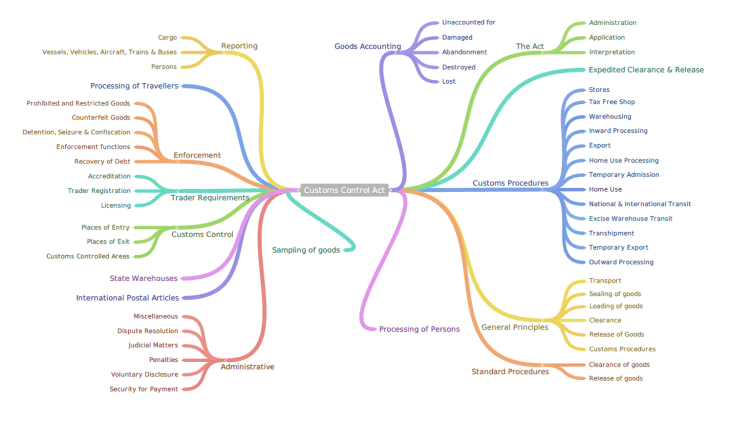
Click on the image to download the Infogram

A new ‘state-of-the-art’ EDI Gateway infrastructure is at an advanced stage of development and configuration, and will be subjected to a series of rigorous testing both internally and with industry service providers over the next few weeks. The gateway is an important component of the organisation’s future aspirations in C-2-C, C-2-B and C-2-G information exchange with it’s stakeholders.

Over the last 2 years, SARS has been a key participant in the WCO’s Globally Networked Customs (GNC) initiative which seeks to develop standardised electronic information exchanges of commercial customs data and common border procedures between customs administrations. This is ‘greenfield development’ and requires innovative thinking between potential customs partners. In this specific area SARS has engaged both Mozambique and Swaziland Customs as willing partners in such an initiative. Developments with Mozambique are at an advanced stage and will shortly become a reality with the conclusion of the bilateral One Stop Border Post (OSBP) agreement that includes provision for electronic data exchange between the two administrations. More on this in a future post.

Technology aside, perhaps the most daunting task on the horizon is the introduction of the new Customs Duty and Control Acts which are currently in the parliamentary process. Much publicity and robust argument was aired in the printed media over the last year, all of which culminated in the parliamentary hearings overseen by parliament’s Standing Committee on Finance (SCoF) during November and December 2013. While an agreement was reached with the freight forwarding sector of the local supply chain and logistics industry on certain aspects of the Control Bill, there still lies much work and clarification to be addressed in these and other areas.

Notwithstanding the signing into law of the Customs Bills, operational enactment thereof can only occur once the ‘rules’ to execute this legislation are circulated for comment, finalised and gazetted. Even considering the legal and approvals process in a simplistic form, the implementation of this new legislation is just too complex to introduce in a once-off, big-bang approach.  Due consideration must be given to a transitional approach taking into account the practicalities thereof as well as economic and logistical consequences of such approach.   It is no understatement that the impact of the new legislation, its incorporation into current automated systems, policies and procedures as well as the necessary re-adjustments to be made by every entity engaged in business with SARS Customs is no small feat.

Furthermore, the implications of the recently concluded WTO Agreement on Trade Facilitation for South African Customs and Trade also needs to be determined and understood. While a large proportion of its content is encapsulated within the Revised Kyoto Convention, it is the first time ever that such requirements are subject to the conditions of a trade agreement.

It’s been some time since I last penned thoughts on the Customs Modernisation initiative. In retrospect and thinking ahead, the underlying bottom line to its longer term success lies in increased ‘communication’ with stakeholders – ironically, the World Customs Organisation’s adopted theme for 2014!

Please feel free to download the infogram on the future Customs Control Act by clicking on the picture above. Official links to the Customs Control and Duty Bills are included below. It would also be wise for parties involved in Excise to consider the contemplated changes contained in the Excise Duty Bill (Customs and Excise Amendment Bill).

Related documents

Zimbabwe to introduce new import and export licences

Zimbabwe-emblem11To curb rampant corruption and smuggling through Zimbabwe’s borders the government is introducing new import and export licences with special security features.

Mike Bimha, Zimbabwean Industry and Commerce Minister says the local industry was being negatively affected by cheap imports into the country, some of which were being smuggled through the country’s borders.

“There are a number of fake import and export permits in the country, which is affecting our industry.As a consequence, my ministry has given a directive that all import and export licenses have to be renewed so that new ones can be issued that have special security features.”

“We are also working on a number of interventions to protect local industry.”

“We are looking at removing duty on raw materials as well as reviewing tariffs and duties with a view to restricting some imports coming into the country.”

“The reviewing of duties is not a once-off exercise but will continue in consultation with local industry.”

“We meet with industry on a regular basis where we discuss tariffs and we make the policy recommendations based on these meetings.

Zimbabwe’s trade deficit is expected to widen this year with statistics showing that the import bill so far this year is now $8,3 billion against exports of $5 billion while imports for last year were $7,6 billion against exports of $4,43 billion. Source: TransportWorldAfrica

China Customs – New Valuation Regulations

China Customs EmblemImportant information regarding customs valuation in respect of imports and exports in the People’s Republic of China.

The General Administration of Customs of the People’s Republic of China (“GAC”) issued two new regulations on customs valuation, both effective from 1 February 2014. GAC Order No. 213 (“Order 213”), entitled Measures of Customs of the People’s Republic of China for the Determination of Dutiable Value of Imports and Exports, will replace the existing regulation with the same title issued under GAC Order No. 148 on 28 March 2006 (“Order 148”). In addition, GAC Order No. 211 (“Order 211”), entitled Measures of Customs of the People’s Republic of China for the Determination of Dutiable Value of Domestic Sales of Bonded Goods, is an entirely new regulation specifically providing for the valuation of bonded goods sold within the territory of China.

Briefly, the abovementioned Orders cover the following issues –

  • Customs may consider the circumstances of a sale in determining the acceptability of transaction value between related parties.
  • Calculation of international freight for imported goods.
  • Commissions in the valuation of exported goods.
  • Bonded materials or finished goods (including defective and substandard goods) sold by a contract manufacturer located within the territory of China.
  • Bonded waste and scrap materials, by-products and residue after accidents sold by a contract manufacturer located within the territory of China.
  • Bonded goods transferred under deep processing and sold by the transferee.
  • Bonded materials or finished goods sold by a manufacturer located within a customs bonded area.
  • Bonded scrap, defective or substandard products and by-products sold by a manufacturer located within a customs bonded area.
  • Bonded goods imported into a customs bonded area for logistics, inspection and exhibition purposes and sold within the territory of China.
  • Bonded goods for Research and Development (“R&D”) in a customs bonded area and sold within the territory of China.

 For more details, read the full analysis at Baker & MacKenzie’s website.

Customs Bill gets escape clause – fallback to old system

City Deep Container Terminal (Transport World Africa)

City Deep Container Terminal (Transport World Africa)

The controversial Customs Control Bill adopted by Parliament’s finance committee on Wednesday includes a “fallback” provision allowing for a return to the current customs control system should the new one fail.

A similar clause was included in the law that introduced value-added tax in 1991, allowing for a legal alternative to be implemented quickly if things do not work out as planned.

The committee also adopted the Customs Duty Bill and the Customs and Excise Amendment Bill as part of a total revamp by the South African Revenue Service (SARS) of the customs system. Visit this link for access to the Bills and submissions to the parliamentary committee.

The Customs Control Bill has been highly contentious as it will fundamentally change the way imported goods are cleared and released. The Democratic Alliance and Business Unity SA (Busa) opposed the original proposals on the grounds that doing away with manifests in the operations of City Deep would threaten the inland terminal in Johannesburg. SARS disputed this but nevertheless amended the bill.

Busa’s Laurraine Lotter yesterday welcomed the inclusion of the fallback clause but said she would have to see the details of the amendments introduced by SARS before commenting.

The fallback provision — which will automatically lapse five years after the effective date of the legislation — was included to be on the safe side, although SARS does not expect the proposed system to fail. It consulted widely on the bill, sought legal opinions about the legality of its amended proposals and ultimately secured the support of ship operators and agents, freight forwarders and Transnet for the amendments.

Implementation could be delayed by 12 months to allow the trade sufficient time to prepare.

SARS chief legal and policy officer Kosie Louw assured the committee this week the existence of City Deep would not be jeopardised. He urged adoption of the new system of customs control, saying the authorities needed more detailed information about incoming cargo to clamp down on fraud and illegal imports.

In terms of the bill, the submission by shipping lines of a manifest that provides only a general description of cargo will be replaced by a clearance declaration. This must contain information on the tariff, value and origin of the goods, and be submitted by the importer (which can be held accountable for its veracity) three calendar days before arrival at the first place of entry into South Africa.

Penalties will be levied only if the clearance is not submitted within three working days after the arrival of the goods. Containers will be provisionally released before arrival of the goods at the first place of entry and finally released at the first point of entry. To allow for seamless movement of goods, shipping lines will still issue multimodal contracts and through bills of lading.

“The revised proposal provides certainty and predictability to role players in the supply chain regarding the movement of goods,” Mr Louw said.

He said the new system would allow customs officials to undertake documentary inspections earlier, mitigating delays. High-risk containers would be identified before arrival, detained on arrival and held at the inland terminal for inspection. Containers with no risk would be able to move “seamlessly” to the inland terminals.

Mr Louw submitted that the objections to the proposal — that it would require traders to change their sale contracts; that sellers would be reluctant to sell under the new terms; that importers would be affected; that carriers would no longer issue a bill of lading to internal terminals; and that it would give rise to delays and congestion at ports — were found to lack foundation by international trade law expert Prof Sieg Eiselen and two advocates.

He said the proposed system would lay a solid and predictable framework for a modernised system of customs control that balanced the need for trade facilitation with the need to prevent imports of illicit goods. The current system was governed by an outdated, 1960s law. Source: Business Day

Related articles

SA Government to Prioritise and Pass Customs Bills

Parliment, Cape Town (Eye Witness News)

Parliament, Cape Town (Eye Witness News)

Government has decided to prioritise the passage of eight bills through Parliament. The bills deal with land restitution, labour relations, and customs and excise.

There are currently 42 bills before the National Assembly and the National Council of Provinces. With the fourth Parliament set to be dissolved ahead of looming general elections, Members of Parliament (MPs) are unlikely to deal with all 42 bills.

A statement just released by the ANC’s office in Parliament to the media states –

“The African National Congress in Parliament has taken note of the huge parliamentary workload which the institution has to process in the next few months before the expiry of the current five-year term of parliament. In terms of the Constitution, the current term of Parliament is set to end ahead of the 2014 national elections. The workload confronting the institution includes committee oversights, constituency programmes, adoption of committee reports, debates on the state of the nation address and the budget, and finalisation and adoption of Bills.”

“Currently, there are 24 Bills before the National Assembly (NA) and 18 currently before the National Council of Provinces (NCOP) – which is a total of 42 Bills the institution must pass before the elections. Our view is that all these Bills are important and therefore the institution should spare neither strength nor effort in ensuring they are processed qualitatively and thoroughly to ensure that they are converted into laws within the stipulated period. We are however alive to the possibility that not all these Bills may be passed in the next few remaining months of parliament.”

“We have therefore sought to prioritise the following Bills, which we believe Parliament should give special attention to ensure they are passed into laws. In terms of the rules of Parliament, Bills that are not passed within the current term of Parliament may be resuscitated in the next parliamentary term. This will be done for those Bills that might not be passed during this term.”

“In determining priority Bills, we have looked at criteria such as complexity, contentiousness, technicality, effect on provinces, and requirement for exhaustive consultation. [Three of the eight bills relate to Customs and Excise]

  1. Customs Control Bill of 2013 – The Customs Control Bill is intended to replace certain provisions of the Customs and Excise Act of 1964 relating to customs control of all means of transport, goods and persons entering or leaving South Africa. The Bills aims to ensure that taxes imposed by various other laws on imported or exported goods are collected and that various other laws regulating imports and exports of goods are complied with. To ensure effective implementation of customs control, the Bill provides for elaborate systems for customs processing of goods at places of entry and exit such as seaports, airports and land border posts;
  2. Customs Duty Bill of 2013 – The Customs Duty Bill is intended to replace certain provisions of the Customs and Excise Act of 1964 which relates to the imposition and collection of imports and export duties. The Bill primarily aims to provide for the levying, payment and recovery of import and export duties on goods imported or exported from South Africa. The Bill will be dealt with in terms of Section 77 of the Constitution; and
  3. Customs and Excise Amendment Bill of 2013 – The Customs and Excise Amendment Bill seeks to amend the provisions of the Customs and Excise Act of 1964 and to remove from the Act all the provisions that have now been incorporated into both the Customs Control Bill and the Customs Duty Bill. Essentially, because the Customs and Excise Amendment Act of 1964 strongly reflected rigidity reminiscent of the apartheid era controls, which are unsuitable to the current modern control systems, it has been split into both the Customs Control Bill and the Customs Duty Bill. The Customs and Excise Amendment Act of 1964 will for now be retained in an amended form for the continued administration of excise duties and relevant levies until it is completely replaced with a new law in future (i.e. Excise Duty Bill).”

Source: Excerpt of a press statement of the Office of the Chief Whip of the ANC, Parliament.

Mauritius – Customs Training of Trainers Course on SADC Rules Of Origin

The SADC Rules of Origin are the cornerstone of the SADC intra-trade and serve to prevent non-SADC members benefiting from preferential tariffs. The determination of the eligibility of products to SADC origin and the granting of preferential tariffs to goods originating in the Member States is an important process in the implementation of the SADC Protocol on Trade and regional integration. Annex I of the SADC Protocol on Trade provide that goods shall be accepted as eligible for preferential treatment within the SADC market if they originate in the member States, and the qualification of such products shall be as provided in Appendix I of Annex I of the Protocol on Trade.

The 2nd Customs Training of Trainer Course was held on the SADC Rules of Origin at the World Customs Organization (WCO) Multilingual Regional Training Centre, Mauritius Revenue Authority from the 25th -30th November 2013. The objective of the training course is to establish a pool of trainers on the SADC Rules of Origin who can provide guidance and train on the subject at national level to Customs officials and relevant Stakeholders.

During his opening address, Mr Sudamo Lall, Director General of the Mauritius Revenue Authority, laid emphasis on the critical importance of the ‘Rules of Origin’ as it has ‘great impact on the duties to be collected, as businesses increasingly locate the different stages of their activities in a way that optimizes their value-addition chain’. On the other hand Mr James Lenaghan Director Customs mentioned that ‘the Rules of Origin in any Free Trade Area are of prime importance as they serve to determine which goods can benefit from preferential tariffs. This enables member states of a particular Free Trade Area to benefit from the tariffs advantages inherent to the Protocol of trade agreed within that Free Trade Area. Since Customs is the controlling agency for preferential origin, it is vital that our officers are trained to correctly apply the SADC Rules of Origin’.

During their short visit at the training workshop, the Executive Secretary ,Dr Stergomena Tax and the WCO Secretary General, Mr Kunio Mukiriya addressed the group on the importance of rules of origin as the basis for regional integration. Dr. Tax also urged the participants from all SADC Member States to cascade the knowledge gained at the Centre to their respective countries.

The SADC Customs Training of Trainers programme is being implemented in collaboration with the World Customs Organization (WCO), the Regional Office for Capacity Building (ROCB), the WCO Regional Training Centres and GIZ (Deutsche Gesellschaft für Internationale Zusammenarbeit (GIZ). Source: SADC Secretariat

Consitutional Court confirms invalidity of certain Sections to the Customs Act

ConCourtThe Constitutional Court (South Africa) handed down judgment in the Gaertner & Orion Cold Storage matter today on the unconstitutionality of certain parts of section 4 of the Customs and Excise Act, 1964.

Section 4(4)-(6) had been challenged in the Western Cape High Court in April 2013 and the matter was taken to the Constitutional Court to be challenged further.

The issue before Court was that SARS conducted a search in terms of section 4 at the third applicant’s premises (Orion Cold Storage (OCS)) and at the house of Mr Gaertner, a director of OCS.

The Act does not require SARS officials to obtain a warrant before a search is conducted and the Applicants launched the proceedings in the High Court in which they sought, and were granted, orders declaring parts of section 4 unconstitutional to the extent that they permit targeted non-routine searches without judicial warrant.

The Applicants argued in the Constitutional Court that section 4 is over broad in that it allows for non-routine or targeted searches by SARS without a warrant.

Briefly, the Constitutional Court order provides that –

  • The declaration of constitutional invalidity of sections 4(4)(a)(i)-(ii), 4(4)(b), 4(5) and 4(6) of the Customs and Excise Act 91 of 1964 made by the Western Cape High Court, Cape Town is confirmed.
  • The declaration of invalidity is however not retrospective.
  • The order is suspended for six months to afford the Legislature an opportunity to cure the invalidity.
  • The Constitutional Court also instructed that during the period of suspension, section 4(4) of the Customs and Excise Act must be applied in accordance with alternative wording.

To access the Constitutional Court judgement (November 2013), Click Here!

To access the Western Cape High Court judgement (April 2013), Click Here!