Massive Ivory Stash Seized In Malaysia


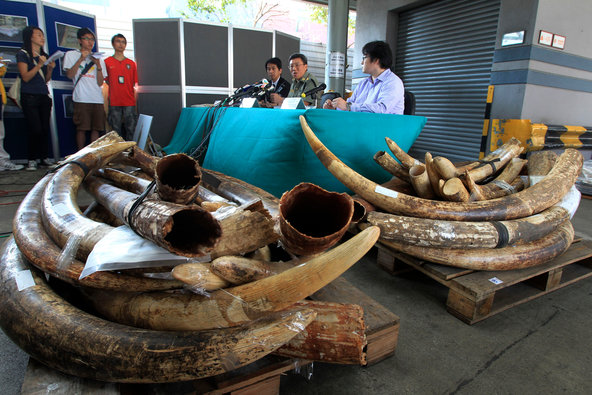
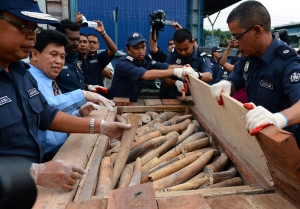
Malaysian Customs officers uncovered illegal ivory concealed within secret compartments in a shipment. (Getty Images)

Malaysian Customs officers uncovered illegal ivory concealed within secret compartments in a shipment. (Getty Images)

The Royal Malaysian Customs has received congratulatory messages from South Africa and the World Customs Organisation after thwarting one of the biggest ivory smuggling operations in recent memory. On Monday, Selangor Customs had seized 24 tonnes of elephant tusks and ivory worth US$20 million (RM60 million) in Port Klang from a China-bound ship that is believed to have sailed from Togo.

It is estimated that 750 elephants were killed to produce the quantum of tusks and ivory that was seized. To date, this is the biggest seizure of its kind in Malaysia. Confirming the seizure, Selangor Customs corporate communications chief Mohd Zhafri Johari explained:  “In the China market, ivory could fetch a price of approximately US$25,000 per kilogramme”.

Those arrested will be charged in court under Section 133(1)(a) of the Customs Act 1967 for false declaration and under the Convention for International Trade in Endangered Species of Wild Fauna and Flora. This international treaty was drawn up in 1973 to protect wildlife against over-exploitation and to prevent international profiteering which involved threatening of species.

Zhafri also noted that the smuggling of ivory through Port Klang was a rare occurrence prior to 2011. Since then, however, customs have made at least three major seizures. The seized ivory is now considered government property and will be destroyed upon completion of investigation and prosecution of the suspected parties. The 1,500-odd tusks were found in two containers. Although shipping documents listed the containers’ final destination as Port Klang, customs intelligence said the containers were planned to be sent to China. Source: Thesundaily.com

Tobacco industry uses trade pacts – to snuff out anti-smoking laws

Anti-tobaccoAs countries around the world ramp up their campaigns against smoking with tough restrictions on tobacco advertising, the industry is fighting back by invoking international trade agreements to thwart the most stringent rules.

A key battlefront is Australia, which is trying to repel a legal assault on its groundbreaking law requiring cigarettes to be sold in plain packs without distinctive brand logos or colors. Contesting the law, which came into effect Dec.1, are the top multinational cigarette makers and three countries — Ukraine, Honduras and Dominican Republic — whose legal fees are being paid by the industry.

The dispute underlines broader concerns about trade provisions that enable foreign companies to challenge national health, labor and environmental standards. Once a country ratifies a trade agreement, its terms supersede domestic laws. If a country’s regulations are found to impose unreasonable restrictions on trade, it must amend the rules or compensate the nation or foreign corporation that brought the complaint. In the case of Australia’s plain packaging law, the tobacco industry and its allies are challenging the measure as a violation of intellectual property rights under trade agreements the nation signed years ago.

Public health advocates fear the legal attack will deter other countries from passing strong measures to combat the public health burdens of smoking. The “cost of defending this case, and the risk of being held liable, would intimidate all but the most wealthy, sophisticated countries into inaction,” said Matthew L. Myers, president of the Campaign for TobaccoFree Kids in Washington D.C.

The advocates also say countries should be free to decide how best to protect public health, without being second-guessed by unelected trade panels. Moreover, they argue, tobacco products, which kill when used as intended, should not be afforded the same trade protections as other goods and services. Worldwide, nearly 6 million people a year die of smoking-related causes, according to the World Health Organization, which says the toll could top 8 million by 2030. With fewer people lighting up in wealthy nations, nearly 80 percent of the world’s 1 billion smokers live in low and middle-income countries.

Marlboro, the world’s top-selling brand, packaged under labeling laws of (clockwise) the U.S., Egypt, Djibouti, Hungary/Photos of non-U.S. packs, Canadian Cancer Society

Marlboro, the world’s top-selling brand, packaged under labeling laws of (clockwise) the U.S., Egypt, Djibouti, Hungary/Photos of non-U.S. packs, Canadian Cancer Society

Countries have been emboldened to pass more stringent measures by the Framework Convention on Tobacco Control. In effect since 2005, the treaty has committed about 175 nations to pursue such measures as higher cigarette taxes, public smoking bans, prohibitions on tobacco advertising, and graphic warning labels with grisly images such as diseased lungs and rotting teeth (The U.S. has signed the treaty, but the Senate has not ratified it. The U.S. Food and Drug Administration has ordered graphic warnings for cigarette packs, but an industry court challenge on 1st Amendment grounds has stalled the rule.)

Cigarette makers say they acknowledge the hazards and the need for regulations. “We actually support the vast majority of them,” said Peter Nixon, vice president of communications for Philip Morris International, which has its headquarters in New York, its operations center in Switzerland, and is the biggest multinational cigarette maker with 16 percent of global sales.

But the industry has watched with growing concern as more than 35 countries have adopted total or near-total bans on cigarette advertising. Its big profits depend on consumer recognition of its brands. Yet in many countries, the once-ubiquitous logos and imagery are receding, leaving the cigarette pack as a last refuge against invisibility.

Now the pack, too, is under attack. Along with plain packaging laws such as Australia’s, countries are weighing retail display bans that keep cigarette packs out of view of consumers, and laws requiring graphic health warnings so large that there is barely any room for trademarks. Tobacco companies contend that countries enforcing such rules are effectively confiscating their intellectual property and must pay damages.

The industry also claims that measures like plain packaging are counterproductive. “We see no evidence — none at all — that this will be effective in reducing smoking,” Nixon of Philip Morris International said in an interview. In fact, he said, generic packaging likely will increase sales of cheap, untaxed counterfeit smokes, thus increasing consumption (my emphasis added).

Comment: And for me this is the bottom line. Governments are happy to collect the ‘sin tax’ every year, most increasing it annually under the pretext of curbing the use of alcohol or tobacco products. Forcing draconian law will only increase the contraband ‘underground’ which these same governments have little control over. The worldwide push under the WHO banner appears to have more of a ‘social conditioning’ connotation than a health one.
Zambia – government to crack whip on crossborder smuggling

New Kasumbalesa border post facility - time to jack up cross-border security

New Kasumbalesa border post facility – time to jack up cross-border security

Copperbelt Permanent Secretary Stanfold Msichili says Government will enhance security measures to curb rampant illegal activities at Kasumbalesa Border Post which threaten public security. Mr Msichili has also directed Chililabombwe acting District Commissioner, Frank Siatwinda, to establish how Congolese managed to set up a booming trading place on the Zambian soil where assorted wares were being sold.

He said the Government would find a lasting solution to combat rampant illegal activities which threatens public security and that there were plans to engage concerned parties from the Democratic Republic of Congo (DRC). The Open Market has been built on our land because of its proximity to the trading area. It will not be easy to control the situation but Government is committed to finding a long-term solution.

Mr Msichili was saddened that scrap metal from DRC, which was banned for export in that country, was being smuggled into Zambia and reloaded for onward transportation to South Africa. He’s adamant that these issues should be addressed by the police, customs and immigration because we are allowing scrap metal to pass through the country. Earlier, Zambia Revenue Authority (ZRA) Kasumbalesa Border station manager Levy Simatimbe told Mr Msichili’s delegation that illegal activities were rampant at the border with some Congolese traders at the controversial Open Market on the Zambian side selling the banned alcohol, ‘Tujilijili’.

During the tour, Kasumbalesa police assistant superintendant Anthony Mphanza said the existence of the Bilanga Township, a few metres from the Zambian side where the population of foreigners was swelling posed a security threat. The Bilanga Township may encroach the Zambian side because its population of foreigners was concentrating along the areas where there was potential for trading in essential basic commodities, like maize meal, cooking oil, sugar, timber, household items, among other items. Illegal trade in cement was becoming a huge public concern at the border. It is estimated that about five tonnes of cement was illegally sold to DRC everyday. Congolese freely come to Comesa Market at Kasumbalesa Border to sell and buy different items. They carry about 10 bags of 25 kilogrammes on a bicycle. Source: The Times (Zambia)

Zim Police make yet another cigarette bust

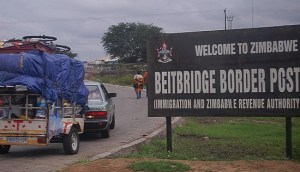
Beit Bridge Borderpost, Zimbabwe

Police in Beitbridge have recovered yet another consignment of cigarettes worth US$20 000 in Tshapfuche as they intensify their anti smuggling operation. The stash destined for export was recovered last Friday morning following the discovery of other contraband shipment worth almost US$500 000 in the same area the previous day.

Countries of the South African Customs Union (South Africa, Namibia, Botswana, Lesotho and Swaziland) charge high duties on cigarettes, meaning that even those bought retail in Zimbabwe can be sold for good profit in South Africa.

The police officer commanding Beitbridge district Chief Superintendent Lawrence Chinhengo said the second stash was recovered at the homestead of a security guard they had earlier on arrested.

The security guard was part of the three suspects who were arrested while looking after the “merchandise” at Edzisani Muleya’s homestead. Chief Supt Chinhengo said the suspect had hid 33 boxes at his sister’s homestead while he kept another 72 boxes at his house.

Three hundred and eleven boxes of Remmington Gold, 442 Cevils, 221 Dullas and 107 Newbury cigarettes worth US$500 000 were last week recovered from Muleya’s homestead. Police say the house had become an illegal transit warehouse.

Muleya has since gone into hiding and police have launched a manhunt. Chief Supt Chinhengo said the Ferret squad, made up of the ZRP, Zimbabwe Revenue Authority and other security agents raided the homestead on Thursday afternoon during an operation code-named Sukani Emanzini (Get out of the Limpopo River). Source: The Herald (Zimbabwe)

Hijackers bleed cigarette exporters

While the world’s health authorities rally for legislation outlawing or at least curbing tobacco abuse, it seems there is a world of intrigue deep in the heart of the tobacco trade. 

Zimbabwe is investigating possible industrial espionage amid reports that South African tobacco firms are hiring hijackers to pounce on export cigarette consignments in transit to that country. In the past year or so, indigenous producers exporting to South Africa lost an estimated R100 million worth of cigarettes to armed robbery syndicates. Among the affected companies are Kingdom, Savanna Tobacco, Breco (Fodya), Cutrag, Trednet and Chelsea.

Savanna Tobacco has confirmed losing cigarettes worth over R18 million through hijackings and robberies while their warehouse in SA has been broken into several times. Only British American Tobacco Company has been spared. At least eight Zimbabweans were arrested at Savanna Tobacco in Harare on suspected espionage. Cosygene Dekeya, a former army military intelligence operative and Edmore Muronzerei appeared in court last week.

Investigations by The Herald showed that the Tobacco Institute of South Africa contracted a security firm, Forensic Security Service, to monitor Zimbabwean cigarette manufacturers, whose brands are giving their South African counterparts stiff competition. Stephen Botha, a former apartheid military supremo owns Forensic Security Services, the company that allegedly recruited spies within the workforce of Zimbabwean cigarette manufacturers. The spies allegedly supply consignment export details, enabling the cartel to track, intercept and hijack. FSS is said to have engaged a local business mogul (name supplied) who owns one of the largest courier service companies to co-ordinate the spies and their payments. The mogul’s trucks have also been hijacked in what might turn out to be inside jobs. Local (Zimbabwean) companies now suspect BAT of being behind the formation of TISA, which has since been regionalised.

Savanna Tobacco executive chairman Mr Adam Molai said it was shocking that South Africans were infiltrating local security organisations to commit economic crimes and bleed the economy. “It is deplorable, you cannot have foreign agencies working for our competitors to distabilise our operations in Zimbabwe. We hope our authorities will ensure that issues of this nature are dealt with accordingly,” said Mr Molai.

Trednet administrative manager Mr Graham Acutt said his company had reduced production by 70 percent. “We are aware of the under cover operations for quite some time now. This is tantamount to industrial espionage and it is highly illegal and frowned upon the world over. Imagine people spying on you and following your consignment. It becomes sensitive and clients will stop buying your product,” he said.

Mr Acutt said he was aware that police were investigating and he was willing to assist as much as he could. “We need more help from the authorities in Zimbabwe to investigate those who are actually behind this. We will assist where we can. This espionage has compromised our ability to export and obviously to earn foreign currency for the country,” he said.

Breco, which is now trading as Fodya said their market intelligence has over time indicated that there were clandestine activities being undertaken by some organisations to disrupt their business. “We understand most companies in this industry experienced this form of activity in one form or another,” said Breco in an e-mail to The Herald. “What is most alarming is that some of the organisations involved in these activities are externally-based and being assisted by local Zimbabweans. If the activities of these institutions or organisations are the real basis for our reduced capacity, then it is illegal,” it said. Source: The Herald (Zimbabwe)

New Zealand – Contraband now available On-line

New Zealand Customs popular Contraband magazine is now available as an online publication. You can still however locate and link to previous publications that are downloadable in .pdf format. The latest edition includes articles on  –

  • What’s My Duty?, an import duty estimator to help people buying goods online know how much duty and GST they may be liable for.
  • China and NZ Customs to work more closely together on to combat the smuggling of pharmaceutical products used to manufacture methamphetamine.
  • Kunio Mikuriya, Secretary General of the World Customs Organization’s (WCO) visit to New Zealand – commending the Service for its strong reputation for border management of Customs.

Source: New Zealand Customs Service


Blood Diamonds – a case of western jealousy perhaps?

Reap What You Sow is the third investigation by Partnership Africa Canada into illicit activity in Zimbabwe‘s diamond sector. The report is divided into three main sections. The first looks at ongoing trade irregularities and the lack of transparency of diamond revenues, and examines ways ZANU and the global diamond industry have interacted, before, during and after the Kimberley Process imposed an embargo on Marange stones in 2009. The second examines the various revenue streams of Obert Mpofu and concludes the Minister of Mines is utilizing monies and assets divorced from his ministerial salary and known business entities. The third offers policy suggestions and recommendations that would improve the management and public beneficiation of Zimbabwe’s diamond revenues.

The biggest conclusion of this report is that despite government pronouncements to the contrary, the illicit trade of Marange diamonds is alive and well. A parallel trade in Marange diamonds continues to thrive, with the full knowledge and complicity of top officials in the Ministry of Mines, ZMDC, MMCZ and military.

The theft of Marange diamonds is perhaps the biggest single plunder of diamonds the world has seen since Cecil Rhodes. Conservative estimates place the losses due to illicit activity at over $2 billion since 2008. PAC has found that while the mismanagement of Marange remains primarily a Zimbabwean problem, the global dimensions of the illegality has metastasized to compromise most of the major diamond markets of the world. Previously most of the illegal trade primarily involved South Africa, Mozambique, UAE and India. This remains the case, but greater vigilance by enforcement authorities should now extend to other centres, particularly Israel. Source:http://www.kubatana.net

One commentator suggests that whilst it makes for interesting reading, it falls short of absolute indictments of individuals, particularly, Obert Mpofu. It unfortunately reads like a laundry list of barely substantiated rumours that have been doing the rounds for years. It seems the writers’ intention is to agitate the individuals, get them to sue the writers and thereby force the accused to disprove the claims on public record. This strategy is currently being used by Core mining in their case against the Minister where in a trial within a trial they claim they paid the Minister a bribe of $10million to ensure their mining rights and partnership with the ZMDC. This partnership was dissolved by the Minister under unclear circumstances. The cases are both before the courts with no resolution on the horizon.

US$500 000 cigarette bootleg seized in raid

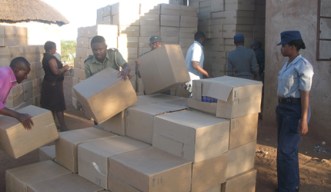
Police and Zimra officials remove cigarettes from an illegal “warehouse” in Tshapfuche, Beitbridge

Zimbabwean Customs and Police have smashed a cigarette smuggling syndicate and recovered a bootleg of export quality cigarettes worth almost US$500 000 in Tshapfuche. The 1 081 boxes of assorted local cigarettes brands were kept at Edzisani Muleya’s homestead. Police said the house had become an illegal transit warehouse.

Muleya disappeared and police have since launched a manhunt. The Ferret squad, made up of the ZRP, Zimbabwe Revenue Authority and other security agents raided the homestead on Thursday afternoon during an operation code-named Sukani Emanzini (Get out of the Limpopo River). Two men and a woman were arrested after police found them taking a nap on top of the cigarette boxes. The suspects kept their “merchandise” in five rooms. By end of day on Thursday, armed police had cordoned off the homestead. Several homesteads in the area were deserted when police arrived.

Police believe the homestead was a transit point for criminals who would then smuggle the cigarettes into South Africa through the Limpopo River. They said South Africa is a choice destination for regional cigarette smugglers who repackage them for export to Asia and other European markets. Another 107 boxes of Newbury cigarettes were recovered in Lutumba on the same day. Police intercepted a suspect attempting move the contraband to “safety”.

Police officer commanding Beitbridge district Chief Superintendent Lawrence Chinhengo yesterday said the raids were made after a tip-off. He said they recovered 311 boxes of Remmington Gold, 442 Cevils, 221 Dullas and 107 Newbury cigarettes. “We received a tip-off to the effect that Edzisani Muleya’s homestead in Tshapfuche area had been turned into an illegal warehouse for cigarettes”.

“We then raided the area on Thursday afternoon, where we found two men who had been hired as security guards sleeping on top of the boxes.” Chief Supt Chinhengo said police recovered documents with the movement, list of suppliers and other people who are part of the syndicate. He said investigations were under way. Last week, a 43-year-old Malawian trucker was fined US$1 000 for attempting to smuggle 262 boxes of export quality cigarettes worth US$35 000 through Beitbridge Border Post. Source: The Herald (Zimbabwe)

Exposing the Illegal Rhino Horn Trade

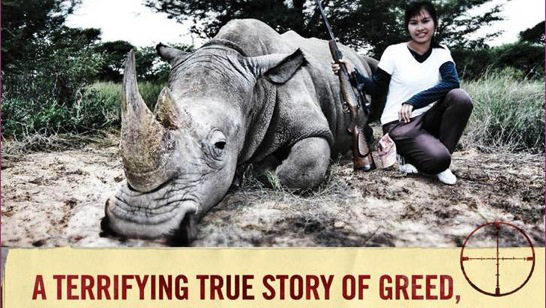
Author and investigative journalist Julian Rademeyer has recently launched his book “Killing for Profit’ A terrifying true story of greed, corruption, depravity and ruthless criminal enterprise.

On the black markets of Southeast Asia, rhino horn is worth more than gold, cocaine and heroin. This is the story of a more than two-year-long investigation into a dangerous criminal underworld where merciless syndicates will stop at nothing to attain their prize. It is a tale of greed, folly and corruption, and of an increasingly desperate battle to save  rhinos – which have existed for more than 50 million years – from extinction.

Killing for Profit is a meticulous, devastating and revelatory account of one of the world’s most secretive trades. It exposes poachers, scoundrels, gangsters, conmen, mercenaries, killers, gun-runners,  diplomats, government officials and kingpins behind the slaughter. And it follows the bloody trail from the frontlines of the rhino wars in South Africa, Zimbabwe and Mozambique to the medicine markets of Vietnam and the lair of a wildlife-trafficking kingpin on the banks of the Mekong River in Laos …

For more information visit – http://killingforprofit.com/the-book/

To purchase the book online visit – Kalahari.com

“Blood Ivory” – Huge seizure of Illegal Ivory in Hong Kong

An emperor, faced with the task of selecting a successor, devises a test: he lays out an array of valuable artifacts — items of gold, jade and ivory — and asks each of his sons to choose one treasure. One prince ponders his options for a while, before selecting an ivory scepter. The emperor is pleased. Ivory is valuable, he says, and also imbued with wisdom. The son with the scepter will rule. This, of course, is merely a fable. But the tale of the emperor and his son hints at ivory’s enduring lure in China. For millennia, it has been seen as a symbol of wealth, a source of wisdom and a sign of nobility. This helps explain why more than 20 years after an international ban on the trade of elephant ivory, the business is booming. “With more disposable income in mainland China, many people are flaunting their wealth, and ivory is seen as a luxury product that confers status,” says Tom Milliken of the Wildlife Trade Monitoring Network. “We are seeing the worst poaching of elephants and the worst illegal trade in ivory over the last 23 years.”

Authorities in Hong Kong have intercepted one of the largest shipments of illegal ivory in history – 1,209 elephant tusks and ivory ornaments weighing more than 8,400 pounds. The Hong Kong Customs and Excise Department announced the seizure on Saturday of 3,813 kilograms of ivory hidden inside two containers shipped from Tanzania and Kenya. One container was labeled as carrying plastic scrap, the other was marked as dried beans.

It was the largest-ever seizure of contraband ivory in Hong Kong. Even within the context of soaring wildlife poaching, the numbers are staggering: the equivalent of more than 600 dead elephants. So lucrative is the ivory trade now that well-armed mafias have gotten in on the act. Hong Kong officials estimated the value of the seizure at 26.7 million Hong Kong dollars, or just under $3.5 million.

The customs agency, which said in a statement that it had “smashed” the ivory smuggling case, reported no arrests. But the South China Morning Post reported that seven people in China were arrested in connection with the seizure. Demand from an increasingly affluent Asia, improved international transport and trade links, and weak enforcement and feeble penalties (in many countries) have caused wildlife poaching to jump over the past decade or two.

More than 300 elephants were killed in Cameroon alone early this year. A video from the World Wildlife Fund shows some of that grim slaughter. In this article, published in September, Jeffrey Gettleman reported that ivory — like blood diamonds from Sierra Leone or plundered minerals from Congo — is now a “conflict resource,” used to help finance conflicts across the African continent.

“Some of Africa’s most notorious armed groups, including the Lord’s Resistance Army, the Shabab and Darfur’s janjaweed,” he wrote, “are hunting down elephants and using the tusks to buy weapons and sustain their mayhem.” Members of some of the African armies backed by the U.S. government, Jeffrey reported, also have been implicated in poaching elephants and dealing in ivory. Source: New York Times

Related Articles

Port of Antwerp – Customs seize record cocaine haul

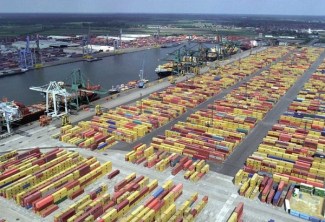
Customs Officers at the Belgian Port of Antwerp seized more than eight tons of cocaine hidden in a shipment of bananas originating from Ecuador last week. The cocaine, with a street value of more than US$500 million, were found in a container on Monday in what is the largest drugs haul ever in both Belgium and the Netherlands, and the second largest ever in Europe.

Dutch authorities have made five arrests in connection with the find, with a 46-year old Belgian truck driver and four Dutch citizens currently being questioned by police. Reports also indicate that a 31-year old Customs Officer from Antwerp is suspected to have helped the gang move the drugs out of the Belgian port, where the truck was put under surveillance before being intercepted on the outskirts of Rotterdam.

“The police investigation is now focusing on the final destination for the drugs and the financing,” Dutch News said citing prosecutors. The 20,000 kilos of bananas, which were seized along with the 7,000 packs of cocaine weighing over a kilo each, have been donated to Rotterdam’s Blijdorp Zoo. Source: Porttechnology.com

Homeland Security’s “Pluto” sub designed to imitate narco subs

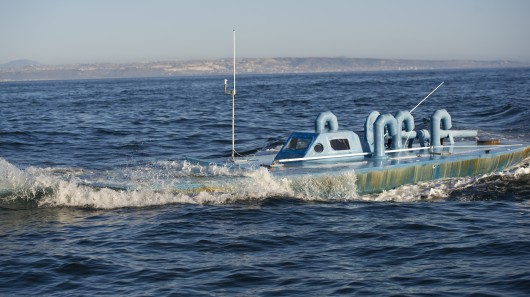
When someone mentions drug running, most people probably picture a person coming through an airport carrying a suitcase with a false bottom or with balloons stuffed up their nether regions. We don’t usually imagine things like submarines. Unfortunately, the South American drug cartels not only imagine them, but they build and operate them. To help combat these underwater smugglers, the Department of Homeland Security Science and Technology Directorate (S&T) is operating their own drug-running submarine called PLUTO to develop and test a new generation of detection equipment.

Named after the hard to detect (former) planet, PLUTO reproduces the characteristics of what are commonly called “narco subs.” When rumors of their existence began to circulate in the 1990s, narco subs were dismissed as something out of a James Bond film and nicknamed “Bigfoot” because everyone in drug enforcement heard about them, but no one had seen one. Then one was captured in 2006 by the U.S. Coast Guard in the Eastern Pacific Ocean.

Narco subs are not true submarines. Instead, they’re a form of semi-submersible or, to give them their official designation, self-propelled, semi-submersibles (SPSSs). They ride very low in the water with only about three inches (7.62 ) of freeboard above the waterline and are designed to give only a tiny radar profile. They also ride very rough and their crews of three or four have little to eat, bad air and no toilet facilities as well as sometimes having an armed guard as a supervisor.

The subs are also meant to be expendable at the end of a delivery “Drug-running is lucrative. It is cheaper to simply build another vessel than to run the risk of trying to get a vessel and its crew home,” said Tom Tomaiko of S&T’s Borders and Maritime Security Division.

PLUTO was built in 2008 and is home-ported at Eglin Air Force Base near Fort Walton Beach, Florida, where it is maintained by the Air Force’s 46th Test Squadron, though it operates in the Gulf of Mexico, and Atlantic and Pacific Oceans. Forty-five feet (13.71 m) long and running at a maximum speed of ten knots (11.52 mph/18.52 kph), though it only cruises at four to eight knots (4.60 mph/7.4 kph to 9.20 mph/14.81 kph), PLUTO can carry up to four crew, but usually only operates with one due to safety.

It’s used by the U.S. Coast Guard, Customs and Border Protection/Air and Marine (CBP/OAM), U.S. Navy, U.S. Air Force and other national agencies as a target submarine capable of mimicking a narco sub for the purpose of testing detection systems from ships, planes and even satellites at various angles and under different sea conditions.

Customs and Border Protection used PLUTO to test its Dash 8 maritime surveillance aircraft’s SeaVue radar to determine detection distances and aspect angles for optimal mission performance and the U.S. Navy tested its P-3 aircraft’s maritime surveillance radar system against the pseudo narco-sub.

PLUTO is only one part of an escalating war between drug cartels and law enforcement agencies. Recently, the cartels have started using true submarines that travel submerged, which means that PLUTO may now be fighting yesterday’s war.

According to Admiral James Stavridis, former Joint Commander for all U.S. forces in the Caribbean, Central and South America, “criminals are never going to wait for law enforcement to catch up. They are always extending the boundaries of imagination, and likewise, we must strive to push forward technology and invest in systems designed specifically to counter the semi-submersible. We need to be able to rapidly detect and interdict this new type of threat, both for its current effects via the drug trade, and – more troublingly – for its potential as a weapon in the hands of terrorists.” Source: Department of Homeland Security

Trade costs and corruption in Ports of Durban and Maputo

Recent years have brought an increased awareness of the importance of trade costs in hindering trade, particularly in the developing world where these costs are highest, says a report in the latest edition of Port Technology. The most salient type of trade costs have often been tariff duties and costs associated with the physical transportation of goods. As a result, several countries embarked on extensive programmes of tariff liberalisation and a significant portion of aid effort was channelled to investments in hard transport infrastructure, such as rebuilding railways and ports (the World Bank alone devotes more than 20 percent of its budget to transport infrastructure projects worldwide).

More recently, new light has been cast on the importance of a different type of trade cost: the cost imposed by the soft infrastructure of transport, defined as the bureaucratic infrastructure handling the movement of goods across borders. While there are many possible sources of inefficiencies stemming from the soft infrastructure of transport, recent research is beginning to document the role played by corruption in transport bureaucracies in driving trade costs. This article provides an overview of this research.

Research into corruption

Corruption can take many forms and emerge in many different phases of the process of clearing goods across borders. Sequeira and Djankov (2011) documented in great detail the ways in which port corruption emerges in Durban and Maputo in Southern Africa – this report is featured in my next post. This research was based on a unique dataset of directly observed bribe payments to each port bureaucracy for a random sample of 1,300 shipments.

The study began by defining two broad categories of port officials that differed in their administrative authority and in their discretion to stop cargo and generate opportunities for bribe extraction: customs officials and port operators. In principle, customs officials hold greater discretionary power to extract bribes than regular port operators, given their broader bureaucratic mandate and the fact that they can access full information on each shipment, and each shipper, at all times. Customs officials possess discretionary power to singlehandedly decide which cargo to stop and whether to reassess the classification of goods for tariff purposes, validate reported prices of goods, or request additional documentation from the shipper.

Regular port operators, on the other hand, have a narrower mandate to move or protect cargo on the docks, and at times even lack access to the cargo’s documentation specifying the value of the cargo and the client firm. This category of officials includes those receiving bribes to adjust reefer temperatures for refrigerated cargo stationed at the port; port gate officials who determine the acceptance of late cargo arrivals; stevedores who auction off forklifts and equipment on the docks; document clerks who stamp import, export and transit documentation for submission to customs; port security who oversee high value cargo vulnerable to theft; shipping planners who auction off priority slots in shipping vessels, and scanner agents who move cargo through non- intrusive scanning technology.

The organisational structure of each port created different opportunities for each type of port official to extract bribes: the high extractive types -customs agents- or the low extractive types -port operators. These opportunities were determined by the extent of face to face interactions between customs officials and clearing agents, the type of management overseeing port operations, and the time horizons of each type of official.

Durban and Maputo

In Durban, direct interaction between clearing agents and customs’ agents was kept to a minimum since all clearance documentation was processed online. In contrast, all clearance documentation was submitted in person by the clearing agent in the Port of Maputo. The close interaction between clearing agents and customs officials in Maputo created more opportunities for corrupt behaviour to emerge in customs relative to Durban.

In Maputo, port operators were privately managed but in Durban, most terminals (for containerised cargo) were under public control, with very lax monitoring and punishment strategies for those engaging in corrupt behaviour. Private management in Maputo was associated with fewer opportunities for bribe payments due to better monitoring and stricter punishment for misconduct. As a result, the organisational features of each bureaucracy determined that the high extractive types in customs had more opportunities to extract bribes in Maputo, while the low extractive types in port operations had more opportunities to extract bribes in Durban. While corruption levels were high in both ports, bribes were higher and more frequent in Maputo relative to Durban.

Finally, port officials with opportunities to extract bribes at each port differed in their time horizons. Customs in Maputo adopted a policy of frequently rotating agents across different terminals and ports, and since bribes varied significantly by the type of terminal at the port, customs agents were aware of the risk of being assigned to terminals with lower levels of extractive potential. On the other hand, port operators in Durban had extended time horizons given the stable support received from dock workers’ unions. Customs officials were therefore the high extractive types with the shortest time horizons, the broadest bureaucratic mandates and more opportunities to interact face to face with clearing agents. As a result, they extracted higher and more frequent bribes, relative to port operators in Durban (the low extractive types) who had longer time horizons and narrower bureaucratic mandates. Source: Port Technology.

Decay in ‘morals’ – irrational and corrupt behaviour

My recent post – Harbour mafia busted! – prompts a serious look at human judgement and the cause and effects of corrupt behaviour. The tragedy of the hit on Johan Nortje brings to reality the result of playing with danger. Those that will subsequently be convicted, most likely never conceived this ‘danger’ at the moment of their initial courtship with the criminal underworld. Neither did they perceive that a fellow law enforcement colleague would bear the brunt of their wrong-doing. That’s the reality of consequence of choice.

The origin of customs collection and control dates back more than 2000 years, as do attempts to undermine a country’s fiscal and economic security. Therefore the scourge of corruption is as old as the laws which gave rise to ‘controls’ at borders and ports of entry. The levying of taxes has always resulted in attempts to circumvent the payment thereof. Corruption of senior officials and politicians is the Achilles heel of poor and developing countries. It is a crime that is largely invisible but its consequences can be far reaching. It destroys confidence and morale in law enforcement structures, and robs local laborers and companies trying to etch out a decent living.

Over the centuries, and particularly the latter decades, governments and their law enforcement arms have fought against fraud in various ways. Populous countries (in the past) always had an abundance of people to staff the Customs or Border agency. Above all it was important for the government of the day to be seen as providing employment, hence a measure of comfort at election time. The close-knit command and control of port and border officials under strict observation of their respective port commanders – who in the past had ultimate control over their regions – proved effective in the main in preventing cross border crimes. However, the emergence of bootlegging and the mafia in the 1930’s (USA) proved a real challenge given that these ‘movements’ had an enormous amount of money to neutralise uncooperative customs officials and law enforcement officers. Buying the cooperation of officials left ‘blackmail’ hanging over the heads of the unfortunate officers. In many cases, breaking silence or turning state witness meant possible assassination for the individual and possibly his family as well. Yet, let it be said that such cross-border crime was very much tangible by way of the persons and the modus operandi involved. No, I’m not suggesting it was easy to contain, but it was certainly a whole lot more visible and localised for the authorities to contend with and address. Still, the manpower and the cost to deploy large task forces on the ground were inhibitive for law enforcement agencies.

Today, the world of ‘illicit goods’ is global; the operators can direct activities from the remotest parts of the world thanks to the information super-highway and all means of information and communication technology available today. Similarly, technology ensures near real-time payments to willing participants in crime. Despite this, the matter of ‘illicit goods’ remains a physical movement requiring ‘people’ to arrange and oversee transportation, and distribution to the buyer. It is a well-known fact that the movement of ‘illicit goods’ has a corresponding financial pipeline through which the profits of crime are channeled. Law enforcement has a challenge in trying to piece these activities together. This will involve cooperation of multiple agencies to bring about a result. More often than not, the selfish ambition of one or other agency overrides the collective approach to smash a syndicate. Once again its the age of key performance areas and indicators, and outcomes based initiatives which get ahead of the real issue – to neutralise an enemy. Today furthermore, unfortunately, its better to secure a huge penalty or forfeiture than to apprehend criminals and face months if not years in court – the revenue target is the primary goal. Money drives both the state and the criminal underworld.

Maybe I will be censured yet. Nonetheless, I will conclude with exercising some freedom of expression concerning views on what I believe fundamentally contributes to criminal and irrational behaviour. The democratic way of modern life has indeed perpetuated a lot of freedoms. With this, however, comes a corresponding responsibility and ability to discern between what is right or wrong. Freedom comes in both guises, sometimes simultaneously so as to confuse the mind – not unlike the ‘forbidden fruit’ in the Garden of Eden – making a choice between the right or wrong path. A flaw in democracy is that it tends to present everything in a “yes we can!” mentality. What this does is ‘challenge’ the individual or group to ‘achieve’. There might be little wrong with this, however, there are no documented guidelines on how to ‘achieve’, hence it is concluded that one must ‘achieve at all costs’. So what has this to do with corruption? The multiplicity of (false) ‘comforts’ offered by the modern world tend to excite the senses and numb the conscience. After all democracy tends to advocate equality in everything, so what can be wrong with a bit of excess, since one has freedom of choice? Wrong! unfortunately, this is the very mentality which drives ‘corrupt’ behaviour. There will always be consequences. Add to this indiscretion some measure of peer pressure, jealousy, or avarice and you have a recipe for a corrupt organisation.

The causes are multi-facetted –

  • The blatant disrespect of corporate structures in not recognising the need for staff to spend quality time with their families. (Less work = less profit and poor returns)
  • Parents too focused on personal gain or pleasing the shareholder, rather than tending to the real needs of their children to build honest citizens.
  • Ill-disciplined ‘educators’ who care little about their ‘learners’ and more about their rights!
  • Law enforcement agencies focused on revenue collection rather than law enforcement.
  • Lack of knowledge amongst politicians and heads of government agencies as to what their real mission ought to be.
  • Lack of a real support base within law enforcement agencies to deal with the threats being faced by their organisation.
  • Lack of role models in our society.

Is it little wonder then that the majority of tendencies today follow corruption? I’ve yet to note a single statesman (sorry states-person) who is morally upright. I would however like to concede that at least that maverick Prof. Jonathan Jansen (University of the Orange Freestate) is not afraid to stand up and talk straight.

Those interested in the topic of organised crime in Africa should can an interesting analysis (below) which the Internet has freely allowed me to obtain. ICT is without doubt a necessary evil!

Related articles

Durban – Harbour mafia busted!

A 3-year covert investigation into a multi-billion rand racket at the Durban harbour has exposed an international mafia, allegedly bribing customs and police officials to allow in container-loads of contraband.

This week, a former Sars customs official was taken by surprise when Hawks and Sars investigators swooped on his Umbilo home and arrested him on 80 counts of alleged corruption. Etienne Kellerman, 47, a former Sars anti-corruption task team member, appeared in the Durban Regional Court on Tuesday. He was released on R100 000 bail and the matter was adjourned to next week. Kellerman is suspected of receiving substantial benefits for allowing contraband through. It is alleged that Sars lost millions of rand in revenue as a result. He resigned from Sars three years ago, days after he was quizzed by Sars investigators about his alleged role in the racket. His job had been to profile and identify high risk companies and containers entering the country.

A further seven Sars officials from Durban and Johannesburg were suspended for their alleged roles in the smuggling racket. Hawks investigator and project manager of this undercover operation, Colonel Brian Dafel, said that in coming weeks they would swoop on 100 more suspects in the country, including Sars officials, police and syndicate members, on charges ranging from racketeering, corruption, money laundering, extortion, murder and attempted murder.

Warrant Officer - Johan NortjeHe said the investigation was triggered by informers who tipped them off about the alleged crooked activities and racketeering at the harbour. The undercover investigation was a joint operation by the Hawks, Sars, independent law enforcement agencies and other key role players, Dafel said. He said they were also closing in on suspects believed to have ordered the hit on Warrant Officer Johan Nortjé, an officer in the police’s protection security service. He was responsible for investigating smuggling of goods and drugs through Durban harbour. A hit was allegedly ordered on his life days after he made a R100m counterfeit bust at the harbour. Nortjé was gunned down outside his Montclair home on January 17 last year, 10 days after he had made the bust.

“Nortjé was one of the few honest cops. He was aware of the container racket and was determined to expose it. He was killed because he was hampering the operation of the syndicate members,” Dafel said.

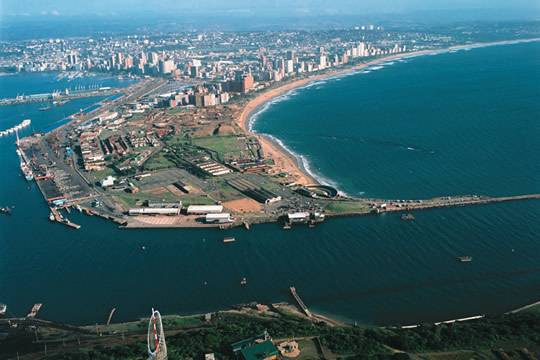
“This is a very dangerous investigation that involves extremely high levels of corruption. “Durban harbour is the biggest port authority that handles 40 percent of the containers nationally. In the past two years, during this investigation, we have seized over R1 billion worth of counterfeit goods and contraband.” He said that several witnesses had been placed in witness protection programmes as they feared for their lives. “People’s lives have been threatened and hits have been ordered. But, none of this will deter this investigation.

Dafel told the Daily News that investigations had revealed that certain SARS and police officials were working in teams between KZN and Gauteng. “This could not be done alone. They worked in groups, including those who cleared the documentation to those who inspected the containers and gave them the final clearance.

Thousands of containers pass through the harbour daily and it is impossible to check each and every one. That is how the counterfeit goods and contraband got through so easily. The syndicate members also communicate through cellphones making it a very smooth operation. He said every member of the syndicate was paid for his or her role in allowing the illegal goods through. The potential value of the illegal commodities was between R10 and R20 million for each container. The international mafia pays bribes of up to R30 000 per container that is allowed to pass through customs undetected. It is reported that one of the biggest problems is the clearing agents who work in cahoots with the police and syndicate members.

Dafel said many of the SARS and SAPS officials who were being investigated stood accused of allowing counterfeit goods or contraband to enter the country illegally, or under-evaluating containers. Since the investigation started, much stricter measures are in place at the harbour making it difficult to smuggle goods into the country. “We have closed the gap significantly for any form of corruption to take place. Also, staff know that they will be arrested and charged if they break the law,” Dafel said.

He said they were also working closely with people abroad and international law enforcement agencies to close in on the racketeers. “There are big name international companies, mainly from China, that are also being investigated. In fact, the goods imported from China are the biggest problem.” Source: Daily News E-edition

Related articles