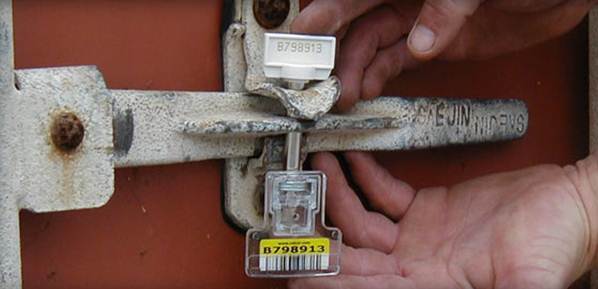
Cargo seal inspection – (Picture: http://www.recolor.com)
Finland – Recent criminal proceedings in which a driver was accused of neglecting to control the cargo security of a trailer which he had picked up from the port of Vuosaari, have been set aside by the Helsinki Appeal Court. When Customs conducted a safety inspection of the cargo, it was found that the cargo had not been secured properly. It was undisputed that the insufficient securing of the cargo could not be seen from outside, and that the driver had checked the trailer, but the trailer had been sealed with the transport company’s seal.
The court first considered whether the transport company’s commercial seal overruled the duty to carry out a cargo safety check. The expert witness testified before the Helsinki District Court that according to the Road Traffic Act, a ‘seal’ is only an official Customs seal (subject to the TIR Convention), and that the term does not include the commercial seals used by transport companies. However, the district court found that a ‘seal’ is not defined in the Road Traffic Act or its preparatory work, and the term thus includes commercial seals. It went on to determine whether checking the cargo could have caused unreasonable harm or delay. The driver stated that pursuant to the employer’s instructions, a cargo unit must never be opened alone; two people must always be present. The district court found that it was not proved that opening the trailer would not have caused unreasonable harm or delay to the transport assignment, and hence the driver had done his best. The criminal charges against the driver were rejected.
The proceedings before the Helsinki Appeal Court were limited to the first question – the definition of the seal. The appeal court found no reason to change the district court’s judgment. The appeal court judgment is final. It is quite common that a driver is assigned to pick up a transport unit which is already loaded, secured and, on many occasions, also sealed. Under these circumstances the driver has no means to carry out cargo safety checks from anywhere other than outside of the transport unit. Source: International Law Office & Hammarström Puhakka Partners, Attorneys (Finland)
 What Happened to the Portcullis?
You must be logged in to post a comment.