Trends such as globalization, lean processes, mass travel and the geographical concentration of production have made supply chain and transport networks more efficient, but have also changed their risk profile. This World Economic Forum report, produced in collaboration with Accenture, calls for new models to address supply chain and transport risks. It highlights the urgent need to review risk management practices to keep pace with rapidly changing contingencies facing the supply chain, transport, aviation and travel sectors. Download the full report here! Source: Creamer Media
Tag / Risk management
Pre-shipment Inspection (PSI) – an antiquated approach
Recently, an organisation called Global Inspection Group (GIG) has advocated PSI – an import verification system – as a solution to counteract South Africa’s trade deficit. The article ‘Import verification would outlaw customs fraud’ alludes to the apparent success of these mechanisms in other African states to support quality and import standards in those countries, respectively. Because South Africa has no verification of imports system ‘it is easy to systematically under-declare goods’, the article states. Furthermore, it mentions that a Finance ministry would benefit from such a system ensuring the collection of the correct duties. [Really? how naive].
South Africa is a free country, and it follows that organisations will go to extremes to secure a business foothold in the country. The question is – to what length and to what end? If any ministry of finance were to rely on a PSI company, it would first disband its customs department, because there is evidently no trust in its frontline and post clearance capability. Most governments (if not all) are pretty much aware of the broader international customs developments championed by the WCO. In recent years, the WCO has developed several diagnostic studies and programmes – with the option of donor funding if required. There would therefore be no sense or credibility in a government that would persist in pursuance of PSI services for fiscal assurance.
Any trade practitioner and supply chain operator in South Africa will readily confirm the hectic ‘change’ programme which is being pursued under Customs Modernisation. These changes and their associated systematic innovations and efficiencies are by no means the result of government capitulating in the face of illegitimate trade. No, it’s a conscious decision to take responsibility for the problem, and together with the allied trade to improve the situation.
It is therefore high time that such organisations which front themselves with the ‘be-all and end-all’ systems in Customs’ tariff and valuation appraisal rather seek a more practical and benefit-delivering model than one which not only scams governments for service and inspection fees, but also offers no benefit to trade. Included are those BOT vehicles offering governments ‘free’ cargo scanning equipment in exchange for a lucrative inspection fee. None of this is based on risk management and is purely profit focussed. The concept forgoes most if not all, the modern customs principles and standards promoted by the WCO. The buzz word is ‘Capacity Building!’
The reality in all of this should be clear. No private sector entity can replace Customs. Outsourcing in any event would require government to set up a vehicle of its own to ‘ensure’ that the outsourcer is doing his job. If there is a dearth in knowledge and skills, then it is up to government to rectify the situation. Source: FTW Print version.
Related articles
- WCO News – October 2011 Edition (mpoverello.wordpress.com)
- Another WCO resource for the Customs and Trade Professional (mpoverello.wordpress.com)
WCO News – Latest edition
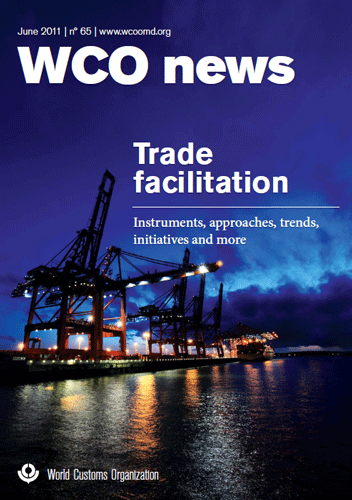 The June 2011 edition of the WCO News is a bumper 56 pages. You will find several interesting articles relating to the latest developments and initiatives on trade facilitation. A particular article features East Africa’s efforts at facilitation at its land borders. Read also about –
-
Korea’s Client-oriented Logistics Information System which automatically measures the time taken for processing imported cargo at each stage of clearance from arrival at port to release (arrival at port > bonded warehouse > import declaration > permission > release), to diagnose and eliminate bottlenecks in logistics.
-
TradeFIRST, Singapore Customs’ latest initiative to improve trade facilitation through better partnerships with business. TradeFIRST is a single trade facilitation window that integrates the concepts of facilitation, compliance and risk management, and promises to make trade easier, fairer and more secure.
-
Latin America leads the way with AEO implementation, and
-
The concept of multi-layered security.
The Magazine is available in traditional PDF format or as an ebook. www.wcoomd.org
Related articles
- A new Customs Journal (mpoverello.wordpress.com)
 What Happened to the Portcullis?
You must be logged in to post a comment.