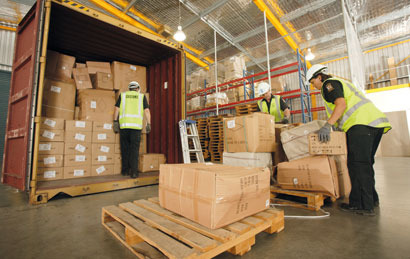
Customs’ JBMS will ultimately provide the Trade Single Window, through which importers and exporters can deal directly with government agencies, and Customs
and MPI can more effectively manage risks for goods crossing the border (credit: FTD Supply Chain Magazine)
The Joint Border Management System (JBMS) programme is a replacement information system that will meet New Zealand’s future border management needs. Comprising a set of integrated information technology products, owned and hosted by Customs and jointly operated with the MPI, it will give Customs, MPI and industry better information and risk-assessment tools to protect New Zealand’s society, trade and biosecurity.
“An agile, effective and efficient border management system is essential for protecting New Zealand from economic, social and environmental harm, for maintaining and improving our international competitiveness, and for collecting over $9 billion a year of government revenue,” says Customs deputy comptroller Robert Lake. “We need a system that keeps us secure, can handle increasing numbers of people, goods and craft, and meets trading partners’ expectations of integrated systems.”
The JBMS will ultimately provide a single electronic point of contact – the Trade Single Window (TSW) – through which the import and export industry can deal directly with government agencies for customs and biosecurity requirements, and Customs and MPI can more effectively manage risks for goods crossing the border.
Companies will be able to submit a single application to both Customs and MPI to lodge import declarations. It’s faster and more efficient. And they can do so directly, not through a third party like they do now.”
The key functions of the Single Window were to have been progressively available to industry from April 2013, however, Customs said it would take three months longer than it originally anticipated for importers and exporters to experience any benefits from the initial $75 million investment in a new Joint Border Management computer system, JBMS. IBM had been due to deliver the first tranche of JBMS, which is a joint initiative between Customs and the Primary Industries Ministry, last month. Customs deputy comptroller Robert Lake said the agencies had decided to push back the launch and deliver the project in stages. Click here for more details.
Risk management
Customs has taken a phased approach to designing and building the JBMS programme to ensure secure information management and to enable Customs to manage the risks of turning on a major new IT system. “Each stage – or tranche – will be thoroughly tested with industry until it is performing as expected. Industry will be able to migrate over to the new system over time. Our current systems will remain in place until the new system is fully proven,” Mr Lake adds.
Tranche 1 has been funded by the government and has been underway since July 2011. Costs of the JBMS are shared with industry, and cost recovery charges will start from 1 July.
“From April, the system will support border agencies to use shared information to work collaboratively in analysing travellers and goods. This will allow border agencies to target risk more accurately and will therefore provide greater consistency and certainty in the end-to-end border clearance process for all goods,” Mr Lake says.
In the second tranche, Customs plans to fully replace all background systems, and add further enhancements and the remaining business functions to the TSW. The second tranche is subject to further government approval and funding.
Trade Single Window
The TSW is one of the major components of the JBMS and will enable parties involved in international trade and transport to submit the craft and cargo clearance data that is required by New Zealand’s border agencies electronically, once, through one entry point. They will also be able to register themselves as users of the TSW, and maintain their own details.
As part of the first tranche, the TSW will include registration (of customers and users), most lodgements (craft and cargo clearances, such as import and export entries, and cargo reports), status enquiries and response functions. In the second tranche, Customs and MPI will investigate options for providing further functions, including remaining lodgements, a reference library, information updates, transaction history and other payments. Customs and MPI are also working on a plan to join up MPI’s animal products and plant export certification systems to the TSW.
“The TSW is expected to deliver significant benefits to importers, exporters and others in the international trade supply chain,” Mr Lake says. “These will include improved coordination of processes and earlier certainty of border agency requirements when advance data is provided. Compliant traders will be able to get their goods through the border with greater speed, consistency and certainty. However, the potential benefits for industry will depend on how individual participants use the information from the TSW to make their supply chains more effective and efficient.” The JBMS is expected to deliver significant benefits to the import and export industry over the next 10–15 years. Source: www.ftdmag.co.nz
For further information also visit New Zealand Customs website – Joint Border Management System (JBMS)



 What Happened to the Portcullis?
You must be logged in to post a comment.