Border Madness!

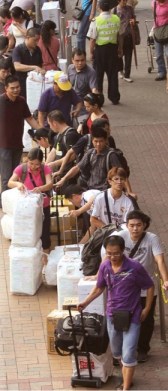
Mainland Chinese visitors line up and wait for check in outside Hong Kong’s Sheung Shui train station with packages of diapers to be parallel imported into Shenzhen for resale.

While communist China bears the brunt of criticism for its exportation of low cost and in many cases inferior products to the rest of the world, the following article suggests one should spare a thought for the Chinese citizens themselves given what they have to put up with from the authorities between Hong Kong and Shenzhen.

The recent hard crackdown on smugglers and couriers across the boundary between Hong Kong and Shenzhen has cut deeply into the business of parallel trading on both sides of the border, and thus far, appears to have reduced the nuisance problem caused to residents of the northern New Territory. However, with the crackdown on-going and the Mass Transit Railway Corporation (MTR) adding further pressure by restricting the dimensions and weight of passenger luggage going across the border, complaints have started buzzing, that the move may have frightened away the passenger couriers, but not the syndicates coordinating them behind the scenes.

Effective 9 October 2012, the Mass Transit Railway Corporation (MTR) imposed a maximum weight limitation of 32 kilograms or 130 centimetres in length for passenger luggage on the East Rail Line, under a three-month trial scheme. Could you just imagine this at an African border crossing? Passengers are allowed only one piece of baggage. All their small parcels and suitcases are required to be bundled up into a single “package,” all part of the bid to curb the passenger-couriers whose clamouring and crowding had become a serious issue for neighbours of MTR in New Territories.

The restrictions were seen as MTR’s contribution to the collaborative effort that involved governments on both sides of the border, to cut down on so-called parallel traders and smugglers. MTR’s new rule has, in general, earned praise from residents of northern New Territory because the nuisance problem caused by the traders/smugglers has been alleviated. However, for residents of Shenzhen, who travel back and forth every day, or residents of `other parts of the mainland who come to Hong Kong for shopping, the size and weight limitations seem be “unnecessary” and “troublesome”.

“I was often asked to buy things in Hong Kong on my way home: cooking oil, rice, baby formula, tissues, etc. I really don’t have time to care about how heavy they are or how long they are,” said Go, a resident of Shenzhen. He Hua, also a Shenzhen resident living in Luohu district who comes to Hong Kong to go shopping two to three times a month, also doesn’t like the new limitation. “I came to Hong Kong regularly to buy things for myself and my family. I paid my money and followed regulations of the Customs, why should I worry about my weight and length? If the goods are all legal, why can’t I take them on the train at one time?” said Hua, who had carried six cans of baby formula with her, which she claimed were for her elder sister’s baby.

Recently, there has been a strengthened effort to combat parallel trade, with a collaborative effort between the Customs and Excise Department of the SAR and the Shenzhen Anti-Smuggling Bureau. The action uncovered 120 cases of parallel trading and made 123 arrests, with the unpaid taxation of the confiscated goods amounting to one million yuan. On the other side of the border, business associated with cross boundary goods was also affected. In North Huaqiang district in Shenzhen, which had been long recognized as the “centre of parallel trading” of “grey goods” from Hong Kong, business has shrunken since the crackdown.

A shop owner in North Huangqian area told China Daily that he had expected to make a huge profit by selling iPhone 5, the latest release by Apple Corporation. It never happened, because his Hong Kong supplier informed him that it was too difficult and that it was risky to get the iPhone 5 across the border. And the seller couldn’t get the supply he had counted on.

“The whole business chain of parallel trading depends on the ‘suppliers’ to smuggle goods from Hong Kong to Shenzhen, especially electronic goods. Now the suppliers have trouble getting through the border, (so) we have trouble getting the goods,” said the anonymous shop owner. Because of serious supply shortage, the price of “grey goods” has soared significantly on the mainland side of the border. The best example was iPhone, which sold originally at HK$5,688 (US$733.8) at the Apple Store in Hong Kong, but was priced at 8,000 yuan (US$1276.5) at the anonymous shop owner’s store. Insiders of the courier industry also told China Daily that the price for smuggling goods across the border with “ant house-moving” tactics had increased from 22 yuan per kilogram to a record high of 50 yuan per kilogram.

The business of stores that sell Hong Kong goods in Shenzhen has picked up since the crackdown, as people who live along the border in Shenzhen choose to buy daily-use goods in local stores – like cooking oil, rice and baby formula, instead of going to Hong Kong by themselves. “We have adequate Hong Kong goods, don’t worry; they are all fresh and delivered to us fresh every day,” said the owner of a store selling Hong Kong goods in Shatoujiao, or Sha Tau Kok in Cantonese, in eastern Shenzhen. The store owner refused to answer how he managed to get “adequate supply” from Hong Kong every day.

The crackdown on smugglers, especially the MTR weight limitation, had stopped individual couriers; however, it didn’t shut down the syndicates coordinating behind the scenes. What’s more, there are some 157 online stores that sold Hong Kong goods on Taobao, the biggest online shopping market in the mainland. The record on the website showed that one of the big shops had sold out 1,357 pieces of Hong Kong goods in the past week, 90 percent of which are daily use goods and food. Source: The China Daily

“Blood Ivory” – Huge seizure of Illegal Ivory in Hong Kong

An emperor, faced with the task of selecting a successor, devises a test: he lays out an array of valuable artifacts — items of gold, jade and ivory — and asks each of his sons to choose one treasure. One prince ponders his options for a while, before selecting an ivory scepter. The emperor is pleased. Ivory is valuable, he says, and also imbued with wisdom. The son with the scepter will rule. This, of course, is merely a fable. But the tale of the emperor and his son hints at ivory’s enduring lure in China. For millennia, it has been seen as a symbol of wealth, a source of wisdom and a sign of nobility. This helps explain why more than 20 years after an international ban on the trade of elephant ivory, the business is booming. “With more disposable income in mainland China, many people are flaunting their wealth, and ivory is seen as a luxury product that confers status,” says Tom Milliken of the Wildlife Trade Monitoring Network. “We are seeing the worst poaching of elephants and the worst illegal trade in ivory over the last 23 years.”

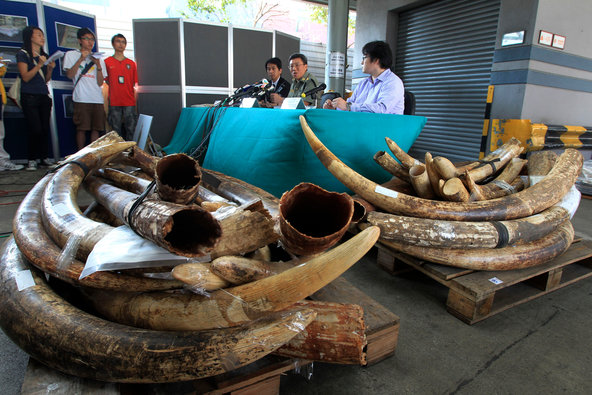
Authorities in Hong Kong have intercepted one of the largest shipments of illegal ivory in history – 1,209 elephant tusks and ivory ornaments weighing more than 8,400 pounds. The Hong Kong Customs and Excise Department announced the seizure on Saturday of 3,813 kilograms of ivory hidden inside two containers shipped from Tanzania and Kenya. One container was labeled as carrying plastic scrap, the other was marked as dried beans.

It was the largest-ever seizure of contraband ivory in Hong Kong. Even within the context of soaring wildlife poaching, the numbers are staggering: the equivalent of more than 600 dead elephants. So lucrative is the ivory trade now that well-armed mafias have gotten in on the act. Hong Kong officials estimated the value of the seizure at 26.7 million Hong Kong dollars, or just under $3.5 million.

The customs agency, which said in a statement that it had “smashed” the ivory smuggling case, reported no arrests. But the South China Morning Post reported that seven people in China were arrested in connection with the seizure. Demand from an increasingly affluent Asia, improved international transport and trade links, and weak enforcement and feeble penalties (in many countries) have caused wildlife poaching to jump over the past decade or two.

More than 300 elephants were killed in Cameroon alone early this year. A video from the World Wildlife Fund shows some of that grim slaughter. In this article, published in September, Jeffrey Gettleman reported that ivory — like blood diamonds from Sierra Leone or plundered minerals from Congo — is now a “conflict resource,” used to help finance conflicts across the African continent.

“Some of Africa’s most notorious armed groups, including the Lord’s Resistance Army, the Shabab and Darfur’s janjaweed,” he wrote, “are hunting down elephants and using the tusks to buy weapons and sustain their mayhem.” Members of some of the African armies backed by the U.S. government, Jeffrey reported, also have been implicated in poaching elephants and dealing in ivory. Source: New York Times

Related Articles

Is South Africa being screwed by China?

In recent days there’s been mutterings amongst several business commentators concerning the state of the South African manufacturing sector and its inability to compete in the local economy in the face of ‘so-called’ cheap imports. For once I heard some common sense instead of the usual WTO/economist waffle which normally just confuses people instead of shedding light on the inherent problems. What the Business Times article below suggests is that our prevailing job plight is self-induced and should not be blamed entirely on rogue elements alone. Under valuation and mis-declaration have and always will pose a challenge to any country. The blame has been placed on Customs not doing its job; yet, the problem appears to lie at the feet of policy makers who have made foolish decisions for which the country as whole now pays the price. 

The trouble began soon after 1994, when then Trade and Industry Minister, anxious to prove to the then rich and powerful, and sceptical, West what lovers of democracy and free markets they were, removed tariff protection on cheap imports against a considerable body of expert advice. And 12 years before we needed to, because the World Trade Organisation‘s predecessor, GATT, had given South Africa 12 years to modernise its manufacturing, improve its skills and prepare itself before lowering import tariffs.

At the time, Trade and Industry Minister and the government thought South Africa did not need a grace period. Leslie Boyd, then head of the Anglo-American industrial division, warned of the devastating consequences but to no avail. “They thought if they took the crutches away we’d become a free market economy and we’d be competitive,” says Stewart Jennings, chairman of the Manufacturing Circle which represents thousands of manufacturers in SA. “It was the most ridiculous thing you could ever imagine. Those of us in business know there is no free market in the world. Every country protects itself. We don’t. Here’s an economy without skills that just throws open the tariffs. We’re the country that’s whiter than white in terms of the WTO. Everybody else just abuses us.”

Business consultant Moeletsi Mbeki opines “[government] is too ideologically orientated, it operates from ideology rather than from practical expertise. This motivates our relationship with China. The Chinese can do no wrong.”

One of the worst mistakes they made, he believes, was to sign an agreement that gave the Chinese market economy status which it did not and does not deserve. The talk was that SA agreed to do this as compensation for imposing a three-year quota on Chinese textile imports. The effect on SA’s manufacturing sector has been devastating. “As a consequence of that agreement it is virtually impossible for us to get countervailing duties into China through ITAC [the International Trade Administration Commission which used to fall under the Department of Trade and Industry but is now under Ebrahim Patel‘s Department of Economic Development],” says Stewart Jennings. “We’ve battled to get dumping duties or safeguards against China. Most of the applications that have gone to ITAC have been kicked into touch.”

First, China starts with a currency that is 30% undervalued. It manipulates it, so any goods it exports to SA are 30% cheaper than they should be. On top of that there are all sorts of incentives for Chinese exporters. And then, as Jennings says, attempts by local manufacturers to defend themselves by applying for countervailing duties more often than not go nowhere.

Iraj Abedian of Pan African Investment and Research says the short answer to the question is yes, we are being screwed. “Not because the Chinese have been smart but because we’ve been snoozing and naïve.”

SA was so flattered to be asked to join the BRIC (Brazil, Russia, India, China) club of developing economies that it did not drive a hard enough bargain. “We were romanticising our relationship with China and celebrating the fact that China was inviting us to join BRIC. We took it as a form of political honeymoon without recognising its effect on manufacturing, without assessing our counter-strategy for safeguarding national interests in the form of jobs and tax revenue.” China needed SA to join BRIC at least as much as SA itself wanted to join, but SA failed to capitalise on this.

Executive director of the Manufacturing Circle, Coenraad Bezuidenhout, who has observed the effect at close quarters, thinks part of it is that “our guys find the prospect of dealing with China daunting. They feel we need China as a market for our raw materials more than China needs us.” He thinks this attitude reflects a worrying lack of professionalism on the part of those who are paid to battle for SA’s interests. “We should be leveraging our position with regard to our minerals and our access to African markets far more than we do when we deal with China.”  Source: Business Times

Open Borders and Integrated Supply Chains break down Global Trade Barriers

East Asian economies have recorded marked improvements in their ability to enable trade, while traditional frontrunners Singapore and Hong Kong retain a clear lead at the top of the global rankings, according to the Global Enabling Trade Report 2012, released today by the World Economic Forum.

The report, which is published every two years, also confirms strong showings for Europe’s major economies, with Finland and the United Kingdom both advancing six places to 6th and 11th, respectively, and Germany and France remaining stable at 13th and 20. Other large economies fare less well: the US continues its decline to 23rd, as does China (56th) and India (100th). Among emerging economies, Turkey (62nd) and Mexico (65th) remain stable while Chile (14th), Saudi Arabia (27th) and South Africa (63rd) climb in the ranking. ASEAN members Thailand (57th), Indonesia (58th) and the Philippines (72nd) also improve. Perhaps the proponents of OSBPs and a BMA in South Africa have not read this or have deeper insight into the matter.

As well as ranking nations’ trade openness, the report finds that traditional notions of trade are increasingly outdated as global value chains require new measurements, policies and cooperation. The report also finds that security, quality and trade can be mutually reinforcing through supply chain integrity efforts, but a knowledge gap in identifying buyers remains an important barrier. The biennial report, covering 132 economies worldwide, measures the abilities of economies to enable trade and highlights areas where improvements are most needed. A widely used reference, it helps countries integrate global value chains and companies with their investment decisions.

At the core of the report is the Enabling Trade Index, which measures institutions, policies and services facilitating the free flow of goods over borders and to destination. It breaks the enablers into four issue areas: market access, border administration, transport and communications infrastructure, and business environment. The Index uses a combination of data from publicly available sources, as well as the results of the Executive Opinion Survey, a comprehensive annual survey conducted by the World Economic Forum with its network of partner research institutes and business organizations in the countries included in the report. The 2012 results demonstrate that the ASEAN Trade in Goods Agreement has facilitated trade since its entry into force in 2010. This year, the report also directly captures the most important obstacles to exporting and importing in each country, and notes the strong links between import and export success. Source: AllAfrica.com / WEF

Hong Kong Customs Moves Forward With E-Lock Plans

The Hong Kong Customs and Excise Department (C&ED) reports that RFID-based container locks can effectively improve the security, convenience and visibility of the customs process for cargo entering the airport. In November 2011, C&ED began testing three types of electronic locks (e-locks) in order to speed up the process of performing customs checks on containers filled with cargo. The solution, known as the Intermodal Transhipment Facilitation Scheme (ITFS), was implemented as a way to streamline the clearance of cargo passing through customs at Hong Kong International Airport for cargo destined for areas both domestic and outside of Hong Kong. The installation and consulting services were provided by the Hong Kong R&D Center for Logistics and Supply Chain Management Enabling Technologies (LSCM), according to Frank Tong, LSCM’s director of research and technology development.

An electronic lock with an active RFID tag is being used to secure freight passing through
customs and Hong Kong International Airport, ensuring that the cargo remains tamper-free,
while also expediting the clearance process.

The Hong Kong C&ED estimates that the system reduces the amount of time required for clearing each container through customs, from two to three hours down to five minutes, since customs officials can now be assured that the containers have not been opened between their inspection at the border control point and their arrival at the airport. What’s more, the agency can now collect a digital record of where each container has been, along with when it was inspected.

Cargo is loaded into freight containers or directly onto trucks—such as those operated by United Parcel Service (UPS)—in Mainland China, and is then transported to a customs control point located at the border with Hong Kong, where C&ED officials inspect the cargo and clear it for entry into Hong Kong. Following that clearance, the shipment continues on to Hong Kong International Airport’s cargo terminal, where the goods are unloaded from the container or vehicle, and are placed into an air cargo container. Once this has occurred, the cargo is moved through another customs control point at the airport, where C&ED again inspects and approves or rejects its passage.

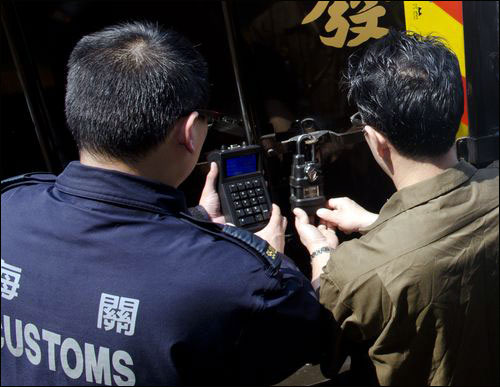
To speed up this process, the R&D Center implemented the use of an e-lock for the customs agency, consisting of a physical lock activated by a built-in active RFID tag, designed to receive a transmission from an RFID reader that allows the lock to be opened or closed. Three types of e-locks are currently being used, provided by three different vendors: Long Sun Logistics Development Ltd, CIMC Intelligent Technology Co. and CelluWare Research Laboratory. Each of the three products employs a different frequency—433 MHz, 315 MHz and 2.4 GHz—but all comply with the ISO 17712 standard for mechanical seals designed for freight containers.

LSCM has installed fixed RFID readers (provided by the three e-lock vendors) at two border control points—Lok Ma Chau and Shenzhen Bay—as well as at Hong Kong International Airport. When a shipment first arrives at either border control point, C&ED’s staff attaches an e-lock, reads the ID number encoded on its built-in RFID tag via a handheld reader, and links that ID with the vehicle registration number of the truck transporting the container. The transporting company must pre-register each vehicle with the Hong Kong C&ED prior to its arrival; the truck’s ID number is listed in the agency’s database, and the customs official can confirm that the vehicle is, in fact, the one expected.

That data, along with the specific cargo being transported, is then stored on the Hong Kong C&ED’s integrated tracking software platform, developed by LSCM, which collects and processes the data and then displays it for customs officials when necessary. The system stores the e-lock ID number linked to the vehicle ID, and transmits instructions to the e-lock, along with a password, thereby causing it to lock. The device also requires a physical key, which remains in the driver’s possession. In this way, two actions must be completed before the container or vehicle can be unlocked: The e-lock must be electronically unlocked via a password from a customs official, and the driver must use a key to physically open the padlock.

The shipment is then transported approximately 42 kilometers (26 miles) to the airport. The e-lock comes with a built-in GPS device that tracks the vehicle’s location as it moves. In that way, the e-lock stores a record of where the vehicle has been. When the lock is later read at the airport, the back-end software compares the actual GPS data against the container’s expected route. The system can issue alerts in circumstances in which an e-lock is found to have lost a GPS signal, or, based on GPS data, the truck appears to have deviated from the intended route.

At Hong Kong International Airport, a C&ED official either selects the container for inspection, or simply instructs the system to issue an unlocking command with the matching password; the container is then brought to a site where the cargo is removed and then loaded onto an aircraft, says Steve Wai-chiu Chan, a C&ED special duties officer. If the container is selected for inspection, the e-lock remains locked. In this scenario, a truck driver would be instructed to await a C&ED officer, and would be unable to unlock the container without providing the proper password. The C&ED officer, upon arrival, would then use a handheld device to read the e-lock, instructing it to unlock by providing the necessary password.

LSCM installed a total of 38 readers at the two land border control points, five logistic hubs at the airport and a marine control point known as the Kwai Chung Customhouse, for items arriving by sea (at the Marine Cargo Terminal located at the airport). Altogether, by February of this year, 109 containers had been equipped with the e-lock device. An average of 100,000 consignments pass through the border daily, and the ITFS e-lock system is utilized for about 17 percent of that cargo.

The solution has enabled a faster customs clearance process, as well as providing a digital record of what was unlocked, and thus inspected, and when this occurred. The system also improves security, since only officers who know the proper password can access the container. Ultimately, Chan says, “it enhances the Hong Kong logistic industry’s competency and reinforces Hong Kong’s position as a world-class logistics hub.” Source: RFID Journal and a word of thanks to Andy Brown (Tenacent) for bringing the article to my attention.

What westerners don’t understand about modern economy

Why is the Chinese economy thriving while that of the West is in crisis? The answer is of great relevance to Africans who have for decades embraced development models created in the boardrooms of Western capitals. Source: AllAfrica.com
Social dumping, unfair competition, undervaluation of the Chinese currency, the Yuan … these is some of the blame that most Western economists and politicians are laying on China. What about if this small beautiful world was off-target?

The growth of China and its strategic position as the first world emerging power have caused unprecedented disarray among the former powerful nations and a consistent visual navigation among Western economists and politicians who were undeniably a few years ago a reference for the success of their economic model which seemed to be irreplaceable. There was a state of complete disarray over 10 years in developed countries struggling to find a compass to better guide their ideas and understand where the position of the East is over the 21st century.

WHAT WOULD HAPPEN IF COMPETITIVENESS TOOK A NEW FACE?

It is disconcerting to see Western economists take childish considerations to explain their lack of competitiveness with China and saying that a huge industrial desert seems to have comfortably established itself in the West and arguing that employees are low wage-earners in China. It is not true. This assertion is wrong because wages are twice lower in Africa and South America than in China, although these two regions of the world do not attract the same amount of investments. The real reasons lie elsewhere.

1. There is a strong state in China exercising influence in almost all the economic process with clear and visible objectives to help millions of Chinese out of poverty.

2. In the make-up of product cost, labour accounts for about 2 to 4 percent or 10 percent at most. It is absurd that in the West, people use the issue of alleged high wages as an excuse to justify non-competitiveness of businesses. If an Italian producer put an item in the market for 100 Euros, whereas his/her Chinese rival is able to sell the same item for 25 Euros, the 200 percent difference cannot be justified as 10 percent of labour cost.

Even if wage cost was granted for free to Europeans producers, there will always be a 190 percent gap to be filled. Focusing on the value, the West will possibly find an initial solution to its current economic crisis which is, unfortunately, at its beginning; a solution to the costs of industrial architecture in the country, purchase of raw materials, the quality of vocational training and logistics to capture the customers who are at the other side of the world. We will review this issue below.

3. State purchased raw materials: Each manufacturer in the West has to find inputs on his own throughout the world, but China is using other methods through state giants to combine all purchases and, therefore enabling the country to be more successful and enjoy the best purchase conditions than a private Western individual waging a humanitarian war.

4 State semi-finished products: A car manufacturing company, for example, in the West has to get supplies from sub-contractors, but in China the government provides necessary stuff and bike manufacturers, for instance, will buy state-provided parts.

It is the same case for air-conditioner manufacturers and other key economic sectors; where an Italian manufacturer has to ensure alone the whole production, his Chinese counterpart, with whom he will be competing in the market, will only deal with a part of the production process, very often, when it comes to assembling and selling items. The parts that Chinese assemble in their factories are donated by their government in need of more revenues by creating more jobs with a view of revitalizing the national economy.

5. Energy is not sold in the opinion of the Chinese. In terms of stock exchange capitalisation, according to the news article published in the magazine Fortune Global for 2010, among the seven largest companies in the world, six of them are dealing with energy: American, British and Dutch companies and the three others are Chinese.

But the most interesting thing is the gap between Western and Chinese companies regarding the profits made by the former; they are higher than for the latter. For example, oil company Shell with 97,000 employees makes $20.116 billion in profits; Exxon Mobile with 103,000 employees generated a net profit of $30.40 billion. The Chinese company Sinopec seems to lag behind; with its 640,000 employees it made only $7.63 billion while its counterpart China National Petroleum, employing 1.5 million people, made just a profit of $14.37 billion.

According to conventional assessments in the West, Shell and Exxon are to be praised for their good job. However, in the pragmatic view of the Chinese, high profits are an indicator of impediment to nation to remain competitive. Chinese authorities consider that business competitiveness begins with energy cost. Companies operating in the energy sector should make profits to conduct their own market research and to explore potential customers, whereas in the West, generating huge profits will delight shareholders, because their names will be on the list of richest individuals in the world.

This different view on the economy was even more acute in 2008 during the crisis marked by a rapid rise in crude oil prices in the markets enabling all Western oil companies to make historically high profits. Exxon Mobile, for example, says there has been an 11 percent increase in its profits last year, $45 billion compared with 2007’s figures in France.

During the same year, the French company Total said that its profits were $22 billion (17 billion Euros), but its Chinese rival, Petrochina, a leader in terms of quantity of petroleum products, lost money because, I think, a very smart political decision made by Beijing government on freezing fuel prices led to a drastic drop of 22 percent in the net income in order to allow Chinese companies to remain always the most competitive in the world.

It is obvious that many petroleum products, such as plastic toys, car accessories, and packaging materials are made in China. Labour costs are not cheaper in the country, but the government expects real benefits at the end of the production line in terms of job creation, accumulating foreign currencies and trade surplus. China is not speculating foolishly in everything that moves, because it can cause a hard blow to the economy following the current situation of the West. China has set a clear objective to distribute generated wealth, to contribute to help millions of people out of poverty, and not to praise the glory of people whose names are on the annual list of the world billionaires in Forbes news.

In terms of petroleum products in Europe, it seems that those in power want to have their cake and eat it at the same time. We want business competitiveness, but at the same time put a 77 percent tax on energy products, accounting for nearly 40 percent in the make-up of the cost of finished products to be transported to the shop and delivered; even the travelling cost incurred by the buyer can also be taken into consideration.

The rise in oil prices is similar to this, but it is even worse in the electricity sector in China, which is almost free of charge. In 2010, power company State Grid Beijing Corporation, the top in the world, with its 1,564,000 employees and hundreds of millions of subscribers, made only $4.56 billion in profits, that is to say less than $5 billion generated by EDF, the French Power company, in 2009 (before it plummeted to 74 percent in 2010 due to setbacks suffered in foreign markets). This company has 158,000 employees, 10 times less people working for its Chinese rival and the number of its subscribers as well is 20 times fewer. The truth is that EDF, a state-owned company’s subscribers are like pigeons that need to be plucked with increases at the beginning of each year by using various pretexts, such as approval is to be obtained for a change in the oil price when it rises.

LOGISTICS AS A GEOSTRATEGIC TOOL FOR POWER

China has got sea behemoths that determine very often political prices. It is not dumping, but operators are just charged at cost price. For example, China Ocean Shipping Company (COSCO), owner of 201 container ships equivalent of 900,000 20-feet average size of a container, allowing freight forwarders to charge 20-40 feet containers from China for delivery in any port in Europe at incredibly low prices, in line with the goals the Chinese government wants to achieve in terms of export. It means that COSCO, a state-owned company, is not looking for profits for itself but looking for benefits of the whole Chinese nation. It is a very powerful geostrategic instrument contributing to the achievement of objectives, winning potential markets in order to bring the Chinese coasts closer to the rest of the world. So, the paradoxical thing is that the cost of land transport within Europe is often four times more expensive than a 30-day maritime transport from China to Europe. We know that 75 percent of trades in Europe are done between European countries and it is easy to guess that this represents an opportunity for China in the coming years if nothing is done by European economists to find a long-term solution to the current economic situation.

On 7 June, 2010, Cosco purchased parcels of land for 1.90 billion Yuan sold by Shanghai local authorities, meaning that this area will become in 10 years the first financial centre in the world. The real estate business is still under the Chinese government control. In fact, out of 11 parcels of land offered for sale, nine were purchased at auction by state-owned companies and only two were purchased by Chinese private companies.

The image of Cosco reflects the versatility of Chinese state-owned giant companies controlling almost everything in the industrial sector, ranging from port management ($ 3.4 billion to handle containers in the port of Piraeus in Greece in 2008) to real estate through the construction of ships and manufacture of containers.

This type of business provides the company with great advantages relating to competitiveness of Chinese businesses while their rivals have to go through a wide range of specializations, let’s say, to make as much profit as possible, according to the capitalist development model. For example, the French branch of COSCO, headquartered in Paris, has been operating in all the French port cities, primarily as a shipping company in the field of consignment, ship repair and air freight in order to achieve the same objective as a new product out of a Chinese factory and it should reach every destination without suffering any penalties regarding transportation or logistics.

In June 2011, 52 Airbus A320 were built in a new plant in Tianjin, China. Once again COSCO acted as a major contractor to execute programmes of Tianjin Airbus Company and was responsible for shipping heavy pieces from Europe to Tianjin, especially barge, inland and maritime transportation of containers, including domestic air transport to the unit in Tianjin.

Once again, the choice of a Chinese state-owned company is not made by chance, but it is the result of a geostrategic decision carefully thought out. In fact, COSCO has been chosen to conduct the same operation, but in the opposite direction, from China to Africa, for assembling an aircraft called XIAN MA-60, with which China pledged to replace the bad habits of Africans who buy only old airplanes from the West. This type of airplanes have been proved as real flying coffins over Africa and are paradoxically more expensive than the new ones built in China. The Chinese company, Xia MA-60, has already been providing equipment to Zimbabwe, Burkina, Burundi and South African airlines.

The Chinese People Daily newspaper of May 25, 2011 said that British Caledonian and Laos Airline and Sri Lankan Air-Force are serving about a hundred destinations and several companies in Asia, Africa and South America. Some indiscreet sources in Beijing report that COSCO will shortly transport aircraft pieces from Chinese coasts to Africa, in the port city of Kribi in Cameroon, where a deep water port is being built to dock large boats.

When the European Aeronautic and Defence Space (EADS) was installed in China, the Chinese government required this company to purchase a large number of its aircraft, but the country is planning to build airplanes for Africa to be used on African soil. Chinese economists and strategists are showing that they understand what Western economists are still struggling to understand about modern economy. The West cannot persist to be successful alone while everything goes perfectly. It’s the right time to help them build new partnerships with other countries to help them when tough times come, because you can provide them with means and opportunity to find a way out.

DEMOCRATIC WEAKNESS

If the democracy of universal suffrage was something so wonderful, there’s no doubt that the West would prefer to keep it or even hide it as a military secret with a view of using its advantage over the rest of the world. If democracy of universal suffrage could allow the development of a nation, it is obvious that the West would not commit itself to back ad hoc opposition groups in such countries to help them become redoubtable rivals in terms of industrial and intellectual production. The truth is quite different and much bitterer. The West understands that one reason for its decline is universal suffrage democracy which brought to power the most mediocre personalities, provided that they are supported by rich people who rarely serve public interest.

The mediocrity of politicians was accompanied by economists trapped over the alleged unwavering superiority of ultra-liberalism. We saw famous economists in Spain, Greece, Portugal, France and Italy arguing that Germany should provide financial assistance to European countries in crisis, because they believe that Germany has been generating huge revenues from the sale of large saloon cars in those countries.

This kind of reasoning betrays the state of collapse of the economists who are unable to understand that Germany cannot afford to save itself and the beginning of its economic crisis is a matter of time; all Western countries seem to be unaffected by this situation because they are governed by the same economic models. The worst is that, the same nations are planning to compete with China. How can they achieve if they refuse to do the easiest exercise in order to share profits generated by Germany, and they have to wonder if they can manage to sell their items in Germany, the first marketplace in the European Union?

The truth is that these economists have already surrendered themselves and given up fighting for lack of ideas. They are moving on to the secondary plan saying that the West would become a tourist destination for people coming from developing countries. President Barack Obama revealed on January 18, 2012 at a tourist park in Florida that he wants to make the United States the first tourist destination in the world in order to boost employment. Mr. Obama does not know that tourism has never helped a country to develop.

He is challenging France as the first tourist destination in the world with 77 million visitors in 2010 (against 59 million in the United States, the second), but the country would not have faced the current financial crisis if tourism was a magic wand. Western economists who believe they have found a miraculous plan to end the crisis by predisposing infrastructure to house rich people from China, India and Brazil, will ask themselves why the French Riviera, the prestigious place for tourist attraction in Paca region where the number of poor people is paradoxically the highest than in the rest of the country.

No country will be able to fight poverty if some people refuse to be in the production trade. Even the richest tourist in the world is not going to consume alone food for five people and if he has to import it to meet his needs, he will return to the starting point, regardless of the difficulty he will encounter to become a specialist on rich people. As some Western paedophiles visited Thailand, the Mauritius government fearing the spread of sex tourism in the country decided to promote luxury tourism.

Unfortunately, 30 years later, drugs are being smuggled into the capital Port Louis by luxury yachts and private jet aircraft, which are not controlled by the authorities who do not want to offend the rich. Nevertheless, we wonder if the current crisis in the West can transform institutional racism because only white people could enter the United States without a visa. The keen interest of the American president in tourism will be a progress for the world, primarily Taiwan, a long-standing US ally, will be the first country to benefit from it. The truth is that the North in crisis is no longer attracting many people, even the poor from the South.

INTELLECTUAL COMPETITION

According to an article by Christine Murris published in Valeurs Actuelles, a French magazine, dated 19 January 2012, in France only 14,700 students enrolled at engineering schools out of 16,800 seats available in 2011. The worst thing happened to graduate engineers in 2010: only 42 percent of them have been able to create wealth. The others have been hired by job speculators in the financial sector. Before students’ graduation, several insurance companies and banking institutions are interested in their mathematical skills to make them earn more money without making any efforts.

At the same time, nine universities out of 11 in Tianjin, the third largest city in China, provide engineering education. In the West, political power is held by people who studied law or literature, whereas in Chine political power is in the hands of engineers. So, we can now understand why Chinese and Western young people are keenly interested in a wealth creating profession. However, both parties are competing with each other. It is surprising to see that all measures taken against industrial desertification in the West will not affect the true values of the whole society.

Today, there is a real intellectual competition among nations. A nation will develop if it has the ability to be ahead of the competition by making sure that sufficient numbers of people are trained and are available to work for factories where they can imagine and create things.

The West believed for over two centuries that intelligence was related to the DNA of so-called white Caucasians. The West is unable to take up a huge challenge represented by the East; that is to say engineers’ competition. A computer and a phone get old after three months of use, that’s the challenge. Symbols are not going to change things.

NATIONALLY COMMUNIST AND INTERNATIONALLY CAPITALIST

In the 2011-2012 report of the forum of 1600 European companies operating in China, it is said that China is a communist country on the national level and capitalistic abroad. This severe report says that ‘it must be particularly good for China to practice the most unbridled export-oriented economic liberalism policy while building up fundamentals of state-controlled economic system in the domestic market following the examples of the Soviet.’ This 338-page report signed by the chairman of European Union Chamber of Commerce, Davide Cucino, and his general secretary, Dirk Moens, reflects the frustration of all Western entrepreneurs operating in China in the hope of getting a billion Chinese consumers. They have no choice other than exporting from China to their native countries.

We are all concerned by this and we need to review thoroughly any economic theories of the two previous centuries taking no consideration of a country’s possibility to play two roles simultaneously: A communist system practiced within the country and unbridled capitalism abroad. Without this rewriting, there is no solution to competitiveness of Western businesses. It may even reduce to nothing the labour cost in the West and will not change significantly the path of the race towards the wall when the issue is vitiated by an uncontrolled variable, such as the role played by the state in modern economy.

WHAT LESSONS FOR AFRICA?

Mandatory privatisation urged by the International Monetary Fund and the World Bank are monumental blunders not be made. For example, the privatisation of the state-owned power company, SONEL, in Cameroon taken over by AES, a US private company, was a strategic mistake of great importance because not only electricity cuts continued but also in a country that intends to develop from its industries, the energy price, especially for electricity, should be determined in comprehensive policy measures to ensure that businesses remain competitive and are better prepared to operate and increase their shares in the international market.

The recipe that Western-educated Africans applied providing that tax should be levied on everything that moves is another strategic mistake that leads straight to failure.

The urgency for Africa is to produce wealth and the government should make sure that production is effective on a large-scale and distributing it will be easier if there is something to share. Africa must export its finished products in order to get foreign currencies necessary to the welfare of its people. The strategic energy prices (gas, diesel, electricity) are more important than the low cost of labour. Taxing people trading at the edge of paved roads may give the illusion of alleviating the state financial burden in Africa. This is a wrong revenue economic system in the West that impedes African competitiveness.

The issue Westerners are faced with is the morality of their system. African economists must endeavour to draft their own economic theories that take into consideration the African interests and realities, instead of being in a permanent standby in order to occupy a subordinate position in Western institutions .In my opinion, what is needed is the courage and independence of African economists to distance themselves from the formulas developed by bureaucrats in Washington to find their own way through new African variables. These variables modified in the context of the 21st century would do a great honour to intellectuals who have the ambition to be creators of a new Africa.

So, an international institution acting against the interest of Africa but dedicated to defend the interest of the West will be created. Africans must ask themselves why the European Union failed to prevent China from investing in Africa. Why the US administration, as well, failed to slow Chinese investment in Africa. Regardless of this, everybody wants to work in the future for Western institutions. How is it that Africa will be out of poverty with Chinese investment than the International Monetary Fund (IMF) turning everything upside down by taking a stand?

In early August 2011 in Nouakchott, Mauritania, the African Caucus was held, a meeting of African countries and their creditors, led by the IMF director. What can be remembered from the meeting is the excitement about a thousand billion dollars that China had drawn from its reserves to inject into the African economy (as a comparison, the famous Marshall Plan worth of $100 billion, is 10 times lower than the former).

There was astounding news from Burundian authorities, very happy for signing contracts with China, they feared reprisals from the IMF. On December 21, 2010 in virtue of a decree, the US President Barak Obama excluded the Democratic Republic of Congo from the list of African countries eligible for the AGOA project and no duty-free export to the United States from the country was possible, because of massive Chinese investments in DR Congo, even if the official reasons for this were the decline of democracy in the country.

Paradoxically, while taking advantage of AGOA and exporting finished products to the United States, authorities in Congo really needed someone to invest in their country to set up processing plants. How can we blame them for accepting Chinese funds?

African municipalities must compete in a smart way to create wealth and therefore create jobs for their own people. Ninety percent of the Bibles used by many religious groups in the United States are printed in China. Most of those printers are owned by local governments deriving income from this business to pave new roads and create more jobs. Municipalities are able to create resources that can ensure the emergence of a strong state in a position to resist and stop the selfish and individualist force. Otherwise, it is not excluded that the continent will free itself from the yoke of the West and to see an internal yoke of a few clans who cheerfully install a revenue economy, exactly the same model that is leading the West into a wall.

Jean-Paul Pougala, a Cameroonian, is director of the Institute of Geostrategic Studies in Geneva, Switzerland.
Durban – Harbour mafia busted!

A 3-year covert investigation into a multi-billion rand racket at the Durban harbour has exposed an international mafia, allegedly bribing customs and police officials to allow in container-loads of contraband.

This week, a former Sars customs official was taken by surprise when Hawks and Sars investigators swooped on his Umbilo home and arrested him on 80 counts of alleged corruption. Etienne Kellerman, 47, a former Sars anti-corruption task team member, appeared in the Durban Regional Court on Tuesday. He was released on R100 000 bail and the matter was adjourned to next week. Kellerman is suspected of receiving substantial benefits for allowing contraband through. It is alleged that Sars lost millions of rand in revenue as a result. He resigned from Sars three years ago, days after he was quizzed by Sars investigators about his alleged role in the racket. His job had been to profile and identify high risk companies and containers entering the country.

A further seven Sars officials from Durban and Johannesburg were suspended for their alleged roles in the smuggling racket. Hawks investigator and project manager of this undercover operation, Colonel Brian Dafel, said that in coming weeks they would swoop on 100 more suspects in the country, including Sars officials, police and syndicate members, on charges ranging from racketeering, corruption, money laundering, extortion, murder and attempted murder.

Warrant Officer - Johan NortjeHe said the investigation was triggered by informers who tipped them off about the alleged crooked activities and racketeering at the harbour. The undercover investigation was a joint operation by the Hawks, Sars, independent law enforcement agencies and other key role players, Dafel said. He said they were also closing in on suspects believed to have ordered the hit on Warrant Officer Johan Nortjé, an officer in the police’s protection security service. He was responsible for investigating smuggling of goods and drugs through Durban harbour. A hit was allegedly ordered on his life days after he made a R100m counterfeit bust at the harbour. Nortjé was gunned down outside his Montclair home on January 17 last year, 10 days after he had made the bust.

“Nortjé was one of the few honest cops. He was aware of the container racket and was determined to expose it. He was killed because he was hampering the operation of the syndicate members,” Dafel said.

“This is a very dangerous investigation that involves extremely high levels of corruption. “Durban harbour is the biggest port authority that handles 40 percent of the containers nationally. In the past two years, during this investigation, we have seized over R1 billion worth of counterfeit goods and contraband.” He said that several witnesses had been placed in witness protection programmes as they feared for their lives. “People’s lives have been threatened and hits have been ordered. But, none of this will deter this investigation.

Dafel told the Daily News that investigations had revealed that certain SARS and police officials were working in teams between KZN and Gauteng. “This could not be done alone. They worked in groups, including those who cleared the documentation to those who inspected the containers and gave them the final clearance.

Thousands of containers pass through the harbour daily and it is impossible to check each and every one. That is how the counterfeit goods and contraband got through so easily. The syndicate members also communicate through cellphones making it a very smooth operation. He said every member of the syndicate was paid for his or her role in allowing the illegal goods through. The potential value of the illegal commodities was between R10 and R20 million for each container. The international mafia pays bribes of up to R30 000 per container that is allowed to pass through customs undetected. It is reported that one of the biggest problems is the clearing agents who work in cahoots with the police and syndicate members.

Dafel said many of the SARS and SAPS officials who were being investigated stood accused of allowing counterfeit goods or contraband to enter the country illegally, or under-evaluating containers. Since the investigation started, much stricter measures are in place at the harbour making it difficult to smuggle goods into the country. “We have closed the gap significantly for any form of corruption to take place. Also, staff know that they will be arrested and charged if they break the law,” Dafel said.

He said they were also working closely with people abroad and international law enforcement agencies to close in on the racketeers. “There are big name international companies, mainly from China, that are also being investigated. In fact, the goods imported from China are the biggest problem.” Source: Daily News E-edition

Related articles