Aircargoshop – a revelation for shippers

The following piece suggests that the realisation of AEO obligations on shippers is real and will be augmented by support systems that may marginalise the highly competitive freight forwarding industry.  While there is a suggestion of cost savings due to non-reliance of shippers on traditional forwarding agents, I believe this is a short-sited view as the ‘real challenge’ lies in whether or not shippers are up to the task in meeting these obligations given their unfamiliarity with customs and transport requirements. I see many shippers having to recruit experienced customs and forwarding experts to maximise their compliance given the burgeoning obligations materializing in international shipping!

In October 2011, Aircargoshop an online booking portal provided shippers the possibility to book their own airfreight without involvement of the traditional shipping agent via the online portal Aircargoshop. This is a development that might have important consequences for the closed airfreight industry. As a consequence the online booking portal offers a lower-priced, more efficient and more transparent process for aircargo booking.

Founder Paul Parramore of Rhenus Logistics suggests that this system will bring down the cost of airfreight by as much as 50%. The Dutch Shipping Council EVO, gave the system the thumbs up and said that it will revolutionise the manner in which the freight business is currently being conducted.

Joost van Doesburg, a consultant with EVO said that in the long run restructuring of the industry is necessary in order to meet the challenges of the 21st century. Many of the forwarders will lose out, but the system is geared towards cost effectiveness and being competitive. He also added that if the forwarder is to add value to the supply chain, then he has to comply to adapting to the system rather than working against it.

On the home front, a recent article featured on the website Freight into Africa reports that the South African Cross Border Transporters Association (SACBTA) will be introducing a similar system which is currently under development for the cross border road freight industry. It will be called “ROAFEonline” or shortened form of Road Freight online which will allow the customer to book directly his freight with accredited SACBTA members hence cutting out the middleman and brokers.

All payments can and will be done online and this system will integrate with SARS EDI (Would like to hear more on this!). The consignor will only have to ensure that his goods are loaded onto the truck, the rest will be done by the system. The cost per transaction to the customer will be a paltry R100.00 in relation to a few thousand Rands normally swallowed up by the middlemen.

Based on our estimations a regular consignor can save up to R3-5 million Rands per annum which hopefully will be passed onto the consumer. With the looming integration of the SADC countries towards one stop clearing, it makes sense to further integrate the system. So whether you are in Dar es Salaam or Lubumbashi, you can now book your freight from Cape Town without having to go through a string of brokers. You also have the assurance that your cargo will be loaded by an accredited SACBTA transporter who complies to the standards set out by SACBTA. It will facilitate consolidations as any accredited transporter will at any given time be able to see what cargo is available. If Transporter A has only 20 tons, he can check which other transporter on the system has another 8 tons to Dar es Salaam for example. The transporters can then consolidate a load on the system which will happen in a shorter period of time than say for instance waiting a month to fill a tri axle.

This system will have many other functionalities that have been incorporated like online tracking, bar coding, which will give the consignor and consignee piece of mind knowing at any given time where their cargo is. It will also be accessible to border agents and customs officials who will be in a position to extract vital information on any consignment long before it actually gets to a border.

The system will go into testing around March of this year and if all goes well should be ready for implementation by the latter part of 2012 or early 2013. We hope that this will go a long way towards restructuring the industry for the better. It has long been the desire of SACBTA to allow industry players to come on board to create a better industry. However, there has been very little interest shown in transforming the industry and we feel this system will by virtue of its nature, transform the industry whether industry players are willing participants or not. Source: Freight into Africa and various own sources.

Ports back campaign to weigh all export containers

The International Association of Ports and Harbours (IAPH) has joined the World Shipping Council (WSC) and International Chamber of Shipping (ICS) in urging the International Maritime Organization (IMO) to establish an international legal requirement that all loaded containers be weighed at the marine port facility before they are stowed aboard a vessel for export. In what has been a much publicized issue since 2008 in the maritime industry, much the same view is taken by customs administrations. Like many other changes in the supply chain, it is a lot easier said than done. Modern ports are designed and developed taking into account requirements for weight bridges, radiation portal monitors, networks to monitor vehicle and container movements in and around port precincts, and inland transportation routes. While the expense and budget for these are usually borne by the relevant port authority, would it not indeed be good if those responsible for the packing/stuffing of containers took it upon themselves to ensure the correct weight, quantity and content are properly declared?

Refer to the joint WSC/ICS paper on “Solving the Problem of Overweight Containers” as well as the ICS’s “Safe Transport of Containers by Sea”. Both are self explanatory and short enough so as not to be considered laborious. In the South African context the question of who packed the box is often unanswered given that a variety of entities could be involved in this activity. In some instances it could be a container depot operator or a freight forwarding and consolidation agent; depending on how ‘safety and compliant conscious’ the shipper wants to be. While it will still take some time before the entire supply chain becomes properly regulated and monitored, now’s the time for ‘operators’ to take stock of what might in future be a new standard. New standards mean more capital outlay with pass-on costs for which the shipper ultimately carries the can.

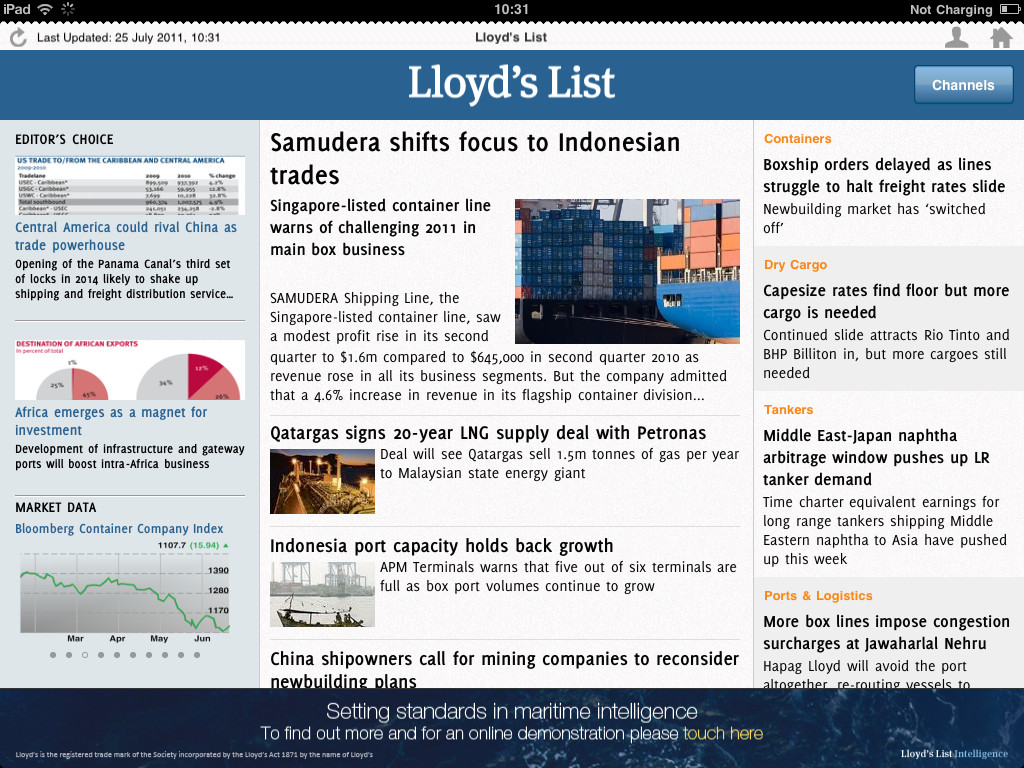
Lloyd’s List now available on iPad and iPhone

The Lloyd’s List App enables subscribers to access current news and market data anytime and anywhere. Once the news is uploaded, it is “cached” within the app, giving users the ability to read the latest headlines on the go without an internet connection. Stories are arranged in recency and categorised into channels Containers, Dry Cargo, Tankers, Ports & Logistics, Finance & Markets, Insurance, Ship Operations, and Regulation. Lloyd’s List subscribers can simply use their existing login details to access the new App. The App is free to download and has been formatted in keeping with mobile devices while retaining the familiar feel of Lloyd’s List.
Lloyds List iPhone-iPad App2

Securing the Global Supply Chain Without U.S. Leadership

In 2007 the European Union’s Framework Programme for Research and Technological Development (FP7) was established as “…a key tool to respond to Europe’s needs in terms of jobs and competitiveness, and to maintain leadership in the global knowledge economy.”   

A new research component called the SMART-CM project (SMART Container Chain Management) was created within the 7th Framework Programme. Its purpose is to … advance technology implementation and research in order to overhaul the complete container door-to-door transport chain so that it is more efficient, secure, market driven, and competitive. It systematically analyses current processes and systems, produces new innovative concepts for processes and technologies, and demonstrates all these in a set of 2 world scale Demonstrators covering 4 supply chain corridors.

Read the full article – Securing the Global Supply Chain Without U.S. Leadership.

The mystery of the identity of the carrier on an inland haulage leg

Herewith an interesting article on a topic which many of us in the customs and supply chain industry are not always fully aware of – authored by Tony Norton and Crispen Camp of Edward Nathan Sonnenbergs.

Over ninety percent of the world‟s commodities are transported by sea. Since the 1960‟s, containerised cargo has steadily grown to become the leading means by which goods are transported across the world‟s oceans.    

Importers of containerised cargo have to consider a number of factors when contemplating the most cost-effective means to bring about the importation of their goods. These factors include the financing of the transaction, insurance, customs duties as well as how the goods are to be conveyed. Importers that have their places of business located at an inland destination, such as Johannesburg, also have to consider who will undertake the onward carriage to Johannesburg from a discharge port such as Durban.

The contracts which govern the conveyance of the cargo are in most cases evidenced by the terms of documents known as „bills of lading‟. Bills of lading traditionally perform three functions, namely: they act as a receipt by the carrier of the cargo concerned; they evidence the terms of the contract of carriage, and they reflect the entitlement of the holder thereof to the goods.

The parties reflected on the Bill of lading are ordinarily the shipping line engaged to transport the goods which is reflected as the carrier, the shipper of cargo and the party to whom the cargo has been consigned.

The terms of the agreement of sale concluded between the exporter and importer of the cargo will impose the obligation on one of the two parties to arrange the transport of the cargo to either the discharge port, for example, Durban, or point of final destination, for example, Johannesburg. Where the agreement of sale does not impose a duty on the exporter to arrange the transport of the cargo to final destination, the importer will have to arrange to do so.

Where an importer has to arrange for the transport of cargo to an inland destination it can do so by a number of different methods.

Firstly, it can make its own arrangements to contract a local road or rail haulier to do so. This is generally known as “merchant haulage” in that it is the merchant or receiver that contracts for the haulage, which has nothing whatsoever to do with the ocean carrier. In those circumstances, if the cargo is lost or damaged en route on the land leg between, say, Durban and Johannesburg, the merchant looks directly to the local road or rail haulier and not to the ocean carrier for compensation. Of course the advantage for importer in choosing to arrange for the onward carriage of the cargo to Johannesburg is that it will be in a position to negotiate transport rates with its nominated road haulage company.

Secondly, the importer can arrange to ensure that the bill of lading contract for the carriage of the cargo extends to Johannesburg, in which event the land leg is generally known as being covered by “carrier haulage”, with the ocean carrier being directly responsible for any loss of, or damage to, the cargo during that leg subject to the terms of the bill of lading concerned.

Lastly, there is a third variation which is commonly and misleadingly known as “carrier assisted haulage” or “carrier haulage”. This is when the importer approaches the ships agent of the ocean carrier to arrange for the on carriage of the cargo from the discharge port, for example, Durban, to the point of final destination, for example, Johannesburg. However, the ships agent generally has no authority from the ocean carrier in these circumstances to agree to extend the ocean carriage to a point of final destination and any assistance rendered by the ships agent in this respect is generally intended by the ships agent to be rendered with the importer as principal so that the contract for the road or rail haulage is directly between the road or rail haulier and the importer, and not between the ocean carrier or the ships agent, on the one hand, and the importer, on the other.  

The problem here is that the correspondence between the parties in this respect does often not clearly reflect that intention, with the term “carrier haulage” or “carrier assisted haulage” leaving the importer with the impression that the ocean carrier or the ships agent is responsible for the road or rail haulage of the cargo and the actual agreement between the ships agent and the importer not clearly reflecting who is responsible one way or another.  

As a general rule of thumb importers should be aware of the fact that if the contract of carriage in the bill of lading does not extend to the inland point of final destination, it is unlikely that the ocean carrier will assume responsibility for the road or rail haulage concerned. In those circumstances, the agreement for the road or rail haulage with the ships agent concerned should be closely examined and clarified to ascertain who the responsible party is for the road or rail haulage leg. Generally it will be found that the intention is that it is the road or rail haulier contracted by the ships agent, on behalf of the importer, notwithstanding the term “carrier haulage” or “carrier assisted haulage” applied to that situation.  

In an ever increasing globalised world economy, the transportation of containerised goods will only continue to expand and, in this environment, importers of goods will have to consider numerous factors along the import chain, not least of which will be whether or not to conclude land leg merchant or carrier haulage contracts or variants thereof and to properly understand the significance of them.

Source: Lexology.com

Durban Dugout versus [nuwe] Transvaalse Tamboekiesfontein

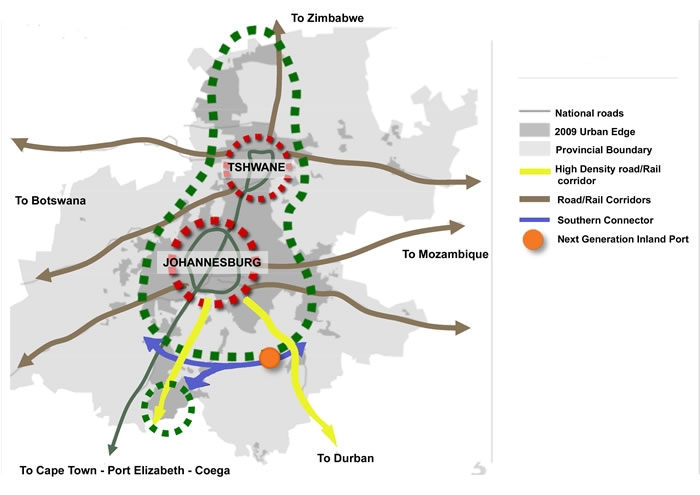
While on the topic of port expansion, an acquaintance of mine reminded me of another development, right here in my backyard. He was referring to Inframax Holding’s proposed development of an inland mega-port and logistics gateway 25 km southeast of the Johannesburg CBD. The 630ha site identified for this project will be called Tambo Springs and is located on land originally known as Tamboekiesfontein farm.

Tambo Springs Logistics Port

Gauteng is the largest metropolitan area in Africa, and one of the largest in the world, with a population of 10 million people generating the largest annual GDP in Africa. Inframax’s vision is to develop this site, and potentially add another 600ha, into a new inland port and logistics gateway that will contribute significantly to meeting Gauteng’s need to increase the current freight logistics capacity/throughput in and out of Johannesburg, to three million twenty-foot-equivalent units (TEUs) by 2015 and four million TEUs by 2020 – with further increases after that.

According to locally born, Texas-based logistics consultant, Franco Eleuteri and Associates, the logistics challenges now faced in Johannesburg/Gauteng have cropped up worldwide wherever cities have expanded fast. Typically, the original logistics centres were developed on the city peripheries. Over the years, however, these cities grow and absorb the centres, making it difficult to expand or upgrade to accommodate new demands. This is basically what is happening to Johannesburg’s City Deep Terminal, which was established in 1977 as a bonded inland container depot where containers from Durban could clear customs in Johannesburg. City Deep still has a vital role to play but the time has come to have it operating in tandem with a larger inland port or ports on the new city periphery and able to accommodate a large efficient intermodal capability for road, rail and air transport. This is fundamental to any 21st Century freight operation.

Tambo Springs is exceptionally well positioned as it is located in the southern periphery of Johannesburg and within the Johannesburg/Durban road freight and rail corridor. It has access to the N3 freeway to Durban (South Africa’s major freight transport route), to the N1 to Cape Town and via the R390, to Port Elizabeth and East London as well as to other freeways to the industrial centres just south of Johannesburg: Heidelberg, Vereeniging, Vanderbijl Park and Sasolburg, all of which are within 20 to 60km.

The site is also only 22km from the City Deep Terminal and 25km from the OR Tambo Air Freight Terminal. These excellent road linkages will allow the site to accommodate both full truck load (FTL) long distance road freight and less than truck load (LTL) regional distribution. On the freight rail side the existing dual directional links already run through the site to all the areas mentioned above. Accordingly, the Tambo Springs development can contribute significantly to optimising the country’s existing infrastructure, particularly that of the Ngqura Deep Water Port near Port Elizabeth. More optimal usage has the potential to increase this Eastern Corridor’s share of South Africa’s freight handling from about 14% to 21% in future. This is important given congestion at Durban harbour.

Inframax has from the outset engaged with key public sector authorities and agencies to canvass in principle policy support for the initiative. These include Gauteng Department of Economic Development; Blue IQ; Transnet Freight Rail and Ekurhuleni Municipality. What is not clear, however, is whether or not Inframax has read the draft Customs Control Bill, which at this point would effectively create a barrier to such development. These are interesting times: a test  as to whether business and trade ‘really’ determine economic and logistics opportunities, or whether policy makers have the vision to see the bigger picture.

Durban’s Dugout Port Proposal – Reality or Pipe Dream?

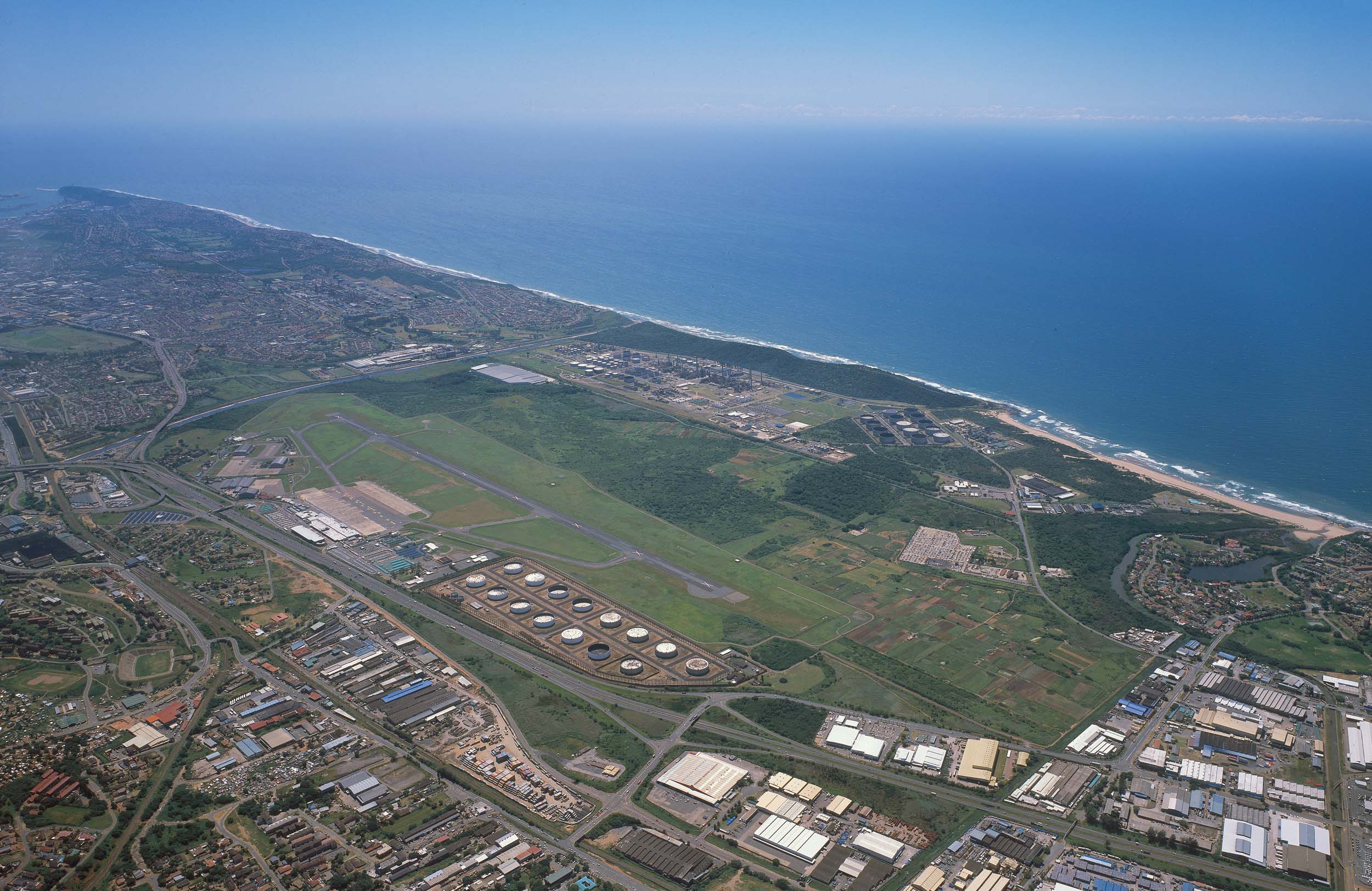
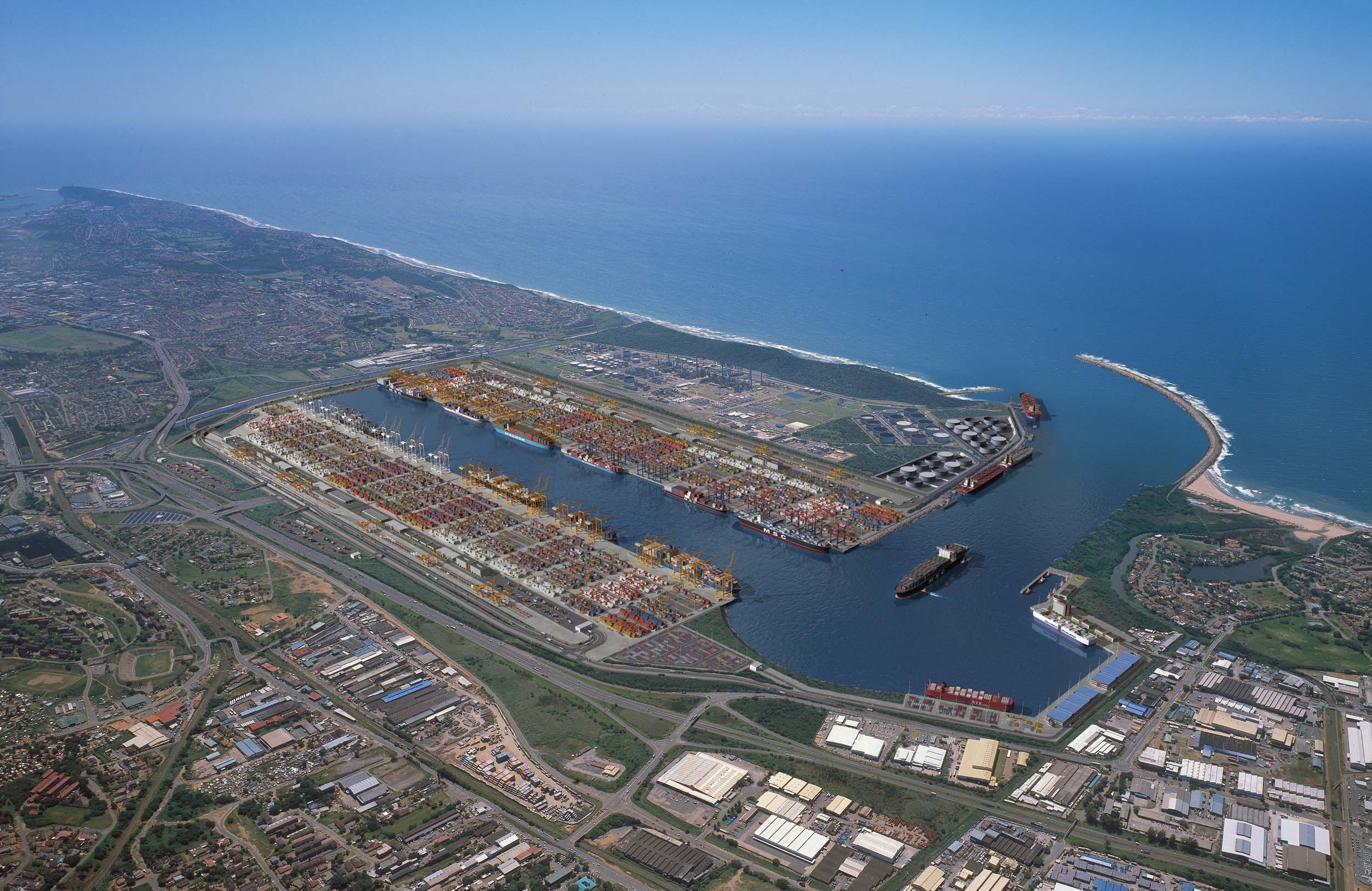
Airport Site Overall 1I received these pictures in an e-mail today. 15 minutes of surfing (the web kind) reveals plans by Transnet to procure the old Durban International Airport site from ACSA and dugout a new port to meet future demand and ensure that Durban remains Africa’s busiest port. Point of correction, Durban Harbour seeded this title to Port Said in Egypt a few years ago, so it would appear someone has a grandiose plan to bring about a mega development which is all honesty is ludicrous given the under-utilisation of Port of Ngqura (Coega) and its adjacent ‘white elephant’, the Coega Industrial Development Zone (IDZ). Government realised after 10 years that Coega was not a great strategic investment. Current levels of activity at  Ngqura are due largely to volumes since diverted from Port Elizabeth container terminal and some new transhipment activity. As long as South African high port charges, piracy up the east coast of Africa and the efficiency of the Suez Canal persist, it is highly unlikely that the shipping conferences are going to increase their traffic around the southern tip of Africa.

Airport Site Overall 2The dugout development cost is estimated at R50 billion, with a further R100 billion to be spent on infrastructure and inland logistics. Was FIFA 2010 not sufficient warning on over-capitalisation with limited return? Unless our ports and inland logistics pipelines begin offering significant advantages over Namport, Maputo and Beira, developments such as the old Durban airport will never realise its fullest potential. It has to be admitted that the concept is brilliant and awe inspiring, but realisation of such is but a daunting pipe dream, me thinks! Transnet chairman Mafika Mkwanazi, is most optimistic insisting that the project will happen with development needing to commence in 2015 to be ready for 2019. I would like to share in this optimism but not at the expense of the taxpayer. Source: IOLProperty.co.za

Thinking out-of-the-box

If container shipping is to assure itself of a licence to operate in the future, the industry needs to change now. No more battles on rates; instead, shipping lines should be giving customers what they really want. This is the view of MAERSK Line CEO Eivind Kolding. The challenge being posed for container shipping is the following:

  • What if we could guarantee that cargo would be on time, every time? 
  • What if placing a shipping order was as easy as buying an airline ticket? 
  • What if the shipping industry was known for beating environmental expectations — not struggling to meet them?

The company has recently launched a manifesto on the need for change. A campaign site – www.changingthewaywethinkaboutshipping.com — has been set up to host the discussion with all stakeholders in the industry. Even sceptics are encouraged to participate! Source: MAERSK website.

The Geography of Transport Systems

http://people.hofstra.edu/geotrans/index.htmlYou might question why I place so many posts relating to research/academic topics. Well, it’s because several of my colleagues and work associates are crazy enough to study part-time – I naturally get bombarded with questions and therefore make a point [now] to ensure I share resourceful sites on this blog. Here is another gem of a site hosted by Dr. Jean-Paul Rodrigue, Dept. of Global Studies & Geography, Hofstra University, New York – The Geography of Transport Systems. If you’re looking for stuff on transportation, logistics, including the politics and history surrounding these topics, then you’ll find this site both interesting and useful. Kindly note the ‘usage rights’ regarding the information on this site.