The Korea Customs Service (KCS) will introduce an Advance Manifest System in accordance with WCO standards as well as fulfill its own responsibilities as a governmental agency of duties for collection and border protection. This follows other major trading partners such as the U.S., Canada, EU and China who have already already adopted the Advance Manifest reporting. Known as KAMS, the new system will be implemented by KCS from 1st December, 2011. For more information click the hyperlink to download Korea Customs Advance Manifest System guideline.
Category / Trade Facilitation
Empty container depots adding to industry’s costs?
FTW published an article recently in regard to ‘empty container depots’ and their apparent negative impact on cost and response to industry needs. It was duly noted that while so much focus was accorded to Port delays, little is said about the additional costs caused by empty container depots. Many of these in fact hold, clean and distribute empty containers on behalf of shipping lines some of whom are not equipped to service the industry due to ill-equipped facilities.
Shipping lines complain about the turnaround of their vessels at the port, but take little interest in ensuring a quick turnaround of vehicles at their appointed container depots. The report continues: “Transporters are delayed for hours at major depots while waiting for containers to be turned in, cleaned and then released for export cargo. Most of these depots do not work 24 hours in line with the port and transporters, which further limits the ability of transporters and industry to perform”. I think this deserves some further thought and consideration, and for this I’ll provide a customs-slanted view.
 Firstly, in other parts of the world, the same mentality prevails whenever a port or customs system is replaced or upgraded – an avalanche of vitriolic sentiment, followed by line operators threatening to institute port delay surcharges and the like. To place matters into true perspective – yes, the port and customs services are there for the benefit and support of the supply chain, and should run and be maintained to offer efficient operation even in the event of catastrophe or a burgeoning logistics market demanding increased capacity and responsiveness. 9/11 provided a catalyst for Customs Inc. to initiate an unheard of demand on trade to increase its internal security mechanisms and even provide information in advance of the lading of a vessel at a foreign port. The US lines were the first to climb on the band wagon in support of heightened security and quickly acted to ensure that their regional offices were able to assist foreign shippers in supplying the required ‘advanced information’ at a nominal charge – varying between $25 and $60 per bill of lading. Sure, this was the cost necessary to ensure lines met their new stringent reporting requirements to the US Homeland Security to obviate possible penalties of $5,000 and up. Nonetheless, the same lines, when asked to provide the local authorities the same courtesy, recoil and look for all sorts of excuses to avoid the subject. Sure, it is understood that only the US has the right to make such demands, not any anyone else. I have followed most other advance cargo reporting requirements with similar amusement.
You see, lines were prepared to make suitable arrangements for US-bound containers such as pre-booking empty containers. Now when the requirement is extended to other parts of the world there is an immediate issue. Simply, and as the article correctly deduces, supply chain security implies that everyone changes – even the empty container depots.
As the local port authorities and your customs service are spending millions in upgrades to meet the demands of the future, so too is the same required of trade. Unlike commercial entities, your customs service remains one of the few who in the world that has not instituted a customs service fee. Certain traders and intermediaries in the industry might complain that recent developments at SARS have seen their costs increase due to new transactional requirements, for example the electronic supporting document issue. This I will discuss on its own in a separate post. The bottom line is that the FTW article is an important cue for those container depots concerned to get their act together. The heat will undoubtedly be turned up on them once SARS introduces its new export clearance and cargo reporting requirements. South Africa needs smaller to medium enterprises offering dedicated services. Perhaps it’s time for the lines (those who operate such facilities) to consider outsourcing these activities to more dedicated enterprises. Read the FTW article here!
Related articles
- Cargo Dwell Time in Durban (mpoverello.wordpress.com)
- Mandatory reporting of Cargo Carrier Code (mpoverello.wordpress.com)
Cargo Dwell Time in Durban
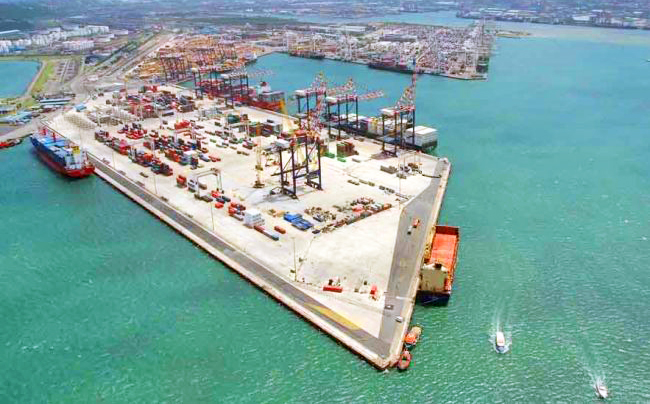 An acquaintance in the forwarding industry brought this working paper to my attention. Titled “Cargo Dwell Time in Durban“, it is very useful reading for logistics operators, Customs and government agencies, and policy makers. The object of the working paper attempts to identify the main reasons why cargo dwell time in Durban port has dramatically reduced in the past decade to a current average of between 3 and 4 days. A major customs reform; changes in port storage tariffs coupled with strict enforcement; massive investments in infrastructure and equipment; and changing customer behavior through contractualization between the port operator and shipping lines or between customs, importers, and brokers have all played a major role. The main lesson for Sub-Saharan Africa that can be drawn from Durban is that cargo dwell time is mainly a function of the characteristics of the private sector, but it is the onus of public sector players, such as customs and the port authority, to put pressure on the private sector to make more efficient use of the port and reduce cargo dwell time. The Working Paper is the product of the World Bank’s Africa Region, Transport Unit, being part of a larger effort to provide open access to its research and make a contribution to development policy discussions around the world. Policy Research Working Papers are also posted on the Web at http://econ.worldbank.org.
Related articles
- Who pays what charges for a shipment..?? (theshippingandfreightblog.wordpress.com)
Single Window, Corridors and Integrated Borders
Besides all the recent modernisation developments here at home, and abroad, there is both renewed interest and pressure on sovereign governments to push for efficiencies and cost savings relating to regional transport corridors. A case in point is the ambitious initiative involving various states of the East African Community. The Heads of State of the Tripartite (COMESA, EAC and SADC) requested an action plan to improve the efficiency of these corridors to facilitate trade, lower costs for businesses, advance regional integration, and improve the economic livelihoods of all East Africans. The Corridor Diagnostic Study is the technical foundation for that plan. See also the East African Corridors website which provides a comprehensive insight into this regional initiative.
South African Supply Chain – a shift in the balance of power?
The Customs Modernisation Programme has engaged supply chain stakeholders for just on a year and 3 months now. What has been seen as an unprecedented approach to Customs/Stakeholder co-creation has no doubt also revealed some significant developments in the industry which prompt some observation and comment.
It is an understatement that the modernisation development impinges upon an individual or company’s ability to modernise on the one hand, while maintaining a constant focus and commitment to their day-to-day operational dealings with clients.
It serves well to take a step back a few years – not quite to the days of antiquity – but far enough back to when declarations were framed ‘manually’ by an entry clerk and assessed ‘manually’ by a customs officer. In both instances the clearing agent and Customs required a level of capability and skills in the specific areas of tariff and valuation. This did not stop at clearances but was a well established trait at most customs branch offices, and indeed clearance brokers, where skills in all specialised areas were generally in abundance. Companies in those days had the capacity to deal with just about any kind of customs and trade issue through their in-house knowledge base and proven track record.
In short, over the last 18 years or so, the ‘skills’ and knowledge base has gradually dwindled where in most cases only the larger companies have been able to maintain top-dollar skills on a fulltime basis. The introduction of systems has to large extent negated the need for knowledgeable (highly paid) entry clerks. A lot of these ‘skills’ landed up at one or other ‘audit firm’, and if collar-and-tie was not the desired work attire, they established their own specialised consultancies.
Automation and EDI have allowed a number of smaller players to enter the fray, but the once established methods of in-house training no longer exist. True, there are reputable learning institutions offering dedicated training, but it is widely acknowledged that mentorship within the organisation was always the best form of knowledge transfer. Some local and international organisations offer highly specialised technical e-learning offerings with ‘accredited’ diplomas or degrees. Yet, one has to question seriously how companies, and Customs for that matter, ensure a return on investment on the knowledge attained? Moreover, staff retention (attrition rather) questions the motive for training, i.e. are staff only interested in training for their personal development, or are companies not focussed enough to ensure staff is retained for a reasonable period to ensure sustainable benefit?
This brings me to the point of this post. The modernisation programme will undoubtedly offer significant benefits to trade. The first release allowed ALL traders and service providers to progress at a common pace with implementation occurring only once all were fully tested and ready. This, itself, extended to joint training programmes between SARS and the trade. The forthcoming release will however reveal the competitive edge for traders whose service providers have their act together versus those who are not quite there. Is this the desired state envisaged by SARS? No. However, equal opportunity is afforded to all involved. True, a large company can dedicate more time and resource to such developments. This is a painful trade-off for some. The reality is therefore brutally clear – to stay with the game, companies must take some pain. It is quite apparent that the pace at which change is occurring is unexpected by some members of the supply chain.
A trend amongst certain service providers has been to recruit so-called customs experts. This is both a strategic and competitive move in that service providers, today more than ever before, require a more intimate understanding of customs procedure. However, while this evolution is silently occurring it needs be mentioned that there exists a fine line in terms of the manner by which these ‘experts’ operate. Bureaus need to be cognisant of this point and their real role in the industry. If such ‘expertise’ goes beyond systems development it may require them having to license with SARS to ensure parity in the industry. These developments are not going unnoticed.
The Customs Modernisation Programme has provided an environment for radical re-structuring where the ‘fit’ will survive and thrive. Unfortunately, nostalgia and novelty are no longer a criteria.
Useful Incoterms Online Resource
 A fundamental aspect of any sale of goods transaction is costing the product accurately. I found this website which I believe is useful for any would be importer/exporter or trade practitioner in the understanding of INCOTERMS. Who is responsible for those charges under the new Incoterms 2010? See: Incoterms® 2010 Freight and Associated Charges—Part 1: Just who is Responsible?
I received another useful tool from Bill Paul of Freight Match Services, Inc., Roselle, Illinois 60172, USA, who has kindly allowed the publication of his Incoterms 2010 Quick Reference Chart for followers and visitors to this blog.
Something for Solution Developers
Herewith a link for service providers: http://www.tradefacilitate.com/ . You can read the case study at the following link: Microsoft Case Study: Microsoft Visual Studio 2010 Ultimate – TradeFacilitate
 What Happened to the Portcullis?
You must be logged in to post a comment.