Africa to Get First Automated Container Terminal

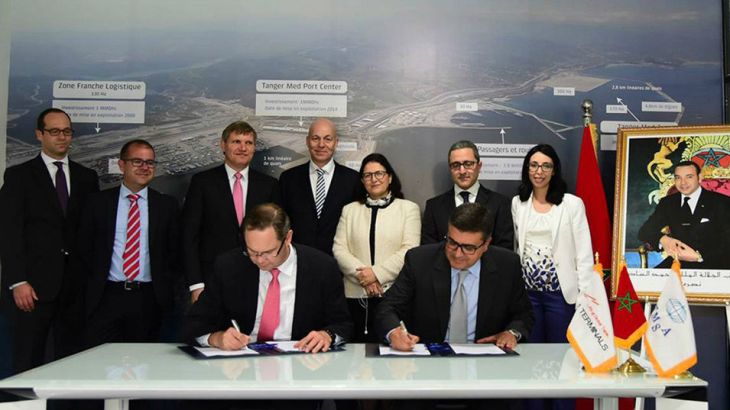
MarEx APM Tangier 2016Maritime Executive reports that the world’s third largest port operator APM Terminals said it will invest 758 million euros ($858.3 million) in a new transhipment terminal in Tangier, Morocco, that will be the first automated terminal in Africa.

APM Terminals, a unit of Denmark’s shipping and oil group A.P. Moller-Maersk, has been named as the operator of the new container transshipment terminal at the Tanger Med 2 port complex. The group already operates the APM Terminals Tangier facility at Tanger Med 1 port, which started operations in July of 2007 and handled 1.7 million TEUs in 2015. The new terminal will have annual capacity of five million TEUs.

Maersk Line, also a part A.P. Moller-Maersk, will be an important customer of the new terminal. The new terminal is scheduled to open in 2019, under the terms of a 30-year concession agreement with the Tanger Med Special Agency (TMSA), which has responsibility for the development and management of the Tanger Med port complex.

The Tanger-Med port complex is strategically located on Africa’s northwest coast near the mouth of the Mediterranean Sea on the Strait of Gibraltar, where the Atlantic Ocean and Mediterranean Sea meet. Tanger-Med is the second-busiest container port on the African continent after Port Said, Egypt. The new APM Terminals MedPort Tangier terminal will increase the port’s total annual throughput capacity to over nine million TEUs.

APM Terminals MedPort Tangier will have up to 2,000 meters of quay length and will feature the technology pioneered at the APM Terminals Maasvlakte II Rotterdam terminal which opened in 2015.

For APM Terminals the Western Mediterranean is an important market. APM Terminals Algeciras, on the Spanish side of the Strait of Gibraltar, operates in tandem with APM Terminals Tangier as an integrated Western Mediterranean transshipment hub. APM Terminals Algeciras handled more than 3.5 million TEUs in 2015, and has completed a major upgrading of its cranes and quay infrastructure to accommodate ultra-large container Ships of 18,000 TEU capacity and above.

The location of the Tangier and Algeciras facilities provide a natural transshipment location for cargoes moving on vessels to and from Africa from Europe and the Far East on the primary East/West shipping route through the Mediterranean Sea; over 200 cargo vessels pass through the Strait of Gibraltar daily on major liner services linking Asia, Europe, the Americas and Africa.

While African ports at present account for only 4.5 percent of global port throughput (including transshipment cargoes), the United Nations 2015 World Population Prospects Report projects that more than half of the world’s population growth between 2015 and 2050 will occur in Africa, with the African population more than doubling from 1.1 billion to 2.4 billion over the next three and a half decades.

Significant investment in port and transportation infrastructure will be required to meet the anticipated needs of the expanding African population and corresponding economic growth.

APM Terminals is the largest port and terminal operating company in Africa by equity-weighted container volume, with 12 facilities operating in 10 countries and three more terminals under construction. Source: Maritime Executive
US will not delay weighing rule

Verified Gross MassThe US Coast Guard has told American shippers that it will not delay implementation of the SOLAS Chapter VI amendment requiring containers to have a verified gross mass before they can be shipped.
The US Agriculture Transportation Coalition (AgTC), representing most of the country’s agricultural and forestry products exporters and thus accounting for a huge slice of US shipping exports, argued that confusion over the VGM could lead to business being lost and threatened supply chain turmoil.

It called for a one-year delay in implementation of the new rules, due to take effect on 1st July, to allow time for government and industry to work together to solve the problems. AgTC cited SOLAS Article VIII(b)(vii)(2), which allows for a Competent Authority [in this case the USCG] to give notice to the IMO of an intention to delay implementation of any SOLAS regulation for up to one year at any point before the entry into force.

However, at a special public meeting convened on 18th February at the offices of the Federal Maritime Commission in Washington, DC, Rear Admiral Paul Thomas, the USCG’s Assistant Commandant for Prevention Policy, said a delay to implementation would not be entertained.

Thomas pointed out that that the VGM is not a US regulation or law, but arises out of international agreement within IMO. As such it will be enforced by flag states, where ships are registered, and any signal that the US was unready or unwilling to comply with the new rule would be interpreted by flag state authorities to mean that loading US export containers on their ships is unsafe. He added that most US exports are carried on foreign flag ships.

This should be the end of the matter. However, the IMO mechanisms allow the US (or any other IMO member-state) to give notice any time up to 30th June. The US could also introduce an “AOB” paper at the next IMO MSC meeting scheduled for May.

At the meeting last week, shippers were reassured that if they used “Method 2” (VGM by calculation), they are legally entitled to rely on the container’s CSC plate as providing an accurate empty tare weight. Source: World Cargo News

Rotterdam Maasvlakte II – World’s first Remote-Controlled Container Port

APM Terminals has released drone footage of its Rotterdam Maasvlakte II terminal. The terminal set a loading record last month on the Madison Maersk with 17,152 TEU loaded, including ten high above deck stowage.

The facility launches the world’s first container terminal to utilize remotely-controlled ship-to-shore (STS) gantry cranes. The cranes move containers between vessels and the landside fleet of 62 battery-powered Lift-Automated Guided Vehicles (Lift-AGVs) which transport containers between the quay and the container yard, including barge and on-dock rail facilities.

The Lift-AGV’s also represent the world’s first series of AGV’s that can lift and stack a container. A fleet of 54 Automated Rail-Mounted Gantry Cranes (ARMGs) then positions containers in the yard in a high-density stacking system. The terminal’s power requirements are provided by wind-generated electricity, enabling terminal operations, which produce no CO2, emissions or pollutants, and which are also considerably quieter than conventional diesel-powered facilities.

The facility, constructed on land entirely reclaimed from the North Sea, has been designed as a multi-modal hub to reduce truck traffic in favor of barge and rail connections to inland locations.

Construction began in May 2012, with the first commercial vessel call in February 2015.

2015 and 2016 are the years of ramping up operations and refining the terminal operating system. The 86 hectare (212 acre) deep-water terminal features 1,000 meters of quay, on-dock rail, and eight fully-automated electric-powered STS cranes, with an annual throughput capacity of 2.7 million TEU.

At planned full build-out, the terminal will cover 180 hectares (445 acres) and offer 2,800 meters of deep-sea quay (19.65 meters/64.5 feet depth), with an annual throughput capacity of six million TEUs. Source: Maritime Executive

War Against Ivory Smuggling

Smuggled Ivory

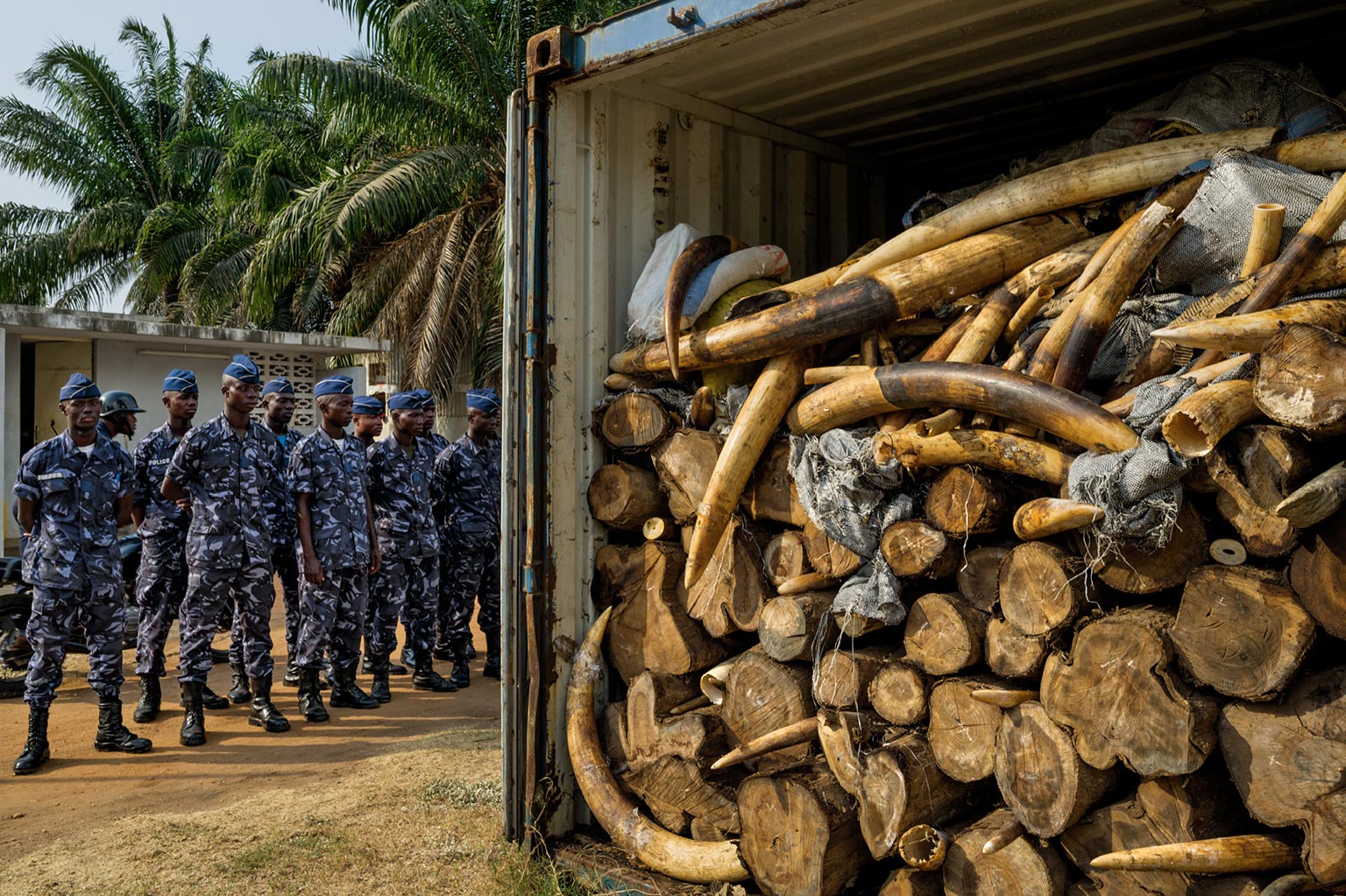
In January 2014, while x-raying a Vietnam-bound container declared to hold cashews, Togolese port authorities saw something strange: ivory. Eventually, more than four tons was found, Africa’s largest seizure since the global ivory trade ban took effect in 1990. [Photo: Brent Stirton, National Geographic]

Last year, one of Kenya’s most adored elephants, Satao, was killed for his ivory. Poachers shot the bull elephant with a poisoned arrow in Tsavo East National Park, waited for him to die a painful death, and then hacked off his face to remove his massive tusks.

Poachers continue to kill an estimated 30,000 elephants a year, one every 15 minutes, fueled to a large extent by China’s love of ivory. Thirty-five years ago, there were 1.2 million elephants in Africa; now around 500,000 remain.

A recent documentary, 101 East, released by Al Jazeera, traces the poaching of elephants and smuggling of ivory from Tanzania’s port of Dar es Salaam through the port of Zanzibar to Hong Kong and Shanghai.

Hong Kong is one of the busiest ports in the world. It handled nearly 200,000 vessels last year and is a key transit hub for smugglers transporting ivory from Africa to China. Between 2000 and 2014, customs officials seized around 33 tons of ivory, taken from an estimated 11,000 elephants.

With the huge challenge faced by customs and other law enforcement agencies in West Africa, wildlife crime is on the rise. Regional traffickers and organized crime groups are exploiting weak, ineffective and inconsistent port controls throughout the region.

U.N. Action in Africa
To address the issue, the United Nations Office on Drugs and Crime (UNODC) organized a workshop in Accra, Ghana, from August 25 to 27 August, and in Dakar, Senegal, from August 31 to September 2. The objective was to provide training for national law enforcement agencies to better fight wildlife crime through the control of maritime containers. The workshop was led by trainers and experts from UNODC, the World Customs Organization (WCO) and the CITES Management Authority.

The Container Control Programme has been developed jointly by UNODC and WCO to assist governments to create sustainable enforcement structures in selected sea and dry ports to minimize the risk of shipping containers being exploited for illicit drug trafficking and other transnational organized crime. The implementation of the program is an opportunity for UNODC to work with governments in establishing a unit dedicated to targeting and inspecting high-risk containers.

UNODC, in partnership with WCO, delivers basic training programs and provides technical and office equipment. For example, the equipment connects the units to the WCO’s ContainerCOMM – a restricted branch of the Customs Enforcement Network dedicated to sharing information worldwide on the use of containers for illicit trafficking.
Sustainability.

UN Secretary-General Ban Ki-moon argues: “Illegal wildlife trade undermines the rule of law, degrades ecosystems and severely hampers the efforts of rural communities striving to sustainably manage their natural resources.”

Wildlife trade is a transnational organized crime that raises profits of about $19 billion annually. In addition, it is often linked to other crimes such as arms trafficking, drug trafficking, corruption, money-laundering and terrorism – that can deprive developing economies of billions of dollars in lost revenues.

Shipping
It’s hardly surprising that many of the big ivory seizures made in recent years have been detected in shipping containers, says Dr. Richard Thomas, Global Communications Coordinator for the environmental organization TRAFFIC. “Partly that’s due to the sheer quantity of ivory being moved (the largest-ever ivory seizure was 7.1 tons) – which from a practical and cost point of view makes sea carriage more attractive than air carriage.

“Also in the smugglers’ favor is the huge numbers of containers moved by sea. Some of the big ports in Asia deal with literally thousands of containers per day. Obviously it’s not practical or feasible to inspect each and every one, and that’s something the organized criminal gangs behind the trafficking rely upon.”

There’s lots of issues to be dealt with, says Thomas: For example, even when an enforcement agency makes a seizure, it’s not easy to find out who actually booked the passage for the container and who knew precisely what was in it and actually put it there. “That’s one area where transport companies can collaborate with enforcement agencies to assist follow-up enquiries. Obviously companies have records of where the container is headed too, obviously key information for follow-up actions,” says Thomas.

TRAFFIC recently ran a workshop in Bangkok under the auspices of the Wildlife Trafficking Response, Assessment and Priority Setting (Wildlife TRAPS) project, targeting the movement of illicit wildlife cargoes across borders.

“The transport industry can serve as the eyes and ears of enforcement agencies as part of a global collaboration to eliminate the poaching and trafficking of illegal wildlife commodities,” said Nick Ahlers, Leader of TRAFFIC’s Wildlife TRAPS project.

“To be successful, the entire logistics sector needs to be part of a united push to eliminate wildlife trafficking from supply chains. In particular, we would welcome participation from major shipping lines and the cargo and baggage-handling sector.”

If nothing is done to stop the ivory trade, Africa’s wild elephants could be gone in a few decades. Source: Reuters.

Related articles