Free Trade talks to kick continent into the future

The first round of negotiations to establish a free trade area covering 27 countries in southern and east Africa will kick off on December 8, in Nairobi. It is envisaged that the negotiations will be completed in 36 months. (Really?)

The three trade blocs involved – the Southern African Development Community (SADC), the East African Community (EAC) and the Common Market for Eastern and Southern Africa (COMESA) – decided in October 2008 in Kampala to move towards a free trade agreement.

The intention is to boost intra-regional trade because the market will be much bigger, there will be more investment flows, enhanced competitiveness and the development of cross-regional infrastructure.

Industrialisation, making goods to sell instead of selling primary products, is a possible and also necessary spin-off. Competition with older established and also bigger emerging economies might be a stumbling block initially, but the huge new market may make it possible for locally manufactured goods to compete with those imported from outside the FTA.

Close to 600 million people live in the FTA with a gross domestic product of $1 trillion – suddenly we are boxing in the same weight division as China, India, Russia, Brazil, the US and the EU. Source: All Africa.com.

BriberyComment: Heard all of this before?  It could be hoped that some positive developments will materialise from more talkshops with promises to alleviate poverty and increase Africa’s slice of the international market. While the retail and telecommunications industries have made significant inroads into Africa, manufacturing remains a moot point. Does Africa have the political will to take risks? Removing internal border controls for instance are not high priority for sovereign governments. Neither for that matter is the question of the integrity of officials who man these borders. And, neither is the matter of removing one of the key contributors to cross border fraud – the “paper customs declaration”. Nonetheless, attempts are still being made to redress these ills. Recent developments within SACU indicate a genuine move towards customs-2-customs information exchange based on the ‘Customs Inter-connectivity’ concept. More on this shortly.
Are Customs Unions Tenuous Arrangements?

Recent reports from Europe suggest all is not entirely well with the ‘customs union’ concept. Let’s face it the philosophy of such economic arrangements has existed for many years. However, human nature and the failure of politicians to learn from history prevail.

On the one hand we have Russia, Belarus, and Kazakhstan entering a new customs union on 1 July 2011. At the same time, Russian Customs will become responsible for transport, sanitary, veterinary, quarantine and phytosanitary control. The impact of this change foresees the displacement of national border controls to the outer borders of the new Customs Union. 35 customs checkpoints and approximately 3,500 customs officers will be made redundant following the implementation of the Customs Union. To take control of the additional functions (transport, sanitary, veterinary, quarantine and phytosanitary control) Customs will need to recruit over 1,000 new specialists. Customs will try to close the gap by a short-term redeploying of personnel, but in the future expects to employ some specialists previously made redundant in other governmental agencies responsible for transport, sanitary affairs. This sounds a bit ludicrous given that 3,500 customs officers are about to be turfed into economic oblivion – truly, the interests of customs staff are not very high on this agenda!

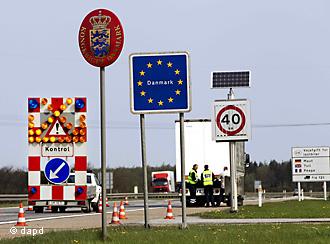
Denmark border crossingElsewhere, tension is developing between Denmark and Germany in a dispute over the Danish government‘s plans to re-establish permanent border controls – this in the EU. Some commentators have even gone so far to state that this could be the writing on the wall for freedom in Europe. The agreement guarantees the free movement of people between the 26 European member states. Denmark insists that the sole aim of the new border controls was “to fight the entry of illegal goods and drugs” into the country.

So, is the dream of a united Europe showing signs of cracks? It seems that the scourge of illegal goods and trafficking have placed some strain on the trust between these two nations. How long before it spreads to other states? At home, here in Southern Africa, there have been several reports of tension between the Republic and the BLNS states. Although the basis for this lies more in the distribution of the common revenue pool, it is no secret that the Southern African Customs Union (SACU) and its porous inland borders offers little support for maintaining the union. With the new Customs Control Bill emphasizing the movement of goods within the union as ‘imports’ and ‘exports’, it would indeed seem a matter of time before full customs controls are reinstated at the national borders rather than current VAT controls.

Southern Africa: Eyeing the Money, Not Development

A new revenue sharing formula in the Southern African Customs Union (SACU) is intended to boost development but has met with resistance from the governments of poorer states in the sub-region that are interested in “just getting the money”. Differences over the economic partnership agreements (EPAs) with the EU nearly tore the customs union apart in 2010; now the issue of the revenue sharing formula has become equally contentious.

The South African Treasury Department wants a revision of the formula.

Smaller member states Botswana, Lesotho, Namibia and Swaziland (BLNS) argue that SACU’s common external tariff (CET) gives South Africa an instrument to protect its own industry, while the level playing field in the union makes it hard for the peripheral countries to build their own industrial bases and compete with their much larger neighbour’s products and services. For this they deserve to be compensated, they argue.

A lot of time was spent on working out the formulation of a new mechanism, but nothing definite was decided on.

Certain trade commentators warned against an “unrealistic” perception of the balance of power in SACU. South Africa feels that it cannot be expected to receive less than what it’s due. At the same time within the BLNS countries there is a shocking lack of understanding of the realities. The South African Treasury is frustrated over having to hand over so much money, without having control over it. It is proposed that South Africa should top up the revenues for reasons of political stability and economic policy but the formula shouldn’t just focus on trade, rather stimulate development.

The current revision of the SACU agreement is mainly inspired by the recession and a couple of years of experience with the current revenue formula, which South Africa now wants to renegotiate. Such changes are not significant enough to drive the process. A leaked draft report on the proposed changes to the formula has caused an outcry in the BLNS, being pitted heavily in favour of South Africa. Countries are still studying the report with a final decision expected in April 2011.

One of the options on the table is to increase the development component of the pool with funds, for instance, going to regional infrastructure projects instead of state coffers. It is however doubtful that countries like Swaziland and Lesotho will be keen on that. For them, it is more important than anything else to get the money.

It is therefore obvious that the current one sided focus, where South Africa compensates the SACU states for their inability to improve their economic plight or maintain domestic fiscal discipline will remain a burden on ‘big brother of the south’ unless some lessons of ‘tough love’ are brought bear on the region. It makes one wonder how on earth SADC let alone an African Union can ever materialize under such mentality.

Original article dated 28 March 2011 featured on allAfrica.com