US Customs agreement on border security upgrades

American terminology never ceases to amaze me – I wonder if they call their stakeholders “clients”?

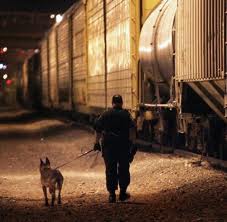
US Customs and Border Protection has announced a penalty Mitigation Decision under which Union Pacific (UP) has agreed to spend US$50 million to enhance the Mexico and United States rail supply chain CBP said the “Mitigation Decision” defines the steps that UP will take to invest US$50 million in security enhancements at critical junctures of the Mexico and US supply chain, and partnering with CBP to form a Rail Fusion Center to identify high-risk shipments.

US Penalty Mitigation DecisionCBP further said the decision provides that CBP will mitigate penalties assessed against UP if the railroad fulfils its obligations under the agreement. In recent years these penalties have become significant, as illegal controlled substances were discovered on trains originating in Mexico and arriving at US-Mexican border crossings. CBP Commissioner Alan D Bersin said: “It’s in the best interest of all that appropriate steps are taken to secure the US border against the smuggling of contraband. UP Chairman Jim Young said the agreement expands a relationship with CBP in which UP has already invested in technology, infrastructure, training and workforce resources to secure rail transportation across the border. Source: World Cargo News Online.

Durban Dig-out Port agreement soon!

An impending agreement between Transnet and the Airports Company SA (ACSA) over the price to be paid for the site of the old Durban International Airport can be expected by the end of September 2011. The agreement will allow Transnet to secure the strategic piece of land on the southern side of Durban for building a new deepwater container port.

While there is common agreement that the land should be secured for a new port which would be built when the time was right – estimates suggest that it will be required before 2020, Transnet and ACSA were reported to be at odds over the amount that the old airport site of 620ha is worth. ACSA was initially asking for at least R3 billion but is understood to have come down to R2 billion. Transnet was prepared to pay around R1 billion. Source: SA Ports.

Securing the Global Supply Chain Without U.S. Leadership

In 2007 the European Union’s Framework Programme for Research and Technological Development (FP7) was established as “…a key tool to respond to Europe’s needs in terms of jobs and competitiveness, and to maintain leadership in the global knowledge economy.”   

A new research component called the SMART-CM project (SMART Container Chain Management) was created within the 7th Framework Programme. Its purpose is to … advance technology implementation and research in order to overhaul the complete container door-to-door transport chain so that it is more efficient, secure, market driven, and competitive. It systematically analyses current processes and systems, produces new innovative concepts for processes and technologies, and demonstrates all these in a set of 2 world scale Demonstrators covering 4 supply chain corridors.

Read the full article – Securing the Global Supply Chain Without U.S. Leadership.

Draft Taxation Laws Amendment Bill, 2011 – Impact on Customs

As if the myriad of changes affecting the Customs industry are not enough, there’s some more important considerations for customs traders and practitioners, soon, posed by the Draft Taxation Laws Amendment Bill [2011].

Goods Sold in Bond. For the purposes of the VAT Act, the Bill proposes that ‘the value to be placed on the importation of goods into the Republic which have been imported and entered for storage in a licensed Customs and Excise storage warehouse but have not been entered for home consumption shall be deemed to be the greater of the value determined in terms of subsection (2)(a) or the value of acquisition determined under section 10(3) if those goods while stored in that storage warehouse are supplied to any person before being entered for home consumption.’

Duty free goods imported on a temporary basis. Goods imported in terms of Rebate Item 470.03, which are duty free, will in future have to be declared under a specific rebate sub-item for duty free goods. In addition, provision is also to be made for the importer of duty free goods, where the importer is contractually entitled to keep a portion of the goods manufactured, processed, finished, equipped or packed in lieu of payment for the operations carried out, that importer must:
a) export those goods within the 12 month period, or
b) process a goods declaration for payment of the VAT on the goods retained and pass a voucher of correction amending the quantity and value of the original declaration.

New tax incentives for Industrial Development Zones. Government is seeking to renew its efforts to enhance the Industrial Development Zone (IDZ) regime to encourage industrial development within certain geographical areas. The main focus of the incentive is to promote capital expenditure. Greenfield projects receive an additional 55% allowance and brownfield projects receive a further 35% additional allowance. The additional allowance for greenfield projects located in IDZ’s will be increased to 100% (instead of the current 55%) and to 75% for brownfield projects (instead of the current 35%).This change will be welcomed by IDZ Operators that are constantly looking for ways to make IDZ’s more attractive. In terms of the Customs and Excise Act, it should be noted that duty rebate and VAT dispensations ONLY apply to entities establishing licensed premises within the customs controlled area of an IDZ.

For more information on the above please click here!

The Draft Taxation Laws Amendment Bill, 2011 is available on the SARS website.


Contrasting fortunes for Freight Forwarders

Freight forwarder associations were celebrating this week after helping force through changes to the International Air Transport Association’s (IATA) Cargo Accounts Settlement System (CASS) in Europe, which could save forwarders having to provide bank guarantees of up to £400,000 (US$655,440). On the other side of the globe, in the US, two US Congressmen have introduced a bill aimed at clamping down on fraudulent brokers and freight forwarders.

The British International Freight Association (BIFA) said that until the recent global financial crisis, the requirement for forwarders, when appropriate, to undergo a financial assessment by IATA had largely been dormant. However, the crisis had sparked a u-turn by IATA, with European forwarders having to undergo financial assessment, and as a consequence, provide CASS with a bank guarantee.

One member, it said, had been faced with having to provide a £400,000 guarantee. However, BIFA along with international freight forwarder association FIATA managed to get this requirement overturned after a small working group – of BIFA, FIATA and IATA – was established through a meeting of the European Air Cargo Programme (EACP) joint council.

In the US, Congressmen Russ Carnahan and Frank Guinta’s bill has won the backing of the US-based Owner-Operator Independent Drivers Association (OOIDA), the Transportation Intermediaries Association (TIA) and the powerful American Trucking Association (ATA). The Fighting Fraud in Transportation Act 2011 would put a stop to a system that allows ruthless brokers and scam artists to continue to operate unchecked. Moreover it would require brokers and freight forwarders to carry a US$100,000 bond rather than the current requirement of $10,000. It would also improve transparency of those seeking to become brokers and establish “significant” penalties, including unlimited liability for freight charges, for those operating without authority. The TIA believes brokers, forwarders, owner-operators and carriers need each other, and the speed of today’s logistics marketplace means that companies must be able to reasonably rely on representations made in the terms of their agreement.

Just goes to show the power of lobbying!

The mystery of the identity of the carrier on an inland haulage leg

Herewith an interesting article on a topic which many of us in the customs and supply chain industry are not always fully aware of – authored by Tony Norton and Crispen Camp of Edward Nathan Sonnenbergs.

Over ninety percent of the world‟s commodities are transported by sea. Since the 1960‟s, containerised cargo has steadily grown to become the leading means by which goods are transported across the world‟s oceans.    

Importers of containerised cargo have to consider a number of factors when contemplating the most cost-effective means to bring about the importation of their goods. These factors include the financing of the transaction, insurance, customs duties as well as how the goods are to be conveyed. Importers that have their places of business located at an inland destination, such as Johannesburg, also have to consider who will undertake the onward carriage to Johannesburg from a discharge port such as Durban.

The contracts which govern the conveyance of the cargo are in most cases evidenced by the terms of documents known as „bills of lading‟. Bills of lading traditionally perform three functions, namely: they act as a receipt by the carrier of the cargo concerned; they evidence the terms of the contract of carriage, and they reflect the entitlement of the holder thereof to the goods.

The parties reflected on the Bill of lading are ordinarily the shipping line engaged to transport the goods which is reflected as the carrier, the shipper of cargo and the party to whom the cargo has been consigned.

The terms of the agreement of sale concluded between the exporter and importer of the cargo will impose the obligation on one of the two parties to arrange the transport of the cargo to either the discharge port, for example, Durban, or point of final destination, for example, Johannesburg. Where the agreement of sale does not impose a duty on the exporter to arrange the transport of the cargo to final destination, the importer will have to arrange to do so.

Where an importer has to arrange for the transport of cargo to an inland destination it can do so by a number of different methods.

Firstly, it can make its own arrangements to contract a local road or rail haulier to do so. This is generally known as “merchant haulage” in that it is the merchant or receiver that contracts for the haulage, which has nothing whatsoever to do with the ocean carrier. In those circumstances, if the cargo is lost or damaged en route on the land leg between, say, Durban and Johannesburg, the merchant looks directly to the local road or rail haulier and not to the ocean carrier for compensation. Of course the advantage for importer in choosing to arrange for the onward carriage of the cargo to Johannesburg is that it will be in a position to negotiate transport rates with its nominated road haulage company.

Secondly, the importer can arrange to ensure that the bill of lading contract for the carriage of the cargo extends to Johannesburg, in which event the land leg is generally known as being covered by “carrier haulage”, with the ocean carrier being directly responsible for any loss of, or damage to, the cargo during that leg subject to the terms of the bill of lading concerned.

Lastly, there is a third variation which is commonly and misleadingly known as “carrier assisted haulage” or “carrier haulage”. This is when the importer approaches the ships agent of the ocean carrier to arrange for the on carriage of the cargo from the discharge port, for example, Durban, to the point of final destination, for example, Johannesburg. However, the ships agent generally has no authority from the ocean carrier in these circumstances to agree to extend the ocean carriage to a point of final destination and any assistance rendered by the ships agent in this respect is generally intended by the ships agent to be rendered with the importer as principal so that the contract for the road or rail haulage is directly between the road or rail haulier and the importer, and not between the ocean carrier or the ships agent, on the one hand, and the importer, on the other.  

The problem here is that the correspondence between the parties in this respect does often not clearly reflect that intention, with the term “carrier haulage” or “carrier assisted haulage” leaving the importer with the impression that the ocean carrier or the ships agent is responsible for the road or rail haulage of the cargo and the actual agreement between the ships agent and the importer not clearly reflecting who is responsible one way or another.  

As a general rule of thumb importers should be aware of the fact that if the contract of carriage in the bill of lading does not extend to the inland point of final destination, it is unlikely that the ocean carrier will assume responsibility for the road or rail haulage concerned. In those circumstances, the agreement for the road or rail haulage with the ships agent concerned should be closely examined and clarified to ascertain who the responsible party is for the road or rail haulage leg. Generally it will be found that the intention is that it is the road or rail haulier contracted by the ships agent, on behalf of the importer, notwithstanding the term “carrier haulage” or “carrier assisted haulage” applied to that situation.  

In an ever increasing globalised world economy, the transportation of containerised goods will only continue to expand and, in this environment, importers of goods will have to consider numerous factors along the import chain, not least of which will be whether or not to conclude land leg merchant or carrier haulage contracts or variants thereof and to properly understand the significance of them.

Source: Lexology.com
Shipping lines get tough over new EU cargo information rules

Seems like ‘cargo reporting’ is becoming as infectious as a virus! The shipping industry has warned its customers that failure to comply with new EU regulations will mean fines and their cargo will not be loaded. Following similar measures introduced by the US in 2002, it seems that not only is there a possibility of “fines” and “no loading of cargo”, but that shipping lines even get to cash in on a revenue opportunity; some to the extent of US$25 per bill of lading. It absolutely amazes me that this is allowed to happen – talk about non-tariff barriers!  While SARS, for example, can give thousands of ZA Rands worth of intellectual property (for free) to the trading community – with the hope of making trading easier – why can the bastions of the sea not do likewise? Seems as though the “war on terror” has been interpreted by some as a ‘cash cow’!  Read the full article online: www.bdpinternational.com.


Penalties for non-compliant Cargo Reporters

Recently SARS issued a communication signalling its intention to penalise non-conforming cargo reporters as of 1 July 2011, if they fail to report their cargo manifests electronically to SARS. Following international practice, all parties who engage in the contract of carriage of goods internationally are obliged to report the details of such cargoes. While customs has traditionally placed more emphasis on the correctness of the goods declaration alone – due to it being the sole means of duty and tax assessment and collection of revenue, the introduction of measures to safeguard the supply chain and combat other forms of nefarious activities, implies that all supply chain operators are ‘known’ and share in the responsibility for their actions and activities.

Perhaps seen in this guise, the whole matter of supply chain security encompassing the universal adoption of the Authorised Economic Operator (AEO) concept seems less appealing than it did a few years ago. Yes, Customs wants to know more and more about your business and who you do business with. Freight forwarders / Clearing Brokers have borne much of the brunt from customs over the years, it’s now time for parties involved in the conveyance of cargoes to come forward and be counted.

Because international shipping by its very nature transcends borders, it has always been difficult for national authorities to apply effective controls over information and parties who in all honesty are representatives/agents for those supplying the ‘original’ shipping documents. What the law now says is that those acting on behalf of foreign principles, liable for the import leg of imported goods are obligated to submit the ‘manifest information’ of those goods (electronically) to SARS.

For those customs brokers who operate as freight forwarders, this is in essence a further requirement which SARS places on your organisation. In essence a freight forwarder has a dual requirement with SARS – declaring the manifested contents of a consignment, as well as making due clearance for regulatory compliance and payment of duties. Another party with a similar dilemma are certain ‘ground handlers’, specifically those who are contractually responsible for the inbound operations of foreign air carriers, as well as the deconsolidation of aircargo upon arrival in their transit shed. They too must report the aircargo manifests electronically to SARS, and secondly to report the outturn of such goods, once unpacked for temporary storage and customs clearance and release.

The NVOCC or Vessel’s Agent must also report all cargo – for which they are contractually responsible – for the inbound leg into the Republic. These parties represent the foreign carrier and must consequentially report the carrier’s manifest (electronically) to SARS.

SARS is for now focussing principally on the reporting of master and house (sea and air)cargo manifests in this phase. Other reports are to follow.

Details for the registration for reporting electronically to SARS’ Automated Cargo Management (ACM) system have been widely distributed, and for sake of convenience are available for download here.

Consequences for non-compliance post 1 July 2011

SARS has put into place mechanisms to identify non-reporters. In such instances customs officers will call for administrative penalties to the extent of R1000,00 for each ‘manifest’ not reported. Moreover, should SARS take measures to ensure that these penalties are not ‘passed on’ to the importer – this would surely defeat the object of SARS’ intentions? Shortly, we’ll discuss the future matching of electronic cargo reports and goods declarations, but first lets endeavour to accomplish the first milestone.

Durban Dugout versus [nuwe] Transvaalse Tamboekiesfontein

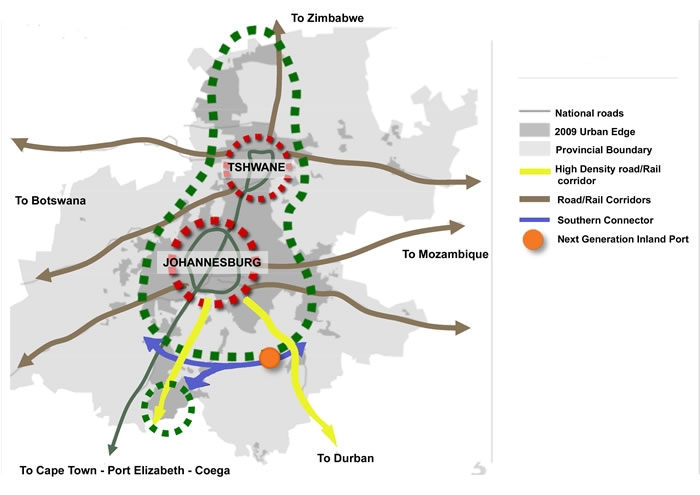
While on the topic of port expansion, an acquaintance of mine reminded me of another development, right here in my backyard. He was referring to Inframax Holding’s proposed development of an inland mega-port and logistics gateway 25 km southeast of the Johannesburg CBD. The 630ha site identified for this project will be called Tambo Springs and is located on land originally known as Tamboekiesfontein farm.

Tambo Springs Logistics Port

Gauteng is the largest metropolitan area in Africa, and one of the largest in the world, with a population of 10 million people generating the largest annual GDP in Africa. Inframax’s vision is to develop this site, and potentially add another 600ha, into a new inland port and logistics gateway that will contribute significantly to meeting Gauteng’s need to increase the current freight logistics capacity/throughput in and out of Johannesburg, to three million twenty-foot-equivalent units (TEUs) by 2015 and four million TEUs by 2020 – with further increases after that.

According to locally born, Texas-based logistics consultant, Franco Eleuteri and Associates, the logistics challenges now faced in Johannesburg/Gauteng have cropped up worldwide wherever cities have expanded fast. Typically, the original logistics centres were developed on the city peripheries. Over the years, however, these cities grow and absorb the centres, making it difficult to expand or upgrade to accommodate new demands. This is basically what is happening to Johannesburg’s City Deep Terminal, which was established in 1977 as a bonded inland container depot where containers from Durban could clear customs in Johannesburg. City Deep still has a vital role to play but the time has come to have it operating in tandem with a larger inland port or ports on the new city periphery and able to accommodate a large efficient intermodal capability for road, rail and air transport. This is fundamental to any 21st Century freight operation.

Tambo Springs is exceptionally well positioned as it is located in the southern periphery of Johannesburg and within the Johannesburg/Durban road freight and rail corridor. It has access to the N3 freeway to Durban (South Africa’s major freight transport route), to the N1 to Cape Town and via the R390, to Port Elizabeth and East London as well as to other freeways to the industrial centres just south of Johannesburg: Heidelberg, Vereeniging, Vanderbijl Park and Sasolburg, all of which are within 20 to 60km.

The site is also only 22km from the City Deep Terminal and 25km from the OR Tambo Air Freight Terminal. These excellent road linkages will allow the site to accommodate both full truck load (FTL) long distance road freight and less than truck load (LTL) regional distribution. On the freight rail side the existing dual directional links already run through the site to all the areas mentioned above. Accordingly, the Tambo Springs development can contribute significantly to optimising the country’s existing infrastructure, particularly that of the Ngqura Deep Water Port near Port Elizabeth. More optimal usage has the potential to increase this Eastern Corridor’s share of South Africa’s freight handling from about 14% to 21% in future. This is important given congestion at Durban harbour.

Inframax has from the outset engaged with key public sector authorities and agencies to canvass in principle policy support for the initiative. These include Gauteng Department of Economic Development; Blue IQ; Transnet Freight Rail and Ekurhuleni Municipality. What is not clear, however, is whether or not Inframax has read the draft Customs Control Bill, which at this point would effectively create a barrier to such development. These are interesting times: a test  as to whether business and trade ‘really’ determine economic and logistics opportunities, or whether policy makers have the vision to see the bigger picture.

Thinking out-of-the-box

If container shipping is to assure itself of a licence to operate in the future, the industry needs to change now. No more battles on rates; instead, shipping lines should be giving customers what they really want. This is the view of MAERSK Line CEO Eivind Kolding. The challenge being posed for container shipping is the following:

  • What if we could guarantee that cargo would be on time, every time? 
  • What if placing a shipping order was as easy as buying an airline ticket? 
  • What if the shipping industry was known for beating environmental expectations — not struggling to meet them?

The company has recently launched a manifesto on the need for change. A campaign site – www.changingthewaywethinkaboutshipping.com — has been set up to host the discussion with all stakeholders in the industry. Even sceptics are encouraged to participate! Source: MAERSK website.

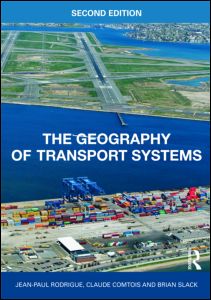
The Geography of Transport Systems

http://people.hofstra.edu/geotrans/index.htmlYou might question why I place so many posts relating to research/academic topics. Well, it’s because several of my colleagues and work associates are crazy enough to study part-time – I naturally get bombarded with questions and therefore make a point [now] to ensure I share resourceful sites on this blog. Here is another gem of a site hosted by Dr. Jean-Paul Rodrigue, Dept. of Global Studies & Geography, Hofstra University, New York – The Geography of Transport Systems. If you’re looking for stuff on transportation, logistics, including the politics and history surrounding these topics, then you’ll find this site both interesting and useful. Kindly note the ‘usage rights’ regarding the information on this site.