The World Customs Organization (WCO) is proud to announce the release of the WCO Data Model Version 4.2.0, marking a significant step forward in the digitalization and harmonization of customs procedures worldwide. This latest version introduces two critical data sets: Customs Bonds and Certificates of Origin, providing WCO Members with tools to streamline operations, and enhance the efficiency of digital customs processes.
The WCO Data Model provides a comprehensive framework for standardizing data elements in cross-border trade. Version 4.2.0 builds on this foundation by incorporating standardized data sets that support key customs processes.
Key Highlights of Version 4.2.0:
Customs Bonds Information Package: This new data set enables WCO Members that require surety-issued customs bonds to streamline and digitalize their bonds submission processes. By adopting this standard, Members can reduce administrative burdens, enhance compliance, and automate obligation management to protect revenue. Importantly, the standardized approach also reduces the time and costs required for implementation, enabling Members to achieve operational efficiency and faster deployment of digitalized customs bond processes.
Certificate of Origin Information Package: Developed using the dataset created by the Technical Committee on Rules of Origin (TCRO), this package empowers Members to digitalize electronic Certificates of Origin (eCOs). This digitalization improves validation of product origin, helping to combat fraud and ensure fair trade practices.
The WCO Data Model Version 4.2.0 is now available to WCO Members and stakeholders. The WCO encourages its members to adopt and implement this latest version to fully realize the benefits of standardized and digitalized customs procedures.
When Nigerian president Bola Tinubu launched a steering committee in July to develop ‘digital free zones’ focussed on tech and services-based businesses, he signalled the start of a new era for special economic zones (SEZs) in the country.
Nigeria’s current SEZ framework dates back 32 years and is centred on export-oriented manufacturing activities. However, the national economy is shifting and technology and services-based sectors are becoming its drivers of growth.
The country is well-positioned to become an African, if not global, leader in tech and financial innovation. By adopting a modern, adaptive regulatory model for SEZs dedicated to future-focused industries, Nigeria can transform itself into a living lab where these businesses can thrive.
Innovation through regulation
Dozens of jurisdictions around the world have rolled out creative regulatory schemes to attract leading firms and entrepreneurs in tech and services. Dubai became the Middle East’s leading financial hub following the establishment of the Dubai International Financial Centre (DIFC) in 2004. Estonia has become an entrepôt for the European market via its e-Residency programme, which allows foreign entrepreneurs to establish a business in the EU. And the US state of Delaware is the legal home of millions of businesses and most Fortune 500 companies, thanks to its favourable laws and world-class court system.
Africa is yet to see a comparably ambitious jurisdiction. However, Nigeria’s innovation ecosystem and standing as one of the continent’s biggest economies make it a leading contender. Its fintech sector, for example, makes up around one-third of Africa’s market according to the World Bank. It has produced several unicorns — including Flutterwave, Paystack and Andela — and has a vibrant entrepreneurial spirit centred in Lagos.
Itana’s infrastructure example
Today, inadequate soft and hard infrastructure both limit the potential of Nigeria’s tech and digital sectors. However, its digital free zone plans can help address this by streamlining the regulatory framework, offering business incentives and improving operational efficiencies. These digital SEZs can also leverage Nigeria’s ratification of the African Continental Free Trade Area Agreement to become a focal point for pan-African business.
The country already has an aspiring digital SEZ which is leading by example. In 2023, Nigeria’s Itana became Africa’s first licensed digital free zone management company. It is building a digital SEZ based in Lagos which can quickly become the premier destination for established tech and digital companies and promising entrepreneurs.
While regulatory frameworks are crucial for these businesses, they must also be supported by quality physical infrastructure. SEZs with high-speed bandwidth, uninterrupted power supply and other utilities are vital for activities largely taking place online. Many of Nigeria’s talented entrepreneurs and professionals choose to leave for places better equipped to support their work. Itana is working to attract and retain the best talent through the development of an eco-friendly, mixed-use tech campus in the Lekki free zone in Lagos, which includes its live-in Accelerate Africa programme backed by Andela founder Iyin Aboyeji. Notably, being physically present in the campus is an option for tenants. They can operate from anywhere in the world, so long as they have a virtual address tied to the digital zone.
Collaboration is key
Developing a competitive digital SEZ framework is a clear priority for Nigeria’s government. Its steering committee is chaired by the president himself, and its members include senior ministers and private sector voices — grouped under the Initiative for the Promotion of Digital Free Zones in Nigeria — including Africa Finance Corporation (AFC), Future Africa, PwC Nigeria, Charter Cities Institute and Itana. AFC is also leading the financing for Itana’s $100m phase-one development.
For all their promise, Nigeria’s rollout of digital SEZs faces hurdles to success. Frameworks like the DIFC, Estonian e-Residency and Delaware corporate law were developed in countries with much higher income levels and more robust legal institutions. Despite Nigeria’s pan-African ambitions, economic integration across the continent remains slow and much of Africa’s best talent is still educated — and often remains — overseas.
However, Nigeria is a strong contender to join the group of countries that have found creative ways to attract and retain digital tech, financial and services-based companies and talent. Digital SEZs’ success could create thousands of good jobs and facilitate innovation and economic transformation, while failure risks permanent secondary status in the global economy.
A digital SEZ framework that attracts global investment, talent and innovation can propel Nigeria to new economic heights as Africa’s ideal jurisdiction to do business, innovate and build the future.
The introduction of the new generation digital FIATA Bill of Lading (FBL) has been confirmed and will be launched by the South African Association of Freight Forwarders (SAAFF) as a new standard to members and exporters for use across the Supply Chain in South Africa.
This development will positively impact supply chain efficiencies and South Africa’s competitive position as a provider of world class logistics services, says Dr Juanita Maree, Chief Executive Officer of SAAFF.
South Africa hosted the Annual Rotational Presidency meeting of the International Federation of Freight Forwarders (FIATA) in Cape Town earlier this month. The FIATA delegation, led by President Ivan Petrov had the opportunity to delve deeper into the South African supply chain logistics sector during their visit, in consultation with industry leaders. Terry Gale, representing Exporters Western Cape and the Fresh Produce Exporters Forum (FPEF) welcomed the imminent introduction of the digital FBL.
Industry recognises the digital FBL and its proven tracking service as a strong solution that will add capacity and increase security of cargo movement through the entire logistics process – a valuable development in a challenging trading environment.
In global terms, the Bill of Lading is recognised as the most important document used in the transportation of goods, FIATA’s Multimodal Transport Bill of Lading is seen as the benchmark; long-standing but in constant evolution and acknowledged by the International Chamber of Commerce (ICC) as a document fully aligned to the UNCTAD/ICC Rules for Multimodal Transport.
This new generation secured digital FBL and tracking solution allows FIATA to protect against fraudulent manipulation and to promote a digital ecosystem of trust for transport and trade documents. It supports transparency and security across the supply chain and will help member companies accelerate their digitalisation efforts. The digital FBL data model is fully aligned with the UN/CEFACT MMT Reference data model to ensure its interoperability with other standards and all trade parties.
Verifiable at any time by legitimate stakeholders interacting with the document, which dramatically reduces fraud risk, the digital FBL can be issued in digital and paper format and cannot be tampered with, with each document also being recorded on an immutable ledger. Stakeholders will be able to access the document audit trail through a unique QR code or on FIATA’s verification portal to certify the validity of the document, the integrity of its issuer and the integrity of its content.
The tracking solution used by FIATA for the digital FBL is already implemented and used by banks, corporates, warehouses, and inspection companies to protect other documents. Software providers worldwide make the secured digital FBL accessible in 17 territories so far through FIATA Association members. Forwarders can implement the digital FBL solution on their own in-house system or use a free digital FBL generator tool.
The 26th/27th Meetings of the SAFE Working Group (SWG) were held successfully from 11 to 14 April 2022. The virtual meetings brought together more than 260 delegates representing Customs administrations, the Private Sector Consultative Group (PSCG), other international organizations and academia.
In his opening remarks, Mr. Pranab Kumar Das, WCO Director of Compliance and Facilitation, highlighted that the SWG had reached an important juncture as the new three-year SAFE review cycle 2021-2024 was about to enter into discussions. It was pointed out that 17 years after it was first published, the SAFE Framework of Standards (FoS) had garnered substantial interest from WCO Members. During the meetings, Guyana became the 172nd WCO Member to express its interest in implementing the SAFE FoS.
With a view to continued enhancement of the AEO criteria and provisions to strengthen the SAFE FoS, WCO Members made several new proposals to revise the Framework. The SWG also received feedback from the private sector on the urgent need to enhance the harmonization of SAFE and AEO implementation. In this context, the SWG heard a presentation by the WCO Anti-Corruption and Integrity Promotion (A-CIP) Programme on maintaining the integrity and transparency of AEO implementation.
On this occasion, the SWG reviewed and adopted the new Work Plan for 2022-2024, which reflected the critical activities the SWG will carry out over the next two years until 2024, in parallel with the SAFE review cycle. The SWG also received an update on the development of new features for the Online AEO Compendium (OAC) and the other extensive work underway in collaboration with other international organizations in the areas of security and facilitation.
Against the backdrop of the WCO’s theme for 2022, the panel discussion on “Scaling up Customs Digital Transformation by Embracing a Data Culture and Building a Data Ecosystem” attracted significant interest from Members and the private sector. The experienced speakers from Member Customs administrations, the private sector and the Secretariat enriched the discussions by sharing their best practices on using data for enhancing risk management and monitoring AEO programmes.
As a way forward, the SWG agreed that efforts will be reserved for a comprehensive review to assess and monitor SAFE implementation for greater harmonization of AEO programmes globally.
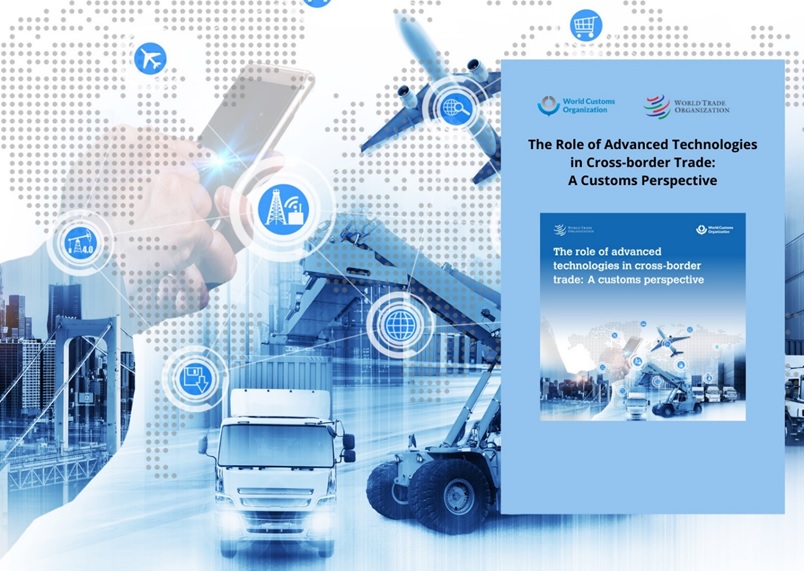
The WCO and the World Trade Organization (WTO) held a webinar to launch their joint publication on Customs use of advance technologies. The event attracted more than 700 attendees and provided insights into how advanced technologies can help Customs administrations facilitate the flow of goods across borders. The publication titled, “The role of advanced technologies in cross-border trade: A customs perspective” provides the current state of play and sheds light on the opportunities and challenges Customs face when deploying these technologies.
The publication outlines the key findings of WCO’s 2021 Annual Consolidated Survey and its results on Customs’ use of advanced technologies such as blockchain, the internet of things, data analytics and artificial intelligence to facilitate trade and enhance safety, security and fair revenue collection.
The joint publication highlights the benefits that can result from the adoption of these advanced technologies, such as enhanced transparency of procedures, sharing of information amongst all relevant stakeholders in real time, better risk management, and improved data quality, leading to greater efficiency in Customs processes and procedures.
In his remarks, WCO Deputy Secretary General Ricardo Treviño Chapa said, “Technologies will assist implementation of international trade facilitation rules and standards, such as the WCO Revised Kyoto Convention and the WTO Trade Facilitation Agreement. We are therefore delighted to be partnering with the WTO, to ensure that our work in assisting our Members’ digital transformation journeys is complementary, that we bring all relevant partners to the same table, and that we avoid duplication.”
In her opening remarks, WTO Deputy Director-General Anabel González noted, “Advanced technologies offer customs an opportunity to take a big leap forward on trade facilitation. Take blockchain. Its widespread application could help us make trade both more transparent and less paper intensive. That would reduce trade costs, which is good news for everyone, especially small businesses, which are disproportionately affected by red tape at the border.”
The webinar presented the main findings from the WCO/WTO paper and featured presentations by Brazil, Nigeria, Singapore and the Inter-American Development Bank. For a greater uptake of these technologies, the speakers underlined the importance of continuous sensitization of Customs and other stakeholders, the need for interoperability and implementation of international standards, the relevance of engaging in dialogues at international level, as well as having a strategy and space for innovation and testing at national level.
The WTO has launched a new book entitled “Trade in Knowledge: Intellectual Property, Trade and Development in a Transformed Global Economy” on 31 March. At the launch event, a wide cross-section of contributors to the publication discussed how their research and analysis had a bearing on current issues lying at the intersection of development, trade, technology and the diffusion of knowledge.
Drawing together insights from a diverse range of leading international scholars and analysts, the publication explores how to build more inclusive, up-to-date and precise ways of measuring knowledge flows, discusses how more nuanced and effective use of these data may guide policymakers and provides insights into the prospects for knowledge-based social and economic development, moving legacy models and adapting to the realities of the contemporary knowledge economy. The book also proposes ideas for updated systems of governance that promote positive sum approaches to the creation and sharing of the benefits of knowledge as a public good, with a view to informing planning for development.
WCO News features an article by the Secretariat on the WCO Data Model – the common language for border management-related processes which enable information to flow seamlessly across different IT systems. The article focuses on the latest data requirements and processes which have been included in the Model through collaboration with stakeholders in the maritime, food safety, waste management and postal sectors. In addition, it offers some practical guidance to Customs administrations which are considering adopting the Model and calls on economic operators to use it in their commercial processes also, as it covers some of the data elements found in commercial documents such as the invoice, packing list and bill of lading.
This is followed by an article by the Botswana Unified Revenue Service (BURS) introducing various projects dealing with the collection, analysis and sharing of data. The author also emphasizes that a culture of innovation has emerged within BURS, and that the working environment supports creative thinking and the generation of new or improved products, services and processes.
The third article presents the results of, and lessons learned from, the first International Survey on Customs Administration (ISOCA), which was co-managed by the WCO and the IMF with the aim of collecting quantitative and qualitative data on Customs administrations and enabling comparisons to be made between countries that share common features. A higher number of participants is required for the Survey to provide a global view of the roles played by Customs administrations, and of their practices. I hope more administrations will participate in future editions of the Survey, which will be simplified to strike a better balance between the need for accurate data and the burden of data collection.
In the next article, Dominican Republic Customs introduces the tools it has developed to measure the time required to release goods and support the Government’s Release in 24 Hours (D24H) Programme, whose objective is to turn the Dominican Republic into the logistics epicenter “par excellence” of the Caribbean region.
A further article takes us to Niger, where the Customs Administration recently financed a study into the use of satellite imagery to analyze cross-border trade flows. The article presents the information collected and explains how it will be used to reorganize operational services and provide efficient links within the territory.
The final article in this Dossier sheds light on the need for harmonization in the digitization of trade documents. This article by the ICC introduces the ICC’s Digital Standards Initiative (DSI), a collaborative cross-industry effort to advance the digitization of trade globally through the adoption of a set of standards.
Many other articles published in this edition of the WCO News directly or indirectly touch on data and on the role that information technology plays in making us more efficient. And this is true of all the editions of our magazine. You have heard or read it many times: in today’s world, it’s all about data. Data is strategic, and we all stand to gain by sharing experience and expertise on how best to manage it in a holistic way.
System Shock: The $50 Trillion Industry Making a Huge Bet on Blockchain
Blockchain may one day eliminate inefficiencies and lack of transparency in supply chains. While slow in coming, this revolution would benefit not only customers and brands, but the “invisible” workers who power global trade.
In this episode of Bloomberg’s System Shock, we explore how cumbersome, paperwork-bound supply chains—like one stretching from kitchen refrigerators in Europe and the U.S. all the way back to a small farmer in Ecuador—are being transformed by that most modern of technologies.
By joining the blockchain-underpinned platform TradeLens, Pakistan Single Window is supporting Customs in modernizing its import-export documentation through a safe & secure, paperless, digital solution to strengthen its controls against trade-based money laundering.
On 20 December 2021, On behalf of Pakistan Customs, the Pakistan Single Window Company today signed an agreement with TradeLens, a blockchain-underpinned logistics platform supported by 5 of the 6 largest ocean carriers globally, to digitize import-export documentation of the containerized cargo moving in and out of the country. Pakistan’s international trade ecosystem is being rapidly transformed through the introduction of technology driven initiatives led by the Pakistan Single Window and the country’s authorities recognize the potential benefits of digitizing supply chains for efficiencies, enhanced transparency, and data-driven decision making.
Advisor to the Prime Minister on Finance and Revenue Mr. Shaukat Tarin added, “Joining the TradeLens platform is allowing us to enhance our ecosystem in a way that all the involved stakeholders get access to a transparent and secure platform that makes processes more efficient.”
Cross-border containerized supply chains are some of the largest and most complex business ecosystems in the world today. It is not uncommon for 30 independent parties, 100 people and up to 200 exchanges of information to be connected to a single shipment. With increased complexity comes increased cost. Shippers or beneficial cargo owners (BCOs) need consistent, auditable and immutable data from multiple sources to effectively manage their supply chains.
The authorization to sign the collaboration came from the PSW Governing Council chaired by Mr. Shaukat Tarin. The Chief Executive Officer of PSW Aftab Haider formally signed the agreement with Irtaza Hussain, the Regional Head of Network for TradeLens at IBM.
PSW integration with TradeLens will help Pakistan Customs and other trade regulators to improve their operational efficiency and create value through the blockchain platform. The immutability of Blockchain-underpinned document information is important in the identification of illegal activities, as well as, improving the smooth operation of legal trade.
Marvin Erdly, Head of TradeLens at IBM. commented “The growth of the TradeLens’ network is evidence that participants from all across the supply chain ecosystem can derive significant value through digital collaboration. Pakistan now joins an increasing number of connected Customs Authorities on the TradeLens platform exploring innovative solutions to enhance global trade access and enhance process efficiencies for all involved”.
TradeLens is a neutral platform brings together data from the entire global supply chain ecosystem including shippers and cargo owners, 3PLs and freight forwarders, intermodal operators, customs and government authorities, ports and terminals, and several ocean carriers. This data allows TradeLens and its network partners to modernize manual and paper-based documents by replacing them with blockchain-enabled digital solutions. It also allows the network partners to provide their customers with deeper visibility into the entire journey for their cargo from origin to destination and reduce uncertainty allowing for better planning and reduced inventory costs. TradeLens welcomed it’s first network member in Pakistan, Al-Hamd International Container Terminal, earlier this year.
The WCO dedicates 2022 to the Scaling up Customs Digital Transformation by Embracing a Data Culture and Building a Data Ecosystem
Traditionally, every year, the Customs community comes together on 26 January to mark International Customs Day. This day of celebration is a unique opportunity for WCO Members, the WCO Secretariat and global Customs’ partners to reflect on a particular theme and to act upon it.
Thus, throughout 2022, under the slogan “Scaling up Customs Digital Transformation by Embracing a Data Culture and Building a Data Ecosystem”, the Customs community will be focusing on how to operate in a fully digital environment and create an operating model that captures and exploits data from across the trade ecosystem.
Over the years, digital technology has evolved rapidly and Customs can now tap into data from other government agencies, commercially available databases, and open-source information platforms such as digitized global public records and multilingual news sources.
The extent to which data can be used effectively depends on various factors surrounding data ethics, including privacy, commercial secrecy and legal issues regarding the use of data by Customs and Tax administrations, and the importance assigned to innovation in public administrations.
To build data ecosystems, or consolidate existing ones, the following enabling actions may be considered:
establishing formal data governance to ensure the relevance, accuracy and timeliness of data;
making use of the standards developed by the WCO and other institutions regarding data format and data exchange;
providing appropriate management of data to ensure that the right people have access to the right data, and that data protection regulations are respected; and,
adopting progressive approaches, such as data analytics, to collect and successfully exploit data to drive decision-making.
A robust data culture empowers people to ask questions, challenge ideas and rely on detailed insights, not just intuition or instinct, to make decisions.
In order to nurture a data-driven culture, administrations need to enhance the data-literacy of their staff – in other words, their ability to interpret and analyze data accurately.
Customs administrations should integrate data science into their curriculums for newly recruited officers and participate in the development of distance learning courses to familiarize Customs officers with the collection and analysis of data in order to forge a data-driven culture. Staff also need to understand the bigger picture, namely the impact of Customs on the effective protection of society, trade facilitation and fair revenue collection.
On the other hand, Customs administrations are invited to consider leveraging data in their relationships with other actors along the supply chain, as well as making data available to the public and academia as a means of enhancing transparency, stimulating the production of knowledge and enabling dialogue with civil society.
Sharing data analysis with other government agencies increases the role and visibility of Customs in policy-making and in obtaining necessary resources, including donor funding. Disseminating Customs data and information in society is part of governments’ response to the general demand for open governance.
To support Customs administrations, the WCO Secretariat has placed data-related topics on the agendas of several committees and working groups, organized awareness-raising seminars, developed e-learning modules, drafted a Capacity Building Framework for Data Analytics which was adopted by the WCO Council in December 2020, issued practical publications and published articles in the WCO News Magazine.
Moreover, a community of experts has been established, under the name of BACUDA (BAnd of CUstoms Data Analysts), which brings together Customs and data scientists with the objective of developing data analytics methodologies.
The Secretariat will continue to investigate ways to collect and share data on Customs administrations with a view to enhancing the way it delivers capacity building, and will continue to undertake data-driven assessments and work with international experts to respond to assistance requests.
More measures will be presented in the WCO Data Strategy that the WCO Secretariat is currently working on. The ambition will be to make data a vernacular language among Customs administrations and between the WCO Secretariat and WCO Members. The road ahead is not an easy one, there will inevitably be challenges along the way, but as we have learned during the COVID-19 pandemic, the Customs community is united, stronger and more resilient in the face of adversity.
The WCO has announced that it has set up a VR training program with the support of CCF-Korea at the WCO Headquarters on 9th November 2021.
This program was developed and first established in RTC Korea last September to support customs officials to learn and understand the basic procedures of physical inspection on containerized cargo at a maritime port.
With the help of VR devices and a cyber master, a trainee is requested to select one of three individual scenarios and detect contraband items such as drugs, counterfeit goods and explosives smuggled in imported cargo.
After selecting one case, documents have to be compared and discrepancies identified. The program will show necessary steps to wear safety gear, inspect the exterior of the container, scan it with ZBV vehicle and study the X-ray black/white and coloured images. In the following step, the container is opened and inspected with tools like a chisel, magnifying glass, scanner, etc., at a bonded area of a dedicated warehouse.
RTC Korea, KCS and WCO Secretariats contributed to the program production and provided materials on drug smuggling cases with pictures, advice on preparatory steps, inspection scenarios taking into account risk indicators from the WCO RM compendium.
The length of one training session is approximately 10 to 15 minutes depending on the trainee‘s progress, and the devices for the VR training are the headset, controller, high-end computer, TV screen and kiosk. The program also developed a screen version that Customs officials can play on their desktop computer and notebook and have the 3D experience.
During the experience session, Dr. Kunio Mikuriya, the Secretary General of the WCO, expressed high interest and called on feedback on future activities from those who experience the program to make it more relevant for Members’ capacity building. In this regard, the immediate task is to prove its effectiveness through regional capacity building activities and WCO meetings.
Dr. Taeil Kang, the Director of Capacity Building Directorate expressed his plans to develop content for other topics including e-commerce transactions, X-ray image screening and uploading on CLiKC and installation in other WCO regions.
For more information, please contact Sungsig Kim, CCF-Korea manager at the Capacity Building Directorate (sungsig.kim@wcoomd.org).
The United Nations Economic Commission for Europe (UNECE) administers the TIR Convention, which was established in 1959 and extensively revised in 1975 and which has, at present, 68 Contracting Parties. The TIR Convention provides for an internationally recognized procedure to facilitate the cross border transportation of goods in transit through the use of a standard, internationally recognized Customs document, the TIR Carnet, which also serves as proof of existence of an internationally valid guarantee.
For many years the TIR Convention proved to be an efficient facilitation tool. However, with the progress in technology, the use of the paper TIR Carnet is increasingly becoming archaic, in particular when it comes to linking it to the electronic procedures applied by national Customs administrations. At each border crossing, Customs officers are faced with additional work of having to key in up to 50 data elements into their national electronic Customs system. In addition, the current situation does not enable Customs authorities to effectively apply risk management procedures based on advance cargo information, as demanded by an increasingly more security-conscious environment.
The eTIR Project
The Contracting Parties to the TIR Convention launched in 2003 the so-called “eTIR Project”, aimed at providing an exchange platform for all actors (Customs authorities, holders, guarantee chains) involved in the TIR system, known as the “eTIR international system”. The eTIR international system aims to ensure the secure exchange of data between national Customs systems related to the international transit of goods, vehicles or containers according to the provisions of the TIR Convention and to allow Customs to manage the data on guarantees, issued by guarantee chains to holders authorized to use the TIR system.
Italian beer brand Birra Peroni has started using EY’s blockchain platform for the purposes of supply chain traceability.
EY has said that the beer company will be using its EY OpsChain Traceability on the public Ethereum blockchain, with each batch having its own non-fungible token (NFT) – a unique, digital certificate of ownership.
Each NFT is recorded on the blockchain, digital ledger distributed around lots of different users instead of held centrally, with each transaction – for example as a product moves through the supply chain or is paid for – time stamped and encrypted to prevent tampering.
In simple terms, it is a technology to store and exchange information within a group in a secure, trustworthy, and efficient manner that doesn’t rely on the use of a database.
NFTs are becoming increasingly used to “tokenise” and confer ownership on physical and virtual goods – including fine art, collectibles and even the first-ever tweet by Twitter founder Jack Dorsey.
However, the technology is also being deployed to protect goods from counterfeiting and as a traceability tool for consumers who are increasingly demanding that the products they buy are made using sustainable and ethical ingredients.
Peroni – part of Japan’s Asahi Group – said using the technology will be a step forward in bringing visibility and transparency to its supply chain, for both consumers and supply chain partners.
“For Birra Peroni, the bond with the agricultural supply chain and the quality of our 100 per cent made-in-Italy malt are fundamental strategic assets,” commented Federico Sannella, the company’s corporate affairs director.
“We believe that sustainability is deeply related to the respect for the raw material, and we wanted to bring this value alive to our consumers, allowing them to follow the journey of the malt from the field to the bottle,” he added.
It’s not the first brewer to take this approach. AB InBev, which sells brands like Budweiser and Stella Artois, is running a blockchain pilot in Europe to give consumers a view of its barley supply chain via a QR code on the packaging.
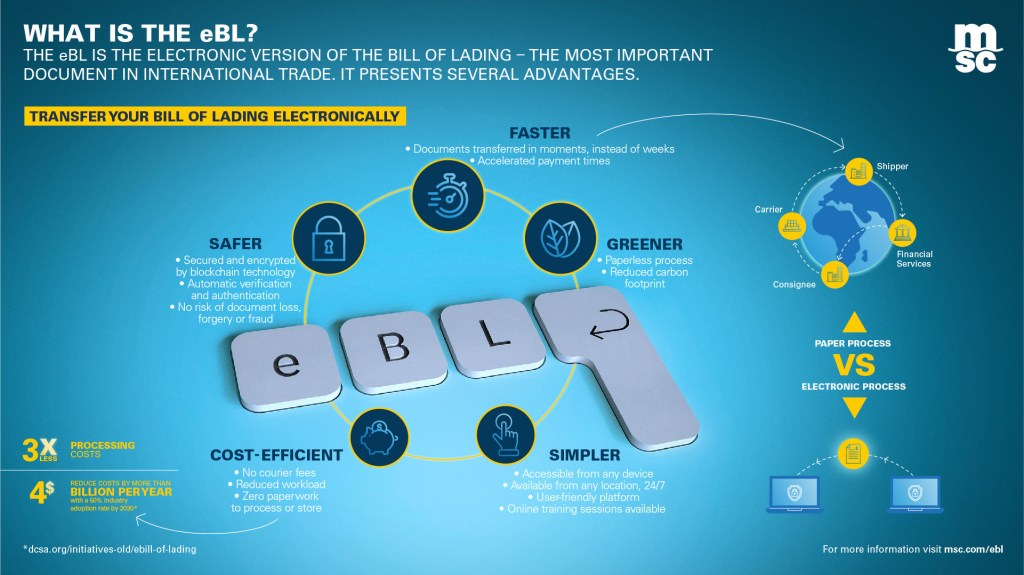
MSC Mediterranean Shipping Company, a global leader in container shipping and logistics, is officially introducing the electronic bill of lading (eBL) for its customers around the world, following a successful pilot phase, using a solution on an independent blockchain platform WAVE BL. The eBL enables shippers and other key supply chain stakeholders to receive and transmit the bill of lading document electronically, without any change or disruption to day-to-day business operations.
WAVE BL is a blockchain-based system that uses distributed ledger technology to ensure that all parties involved in a cargo shipment booking can issue, transfer, endorse and manage documents through a secure, decentralised network. Users can issue all originals, negotiable or non-negotiable, and exchange them via a direct, encrypted, peer-to-peer transmission. It’s also possible for users to amend documents. WAVE BL’s communication protocol is approved by the International Group of Protection & Indemnity Clubs, and meets the highest industry standards for security and privacy.
“MSC has chosen WAVE BL because it is the only solution that mirrors the traditional paper-based process that the shipping and cargo transportation industry is used to,” says André Simha, Global Chief Digital & Information Officer at MSC. “It provides a digital alternative to all the possibilities available with traditional print documents, just much faster and more secure.”
The WAVE BL platform can be used free of charge throughout 2021 for exporters, importers and traders. Users only pay for issuing the original documents, and they do not need to invest in any IT infrastructure or make operational changes in order to use the service. They can simply sign up via MSC’s website: www.msc.com/eBL.
The European Union makes it a top priority to ensure the security of its citizens and single market. Every year trillions of Euros worth of goods are imported into EU, with the EU-27 now accounting for around 15 % of the world’s trade in goods. The European Union is implementing a new customs pre-arrival security and safety programme, underpinned by a large-scale advance cargo information system – Import Control System 2 (ICS2). The programme is one of the main contributors towards establishing an integrated EU approach to reinforce customs risk management under the common risk management framework (CRMF).
The pre-arrival security and safety programme will support effective risk-based customs controls whilst facilitating free flow of legitimate trade across the EU external borders. It represents the first line of defence in terms of protection of the EU internal market and the EU consumers. The new programme will remodel the existing process in terms of IT, legal, customs risk management/controls and trade operational perspectives.
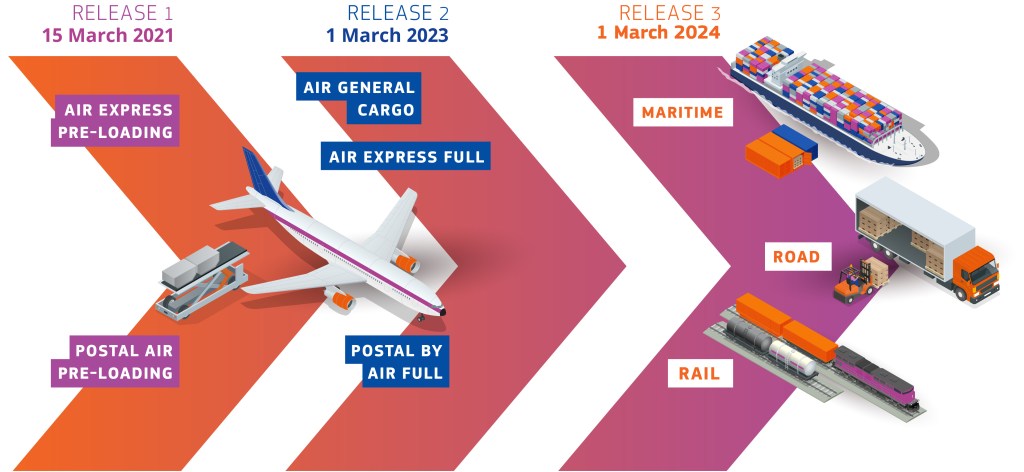
The EU’s new advance cargo information system ICS2 supports implementation of this new customs safety and security regulatory regime aimed to better protect single market and EU citizens. It will collect data about all goods entering the EU prior to their arrival. Economic Operators (EOs) will have to declare safety and security data to ICS2, through the Entry Summary Declaration (ENS). The obligation to start filing such declarations will not be the same for all EOs. It will depend on the type of services that they provide in the international movement of goods and is linked to the three release dates of ICS2 (15 March 2021, 1 March 2023, and 1 March 2024).
Advance cargo information and risk analysis will enable early identification of threats and help customs authorities to intervene at the most appropriate point in the supply chain.
ICS2 introduces more efficient and effective EU customs security and safety capabilities that will:
Increase protection of EU citizens and the internal market against security and safety threats;
Allow EU Customs authorities to better identify high-risk consignments and intervene at the most appropriate point in supply chain;
Support proportionate, targeted customs measures at the external borders in crisis response scenarios;
Facilitate cross-border clearance for the legitimate trade;
Simplify the exchange of information between Economic Operators (EOs) and EU Customs Authorities.
For more information on the ICS2 programme, refer to the EU Webpage here!






 What Happened to the Portcullis?
You must be logged in to post a comment.